GENDER AND
DEVELOPMENT
ELVIRA M. ANTONINO
SCHOOL PRINCIPAL II
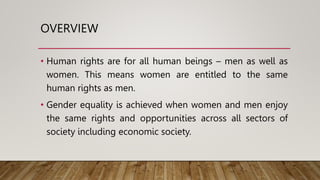
OVERVIEW
• Human rights are for all human beings – men as well as
women. This means women are entitled to the same
human rights as men.
• Gender equality is achieved when women and men enjoy
the same rights and opportunities across all sectors of
society including economic society.
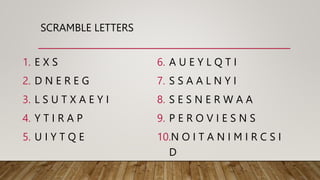
SCRAMBLE LETTERS
1. E X S
2. D N E R E G
3. L S U T X A E Y I
4. Y T I R A P
5. U I Y T Q E
6. A U E Y L Q T I
7. S S A A L N Y I
8. S E S N E R W A A
9. P E R O V I E S N S
10.N O I T A N I M I R C S I
D
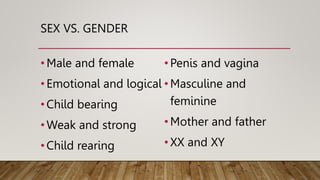
SEX VS. GENDER
•Male and female
•Emotional and logical
•Child bearing
•Weak and strong
•Child rearing
•Penis and vagina
•Masculine and
feminine
•Mother and father
•XX and XY
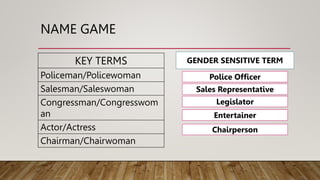
NAME GAME
KEY TERMS
Policeman/Policewoman
Salesman/Saleswoman
Congressman/Congresswom
an
Actor/Actress
Chairman/Chairwoman
GENDER SENSITIVE TERM
Police Officer
Sales Representative
Legislator
Entertainer
Chairperson
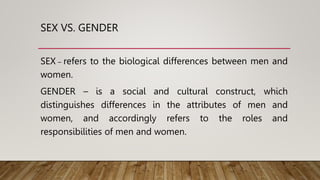
SEX VS. GENDER
SEX – refers to the biological differences between men and
women.
GENDER – is a social and cultural construct, which
distinguishes differences in the attributes of men and
women, and accordingly refers to the roles and
responsibilities of men and women.
GENDER AND DEVELOPMENT
CONCEPT
SEXUALITY
A fundamental aspect of human physiology
GENDER EQUITY
The process of being fair to men and women.
GENDER EQUALITY
Means that women and men have equal conditions,
treatment and opportunities for realizing their full potential,
human rights and dignity, and for contributing to and
benefiting from economic, social, cultural and political
development.
GENDER AND DEVELOPMENT (GAD)
Approach focuses on intervention to address unequal
gender relations in the entire development cycle (access,
processes and outcomes) that prevent women from full and
equal participation in, and benefits from development.
NATIONAL LEGISLATIONS/DEPED ORDERS
• RA 9710
• RA 9262
• DO No. 32, s. 2017
• DO No. 63 s. 2012
COMPOSITION OF GAD FOCAL POINT SYSTEM
(GFPS)
• School GAD Coordinator (To be designated by the
Principal)
• Asst. Principal/Department Head ( Senior HS)
• Grade Level Coordinator/s ( Elementary)
• Guidance Teacher/ Coordinator
• School Bookkeeper ( Secondary)
• Administrative Assistant
FUNCTIONS OF GAD FOCAL POINT PERSON
• Lead in gender mainstreaming
• Use harmonized GAD guidelines for Programs and Projects
(P&P)
• Recommend formulation/revision of policies for women’s
status of policies and child protection
• Lead in review and updating sex-disaggregated data for
GAD database
• Implement advocacy activities
• Identify gender issues arising from gender analysis
• Prepare GAD plans, budgets and accomplishment reports
• Ensure the effective and efficient implementation of the
GAD plan and utilization of GAD budget
• Give incentives to outstanding institutional GAD programs
• Build and strengthen partnership with all GAD focal point
persons in the department
GENDER RESPONSIVE TEACHING AND
LEARNING ENVIRONMENT
OVERVIEW
• The school is a catalyst for change
• Gender responsive teaching pedagogy is considered to be
one which is safe, healthy, inclusive and conducive to
learning.
• The teacher serves as the most important agent to make
change happen.
Teachers have a critical role in facilitating learning free of
gender biases. Learning environments have both physical
and social aspects.
DO’S AND DON’TS IN PROMOTING
GENDER SENSITIVE TEACHING
STRATEGIES
IMPORTANCE OF DEVELOPING COUNSELLING SKILLS
• Teachers should be observant enough to be aware of
problems related to learners’ personal and social lives.
• Teachers should be trained and have gender sensitive
counseling skills to address cases of gender-based
discrimination and violence.
IMPORTANCE OF EXTRA CURRICULAR ACTIVITIES
• Serve as venue in learning key ideas on gender responsiveness
and erasing gender stereotypes.
• The added value of giving learners the opportunity to build
teamwork, communication and leadership skills that can be
used later in life.
• Venue in working and communicating effectively with other
genders.
TWO DIMENSIONS OF A LEARNING
ENVIRONMENT
A. PHYSICAL DIMENSION
• Shape of the classroom and other learning spaces
• Lighting and sound
• Access to fresh water
• Health services and counseling
• Toilets
• Access to sports and recreation facilities
B. SOCIAL DIMENSION
• Teacher-learner interaction
• Learner- learner interaction
CHARACTERISTICS OF A GENDER-SENSITIVE LEARNING
ENVIRONMENT WITHIN THE CLASSROOM
• Safe
• Healthy
• Inclusive
• Conducive to learning
COMMON FORMS OF SCHOOL-RELATED GENDER-
BASED VIOLENCE
• Corporal punishment
• Physical violence and abuse
• Psychosocial violence and abuse
• Bullying including cyber-bullying
• Sexual violence and sexual abuse
MOST COMMON CONSEQUENCES OF SCHOOL-
RELATED GENDER-BASED VIOLENCE
• Lower educational participation, achievement and
continuation
• Impact on health and psychosocial well-being of learners
• Intergenerational transmission of violence
• Broader socio-economic consequences
THANK YOU 

GENDER-AND-DEVELOPMENT.pptx

  • 1.
    GENDER AND DEVELOPMENT ELVIRA M.ANTONINO SCHOOL PRINCIPAL II
  • 2.
    OVERVIEW • Human rightsare for all human beings – men as well as women. This means women are entitled to the same human rights as men. • Gender equality is achieved when women and men enjoy the same rights and opportunities across all sectors of society including economic society.
  • 3.
    SCRAMBLE LETTERS 1. EX S 2. D N E R E G 3. L S U T X A E Y I 4. Y T I R A P 5. U I Y T Q E 6. A U E Y L Q T I 7. S S A A L N Y I 8. S E S N E R W A A 9. P E R O V I E S N S 10.N O I T A N I M I R C S I D
  • 4.
    SEX VS. GENDER •Maleand female •Emotional and logical •Child bearing •Weak and strong •Child rearing •Penis and vagina •Masculine and feminine •Mother and father •XX and XY
  • 5.
    NAME GAME KEY TERMS Policeman/Policewoman Salesman/Saleswoman Congressman/Congresswom an Actor/Actress Chairman/Chairwoman GENDERSENSITIVE TERM Police Officer Sales Representative Legislator Entertainer Chairperson
  • 6.
    SEX VS. GENDER SEX– refers to the biological differences between men and women. GENDER – is a social and cultural construct, which distinguishes differences in the attributes of men and women, and accordingly refers to the roles and responsibilities of men and women.
  • 7.
  • 8.
    SEXUALITY A fundamental aspectof human physiology
  • 9.
    GENDER EQUITY The processof being fair to men and women.
  • 10.
    GENDER EQUALITY Means thatwomen and men have equal conditions, treatment and opportunities for realizing their full potential, human rights and dignity, and for contributing to and benefiting from economic, social, cultural and political development.
  • 11.
    GENDER AND DEVELOPMENT(GAD) Approach focuses on intervention to address unequal gender relations in the entire development cycle (access, processes and outcomes) that prevent women from full and equal participation in, and benefits from development.
  • 12.
    NATIONAL LEGISLATIONS/DEPED ORDERS •RA 9710 • RA 9262 • DO No. 32, s. 2017 • DO No. 63 s. 2012
  • 13.
    COMPOSITION OF GADFOCAL POINT SYSTEM (GFPS) • School GAD Coordinator (To be designated by the Principal) • Asst. Principal/Department Head ( Senior HS) • Grade Level Coordinator/s ( Elementary) • Guidance Teacher/ Coordinator • School Bookkeeper ( Secondary) • Administrative Assistant
  • 14.
    FUNCTIONS OF GADFOCAL POINT PERSON • Lead in gender mainstreaming • Use harmonized GAD guidelines for Programs and Projects (P&P) • Recommend formulation/revision of policies for women’s status of policies and child protection • Lead in review and updating sex-disaggregated data for GAD database
  • 15.
    • Implement advocacyactivities • Identify gender issues arising from gender analysis • Prepare GAD plans, budgets and accomplishment reports • Ensure the effective and efficient implementation of the GAD plan and utilization of GAD budget • Give incentives to outstanding institutional GAD programs • Build and strengthen partnership with all GAD focal point persons in the department
  • 16.
    GENDER RESPONSIVE TEACHINGAND LEARNING ENVIRONMENT
  • 17.
    OVERVIEW • The schoolis a catalyst for change • Gender responsive teaching pedagogy is considered to be one which is safe, healthy, inclusive and conducive to learning. • The teacher serves as the most important agent to make change happen.
  • 18.
    Teachers have acritical role in facilitating learning free of gender biases. Learning environments have both physical and social aspects.
  • 19.
    DO’S AND DON’TSIN PROMOTING GENDER SENSITIVE TEACHING STRATEGIES
  • 20.
    IMPORTANCE OF DEVELOPINGCOUNSELLING SKILLS • Teachers should be observant enough to be aware of problems related to learners’ personal and social lives. • Teachers should be trained and have gender sensitive counseling skills to address cases of gender-based discrimination and violence.
  • 21.
    IMPORTANCE OF EXTRACURRICULAR ACTIVITIES • Serve as venue in learning key ideas on gender responsiveness and erasing gender stereotypes. • The added value of giving learners the opportunity to build teamwork, communication and leadership skills that can be used later in life. • Venue in working and communicating effectively with other genders.
  • 22.
    TWO DIMENSIONS OFA LEARNING ENVIRONMENT
  • 23.
    A. PHYSICAL DIMENSION •Shape of the classroom and other learning spaces • Lighting and sound • Access to fresh water • Health services and counseling • Toilets • Access to sports and recreation facilities
  • 24.
    B. SOCIAL DIMENSION •Teacher-learner interaction • Learner- learner interaction
  • 25.
    CHARACTERISTICS OF AGENDER-SENSITIVE LEARNING ENVIRONMENT WITHIN THE CLASSROOM • Safe • Healthy • Inclusive • Conducive to learning
  • 26.
    COMMON FORMS OFSCHOOL-RELATED GENDER- BASED VIOLENCE • Corporal punishment • Physical violence and abuse • Psychosocial violence and abuse • Bullying including cyber-bullying • Sexual violence and sexual abuse
  • 27.
    MOST COMMON CONSEQUENCESOF SCHOOL- RELATED GENDER-BASED VIOLENCE • Lower educational participation, achievement and continuation • Impact on health and psychosocial well-being of learners • Intergenerational transmission of violence • Broader socio-economic consequences
  • 28.