Influence of Gender on
Consumer Buying Behaviour
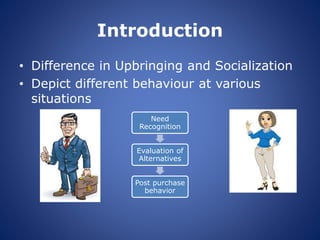
Introduction
• Difference in Upbringing and Socialization
• Depict different behaviour at various
situations
Need
Recognition
Evaluation of
Alternatives
Post purchase
behavior
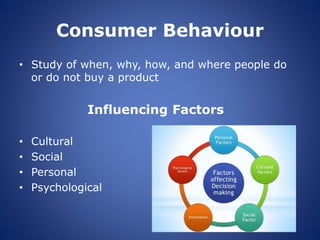
Consumer Behaviour
• Study of when, why, how, and where people do
or do not buy a product
Influencing Factors
• Cultural
• Social
• Personal
• Psychological
How Buying Behavior Changed
Over Time
• Consumers of Pre-liberalization
phase-stable, inward looking, risk averse
and limited choices
• Consumers of Transient Phase-
Experienced multi-choices, risk takers ,
better off than parents
• New millennium Consumers-Enjoy life,
greater self control, exposure to products,
personal style and pleasure
How Gender Difference
Determines Buying Behaviour
• Women are considered as being warm,
expressive, compassionate, and
understanding.
• Approach problems with similar goals but
different consideration.
• Women are concerned about how problem
is solved-share and discuss the problem.
• For men solving a problem demonstrate
their competency-commitment to a
relationship.
Reason Behind Gender
buyer Behaviour ?
Alternative methods-:
• Colours
• Themes
• Music
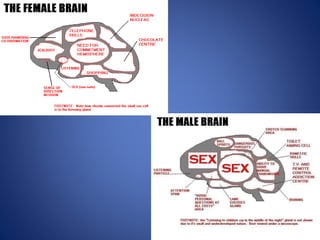
 For women, the promotions emphasised beauty and youth.
 For men it is upon value ambition and physical strength.
 men tend to buy instrumental and leisure items.
 women tend to buy symbolic and self expressive goods.
• Includes both the usual emphasis on beauty
and youth.
• By using an older women looking younger
adds to appeal of beauty and youth.
• It shows strength through the use of a healthy
looking model, who is muscular and young.
• The use of sea indicates health and strength.
• The blue colour appeal to the males.
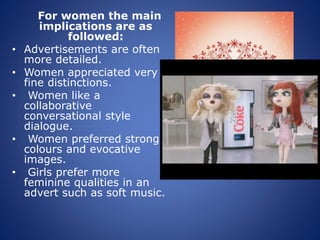
For women the main
implications are as
followed:
• Advertisements are often
more detailed.
• Women appreciated very
fine distinctions.
• Women like a
collaborative
conversational style
dialogue.
• Women preferred strong
colours and evocative
images.
• Girls prefer more
feminine qualities in an
advert such as soft music.
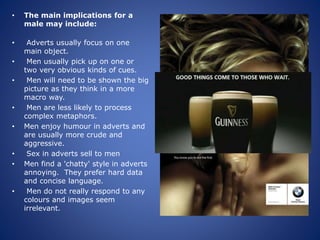
• The main implications for a
male may include:
• Adverts usually focus on one
main object.
• Men usually pick up on one or
two very obvious kinds of cues.
• Men will need to be shown the big
picture as they think in a more
macro way.
• Men are less likely to process
complex metaphors.
• Men enjoy humour in adverts and
are usually more crude and
aggressive.
• Sex in adverts sell to men
• Men find a 'chatty' style in adverts
annoying. They prefer hard data
and concise language.
• Men do not really respond to any
colours and images seem
irrelevant.
How Communication Strategy
Works?
Stereotypical Traits
MEN
Brave, competitive,
aggressive, active and strong
WOMEN
sensitive, gentle, caring and
emotional
CONCEPT OF MASCULINITY AND FEMININITY
What sort of strategies do Brands adopt based on
Gender differences ?
W.A.L.S. Campaign
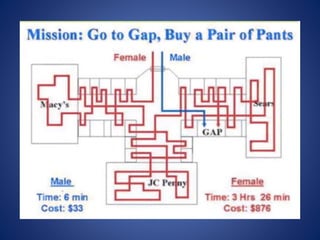
MEN BUY,WOMEN SHOP
For men, the process of shopping is a mission
-They love having bought something. They just don’t
like the process. It’s a subtle difference, but an
important one.”
The biggest misconception is that men don’t like
shopping
WOMEN-
I love shopping even when I have a deadline
MEN-
We buy it and we leave
Feeling Important vs. Checking
Out fast
• “lack of help when needed” is the top
problem for women
• Women shoppers values sales
associates who make them feel
important
• Men value the sales associate’s effort in
getting them through checkout quickly
• Difficulty in finding parking close to the
store’s entrance is the top problem for
men
Women are gatherers. Men
are hunters
• She wants more interaction
• He wants quick answers
• Women tend to be more focused on people
• Men act almost as if they are dealing with an ATM
machine
• In fact, they want to deal with an ATM machine.
They really don’t want to deal with a person
Men and online
• The clutter and lack of control that causes many
men to shy away from a high street shopping
spree.
• Men are very vocal customers and will go to great
lengths to let us know whether they like
something or not.
• Women tend to shop more on impulse or because
it’s ‘in fashion’, men more out of necessity or
pure desire.
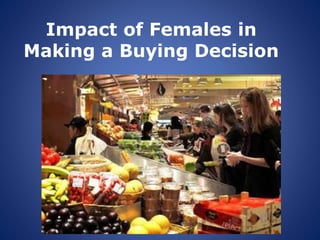
Impact of Females in
Making a Buying Decision
• In the Indian Society it is assumed that the females of
the family play a pivotal role while any buying
decision is made.
• women are much stronger buying involvement than
did men, in terms of emotional involvement whereas
men were high on quality and efficiency.
• Women list more objects of sentimental value,
while men choose more items relating to leisure
and finances.
• women generally make purchase decisions on a
more emotive level, whereas men go more with the
facts and data.
• "Men Buy, Women Shop,
Factors affecting the buying
behavior of women
• Factor of time
• Long term consideration
• Influence of advertisements
• Post purchase experience
• Past regrets related to any purchase
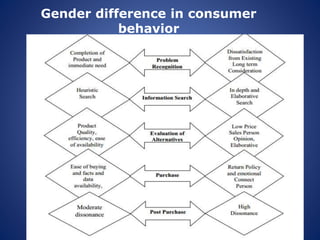
Gender difference in consumer
behavior
Conclusion & suggestions
• Marketers need to understand gender based
tendencies in order to better satisfy the
customers.
• Concentrate on women of age group20 – 50 on
their marketing of house hold goods.
• While marketing expensive/ durable goods male
segment need to be targeted.
Men & Women
• Female customers:
– Mall exploring
– Opportunistic
– Selflessness
• Men hunt for meat, women hunt for
vegetables
• Marketing overload:
– Traditional approach to purchasing decision
– Open sided
– Single brand approach
Gender marketing
• Different Section of store for men & women
• Eg. Toys: Lego, Barbie
• 25% increase in sales
• Gendered difference since 1970's
• Targeting a segment offers more lucrative profits
• Shape, texture, packaging, logos, verbiage,
graphics, sound, and names to define the gender
of a brand
• Gender contamination
Gender Perception
• Women’s perception: “There is a pride in
the ability to be prudent and get the best
products for the best prices”
• Marketers empathize greatly by placing
selective deals to offer a sense of
accomplishment for women’s shopping
experience
Buying behaviour
• Decision simplicity index for customers:
– Navigate info about a brand
– Trust
– How quickly can the options be weighed?
• Gen X & Gen Y
• Eg: Mc-D: Find the woman inside the mom
• Autonomous men- untapped market
• How do women & men look at opinions differently in a
buying pattern?
– Women- gather opinions for a decision
– Men- vice-versa
• Most important factors:
– Men: Age, income & education
– Women: Family status & employment status
Thank You

Gender influence on Consumer Buying Behaviour

  • 1.
    Influence of Genderon Consumer Buying Behaviour
  • 2.
    Introduction • Difference inUpbringing and Socialization • Depict different behaviour at various situations Need Recognition Evaluation of Alternatives Post purchase behavior
  • 3.
    Consumer Behaviour • Studyof when, why, how, and where people do or do not buy a product Influencing Factors • Cultural • Social • Personal • Psychological
  • 4.
    How Buying BehaviorChanged Over Time • Consumers of Pre-liberalization phase-stable, inward looking, risk averse and limited choices • Consumers of Transient Phase- Experienced multi-choices, risk takers , better off than parents • New millennium Consumers-Enjoy life, greater self control, exposure to products, personal style and pleasure
  • 5.
    How Gender Difference DeterminesBuying Behaviour • Women are considered as being warm, expressive, compassionate, and understanding. • Approach problems with similar goals but different consideration. • Women are concerned about how problem is solved-share and discuss the problem. • For men solving a problem demonstrate their competency-commitment to a relationship.
  • 6.
    Reason Behind Gender buyerBehaviour ? Alternative methods-: • Colours • Themes • Music  For women, the promotions emphasised beauty and youth.  For men it is upon value ambition and physical strength.  men tend to buy instrumental and leisure items.  women tend to buy symbolic and self expressive goods.
  • 7.
    • Includes boththe usual emphasis on beauty and youth. • By using an older women looking younger adds to appeal of beauty and youth.
  • 8.
    • It showsstrength through the use of a healthy looking model, who is muscular and young. • The use of sea indicates health and strength. • The blue colour appeal to the males.
  • 10.
    For women themain implications are as followed: • Advertisements are often more detailed. • Women appreciated very fine distinctions. • Women like a collaborative conversational style dialogue. • Women preferred strong colours and evocative images. • Girls prefer more feminine qualities in an advert such as soft music.
  • 12.
    • The mainimplications for a male may include: • Adverts usually focus on one main object. • Men usually pick up on one or two very obvious kinds of cues. • Men will need to be shown the big picture as they think in a more macro way. • Men are less likely to process complex metaphors. • Men enjoy humour in adverts and are usually more crude and aggressive. • Sex in adverts sell to men • Men find a 'chatty' style in adverts annoying. They prefer hard data and concise language. • Men do not really respond to any colours and images seem irrelevant.
  • 14.
    How Communication Strategy Works? StereotypicalTraits MEN Brave, competitive, aggressive, active and strong WOMEN sensitive, gentle, caring and emotional CONCEPT OF MASCULINITY AND FEMININITY What sort of strategies do Brands adopt based on Gender differences ?
  • 17.
  • 18.
    MEN BUY,WOMEN SHOP Formen, the process of shopping is a mission -They love having bought something. They just don’t like the process. It’s a subtle difference, but an important one.” The biggest misconception is that men don’t like shopping WOMEN- I love shopping even when I have a deadline MEN- We buy it and we leave
  • 19.
    Feeling Important vs.Checking Out fast • “lack of help when needed” is the top problem for women • Women shoppers values sales associates who make them feel important • Men value the sales associate’s effort in getting them through checkout quickly • Difficulty in finding parking close to the store’s entrance is the top problem for men
  • 20.
    Women are gatherers.Men are hunters • She wants more interaction • He wants quick answers • Women tend to be more focused on people • Men act almost as if they are dealing with an ATM machine • In fact, they want to deal with an ATM machine. They really don’t want to deal with a person
  • 21.
    Men and online •The clutter and lack of control that causes many men to shy away from a high street shopping spree. • Men are very vocal customers and will go to great lengths to let us know whether they like something or not. • Women tend to shop more on impulse or because it’s ‘in fashion’, men more out of necessity or pure desire.
  • 22.
    Impact of Femalesin Making a Buying Decision
  • 23.
    • In theIndian Society it is assumed that the females of the family play a pivotal role while any buying decision is made. • women are much stronger buying involvement than did men, in terms of emotional involvement whereas men were high on quality and efficiency. • Women list more objects of sentimental value, while men choose more items relating to leisure and finances. • women generally make purchase decisions on a more emotive level, whereas men go more with the facts and data. • "Men Buy, Women Shop,
  • 24.
    Factors affecting thebuying behavior of women • Factor of time • Long term consideration • Influence of advertisements • Post purchase experience • Past regrets related to any purchase
  • 26.
    Gender difference inconsumer behavior
  • 27.
    Conclusion & suggestions •Marketers need to understand gender based tendencies in order to better satisfy the customers. • Concentrate on women of age group20 – 50 on their marketing of house hold goods. • While marketing expensive/ durable goods male segment need to be targeted.
  • 28.
    Men & Women •Female customers: – Mall exploring – Opportunistic – Selflessness • Men hunt for meat, women hunt for vegetables • Marketing overload: – Traditional approach to purchasing decision – Open sided – Single brand approach
  • 29.
    Gender marketing • DifferentSection of store for men & women • Eg. Toys: Lego, Barbie • 25% increase in sales • Gendered difference since 1970's • Targeting a segment offers more lucrative profits • Shape, texture, packaging, logos, verbiage, graphics, sound, and names to define the gender of a brand • Gender contamination
  • 31.
    Gender Perception • Women’sperception: “There is a pride in the ability to be prudent and get the best products for the best prices” • Marketers empathize greatly by placing selective deals to offer a sense of accomplishment for women’s shopping experience
  • 33.
    Buying behaviour • Decisionsimplicity index for customers: – Navigate info about a brand – Trust – How quickly can the options be weighed? • Gen X & Gen Y • Eg: Mc-D: Find the woman inside the mom • Autonomous men- untapped market • How do women & men look at opinions differently in a buying pattern? – Women- gather opinions for a decision – Men- vice-versa • Most important factors: – Men: Age, income & education – Women: Family status & employment status
  • 34.