Gender Communication in
Media
Nate Prince
Media
There is no such thing as “the media” that
exists as one large, singular being
“Media” is a plural term that includes TV,
radio, movies, newspapers, magazines, the
Internet, and books, among others
While operating as separate entities, media
tend to have overriding, dominant themes
that shape, influence, and reinforce
identity
Media as an Institution
Media Economics
Media and Power
Media and Hegemony
Media Polyvalence and Oppositional
Readings
QuickTime™ and a
decompressor
are needed to see this picture.
Media Economics
Media is not just art, but is a commercial
product that exists in part to make money
It is usually targeted at certain groups in
order to sell certain products
Commodification is a result
QuickTime™ and a
decompressor
are needed to see this picture.
Media and Power
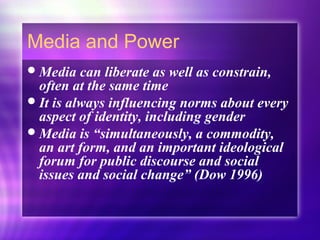
Media can liberate as well as constrain,
often at the same time
It is always influencing norms about every
aspect of identity, including gender
Media is “simultaneously, a commodity,
an art form, and an important ideological
forum for public discourse and social
issues and social change” (Dow 1996)
Media and Power
QuickTime™ and a
decompressor
are needed to see this picture.
QuickTime™ and a
decompressor
are needed to see this picture.
QuickTime™ and a
decompressor
are needed to see this picture.
Media and Hegemony
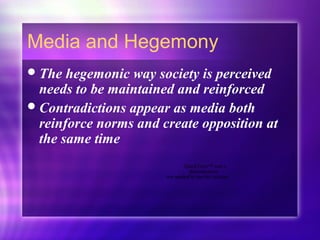
The hegemonic way society is perceived
needs to be maintained and reinforced
Contradictions appear as media both
reinforce norms and create opposition at
the same time
QuickTime™ and a
decompressor
are needed to see this picture.
Media Polyvalence and Oppositional
Readings
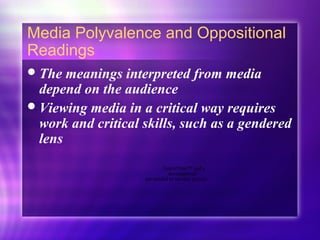
The meanings interpreted from media
depend on the audience
Viewing media in a critical way requires
work and critical skills, such as a gendered
lens
QuickTime™ and a
decompressor
are needed to see this picture.
Interlocking Institutions
Media are “the mechanisms by which
other institutions are represented and
constructed.”
QuickTime™ and a
decompressor
are needed to see this picture.
QuickTime™ and a
decompressor
are needed to see this picture.
Body Image
Media effect male gender norms as well as
female, and is increasingly influencing
male body image
QuickTime™ and a
decompressor
are needed to see this picture.
QuickTime™ and a
decompressor
are needed to see this picture.QuickTime™ and a
decompressor
are needed to see this picture.
Media Research
Media Content:
-analysis that quantifies what is in media
and assumes effects
Media Effects:
-tries to put numbers to the effects of content
analysis
QuickTime™ and a
decompressor
are needed to see this picture.
Gazes
“Gaze” is the way a medium is looked at,
predominantly from the White male
perspective
Our gender roles are
influenced by how
we think the world
looks at us
QuickTime™ and a
decompressor
are needed to see this picture.
The Oppositional Gaze
As long as we understand that media is
putting is in a certain perspective, we can
actively seek to view media from a
different point of view and create our own
counter messages
QuickTime™ and a
decompressor
are needed to see this picture.
The Oppositional Gaze
Some identities are commodified, and sold
to people who identify with other groups
QuickTime™ and a
decompressor
are needed to see this picture.
QuickTime™ and a
decompressor
are needed to see this picture.
Media as Liberator and Constraining
Gender is Constructed and Thus Always in
Flux
Resecuring Genders’ Borders
Progressive Representations Resecure
Traditional Gender Norms
New Technologies Replicate
Old Gender Norms QuickTime™ and a
decompressor
are needed to see this picture.
Gender is Always Changing
More than ever before media is addressing
the idea of “how to be a Man”
Publications have always existed about
how to be feminine, but the idea of
masculinity was considered obvious
Race and ethnicity influences how culture
construct gender roles and identities
Ideas, such as “feminism”, are sometimes
commodified and used to sell products
Gender Borders
Some are worried that the idea of
masculinity is being destabilized
We see the results of this fear in such
films as Fight Club
QuickTime™ and a
decompressor
are needed to see this picture.
Progressive Representations
Resecure Traditional Gender Norms
Media constrains gender identity even
when it seems it is liberating
Subordinate roles are still seen within the
framework of existing cultural norms
QuickTime™ and a
decompressor
are needed to see this picture.
New Tech Replicates Old Norms
The Internet was supposed to transcend
gender, age, race, ethnicity, and every
other gender identity
There is still a digital divide that restricts
Internet access to many people
Gender identities are just as important in
online communication as they are in any
other form of communication
Conclusion
Media allows for a large range of gender
roles to be performed, but there are still
limits
In order to consume media effectively, we
must use a gendered lens and understand
that we can be active
participants rather
than simply passive
bystanders
QuickTime™ and a
decompressor
are needed to see this picture.

Gender Communication In Media

  • 1.
  • 2.
    Media There is nosuch thing as “the media” that exists as one large, singular being “Media” is a plural term that includes TV, radio, movies, newspapers, magazines, the Internet, and books, among others While operating as separate entities, media tend to have overriding, dominant themes that shape, influence, and reinforce identity
  • 3.
    Media as anInstitution Media Economics Media and Power Media and Hegemony Media Polyvalence and Oppositional Readings QuickTime™ and a decompressor are needed to see this picture.
  • 4.
    Media Economics Media isnot just art, but is a commercial product that exists in part to make money It is usually targeted at certain groups in order to sell certain products Commodification is a result QuickTime™ and a decompressor are needed to see this picture.
  • 5.
    Media and Power Mediacan liberate as well as constrain, often at the same time It is always influencing norms about every aspect of identity, including gender Media is “simultaneously, a commodity, an art form, and an important ideological forum for public discourse and social issues and social change” (Dow 1996)
  • 6.
    Media and Power QuickTime™and a decompressor are needed to see this picture. QuickTime™ and a decompressor are needed to see this picture. QuickTime™ and a decompressor are needed to see this picture.
  • 7.
    Media and Hegemony Thehegemonic way society is perceived needs to be maintained and reinforced Contradictions appear as media both reinforce norms and create opposition at the same time QuickTime™ and a decompressor are needed to see this picture.
  • 8.
    Media Polyvalence andOppositional Readings The meanings interpreted from media depend on the audience Viewing media in a critical way requires work and critical skills, such as a gendered lens QuickTime™ and a decompressor are needed to see this picture.
  • 9.
    Interlocking Institutions Media are“the mechanisms by which other institutions are represented and constructed.” QuickTime™ and a decompressor are needed to see this picture. QuickTime™ and a decompressor are needed to see this picture.
  • 10.
    Body Image Media effectmale gender norms as well as female, and is increasingly influencing male body image QuickTime™ and a decompressor are needed to see this picture. QuickTime™ and a decompressor are needed to see this picture.QuickTime™ and a decompressor are needed to see this picture.
  • 11.
    Media Research Media Content: -analysisthat quantifies what is in media and assumes effects Media Effects: -tries to put numbers to the effects of content analysis QuickTime™ and a decompressor are needed to see this picture.
  • 12.
    Gazes “Gaze” is theway a medium is looked at, predominantly from the White male perspective Our gender roles are influenced by how we think the world looks at us QuickTime™ and a decompressor are needed to see this picture.
  • 13.
    The Oppositional Gaze Aslong as we understand that media is putting is in a certain perspective, we can actively seek to view media from a different point of view and create our own counter messages QuickTime™ and a decompressor are needed to see this picture.
  • 14.
    The Oppositional Gaze Someidentities are commodified, and sold to people who identify with other groups QuickTime™ and a decompressor are needed to see this picture. QuickTime™ and a decompressor are needed to see this picture.
  • 15.
    Media as Liberatorand Constraining Gender is Constructed and Thus Always in Flux Resecuring Genders’ Borders Progressive Representations Resecure Traditional Gender Norms New Technologies Replicate Old Gender Norms QuickTime™ and a decompressor are needed to see this picture.
  • 16.
    Gender is AlwaysChanging More than ever before media is addressing the idea of “how to be a Man” Publications have always existed about how to be feminine, but the idea of masculinity was considered obvious Race and ethnicity influences how culture construct gender roles and identities Ideas, such as “feminism”, are sometimes commodified and used to sell products
  • 17.
    Gender Borders Some areworried that the idea of masculinity is being destabilized We see the results of this fear in such films as Fight Club QuickTime™ and a decompressor are needed to see this picture.
  • 18.
    Progressive Representations Resecure TraditionalGender Norms Media constrains gender identity even when it seems it is liberating Subordinate roles are still seen within the framework of existing cultural norms QuickTime™ and a decompressor are needed to see this picture.
  • 19.
    New Tech ReplicatesOld Norms The Internet was supposed to transcend gender, age, race, ethnicity, and every other gender identity There is still a digital divide that restricts Internet access to many people Gender identities are just as important in online communication as they are in any other form of communication
  • 20.
    Conclusion Media allows fora large range of gender roles to be performed, but there are still limits In order to consume media effectively, we must use a gendered lens and understand that we can be active participants rather than simply passive bystanders QuickTime™ and a decompressor are needed to see this picture.