NEW SOUTH WALES
Gender and violence
attitudes. Emerging themes
from client interviews after
a Men’s Behaviour Change
Program
Rebecca Gray & Tim Broady
FRSA November 2015
NEW SOUTH WALES
• Men’s Behaviour Change Programs
• Literature review: gender, violence, behaviour change
• Evaluating Programs
• Research aims and methods
• Findings
• Client accounts of what changed
• Client’s gender attitudes
• Recommendations
Overview
NEW SOUTH WALES
Men’s behaviour change programs
• Based in community or corrections settings
• Weekly groups for between 12-27 weeks
• Psychoeducational and process oriented interventions
• Aim to cease violence and increase accountability
• Periodic contact with women for verification
• Not standardised
• Not widely available
Programs
NEW SOUTH WALES
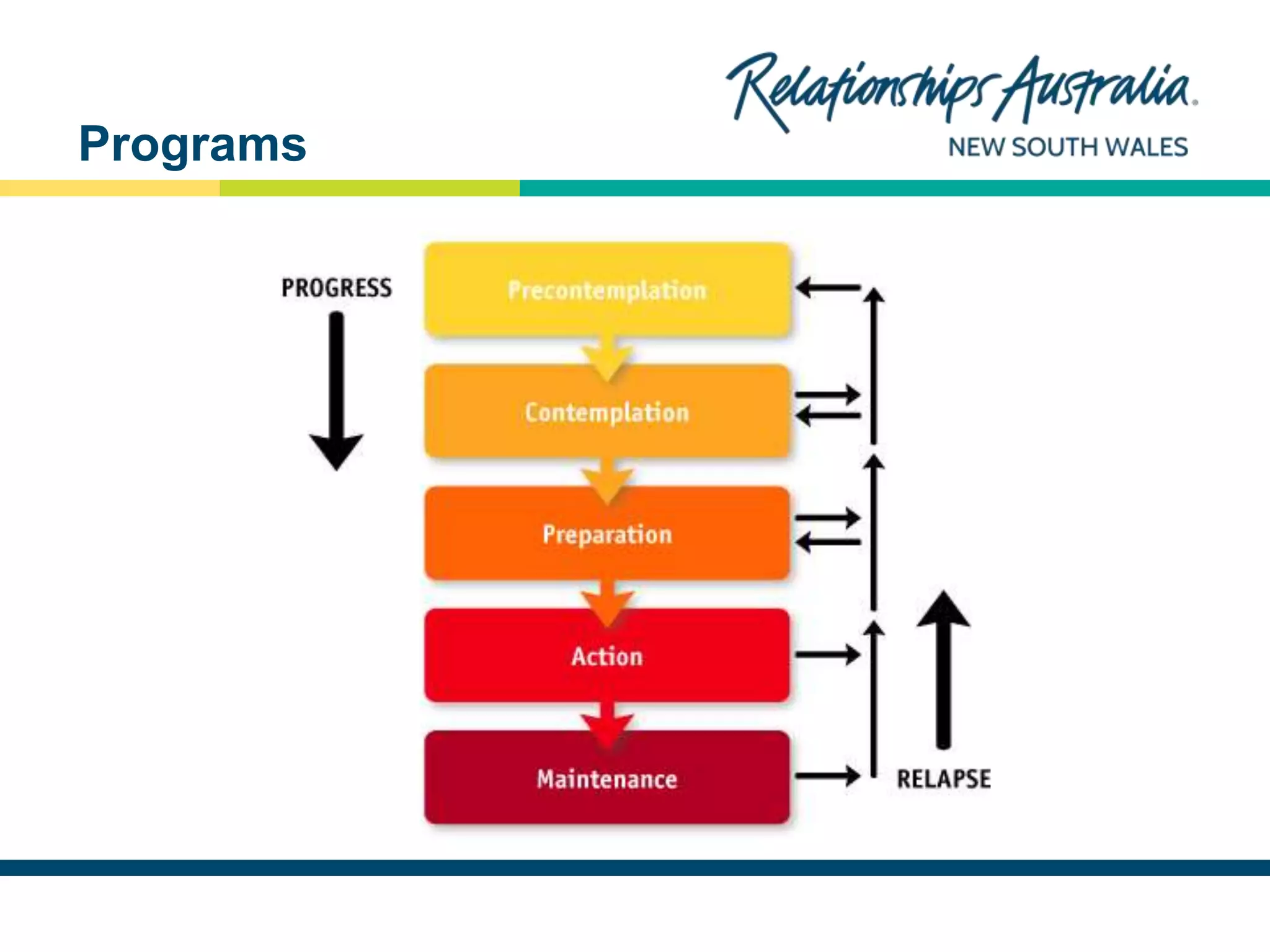
Behaviour Change
• Is different for different men, happens at different times
• Some men need multiple interventions
• Clients are adult survivors of their own family violence
• Motivating and retaining the clients is a key task
Programs
NEW SOUTH WALES
Programs
NEW SOUTH WALES
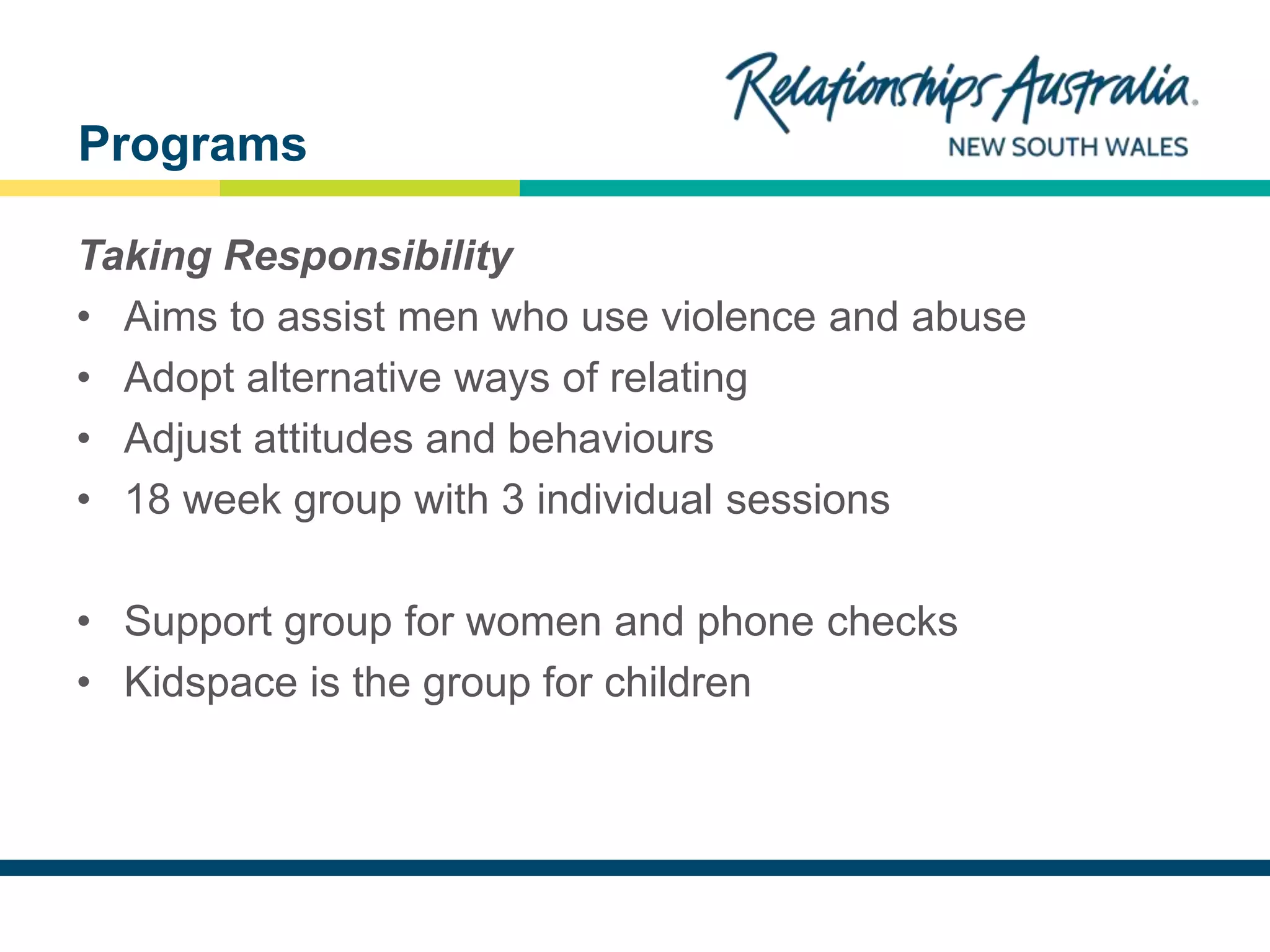
Taking Responsibility
• Aims to assist men who use violence and abuse
• Adopt alternative ways of relating
• Adjust attitudes and behaviours
• 18 week group with 3 individual sessions
• Support group for women and phone checks
• Kidspace is the group for children
Programs
NEW SOUTH WALES
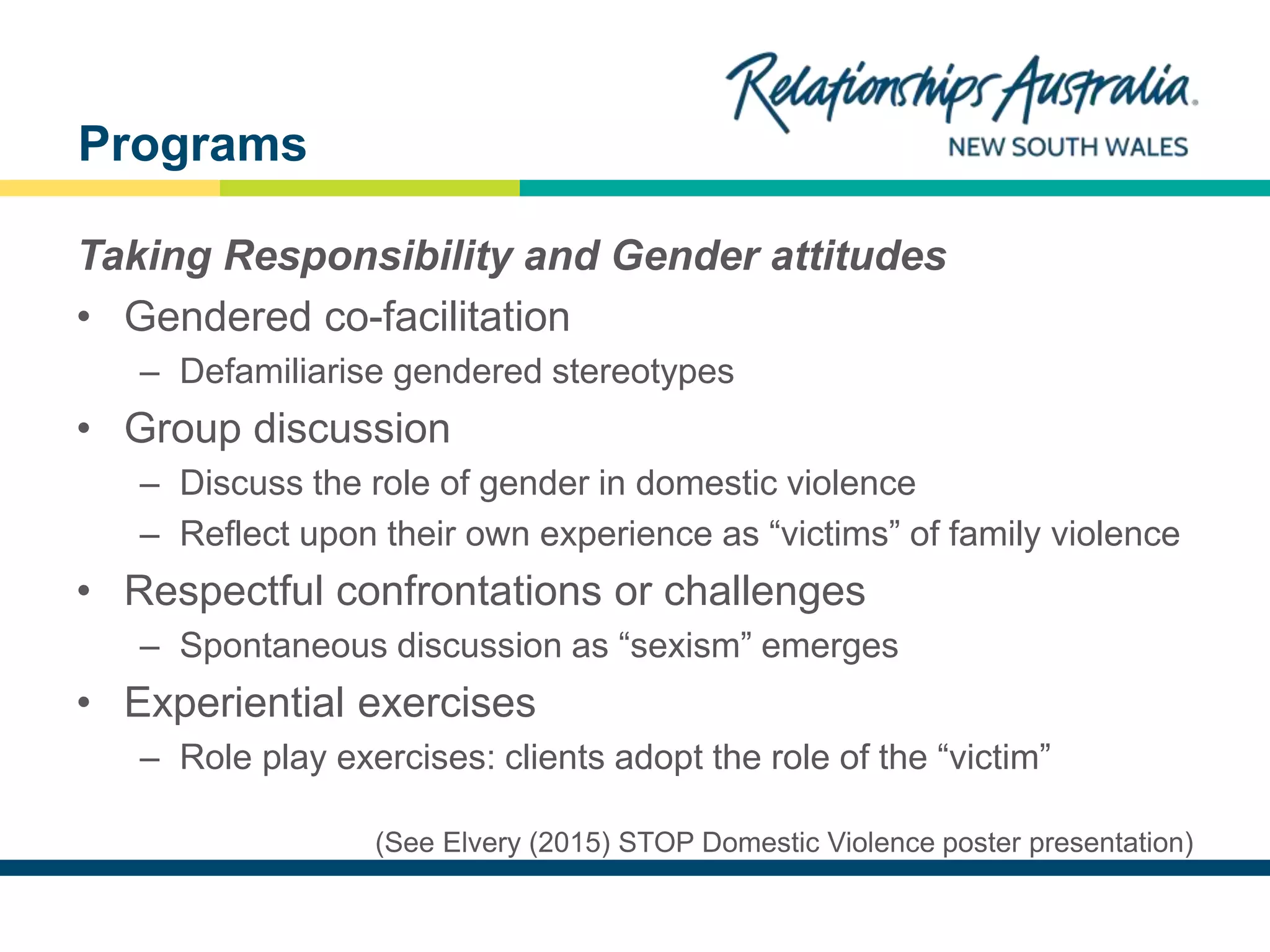
Taking Responsibility and Gender attitudes
• Gendered co-facilitation
– Defamiliarise gendered stereotypes
• Group discussion
– Discuss the role of gender in domestic violence
– Reflect upon their own experience as “victims” of family violence
• Respectful confrontations or challenges
– Spontaneous discussion as “sexism” emerges
• Experiential exercises
– Role play exercises: clients adopt the role of the “victim”
(See Elvery (2015) STOP Domestic Violence poster presentation)
Programs
NEW SOUTH WALES
Gender and violence
VicHealth research found three themes:
1. Gender inequality
2. Rigid gender roles
3. Violence supportive attitudes
UN Women, Investing in Gender Inequality: Ending
Violence Against Women (2010) found:
Countries with low equality scores have a greater
prevalence of violence against women.
Literature Review
NEW SOUTH WALES
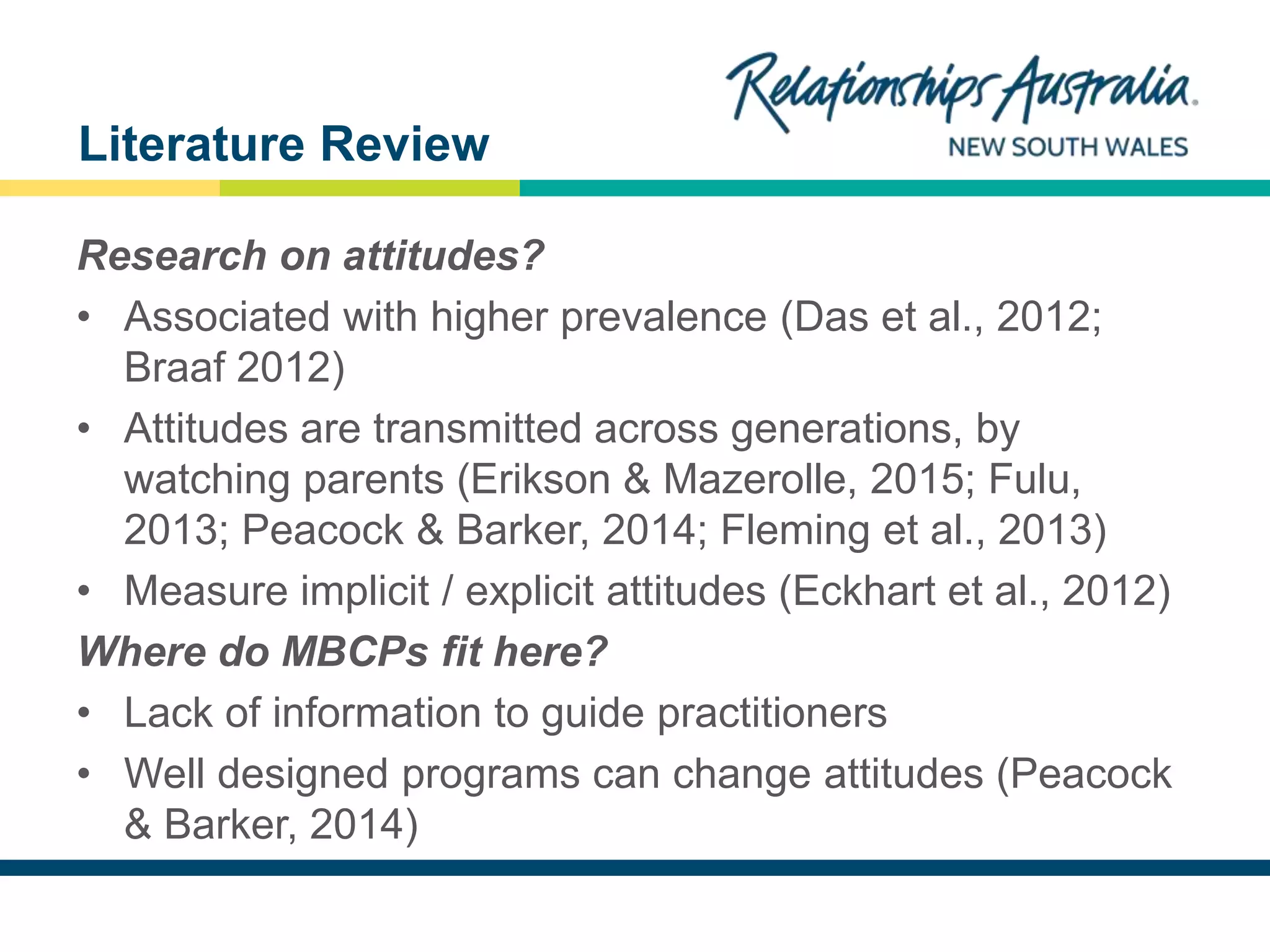
Research on attitudes?
• Associated with higher prevalence (Das et al., 2012;
Braaf 2012)
• Attitudes are transmitted across generations, by
watching parents (Erikson & Mazerolle, 2015; Fulu,
2013; Peacock & Barker, 2014; Fleming et al., 2013)
• Measure implicit / explicit attitudes (Eckhart et al., 2012)
Where do MBCPs fit here?
• Lack of information to guide practitioners
• Well designed programs can change attitudes (Peacock
& Barker, 2014)
Literature Review
NEW SOUTH WALES
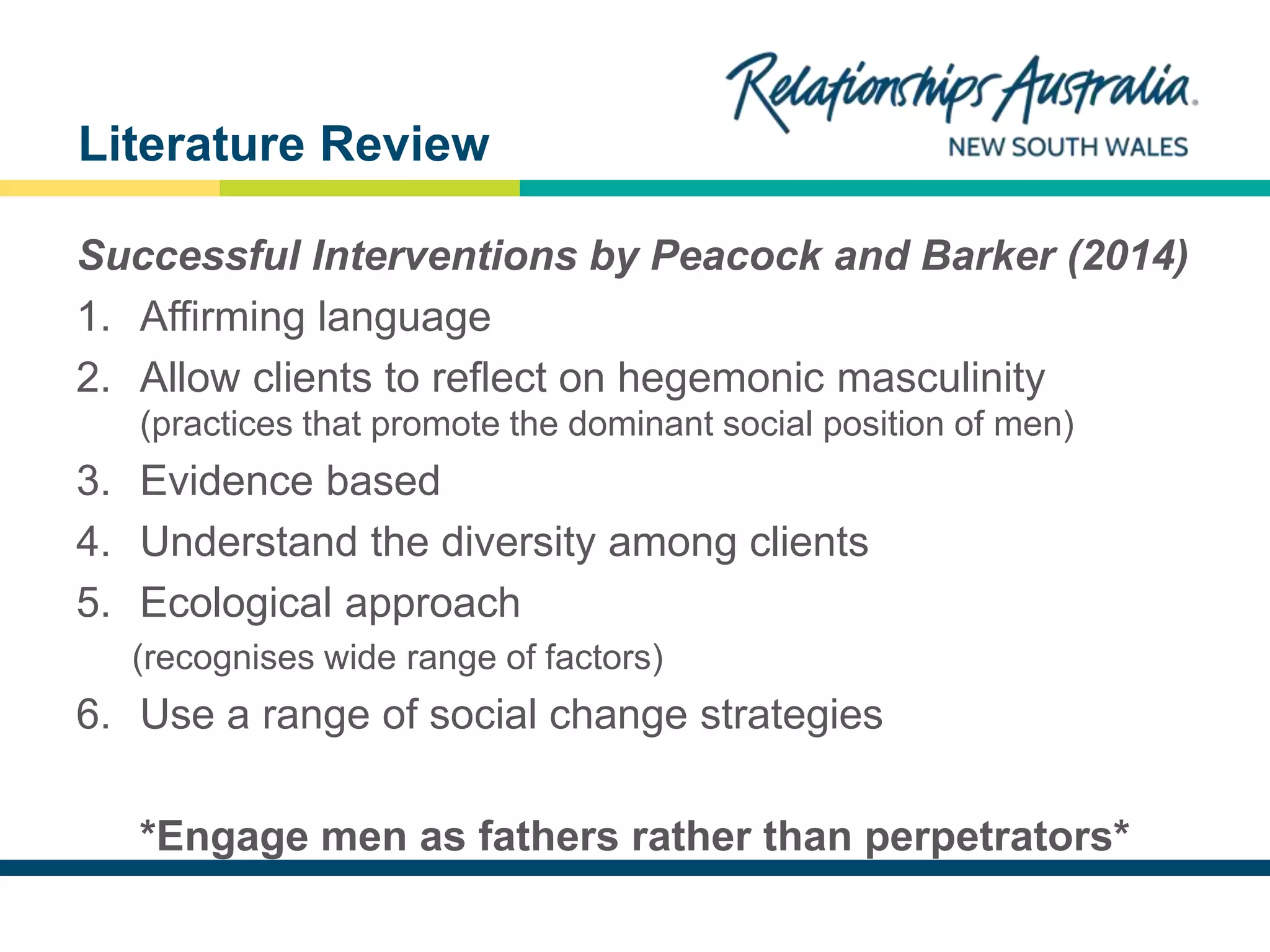
Successful Interventions by Peacock and Barker (2014)
1. Affirming language
2. Allow clients to reflect on hegemonic masculinity
(practices that promote the dominant social position of men)
3. Evidence based
4. Understand the diversity among clients
5. Ecological approach
(recognises wide range of factors)
6. Use a range of social change strategies
*Engage men as fathers rather than perpetrators*
Literature Review
NEW SOUTH WALES
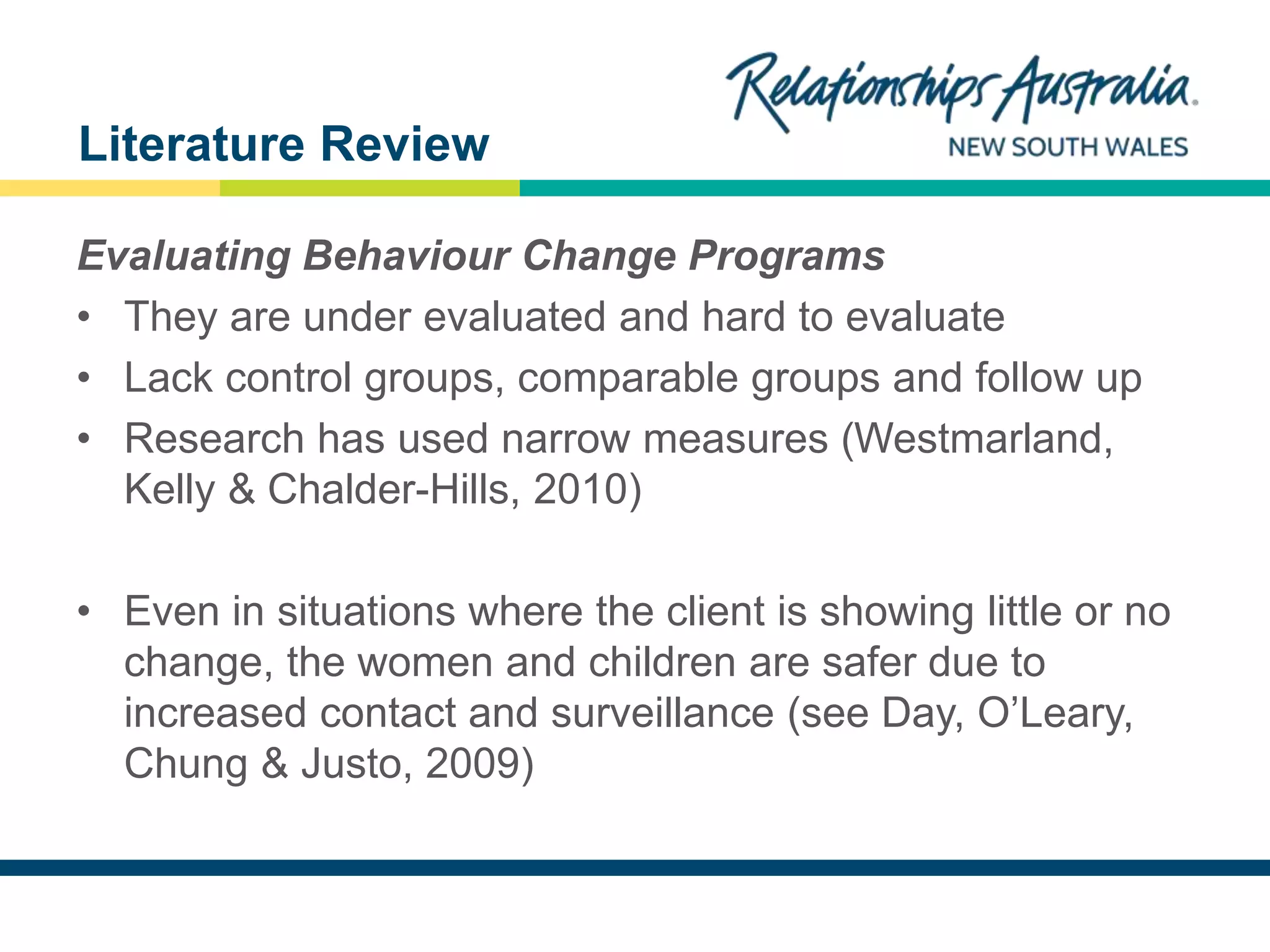
Evaluating Behaviour Change Programs
• They are under evaluated and hard to evaluate
• Lack control groups, comparable groups and follow up
• Research has used narrow measures (Westmarland,
Kelly & Chalder-Hills, 2010)
• Even in situations where the client is showing little or no
change, the women and children are safer due to
increased contact and surveillance (see Day, O’Leary,
Chung & Justo, 2009)
Literature Review
NEW SOUTH WALES
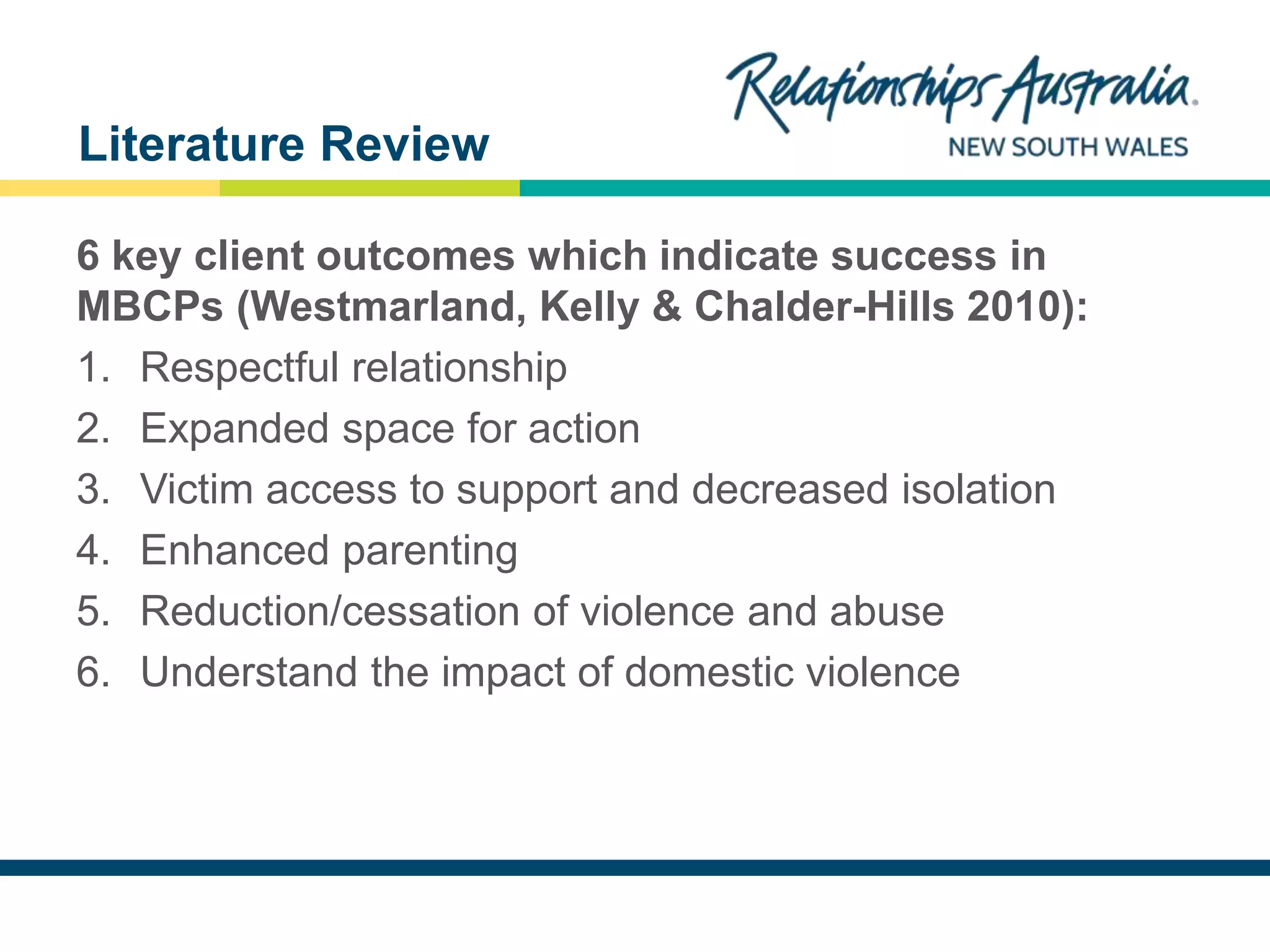
6 key client outcomes which indicate success in
MBCPs (Westmarland, Kelly & Chalder-Hills 2010):
1. Respectful relationship
2. Expanded space for action
3. Victim access to support and decreased isolation
4. Enhanced parenting
5. Reduction/cessation of violence and abuse
6. Understand the impact of domestic violence
Literature Review
NEW SOUTH WALES
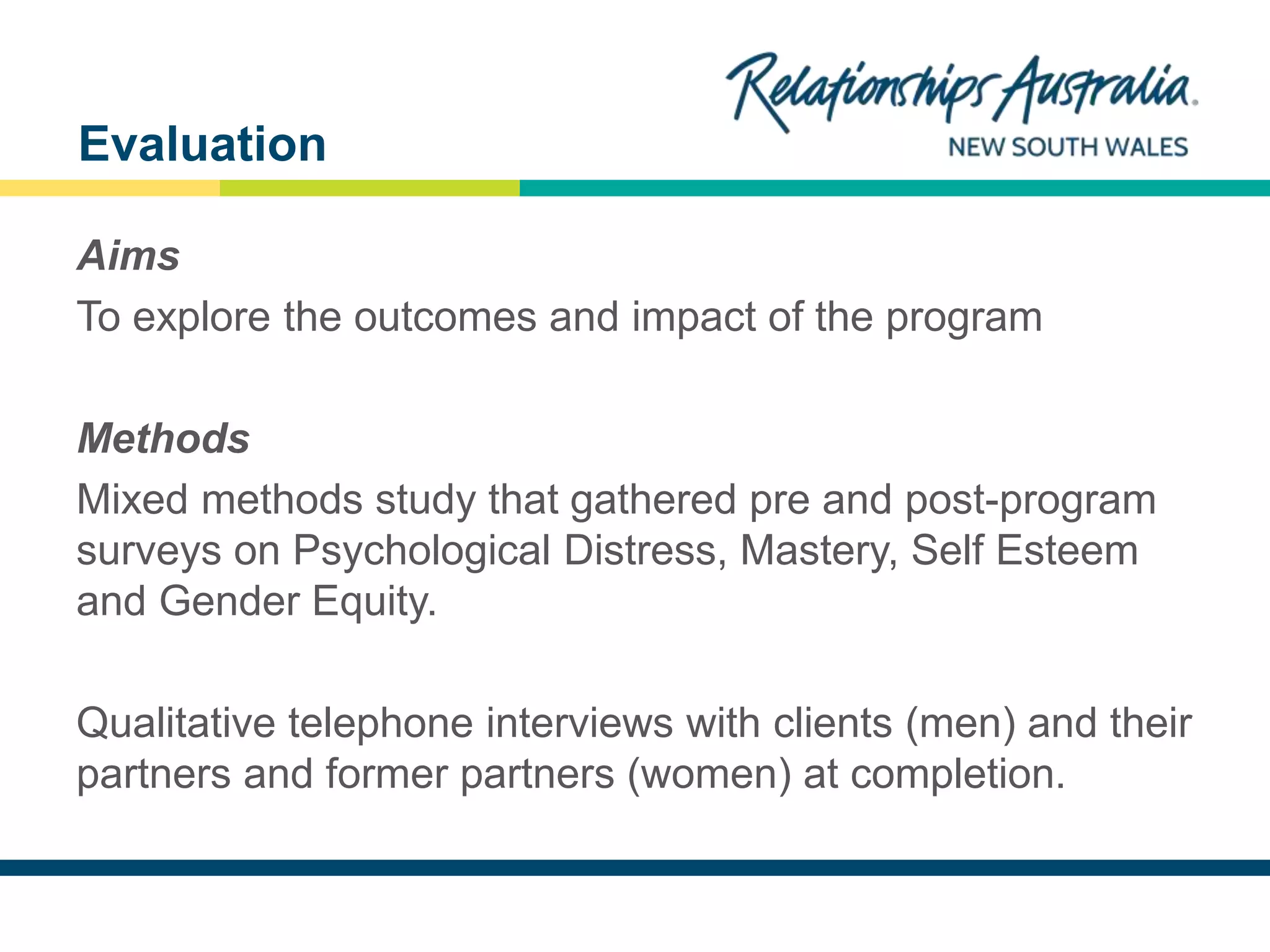
Aims
To explore the outcomes and impact of the program
Methods
Mixed methods study that gathered pre and post-program
surveys on Psychological Distress, Mastery, Self Esteem
and Gender Equity.
Qualitative telephone interviews with clients (men) and their
partners and former partners (women) at completion.
Evaluation
NEW SOUTH WALES
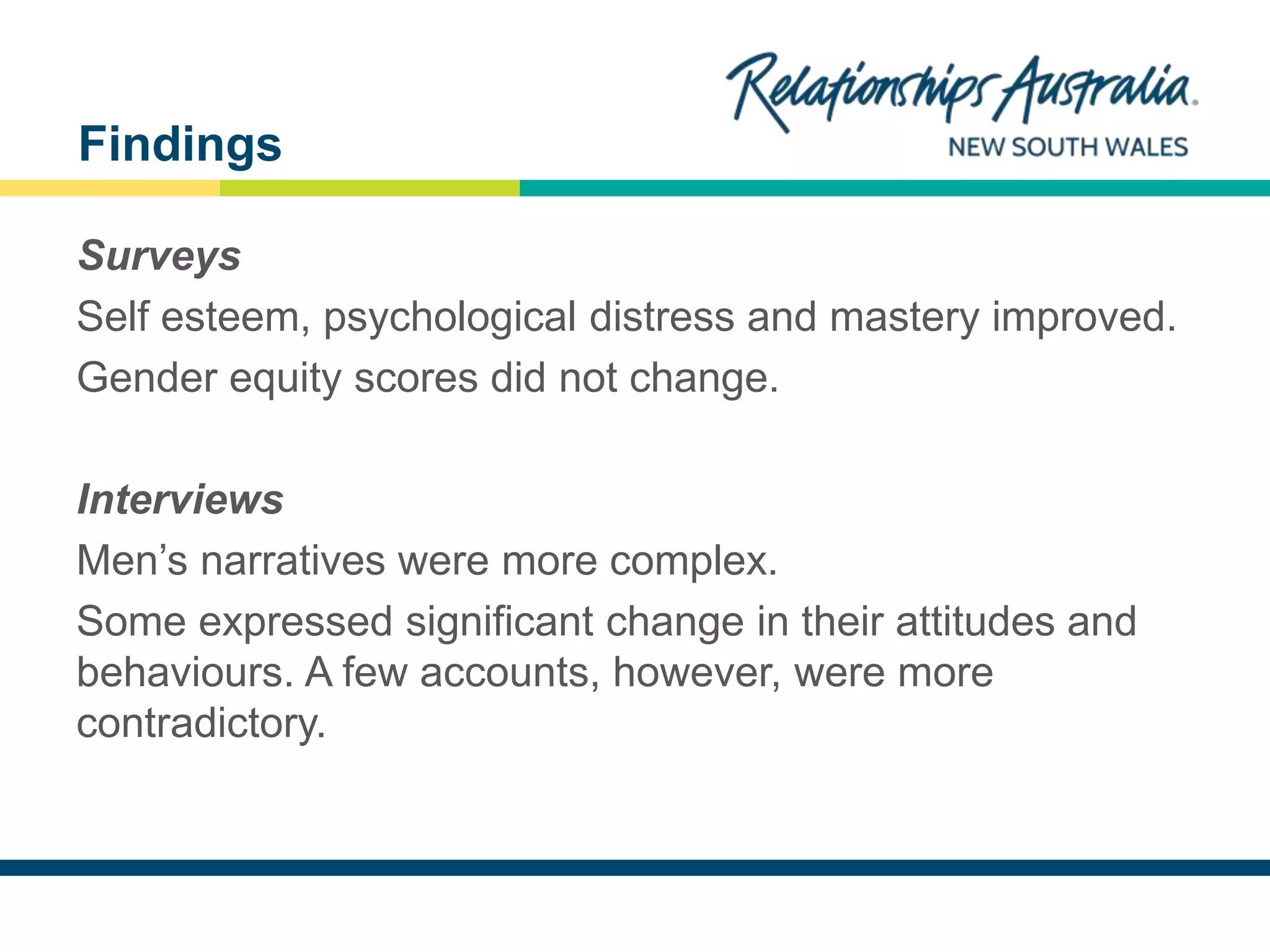
Surveys
Self esteem, psychological distress and mastery improved.
Gender equity scores did not change.
Interviews
Men’s narratives were more complex.
Some expressed significant change in their attitudes and
behaviours. A few accounts, however, were more
contradictory.
Findings
NEW SOUTH WALES
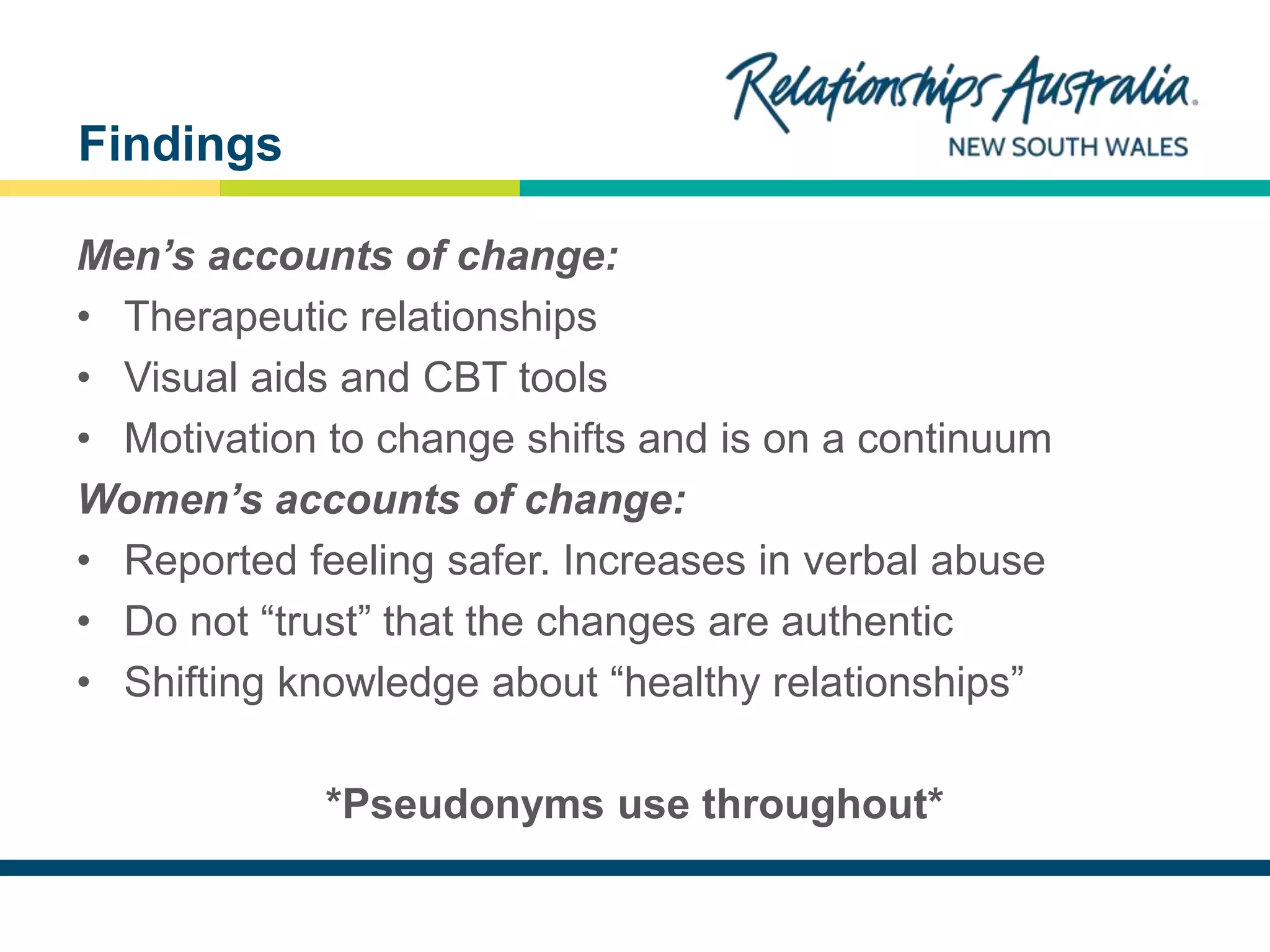
Men’s accounts of change:
• Therapeutic relationships
• Visual aids and CBT tools
• Motivation to change shifts and is on a continuum
Women’s accounts of change:
• Reported feeling safer. Increases in verbal abuse
• Do not “trust” that the changes are authentic
• Shifting knowledge about “healthy relationships”
*Pseudonyms use throughout*
Findings
NEW SOUTH WALES
Change increases motivation to change
Just seeing the impact of your behaviour. And kind of,
we […] came up with what we felt the other person was
going through. And seeing it there collectively and the
sequence it happened in, it was like, “My God. What the
hell am I doing? Why would I wanna be doing that?” (Hugo)
I certainly know what it’s like to be respectful now
because I actually like the bloke I am whereas before I
didn’t. Now… yeah, I’m happy with meself as a man, father,
partner, yep. I’m real happy actually. (Eddie)
Motivation
NEW SOUTH WALES
Self improvement
I’m much more comfortable in my own skin now, and feel
I have a worth, or a right to my position, and that I don’t
have to force it on others. (Hugo)
It’s just good to know that people actually want to spend
time with me now. Before, people only spent time with me
‘cause they had to, or they didn’t want to be rude. […] I feel
now that I’m very strong, very motivated, and very worthy
person […] The course helped me to realise that I am just
as valuable as any other person. (Parker)
Motivation
NEW SOUTH WALES
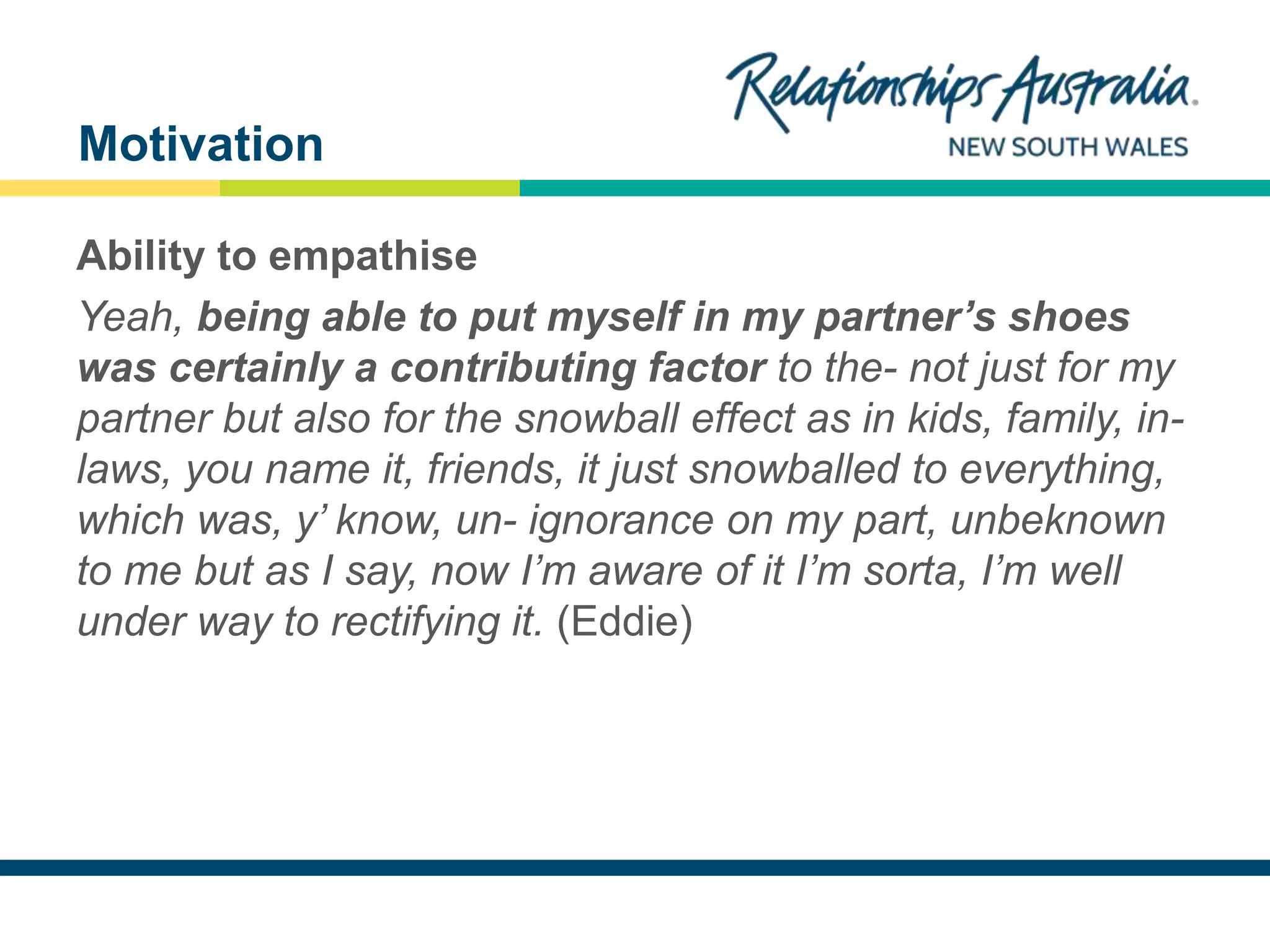
Ability to empathise
Yeah, being able to put myself in my partner’s shoes
was certainly a contributing factor to the- not just for my
partner but also for the snowball effect as in kids, family, in-
laws, you name it, friends, it just snowballed to everything,
which was, y’ know, un- ignorance on my part, unbeknown
to me but as I say, now I’m aware of it I’m sorta, I’m well
under way to rectifying it. (Eddie)
Motivation
NEW SOUTH WALES
Her words were she feels she can have a say without being
judged, and that I can have my say without blaming
her… So she’s certainly noticing the difference, but […]
she doesn’t know whether she can trust it… But we can
talk about it. I can say: “Well, you know, I’ve created that,” If
for ten years you’ve had these volatile reactions that come
out of the blue. Essentially I’ve conditioned her. […] I can
own my own improvement and I can feel I’ve improved, and
her not believing or seeing that, I can see it’s coming from
that fear, from that history, you know? And I have to be
patient and let her have that. (Hugo)
Gender attitudes
NEW SOUTH WALES
Contradictory expressions of change
Certainly, my values changed. [The program] made me
reassess my values in terms of how I view my wife or my
kids. I don’t need to have control of everything. I can let my
wife take control of more things. But [my wife’s reaction]
is completely disproportionate. (Felix)
Gender attitudes
NEW SOUTH WALES
Contradictory expressions of change
I mean that’s one of the reasons I did the course, to
confront and address my issues. And that’s why I’ll just
have to keep on moving forward. I hope that, you know,
how do I put it? That I’ll find enjoyment out of
something. I may not be in a relationship with my wife, but
I’ve got to sort it myself, and anyway I haven’t been overly
impressed with her at this stage. (Jett)
Gender attitudes
NEW SOUTH WALES
Entangled with relationship dynamics
It sorta depends if she’s gonna be civil or not. But yeah,
not to her, just in talk to me wife, y’ know, might say, “Oh
the bitch won’t let me have my son on the weekend”. (Baz)
You know, I’ve gotta be reasonable in unreasonable
circumstances and, obviously, be mindful that there’s
still quite a bit of hurt there and obviously reluctance.
But at the same time I just think that she’s getting
dragged along into all the legal elements and advice
from DoCS potentially, and her solicitor. (Felix)
Gender attitudes
NEW SOUTH WALES
Well basically she has chosen in her mind that things can’t
be repaired when in, I know that a lot of things can be
repaired, especially with the way we talk to one another
and share with one another. But unfortunately my partner,
[…] after 12 years of marriage, decided not to pursue it any
more. […] She thinks that she’s not that way inclined […]
especially the way she can relate and talk, and rip into me
verbally, I mean it’s just beyond a joke. (Preston)
Gender attitudes
NEW SOUTH WALES
Tied to notions of masculinity
As a child my father was, you know: ‘the man’s job is the
provider’ and that sort of thing, y’ know? So [the program]
changed my view about all that sort of stuff. (Anton)
You do is what your parents do pretty much, y’ know? I
know we all say that we don’t, but they’re our teachers. So
havin’ a look at the way your parents are is usually the way
you take life on. I guess it’s hard to break the cycle,
break the chain. (Anton)
Gender attitudes
NEW SOUTH WALES
Family of origin influences
I’m a big believer, it’s kind of stuff you’ve learnt from your
childhood. You kinda treat as you were treated, if that
makes sense? But once you, you know, shine a light on
it and expose it, you realise how negative [it is] (Hugo)
‘Cause I’ve got a lot of childhood issues[…] My problem is
how my father bashed me up. And that’s helped, doin’ the
course […] In the group there’s fathers out there just tryin’.
We weren’t raised to do this stuff. Our fathers were at the
pubs and stuff. […] We don’t know what to do. (Heath)
Gender attitudes
NEW SOUTH WALES
Emasculation and shame
‘Cause it ain’t always the bloke who’s in the wrong, y’ know
what I mean? Us blokes, we always get f***in’ bent over
and rooted and mate, it ain’t always our fault. (Ian)
I’m ashamed of my behaviour from the past. I’m glad of
what’s happening now, on the road to recovery. (Ziggy)
I still have moments of, where I feel vulnerable, obviously
through some of the things that I’ve inflicted on my partner,
but […] I won’t ever forgive myself basically. (Martin)
Gender attitudes
NEW SOUTH WALES
• Explore the use of gender equity scores
• Expand surveys
– For example, implicit and explicit measures
• Imperative to seek verification from women
• Design interventions which address attitudes to gender
• And the association with violent behaviour
• Test the impact of these interventions
Recommendations
NEW SOUTH WALES
Gray, R.M. & Broady, T.R. (2015, November) Gender and
violence attitudes: emerging themes from client interviews
after a Men’s Behaviour Change Program. Future of
Families: Preparing for Change, FRSA National
Conference. Brisbane, Australia: Brisbane Convention and
Exhibition Centre.
Thanks!
Suggested citation

Gender and violence attitudes: emerging themes from client interviews after a Men’s Behaviour Change Program

  • 1.
    NEW SOUTH WALES Genderand violence attitudes. Emerging themes from client interviews after a Men’s Behaviour Change Program Rebecca Gray & Tim Broady FRSA November 2015
  • 2.
    NEW SOUTH WALES •Men’s Behaviour Change Programs • Literature review: gender, violence, behaviour change • Evaluating Programs • Research aims and methods • Findings • Client accounts of what changed • Client’s gender attitudes • Recommendations Overview
  • 3.
    NEW SOUTH WALES Men’sbehaviour change programs • Based in community or corrections settings • Weekly groups for between 12-27 weeks • Psychoeducational and process oriented interventions • Aim to cease violence and increase accountability • Periodic contact with women for verification • Not standardised • Not widely available Programs
  • 4.
    NEW SOUTH WALES BehaviourChange • Is different for different men, happens at different times • Some men need multiple interventions • Clients are adult survivors of their own family violence • Motivating and retaining the clients is a key task Programs
  • 5.
  • 6.
    NEW SOUTH WALES TakingResponsibility • Aims to assist men who use violence and abuse • Adopt alternative ways of relating • Adjust attitudes and behaviours • 18 week group with 3 individual sessions • Support group for women and phone checks • Kidspace is the group for children Programs
  • 7.
    NEW SOUTH WALES TakingResponsibility and Gender attitudes • Gendered co-facilitation – Defamiliarise gendered stereotypes • Group discussion – Discuss the role of gender in domestic violence – Reflect upon their own experience as “victims” of family violence • Respectful confrontations or challenges – Spontaneous discussion as “sexism” emerges • Experiential exercises – Role play exercises: clients adopt the role of the “victim” (See Elvery (2015) STOP Domestic Violence poster presentation) Programs
  • 8.
    NEW SOUTH WALES Genderand violence VicHealth research found three themes: 1. Gender inequality 2. Rigid gender roles 3. Violence supportive attitudes UN Women, Investing in Gender Inequality: Ending Violence Against Women (2010) found: Countries with low equality scores have a greater prevalence of violence against women. Literature Review
  • 9.
    NEW SOUTH WALES Researchon attitudes? • Associated with higher prevalence (Das et al., 2012; Braaf 2012) • Attitudes are transmitted across generations, by watching parents (Erikson & Mazerolle, 2015; Fulu, 2013; Peacock & Barker, 2014; Fleming et al., 2013) • Measure implicit / explicit attitudes (Eckhart et al., 2012) Where do MBCPs fit here? • Lack of information to guide practitioners • Well designed programs can change attitudes (Peacock & Barker, 2014) Literature Review
  • 10.
    NEW SOUTH WALES SuccessfulInterventions by Peacock and Barker (2014) 1. Affirming language 2. Allow clients to reflect on hegemonic masculinity (practices that promote the dominant social position of men) 3. Evidence based 4. Understand the diversity among clients 5. Ecological approach (recognises wide range of factors) 6. Use a range of social change strategies *Engage men as fathers rather than perpetrators* Literature Review
  • 11.
    NEW SOUTH WALES EvaluatingBehaviour Change Programs • They are under evaluated and hard to evaluate • Lack control groups, comparable groups and follow up • Research has used narrow measures (Westmarland, Kelly & Chalder-Hills, 2010) • Even in situations where the client is showing little or no change, the women and children are safer due to increased contact and surveillance (see Day, O’Leary, Chung & Justo, 2009) Literature Review
  • 12.
    NEW SOUTH WALES 6key client outcomes which indicate success in MBCPs (Westmarland, Kelly & Chalder-Hills 2010): 1. Respectful relationship 2. Expanded space for action 3. Victim access to support and decreased isolation 4. Enhanced parenting 5. Reduction/cessation of violence and abuse 6. Understand the impact of domestic violence Literature Review
  • 13.
    NEW SOUTH WALES Aims Toexplore the outcomes and impact of the program Methods Mixed methods study that gathered pre and post-program surveys on Psychological Distress, Mastery, Self Esteem and Gender Equity. Qualitative telephone interviews with clients (men) and their partners and former partners (women) at completion. Evaluation
  • 14.
    NEW SOUTH WALES Surveys Selfesteem, psychological distress and mastery improved. Gender equity scores did not change. Interviews Men’s narratives were more complex. Some expressed significant change in their attitudes and behaviours. A few accounts, however, were more contradictory. Findings
  • 15.
    NEW SOUTH WALES Men’saccounts of change: • Therapeutic relationships • Visual aids and CBT tools • Motivation to change shifts and is on a continuum Women’s accounts of change: • Reported feeling safer. Increases in verbal abuse • Do not “trust” that the changes are authentic • Shifting knowledge about “healthy relationships” *Pseudonyms use throughout* Findings
  • 16.
    NEW SOUTH WALES Changeincreases motivation to change Just seeing the impact of your behaviour. And kind of, we […] came up with what we felt the other person was going through. And seeing it there collectively and the sequence it happened in, it was like, “My God. What the hell am I doing? Why would I wanna be doing that?” (Hugo) I certainly know what it’s like to be respectful now because I actually like the bloke I am whereas before I didn’t. Now… yeah, I’m happy with meself as a man, father, partner, yep. I’m real happy actually. (Eddie) Motivation
  • 17.
    NEW SOUTH WALES Selfimprovement I’m much more comfortable in my own skin now, and feel I have a worth, or a right to my position, and that I don’t have to force it on others. (Hugo) It’s just good to know that people actually want to spend time with me now. Before, people only spent time with me ‘cause they had to, or they didn’t want to be rude. […] I feel now that I’m very strong, very motivated, and very worthy person […] The course helped me to realise that I am just as valuable as any other person. (Parker) Motivation
  • 18.
    NEW SOUTH WALES Abilityto empathise Yeah, being able to put myself in my partner’s shoes was certainly a contributing factor to the- not just for my partner but also for the snowball effect as in kids, family, in- laws, you name it, friends, it just snowballed to everything, which was, y’ know, un- ignorance on my part, unbeknown to me but as I say, now I’m aware of it I’m sorta, I’m well under way to rectifying it. (Eddie) Motivation
  • 19.
    NEW SOUTH WALES Herwords were she feels she can have a say without being judged, and that I can have my say without blaming her… So she’s certainly noticing the difference, but […] she doesn’t know whether she can trust it… But we can talk about it. I can say: “Well, you know, I’ve created that,” If for ten years you’ve had these volatile reactions that come out of the blue. Essentially I’ve conditioned her. […] I can own my own improvement and I can feel I’ve improved, and her not believing or seeing that, I can see it’s coming from that fear, from that history, you know? And I have to be patient and let her have that. (Hugo) Gender attitudes
  • 20.
    NEW SOUTH WALES Contradictoryexpressions of change Certainly, my values changed. [The program] made me reassess my values in terms of how I view my wife or my kids. I don’t need to have control of everything. I can let my wife take control of more things. But [my wife’s reaction] is completely disproportionate. (Felix) Gender attitudes
  • 21.
    NEW SOUTH WALES Contradictoryexpressions of change I mean that’s one of the reasons I did the course, to confront and address my issues. And that’s why I’ll just have to keep on moving forward. I hope that, you know, how do I put it? That I’ll find enjoyment out of something. I may not be in a relationship with my wife, but I’ve got to sort it myself, and anyway I haven’t been overly impressed with her at this stage. (Jett) Gender attitudes
  • 22.
    NEW SOUTH WALES Entangledwith relationship dynamics It sorta depends if she’s gonna be civil or not. But yeah, not to her, just in talk to me wife, y’ know, might say, “Oh the bitch won’t let me have my son on the weekend”. (Baz) You know, I’ve gotta be reasonable in unreasonable circumstances and, obviously, be mindful that there’s still quite a bit of hurt there and obviously reluctance. But at the same time I just think that she’s getting dragged along into all the legal elements and advice from DoCS potentially, and her solicitor. (Felix) Gender attitudes
  • 23.
    NEW SOUTH WALES Wellbasically she has chosen in her mind that things can’t be repaired when in, I know that a lot of things can be repaired, especially with the way we talk to one another and share with one another. But unfortunately my partner, […] after 12 years of marriage, decided not to pursue it any more. […] She thinks that she’s not that way inclined […] especially the way she can relate and talk, and rip into me verbally, I mean it’s just beyond a joke. (Preston) Gender attitudes
  • 24.
    NEW SOUTH WALES Tiedto notions of masculinity As a child my father was, you know: ‘the man’s job is the provider’ and that sort of thing, y’ know? So [the program] changed my view about all that sort of stuff. (Anton) You do is what your parents do pretty much, y’ know? I know we all say that we don’t, but they’re our teachers. So havin’ a look at the way your parents are is usually the way you take life on. I guess it’s hard to break the cycle, break the chain. (Anton) Gender attitudes
  • 25.
    NEW SOUTH WALES Familyof origin influences I’m a big believer, it’s kind of stuff you’ve learnt from your childhood. You kinda treat as you were treated, if that makes sense? But once you, you know, shine a light on it and expose it, you realise how negative [it is] (Hugo) ‘Cause I’ve got a lot of childhood issues[…] My problem is how my father bashed me up. And that’s helped, doin’ the course […] In the group there’s fathers out there just tryin’. We weren’t raised to do this stuff. Our fathers were at the pubs and stuff. […] We don’t know what to do. (Heath) Gender attitudes
  • 26.
    NEW SOUTH WALES Emasculationand shame ‘Cause it ain’t always the bloke who’s in the wrong, y’ know what I mean? Us blokes, we always get f***in’ bent over and rooted and mate, it ain’t always our fault. (Ian) I’m ashamed of my behaviour from the past. I’m glad of what’s happening now, on the road to recovery. (Ziggy) I still have moments of, where I feel vulnerable, obviously through some of the things that I’ve inflicted on my partner, but […] I won’t ever forgive myself basically. (Martin) Gender attitudes
  • 27.
    NEW SOUTH WALES •Explore the use of gender equity scores • Expand surveys – For example, implicit and explicit measures • Imperative to seek verification from women • Design interventions which address attitudes to gender • And the association with violent behaviour • Test the impact of these interventions Recommendations
  • 28.
    NEW SOUTH WALES Gray,R.M. & Broady, T.R. (2015, November) Gender and violence attitudes: emerging themes from client interviews after a Men’s Behaviour Change Program. Future of Families: Preparing for Change, FRSA National Conference. Brisbane, Australia: Brisbane Convention and Exhibition Centre. Thanks! Suggested citation

Editor's Notes

  • #2  There is some duplication across these sources of initiatives