COURAGEOUS CONVERSATIONS:
CONSIDERING THE WAYS WE TALK ABOUT
MEN WHO ABUSE
Ian DeGeer, PhD (Can)
March 30, 2012
“For change to be enduring, the violent offender must undergo
a radical transformation that touches the very substrates of his
being” (Garland & Fredrickson, 2009)
WELCOME!
AGENDA
Part 1:
• What do you mean by ‘courageous’?
• The Personal
• The Research
• The Academic
Part 2: Courageous practices
• Looking at new ways of practice
• Challenging the established set of norms regarding
work with men
MATERIAL FRAMING TODAY’S DISCUSSION
 Personal practice experience
 2010 study published in the Journal of Interpersonal
violence
 Work in the Niagara Region Domestic Violence
Report Cards
 Various theorists and writers: Brene Brown, Peter
Lehmann, Noah Levine, James Cloughey, Swift &
Callahan (2009), Mary Douglas, Paul Kivel,
Jackson Katz, Tod Agusta-Scot
OPENING QUESTIONS
 In what ways do you think your community is
successful in engaging men who abuse?
 What is the language that is used to talk about men
who abuse (good/bad)?
 What are the obstacles that your community faces
in working with these men?
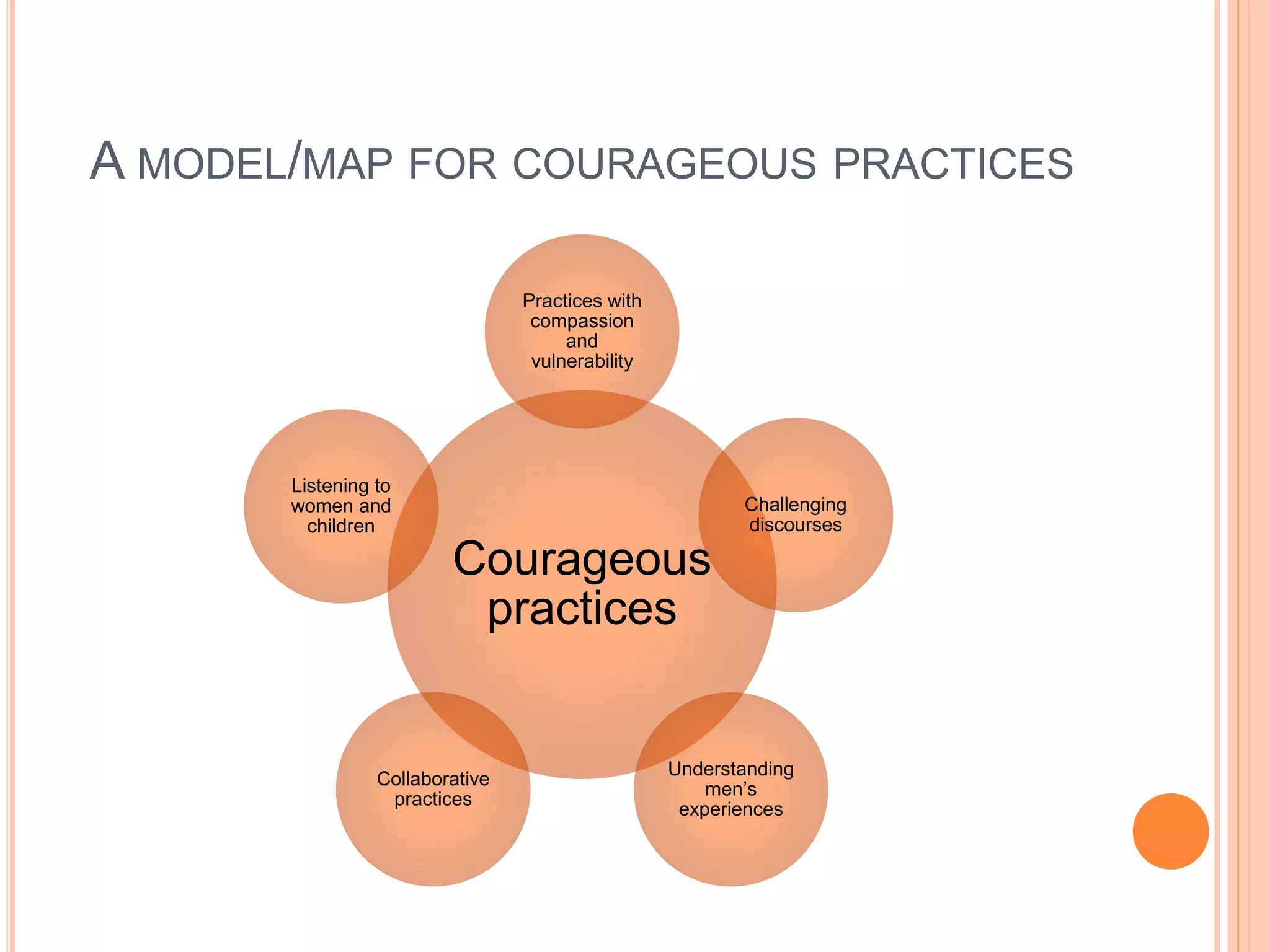
A MODEL/MAP FOR COURAGEOUS PRACTICES
Courageous
practices
Practices with
compassion
and
vulnerability
Challenging
discourses
Understanding
men’s
experiences
Collaborative
practices
Listening to
women and
children
WHAT DO YOU MEAN ‘COURAGEOUS’?
 The root of courage is ‘cor’ – in Latin means heart
 Courage originally meant “To speak one’s mind by
telling all one’s heart” (Brown, 2010)
 Courage: heroics vs. vulnerability
 Our current approaches lead us to blame and
shame – we live in a blame society
 Today’s talk includes considering practices that
move us to engage deeply with compassion and
vulnerability
WHAT DO YOU MEAN ‘COURAGEOUS’
One who practices with courage sees imperfection as
human; meets imperfection with openness and
vulnerability and has the capacity to offer
compassion to those who have been imperfect
while holding them to account for their behaviour.
The Personal
“once you have seen a pattern, you cannot unsee it…”
THE PERSONAL
 13 years in child welfare
 11 years co-facilitating men’s groups
 The Hadley inquest
 A lifetime of being a man in our society…
WHAT LED TOWARDS REALIZING THE NEED
FOR CHANGE?
 Work with my most recent co-facilitator was seminal
(worked together for 5 years)
 After the first few groups we saw patterns amongst
the men
 Men came into group with feelings of shame and
embarrassment
 Men expected to experience us as punitive and
punishing – an extension of the criminal justice
system
 Men were insightful about their lives and wanted to
engage in the process of discovery
WHAT ABOUT SHAME?
 “Shame is the intensely painful feeling or
experience of believing that we are flawed and
therefore unworthy of love and belonging” (Brown,
2010)
 Shame is one of the most prominent emotions men
express throughout the group process
 Men were shamed throughout the process of
engagement with the CJS
 Shame controlled their level of engagement with
the group process
SHAME AND GUILT
Guilt = I did something bad
Shame = I am bad
 Men lacked shame resiliency – the ability to move
beyond shame, develop courage to examine their
imperfections and reconnect as a result.
 Shame disabled the men from being able to
distinguish the bad thing they did and their
construction as bad
The Research
WHY SHOULD WE RETHINK OUR WORK
WITH ABUSIVE MEN?
Where we have been:
 Abusive men are treated unkind in the literature
 Portrayed generally as pathological, defiant and in
a constant state of denial (Lehmann & Simmons,
2009)
 Beliefs regarding entitlement, minimizing their
behaviour and power and control are pervasive in
the literature (Gondolf, 2002)
 Low completion rates for IPV programs
 Recidivism rates are also concerning
CONT’D
 Treatment models for abusive men remain largely
unchanged – most copy Duluth (psycho-
educational + feminism)
 It is not therapy, rather peer education that relies on
challenging and confrontation of abusive belief
systems
 Many agencies (CW/police/probation) have
struggled to work with this population to create
safety – and have reinforced many stereotypes
regarding these men
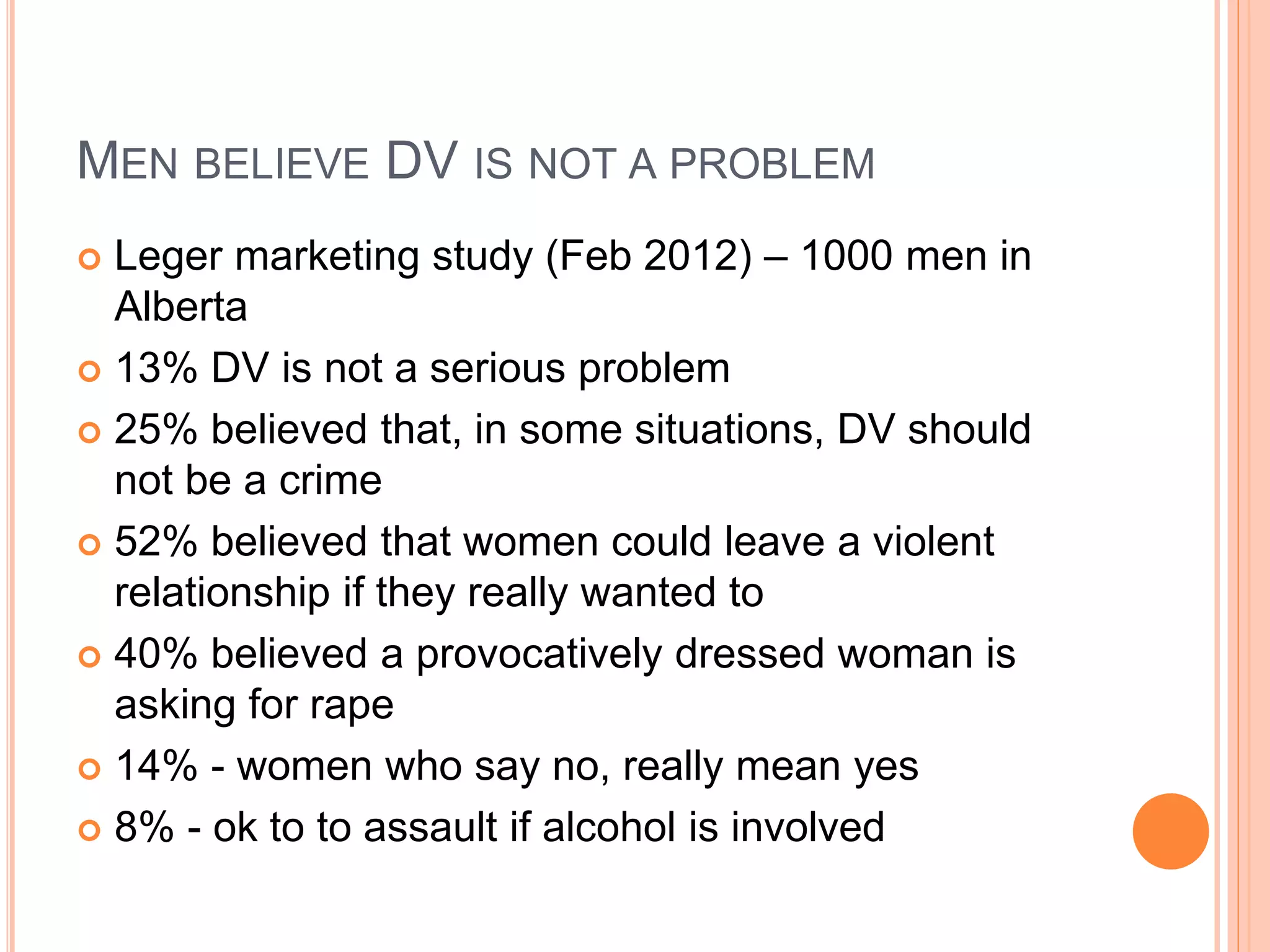
MEN BELIEVE DV IS NOT A PROBLEM
 Leger marketing study (Feb 2012) – 1000 men in
Alberta
 13% DV is not a serious problem
 25% believed that, in some situations, DV should
not be a crime
 52% believed that women could leave a violent
relationship if they really wanted to
 40% believed a provocatively dressed woman is
asking for rape
 14% - women who say no, really mean yes
 8% - ok to to assault if alcohol is involved
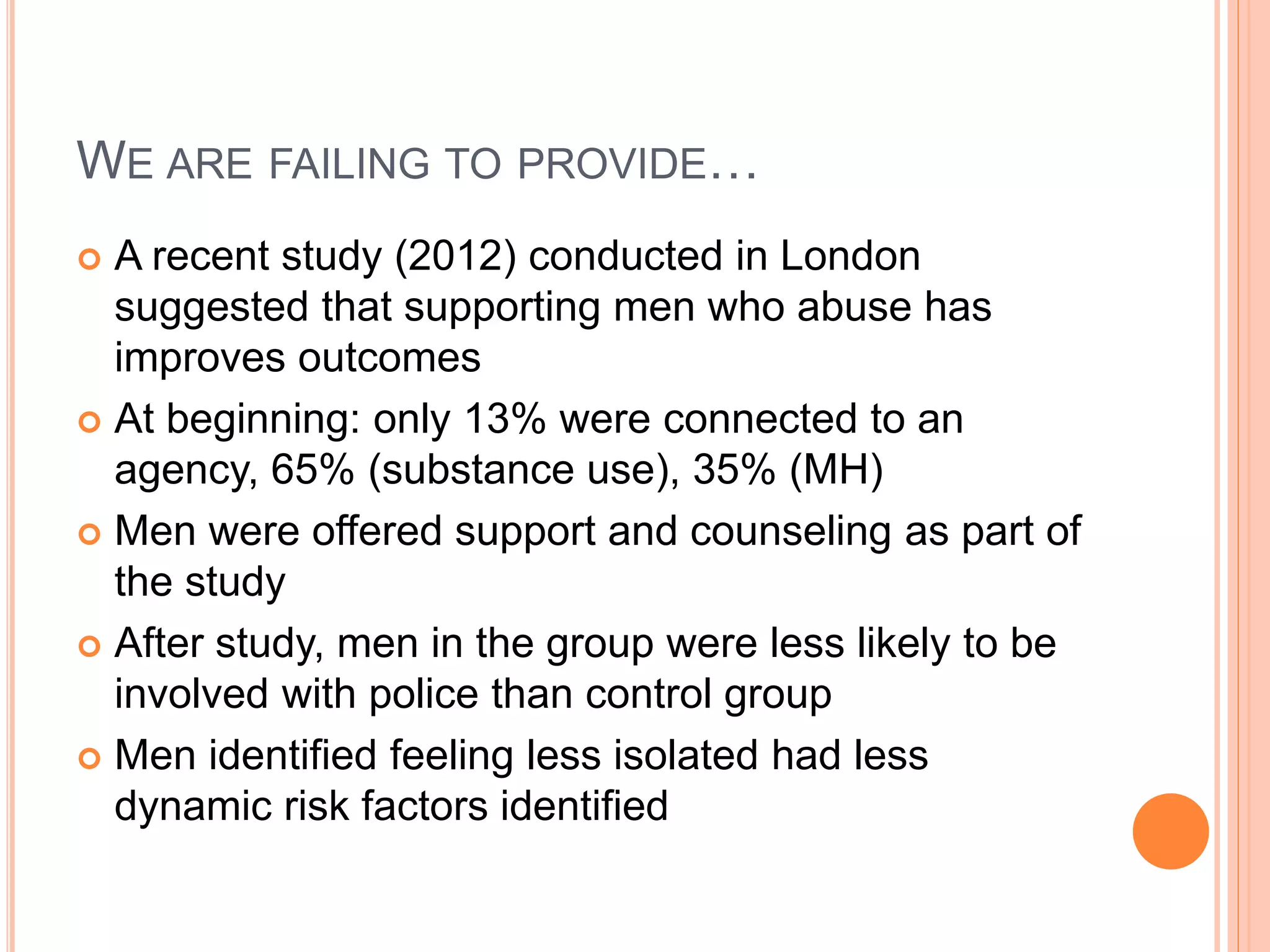
WE ARE FAILING TO PROVIDE…
 A recent study (2012) conducted in London
suggested that supporting men who abuse has
improves outcomes
 At beginning: only 13% were connected to an
agency, 65% (substance use), 35% (MH)
 Men were offered support and counseling as part of
the study
 After study, men in the group were less likely to be
involved with police than control group
 Men identified feeling less isolated had less
dynamic risk factors identified
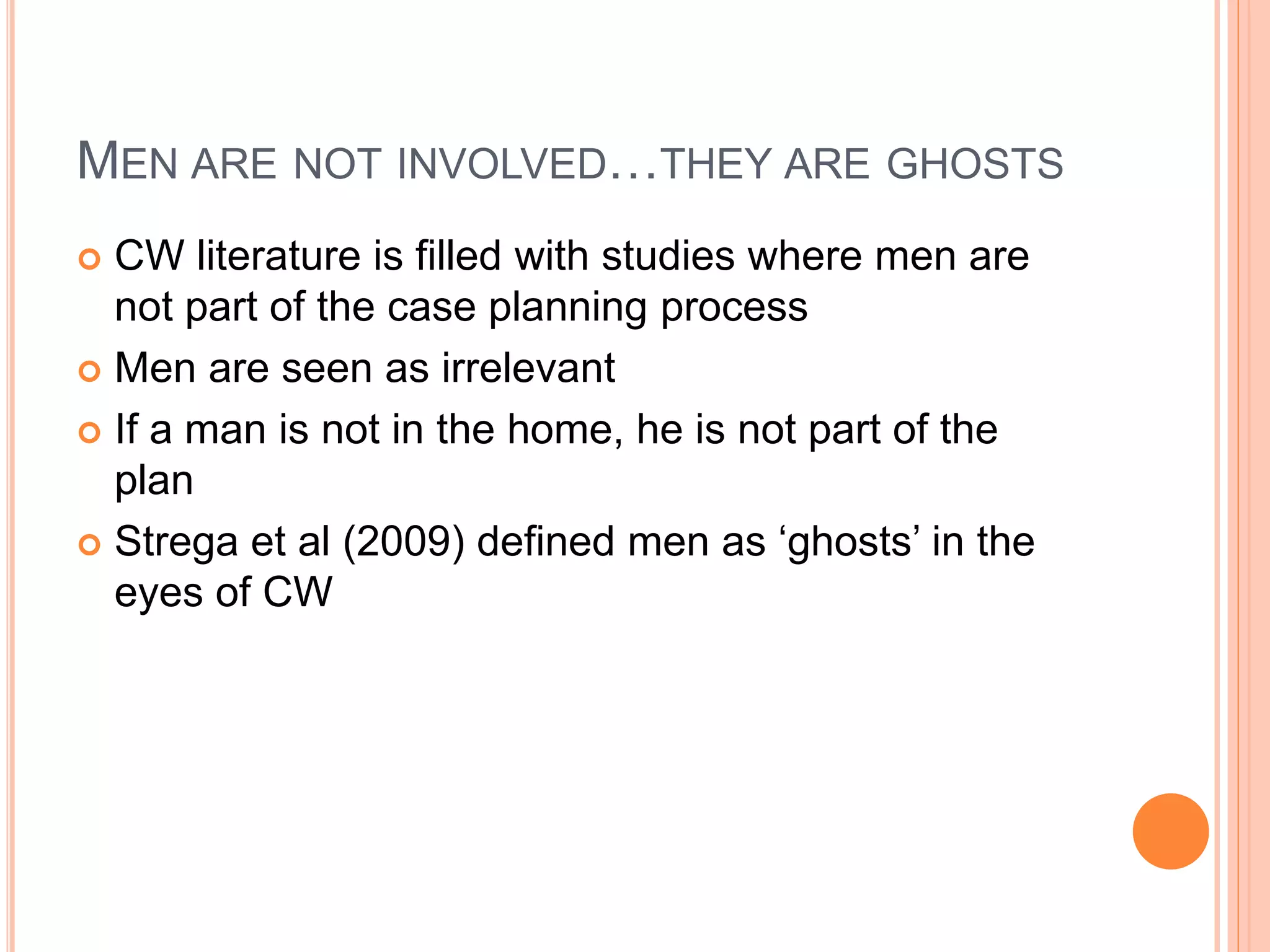
MEN ARE NOT INVOLVED…THEY ARE GHOSTS
 CW literature is filled with studies where men are
not part of the case planning process
 Men are seen as irrelevant
 If a man is not in the home, he is not part of the
plan
 Strega et al (2009) defined men as ‘ghosts’ in the
eyes of CW
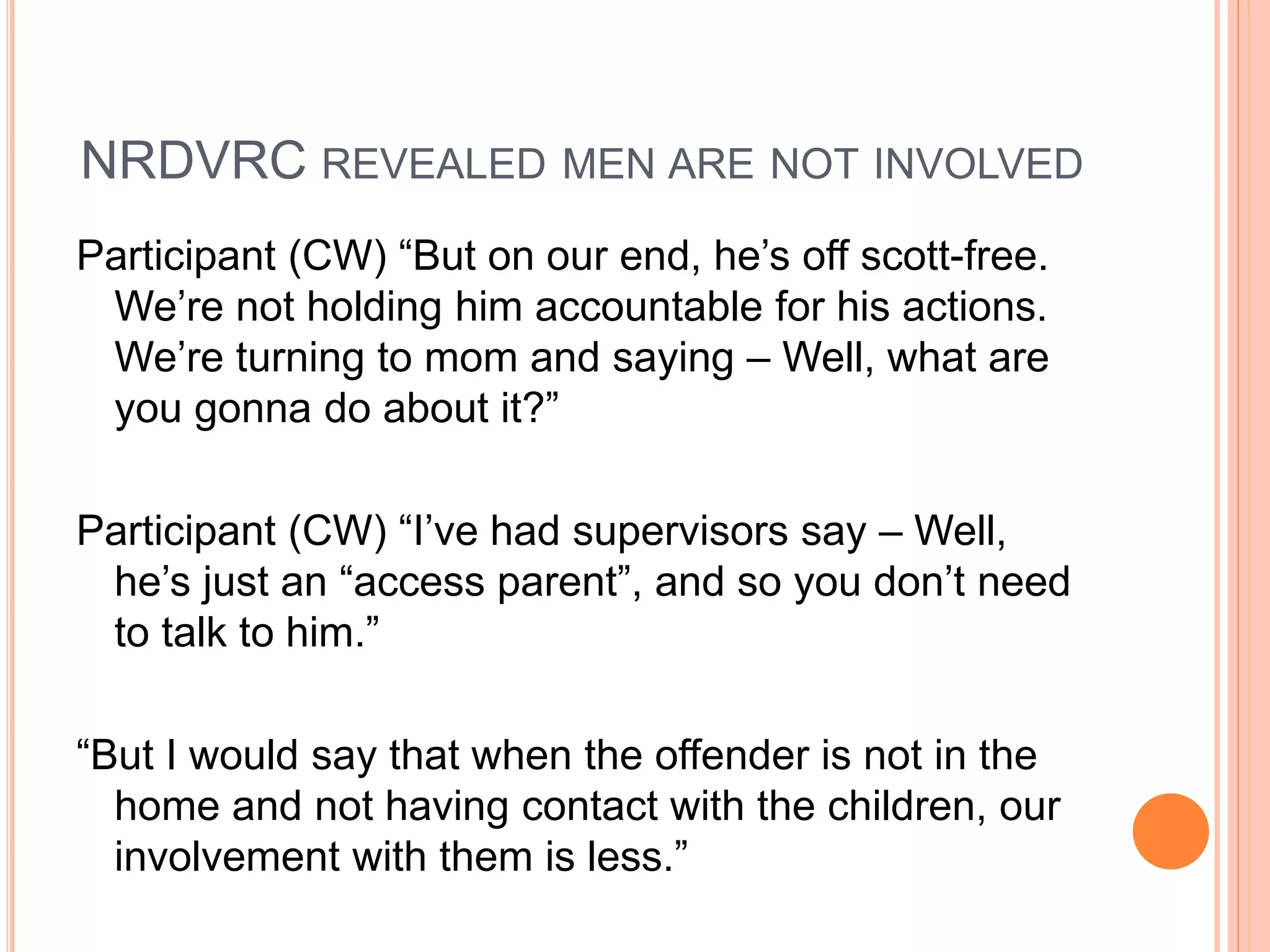
NRDVRC REVEALED MEN ARE NOT INVOLVED
Participant (CW) “But on our end, he’s off scott-free.
We’re not holding him accountable for his actions.
We’re turning to mom and saying – Well, what are
you gonna do about it?”
Participant (CW) “I’ve had supervisors say – Well,
he’s just an “access parent”, and so you don’t need
to talk to him.”
“But I would say that when the offender is not in the
home and not having contact with the children, our
involvement with them is less.”
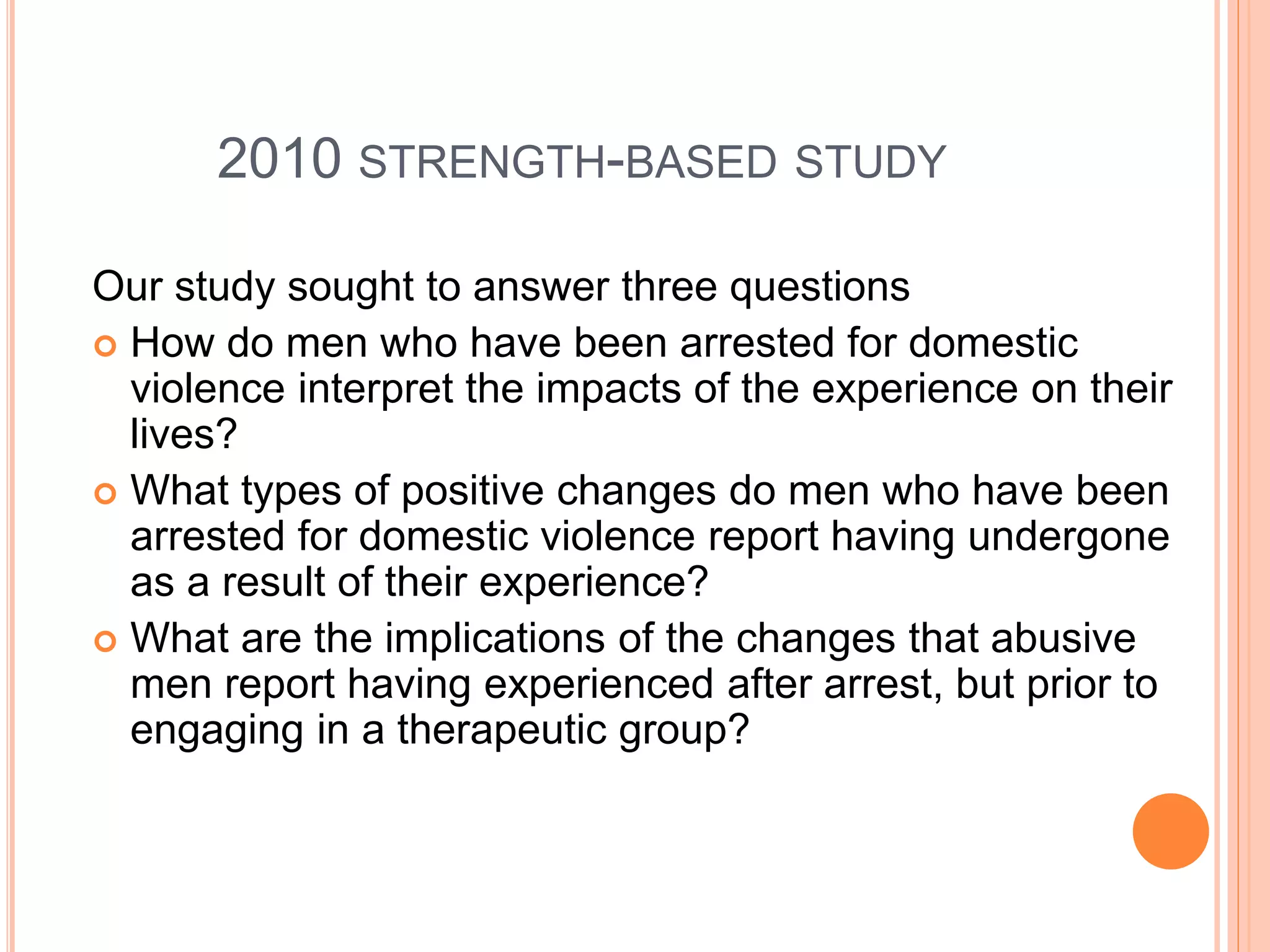
2010 STRENGTH-BASED STUDY
Our study sought to answer three questions
 How do men who have been arrested for domestic
violence interpret the impacts of the experience on their
lives?
 What types of positive changes do men who have been
arrested for domestic violence report having undergone
as a result of their experience?
 What are the implications of the changes that abusive
men report having experienced after arrest, but prior to
engaging in a therapeutic group?
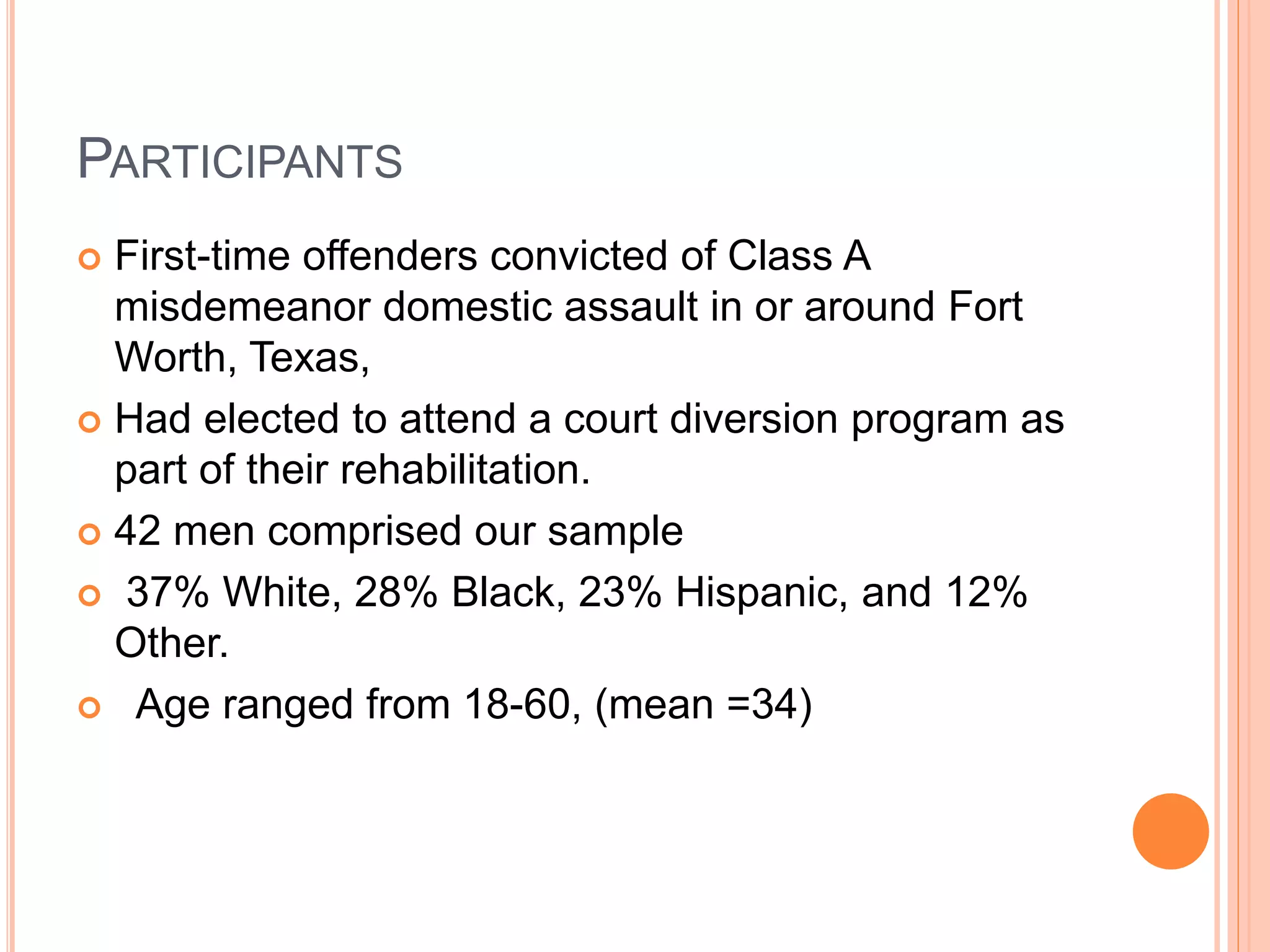
PARTICIPANTS
 First-time offenders convicted of Class A
misdemeanor domestic assault in or around Fort
Worth, Texas,
 Had elected to attend a court diversion program as
part of their rehabilitation.
 42 men comprised our sample
 37% White, 28% Black, 23% Hispanic, and 12%
Other.
 Age ranged from 18-60, (mean =34)
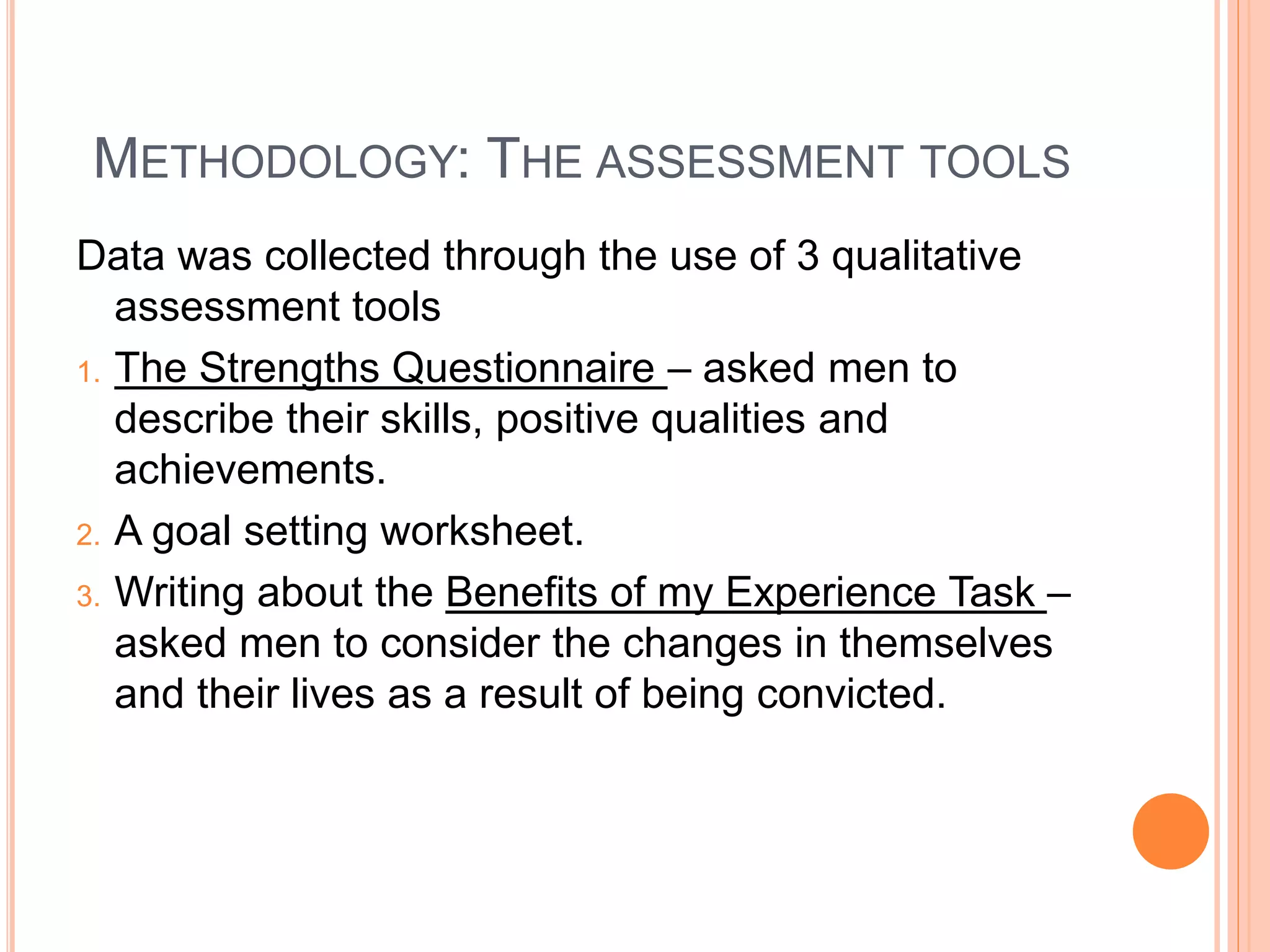
METHODOLOGY: THE ASSESSMENT TOOLS
Data was collected through the use of 3 qualitative
assessment tools
1. The Strengths Questionnaire – asked men to
describe their skills, positive qualities and
achievements.
2. A goal setting worksheet.
3. Writing about the Benefits of my Experience Task –
asked men to consider the changes in themselves
and their lives as a result of being convicted.
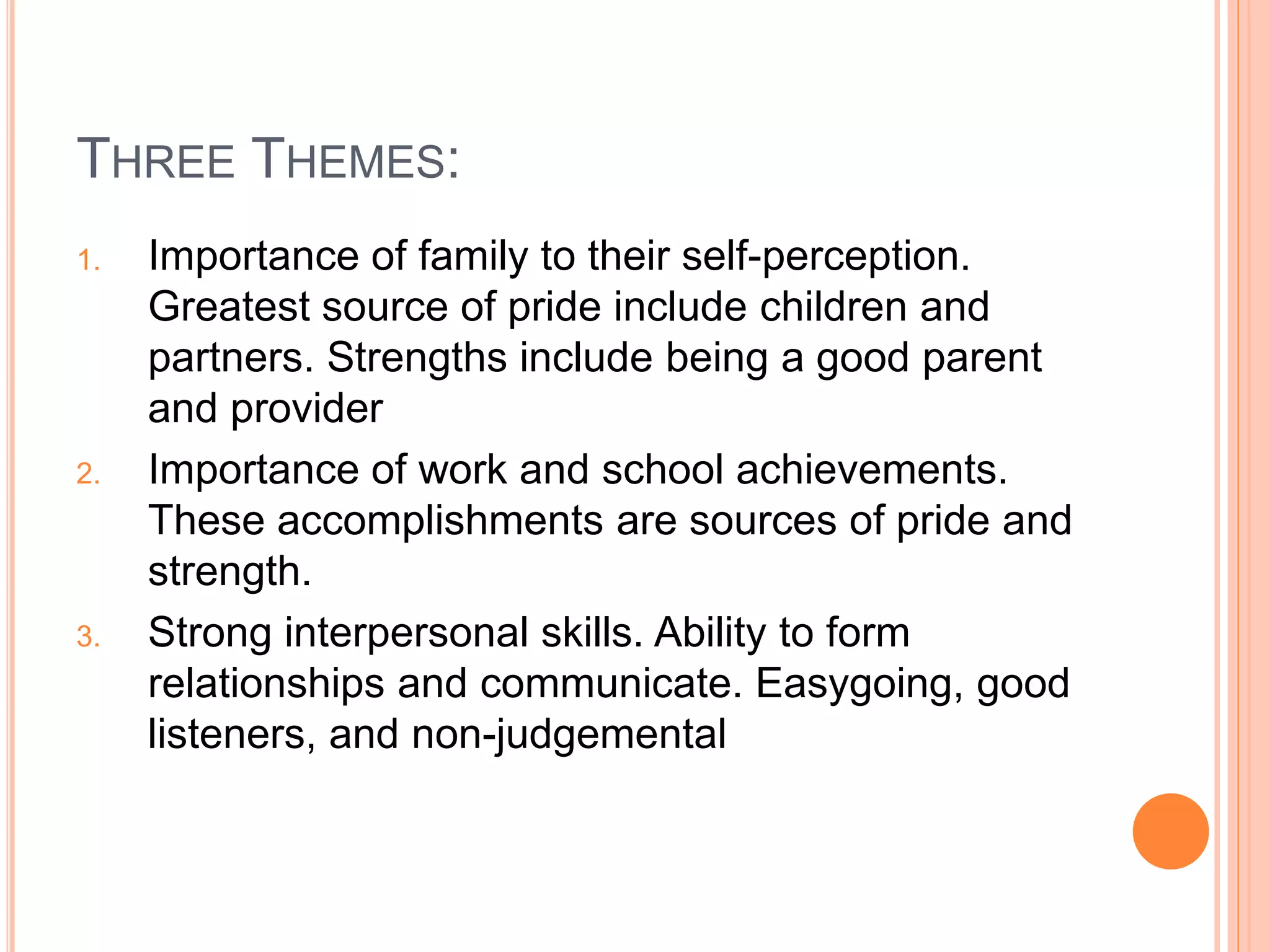
THREE THEMES:
1. Importance of family to their self-perception.
Greatest source of pride include children and
partners. Strengths include being a good parent
and provider
2. Importance of work and school achievements.
These accomplishments are sources of pride and
strength.
3. Strong interpersonal skills. Ability to form
relationships and communicate. Easygoing, good
listeners, and non-judgemental
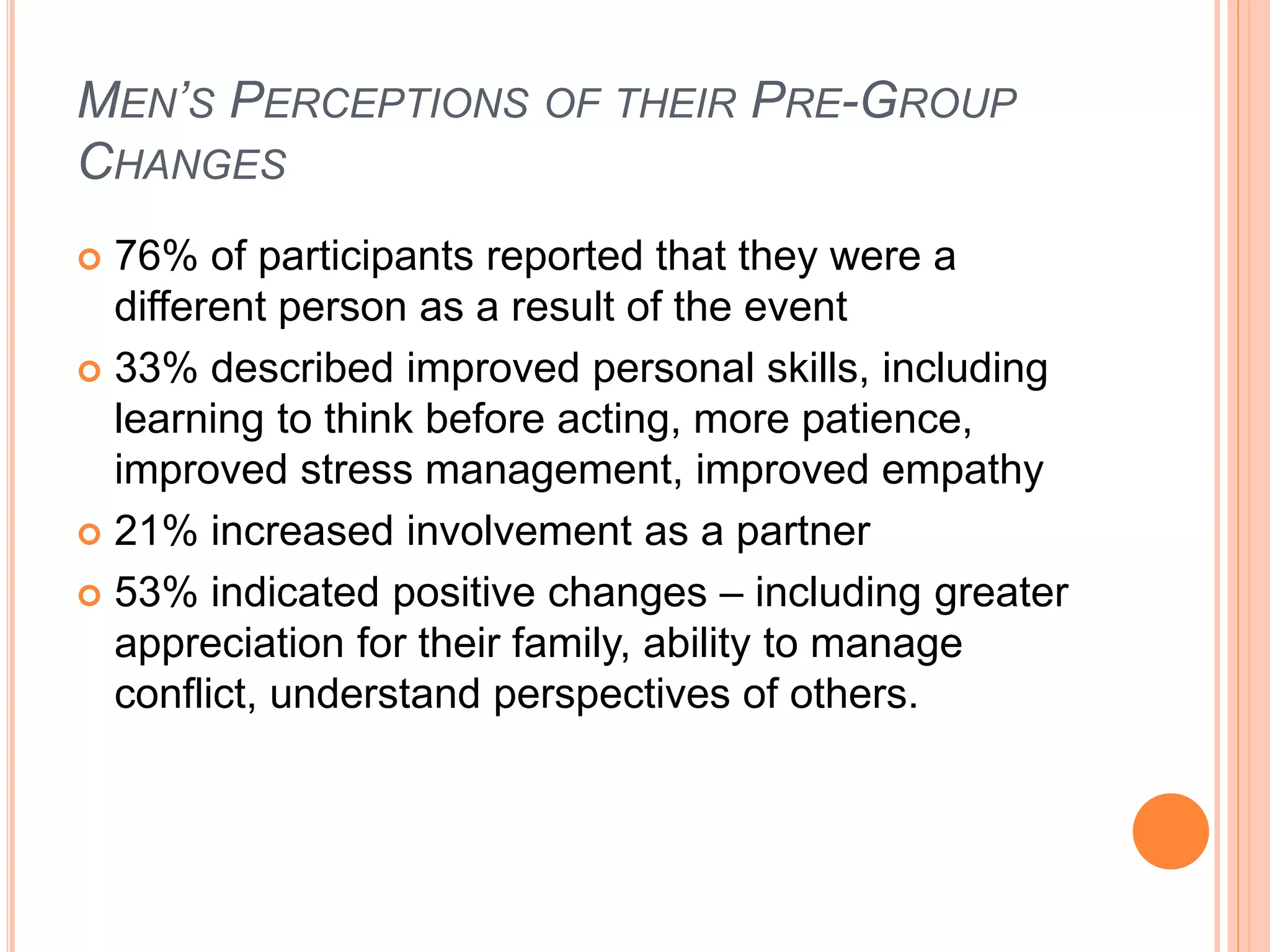
MEN’S PERCEPTIONS OF THEIR PRE-GROUP
CHANGES
 76% of participants reported that they were a
different person as a result of the event
 33% described improved personal skills, including
learning to think before acting, more patience,
improved stress management, improved empathy
 21% increased involvement as a partner
 53% indicated positive changes – including greater
appreciation for their family, ability to manage
conflict, understand perspectives of others.
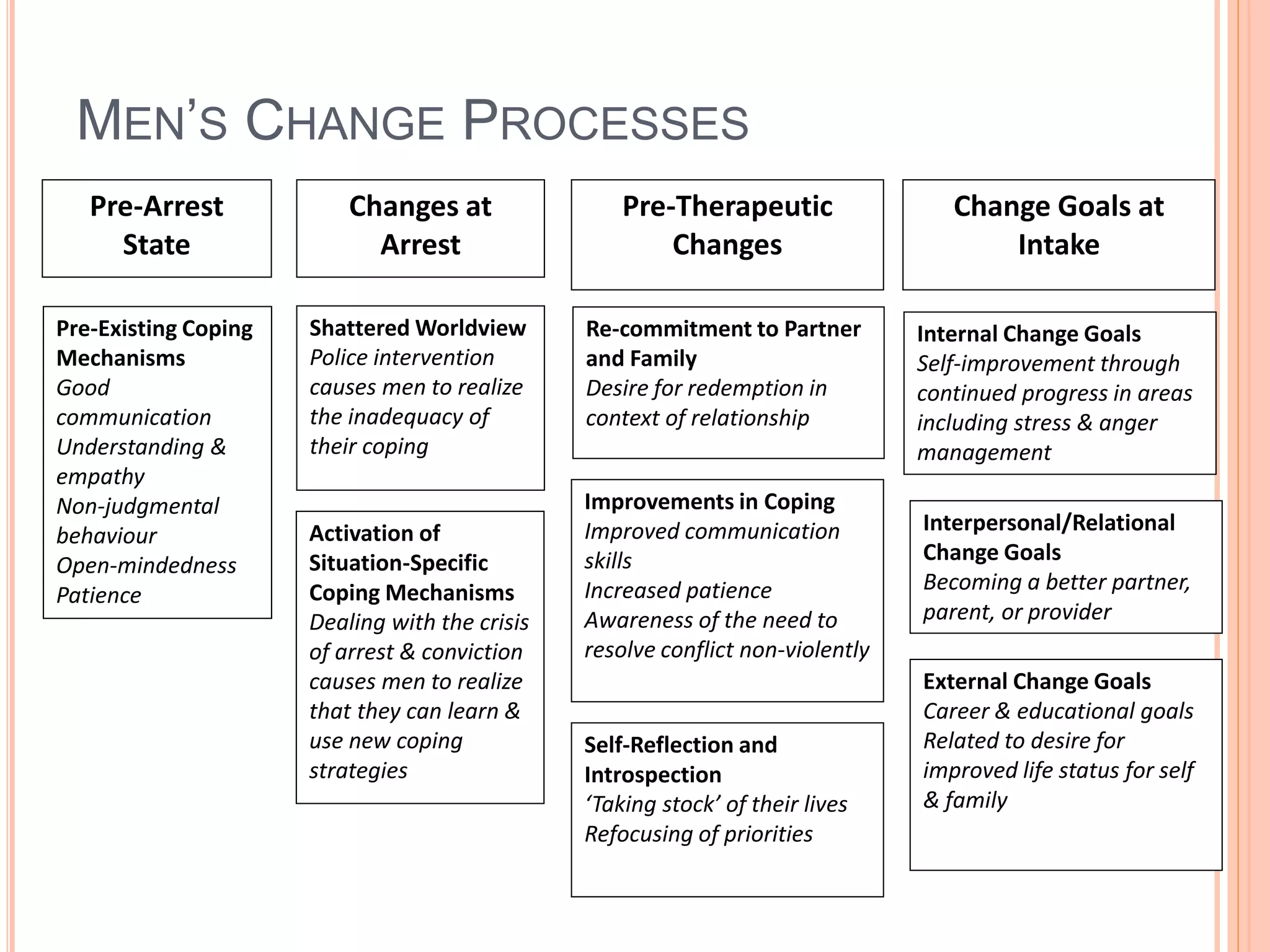
MEN’S CHANGE PROCESSES
Pre-Existing Coping
Mechanisms
Good
communication
Understanding &
empathy
Non-judgmental
behaviour
Open-mindedness
Patience
Shattered Worldview
Police intervention
causes men to realize
the inadequacy of
their coping
Activation of
Situation-Specific
Coping Mechanisms
Dealing with the crisis
of arrest & conviction
causes men to realize
that they can learn &
use new coping
strategies
Pre-Arrest
State
Changes at
Arrest
Re-commitment to Partner
and Family
Desire for redemption in
context of relationship
Pre-Therapeutic
Changes
Improvements in Coping
Improved communication
skills
Increased patience
Awareness of the need to
resolve conflict non-violently
Self-Reflection and
Introspection
‘Taking stock’ of their lives
Refocusing of priorities
Change Goals at
Intake
Internal Change Goals
Self-improvement through
continued progress in areas
including stress & anger
management
Interpersonal/Relational
Change Goals
Becoming a better partner,
parent, or provider
External Change Goals
Career & educational goals
Related to desire for
improved life status for self
& family
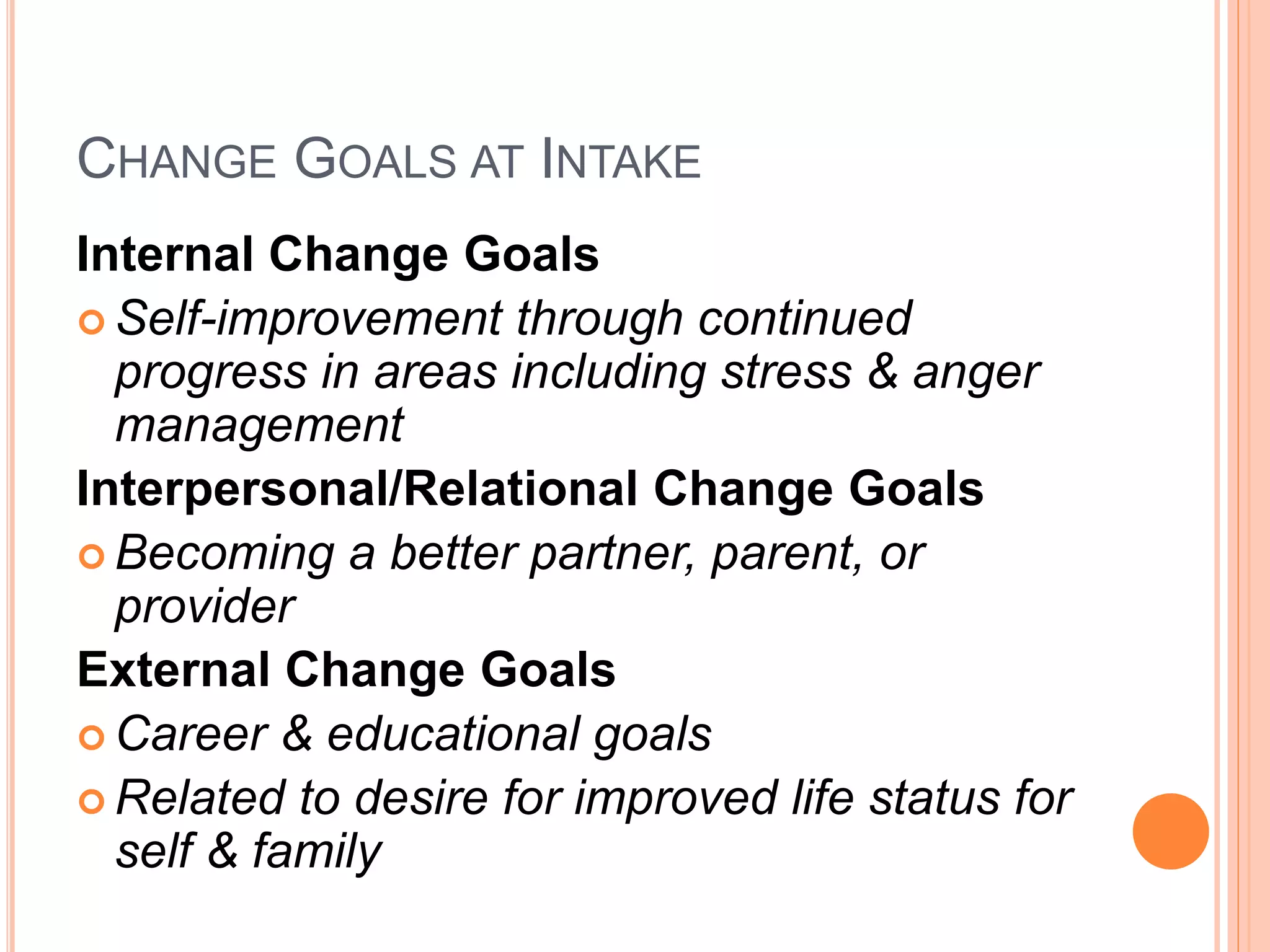
CHANGE GOALS AT INTAKE
Internal Change Goals
 Self-improvement through continued
progress in areas including stress & anger
management
Interpersonal/Relational Change Goals
 Becoming a better partner, parent, or
provider
External Change Goals
 Career & educational goals
 Related to desire for improved life status for
self & family
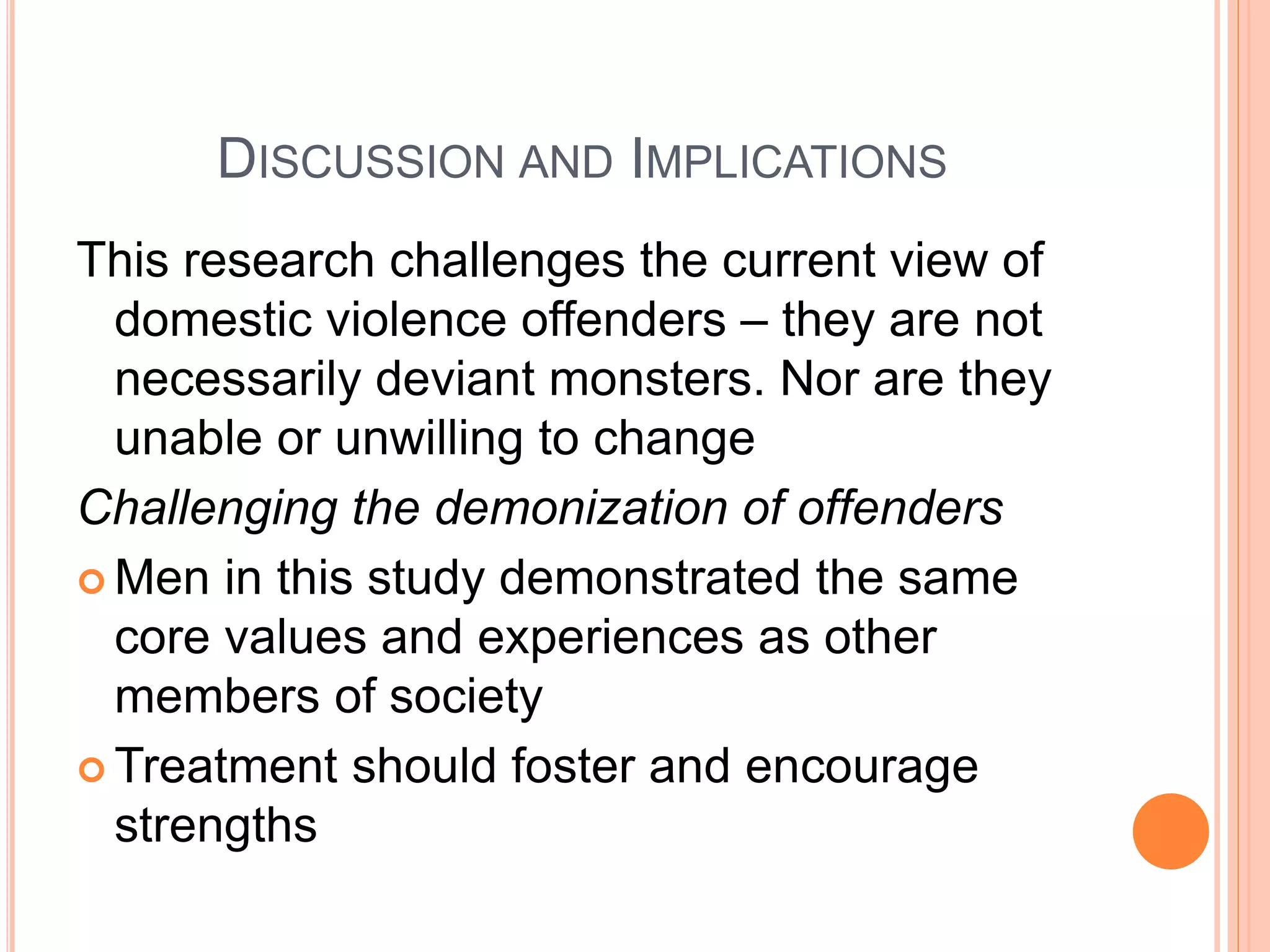
DISCUSSION AND IMPLICATIONS
This research challenges the current view of
domestic violence offenders – they are not
necessarily deviant monsters. Nor are they
unable or unwilling to change
Challenging the demonization of offenders
 Men in this study demonstrated the same
core values and experiences as other
members of society
 Treatment should foster and encourage
strengths
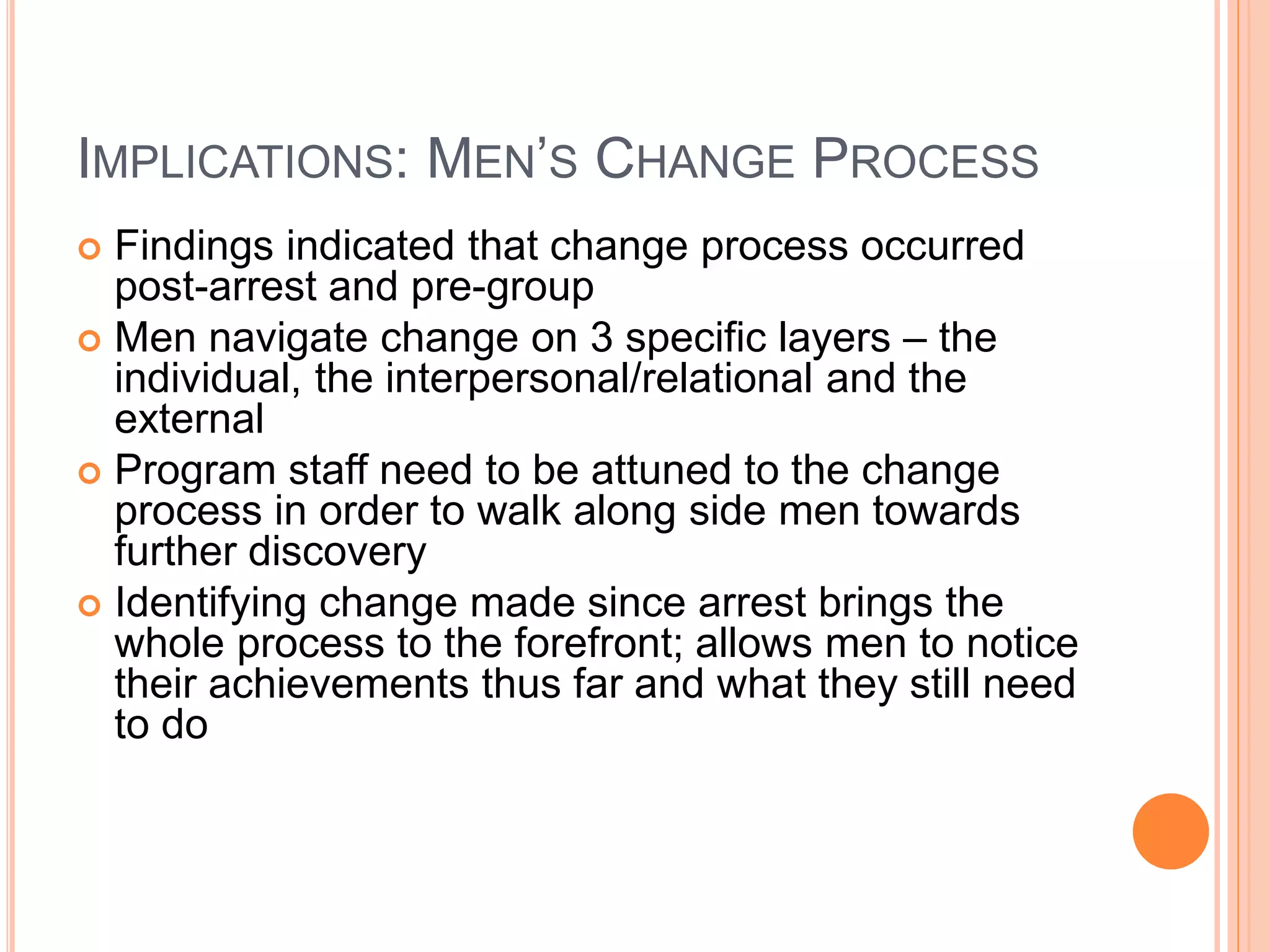
IMPLICATIONS: MEN’S CHANGE PROCESS
 Findings indicated that change process occurred
post-arrest and pre-group
 Men navigate change on 3 specific layers – the
individual, the interpersonal/relational and the
external
 Program staff need to be attuned to the change
process in order to walk along side men towards
further discovery
 Identifying change made since arrest brings the
whole process to the forefront; allows men to notice
their achievements thus far and what they still need
to do
IMPLICATIONS: PARADIGM SHIFT
 Men’s perceptions of themselves does not
match the traditional ways of thinking
 Strengths-based perspective identifies the
resources over deficiencies; seeks to
encourage additional strengths
 New framework also reconfigures the
responsibilities of the client and the worker
within treatment programs
IMPLICATIONS: GOAL SETTING
 Men join group with goals and having taken steps to
realize them
 Research has shown that self-determined goals can
reduce recidivism (Lee, Uken & Seebold, 2007)
 Personally meaningful goals can lead to motivated and
involved participants
IMPLICATIONS: BENEFIT-FINDING
 Majority of men reported benefiting from their
involvement with the justice system
 Psychological well-being improved through the process
of letting go and moving on
 Encourage men to think about involvement with the law
was the “right thing to do” for themselves and their
relationships
 Benefit-finding activities leads to increased forgiveness
and reparation in relationships (McCullough, Root & Cohen,
2006)
The Academic
RISK
 Risk is part of our lives but we rarely think about it.
 How many of you use a risk assessment tool?
 How many of you develop safety plans?
 As I heard more about risk, outside of CW, I
followed the trail…
RISK
 As a society, we have become increasingly
concerned with ‘risk’ and minimizing or avoiding
risk.
 People are now ‘at risk’
 Risk has come to shape institutional behaviours
(risk management) and individual choices.
 Risk has become a forensic tool to allocate blame
in our society (Douglas, 1992).
 Risk has replaced the notion of danger (and safety)
in our society
RISK AND NEOLIBERALISM
 Risk has also come to be associated with the neo-
liberal discourse as part of the political spectrum
 In a neoliberal world, personal failure is “generally
attributed to personal failings, and the victim is all
too often blamed” (Harvey, 2005, P. 76).
 Neoliberalism upholds very specific values –
traditional, family oriented values
 Violence within the family setting could be labeled
as running counter to ‘traditional family values’
resulting in state intervention
 In many ways, domestic violence (VAW) has
resulted in new risks within the family requiring
state involvement
CHALLENGES TO THE NEOLIBERAL RISK
DISCOURSE
 Men and women experience risks in our society
differently
 Beck (1992) “smog is indiscriminate”
 To suggest that everyone experiences risks the
same tends to de-personalize the individual nature
of living
RISK AND CHILD WELFARE
 Risk and risk assessment has changed CW in
Ontario
 Mothers, used to ‘fail to protect’ now place children
‘at risk’
 Risk assessment tools actually solidify the risks
men pose – entry point – but CW continues to fail to
engage these men
WHAT FRONT-LINE WORKERS SAID
Interviewer: “What percentage of your work, do you
think, is guided by that notion of risk?”
Participant (CW): “I would say almost all of it.”
Participant (CW): “It increases the risk when there’s
domestic violence.”
Participant (probation): “The ODARA is 13 questions
that we use to predict risk, again.”
RISK AND GENDER
 Generally, men are seen to be risk seekers and
women are risk avoiders
 However, it is the type of risks that women avoid
that is of interest
 Women are more likely to experience risk in the
confines of intimate relationships (with their
partners) or are more likely to be aware that harm is
likely to come to them as a result of a man (Chan
and Rigakos, 2002)
 Therefore risks for women are related to their
perceptions of harm at the hands of men
RISK, VAW & GENDER
 The criminal justice system has concerned itself
with the risk of offenders (risk assessment)
whereas the VAW sector has concerned itself with
the risk associated with victims
 Often this can be confusing, because some women
stay in violent relationships, which suggests an
awareness of the risks
WHAT WOMEN TOLD US…
Participant (woman): “it’s pretty sad when you are
afraid to call the authorities, when you would rather
risk your life or the life of your children before you’ll
call the authorities.”
“They’re supposed to help you save your life, and
you’d rather take that chance and staying with a
horrible abuser and risk your life rather than call?”
COURAGE AND RISK
 The reliance and pervasive use of risk has had
implications – “High-risk offender” – institutionalized
processes which creates barriers to engagement
 Risk is narrow in it’s construction and restricts our
ability to see the complexities of individual lives
 It takes courage to see beyond risk factors and see
the individual
This page left intentionally blank…
PART II: COURAGEOUS PRACTICES
 How might reconsidering the ways we talk about
men, shift our work
 Can we be open to new ways of practice and
assessment?
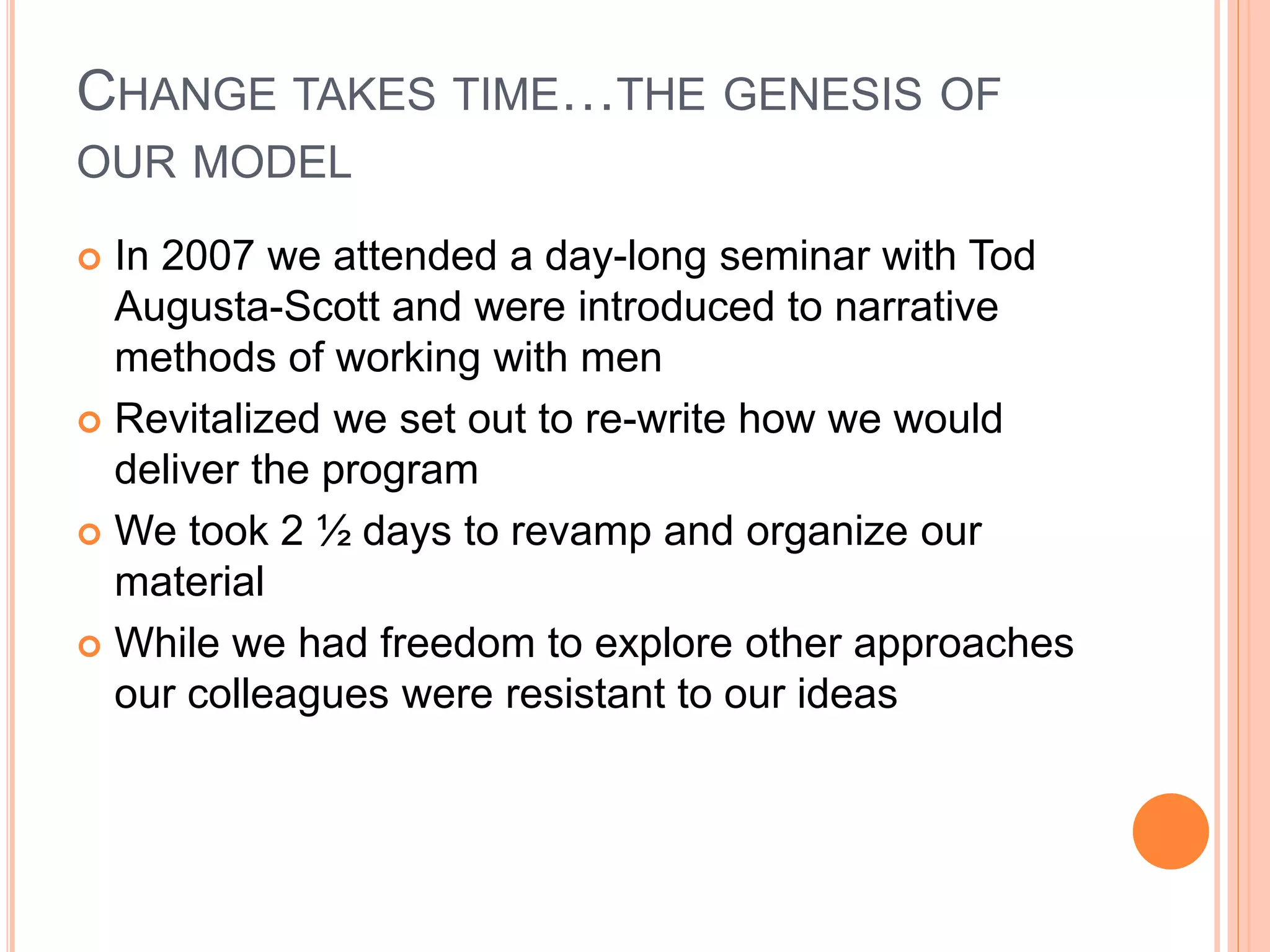
CHANGE TAKES TIME…THE GENESIS OF
OUR MODEL
 In 2007 we attended a day-long seminar with Tod
Augusta-Scott and were introduced to narrative
methods of working with men
 Revitalized we set out to re-write how we would
deliver the program
 We took 2 ½ days to revamp and organize our
material
 While we had freedom to explore other approaches
our colleagues were resistant to our ideas
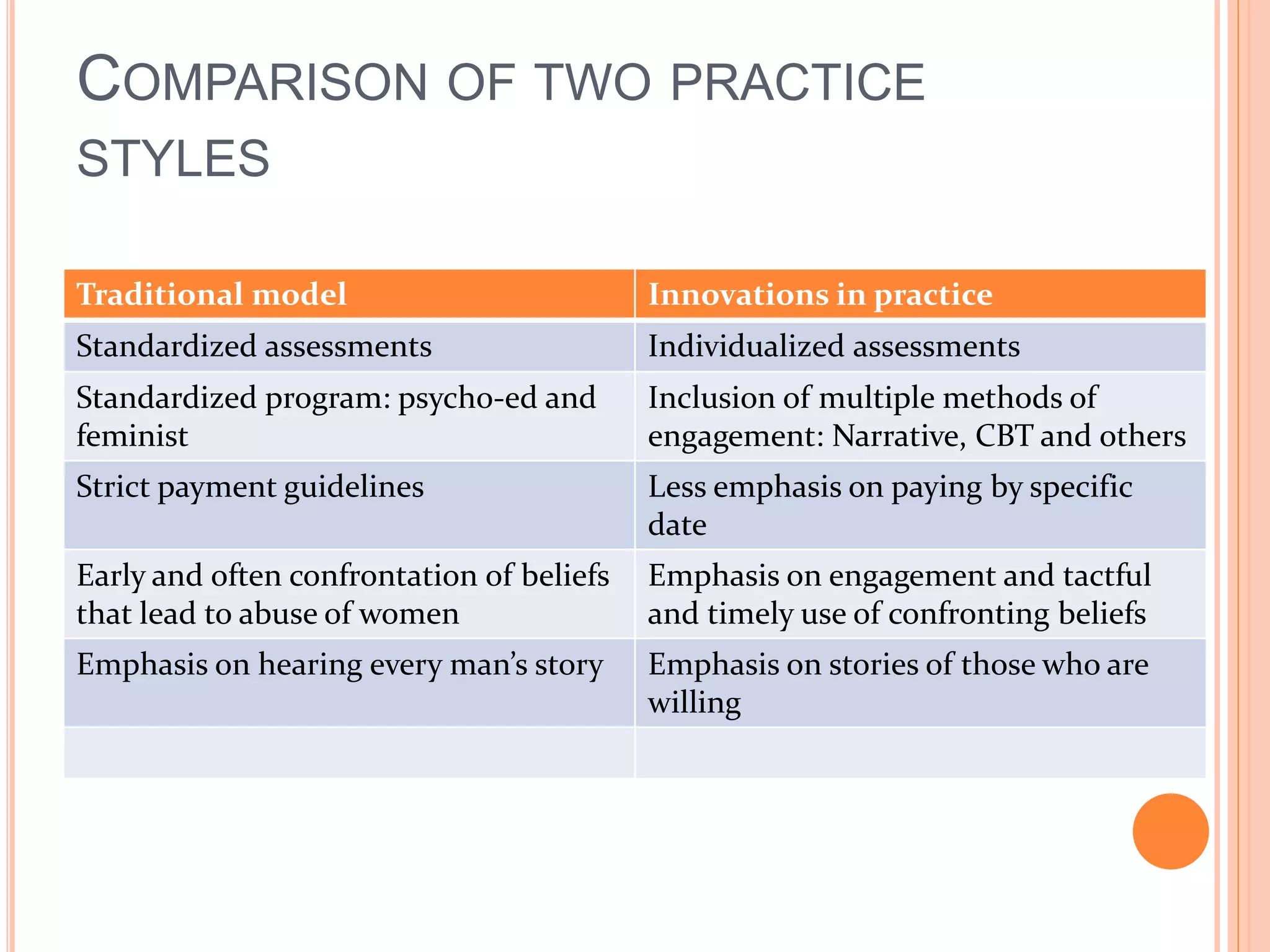
COMPARISON OF TWO PRACTICE
STYLES
Traditional model Innovations in practice
Standardized assessments Individualized assessments
Standardized program: psycho-ed and
feminist
Inclusion of multiple methods of
engagement: Narrative, CBT and others
Strict payment guidelines Less emphasis on paying by specific
date
Early and often confrontation of beliefs
that lead to abuse of women
Emphasis on engagement and tactful
and timely use of confronting beliefs
Emphasis on hearing every man’s story Emphasis on stories of those who are
willing
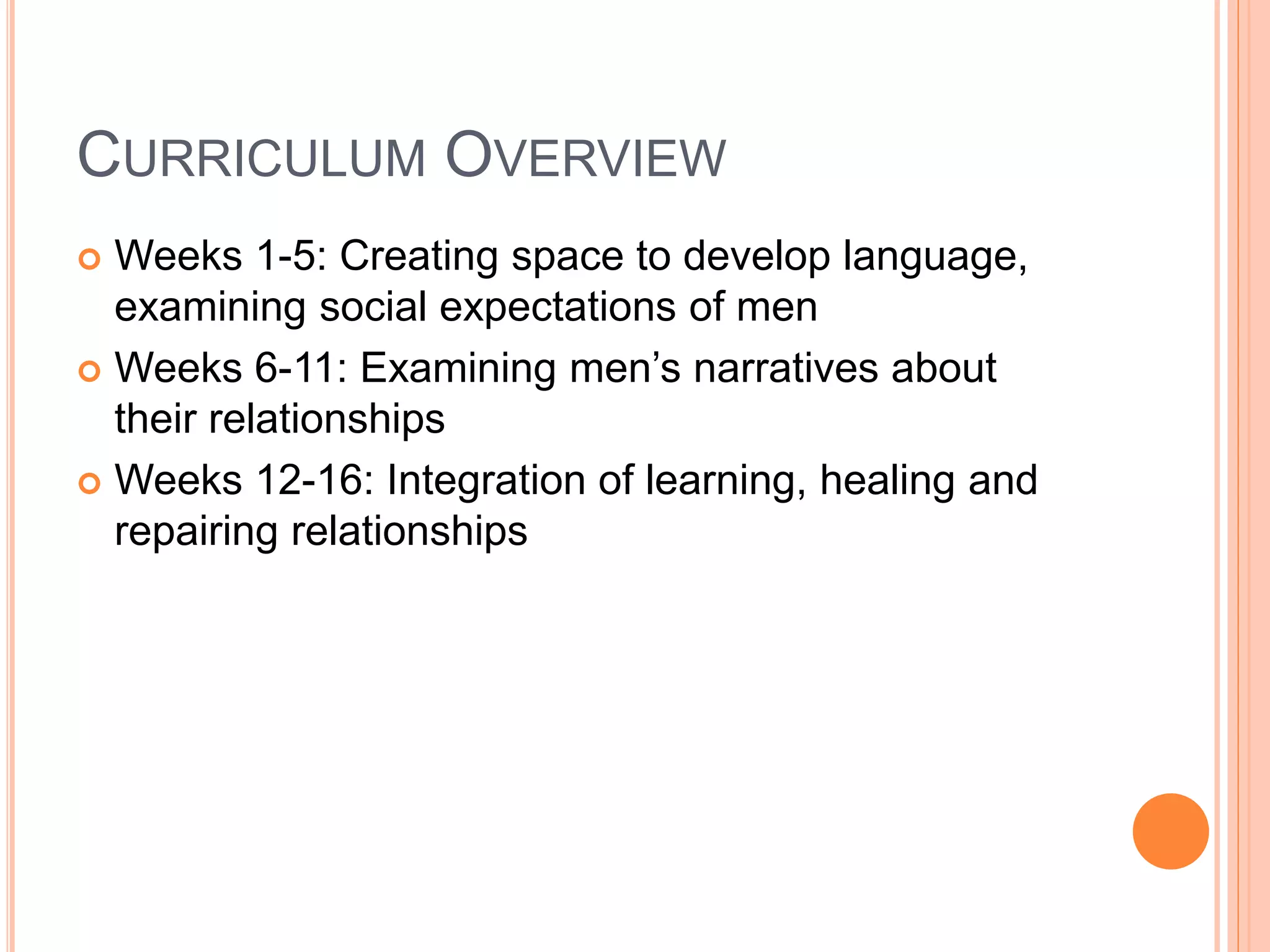
CURRICULUM OVERVIEW
 Weeks 1-5: Creating space to develop language,
examining social expectations of men
 Weeks 6-11: Examining men’s narratives about
their relationships
 Weeks 12-16: Integration of learning, healing and
repairing relationships
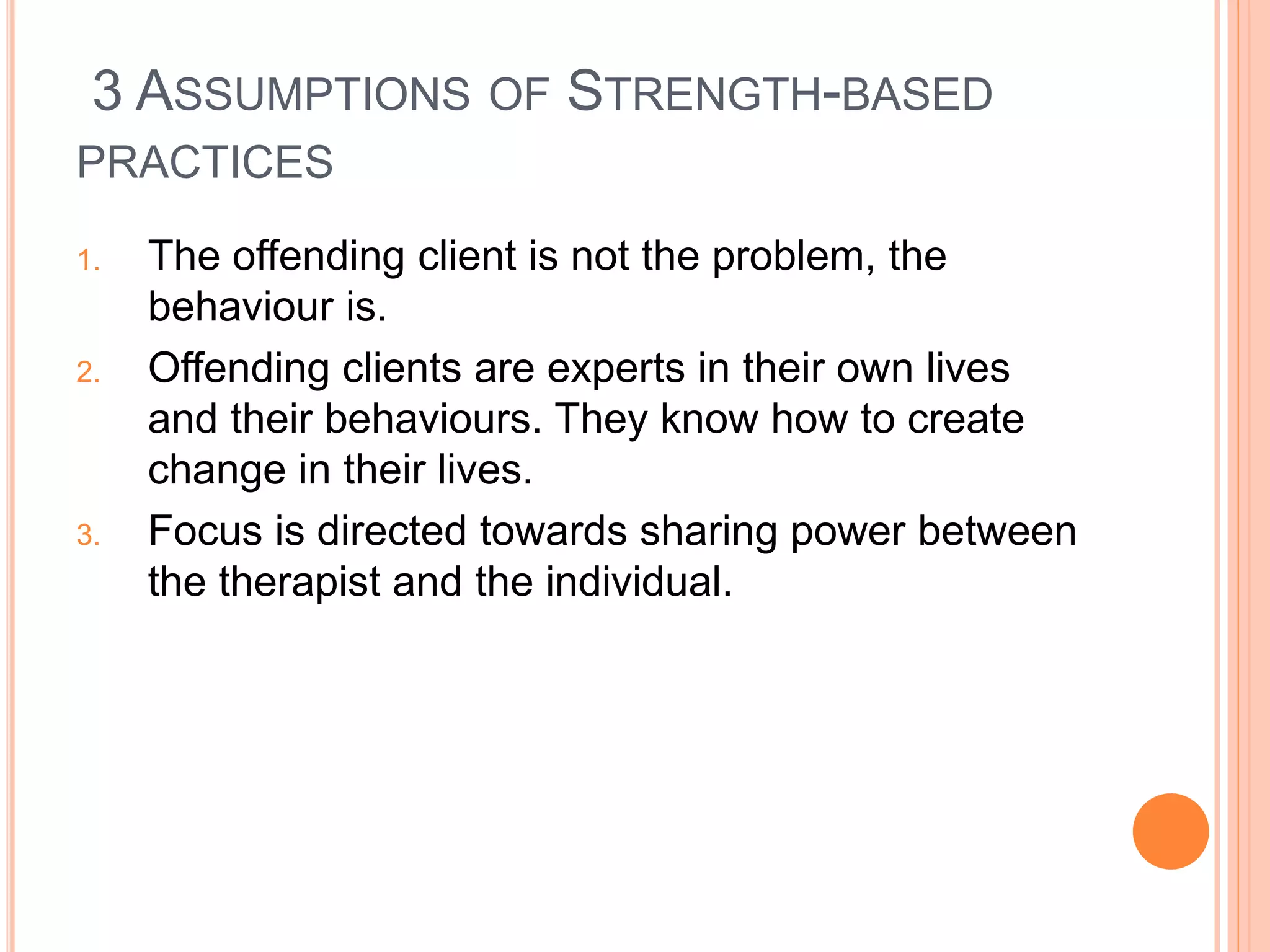
3 ASSUMPTIONS OF STRENGTH-BASED
PRACTICES
1. The offending client is not the problem, the
behaviour is.
2. Offending clients are experts in their own lives
and their behaviours. They know how to create
change in their lives.
3. Focus is directed towards sharing power between
the therapist and the individual.
CLINICAL INTERVENTION TRAITS OF S.B.P
 Clients come with a set of skills to make change in
their lives
 Emphasis is on the development of a positive
therapeutic relationship
 Engagement focuses on creating a sense of
change in the individual
 Build on pre-existing resources that exist in the
individual
STRENGTH BASED ASSESSMENTS
(LEHMANN & SIMMONS, 2009)
Non-confrontational acknowledgement
 Due to their experiences, offenders expect to
have to defend themselves
 It is not as important to listen to past acts as
opposed to encourage behavioural change
 Intervention is separate from punishment
 The goal is to build a therapeutic alliance, not
alienate
STRENGTH BASED ASSESSMENTS
Discover what the client wants
 What are the goals of the individual?
 How do you deal with mandated clients?
 “How will you be different in 16 weeks?”
 “What do you think you need to work on?”
 “How will you achieve your goals?”
 “Tell me what kind of parent you want to be?”
 “What sort of relationship do you wish to have with
your children”
STRENGTH BASED ASSESSMENTS
Seek multidimensional strengths
 We need to include context of the individual in our
assessments
 What strengths exist in the personal and
environment for the individual?
 Who is your 2am person?
STRENGTH BASED ASSESSMENTS
Discover the client’s uniqueness
 Not every client is the same, nor will they have the
same strengths
 SBP is not a one size fits all model
 Its is important to discover the internal and external
strengths of an individual to build a framework for
solutions
STRENGTH BASED ASSESSMENTS
Use language the client can understand
 Speak to a client in a manner that they are
comfortable with
 Professional language may separate therapist from
client (alter the relationship, and reduce efforts to
elicit participation)
 It is important to remember that communicative
interchange is important as we derive meaning from
this interaction
STRENGTH BASED ASSESSMENTS
Approach assessment as a joint activity
 Strength-based assessments are collaborations
 Our role is to assist in the process of discovery for
the man and for us
 A joint process allows us to learn and subsequently
guide the man to change
 What are your recent successes?
 What have you done that your are proud of?
STRENGTH BASED ASSESSMENTS
Remember, it’s a process not a product
 Assessment is a continual process, not just a report
 SBP require to continually assess and evaluate the
needs of the men
 This includes goal setting, movement towards
change and other significant changes that may
have occurred
OTHER COURAGEOUS PRACTICES TO
CONSIDER
 Couple counseling
 Family group decision making
 Individual counseling
 ‘alternative practices with men’ – mindfulness
 Practices that address co-occurring issues
 Academics must teach courageous practices
COURAGE AND COLLABORATION
 In order to be truly effective collaboration takes
courage
 Consider the relationship between CW and VAW
sector
 These days collaboration is the new ‘norm’
 Yet collaboration requires our ability to hold our
partners to account when necessary
COURAGE AND THE OCCUPY MOVEMENT
 To truly work courageously, we must be prepared to
oppose and challenge governmental policy
 We must articulate our position that increases
funding to men’s programs while simultaneously
adequately funding women and children’s programs
 There are currently plans to drastically reduce the
PAR program from 16 to 12 weeks and limit who
can attend and how many times one can attend –
only strong opposition will truly inform the
government
SOME FINAL THOUGHTS
 Courageous practices are revolutionary
 Collaborative practices are our best opportunity to
examine and end this issue
 These practices take time…

courageous powerpoint

  • 1.
    COURAGEOUS CONVERSATIONS: CONSIDERING THEWAYS WE TALK ABOUT MEN WHO ABUSE Ian DeGeer, PhD (Can) March 30, 2012 “For change to be enduring, the violent offender must undergo a radical transformation that touches the very substrates of his being” (Garland & Fredrickson, 2009)
  • 2.
    WELCOME! AGENDA Part 1: • Whatdo you mean by ‘courageous’? • The Personal • The Research • The Academic Part 2: Courageous practices • Looking at new ways of practice • Challenging the established set of norms regarding work with men
  • 3.
    MATERIAL FRAMING TODAY’SDISCUSSION  Personal practice experience  2010 study published in the Journal of Interpersonal violence  Work in the Niagara Region Domestic Violence Report Cards  Various theorists and writers: Brene Brown, Peter Lehmann, Noah Levine, James Cloughey, Swift & Callahan (2009), Mary Douglas, Paul Kivel, Jackson Katz, Tod Agusta-Scot
  • 4.
    OPENING QUESTIONS  Inwhat ways do you think your community is successful in engaging men who abuse?  What is the language that is used to talk about men who abuse (good/bad)?  What are the obstacles that your community faces in working with these men?
  • 5.
    A MODEL/MAP FORCOURAGEOUS PRACTICES Courageous practices Practices with compassion and vulnerability Challenging discourses Understanding men’s experiences Collaborative practices Listening to women and children
  • 6.
    WHAT DO YOUMEAN ‘COURAGEOUS’?  The root of courage is ‘cor’ – in Latin means heart  Courage originally meant “To speak one’s mind by telling all one’s heart” (Brown, 2010)  Courage: heroics vs. vulnerability  Our current approaches lead us to blame and shame – we live in a blame society  Today’s talk includes considering practices that move us to engage deeply with compassion and vulnerability
  • 7.
    WHAT DO YOUMEAN ‘COURAGEOUS’ One who practices with courage sees imperfection as human; meets imperfection with openness and vulnerability and has the capacity to offer compassion to those who have been imperfect while holding them to account for their behaviour.
  • 8.
    The Personal “once youhave seen a pattern, you cannot unsee it…”
  • 9.
    THE PERSONAL  13years in child welfare  11 years co-facilitating men’s groups  The Hadley inquest  A lifetime of being a man in our society…
  • 10.
    WHAT LED TOWARDSREALIZING THE NEED FOR CHANGE?  Work with my most recent co-facilitator was seminal (worked together for 5 years)  After the first few groups we saw patterns amongst the men  Men came into group with feelings of shame and embarrassment  Men expected to experience us as punitive and punishing – an extension of the criminal justice system  Men were insightful about their lives and wanted to engage in the process of discovery
  • 11.
    WHAT ABOUT SHAME? “Shame is the intensely painful feeling or experience of believing that we are flawed and therefore unworthy of love and belonging” (Brown, 2010)  Shame is one of the most prominent emotions men express throughout the group process  Men were shamed throughout the process of engagement with the CJS  Shame controlled their level of engagement with the group process
  • 12.
    SHAME AND GUILT Guilt= I did something bad Shame = I am bad  Men lacked shame resiliency – the ability to move beyond shame, develop courage to examine their imperfections and reconnect as a result.  Shame disabled the men from being able to distinguish the bad thing they did and their construction as bad
  • 13.
  • 14.
    WHY SHOULD WERETHINK OUR WORK WITH ABUSIVE MEN? Where we have been:  Abusive men are treated unkind in the literature  Portrayed generally as pathological, defiant and in a constant state of denial (Lehmann & Simmons, 2009)  Beliefs regarding entitlement, minimizing their behaviour and power and control are pervasive in the literature (Gondolf, 2002)  Low completion rates for IPV programs  Recidivism rates are also concerning
  • 15.
    CONT’D  Treatment modelsfor abusive men remain largely unchanged – most copy Duluth (psycho- educational + feminism)  It is not therapy, rather peer education that relies on challenging and confrontation of abusive belief systems  Many agencies (CW/police/probation) have struggled to work with this population to create safety – and have reinforced many stereotypes regarding these men
  • 16.
    MEN BELIEVE DVIS NOT A PROBLEM  Leger marketing study (Feb 2012) – 1000 men in Alberta  13% DV is not a serious problem  25% believed that, in some situations, DV should not be a crime  52% believed that women could leave a violent relationship if they really wanted to  40% believed a provocatively dressed woman is asking for rape  14% - women who say no, really mean yes  8% - ok to to assault if alcohol is involved
  • 17.
    WE ARE FAILINGTO PROVIDE…  A recent study (2012) conducted in London suggested that supporting men who abuse has improves outcomes  At beginning: only 13% were connected to an agency, 65% (substance use), 35% (MH)  Men were offered support and counseling as part of the study  After study, men in the group were less likely to be involved with police than control group  Men identified feeling less isolated had less dynamic risk factors identified
  • 18.
    MEN ARE NOTINVOLVED…THEY ARE GHOSTS  CW literature is filled with studies where men are not part of the case planning process  Men are seen as irrelevant  If a man is not in the home, he is not part of the plan  Strega et al (2009) defined men as ‘ghosts’ in the eyes of CW
  • 19.
    NRDVRC REVEALED MENARE NOT INVOLVED Participant (CW) “But on our end, he’s off scott-free. We’re not holding him accountable for his actions. We’re turning to mom and saying – Well, what are you gonna do about it?” Participant (CW) “I’ve had supervisors say – Well, he’s just an “access parent”, and so you don’t need to talk to him.” “But I would say that when the offender is not in the home and not having contact with the children, our involvement with them is less.”
  • 20.
    2010 STRENGTH-BASED STUDY Ourstudy sought to answer three questions  How do men who have been arrested for domestic violence interpret the impacts of the experience on their lives?  What types of positive changes do men who have been arrested for domestic violence report having undergone as a result of their experience?  What are the implications of the changes that abusive men report having experienced after arrest, but prior to engaging in a therapeutic group?
  • 21.
    PARTICIPANTS  First-time offendersconvicted of Class A misdemeanor domestic assault in or around Fort Worth, Texas,  Had elected to attend a court diversion program as part of their rehabilitation.  42 men comprised our sample  37% White, 28% Black, 23% Hispanic, and 12% Other.  Age ranged from 18-60, (mean =34)
  • 22.
    METHODOLOGY: THE ASSESSMENTTOOLS Data was collected through the use of 3 qualitative assessment tools 1. The Strengths Questionnaire – asked men to describe their skills, positive qualities and achievements. 2. A goal setting worksheet. 3. Writing about the Benefits of my Experience Task – asked men to consider the changes in themselves and their lives as a result of being convicted.
  • 23.
    THREE THEMES: 1. Importanceof family to their self-perception. Greatest source of pride include children and partners. Strengths include being a good parent and provider 2. Importance of work and school achievements. These accomplishments are sources of pride and strength. 3. Strong interpersonal skills. Ability to form relationships and communicate. Easygoing, good listeners, and non-judgemental
  • 24.
    MEN’S PERCEPTIONS OFTHEIR PRE-GROUP CHANGES  76% of participants reported that they were a different person as a result of the event  33% described improved personal skills, including learning to think before acting, more patience, improved stress management, improved empathy  21% increased involvement as a partner  53% indicated positive changes – including greater appreciation for their family, ability to manage conflict, understand perspectives of others.
  • 25.
    MEN’S CHANGE PROCESSES Pre-ExistingCoping Mechanisms Good communication Understanding & empathy Non-judgmental behaviour Open-mindedness Patience Shattered Worldview Police intervention causes men to realize the inadequacy of their coping Activation of Situation-Specific Coping Mechanisms Dealing with the crisis of arrest & conviction causes men to realize that they can learn & use new coping strategies Pre-Arrest State Changes at Arrest Re-commitment to Partner and Family Desire for redemption in context of relationship Pre-Therapeutic Changes Improvements in Coping Improved communication skills Increased patience Awareness of the need to resolve conflict non-violently Self-Reflection and Introspection ‘Taking stock’ of their lives Refocusing of priorities Change Goals at Intake Internal Change Goals Self-improvement through continued progress in areas including stress & anger management Interpersonal/Relational Change Goals Becoming a better partner, parent, or provider External Change Goals Career & educational goals Related to desire for improved life status for self & family
  • 26.
    CHANGE GOALS ATINTAKE Internal Change Goals  Self-improvement through continued progress in areas including stress & anger management Interpersonal/Relational Change Goals  Becoming a better partner, parent, or provider External Change Goals  Career & educational goals  Related to desire for improved life status for self & family
  • 27.
    DISCUSSION AND IMPLICATIONS Thisresearch challenges the current view of domestic violence offenders – they are not necessarily deviant monsters. Nor are they unable or unwilling to change Challenging the demonization of offenders  Men in this study demonstrated the same core values and experiences as other members of society  Treatment should foster and encourage strengths
  • 28.
    IMPLICATIONS: MEN’S CHANGEPROCESS  Findings indicated that change process occurred post-arrest and pre-group  Men navigate change on 3 specific layers – the individual, the interpersonal/relational and the external  Program staff need to be attuned to the change process in order to walk along side men towards further discovery  Identifying change made since arrest brings the whole process to the forefront; allows men to notice their achievements thus far and what they still need to do
  • 29.
    IMPLICATIONS: PARADIGM SHIFT Men’s perceptions of themselves does not match the traditional ways of thinking  Strengths-based perspective identifies the resources over deficiencies; seeks to encourage additional strengths  New framework also reconfigures the responsibilities of the client and the worker within treatment programs
  • 30.
    IMPLICATIONS: GOAL SETTING Men join group with goals and having taken steps to realize them  Research has shown that self-determined goals can reduce recidivism (Lee, Uken & Seebold, 2007)  Personally meaningful goals can lead to motivated and involved participants
  • 31.
    IMPLICATIONS: BENEFIT-FINDING  Majorityof men reported benefiting from their involvement with the justice system  Psychological well-being improved through the process of letting go and moving on  Encourage men to think about involvement with the law was the “right thing to do” for themselves and their relationships  Benefit-finding activities leads to increased forgiveness and reparation in relationships (McCullough, Root & Cohen, 2006)
  • 32.
  • 33.
    RISK  Risk ispart of our lives but we rarely think about it.  How many of you use a risk assessment tool?  How many of you develop safety plans?  As I heard more about risk, outside of CW, I followed the trail…
  • 34.
    RISK  As asociety, we have become increasingly concerned with ‘risk’ and minimizing or avoiding risk.  People are now ‘at risk’  Risk has come to shape institutional behaviours (risk management) and individual choices.  Risk has become a forensic tool to allocate blame in our society (Douglas, 1992).  Risk has replaced the notion of danger (and safety) in our society
  • 35.
    RISK AND NEOLIBERALISM Risk has also come to be associated with the neo- liberal discourse as part of the political spectrum  In a neoliberal world, personal failure is “generally attributed to personal failings, and the victim is all too often blamed” (Harvey, 2005, P. 76).
  • 36.
     Neoliberalism upholdsvery specific values – traditional, family oriented values  Violence within the family setting could be labeled as running counter to ‘traditional family values’ resulting in state intervention  In many ways, domestic violence (VAW) has resulted in new risks within the family requiring state involvement
  • 37.
    CHALLENGES TO THENEOLIBERAL RISK DISCOURSE  Men and women experience risks in our society differently  Beck (1992) “smog is indiscriminate”  To suggest that everyone experiences risks the same tends to de-personalize the individual nature of living
  • 38.
    RISK AND CHILDWELFARE  Risk and risk assessment has changed CW in Ontario  Mothers, used to ‘fail to protect’ now place children ‘at risk’  Risk assessment tools actually solidify the risks men pose – entry point – but CW continues to fail to engage these men
  • 39.
    WHAT FRONT-LINE WORKERSSAID Interviewer: “What percentage of your work, do you think, is guided by that notion of risk?” Participant (CW): “I would say almost all of it.” Participant (CW): “It increases the risk when there’s domestic violence.” Participant (probation): “The ODARA is 13 questions that we use to predict risk, again.”
  • 40.
    RISK AND GENDER Generally, men are seen to be risk seekers and women are risk avoiders  However, it is the type of risks that women avoid that is of interest  Women are more likely to experience risk in the confines of intimate relationships (with their partners) or are more likely to be aware that harm is likely to come to them as a result of a man (Chan and Rigakos, 2002)  Therefore risks for women are related to their perceptions of harm at the hands of men
  • 41.
    RISK, VAW &GENDER  The criminal justice system has concerned itself with the risk of offenders (risk assessment) whereas the VAW sector has concerned itself with the risk associated with victims  Often this can be confusing, because some women stay in violent relationships, which suggests an awareness of the risks
  • 42.
    WHAT WOMEN TOLDUS… Participant (woman): “it’s pretty sad when you are afraid to call the authorities, when you would rather risk your life or the life of your children before you’ll call the authorities.” “They’re supposed to help you save your life, and you’d rather take that chance and staying with a horrible abuser and risk your life rather than call?”
  • 43.
    COURAGE AND RISK The reliance and pervasive use of risk has had implications – “High-risk offender” – institutionalized processes which creates barriers to engagement  Risk is narrow in it’s construction and restricts our ability to see the complexities of individual lives  It takes courage to see beyond risk factors and see the individual
  • 44.
    This page leftintentionally blank…
  • 45.
    PART II: COURAGEOUSPRACTICES  How might reconsidering the ways we talk about men, shift our work  Can we be open to new ways of practice and assessment?
  • 46.
    CHANGE TAKES TIME…THEGENESIS OF OUR MODEL  In 2007 we attended a day-long seminar with Tod Augusta-Scott and were introduced to narrative methods of working with men  Revitalized we set out to re-write how we would deliver the program  We took 2 ½ days to revamp and organize our material  While we had freedom to explore other approaches our colleagues were resistant to our ideas
  • 47.
    COMPARISON OF TWOPRACTICE STYLES Traditional model Innovations in practice Standardized assessments Individualized assessments Standardized program: psycho-ed and feminist Inclusion of multiple methods of engagement: Narrative, CBT and others Strict payment guidelines Less emphasis on paying by specific date Early and often confrontation of beliefs that lead to abuse of women Emphasis on engagement and tactful and timely use of confronting beliefs Emphasis on hearing every man’s story Emphasis on stories of those who are willing
  • 48.
    CURRICULUM OVERVIEW  Weeks1-5: Creating space to develop language, examining social expectations of men  Weeks 6-11: Examining men’s narratives about their relationships  Weeks 12-16: Integration of learning, healing and repairing relationships
  • 49.
    3 ASSUMPTIONS OFSTRENGTH-BASED PRACTICES 1. The offending client is not the problem, the behaviour is. 2. Offending clients are experts in their own lives and their behaviours. They know how to create change in their lives. 3. Focus is directed towards sharing power between the therapist and the individual.
  • 50.
    CLINICAL INTERVENTION TRAITSOF S.B.P  Clients come with a set of skills to make change in their lives  Emphasis is on the development of a positive therapeutic relationship  Engagement focuses on creating a sense of change in the individual  Build on pre-existing resources that exist in the individual
  • 51.
    STRENGTH BASED ASSESSMENTS (LEHMANN& SIMMONS, 2009) Non-confrontational acknowledgement  Due to their experiences, offenders expect to have to defend themselves  It is not as important to listen to past acts as opposed to encourage behavioural change  Intervention is separate from punishment  The goal is to build a therapeutic alliance, not alienate
  • 52.
    STRENGTH BASED ASSESSMENTS Discoverwhat the client wants  What are the goals of the individual?  How do you deal with mandated clients?  “How will you be different in 16 weeks?”  “What do you think you need to work on?”  “How will you achieve your goals?”  “Tell me what kind of parent you want to be?”  “What sort of relationship do you wish to have with your children”
  • 53.
    STRENGTH BASED ASSESSMENTS Seekmultidimensional strengths  We need to include context of the individual in our assessments  What strengths exist in the personal and environment for the individual?  Who is your 2am person?
  • 54.
    STRENGTH BASED ASSESSMENTS Discoverthe client’s uniqueness  Not every client is the same, nor will they have the same strengths  SBP is not a one size fits all model  Its is important to discover the internal and external strengths of an individual to build a framework for solutions
  • 55.
    STRENGTH BASED ASSESSMENTS Uselanguage the client can understand  Speak to a client in a manner that they are comfortable with  Professional language may separate therapist from client (alter the relationship, and reduce efforts to elicit participation)  It is important to remember that communicative interchange is important as we derive meaning from this interaction
  • 56.
    STRENGTH BASED ASSESSMENTS Approachassessment as a joint activity  Strength-based assessments are collaborations  Our role is to assist in the process of discovery for the man and for us  A joint process allows us to learn and subsequently guide the man to change  What are your recent successes?  What have you done that your are proud of?
  • 57.
    STRENGTH BASED ASSESSMENTS Remember,it’s a process not a product  Assessment is a continual process, not just a report  SBP require to continually assess and evaluate the needs of the men  This includes goal setting, movement towards change and other significant changes that may have occurred
  • 58.
    OTHER COURAGEOUS PRACTICESTO CONSIDER  Couple counseling  Family group decision making  Individual counseling  ‘alternative practices with men’ – mindfulness  Practices that address co-occurring issues  Academics must teach courageous practices
  • 59.
    COURAGE AND COLLABORATION In order to be truly effective collaboration takes courage  Consider the relationship between CW and VAW sector  These days collaboration is the new ‘norm’  Yet collaboration requires our ability to hold our partners to account when necessary
  • 60.
    COURAGE AND THEOCCUPY MOVEMENT  To truly work courageously, we must be prepared to oppose and challenge governmental policy  We must articulate our position that increases funding to men’s programs while simultaneously adequately funding women and children’s programs  There are currently plans to drastically reduce the PAR program from 16 to 12 weeks and limit who can attend and how many times one can attend – only strong opposition will truly inform the government
  • 61.
    SOME FINAL THOUGHTS Courageous practices are revolutionary  Collaborative practices are our best opportunity to examine and end this issue  These practices take time…

Editor's Notes

  • #50 The behaviour does not define the client. This changes the focus of intervention on the ability of the individual to change. Working on reducing disempowering beliefs