WEEK 2.1-2.2
LEARNING
COMPETENCIES
1.Explain the postulates of the Cell theory
2.Describe the structure and function of major
and subcellular organelles
LEARNING COMPETENCIES
1.Distinguish prokaryotic and eukaryotic cells
according to their distinguishing features.
2.Classify different cell types (of plant/animal
tissues) and specify the functions of each
3.Describe some cell modifications that lead to
adaptation to carry out specialized functions (e.g.,
microvilli, root hair)
CELL SPECIALIZATION
SPECIALIZED CELLS IN ANIMALS
CELL NAME FUNCTION ADAPTATION
Red
bood
cell
• Carry O2
throughout
the body
• No nucleus
• Biconcave
shape
• Contains
hemoglobin
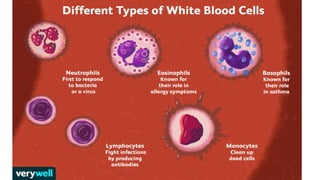
CELL NAME FUNCTION ADAPTATION
white
bood
cell
• Plays an
important
role in the
immune
system
• Irregular
shape
• Can
produce
antibodies
and
antitoxins
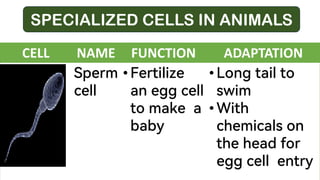
SPECIALIZED CELLS IN ANIMALS
CELL NAME FUNCTION ADAPTATION
Sperm
cell
• Fertilize
an egg cell
to make a
baby
• Long tail to
swim
• With
chemicals on
the head for
egg cell entry
SPECIALIZED CELLS IN ANIMALS
CELL NAME FUNCTION ADAPTATION
egg
cell
• Carries
genetic
material
• Large and
bulky
SPECIALIZED CELLS IN ANIMALS
CELL NAME FUNCTION ADAPTATION
nerve
cell or
neuron
• Carry
nerve
impulses
through
the body
• Long, thin
axon
• Branching
dendrites
• myelinated
SPECIALIZED CELLS IN ANIMALS
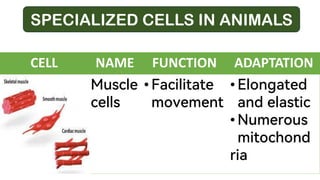
CELL NAME FUNCTION ADAPTATION
Muscle
cells
• Facilitate
movement
• Elongated
and elastic
• Numerous
mitochond
ria
SPECIALIZED CELLS IN ANIMALS
SPECIALIZED CELLS IN PLANTS
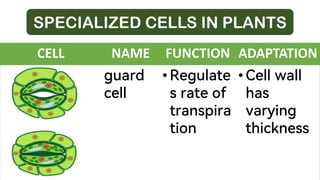
CELL NAME FUNCTION ADAPTATION
guard
cell
• Regulate
s rate of
transpira
tion
• Cell wall
has
varying
thickness
SPECIALIZED CELLS IN PLANTS
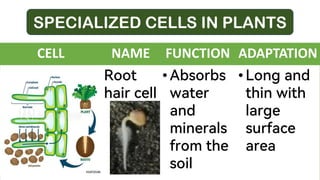
CELL NAME FUNCTION ADAPTATION
Root
hair cell
• Absorbs
water
and
minerals
from the
soil
• Long and
thin with
large
surface
area
SPECIALIZED CELLS IN PLANTS
CELL NAME FUNCTION ADAPTATION
Photosy
nthetic
cell
• Produces
food
through the
process of
photosynth
esis
• Contains
numerous
chloroplas
ts
SPECIALIZED CELLS IN PLANTS
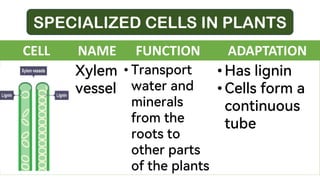
CELL NAME FUNCTION ADAPTATION
Xylem
vessel
• Transport
water and
minerals
from the
roots to
other parts
of the plants
• Has lignin
• Cells form a
continuous
tube
SPECIALIZED CELLS IN PLANTS
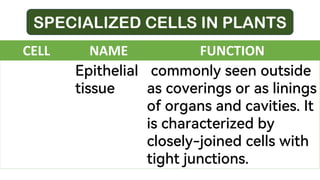
CELL NAME FUNCTION
Epithelial
tissue
commonly seen outside
as coverings or as linings
of organs and cavities. It
is characterized by
closely-joined cells with
tight junctions.
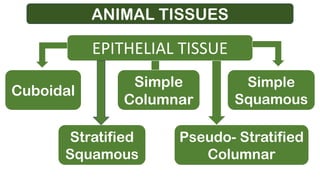
ANIMAL TISSUES
EPITHELIAL TISSUE
Cuboidal
Simple
Columnar
Simple
Squamous
Stratified
Squamous
Pseudo- Stratified
Columnar
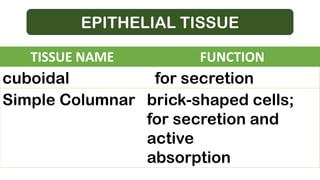
EPITHELIAL TISSUE
TISSUE NAME FUNCTION
cuboidal for secretion
Simple Columnar brick-shaped cells;
for secretion and
active
absorption
EPITHELIAL TISSUE
TISSUE NAME FUNCTION
Simple
Squamous
plate-like cells; for
exchange of material
through diffusion
Stratified
Squamous
multilayered and
regenerates quickly for
protection
EPITHELIAL TISSUE
TISSUE NAME FUNCTION
Pseudo-
Stratified
Columnar
for lining of respiratory
tract; usually lined with
cilia (i.e., a type of cell
modification that sweeps
the mucus)
ANIMAL TISSUES
CONNECTIVE TISSUE
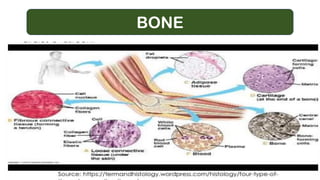
Blood Bone
Connective
Tissue Proper
cartilage
EPITHELIAL TISSUE
TISSUE NAME FUNCTION
Blood made up of plasma:
contains water, salts and dissolve
proteins, erythrocytes that carry
oxygen (RBC), leukocytes for
defense (WBC), and platelets for
blood
clotting.
EPITHELIAL TISSUE
TISSUE NAME FUNCTION
Connective
Tissue
Proper
(CTP)
made up of loose
connective tissue that is found in
the skin and fibrous connective
tissue that is made up of
collagenous fibers found in
tendons and
ligaments.
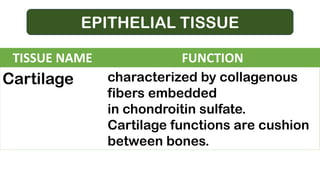
EPITHELIAL TISSUE
TISSUE NAME FUNCTION
Cartilage characterized by collagenous
fibers embedded
in chondroitin sulfate.
Cartilage functions are cushion
between bones.
EPITHELIAL TISSUE
TISSUE NAME FUNCTION
Bone mineralized connective tissue
made by bone-forming
cells called osteoblasts which
deposits collagen
BONE
EPITHELIAL TISSUE
TISSUE NAME FUNCTION
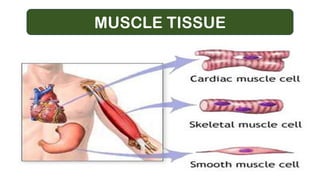
Muscle
Tissue
These tissues are composed of
long cells called muscle fibers
that allow the body to move
voluntary or involuntary. This
tissue is responsible for
movements in our body
MUSCLE TISSUE
TISSUE NAME FUNCTION
A. Skeletal striated: voluntary movements,
attached to the
skeleton
B. Cardiac involuntary, located in the walls
of the heart
MUSCLE TISSUE
TISSUE NAME FUNCTION
A. Smooth not striated; involuntary, located
in walls of hollow visceral
organs
MUSCLE TISSUE
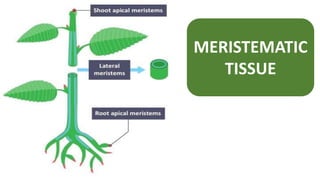
MERISTEMATIC TISSUE
The cells differentiate into
new tissue of
the plant. Meristematic tissue
is found at the meristems of
plants
MERISTEMATIC TISSUE
Apical
meristem
Lateral
meristem
are located at the growing points at the tips
of roots and stems and results in an increase
in the length of these structures.
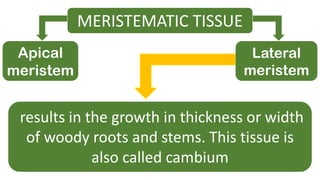
MERISTEMATIC TISSUE
Apical
meristem
Lateral
meristem
results in the growth in thickness or width
of woody roots and stems. This tissue is
also called cambium
MERISTEMATIC
TISSUE
PERMANENT TISSUE
Epidermal
tissue
Phloem
tissue
Guard
cells
Vascular
tissue
Root
Hair
cells
xylem
tissue
PERMANENT TISSUE
Epidermal
tissue
This is the outermost layer of cells
that covers the roots, stems, and
leaves.
PERMANENT TISSUE
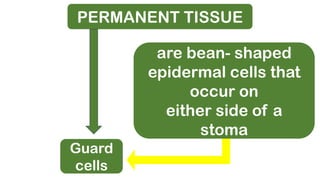
Guard
cells
are bean- shaped
epidermal cells that
occur on
either side of a
stoma
PERMANENT TISSUE
Root
Hair
cells
The hair
functions to increase
the surface area of the
root to maximize the
uptake of water and
nutrients.
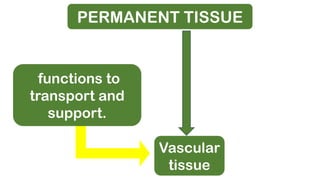
PERMANENT TISSUE
Vascular
tissue
functions to
transport and
support.
PERMANENT TISSUE
xylem
tissue
transport water and
mineral salts from the
ground water through
the roots to the stems
and leaves.
CELL MODIFICATION
Adaptations or changes acquired by
the cell after cell division that aids
the cell in various beneficial ways
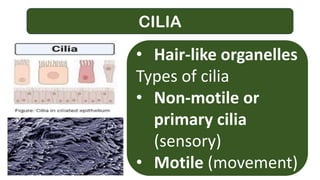
CILIA
• Hair-like organelles
Types of cilia
• Non-motile or
primary cilia
(sensory)
• Motile (movement)
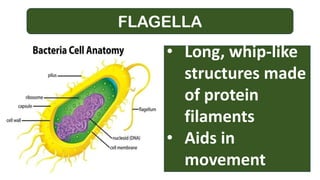
FLAGELLA
• Long, whip-like
structures made
of protein
filaments
• Aids in
movement
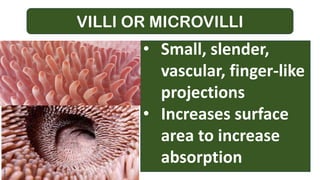
VILLI OR MICROVILLI
• Small, slender,
vascular, finger-like
projections
• Increases surface
area to increase
absorption
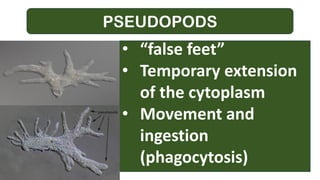
PSEUDOPODS
• “false feet”
• Temporary extension
of the cytoplasm
• Movement and
ingestion
(phagocytosis)
GENBIO students copy CELL SPECIALIZATION & MODIFICATION.pdf

GENBIO students copy CELL SPECIALIZATION & MODIFICATION.pdf