Date
NON-VERBAL
COMMUNICATION
Date
OBJECTIVES:
• Explain the relationship of non-verbal communication
and verbal communication;
• Describe why non-verbal communication is important in
any speech situation;
• Apply non-verbal cues effectively and appropriately in
specific situations;
• Practice effective non-verbal communication skills; and
• Reflect on a learning experience.
Date
IMPORTANCE OF NON-VERBAL
COMMUNICATION
✤It enhances and emphasizes the message of your
speech.
✤It can communicate all feelings, attitudes, and
perceptions as well as express anything without
saying a word.
✤It can sustain the attention of listeners and keep
them engaged in the speech.
✤It reflects what type of speaker you are.
Date
IMPORTANCE OF NON-VERBAL
COMMUNICATION
✤It makes you more dynamic and animated in
your delivery.
✤It serves as a channel to release tensions and
nervousness.
✤It helps you make your speech more dramatic.
✤It can build connections with listeners.
✤ It makes you credible as a speaker.
Date
ASPECTS OF
NON-VERBAL
COMMUNICATION
Date
ASPECTS OF NON-VERBAL COMMUNICATION
✤Refers to your body movements which include
eye contact, facial expressions, posture &
gestures,
1. BODY LANGUAGE
Date
ASPECTS OF NON-VERBAL
COMMUNICATION
• USING EYE CONTACT
✤Be sure that you master your speech.
✤Look at them straight in the eyes.
✤Use your eyes in identifying listener’s
behavior.
✤Glance smoothly at your left, center, and
right.
✤Control movements of your eyes.
Date
ASPECTS OF NON-VERBAL
COMMUNICATION
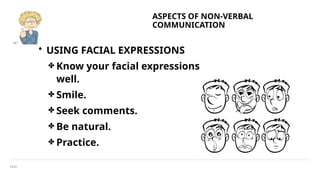
• USING FACIAL EXPRESSIONS
✤ Know your facial expressions
well.
✤ Smile.
✤ Seek comments.
✤ Be natural.
✤ Practice.
Date
ASPECTS OF NON-VERBAL
COMMUNICATION
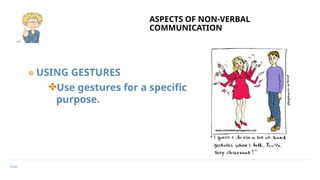
๏ USING GESTURES
✤Use gestures for a specific
purpose.
Date
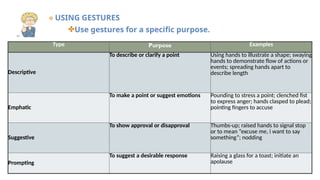
๏ USING GESTURES
✤Use gestures for a specific purpose.
Type Purpose Examples
Descriptive
To describe or clarify a point Using hands to illustrate a shape; swaying
hands to demonstrate flow of actions or
events; spreading hands apart to
describe length
Emphatic
To make a point or suggest emotions Pounding to stress a point; clenched fist
to express anger; hands clasped to plead;
pointing fingers to accuse
Suggestive
To show approval or disapproval Thumbs-up; raised hands to signal stop
or to mean “excuse me, i want to say
something”; nodding
Prompting
To suggest a desirable response Raising a glass for a toast; initiate an
apolause
Date
ASPECTS OF NON-VERBAL
COMMUNICATION
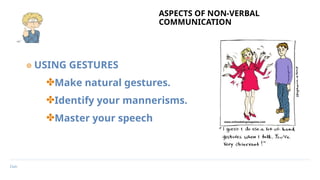
๏ USING GESTURES
✤Make natural gestures.
✤Identify your mannerisms.
✤Master your speech
Date
ASPECTS OF NON-VERBAL COMMUNICATION
๏ USING GESTURES
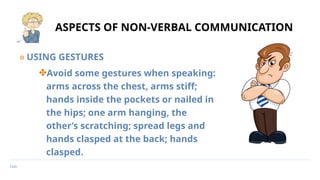
✤Avoid some gestures when speaking:
arms across the chest, arms stiff;
hands inside the pockets or nailed in
the hips; one arm hanging, the
other’s scratching; spread legs and
hands clasped at the back; hands
clasped.
Date
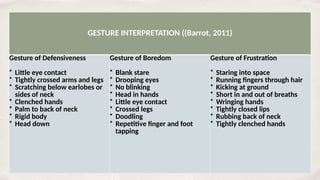
GESTURE INTERPRETATION ((Barrot, 2011)
Gesture of Defensiveness
* Little eye contact
* Tightly crossed arms and legs
* Scratching below earlobes or
sides of neck
* Clenched hands
* Palm to back of neck
* Rigid body
* Head down
Gesture of Boredom
* Blank stare
* Drooping eyes
* No blinking
* Head in hands
* Little eye contact
* Crossed legs
* Doodling
* Repetitive finger and foot
tapping
Gesture of Frustration
* Staring into space
* Running fingers through hair
* Kicking at ground
* Short in and out of breaths
* Wringing hands
* Tightly closed lips
* Rubbing back of neck
* Tightly clenched hands
Date
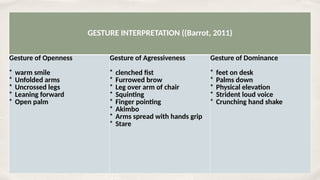
GESTURE INTERPRETATION ((Barrot, 2011)
Gesture of Openness
* warm smile
* Unfolded arms
* Uncrossed legs
* Leaning forward
* Open palm
Gesture of Agressiveness
* clenched fist
* Furrowed brow
* Leg over arm of chair
* Squinting
* Finger pointing
* Akimbo
* Arms spread with hands grip
* Stare
Gesture of Dominance
* feet on desk
* Palms down
* Physical elevation
* Strident loud voice
* Crunching hand shake
Date
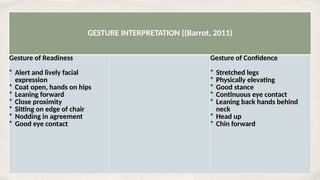
GESTURE INTERPRETATION ((Barrot, 2011)
Gesture of Readiness
* Alert and lively facial
expression
* Coat open, hands on hips
* Leaning forward
* Close proximity
* Sitting on edge of chair
* Nodding in agreement
* Good eye contact
Gesture of Confidence
* Stretched legs
* Physically elevating
* Good stance
* Continuous eye contact
* Leaning back hands behind
neck
* Head up
* Chin forward
Date
ASPECTS OF NON-VERBAL
COMMUNICATION
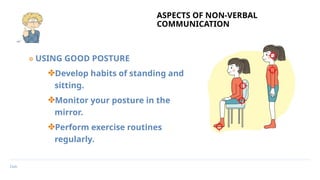
๏ USING GOOD POSTURE
✤Develop habits of standing and
sitting.
✤Monitor your posture in the
mirror.
✤Perform exercise routines
regularly.
Date
ASPECTS OF NON-VERBAL COMMUNICATION
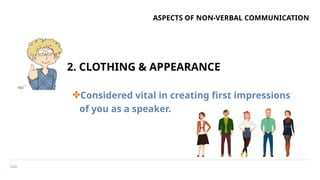
✤Considered vital in creating first impressions
of you as a speaker.
2. CLOTHING & APPEARANCE
Date
ASPECTS OF NON-VERBAL
COMMUNICATION
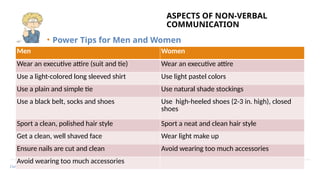
Men Women
Wear an executive attire (suit and tie) Wear an executive attire
Use a light-colored long sleeved shirt Use light pastel colors
Use a plain and simple tie Use natural shade stockings
Use a black belt, socks and shoes Use high-heeled shoes (2-3 in. high), closed
shoes
Sport a clean, polished hair style Sport a neat and clean hair style
Get a clean, well shaved face Wear light make up
Ensure nails are cut and clean Avoid wearing too much accessories
Avoid wearing too much accessories
• Power Tips for Men and Women
Date
ASPECTS OF NON-VERBAL COMMUNICATION
✤Include volume, rate, tone and pitch.
3. VOCAL ELEMENTS
Date
ASPECTS OF NON-VERBAL
COMMUNICATION
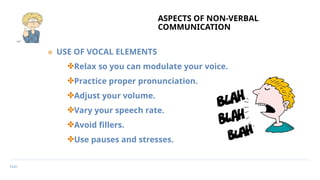
๏ USE OF VOCAL ELEMENTS
✤Relax so you can modulate your voice.
✤Practice proper pronunciation.
✤Adjust your volume.
✤Vary your speech rate.
✤Avoid fillers.
✤Use pauses and stresses.
Date
ASPECTS OF NON-VERBAL COMMUNICATION
✤The space and distance between the speaker
and the audience.
4. PROXEMICS
Date
ASPECTS OF NON-VERBAL COMMUNICATION
✤Reflect people’s personality and reveal
character.
5. COLORS
Date
ASPECTS OF NON-VERBAL COMMUNICATION
✤Is a physical contact. Is used to communicate
love, care, or comfort.
6. TOUCH
GEDCORE 03 Module 2 Topic 3 Non-Verbal Communication.pptx

GEDCORE 03 Module 2 Topic 3 Non-Verbal Communication.pptx

  • 1.
  • 2.
    Date OBJECTIVES: • Explain therelationship of non-verbal communication and verbal communication; • Describe why non-verbal communication is important in any speech situation; • Apply non-verbal cues effectively and appropriately in specific situations; • Practice effective non-verbal communication skills; and • Reflect on a learning experience.
  • 5.
    Date IMPORTANCE OF NON-VERBAL COMMUNICATION ✤Itenhances and emphasizes the message of your speech. ✤It can communicate all feelings, attitudes, and perceptions as well as express anything without saying a word. ✤It can sustain the attention of listeners and keep them engaged in the speech. ✤It reflects what type of speaker you are.
  • 6.
    Date IMPORTANCE OF NON-VERBAL COMMUNICATION ✤Itmakes you more dynamic and animated in your delivery. ✤It serves as a channel to release tensions and nervousness. ✤It helps you make your speech more dramatic. ✤It can build connections with listeners. ✤ It makes you credible as a speaker.
  • 7.
  • 8.
    Date ASPECTS OF NON-VERBALCOMMUNICATION ✤Refers to your body movements which include eye contact, facial expressions, posture & gestures, 1. BODY LANGUAGE
  • 9.
    Date ASPECTS OF NON-VERBAL COMMUNICATION •USING EYE CONTACT ✤Be sure that you master your speech. ✤Look at them straight in the eyes. ✤Use your eyes in identifying listener’s behavior. ✤Glance smoothly at your left, center, and right. ✤Control movements of your eyes.
  • 10.
    Date ASPECTS OF NON-VERBAL COMMUNICATION •USING FACIAL EXPRESSIONS ✤ Know your facial expressions well. ✤ Smile. ✤ Seek comments. ✤ Be natural. ✤ Practice.
  • 11.
    Date ASPECTS OF NON-VERBAL COMMUNICATION ๏USING GESTURES ✤Use gestures for a specific purpose.
  • 12.
    Date ๏ USING GESTURES ✤Usegestures for a specific purpose. Type Purpose Examples Descriptive To describe or clarify a point Using hands to illustrate a shape; swaying hands to demonstrate flow of actions or events; spreading hands apart to describe length Emphatic To make a point or suggest emotions Pounding to stress a point; clenched fist to express anger; hands clasped to plead; pointing fingers to accuse Suggestive To show approval or disapproval Thumbs-up; raised hands to signal stop or to mean “excuse me, i want to say something”; nodding Prompting To suggest a desirable response Raising a glass for a toast; initiate an apolause
  • 13.
    Date ASPECTS OF NON-VERBAL COMMUNICATION ๏USING GESTURES ✤Make natural gestures. ✤Identify your mannerisms. ✤Master your speech
  • 14.
    Date ASPECTS OF NON-VERBALCOMMUNICATION ๏ USING GESTURES ✤Avoid some gestures when speaking: arms across the chest, arms stiff; hands inside the pockets or nailed in the hips; one arm hanging, the other’s scratching; spread legs and hands clasped at the back; hands clasped.
  • 15.
    Date GESTURE INTERPRETATION ((Barrot,2011) Gesture of Defensiveness * Little eye contact * Tightly crossed arms and legs * Scratching below earlobes or sides of neck * Clenched hands * Palm to back of neck * Rigid body * Head down Gesture of Boredom * Blank stare * Drooping eyes * No blinking * Head in hands * Little eye contact * Crossed legs * Doodling * Repetitive finger and foot tapping Gesture of Frustration * Staring into space * Running fingers through hair * Kicking at ground * Short in and out of breaths * Wringing hands * Tightly closed lips * Rubbing back of neck * Tightly clenched hands
  • 16.
    Date GESTURE INTERPRETATION ((Barrot,2011) Gesture of Openness * warm smile * Unfolded arms * Uncrossed legs * Leaning forward * Open palm Gesture of Agressiveness * clenched fist * Furrowed brow * Leg over arm of chair * Squinting * Finger pointing * Akimbo * Arms spread with hands grip * Stare Gesture of Dominance * feet on desk * Palms down * Physical elevation * Strident loud voice * Crunching hand shake
  • 17.
    Date GESTURE INTERPRETATION ((Barrot,2011) Gesture of Readiness * Alert and lively facial expression * Coat open, hands on hips * Leaning forward * Close proximity * Sitting on edge of chair * Nodding in agreement * Good eye contact Gesture of Confidence * Stretched legs * Physically elevating * Good stance * Continuous eye contact * Leaning back hands behind neck * Head up * Chin forward
  • 18.
    Date ASPECTS OF NON-VERBAL COMMUNICATION ๏USING GOOD POSTURE ✤Develop habits of standing and sitting. ✤Monitor your posture in the mirror. ✤Perform exercise routines regularly.
  • 19.
    Date ASPECTS OF NON-VERBALCOMMUNICATION ✤Considered vital in creating first impressions of you as a speaker. 2. CLOTHING & APPEARANCE
  • 20.
    Date ASPECTS OF NON-VERBAL COMMUNICATION MenWomen Wear an executive attire (suit and tie) Wear an executive attire Use a light-colored long sleeved shirt Use light pastel colors Use a plain and simple tie Use natural shade stockings Use a black belt, socks and shoes Use high-heeled shoes (2-3 in. high), closed shoes Sport a clean, polished hair style Sport a neat and clean hair style Get a clean, well shaved face Wear light make up Ensure nails are cut and clean Avoid wearing too much accessories Avoid wearing too much accessories • Power Tips for Men and Women
  • 21.
    Date ASPECTS OF NON-VERBALCOMMUNICATION ✤Include volume, rate, tone and pitch. 3. VOCAL ELEMENTS
  • 22.
    Date ASPECTS OF NON-VERBAL COMMUNICATION ๏USE OF VOCAL ELEMENTS ✤Relax so you can modulate your voice. ✤Practice proper pronunciation. ✤Adjust your volume. ✤Vary your speech rate. ✤Avoid fillers. ✤Use pauses and stresses.
  • 23.
    Date ASPECTS OF NON-VERBALCOMMUNICATION ✤The space and distance between the speaker and the audience. 4. PROXEMICS
  • 24.
    Date ASPECTS OF NON-VERBALCOMMUNICATION ✤Reflect people’s personality and reveal character. 5. COLORS
  • 25.
    Date ASPECTS OF NON-VERBALCOMMUNICATION ✤Is a physical contact. Is used to communicate love, care, or comfort. 6. TOUCH

Editor's Notes

  • #8 It is important to use eye contact ; your listeners can detect how confident you are or how interested you are to talk to them. Helps you establish and maintain eye contact. Gets the attention of your listener’s There may be some who show acts of boredom, inattentiveness, or confusion. Adjust your speech delivery Some speakers use W-X-M shape glance. Do not look up or down.
  • #9 It is important to use eye contact ; your listeners can detect how confident you are or how interested you are to talk to them. Helps you establish and maintain eye contact. Gets the attention of your listener’s There may be some who show acts of boredom, inattentiveness, or confusion. Adjust your speech delivery Some speakers use W-X-M shape glance. Do not look up or down.
  • #10 Your tools to express or communicate your emotions through your eyes, eye bows, lips, ear, tongue, and nose. 1. By looking at the mirror, see how you show happiness, sadness, fear, surprise, anger, and disgust. 2. It is the best facial expression because, generally, it conveys politeness, disguises real feelings, and shows affection. 3. Consult from your family or friends regarding your facial expressions. 4. Do not exaggerate. Exaggerating facial expressions may be interpreted as fake. 5. Do the “a-e-i-o-u” technique when you practice
  • #11 Include movements of your hands, legs, and other body parts that carry meanings. descriptive-using hands to illustrate shape; swaying hands to demonstrate flow of actions; spreading hands to describe length emphatic-pounding to stress a point; clenched fist to express anger; hands clasped to plead; pointing to accuse. suggestive-thumbs up; raised hands to signal stop or excuse; nodding. prompting- raising a glass; initiate an applause. 2. Never exaggerate and avoid too many gestures especially in professional speaking. 3. Practice how to avoid or control them when you speak. 4. Your gestures will emerge naturally and spontaneously at some point. 5. Arms across the chest, arms stiff; hands inside the pocket or nailed in the hips; scratching; hands clasped.
  • #12 Include movements of your hands, legs, and other body parts that carry meanings. descriptive-using hands to illustrate shape; swaying hands to demonstrate flow of actions; spreading hands to describe length emphatic-pounding to stress a point; clenched fist to express anger; hands clasped to plead; pointing to accuse. suggestive-thumbs up; raised hands to signal stop or excuse; nodding. prompting- raising a glass; initiate an applause. 2. Never exaggerate and avoid too many gestures especially in professional speaking. 3. Practice how to avoid or control them when you speak. 4. Your gestures will emerge naturally and spontaneously at some point. 5. Arms across the chest, arms stiff; hands inside the pocket or nailed in the hips; scratching; hands clasped.
  • #13 Include movements of your hands, legs, and other body parts that carry meanings. descriptive-using hands to illustrate shape; swaying hands to demonstrate flow of actions; spreading hands to describe length emphatic-pounding to stress a point; clenched fist to express anger; hands clasped to plead; pointing to accuse. suggestive-thumbs up; raised hands to signal stop or excuse; nodding. prompting- raising a glass; initiate an applause. 2. Never exaggerate and avoid too many gestures especially in professional speaking. 3. Practice how to avoid or control them when you speak. 4. Your gestures will emerge naturally and spontaneously at some point. 5. Arms across the chest, arms stiff; hands inside the pocket or nailed in the hips; scratching; hands clasped.
  • #14 Include movements of your hands, legs, and other body parts that carry meanings. descriptive-using hands to illustrate shape; swaying hands to demonstrate flow of actions; spreading hands to describe length emphatic-pounding to stress a point; clenched fist to express anger; hands clasped to plead; pointing to accuse. suggestive-thumbs up; raised hands to signal stop or excuse; nodding. prompting- raising a glass; initiate an applause. 2. Never exaggerate and avoid too many gestures especially in professional speaking. 3. Practice how to avoid or control them when you speak. 4. Your gestures will emerge naturally and spontaneously at some point. 5. Arms across the chest, arms stiff; hands inside the pocket or nailed in the hips; scratching; hands clasped.
  • #18 The position of your body either when you stand or when you sit. It is very important because it shows confidence and elicits positive impression from your audience. 1. Make sure that you stand tall with chest out and chin up.
  • #19 It is important to use eye contact ; your listeners can detect how confident you are or how interested you are to talk to them. Helps you establish and maintain eye contact. Gets the attention of your listener’s There may be some who show acts of boredom, inattentiveness, or confusion. Adjust your speech delivery Some speakers use W-X-M shape glance. Do not look up or down.
  • #21 Volume: is the loudness or softness of the voice Rate is the speed of delivery Tone is the voice quality Pitch is the highness or lowness of the voice