THE
ILIAD
LOVE FRIENDSHIP HONOR
RIVALRY FREE WILL FATE
HOMER
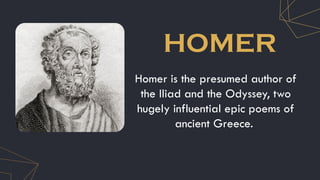
Homer is the presumed author of
the Iliad and the Odyssey, two
hugely influential epic poems of
ancient Greece.
THE ILIAD
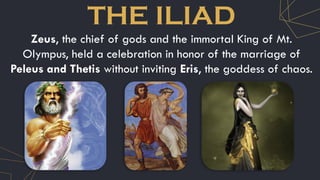
Zeus, the chief of gods and the immortal King of Mt.
Olympus, held a celebration in honor of the marriage of
Peleus and Thetis without inviting Eris, the goddess of chaos.
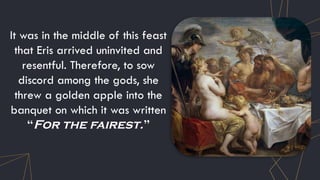
It was in the middle of this feast
that Eris arrived uninvited and
resentful. Therefore, to sow
discord among the gods, she
threw a golden apple into the
banquet on which it was written
“For the fairest.”
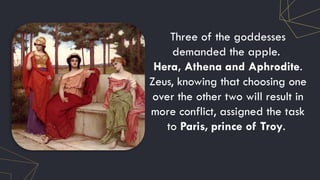
Three of the goddesses
demanded the apple.
Hera, Athena and Aphrodite.
Zeus, knowing that choosing one
over the other two will result in
more conflict, assigned the task
to Paris, prince of Troy.
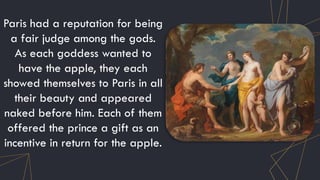
Paris had a reputation for being
a fair judge among the gods.
As each goddess wanted to
have the apple, they each
showed themselves to Paris in all
their beauty and appeared
naked before him. Each of them
offered the prince a gift as an
incentive in return for the apple.
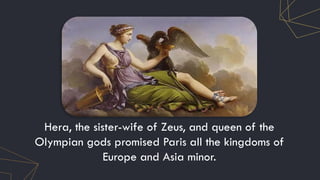
Hera, the sister-wife of Zeus, and queen of the
Olympian gods promised Paris all the kingdoms of
Europe and Asia minor.
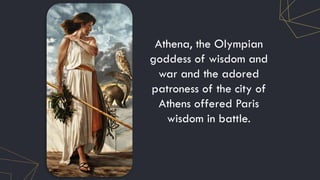
Athena, the Olympian
goddess of wisdom and
war and the adored
patroness of the city of
Athens offered Paris
wisdom in battle.
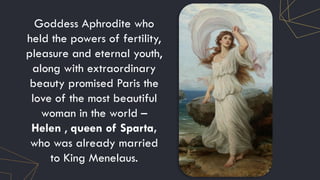
Goddess Aphrodite who
held the powers of fertility,
pleasure and eternal youth,
along with extraordinary
beauty promised Paris the
love of the most beautiful
woman in the world –
Helen , queen of Sparta,
who was already married
to King Menelaus.
Who would you
give the apple to if
you were Paris?
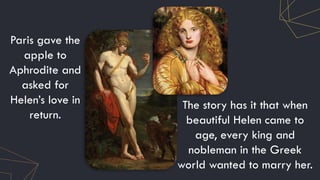
Paris gave the
apple to
Aphrodite and
asked for
Helen’s love in
return.
The story has it that when
beautiful Helen came to
age, every king and
nobleman in the Greek
world wanted to marry her.
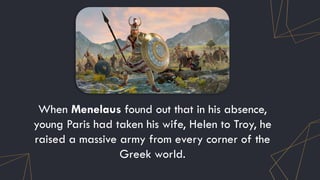
When Menelaus found out that in his absence,
young Paris had taken his wife, Helen to Troy, he
raised a massive army from every corner of the
Greek world.
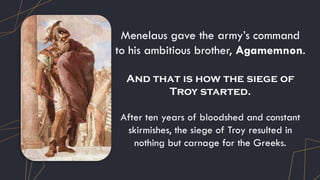
Menelaus gave the army’s command
to his ambitious brother, Agamemnon.
And that is how the siege of
Troy started.
After ten years of bloodshed and constant
skirmishes, the siege of Troy resulted in
nothing but carnage for the Greeks.
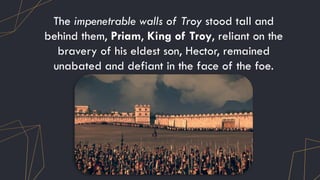
The impenetrable walls of Troy stood tall and
behind them, Priam, King of Troy, reliant on the
bravery of his eldest son, Hector, remained
unabated and defiant in the face of the foe.
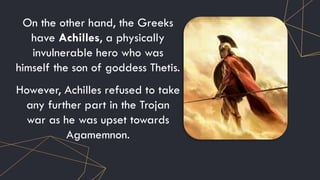
On the other hand, the Greeks
have Achilles, a physically
invulnerable hero who was
himself the son of goddess Thetis.
However, Achilles refused to take
any further part in the Trojan
war as he was upset towards
Agamemnon.
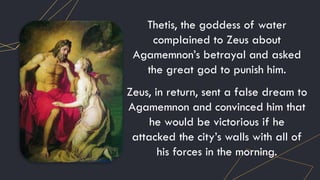
Thetis, the goddess of water
complained to Zeus about
Agamemnon’s betrayal and asked
the great god to punish him.
Zeus, in return, sent a false dream to
Agamemnon and convinced him that
he would be victorious if he
attacked the city’s walls with all of
his forces in the morning.
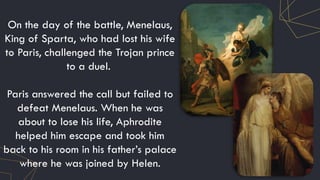
On the day of the battle, Menelaus,
King of Sparta, who had lost his wife
to Paris, challenged the Trojan prince
to a duel.
Paris answered the call but failed to
defeat Menelaus. When he was
about to lose his life, Aphrodite
helped him escape and took him
back to his room in his father’s palace
where he was joined by Helen.
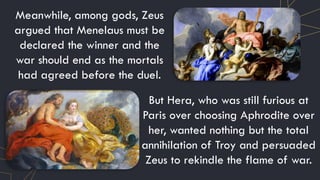
Meanwhile, among gods, Zeus
argued that Menelaus must be
declared the winner and the
war should end as the mortals
had agreed before the duel.
But Hera, who was still furious at
Paris over choosing Aphrodite over
her, wanted nothing but the total
annihilation of Troy and persuaded
Zeus to rekindle the flame of war.

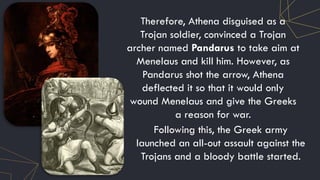
Therefore, Athena disguised as a
Trojan soldier, convinced a Trojan
archer named Pandarus to take aim at
Menelaus and kill him. However, as
Pandarus shot the arrow, Athena
deflected it so that it would only
wound Menelaus and give the Greeks
a reason for war.
Following this, the Greek army
launched an all-out assault against the
Trojans and a bloody battle started.
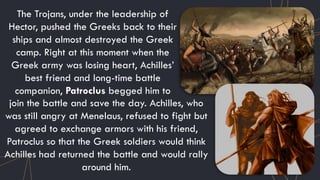
The Trojans, under the leadership of
Hector, pushed the Greeks back to their
ships and almost destroyed the Greek
camp. Right at this moment when the
Greek army was losing heart, Achilles’
best friend and long-time battle
companion, Patroclus begged him to
join the battle and save the day. Achilles, who
was still angry at Menelaus, refused to fight but
agreed to exchange armors with his friend,
Patroclus so that the Greek soldiers would think
Achilles had returned the battle and would rally
around him.
With the arrival of Patroclus in Achilles'
disguise, the turn of events quickly
changed in favor of the Greeks. The
Trojans retreated to the city and Patroclus
pushed forward against the enemy and
killed everyone in his way including the
mortal son of Zeus, Sarpedon.
Apollo first convinced Hector to charge the enemy then he appeared
behind Patroclus and wounded him. When Hector arrived, Patroclus was
on his knees, defeated and ready to accept his destiny. Hector humiliated
the fallen man and finished him off only to hear Patroclus foretelling
Hector's bitter end with his last breath.
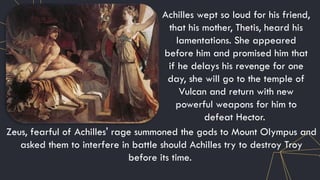
Achilles wept so loud for his friend,
that his mother, Thetis, heard his
lamentations. She appeared
before him and promised him that
if he delays his revenge for one
day, she will go to the temple of
Vulcan and return with new
powerful weapons for him to
defeat Hector.
Zeus, fearful of Achilles' rage summoned the gods to Mount Olympus and
asked them to interfere in battle should Achilles try to destroy Troy
before its time.
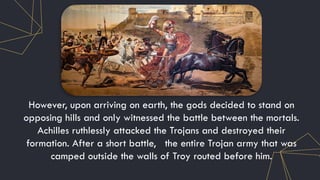
However, upon arriving on earth, the gods decided to stand on
opposing hills and only witnessed the battle between the mortals.
Achilles ruthlessly attacked the Trojans and destroyed their
formation. After a short battle, the entire Trojan army that was
camped outside the walls of Troy routed before him.
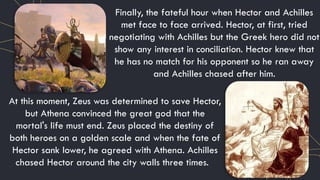
Finally, the fateful hour when Hector and Achilles
met face to face arrived. Hector, at first, tried
negotiating with Achilles but the Greek hero did not
show any interest in conciliation. Hector knew that
he has no match for his opponent so he ran away
and Achilles chased after him.
At this moment, Zeus was determined to save Hector,
but Athena convinced the great god that the
mortal's life must end. Zeus placed the destiny of
both heroes on a golden scale and when the fate of
Hector sank lower, he agreed with Athena. Achilles
chased Hector around the city walls three times.
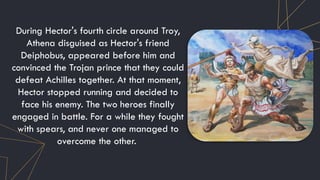
During Hector's fourth circle around Troy,
Athena disguised as Hector's friend
Deiphobus, appeared before him and
convinced the Trojan prince that they could
defeat Achilles together. At that moment,
Hector stopped running and decided to
face his enemy. The two heroes finally
engaged in battle. For a while they fought
with spears, and never one managed to
overcome the other.
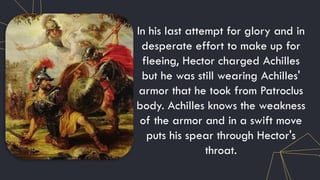
In his last attempt for glory and in
desperate effort to make up for
fleeing, Hector charged Achilles
but he was still wearing Achilles'
armor that he took from Patroclus
body. Achilles knows the weakness
of the armor and in a swift move
puts his spear through Hector's
throat.
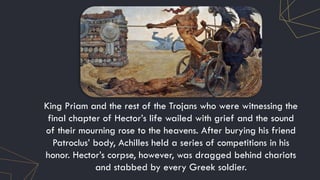
King Priam and the rest of the Trojans who were witnessing the
final chapter of Hector’s life wailed with grief and the sound
of their mourning rose to the heavens. After burying his friend
Patroclus’ body, Achilles held a series of competitions in his
honor. Hector’s corpse, however, was dragged behind chariots
and stabbed by every Greek soldier.
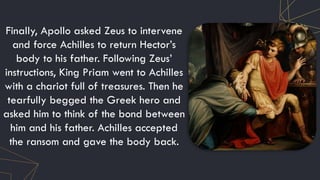
Finally, Apollo asked Zeus to intervene
and force Achilles to return Hector’s
body to his father. Following Zeus’
instructions, King Priam went to Achilles
with a chariot full of treasures. Then he
tearfully begged the Greek hero and
asked him to think of the bond between
him and his father. Achilles accepted
the ransom and gave the body back.
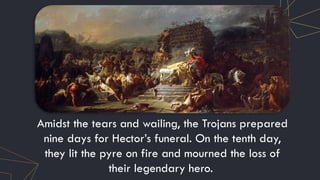
Amidst the tears and wailing, the Trojans prepared
nine days for Hector’s funeral. On the tenth day,
they lit the pyre on fire and mourned the loss of
their legendary hero.
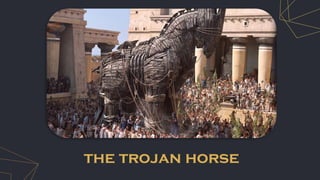
the trojan horse
EL                    112 The Iliad.pptx

EL 112 The Iliad.pptx

  • 1.
  • 2.
  • 3.
    HOMER Homer is thepresumed author of the Iliad and the Odyssey, two hugely influential epic poems of ancient Greece.
  • 4.
    THE ILIAD Zeus, thechief of gods and the immortal King of Mt. Olympus, held a celebration in honor of the marriage of Peleus and Thetis without inviting Eris, the goddess of chaos.
  • 5.
    It was inthe middle of this feast that Eris arrived uninvited and resentful. Therefore, to sow discord among the gods, she threw a golden apple into the banquet on which it was written “For the fairest.”
  • 6.
    Three of thegoddesses demanded the apple. Hera, Athena and Aphrodite. Zeus, knowing that choosing one over the other two will result in more conflict, assigned the task to Paris, prince of Troy.
  • 7.
    Paris had areputation for being a fair judge among the gods. As each goddess wanted to have the apple, they each showed themselves to Paris in all their beauty and appeared naked before him. Each of them offered the prince a gift as an incentive in return for the apple.
  • 8.
    Hera, the sister-wifeof Zeus, and queen of the Olympian gods promised Paris all the kingdoms of Europe and Asia minor.
  • 9.
    Athena, the Olympian goddessof wisdom and war and the adored patroness of the city of Athens offered Paris wisdom in battle.
  • 10.
    Goddess Aphrodite who heldthe powers of fertility, pleasure and eternal youth, along with extraordinary beauty promised Paris the love of the most beautiful woman in the world – Helen , queen of Sparta, who was already married to King Menelaus.
  • 11.
    Who would you givethe apple to if you were Paris?
  • 12.
    Paris gave the appleto Aphrodite and asked for Helen’s love in return. The story has it that when beautiful Helen came to age, every king and nobleman in the Greek world wanted to marry her.
  • 13.
    When Menelaus foundout that in his absence, young Paris had taken his wife, Helen to Troy, he raised a massive army from every corner of the Greek world.
  • 14.
    Menelaus gave thearmy’s command to his ambitious brother, Agamemnon. And that is how the siege of Troy started. After ten years of bloodshed and constant skirmishes, the siege of Troy resulted in nothing but carnage for the Greeks.
  • 15.
    The impenetrable wallsof Troy stood tall and behind them, Priam, King of Troy, reliant on the bravery of his eldest son, Hector, remained unabated and defiant in the face of the foe.
  • 16.
    On the otherhand, the Greeks have Achilles, a physically invulnerable hero who was himself the son of goddess Thetis. However, Achilles refused to take any further part in the Trojan war as he was upset towards Agamemnon.
  • 17.
    Thetis, the goddessof water complained to Zeus about Agamemnon’s betrayal and asked the great god to punish him. Zeus, in return, sent a false dream to Agamemnon and convinced him that he would be victorious if he attacked the city’s walls with all of his forces in the morning.
  • 18.
    On the dayof the battle, Menelaus, King of Sparta, who had lost his wife to Paris, challenged the Trojan prince to a duel. Paris answered the call but failed to defeat Menelaus. When he was about to lose his life, Aphrodite helped him escape and took him back to his room in his father’s palace where he was joined by Helen.
  • 19.
    Meanwhile, among gods,Zeus argued that Menelaus must be declared the winner and the war should end as the mortals had agreed before the duel. But Hera, who was still furious at Paris over choosing Aphrodite over her, wanted nothing but the total annihilation of Troy and persuaded Zeus to rekindle the flame of war.
  • 20.
    Therefore, Athena disguisedas a Trojan soldier, convinced a Trojan archer named Pandarus to take aim at Menelaus and kill him. However, as Pandarus shot the arrow, Athena deflected it so that it would only wound Menelaus and give the Greeks a reason for war. Following this, the Greek army launched an all-out assault against the Trojans and a bloody battle started.
  • 21.
    The Trojans, underthe leadership of Hector, pushed the Greeks back to their ships and almost destroyed the Greek camp. Right at this moment when the Greek army was losing heart, Achilles’ best friend and long-time battle companion, Patroclus begged him to join the battle and save the day. Achilles, who was still angry at Menelaus, refused to fight but agreed to exchange armors with his friend, Patroclus so that the Greek soldiers would think Achilles had returned the battle and would rally around him.
  • 22.
    With the arrivalof Patroclus in Achilles' disguise, the turn of events quickly changed in favor of the Greeks. The Trojans retreated to the city and Patroclus pushed forward against the enemy and killed everyone in his way including the mortal son of Zeus, Sarpedon. Apollo first convinced Hector to charge the enemy then he appeared behind Patroclus and wounded him. When Hector arrived, Patroclus was on his knees, defeated and ready to accept his destiny. Hector humiliated the fallen man and finished him off only to hear Patroclus foretelling Hector's bitter end with his last breath.
  • 23.
    Achilles wept soloud for his friend, that his mother, Thetis, heard his lamentations. She appeared before him and promised him that if he delays his revenge for one day, she will go to the temple of Vulcan and return with new powerful weapons for him to defeat Hector. Zeus, fearful of Achilles' rage summoned the gods to Mount Olympus and asked them to interfere in battle should Achilles try to destroy Troy before its time.
  • 24.
    However, upon arrivingon earth, the gods decided to stand on opposing hills and only witnessed the battle between the mortals. Achilles ruthlessly attacked the Trojans and destroyed their formation. After a short battle, the entire Trojan army that was camped outside the walls of Troy routed before him.
  • 25.
    Finally, the fatefulhour when Hector and Achilles met face to face arrived. Hector, at first, tried negotiating with Achilles but the Greek hero did not show any interest in conciliation. Hector knew that he has no match for his opponent so he ran away and Achilles chased after him. At this moment, Zeus was determined to save Hector, but Athena convinced the great god that the mortal's life must end. Zeus placed the destiny of both heroes on a golden scale and when the fate of Hector sank lower, he agreed with Athena. Achilles chased Hector around the city walls three times.
  • 26.
    During Hector's fourthcircle around Troy, Athena disguised as Hector's friend Deiphobus, appeared before him and convinced the Trojan prince that they could defeat Achilles together. At that moment, Hector stopped running and decided to face his enemy. The two heroes finally engaged in battle. For a while they fought with spears, and never one managed to overcome the other.
  • 27.
    In his lastattempt for glory and in desperate effort to make up for fleeing, Hector charged Achilles but he was still wearing Achilles' armor that he took from Patroclus body. Achilles knows the weakness of the armor and in a swift move puts his spear through Hector's throat.
  • 28.
    King Priam andthe rest of the Trojans who were witnessing the final chapter of Hector’s life wailed with grief and the sound of their mourning rose to the heavens. After burying his friend Patroclus’ body, Achilles held a series of competitions in his honor. Hector’s corpse, however, was dragged behind chariots and stabbed by every Greek soldier.
  • 29.
    Finally, Apollo askedZeus to intervene and force Achilles to return Hector’s body to his father. Following Zeus’ instructions, King Priam went to Achilles with a chariot full of treasures. Then he tearfully begged the Greek hero and asked him to think of the bond between him and his father. Achilles accepted the ransom and gave the body back.
  • 30.
    Amidst the tearsand wailing, the Trojans prepared nine days for Hector’s funeral. On the tenth day, they lit the pyre on fire and mourned the loss of their legendary hero.
  • 31.