Examinations & Assessment Chief Directorate:
ASSESSMENT DIRECTORATE:
GEC PILOT PROJECT
GEC MARKING, QUALITY ASSURANCE AND MODERATION
PRESENTATION OUTLINE
Marking ICAT and National Common tests
1.Marking procedures
2.Moderation,QA and remarking
2.1 Provincial moderation system
2.2 Moderation principles
2.3 Pyramidal approach and levels of
moderation
2.4 Objectives of post-moderation
2.5 Moderation at school and district level
2.6 Moderation at Provincial level
2.7 Sampling of schools
2.8 Dates for moderation
MARKING of ICAT and COMMON TEST
MARKING
• Marking should uphold the principles of assessment i.e., validity, reliability and
fairness.
• Each subject and phase should be able to determine marking policy in their own
area.
• Marking should be conducted with the necessary professionalism, fairness and
dedication to promote the integrity and credibility of assessment system and
examinations.
• Marking inform learners on what they are doing well, their progress and motivate
them to improve their performance.
• It provides learners with acknowledgement of the work they have done.
• It should aim at promoting, advancing and helping learners to progress.
MARKING PROCEDURE - ICAT
• A marking guideline discussion among educators teaching the same subject
should be conducted prior to the marking process.(marking standardization
meeting)
• During the meeting, the educators will share understanding of marking criteria,
and awarding of marks should be clear and in line with marking policy of the
subject.
• Each script or LEP’s must receive the same due consideration and attention of
the educator and the marking guideline must be applied in a consistent manner
throughout the marking process.
• An excellent professional standard must be upheld within the marking of the
subject.
• During the marking process, the educator will be engaging with the learners,
setting expectations that learners will always act upon feedback.
• The educator should ensure that learners are marked equally and fairly against
the task.
MARKING PROCEDURE
Marking of written work will
involve more detailed
educator’s comments. The
comments should be
formative and constructive,
indicating strengths,
weaknesses and ways to
improve.
It is important for learners
to assimilate or digest the
feedback coming from the
marking process.
GENERAL RULES OF MARKING:
• A tick should constitute 1 mark.
• .The mark allocation for each question should be on the right-
hand side of the script.
• The total mark for each section should be written at the end of
each section.
• The overall total mark of the script should be written at the end
of the written script.
• The overall total mark should be transferred to the front page
of the script, signed and dated by the educator.
• Marks should be recorded in the mark sheet and transferred to
GEC MARKING
PROCEDURE IN
2024 – Common
tests
In cases where there is more than one teacher teaching
the subject at the school, the scripts should be exchanged
so that a teacher does not mark the scripts of his/her own
learners
Marking should be conducted at school, with the senior teacher or
Head of Department acting as an Internal Moderator. Only the final,
approved marking guideline must be used in the marking.
The PEDs are expected to host a similar Provincial Marking
Standardization Meeting with the district subject advisors of each sampled
subjects, in preparation for the marking and moderation to be undertaken
by the schools and district subject advisors. The district subject advisors
are in turn, expected to mediate the marking guidelines with their teachers
in their districts.
Two designated Subject officials per province will be required to
participate in the virtual marking standardization meeting which will
be hosted by the DBE.
MODERATION, QA and
REMARKING
(POST-MODERATION)
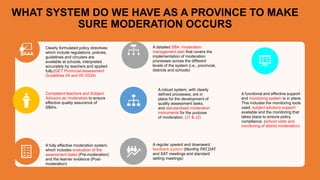
WHAT SYSTEM DO WE HAVE AS A PROVINCE TO MAKE
SURE MODERATION OCCURS
Clearly formulated policy directives
which include regulations, policies,
guidelines and circulars are
available at schools, interpreted
accurately by teachers and applied
fully.(GET Provincial Assessment
Guidelines 04 and 05 /2024)
A detailed SBA moderation
management plan that covers the
implementation of moderation
processes across the different
levels of the system (i.e., provincial,
districts and schools)
Competent teachers and Subject
Advisors as moderators to ensure
effective quality assurance of
SBA’s.
A robust system, with clearly
defined processes, are in
place for the development of
quality assessment tasks,
and standardized moderation
instruments for the purpose
of moderation. (J1 & J2)
A functional and effective support
and monitoring system is in place.
This includes the monitoring tools
used, subject advisory support
available and the monitoring that
takes place to ensure policy
compliance. (school visits and
monitoring of district moderation)
A fully effective moderation system,
which includes evaluation of the
assessment tasks (Pre-moderation)
and the learner evidence (Post-
moderation)
A regular upward and downward
feedback system (Monthly PAT,DAT
and SAT meetings and standard
setting meetings)
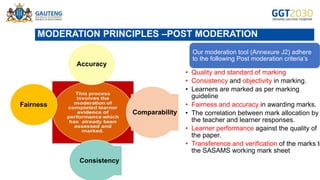
MODERATION PRINCIPLES –POST MODERATION
Accuracy
Comparability
Consistency
Fairness
Our moderation tool (Annexure J2) adhere
to the following Post moderation criteria’s
• Quality and standard of marking
• Consistency and objectivity in marking.
• Learners are marked as per marking
guideline
• Fairness and accuracy in awarding marks.
• The correlation between mark allocation by
the teacher and learner responses.
• Learner performance against the quality of
the paper.
• Transference and verification of the marks to
the SASAMS working mark sheet
OBJECTIVES OF POST-MODERATION
• It is the process to ensure that all learners are
assessed against the same standards when
being marked.
• It is also a process used to ensure consistency of
marking across each subject area and marks are
awarded appropriately and fairly.
• It is a form of feedback to markers (educators) to
help them align their marking standard with those
of other markers.
• It is a process where remarking should be
diagnostic in promoting questioning and explores
deep understanding of performance of learners. It
gives guidance for improvement based on their
understanding, misconception and/or learning
strategies used.
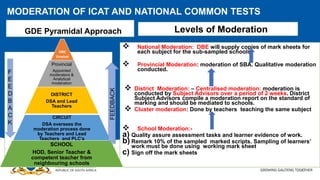
GDE Pyramidal Approach Levels of Moderation
 National Moderation: DBE will supply copies of mark sheets for
each subject for the sub-sampled schools
 Provincial Moderation: moderation of SBA. Qualitative moderation
conducted.
 District Moderation: – Centralised moderation: moderation is
conducted by Subject Advisors over a period of 2 weeks. District
Subject Advisors compile a moderation report on the standard of
marking and should be mediated to schools.
 Cluster moderation: Done by teachers teaching the same subject
 School Moderation:-
a) Quality assure assessment tasks and learner evidence of work.
b) Remark 10% of the sampled marked scripts. Sampling of learners’
work must be done using working mark sheet
c) Sign off the mark sheets
FEEDBACK
DBE
Umalusi
Provincial
Appointed
moderators &
Analytical
moderation
DISTRICT
DSA and Lead
Teachers
CIRCUIT
DSA oversees the
moderation process done
by Teachers and Lead
Teachers and PLC’s
SCHOOL
HOD, Senior Teacher &
competent teacher from
neighbouring schools
F
E
E
D
B
A
C
K
FEEDBACK
MODERATION OF ICAT AND NATIONAL COMMON TESTS
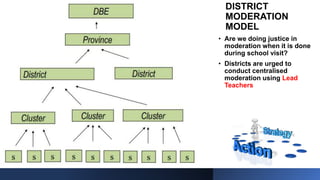
DISTRICT
MODERATION
MODEL
• Are we doing justice in
moderation when it is done
during school visit?
• Districts are urged to
conduct centralised
moderation using Lead
Teachers
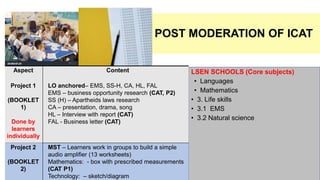
POST MODERATION OF ICAT
LSEN SCHOOLS (Core subjects)
• Languages
• Mathematics
• 3. Life skills
• 3.1 EMS
• 3.2 Natural science
Aspect Content
Project 1
(BOOKLET
1)
Done by
learners
individually
LO anchored– EMS, SS-H, CA, HL, FAL
EMS – business opportunity research (CAT, P2)
SS (H) – Apartheids laws research
CA – presentation, drama, song
HL – Interview with report (CAT)
FAL - Business letter (CAT)
Project 2
(BOOKLET
2)
MST – Learners work in groups to build a simple
audio amplifier (13 worksheets)
Mathematics: - box with prescribed measurements
(CAT P1)
Technology: – sketch/diagram
POST MODERATION AT SCHOOL AND DISTRICT LEVEL
When moderating (remarking), The moderator
should alert the EDUCATOR of the following:
 Teachers not following the marking principles
(inconsistency).
 Incidents of double testing, shadow, global and
lenient marking.
 Marking not according to the marking guideline
 Giving marks that do not appear on the marking
guideline
 Learners whose marks are not correctly added
(be specific).
 Incorrect awarding of marks..
 Learners using incorrect concepts in their
written report which is not being corrected by
the teacher.
 Learners credited for incorrect responses.
Key issues to look at:
 Consistency and objectivity in marking.
 The correlation between mark allocation
by the teacher and learner responses.
 Fairness and accuracy in awarding
marks.
 Learner performance against the quality
of the paper.
 The quality and standard of learner
responses to each question type and
specific examples of common errors
and learner misconceptions.
(item/diagnostic analysis)
 Transference and verification of the
marks to the SASAMS working mark
sheet.
MODERATING - Working mark sheets- SASAMS
(Learner performance)
The moderator/Hod
should check that all
learners have marks and
teachers have transferred
the marks correctly from
the learners' work.
All the calculations and
weightings has been
done correctly. (SASAMS
automatically calculate
the weightings)
Where a learner has not
completed an SBA
component with valid
reasons , the learner
must be given an
extended opportunity.
The moderator should sign
next to the sampled learner in
agreement with the recorded
mark or put an Asterix where the
moderated mark is different.
Should highlight sampled
learners
The school should keep
all the records of learner's
evidence of assessment
for all tasks administered
for a period of six months
the following year.
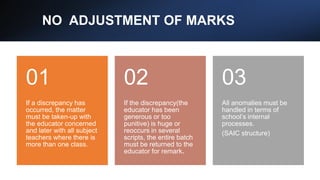
NO ADJUSTMENT OF MARKS
If a discrepancy has
occurred, the matter
must be taken-up with
the educator concerned
and later with all subject
teachers where there is
more than one class.
01
If the discrepancy(the
educator has been
generous or too
punitive) is huge or
reoccurs in several
scripts, the entire batch
must be returned to the
educator for remark.
02
All anomalies must be
handled in terms of
school’s internal
processes.
(SAIC structure)
03
KEY DOCUMENTS NEEDED
FOR SUBMISSION DURING
POST-MODERATION
• Learner scripts or learner
evidence of work
• Item Analysis – Analyzing the
reasons for performance
• SASAMS Working mark sheets
– signed and dated.
• Diagnostic Analysis – Levels of
performance
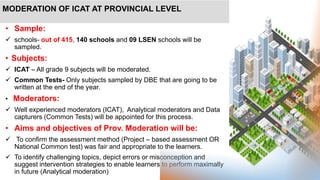
MODERATION OF ICAT AT PROVINCIAL LEVEL
• Sample:
 schools- out of 415, 140 schools and 09 LSEN schools will be
sampled.
• Subjects:
 ICAT – All grade 9 subjects will be moderated.
 Common Tests- Only subjects sampled by DBE that are going to be
written at the end of the year.
• Moderators:
 Well experienced moderators (ICAT), Analytical moderators and Data
capturers (Common Tests) will be appointed for this process.
• Aims and objectives of Prov. Moderation will be:
 To confirm the assessment method (Project – based assessment OR
National Common test) was fair and appropriate to the learners.
 To identify challenging topics, depict errors or misconception and
suggest intervention strategies to enable learners to perform maximally
in future (Analytical moderation)
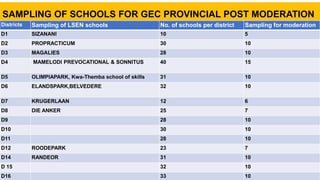
SAMPLING OF SCHOOLS FOR GEC PROVINCIAL POST MODERATION
Districts Sampling of LSEN schools No. of schools per district Sampling for moderation
D1 SIZANANI 10 5
D2 PROPRACTICUM 30 10
D3 MAGALIES 28 10
D4 MAMELODI PREVOCATIONAL & SONNITUS 40 15
D5 OLIMPIAPARK, Kwa-Themba school of skills 31 10
D6 ELANDSPARK,BELVEDERE 32 10
D7 KRUGERLAAN 12 6
D8 DIE ANKER 25 7
D9 28 10
D10 30 10
D11 28 10
D12 ROODEPARK 23 7
D14 RANDEOR 31 10
D 15 32 10
D16 33 10
21
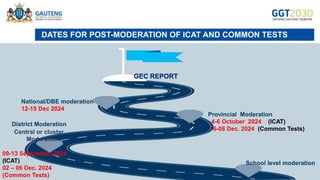
School level moderation
District Moderation
Provincial Moderation
4-6 October 2024 (ICAT)
6-08 Dec. 2024 (Common Tests)
National/DBE moderation
12-15 Dec 2024
DATES FOR POST-MODERATION OF ICAT AND COMMON TESTS
Central or cluster
Moderation
09-13 September. 2024
(ICAT)
02 – 06 Dec. 2024
(Common Tests)
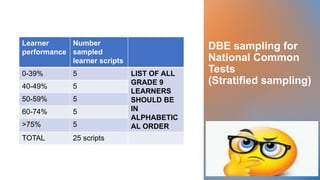
DBE sampling for
National Common
Tests
(Stratified sampling)
Learner
performance
Number
sampled
learner scripts
0-39% 5 LIST OF ALL
GRADE 9
LEARNERS
SHOULD BE
IN
ALPHABETIC
AL ORDER
40-49% 5
50-59% 5
60-74% 5
>75% 5
TOTAL 25 scripts
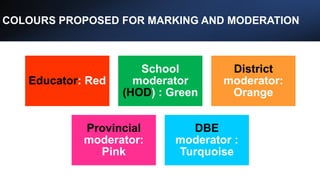
COLOURS PROPOSED FOR MARKING AND MODERATION
Educator: Red
School
moderator
(HOD) : Green
District
moderator:
Orange
Provincial
moderator:
Pink
DBE
moderator :
Turquoise
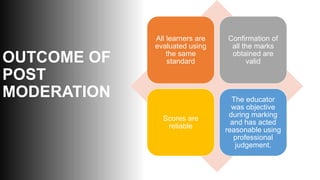
OUTCOME OF
POST
MODERATION
All learners are
evaluated using
the same
standard
Confirmation of
all the marks
obtained are
valid
Scores are
reliable
The educator
was objective
during marking
and has acted
reasonable using
professional
judgement.
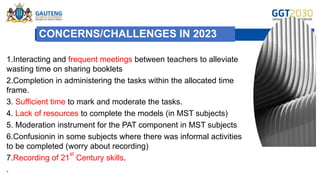
1.Interacting and frequent meetings between teachers to alleviate
wasting time on sharing booklets
2.Completion in administering the tasks within the allocated time
frame.
3. Sufficient time to mark and moderate the tasks.
4. Lack of resources to complete the models (in MST subjects)
5. Moderation instrument for the PAT component in MST subjects
6.Confusionin in some subjects where there was informal activities
to be completed (worry about recording)
7.Recording of 21
st
Century skills.
.
CONCERNS/CHALLENGES IN 2023
THANK YOU

GEC MODERATION PRESENTATION WORKSHOP v1 (1).pptx

  • 1.
    Examinations & AssessmentChief Directorate: ASSESSMENT DIRECTORATE: GEC PILOT PROJECT GEC MARKING, QUALITY ASSURANCE AND MODERATION
  • 2.
    PRESENTATION OUTLINE Marking ICATand National Common tests 1.Marking procedures 2.Moderation,QA and remarking 2.1 Provincial moderation system 2.2 Moderation principles 2.3 Pyramidal approach and levels of moderation 2.4 Objectives of post-moderation 2.5 Moderation at school and district level 2.6 Moderation at Provincial level 2.7 Sampling of schools 2.8 Dates for moderation
  • 3.
    MARKING of ICATand COMMON TEST
  • 4.
    MARKING • Marking shoulduphold the principles of assessment i.e., validity, reliability and fairness. • Each subject and phase should be able to determine marking policy in their own area. • Marking should be conducted with the necessary professionalism, fairness and dedication to promote the integrity and credibility of assessment system and examinations. • Marking inform learners on what they are doing well, their progress and motivate them to improve their performance. • It provides learners with acknowledgement of the work they have done. • It should aim at promoting, advancing and helping learners to progress.
  • 5.
    MARKING PROCEDURE -ICAT • A marking guideline discussion among educators teaching the same subject should be conducted prior to the marking process.(marking standardization meeting) • During the meeting, the educators will share understanding of marking criteria, and awarding of marks should be clear and in line with marking policy of the subject. • Each script or LEP’s must receive the same due consideration and attention of the educator and the marking guideline must be applied in a consistent manner throughout the marking process. • An excellent professional standard must be upheld within the marking of the subject. • During the marking process, the educator will be engaging with the learners, setting expectations that learners will always act upon feedback. • The educator should ensure that learners are marked equally and fairly against the task.
  • 6.
    MARKING PROCEDURE Marking ofwritten work will involve more detailed educator’s comments. The comments should be formative and constructive, indicating strengths, weaknesses and ways to improve. It is important for learners to assimilate or digest the feedback coming from the marking process. GENERAL RULES OF MARKING: • A tick should constitute 1 mark. • .The mark allocation for each question should be on the right- hand side of the script. • The total mark for each section should be written at the end of each section. • The overall total mark of the script should be written at the end of the written script. • The overall total mark should be transferred to the front page of the script, signed and dated by the educator. • Marks should be recorded in the mark sheet and transferred to
  • 7.
    GEC MARKING PROCEDURE IN 2024– Common tests In cases where there is more than one teacher teaching the subject at the school, the scripts should be exchanged so that a teacher does not mark the scripts of his/her own learners Marking should be conducted at school, with the senior teacher or Head of Department acting as an Internal Moderator. Only the final, approved marking guideline must be used in the marking. The PEDs are expected to host a similar Provincial Marking Standardization Meeting with the district subject advisors of each sampled subjects, in preparation for the marking and moderation to be undertaken by the schools and district subject advisors. The district subject advisors are in turn, expected to mediate the marking guidelines with their teachers in their districts. Two designated Subject officials per province will be required to participate in the virtual marking standardization meeting which will be hosted by the DBE.
  • 8.
  • 9.
    WHAT SYSTEM DOWE HAVE AS A PROVINCE TO MAKE SURE MODERATION OCCURS Clearly formulated policy directives which include regulations, policies, guidelines and circulars are available at schools, interpreted accurately by teachers and applied fully.(GET Provincial Assessment Guidelines 04 and 05 /2024) A detailed SBA moderation management plan that covers the implementation of moderation processes across the different levels of the system (i.e., provincial, districts and schools) Competent teachers and Subject Advisors as moderators to ensure effective quality assurance of SBA’s. A robust system, with clearly defined processes, are in place for the development of quality assessment tasks, and standardized moderation instruments for the purpose of moderation. (J1 & J2) A functional and effective support and monitoring system is in place. This includes the monitoring tools used, subject advisory support available and the monitoring that takes place to ensure policy compliance. (school visits and monitoring of district moderation) A fully effective moderation system, which includes evaluation of the assessment tasks (Pre-moderation) and the learner evidence (Post- moderation) A regular upward and downward feedback system (Monthly PAT,DAT and SAT meetings and standard setting meetings)
  • 10.
    MODERATION PRINCIPLES –POSTMODERATION Accuracy Comparability Consistency Fairness Our moderation tool (Annexure J2) adhere to the following Post moderation criteria’s • Quality and standard of marking • Consistency and objectivity in marking. • Learners are marked as per marking guideline • Fairness and accuracy in awarding marks. • The correlation between mark allocation by the teacher and learner responses. • Learner performance against the quality of the paper. • Transference and verification of the marks to the SASAMS working mark sheet
  • 11.
    OBJECTIVES OF POST-MODERATION •It is the process to ensure that all learners are assessed against the same standards when being marked. • It is also a process used to ensure consistency of marking across each subject area and marks are awarded appropriately and fairly. • It is a form of feedback to markers (educators) to help them align their marking standard with those of other markers. • It is a process where remarking should be diagnostic in promoting questioning and explores deep understanding of performance of learners. It gives guidance for improvement based on their understanding, misconception and/or learning strategies used.
  • 12.
    GDE Pyramidal ApproachLevels of Moderation  National Moderation: DBE will supply copies of mark sheets for each subject for the sub-sampled schools  Provincial Moderation: moderation of SBA. Qualitative moderation conducted.  District Moderation: – Centralised moderation: moderation is conducted by Subject Advisors over a period of 2 weeks. District Subject Advisors compile a moderation report on the standard of marking and should be mediated to schools.  Cluster moderation: Done by teachers teaching the same subject  School Moderation:- a) Quality assure assessment tasks and learner evidence of work. b) Remark 10% of the sampled marked scripts. Sampling of learners’ work must be done using working mark sheet c) Sign off the mark sheets FEEDBACK DBE Umalusi Provincial Appointed moderators & Analytical moderation DISTRICT DSA and Lead Teachers CIRCUIT DSA oversees the moderation process done by Teachers and Lead Teachers and PLC’s SCHOOL HOD, Senior Teacher & competent teacher from neighbouring schools F E E D B A C K FEEDBACK MODERATION OF ICAT AND NATIONAL COMMON TESTS
  • 13.
    DISTRICT MODERATION MODEL • Are wedoing justice in moderation when it is done during school visit? • Districts are urged to conduct centralised moderation using Lead Teachers
  • 14.
    POST MODERATION OFICAT LSEN SCHOOLS (Core subjects) • Languages • Mathematics • 3. Life skills • 3.1 EMS • 3.2 Natural science Aspect Content Project 1 (BOOKLET 1) Done by learners individually LO anchored– EMS, SS-H, CA, HL, FAL EMS – business opportunity research (CAT, P2) SS (H) – Apartheids laws research CA – presentation, drama, song HL – Interview with report (CAT) FAL - Business letter (CAT) Project 2 (BOOKLET 2) MST – Learners work in groups to build a simple audio amplifier (13 worksheets) Mathematics: - box with prescribed measurements (CAT P1) Technology: – sketch/diagram
  • 15.
    POST MODERATION ATSCHOOL AND DISTRICT LEVEL When moderating (remarking), The moderator should alert the EDUCATOR of the following:  Teachers not following the marking principles (inconsistency).  Incidents of double testing, shadow, global and lenient marking.  Marking not according to the marking guideline  Giving marks that do not appear on the marking guideline  Learners whose marks are not correctly added (be specific).  Incorrect awarding of marks..  Learners using incorrect concepts in their written report which is not being corrected by the teacher.  Learners credited for incorrect responses. Key issues to look at:  Consistency and objectivity in marking.  The correlation between mark allocation by the teacher and learner responses.  Fairness and accuracy in awarding marks.  Learner performance against the quality of the paper.  The quality and standard of learner responses to each question type and specific examples of common errors and learner misconceptions. (item/diagnostic analysis)  Transference and verification of the marks to the SASAMS working mark sheet.
  • 16.
    MODERATING - Workingmark sheets- SASAMS (Learner performance) The moderator/Hod should check that all learners have marks and teachers have transferred the marks correctly from the learners' work. All the calculations and weightings has been done correctly. (SASAMS automatically calculate the weightings) Where a learner has not completed an SBA component with valid reasons , the learner must be given an extended opportunity. The moderator should sign next to the sampled learner in agreement with the recorded mark or put an Asterix where the moderated mark is different. Should highlight sampled learners The school should keep all the records of learner's evidence of assessment for all tasks administered for a period of six months the following year.
  • 17.
    NO ADJUSTMENT OFMARKS If a discrepancy has occurred, the matter must be taken-up with the educator concerned and later with all subject teachers where there is more than one class. 01 If the discrepancy(the educator has been generous or too punitive) is huge or reoccurs in several scripts, the entire batch must be returned to the educator for remark. 02 All anomalies must be handled in terms of school’s internal processes. (SAIC structure) 03
  • 18.
    KEY DOCUMENTS NEEDED FORSUBMISSION DURING POST-MODERATION • Learner scripts or learner evidence of work • Item Analysis – Analyzing the reasons for performance • SASAMS Working mark sheets – signed and dated. • Diagnostic Analysis – Levels of performance
  • 19.
    MODERATION OF ICATAT PROVINCIAL LEVEL • Sample:  schools- out of 415, 140 schools and 09 LSEN schools will be sampled. • Subjects:  ICAT – All grade 9 subjects will be moderated.  Common Tests- Only subjects sampled by DBE that are going to be written at the end of the year. • Moderators:  Well experienced moderators (ICAT), Analytical moderators and Data capturers (Common Tests) will be appointed for this process. • Aims and objectives of Prov. Moderation will be:  To confirm the assessment method (Project – based assessment OR National Common test) was fair and appropriate to the learners.  To identify challenging topics, depict errors or misconception and suggest intervention strategies to enable learners to perform maximally in future (Analytical moderation)
  • 20.
    SAMPLING OF SCHOOLSFOR GEC PROVINCIAL POST MODERATION Districts Sampling of LSEN schools No. of schools per district Sampling for moderation D1 SIZANANI 10 5 D2 PROPRACTICUM 30 10 D3 MAGALIES 28 10 D4 MAMELODI PREVOCATIONAL & SONNITUS 40 15 D5 OLIMPIAPARK, Kwa-Themba school of skills 31 10 D6 ELANDSPARK,BELVEDERE 32 10 D7 KRUGERLAAN 12 6 D8 DIE ANKER 25 7 D9 28 10 D10 30 10 D11 28 10 D12 ROODEPARK 23 7 D14 RANDEOR 31 10 D 15 32 10 D16 33 10
  • 21.
    21 School level moderation DistrictModeration Provincial Moderation 4-6 October 2024 (ICAT) 6-08 Dec. 2024 (Common Tests) National/DBE moderation 12-15 Dec 2024 DATES FOR POST-MODERATION OF ICAT AND COMMON TESTS Central or cluster Moderation 09-13 September. 2024 (ICAT) 02 – 06 Dec. 2024 (Common Tests)
  • 22.
    DBE sampling for NationalCommon Tests (Stratified sampling) Learner performance Number sampled learner scripts 0-39% 5 LIST OF ALL GRADE 9 LEARNERS SHOULD BE IN ALPHABETIC AL ORDER 40-49% 5 50-59% 5 60-74% 5 >75% 5 TOTAL 25 scripts
  • 23.
    COLOURS PROPOSED FORMARKING AND MODERATION Educator: Red School moderator (HOD) : Green District moderator: Orange Provincial moderator: Pink DBE moderator : Turquoise
  • 24.
    OUTCOME OF POST MODERATION All learnersare evaluated using the same standard Confirmation of all the marks obtained are valid Scores are reliable The educator was objective during marking and has acted reasonable using professional judgement.
  • 25.
    1.Interacting and frequentmeetings between teachers to alleviate wasting time on sharing booklets 2.Completion in administering the tasks within the allocated time frame. 3. Sufficient time to mark and moderate the tasks. 4. Lack of resources to complete the models (in MST subjects) 5. Moderation instrument for the PAT component in MST subjects 6.Confusionin in some subjects where there was informal activities to be completed (worry about recording) 7.Recording of 21 st Century skills. . CONCERNS/CHALLENGES IN 2023
  • 27.