Why Are WeHere Today?
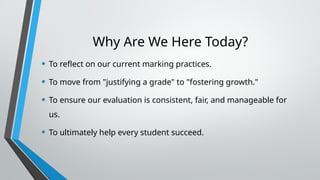
• To reflect on our current marking practices.
• To move from "justifying a grade" to "fostering growth."
• To ensure our evaluation is consistent, fair, and manageable for
us.
• To ultimately help every student succeed.
3.
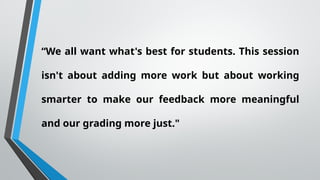
“We all wantwhat's best for students. This session
isn't about adding more work but about working
smarter to make our feedback more meaningful
and our grading more just."
4.
The Reality ofMarking
The Challenge: The Marking Mountain
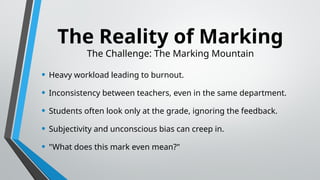
• Heavy workload leading to burnout.
• Inconsistency between teachers, even in the same department.
• Students often look only at the grade, ignoring the feedback.
• Subjectivity and unconscious bias can creep in.
• "What does this mark even mean?"
5.
"Let's be honest.We've all felt this. The stack of
papers can feel endless. And sometimes, a 'B' in one
class might mean something different in another.
Today, we'll tackle these challenges head-on."
6.
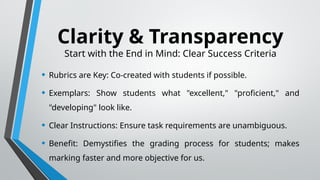
Clarity & Transparency
Startwith the End in Mind: Clear Success Criteria
• Rubrics are Key: Co-created with students if possible.
• Exemplars: Show students what "excellent," "proficient," and
"developing" look like.
• Clear Instructions: Ensure task requirements are unambiguous.
• Benefit: Demystifies the grading process for students; makes
marking faster and more objective for us.
7.
"When students knowexactly what is expected, they can
focus on demonstrating their learning. A good rubric
isn't just a grading tool; it's a learning tool. Let's take 2
minutes to turn to a partner and share one assignment
where you feel the success criteria are very clear."
8.
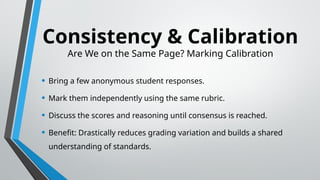
Consistency & Calibration
AreWe on the Same Page? Marking Calibration
• Bring a few anonymous student responses.
• Mark them independently using the same rubric.
• Discuss the scores and reasoning until consensus is reached.
• Benefit: Drastically reduces grading variation and builds a shared
understanding of standards.
9.
"This is oneof the most powerful practices. By
norming together, we ensure that a '4' on the
analytic rubric means the same thing to all of us.
It's professional development in its purest form."
10.
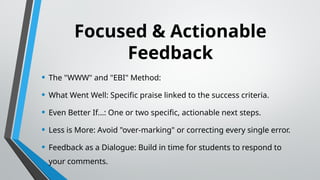
Focused & Actionable
Feedback
•The "WWW" and "EBI" Method:
• What Went Well: Specific praise linked to the success criteria.
• Even Better If...: One or two specific, actionable next steps.
• Less is More: Avoid "over-marking" or correcting every single error.
• Feedback as a Dialogue: Build in time for students to respond to
your comments.
11.
"Instead of writing'vague' in the margin, try 'Even
Better If you provided a specific example from the text
to support this point.' This gives the student a clear
path forward. The goal is for them to act on the
feedback, not just receive it."
12.
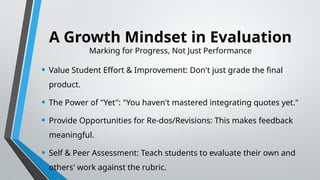
A Growth Mindsetin Evaluation
Marking for Progress, Not Just Performance
• Value Student Effort & Improvement: Don't just grade the final
product.
• The Power of "Yet": "You haven't mastered integrating quotes yet."
• Provide Opportunities for Re-dos/Revisions: This makes feedback
meaningful.
• Self & Peer Assessment: Teach students to evaluate their own and
others' work against the rubric.
13.
"When we allowredoes focused on specific
feedback, we send the message that learning is a
process. It’s not about being 'smart,' it's about
growing. This can be transformative for struggling
students."
14.
The Myth ofthe "Objective" Grade
Addressing Bias: Striving for True Fairness
We all have unconscious biases (e.g., based on past performance, behaviour,
gender, name).
Strategies to Mitigate Bias:
• Anonymous Marking: Where practical, remove names.
• Focus on the Rubric: Anchor your judgement to the criteria, not the student.
• Take Breaks: Avoid marathon marking sessions where fatigue sets in.
• Reflect: Ask yourself, "Am I grading the work, or the student?"
15.
Our Action Plan
WhatWill You Take Away?
One thing I will try is...
• Make a committment to guide students about rubric from next
unit.
• Conduct a guidance session for your class/ colleagues.
• Implement the "WWW/EBI" feedback model.
• Prepare a model answers booklet for guiding students/ teachers.
16.
"Let's make acommitment. Look at this list and
choose just one thing you will implement in the
coming weeks. Small, consistent changes lead to
big results."