Build go kit Microservices at
Kubernetes with ease
HELLO!
Cage Chung
@CageChung @cage1016
cage.chung@gmail.com
GDG Cloud Taipei co-organizer
Google Developer Expert (GCP)
Agenda
◉ Gokitistiok8s
◉ Go-kit
◉ Service mesh
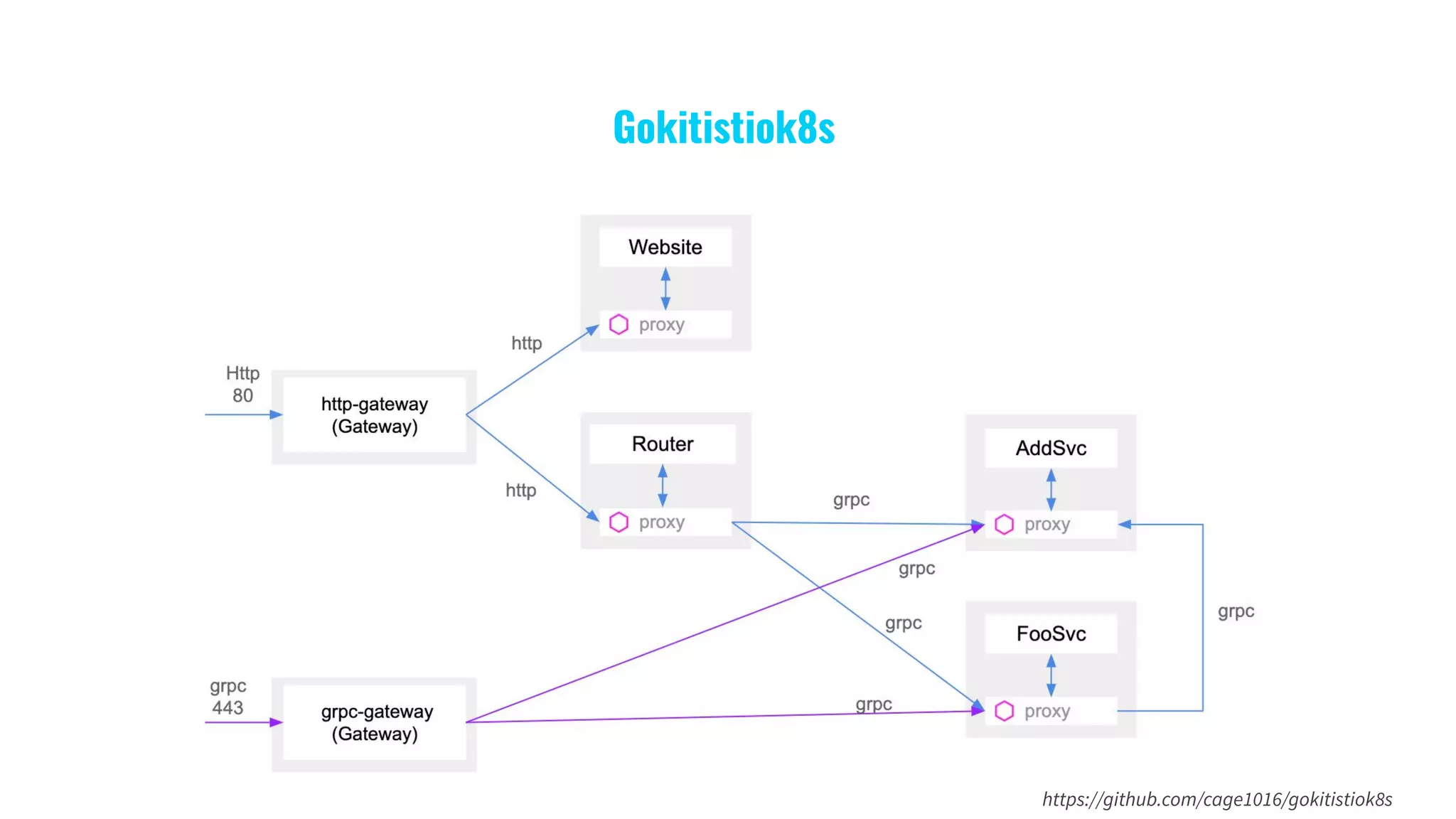
Gokitistiok8s
go kit microservice demo with istio & jaeger at kubernetes 1
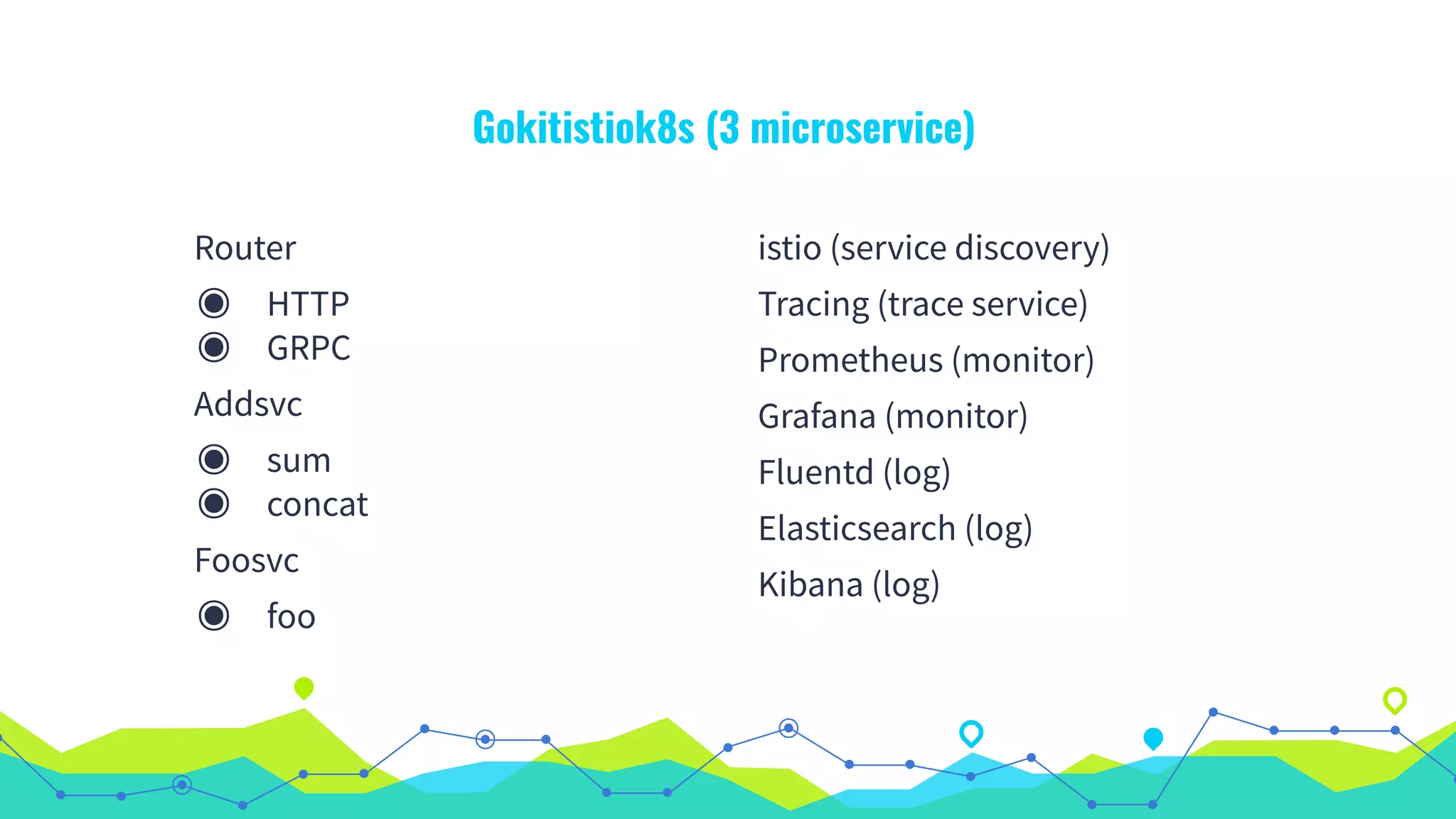
Gokitistiok8s (3 microservice)
Router
◉ HTTP
◉ GRPC
Addsvc
◉ sum
◉ concat
Foosvc
◉ foo
istio (service discovery)
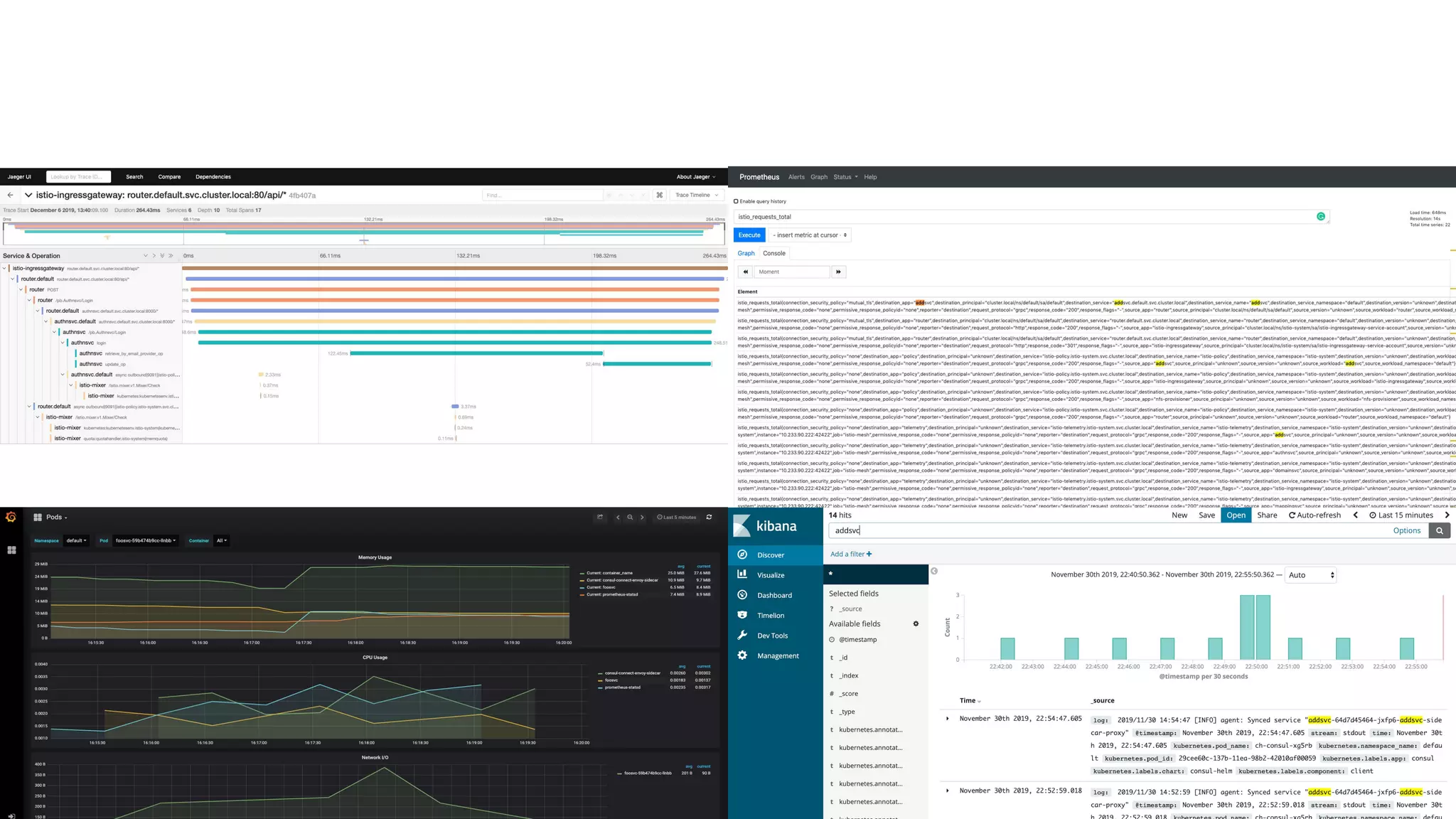
Tracing (trace service)
Prometheus (monitor)
Grafana (monitor)
Fluentd (log)
Elasticsearch (log)
Kibana (log)
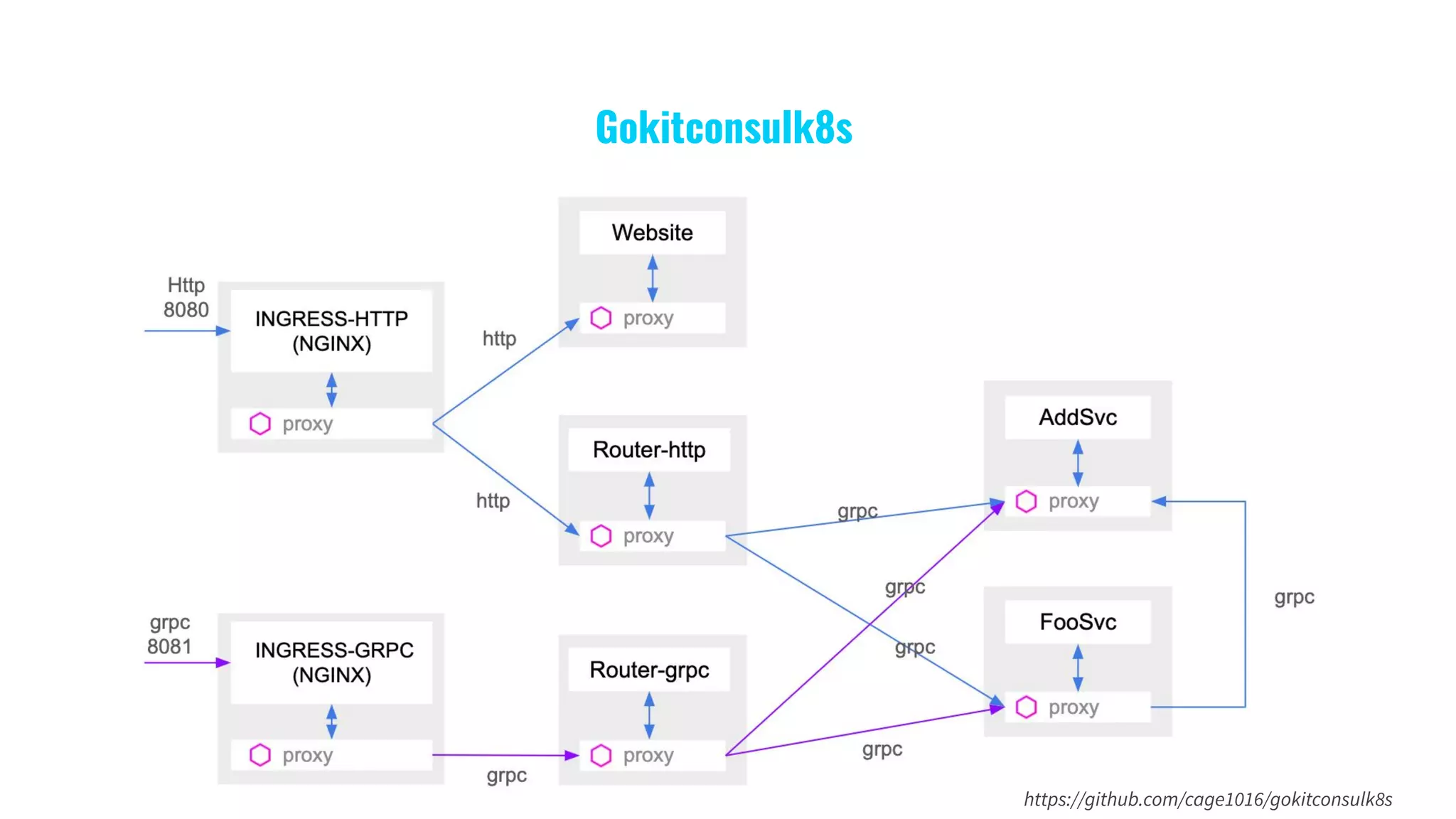
Gokitconsulk8s
https://github.com/cage1016/gokitconsulk8s
Gokitistiok8s
https://github.com/cage1016/gokitistiok8s
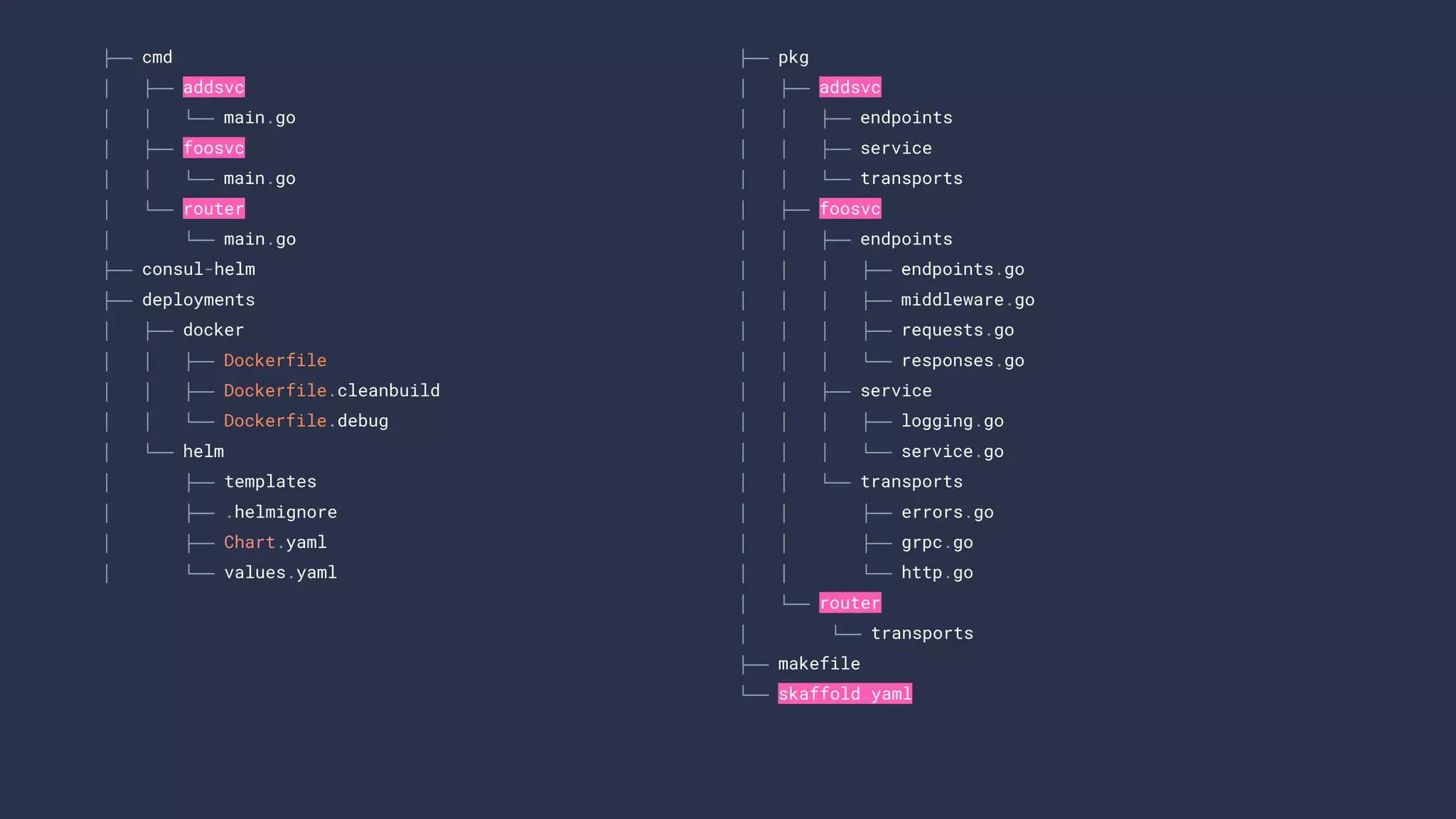
├── cmd
│ ├── addsvc
│ │ └── main.go
│ ├── foosvc
│ │ └── main.go
│ └── router
│ └── main.go
├── consul-helm
├── deployments
│ ├── docker
│ │ ├── Dockerfile
│ │ ├── Dockerfile.cleanbuild
│ │ └── Dockerfile.debug
│ └── helm
│ ├── templates
│ ├── .helmignore
│ ├── Chart.yaml
│ └── values.yaml
├── pkg
│ ├── addsvc
│ │ ├── endpoints
│ │ ├── service
│ │ └── transports
│ ├── foosvc
│ │ ├── endpoints
│ │ │ ├── endpoints.go
│ │ │ ├── middleware.go
│ │ │ ├── requests.go
│ │ │ └── responses.go
│ │ ├── service
│ │ │ ├── logging.go
│ │ │ └── service.go
│ │ └── transports
│ │ ├── errors.go
│ │ ├── grpc.go
│ │ └── http.go
│ └── router
│ └── transports
├── makefile
└── skaffold.yaml
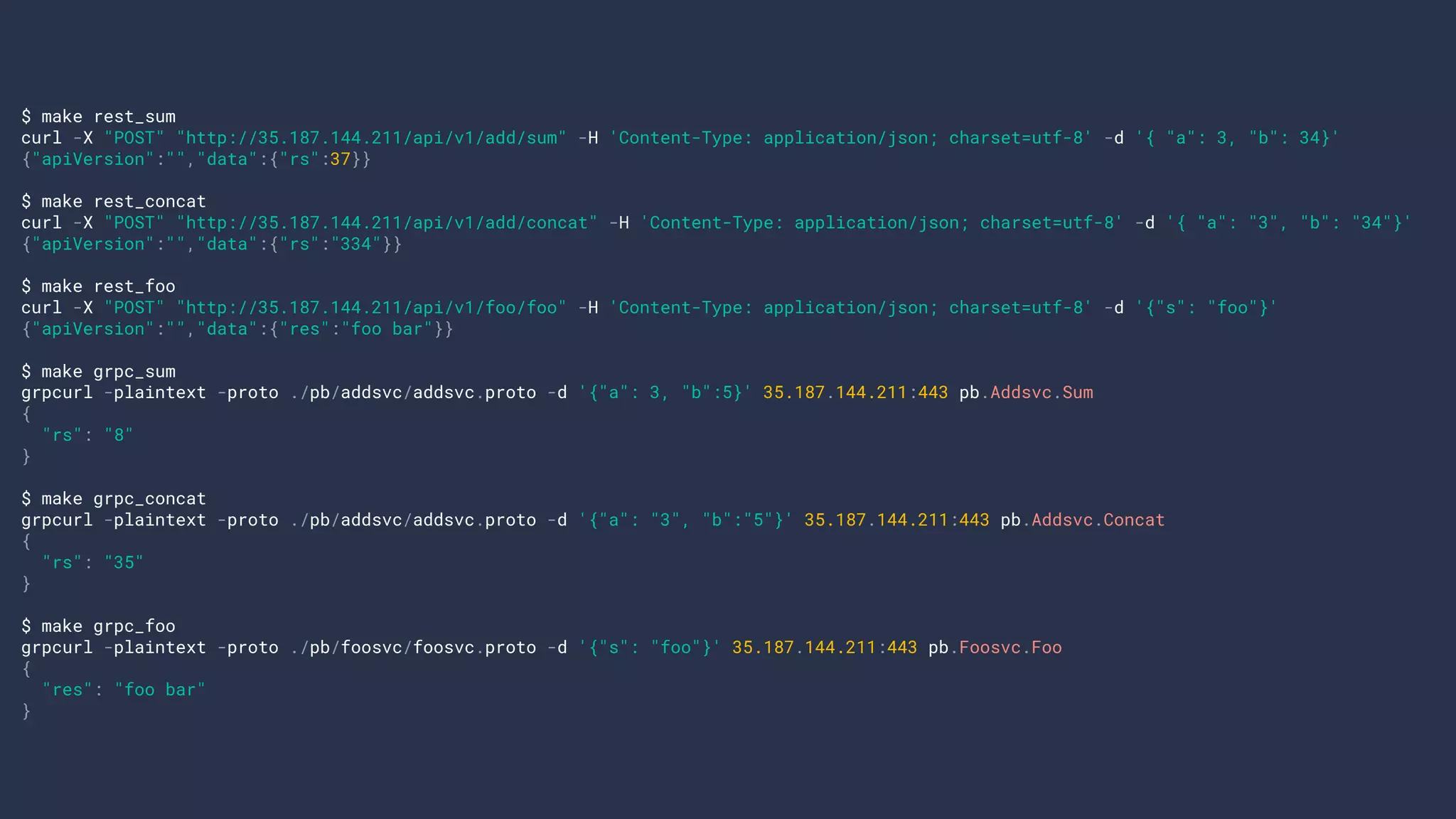
$ make rest_sum
curl -X "POST" "http://35.187.144.211/api/v1/add/sum" -H 'Content-Type: application/json; charset=utf-8' -d '{ "a": 3, "b": 34}'
{"apiVersion":"","data":{"rs":37}}
$ make rest_concat
curl -X "POST" "http://35.187.144.211/api/v1/add/concat" -H 'Content-Type: application/json; charset=utf-8' -d '{ "a": "3", "b": "34"}'
{"apiVersion":"","data":{"rs":"334"}}
$ make rest_foo
curl -X "POST" "http://35.187.144.211/api/v1/foo/foo" -H 'Content-Type: application/json; charset=utf-8' -d '{"s": "foo"}'
{"apiVersion":"","data":{"res":"foo bar"}}
$ make grpc_sum
grpcurl -plaintext -proto ./pb/addsvc/addsvc.proto -d '{"a": 3, "b":5}' 35.187.144.211:443 pb.Addsvc.Sum
{
"rs": "8"
}
$ make grpc_concat
grpcurl -plaintext -proto ./pb/addsvc/addsvc.proto -d '{"a": "3", "b":"5"}' 35.187.144.211:443 pb.Addsvc.Concat
{
"rs": "35"
}
$ make grpc_foo
grpcurl -plaintext -proto ./pb/foosvc/foosvc.proto -d '{"s": "foo"}' 35.187.144.211:443 pb.Foosvc.Foo
{
"res": "foo bar"
}
Demohttps://github.com/cage1016/gokitistiok8s
Go-kit
Toolkit for microservices 2
“Microservice solve organizational
problems
~
Microservice cause technical
problems
Problem solved
1. Team are blocked on other teams, can’t make progress
2. Product velocity stalled
Problem cause
1. Testing becomes really hard
2. Build pipelines
3. Requires dev/ops culture: devs deploy and operate their
work
4. Monitoring and instrumentation - tailing logs?
5. Distributed tracing
6. Security
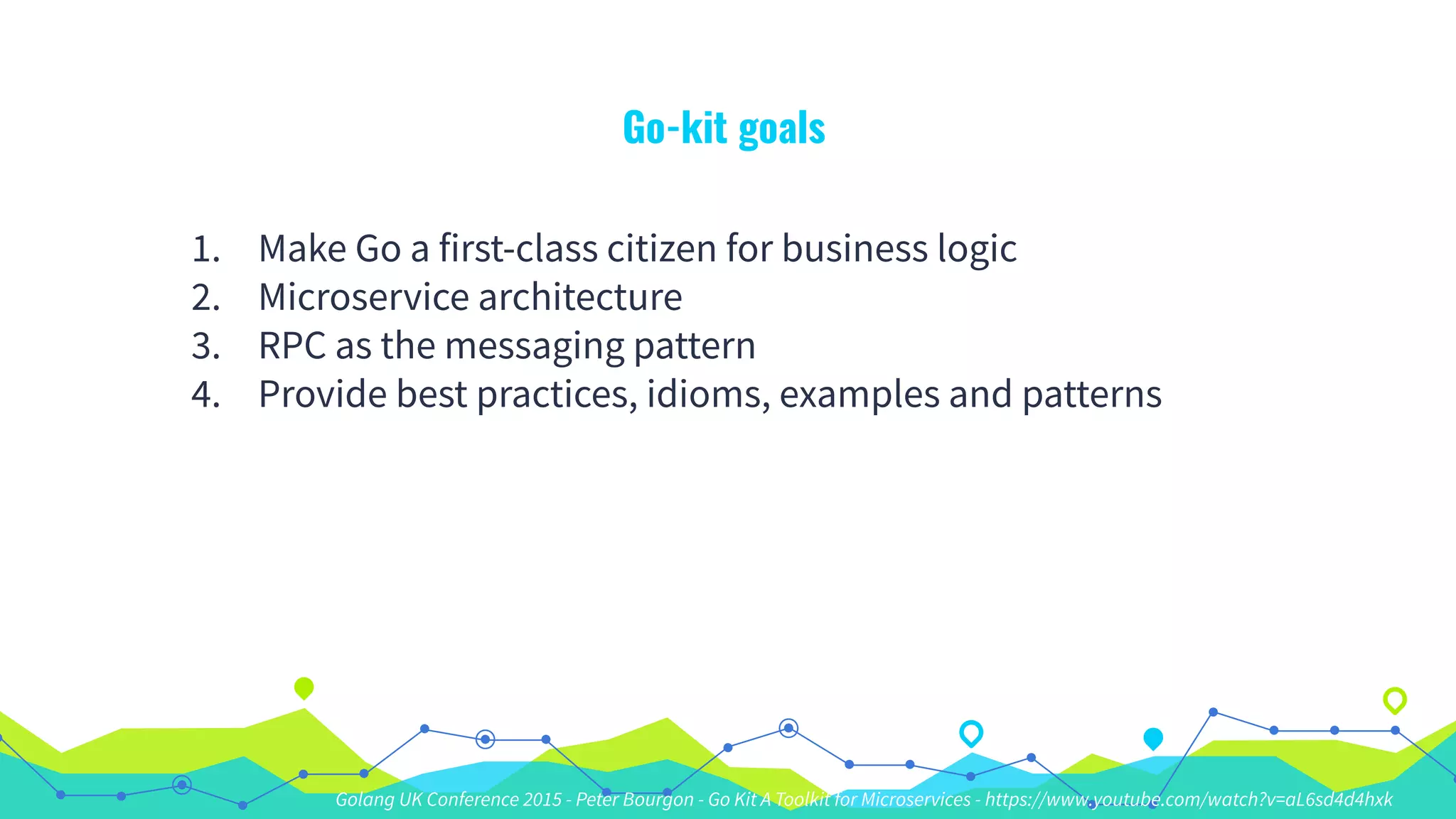
Go-kit goals
1. Make Go a first-class citizen for business logic
2. Microservice architecture
3. RPC as the messaging pattern
4. Provide best practices, idioms, examples and patterns
Golang UK Conference 2015 - Peter Bourgon - Go Kit A Toolkit for Microservices - https://www.youtube.com/watch?v=aL6sd4d4hxk
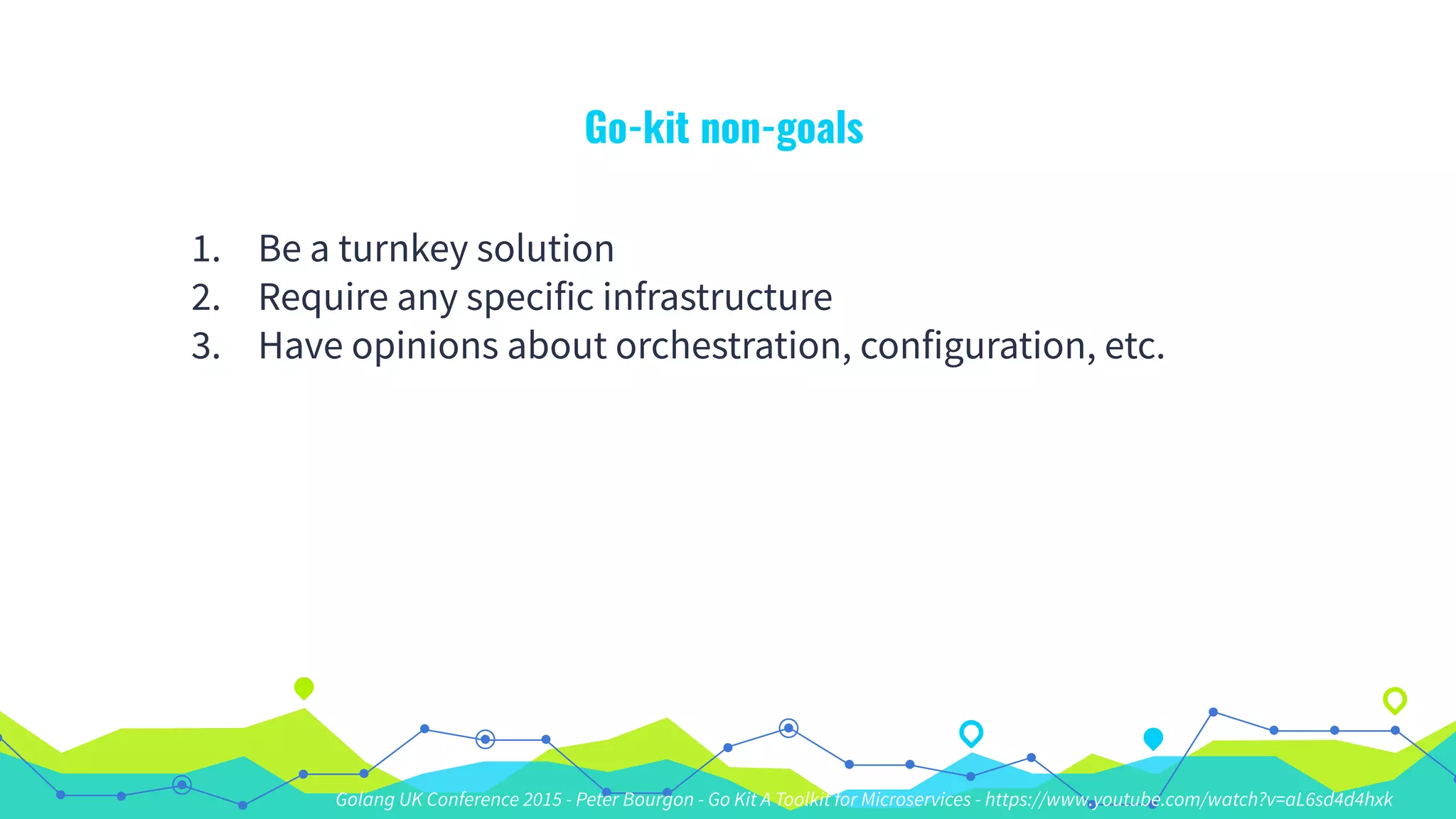
Go-kit non-goals
1. Be a turnkey solution
2. Require any specific infrastructure
3. Have opinions about orchestration, configuration, etc.
Golang UK Conference 2015 - Peter Bourgon - Go Kit A Toolkit for Microservices - https://www.youtube.com/watch?v=aL6sd4d4hxk
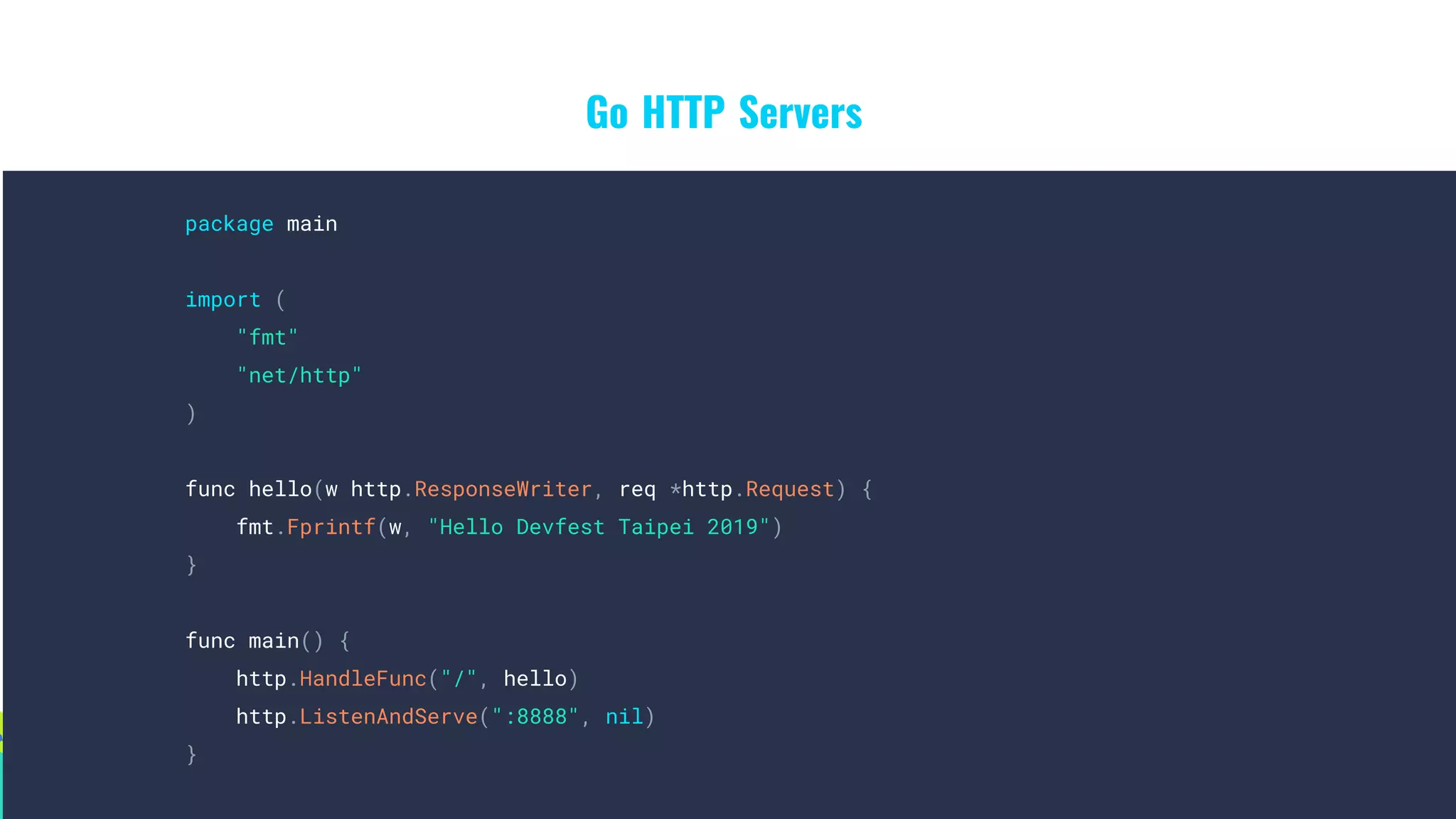
Go HTTP Servers
package main
import (
"fmt"
"net/http"
)
func hello(w http.ResponseWriter, req *http.Request) {
fmt.Fprintf(w, "Hello Devfest Taipei 2019")
}
func main() {
http.HandleFunc("/", hello)
http.ListenAndServe(":8888", nil)
}
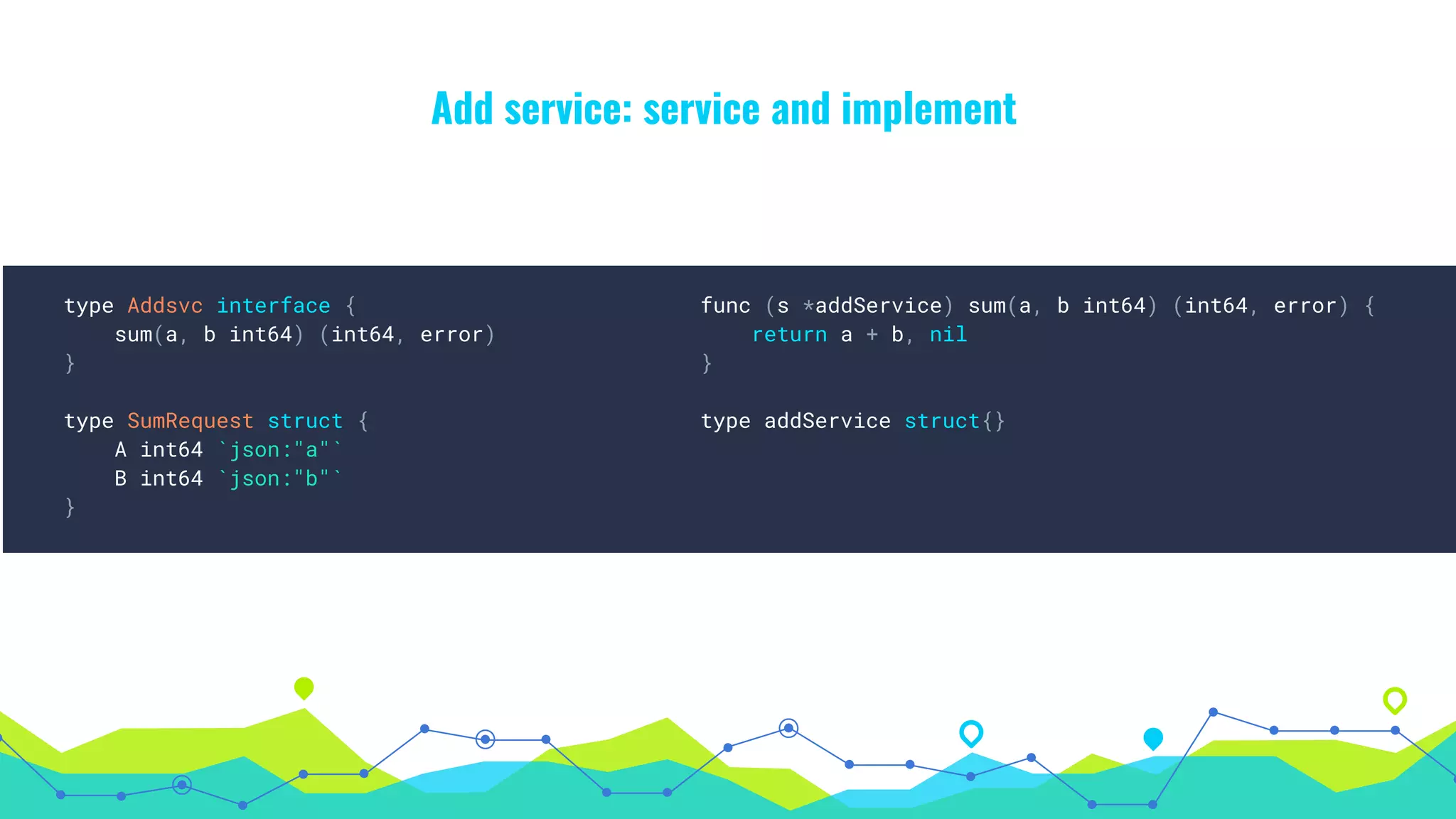
Add service: service and implement
type Addsvc interface {
sum(a, b int64) (int64, error)
}
type SumRequest struct {
A int64 `json:"a"`
B int64 `json:"b"`
}
func (s *addService) sum(a, b int64) (int64, error) {
return a + b, nil
}
type addService struct{}
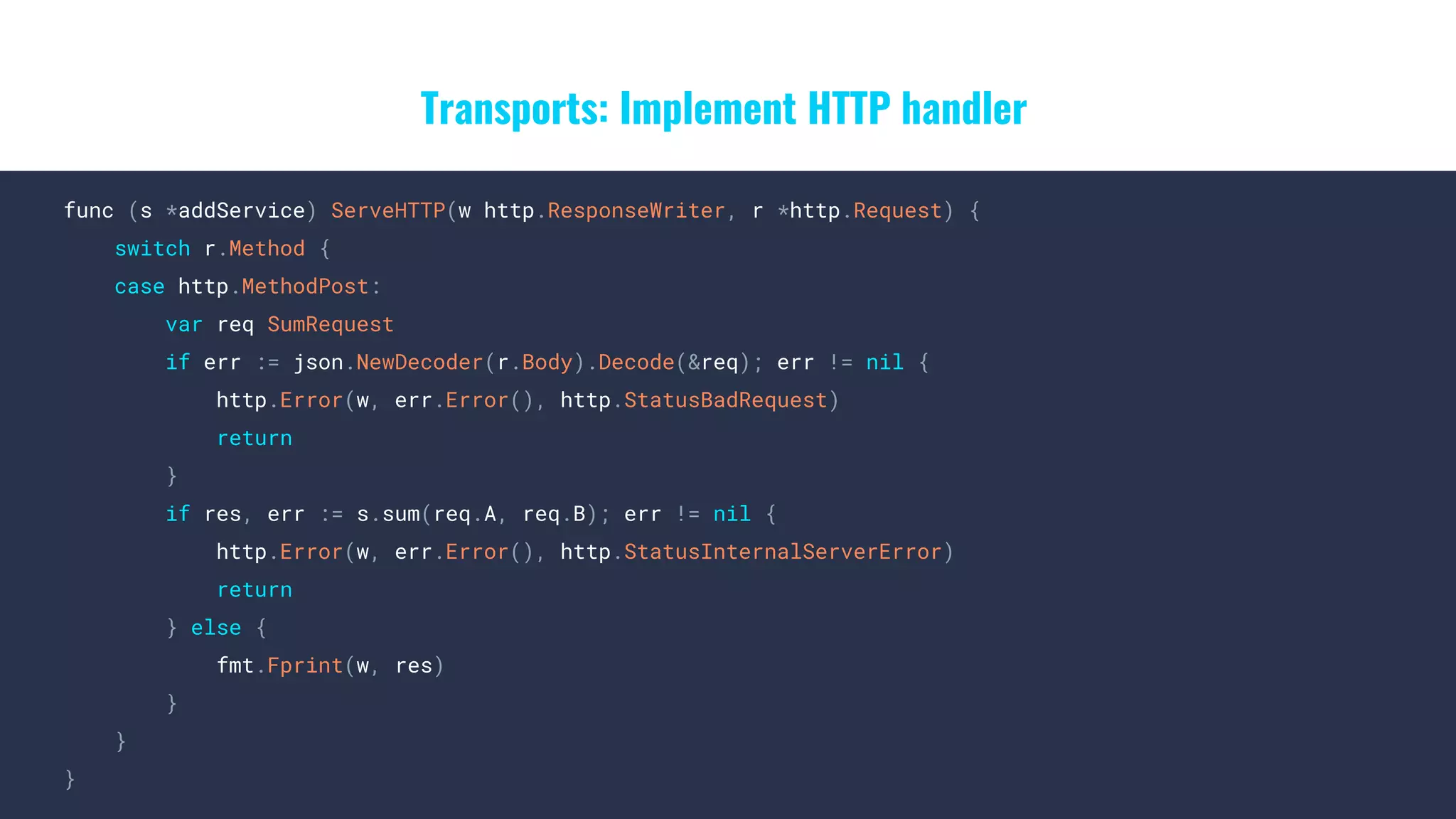
Transports: Implement HTTP handler
func (s *addService) ServeHTTP(w http.ResponseWriter, r *http.Request) {
switch r.Method {
case http.MethodPost:
var req SumRequest
if err := json.NewDecoder(r.Body).Decode(&req); err != nil {
http.Error(w, err.Error(), http.StatusBadRequest)
return
}
if res, err := s.sum(req.A, req.B); err != nil {
http.Error(w, err.Error(), http.StatusInternalServerError)
return
} else {
fmt.Fprint(w, res)
}
}
}
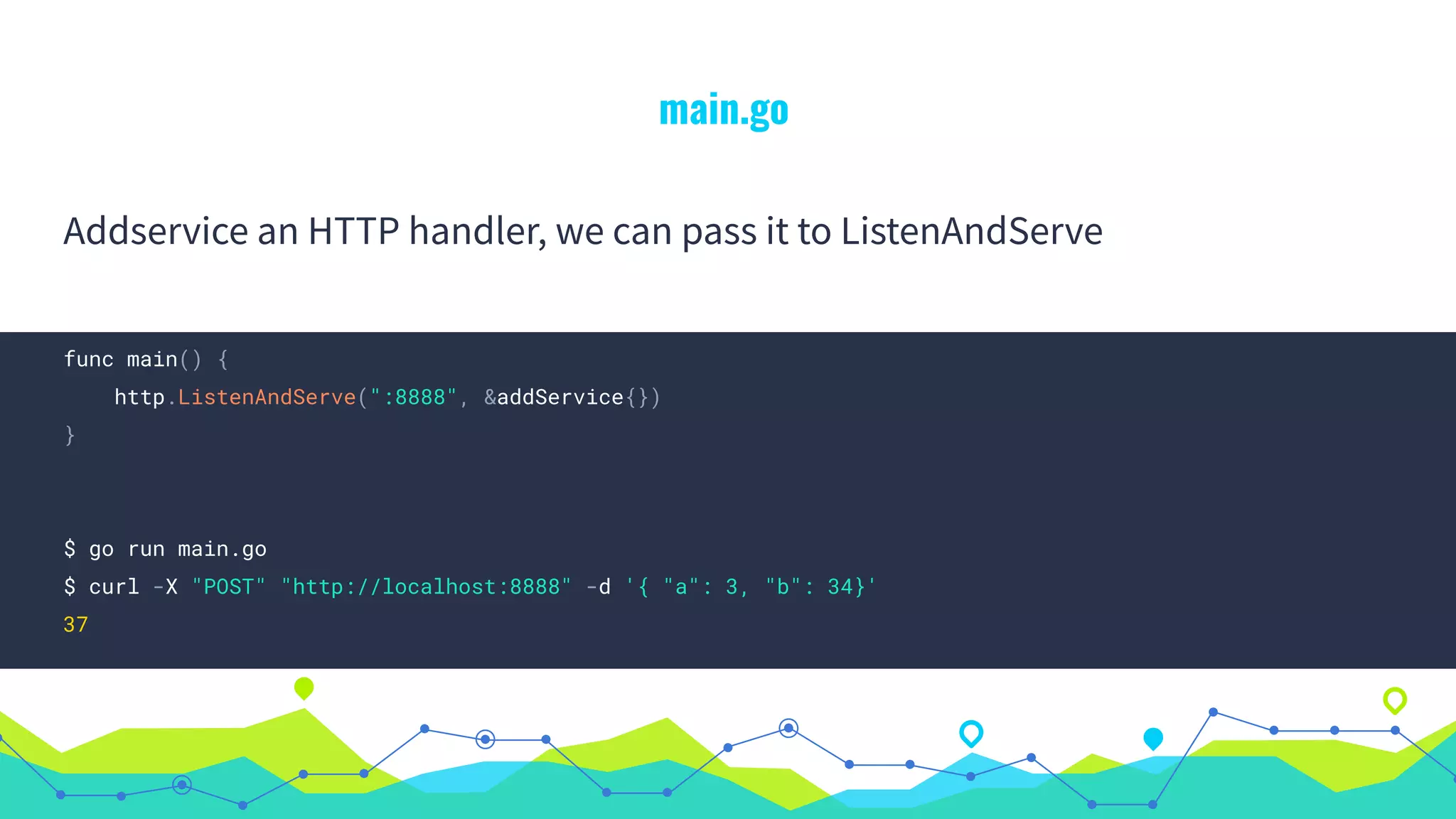
main.go
func main() {
http.ListenAndServe(":8888", &addService{})
}
$ go run main.go
$ curl -X "POST" "http://localhost:8888" -d '{ "a": 3, "b": 34}'
37
Addservice an HTTP handler, we can pass it to ListenAndServe
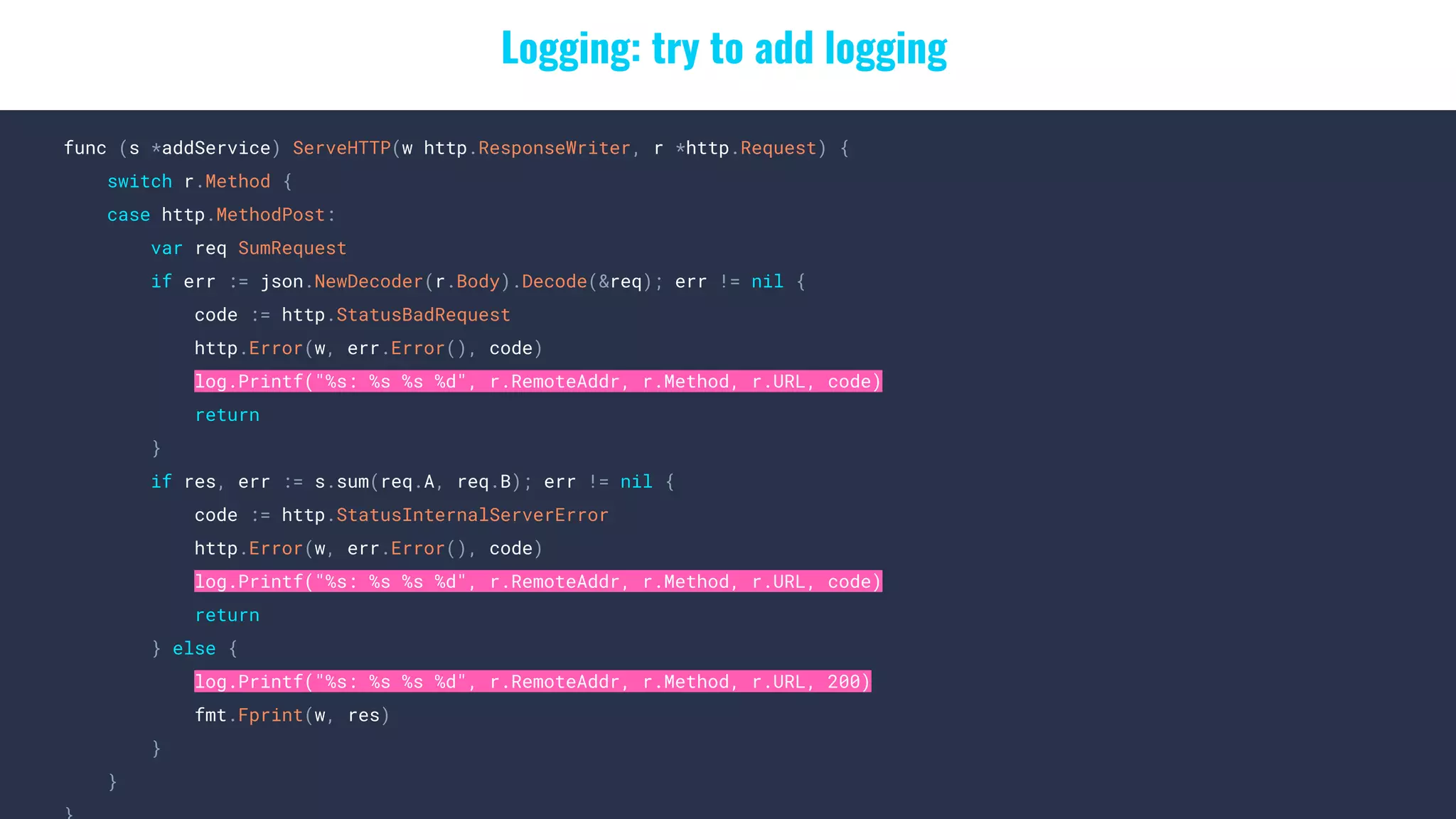
Logging: try to add logging
func (s *addService) ServeHTTP(w http.ResponseWriter, r *http.Request) {
switch r.Method {
case http.MethodPost:
var req SumRequest
if err := json.NewDecoder(r.Body).Decode(&req); err != nil {
code := http.StatusBadRequest
http.Error(w, err.Error(), code)
log.Printf("%s: %s %s %d", r.RemoteAddr, r.Method, r.URL, code)
return
}
if res, err := s.sum(req.A, req.B); err != nil {
code := http.StatusInternalServerError
http.Error(w, err.Error(), code)
log.Printf("%s: %s %s %d", r.RemoteAddr, r.Method, r.URL, code)
return
} else {
log.Printf("%s: %s %s %d", r.RemoteAddr, r.Method, r.URL, 200)
fmt.Fprint(w, res)
}
}
Logging
func main() {
log.Printf("listening on :8888")
log.Fatal(http.ListenAndServe(":8888", &addService{}))
}
$ go run main.go
2019/11/29 15:24:29 listening on :8888
2019/11/29 15:24:32 [::1]:52200: POST / 200
$ curl -X "POST" "http://localhost:8888" -d '{ "a": 3, "b": 34}'
37
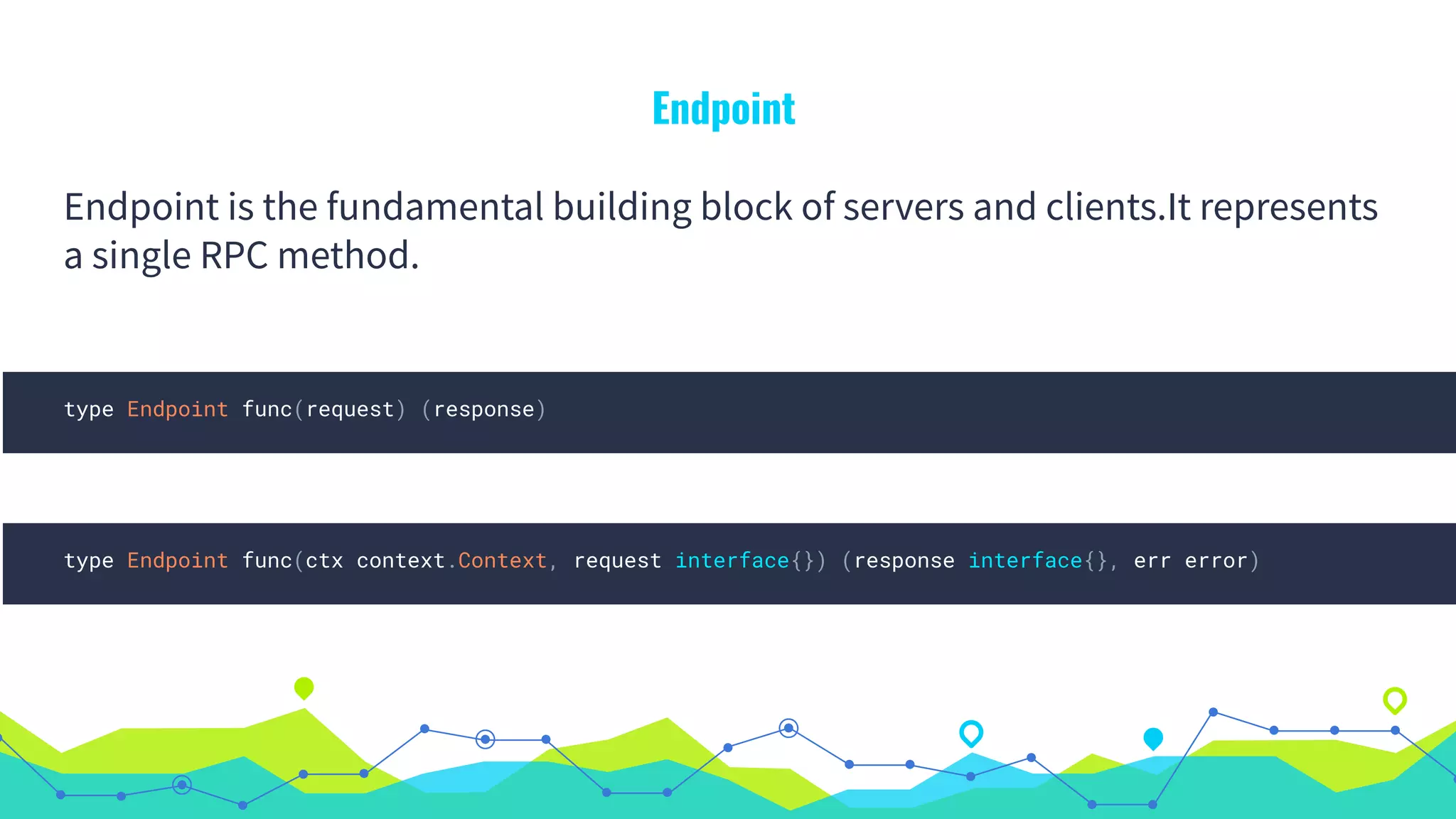
Endpoint
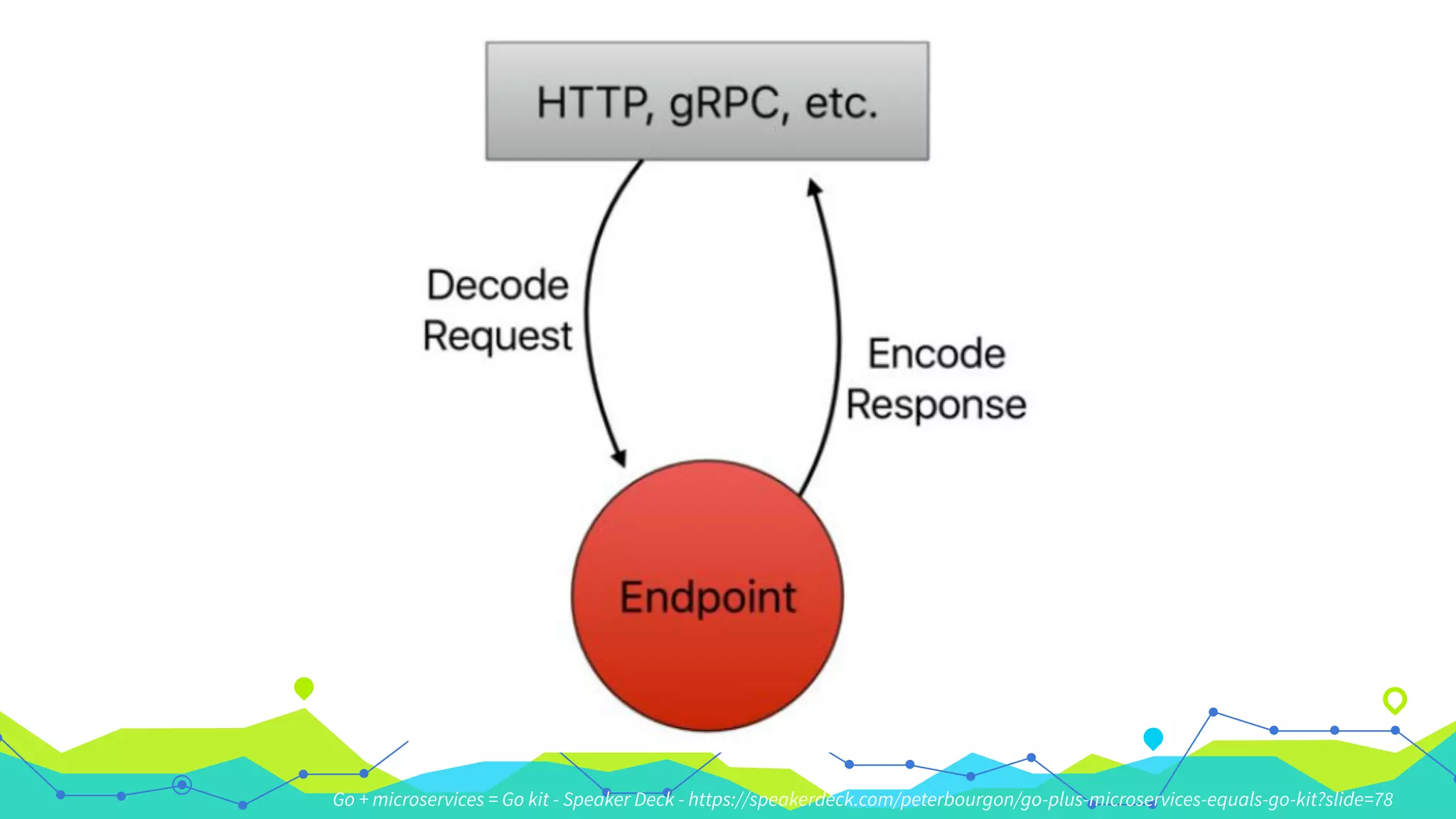
Endpoint is the fundamental building block of servers and clients.It represents
a single RPC method.
type Endpoint func(request) (response)
type Endpoint func(ctx context.Context, request interface{}) (response interface{}, err error)
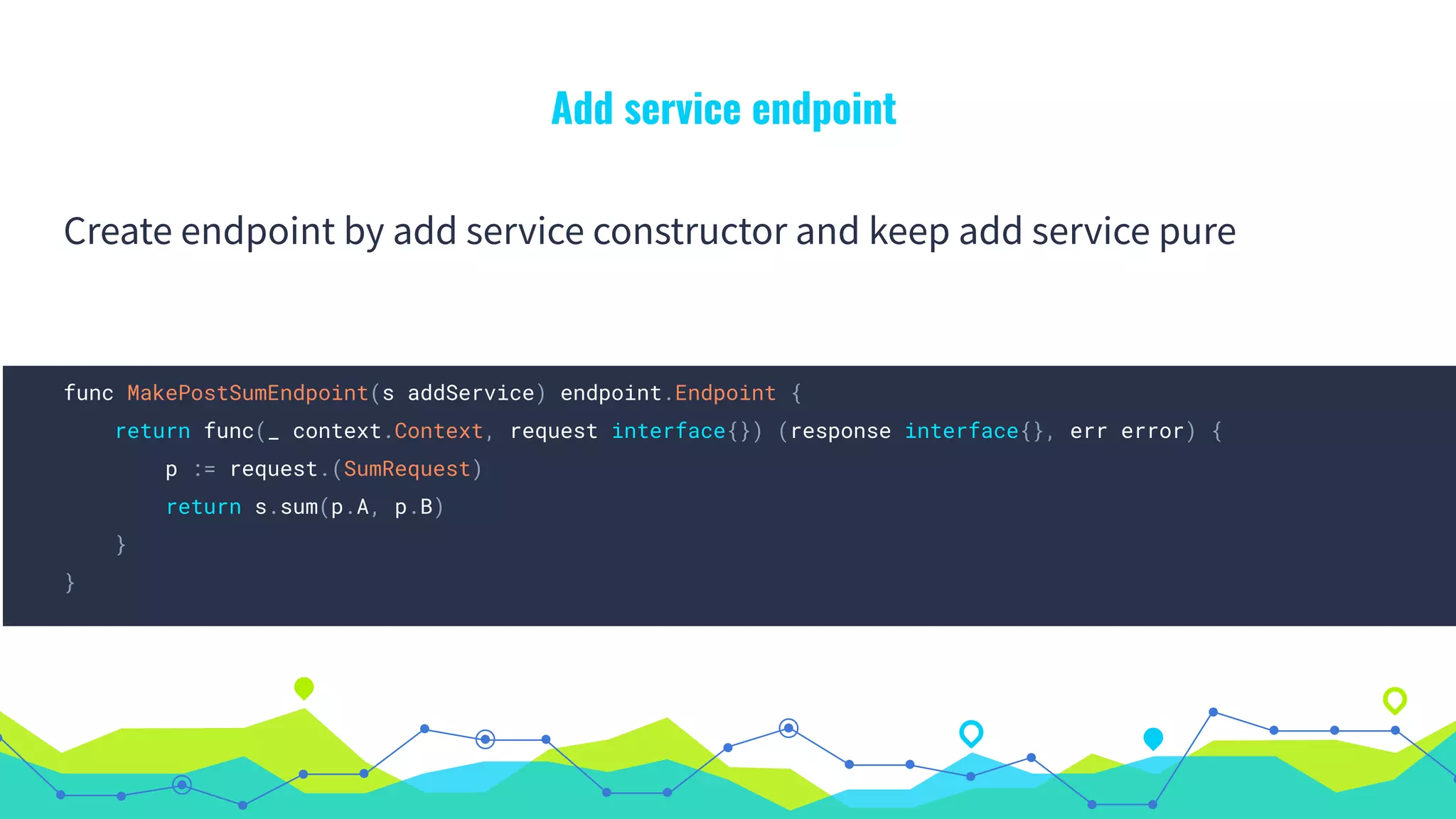
Add service endpoint
Create endpoint by add service constructor and keep add service pure
func MakePostSumEndpoint(s addService) endpoint.Endpoint {
return func(_ context.Context, request interface{}) (response interface{}, err error) {
p := request.(SumRequest)
return s.sum(p.A, p.B)
}
}
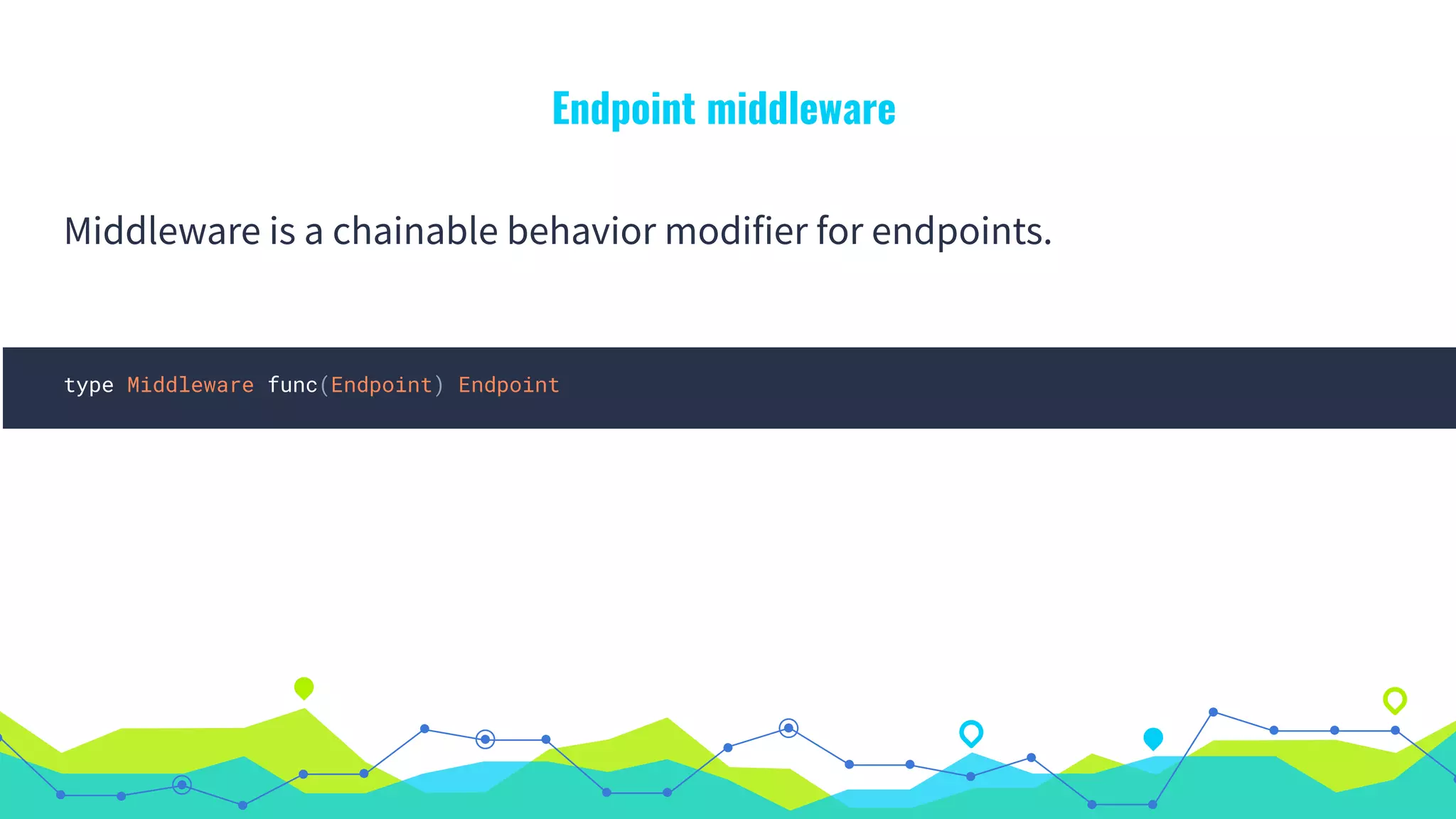
Endpoint middleware
Middleware is a chainable behavior modifier for endpoints.
type Middleware func(Endpoint) Endpoint
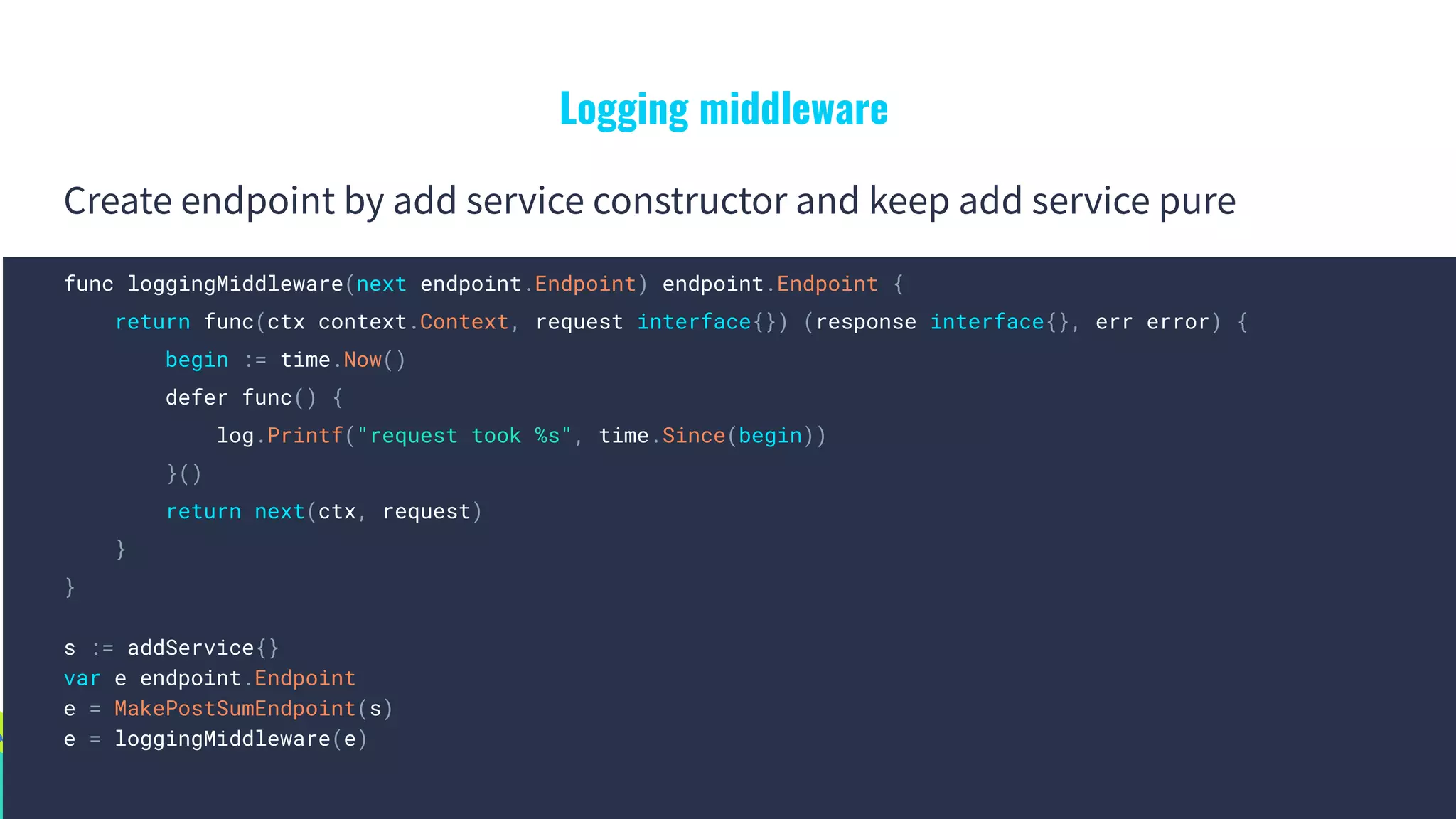
Logging middleware
Create endpoint by add service constructor and keep add service pure
func loggingMiddleware(next endpoint.Endpoint) endpoint.Endpoint {
return func(ctx context.Context, request interface{}) (response interface{}, err error) {
begin := time.Now()
defer func() {
log.Printf("request took %s", time.Since(begin))
}()
return next(ctx, request)
}
}
s := addService{}
var e endpoint.Endpoint
e = MakePostSumEndpoint(s)
e = loggingMiddleware(e)
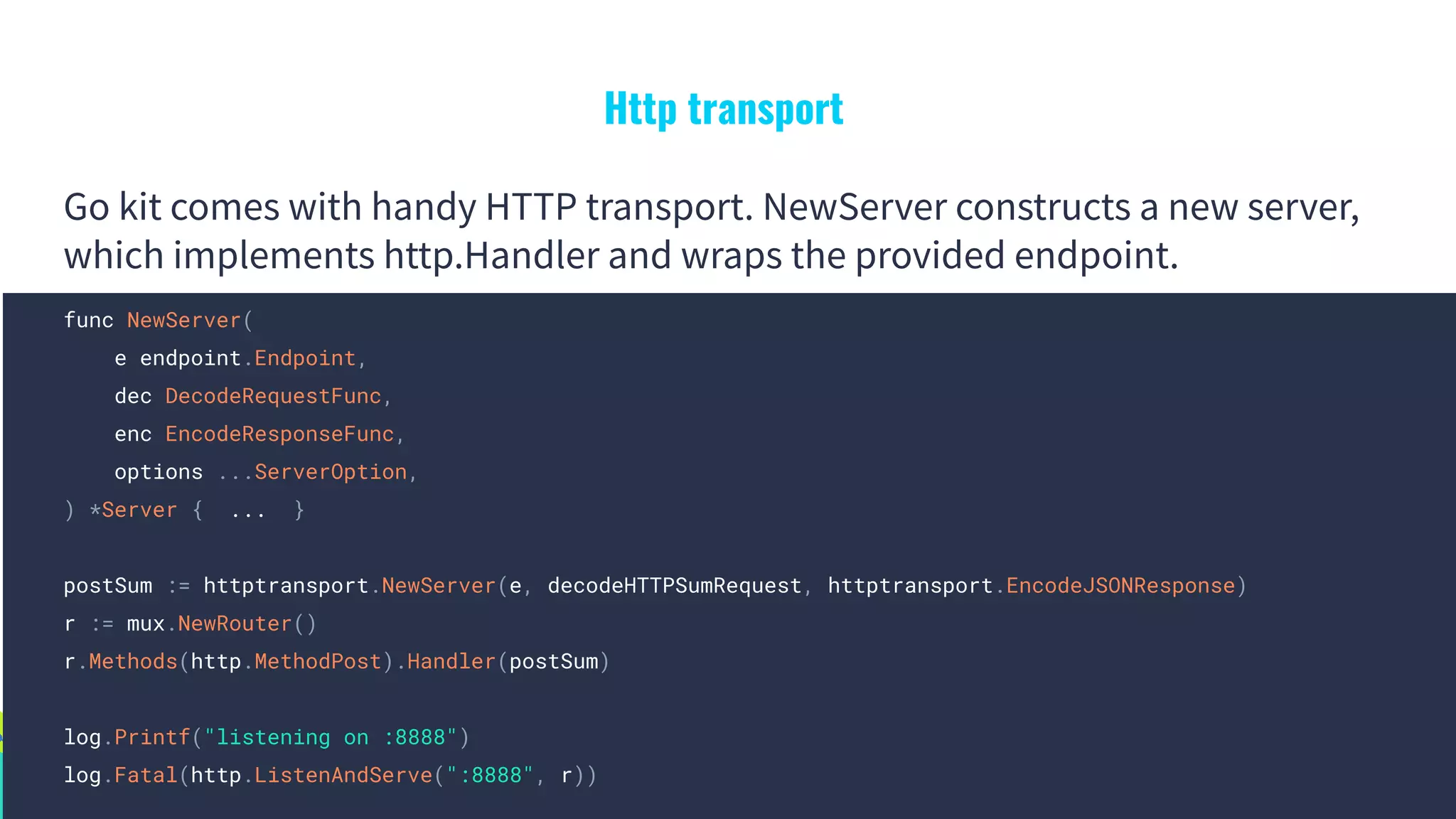
Http transport
Go kit comes with handy HTTP transport. NewServer constructs a new server,
which implements http.Handler and wraps the provided endpoint.
func NewServer(
e endpoint.Endpoint,
dec DecodeRequestFunc,
enc EncodeResponseFunc,
options ...ServerOption,
) *Server { ... }
postSum := httptransport.NewServer(e, decodeHTTPSumRequest, httptransport.EncodeJSONResponse)
r := mux.NewRouter()
r.Methods(http.MethodPost).Handler(postSum)
log.Printf("listening on :8888")
log.Fatal(http.ListenAndServe(":8888", r))
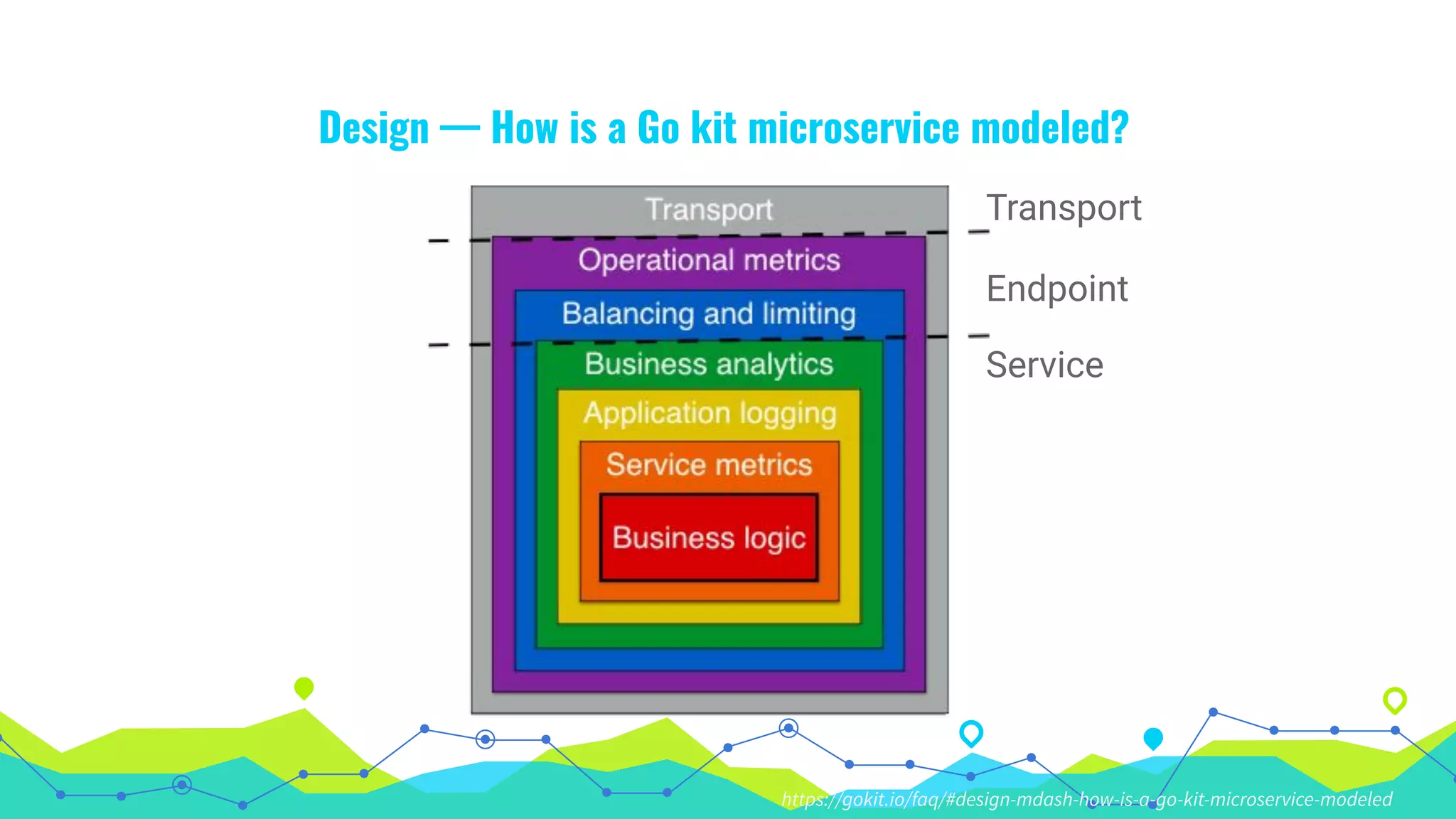
Design — How is a Go kit microservice modeled?
Transport
Endpoint
Service
https://gokit.io/faq/#design-mdash-how-is-a-go-kit-microservice-modeled
Go + microservices = Go kit - Speaker Deck - https://speakerdeck.com/peterbourgon/go-plus-microservices-equals-go-kit?slide=78
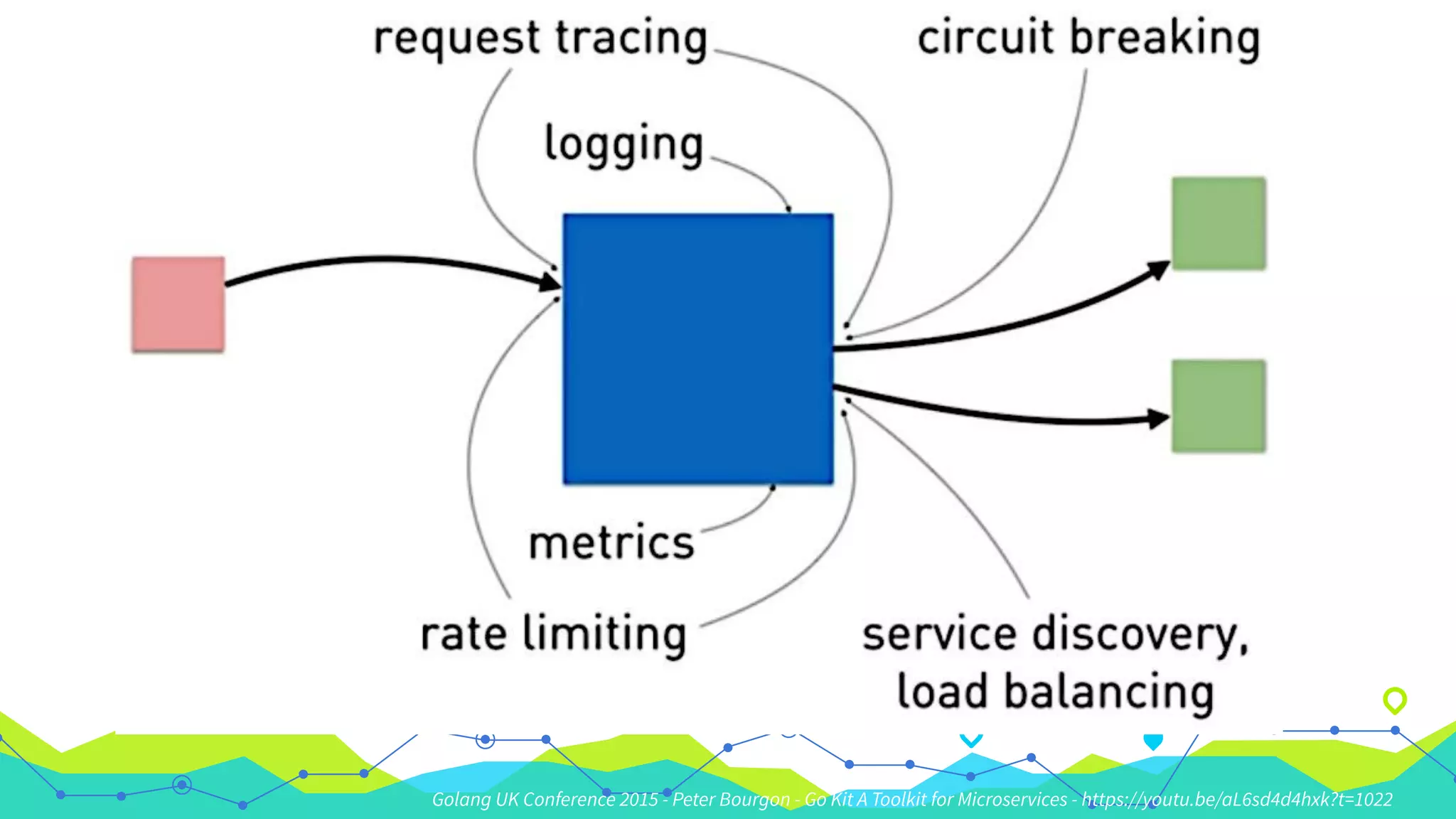
Golang UK Conference 2015 - Peter Bourgon - Go Kit A Toolkit for Microservices - https://youtu.be/aL6sd4d4hxk?t=1022
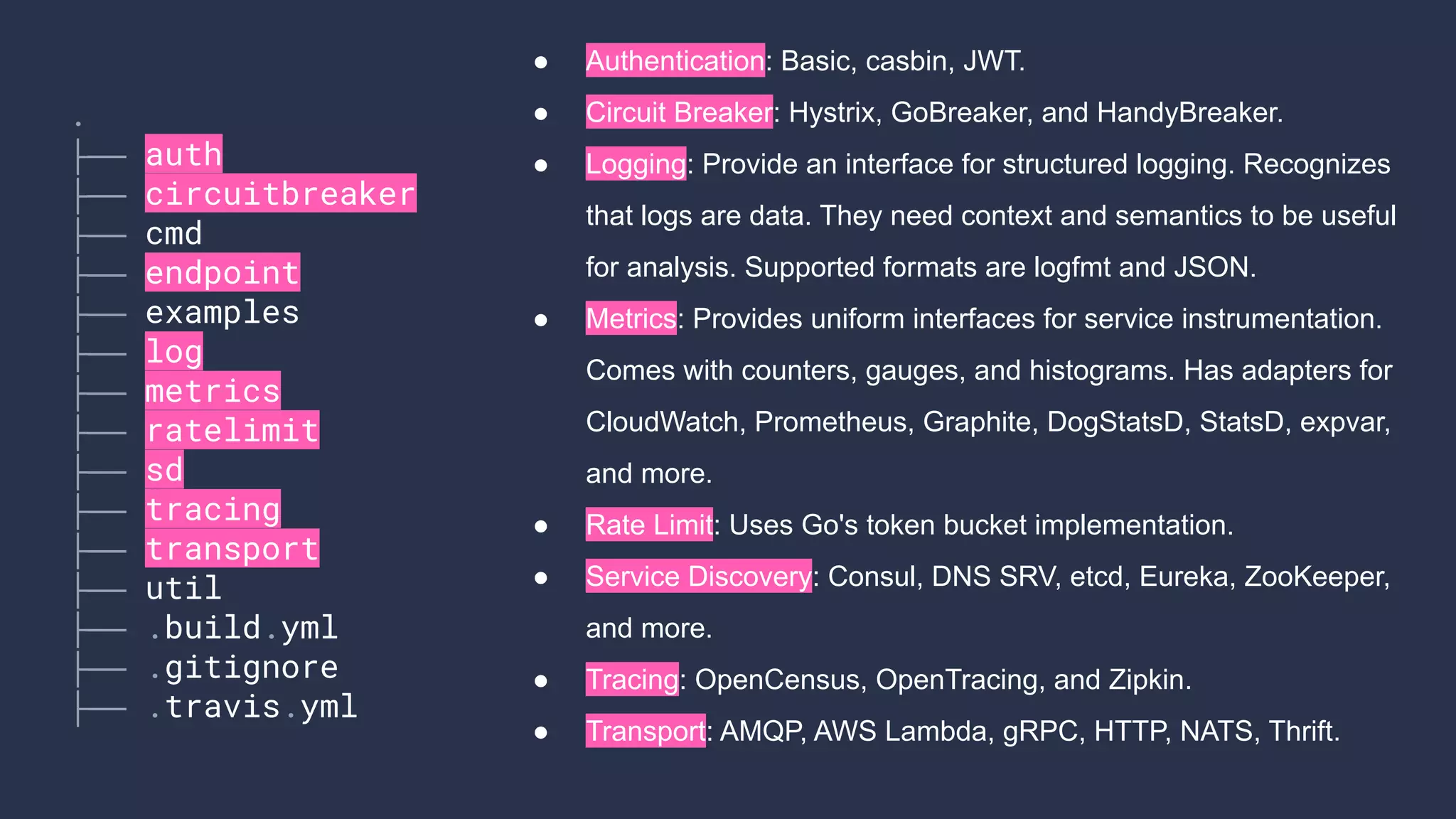
● Authentication: Basic, casbin, JWT.
● Circuit Breaker: Hystrix, GoBreaker, and HandyBreaker.
● Logging: Provide an interface for structured logging. Recognizes
that logs are data. They need context and semantics to be useful
for analysis. Supported formats are logfmt and JSON.
● Metrics: Provides uniform interfaces for service instrumentation.
Comes with counters, gauges, and histograms. Has adapters for
CloudWatch, Prometheus, Graphite, DogStatsD, StatsD, expvar,
and more.
● Rate Limit: Uses Go's token bucket implementation.
● Service Discovery: Consul, DNS SRV, etcd, Eureka, ZooKeeper,
and more.
● Tracing: OpenCensus, OpenTracing, and Zipkin.
● Transport: AMQP, AWS Lambda, gRPC, HTTP, NATS, Thrift.
.
├── auth
├── circuitbreaker
├── cmd
├── endpoint
├── examples
├── log
├── metrics
├── ratelimit
├── sd
├── tracing
├── transport
├── util
├── .build.yml
├── .gitignore
├── .travis.yml
DemoGokit generator: squaresvc
Service mesh
3
“Microservice cause technical
problems
~
Service Mesh solve technical
problems
What Is a Service Mesh? By NGINX
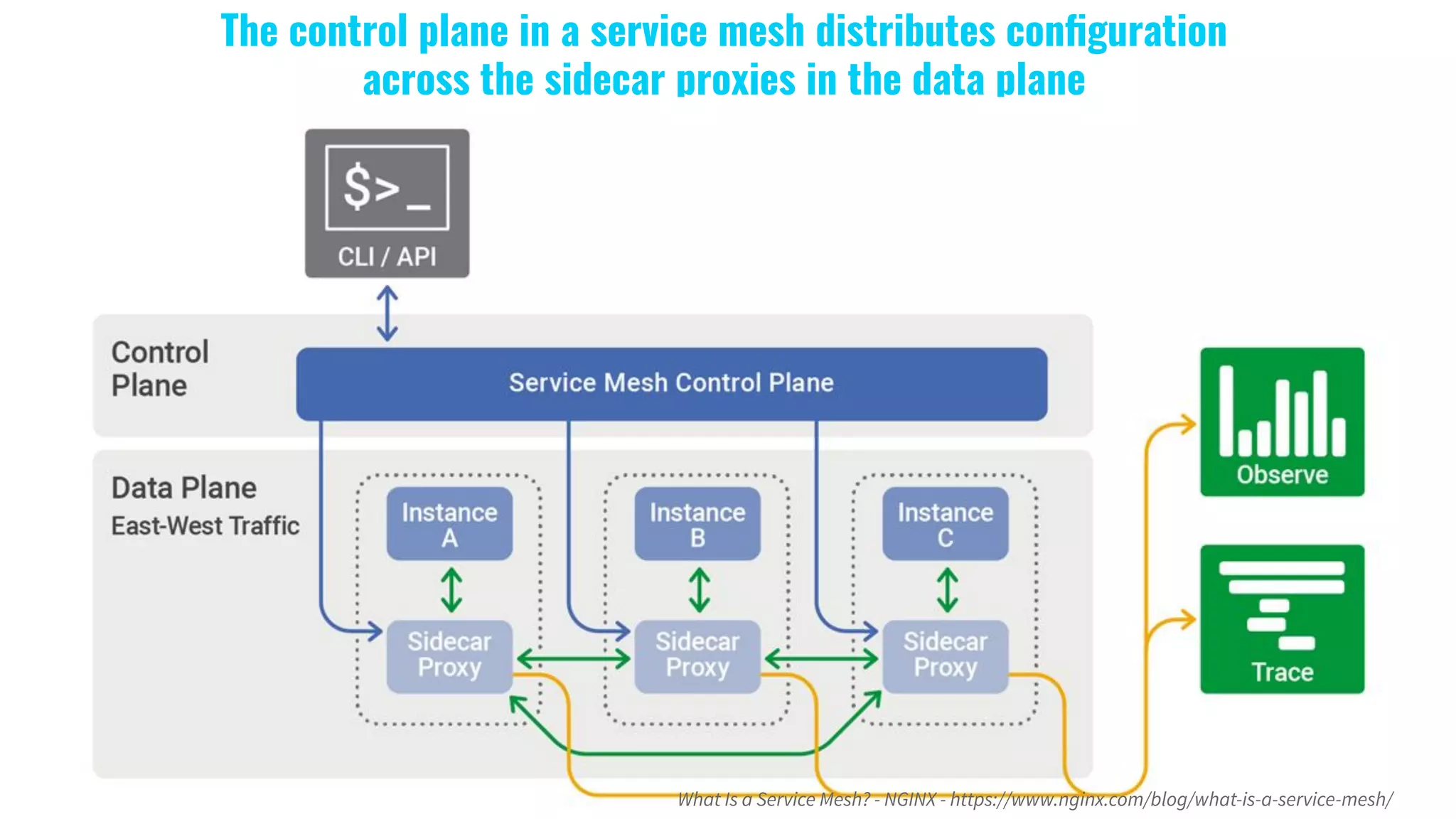
1. Container orchestration framework
2. Services and instances (Kubernetes pods).
3. Sidecar proxy
4. Service discovery
5. Load balancing
6. Encryption
7. Authentication and authorization
8. Support for the circuit breaker pattern
What Is a Service Mesh? - NGINX - https://www.nginx.com/blog/what-is-a-service-mesh/
The control plane in a service mesh distributes configuration
across the sidecar proxies in the data plane
What Is a Service Mesh? - NGINX - https://www.nginx.com/blog/what-is-a-service-mesh/
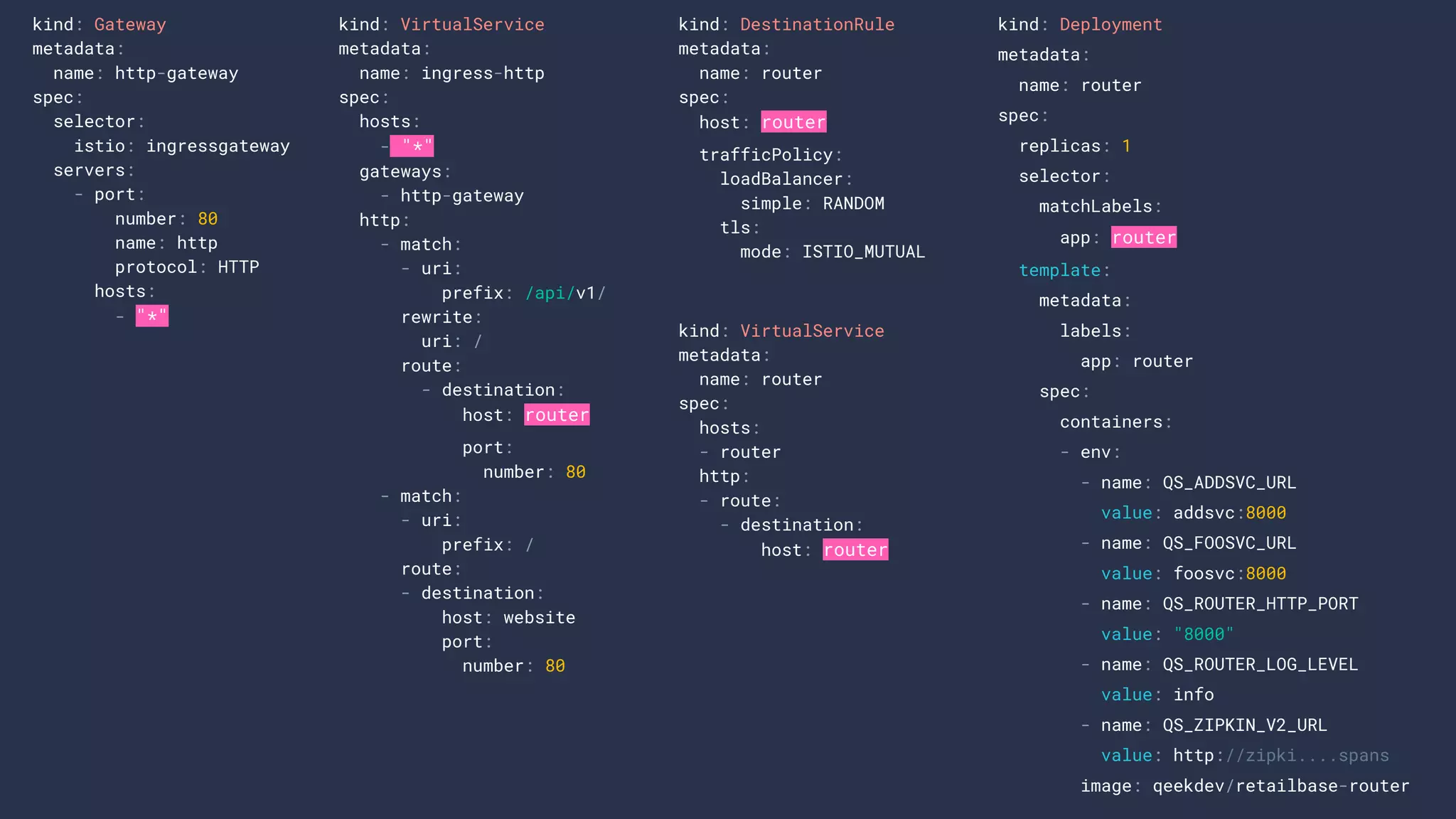
kind: Gateway
metadata:
name: http-gateway
spec:
selector:
istio: ingressgateway
servers:
- port:
number: 80
name: http
protocol: HTTP
hosts:
- "*"
kind: VirtualService
metadata:
name: ingress-http
spec:
hosts:
- "*"
gateways:
- http-gateway
http:
- match:
- uri:
prefix: /api/v1/
rewrite:
uri: /
route:
- destination:
host: router
port:
number: 80
- match:
- uri:
prefix: /
route:
- destination:
host: website
port:
number: 80
kind: DestinationRule
metadata:
name: router
spec:
host: router
trafficPolicy:
loadBalancer:
simple: RANDOM
tls:
mode: ISTIO_MUTUAL
kind: VirtualService
metadata:
name: router
spec:
hosts:
- router
http:
- route:
- destination:
host: router
kind: Deployment
metadata:
name: router
spec:
replicas: 1
selector:
matchLabels:
app: router
template:
metadata:
labels:
app: router
spec:
containers:
- env:
- name: QS_ADDSVC_URL
value: addsvc:8000
- name: QS_FOOSVC_URL
value: foosvc:8000
- name: QS_ROUTER_HTTP_PORT
value: "8000"
- name: QS_ROUTER_LOG_LEVEL
value: info
- name: QS_ZIPKIN_V2_URL
value: http://zipki....spans
image: qeekdev/retailbase-router
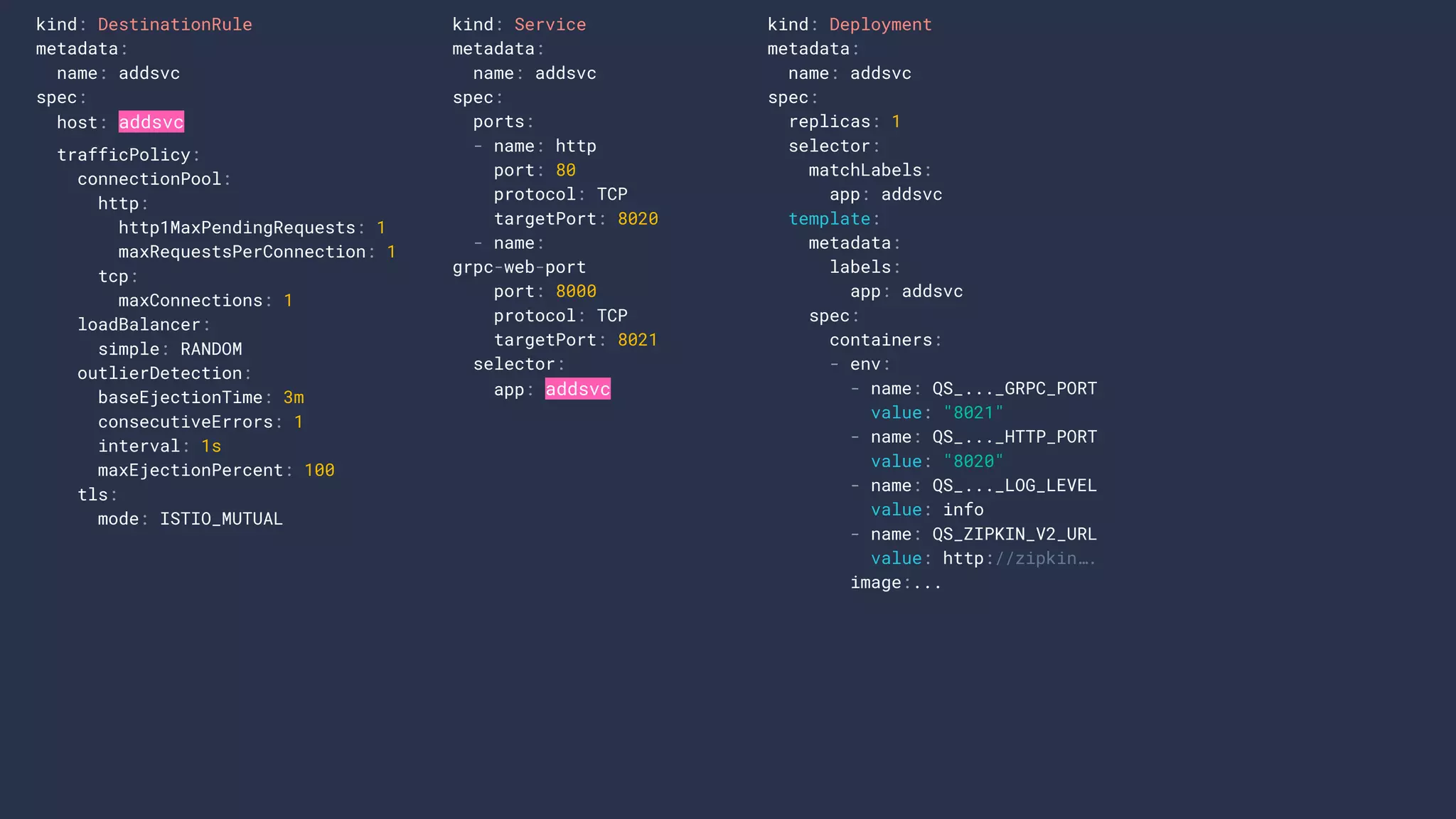
kind: DestinationRule
metadata:
name: addsvc
spec:
host: addsvc
trafficPolicy:
connectionPool:
http:
http1MaxPendingRequests: 1
maxRequestsPerConnection: 1
tcp:
maxConnections: 1
loadBalancer:
simple: RANDOM
outlierDetection:
baseEjectionTime: 3m
consecutiveErrors: 1
interval: 1s
maxEjectionPercent: 100
tls:
mode: ISTIO_MUTUAL
kind: Service
metadata:
name: addsvc
spec:
ports:
- name: http
port: 80
protocol: TCP
targetPort: 8020
- name:
grpc-web-port
port: 8000
protocol: TCP
targetPort: 8021
selector:
app: addsvc
kind: Deployment
metadata:
name: addsvc
spec:
replicas: 1
selector:
matchLabels:
app: addsvc
template:
metadata:
labels:
app: addsvc
spec:
containers:
- env:
- name: QS_..._GRPC_PORT
value: "8021"
- name: QS_..._HTTP_PORT
value: "8020"
- name: QS_..._LOG_LEVEL
value: info
- name: QS_ZIPKIN_V2_URL
value: http://zipkin….
image:...
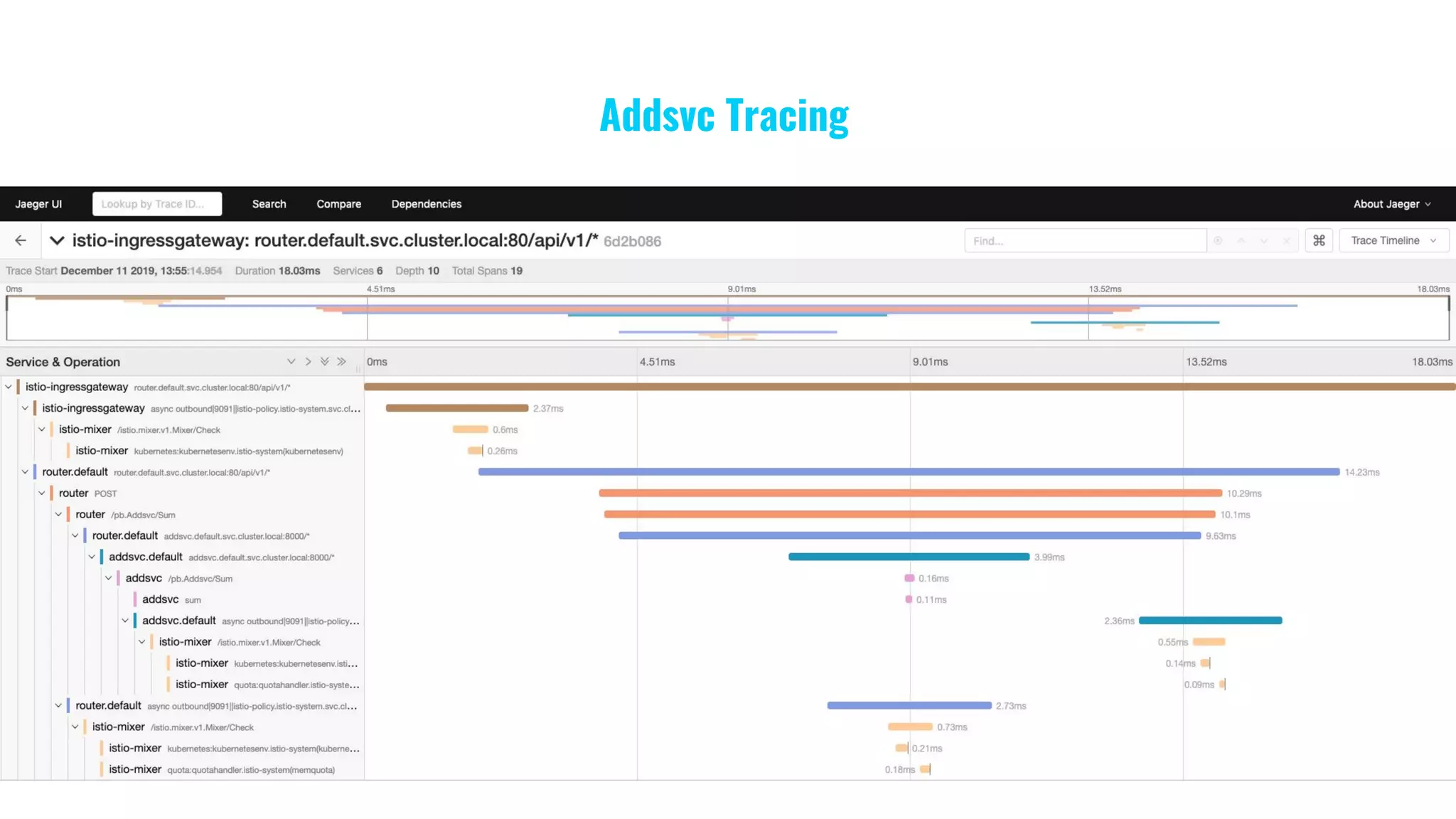
Addsvc Tracing
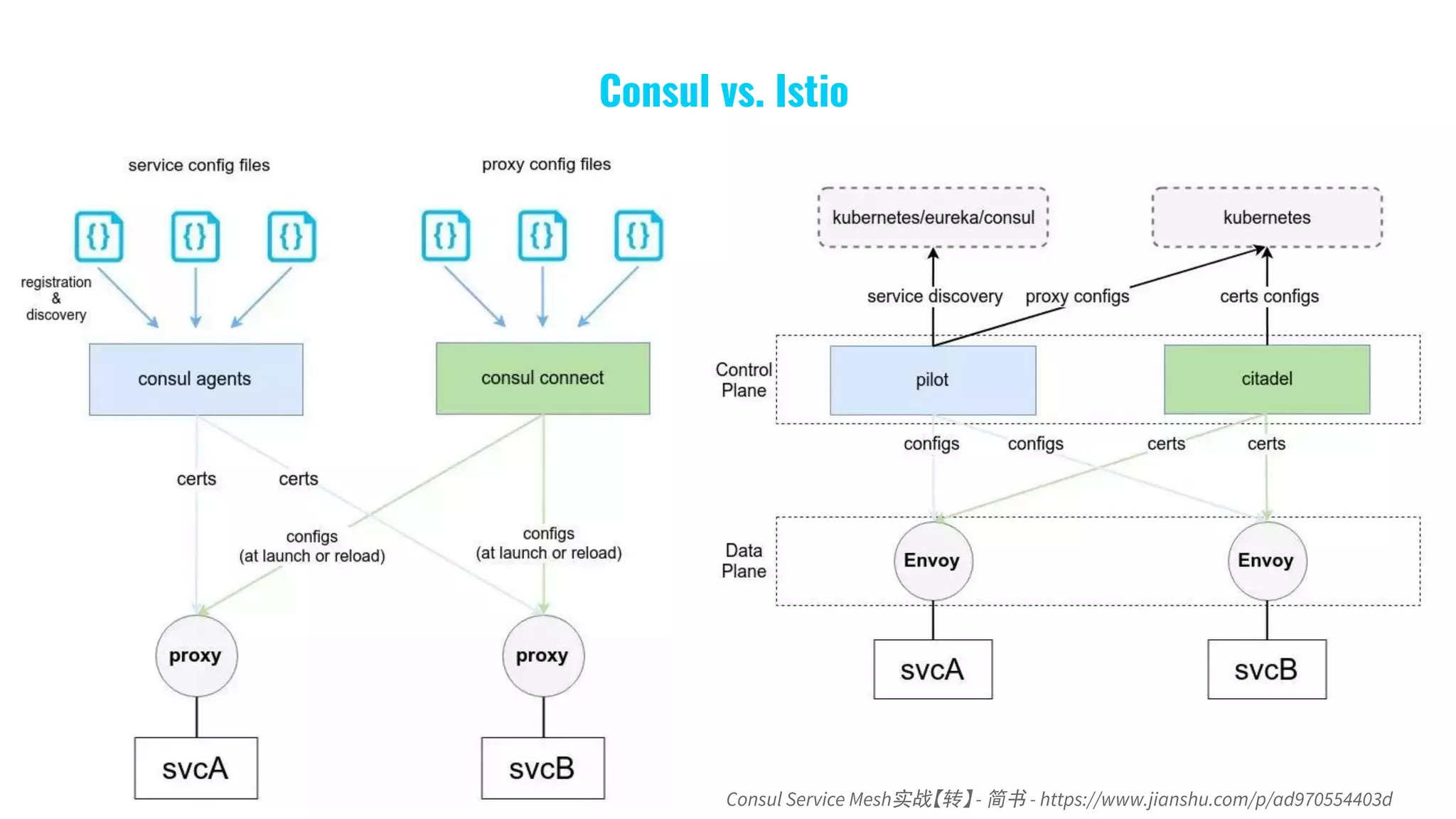
Consul vs. Istio
Consul Service Mesh实战【转】 - 简书 - https://www.jianshu.com/p/ad970554403d
Reference
1. Go + Microservices = Go Kit [I] - Peter Bourgon, Go Kit
2. Go kit
3. https://gokit.io/faq/
4. cage1016/gokitistio8s
5. cage1016/gk
6. What Is a Service Mesh?
Q & A

GDG Cloud Taipei meetup #50 - Build go kit microservices at kubernetes with ease

  • 1.
    Build go kitMicroservices at Kubernetes with ease
  • 2.
    HELLO! Cage Chung @CageChung @cage1016 cage.chung@gmail.com GDGCloud Taipei co-organizer Google Developer Expert (GCP)
  • 3.
  • 4.
    Gokitistiok8s go kit microservicedemo with istio & jaeger at kubernetes 1
  • 5.
    Gokitistiok8s (3 microservice) Router ◉HTTP ◉ GRPC Addsvc ◉ sum ◉ concat Foosvc ◉ foo istio (service discovery) Tracing (trace service) Prometheus (monitor) Grafana (monitor) Fluentd (log) Elasticsearch (log) Kibana (log)
  • 6.
  • 7.
  • 9.
    ├── cmd │ ├──addsvc │ │ └── main.go │ ├── foosvc │ │ └── main.go │ └── router │ └── main.go ├── consul-helm ├── deployments │ ├── docker │ │ ├── Dockerfile │ │ ├── Dockerfile.cleanbuild │ │ └── Dockerfile.debug │ └── helm │ ├── templates │ ├── .helmignore │ ├── Chart.yaml │ └── values.yaml ├── pkg │ ├── addsvc │ │ ├── endpoints │ │ ├── service │ │ └── transports │ ├── foosvc │ │ ├── endpoints │ │ │ ├── endpoints.go │ │ │ ├── middleware.go │ │ │ ├── requests.go │ │ │ └── responses.go │ │ ├── service │ │ │ ├── logging.go │ │ │ └── service.go │ │ └── transports │ │ ├── errors.go │ │ ├── grpc.go │ │ └── http.go │ └── router │ └── transports ├── makefile └── skaffold.yaml
  • 10.
    $ make rest_sum curl-X "POST" "http://35.187.144.211/api/v1/add/sum" -H 'Content-Type: application/json; charset=utf-8' -d '{ "a": 3, "b": 34}' {"apiVersion":"","data":{"rs":37}} $ make rest_concat curl -X "POST" "http://35.187.144.211/api/v1/add/concat" -H 'Content-Type: application/json; charset=utf-8' -d '{ "a": "3", "b": "34"}' {"apiVersion":"","data":{"rs":"334"}} $ make rest_foo curl -X "POST" "http://35.187.144.211/api/v1/foo/foo" -H 'Content-Type: application/json; charset=utf-8' -d '{"s": "foo"}' {"apiVersion":"","data":{"res":"foo bar"}} $ make grpc_sum grpcurl -plaintext -proto ./pb/addsvc/addsvc.proto -d '{"a": 3, "b":5}' 35.187.144.211:443 pb.Addsvc.Sum { "rs": "8" } $ make grpc_concat grpcurl -plaintext -proto ./pb/addsvc/addsvc.proto -d '{"a": "3", "b":"5"}' 35.187.144.211:443 pb.Addsvc.Concat { "rs": "35" } $ make grpc_foo grpcurl -plaintext -proto ./pb/foosvc/foosvc.proto -d '{"s": "foo"}' 35.187.144.211:443 pb.Foosvc.Foo { "res": "foo bar" }
  • 11.
  • 12.
  • 13.
  • 14.
    Problem solved 1. Teamare blocked on other teams, can’t make progress 2. Product velocity stalled
  • 15.
    Problem cause 1. Testingbecomes really hard 2. Build pipelines 3. Requires dev/ops culture: devs deploy and operate their work 4. Monitoring and instrumentation - tailing logs? 5. Distributed tracing 6. Security
  • 16.
    Go-kit goals 1. MakeGo a first-class citizen for business logic 2. Microservice architecture 3. RPC as the messaging pattern 4. Provide best practices, idioms, examples and patterns Golang UK Conference 2015 - Peter Bourgon - Go Kit A Toolkit for Microservices - https://www.youtube.com/watch?v=aL6sd4d4hxk
  • 17.
    Go-kit non-goals 1. Bea turnkey solution 2. Require any specific infrastructure 3. Have opinions about orchestration, configuration, etc. Golang UK Conference 2015 - Peter Bourgon - Go Kit A Toolkit for Microservices - https://www.youtube.com/watch?v=aL6sd4d4hxk
  • 18.
    Go HTTP Servers packagemain import ( "fmt" "net/http" ) func hello(w http.ResponseWriter, req *http.Request) { fmt.Fprintf(w, "Hello Devfest Taipei 2019") } func main() { http.HandleFunc("/", hello) http.ListenAndServe(":8888", nil) }
  • 19.
    Add service: serviceand implement type Addsvc interface { sum(a, b int64) (int64, error) } type SumRequest struct { A int64 `json:"a"` B int64 `json:"b"` } func (s *addService) sum(a, b int64) (int64, error) { return a + b, nil } type addService struct{}
  • 20.
    Transports: Implement HTTPhandler func (s *addService) ServeHTTP(w http.ResponseWriter, r *http.Request) { switch r.Method { case http.MethodPost: var req SumRequest if err := json.NewDecoder(r.Body).Decode(&req); err != nil { http.Error(w, err.Error(), http.StatusBadRequest) return } if res, err := s.sum(req.A, req.B); err != nil { http.Error(w, err.Error(), http.StatusInternalServerError) return } else { fmt.Fprint(w, res) } } }
  • 21.
    main.go func main() { http.ListenAndServe(":8888",&addService{}) } $ go run main.go $ curl -X "POST" "http://localhost:8888" -d '{ "a": 3, "b": 34}' 37 Addservice an HTTP handler, we can pass it to ListenAndServe
  • 22.
    Logging: try toadd logging func (s *addService) ServeHTTP(w http.ResponseWriter, r *http.Request) { switch r.Method { case http.MethodPost: var req SumRequest if err := json.NewDecoder(r.Body).Decode(&req); err != nil { code := http.StatusBadRequest http.Error(w, err.Error(), code) log.Printf("%s: %s %s %d", r.RemoteAddr, r.Method, r.URL, code) return } if res, err := s.sum(req.A, req.B); err != nil { code := http.StatusInternalServerError http.Error(w, err.Error(), code) log.Printf("%s: %s %s %d", r.RemoteAddr, r.Method, r.URL, code) return } else { log.Printf("%s: %s %s %d", r.RemoteAddr, r.Method, r.URL, 200) fmt.Fprint(w, res) } }
  • 23.
    Logging func main() { log.Printf("listeningon :8888") log.Fatal(http.ListenAndServe(":8888", &addService{})) } $ go run main.go 2019/11/29 15:24:29 listening on :8888 2019/11/29 15:24:32 [::1]:52200: POST / 200 $ curl -X "POST" "http://localhost:8888" -d '{ "a": 3, "b": 34}' 37
  • 24.
    Endpoint Endpoint is thefundamental building block of servers and clients.It represents a single RPC method. type Endpoint func(request) (response) type Endpoint func(ctx context.Context, request interface{}) (response interface{}, err error)
  • 25.
    Add service endpoint Createendpoint by add service constructor and keep add service pure func MakePostSumEndpoint(s addService) endpoint.Endpoint { return func(_ context.Context, request interface{}) (response interface{}, err error) { p := request.(SumRequest) return s.sum(p.A, p.B) } }
  • 26.
    Endpoint middleware Middleware isa chainable behavior modifier for endpoints. type Middleware func(Endpoint) Endpoint
  • 27.
    Logging middleware Create endpointby add service constructor and keep add service pure func loggingMiddleware(next endpoint.Endpoint) endpoint.Endpoint { return func(ctx context.Context, request interface{}) (response interface{}, err error) { begin := time.Now() defer func() { log.Printf("request took %s", time.Since(begin)) }() return next(ctx, request) } } s := addService{} var e endpoint.Endpoint e = MakePostSumEndpoint(s) e = loggingMiddleware(e)
  • 28.
    Http transport Go kitcomes with handy HTTP transport. NewServer constructs a new server, which implements http.Handler and wraps the provided endpoint. func NewServer( e endpoint.Endpoint, dec DecodeRequestFunc, enc EncodeResponseFunc, options ...ServerOption, ) *Server { ... } postSum := httptransport.NewServer(e, decodeHTTPSumRequest, httptransport.EncodeJSONResponse) r := mux.NewRouter() r.Methods(http.MethodPost).Handler(postSum) log.Printf("listening on :8888") log.Fatal(http.ListenAndServe(":8888", r))
  • 29.
    Design — Howis a Go kit microservice modeled? Transport Endpoint Service https://gokit.io/faq/#design-mdash-how-is-a-go-kit-microservice-modeled
  • 30.
    Go + microservices= Go kit - Speaker Deck - https://speakerdeck.com/peterbourgon/go-plus-microservices-equals-go-kit?slide=78
  • 31.
    Golang UK Conference2015 - Peter Bourgon - Go Kit A Toolkit for Microservices - https://youtu.be/aL6sd4d4hxk?t=1022
  • 32.
    ● Authentication: Basic,casbin, JWT. ● Circuit Breaker: Hystrix, GoBreaker, and HandyBreaker. ● Logging: Provide an interface for structured logging. Recognizes that logs are data. They need context and semantics to be useful for analysis. Supported formats are logfmt and JSON. ● Metrics: Provides uniform interfaces for service instrumentation. Comes with counters, gauges, and histograms. Has adapters for CloudWatch, Prometheus, Graphite, DogStatsD, StatsD, expvar, and more. ● Rate Limit: Uses Go's token bucket implementation. ● Service Discovery: Consul, DNS SRV, etcd, Eureka, ZooKeeper, and more. ● Tracing: OpenCensus, OpenTracing, and Zipkin. ● Transport: AMQP, AWS Lambda, gRPC, HTTP, NATS, Thrift. . ├── auth ├── circuitbreaker ├── cmd ├── endpoint ├── examples ├── log ├── metrics ├── ratelimit ├── sd ├── tracing ├── transport ├── util ├── .build.yml ├── .gitignore ├── .travis.yml
  • 33.
  • 34.
  • 35.
  • 36.
    What Is aService Mesh? By NGINX 1. Container orchestration framework 2. Services and instances (Kubernetes pods). 3. Sidecar proxy 4. Service discovery 5. Load balancing 6. Encryption 7. Authentication and authorization 8. Support for the circuit breaker pattern What Is a Service Mesh? - NGINX - https://www.nginx.com/blog/what-is-a-service-mesh/
  • 37.
    The control planein a service mesh distributes configuration across the sidecar proxies in the data plane What Is a Service Mesh? - NGINX - https://www.nginx.com/blog/what-is-a-service-mesh/
  • 38.
    kind: Gateway metadata: name: http-gateway spec: selector: istio:ingressgateway servers: - port: number: 80 name: http protocol: HTTP hosts: - "*" kind: VirtualService metadata: name: ingress-http spec: hosts: - "*" gateways: - http-gateway http: - match: - uri: prefix: /api/v1/ rewrite: uri: / route: - destination: host: router port: number: 80 - match: - uri: prefix: / route: - destination: host: website port: number: 80 kind: DestinationRule metadata: name: router spec: host: router trafficPolicy: loadBalancer: simple: RANDOM tls: mode: ISTIO_MUTUAL kind: VirtualService metadata: name: router spec: hosts: - router http: - route: - destination: host: router kind: Deployment metadata: name: router spec: replicas: 1 selector: matchLabels: app: router template: metadata: labels: app: router spec: containers: - env: - name: QS_ADDSVC_URL value: addsvc:8000 - name: QS_FOOSVC_URL value: foosvc:8000 - name: QS_ROUTER_HTTP_PORT value: "8000" - name: QS_ROUTER_LOG_LEVEL value: info - name: QS_ZIPKIN_V2_URL value: http://zipki....spans image: qeekdev/retailbase-router
  • 39.
    kind: DestinationRule metadata: name: addsvc spec: host:addsvc trafficPolicy: connectionPool: http: http1MaxPendingRequests: 1 maxRequestsPerConnection: 1 tcp: maxConnections: 1 loadBalancer: simple: RANDOM outlierDetection: baseEjectionTime: 3m consecutiveErrors: 1 interval: 1s maxEjectionPercent: 100 tls: mode: ISTIO_MUTUAL kind: Service metadata: name: addsvc spec: ports: - name: http port: 80 protocol: TCP targetPort: 8020 - name: grpc-web-port port: 8000 protocol: TCP targetPort: 8021 selector: app: addsvc kind: Deployment metadata: name: addsvc spec: replicas: 1 selector: matchLabels: app: addsvc template: metadata: labels: app: addsvc spec: containers: - env: - name: QS_..._GRPC_PORT value: "8021" - name: QS_..._HTTP_PORT value: "8020" - name: QS_..._LOG_LEVEL value: info - name: QS_ZIPKIN_V2_URL value: http://zipkin…. image:...
  • 40.
  • 41.
    Consul vs. Istio ConsulService Mesh实战【转】 - 简书 - https://www.jianshu.com/p/ad970554403d
  • 42.
    Reference 1. Go +Microservices = Go Kit [I] - Peter Bourgon, Go Kit 2. Go kit 3. https://gokit.io/faq/ 4. cage1016/gokitistio8s 5. cage1016/gk 6. What Is a Service Mesh?
  • 43.