Buy Now Pay Later (BNPL): A
convenience or a trap
BNPL also known as Buy Now Pay Later is a payment
option where you can make a purchase without
having to pay the full amount at the time of purchase.
Typically, you sign up with a company providing this
facility who makes the payment when you make the
purchase. However, once the lender pays on your
behalf, you will have to repay the amount within a
specified time period. When compared to a personal
loan, generally no interest is levied under the BNPL
scheme. You can either pay it as a lumpsum amount,
or you can pay it via no cost Equated Monthly
Instalments (EMIs). If you fail to pay the amount
within the given repayment tenure, then the lender
will be liable to charge you interest on your amount.
Further delay could impact your credit score.
Here's how BNPL usually works:
1. Customer make a purchase at a participating
retailer.
2. Opts for the ‘Buy now, pay later’ option.
3. Makes a small down payment of the overall
purchase amount and completes the
transaction.
4. The remaining amount shall be deducted in a
series of interest-free EMIs.
5. The payment of EMIs is made via bank transfer,
cheques, credit card, debit card or directly from
the bank account.
 Increases affordability
 Instant access to credit
 Safe and secure transaction
 Can choose repayment tenure
 No cost EMI
 Simple process
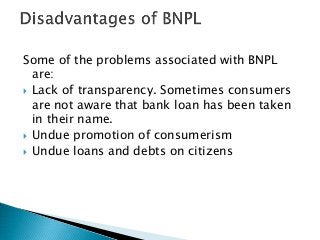
Some of the problems associated with BNPL
are:
 Lack of transparency. Sometimes consumers
are not aware that bank loan has been taken
in their name.
 Undue promotion of consumerism
 Undue loans and debts on citizens
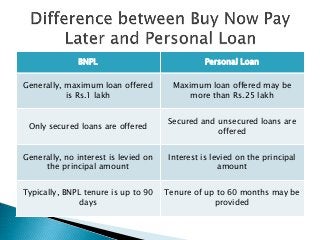
BNPL Personal Loan
Generally, maximum loan offered
is Rs.1 lakh
Maximum loan offered may be
more than Rs.25 lakh
Only secured loans are offered
Secured and unsecured loans are
offered
Generally, no interest is levied on
the principal amount
Interest is levied on the principal
amount
Typically, BNPL tenure is up to 90
days
Tenure of up to 60 months may be
provided
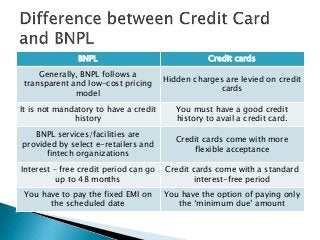
BNPL Credit cards
Generally, BNPL follows a
transparent and low-cost pricing
model
Hidden charges are levied on credit
cards
It is not mandatory to have a credit
history
You must have a good credit
history to avail a credit card.
BNPL services/facilities are
provided by select e-retailers and
fintech organizations
Credit cards come with more
flexible acceptance
Interest – free credit period can go
up to 48 months
Credit cards come with a standard
interest-free period
You have to pay the fixed EMI on
the scheduled date
You have the option of paying only
the ‘minimum due’ amount
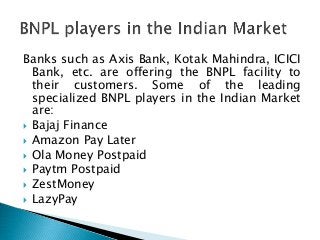
Banks such as Axis Bank, Kotak Mahindra, ICICI
Bank, etc. are offering the BNPL facility to
their customers. Some of the leading
specialized BNPL players in the Indian Market
are:
 Bajaj Finance
 Amazon Pay Later
 Ola Money Postpaid
 Paytm Postpaid
 ZestMoney
 LazyPay
BNPL makes money from both sellers and
consumers. In case of sellers, they pay BNPL a
fee ranging between 2% and 8% of the
purchasing amount if the customer uses the
BNPL facility. BNPL players also make money
from customers by charging an interest on
delays ranging between 10% and 30% based
on their credit score, repayment tenure, etc.
 Many fintech firms have stopped the buy now pay later
(BNPL) services after a recent Reserve Bank of India
notification. The new guidelines, issued by the RBI last
month, stopped non-bank prepaid payment instruments
(PPIs) from being loaded with credit lines. The central
bank's move comes amid rising concerns over card-based
credit services and PPIs being loaded through credit lines.
 According to the RBI, the new credit instruments could
result in systemic risk. The new-age fintech firms are
using lines of credit from banks and non-banking financial
companies (NBFCs) to load customer wallets. The bank
regulator is apprehensive about a lack of due diligence
while loading the PPIs through credit lines.
 The new RBI guidelines, issued on June 20, have
sent the fintech companies into a tizzy and many
have temporarily stopped prepaid instruments.
According to the new directive, non-banking
companies cannot offer credit cards or other PPIs
without the prior approval of RBI. However, the
customers can load their pre-paid wallets with
cash or use credit and debit cards issued by their
banks for the same.
 Fintech firms have requested a clarification from
the RBI as the new guidelines have caused a
disruption in the industry, especially adversely
affecting small players.
Fintech startup PayU India's lending platform,
LazyPay, has temporarily discontinued its buy
now pay later product LazyPlus UPI. Online
credit service platforms Jupiter, EarlySalary
and KreditBee have temporarily halted all
transactions through their prepaid
cards. Slice and Uni also have restricted
issuances of new credit cards after the RBI
directive, the ET report mentioned quoting
sources.
G.D topic Buy now Pay later.pptx

G.D topic Buy now Pay later.pptx

  • 1.
    Buy Now PayLater (BNPL): A convenience or a trap
  • 2.
    BNPL also knownas Buy Now Pay Later is a payment option where you can make a purchase without having to pay the full amount at the time of purchase. Typically, you sign up with a company providing this facility who makes the payment when you make the purchase. However, once the lender pays on your behalf, you will have to repay the amount within a specified time period. When compared to a personal loan, generally no interest is levied under the BNPL scheme. You can either pay it as a lumpsum amount, or you can pay it via no cost Equated Monthly Instalments (EMIs). If you fail to pay the amount within the given repayment tenure, then the lender will be liable to charge you interest on your amount. Further delay could impact your credit score.
  • 3.
    Here's how BNPLusually works: 1. Customer make a purchase at a participating retailer. 2. Opts for the ‘Buy now, pay later’ option. 3. Makes a small down payment of the overall purchase amount and completes the transaction. 4. The remaining amount shall be deducted in a series of interest-free EMIs. 5. The payment of EMIs is made via bank transfer, cheques, credit card, debit card or directly from the bank account.
  • 4.
     Increases affordability Instant access to credit  Safe and secure transaction  Can choose repayment tenure  No cost EMI  Simple process
  • 5.
    Some of theproblems associated with BNPL are:  Lack of transparency. Sometimes consumers are not aware that bank loan has been taken in their name.  Undue promotion of consumerism  Undue loans and debts on citizens
  • 6.
    BNPL Personal Loan Generally,maximum loan offered is Rs.1 lakh Maximum loan offered may be more than Rs.25 lakh Only secured loans are offered Secured and unsecured loans are offered Generally, no interest is levied on the principal amount Interest is levied on the principal amount Typically, BNPL tenure is up to 90 days Tenure of up to 60 months may be provided
  • 7.
    BNPL Credit cards Generally,BNPL follows a transparent and low-cost pricing model Hidden charges are levied on credit cards It is not mandatory to have a credit history You must have a good credit history to avail a credit card. BNPL services/facilities are provided by select e-retailers and fintech organizations Credit cards come with more flexible acceptance Interest – free credit period can go up to 48 months Credit cards come with a standard interest-free period You have to pay the fixed EMI on the scheduled date You have the option of paying only the ‘minimum due’ amount
  • 8.
    Banks such asAxis Bank, Kotak Mahindra, ICICI Bank, etc. are offering the BNPL facility to their customers. Some of the leading specialized BNPL players in the Indian Market are:  Bajaj Finance  Amazon Pay Later  Ola Money Postpaid  Paytm Postpaid  ZestMoney  LazyPay
  • 9.
    BNPL makes moneyfrom both sellers and consumers. In case of sellers, they pay BNPL a fee ranging between 2% and 8% of the purchasing amount if the customer uses the BNPL facility. BNPL players also make money from customers by charging an interest on delays ranging between 10% and 30% based on their credit score, repayment tenure, etc.
  • 10.
     Many fintechfirms have stopped the buy now pay later (BNPL) services after a recent Reserve Bank of India notification. The new guidelines, issued by the RBI last month, stopped non-bank prepaid payment instruments (PPIs) from being loaded with credit lines. The central bank's move comes amid rising concerns over card-based credit services and PPIs being loaded through credit lines.  According to the RBI, the new credit instruments could result in systemic risk. The new-age fintech firms are using lines of credit from banks and non-banking financial companies (NBFCs) to load customer wallets. The bank regulator is apprehensive about a lack of due diligence while loading the PPIs through credit lines.
  • 11.
     The newRBI guidelines, issued on June 20, have sent the fintech companies into a tizzy and many have temporarily stopped prepaid instruments. According to the new directive, non-banking companies cannot offer credit cards or other PPIs without the prior approval of RBI. However, the customers can load their pre-paid wallets with cash or use credit and debit cards issued by their banks for the same.  Fintech firms have requested a clarification from the RBI as the new guidelines have caused a disruption in the industry, especially adversely affecting small players.
  • 12.
    Fintech startup PayUIndia's lending platform, LazyPay, has temporarily discontinued its buy now pay later product LazyPlus UPI. Online credit service platforms Jupiter, EarlySalary and KreditBee have temporarily halted all transactions through their prepaid cards. Slice and Uni also have restricted issuances of new credit cards after the RBI directive, the ET report mentioned quoting sources.