A WIDER PERSPECTIVE
Special Thematic Event on “Building Synergy and Coherence in the Implementation of the
Istanbul Plan of Action in the Context of the 2030 Sustainable Development Agenda”
Presentation at the Trusteeship Council Chamber, UN HQs
New York, USA, 11 February 2016
By Finn Tarp, Director, UNU-WIDER
Introduction
• Highlight: the overlap and synergy between the 5 objectives and 8 priority areas of the
IPoA and the 17 SDGs – and stress that the 2030 Agenda aptly recognises the need for
special attention to the LDCs
• Question: What are the measures the development partners and international
organizations should adopt to scale up support and facilitate the realization of the IPoA
and the 2030 Agenda by the LDCs?
• Focus on 5 sets of concerns (which emerge from 5 UNU-WIDER research programmes)
– In 5 minutes + a conclusion
• WIDER web-site: see https://www.wider.unu.edu/
1. Growth and Poverty (GAPP)
• Carried out 16 carefully designed country case studies from the 24 most populous
countries in sub-Saharan Africa
– Covering almost 75% of the African population and 9 of the largest 10 countries
– Focus on monetary and non-monetary indicators of well-being
• Key message: There is a lot to celebrate in African development + those which succeed
have taken agriculture and economic transformation serious
• Yet, key challenges remain:
– By 2013 GDP/capita was only 7.7% higher than in 1974 => growth remains indispensable
– Aid to LDCs is falling => risk of leaving those most in need behind
• For more on GAPP: see https://www.wider.unu.edu/project/reconciling-
africa%E2%80%99s-growth-poverty-and-inequality-trends-growth-and-poverty-project-
gapp
2. Research and Communication on Foreign Aid
(ReCom)
• Brought together more than 300 researchers from 59 countries; who
produced 247 original studies under 5 core themes (including gender
equality) + a synthesis paper
• Key message: aid is effective, and has a very respectable rate of return;
including in places with weak institutional environments
• Yes, there is also a lot to improve:
– Fragmentation remains high and very costly, and see
https://www.wider.unu.edu/publication/aid-post-2015-world for 15 succinct
ReCom findings/recommendations
3. Learning to Compete (L2C)
• A four year UNU-WIDER, Brookings and AfDB research programme, which offers a
comprehensive, comparative, cross-country analysis of Africa’s economic
transformation and industrialization experience
• And 3 high profile books are just about to be launched (including contributions by
Nobel price laureates)
• With 3 key messages: business as usual is not enough; structural transformation is
very slow; and employment creation is severely lagging
• So only with a more strategic approach to industrial policy, the role of the state and
private sector, and a strong commitment of the region’s political leadership can
Africa industrialize
• https://www.wider.unu.edu/project/learning-compete-l2c-accelerating-industrial-
development-africa
4. Development Under Climate Change
(DUCC)
• WIDER has carried out a series of comprehensive country level climate change
assessments and developed cutting edge approaches to evaluating energy policy
choices
• Key messages:
– Deliberate long term planning accounting for the many uncertainties in climate change impacts is
critically needed for effective adaptation; and successful implementation and deepening of the
CoP21 agreement is crucial for mitigation
– At the same time: LDCs have intrinsic advantages in renewable energy production. Africa’s large
hydropower potential could be linked with its very substantial wind and solar resources to generate
clean reliable power at low cost
• For more on DUCC: see https://www.wider.unu.edu/project/ducc-%E2%80%93-
development-under-climate-change
5. Data to Support the SDGs
• WIDER is home of the World Income Inequality Data Base (WIID) – so what
do we know about global inequality trends?
• A key message: technical assistance and capacity building is critical in
developing the necessary data systems called for
• But it is not only technical issues that are faced: widespread political
sensitivities exist – and the lack of data by gender is striking
• For more on the WIID: see https://www.wider.unu.edu/project/wiid-world-
income-inequality-database
UN High-Level Panel report on the post-2015
development agenda
• Called for:
• “..A quantum leap forward in economic opportunities
and a profound economic transformation to end
extreme poverty and improve livelihoods…”
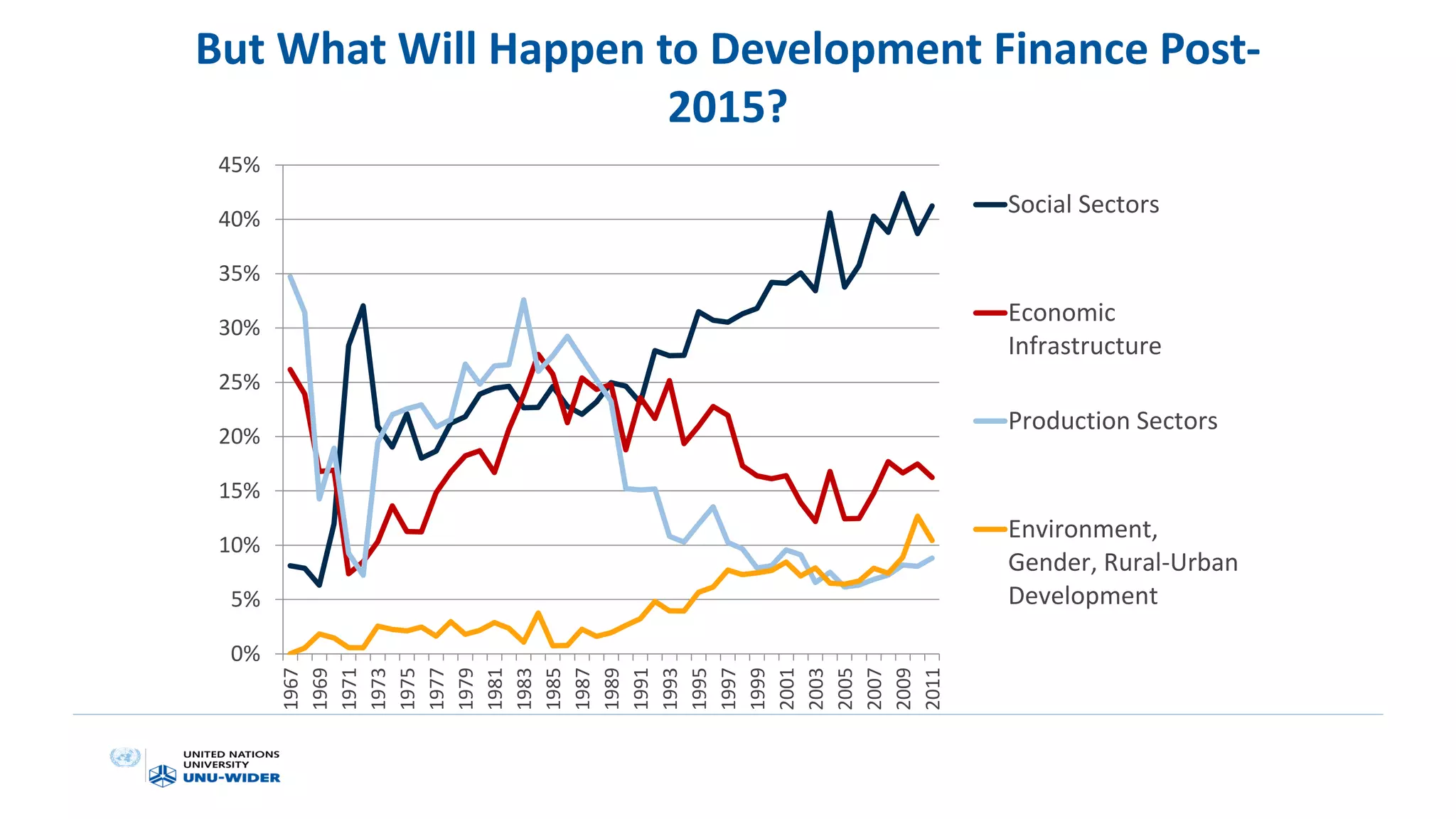
But What Will Happen to Development Finance Post-
2015?
0%
5%
10%
15%
20%
25%
30%
35%
40%
45%
1967
1969
1971
1973
1975
1977
1979
1981
1983
1985
1987
1989
1991
1993
1995
1997
1999
2001
2003
2005
2007
2009
2011
Social Sectors
Economic
Infrastructure
Production Sectors
Environment,
Gender, Rural-Urban
Development
A Dilemma
• Where does: growth, jobs, improved livelihoods, poverty reduction, and
reduced inequality (including gender equity) come from?
• In the years to come it will be even more critical than in the past to work
on:
– Creating a conducive physical and policy environment
– Mobilising the necessary financial resources (private and public) for
investments in infrastructure and human capital
– Generating new ideas and knowledge
• Scaling up as suggested here is indispensable for the success of the IPoA as
well as the 2030 SDG agenda
www.wider.unu.edu
Helsinki, Finland

Finn Tarp's presentation at 'Building synergy and coherence in the implementation of the Istanbul Programme of Action in the context of the 2030 Development Agenda'

  • 1.
    A WIDER PERSPECTIVE SpecialThematic Event on “Building Synergy and Coherence in the Implementation of the Istanbul Plan of Action in the Context of the 2030 Sustainable Development Agenda” Presentation at the Trusteeship Council Chamber, UN HQs New York, USA, 11 February 2016 By Finn Tarp, Director, UNU-WIDER
  • 2.
    Introduction • Highlight: theoverlap and synergy between the 5 objectives and 8 priority areas of the IPoA and the 17 SDGs – and stress that the 2030 Agenda aptly recognises the need for special attention to the LDCs • Question: What are the measures the development partners and international organizations should adopt to scale up support and facilitate the realization of the IPoA and the 2030 Agenda by the LDCs? • Focus on 5 sets of concerns (which emerge from 5 UNU-WIDER research programmes) – In 5 minutes + a conclusion • WIDER web-site: see https://www.wider.unu.edu/
  • 3.
    1. Growth andPoverty (GAPP) • Carried out 16 carefully designed country case studies from the 24 most populous countries in sub-Saharan Africa – Covering almost 75% of the African population and 9 of the largest 10 countries – Focus on monetary and non-monetary indicators of well-being • Key message: There is a lot to celebrate in African development + those which succeed have taken agriculture and economic transformation serious • Yet, key challenges remain: – By 2013 GDP/capita was only 7.7% higher than in 1974 => growth remains indispensable – Aid to LDCs is falling => risk of leaving those most in need behind • For more on GAPP: see https://www.wider.unu.edu/project/reconciling- africa%E2%80%99s-growth-poverty-and-inequality-trends-growth-and-poverty-project- gapp
  • 4.
    2. Research andCommunication on Foreign Aid (ReCom) • Brought together more than 300 researchers from 59 countries; who produced 247 original studies under 5 core themes (including gender equality) + a synthesis paper • Key message: aid is effective, and has a very respectable rate of return; including in places with weak institutional environments • Yes, there is also a lot to improve: – Fragmentation remains high and very costly, and see https://www.wider.unu.edu/publication/aid-post-2015-world for 15 succinct ReCom findings/recommendations
  • 5.
    3. Learning toCompete (L2C) • A four year UNU-WIDER, Brookings and AfDB research programme, which offers a comprehensive, comparative, cross-country analysis of Africa’s economic transformation and industrialization experience • And 3 high profile books are just about to be launched (including contributions by Nobel price laureates) • With 3 key messages: business as usual is not enough; structural transformation is very slow; and employment creation is severely lagging • So only with a more strategic approach to industrial policy, the role of the state and private sector, and a strong commitment of the region’s political leadership can Africa industrialize • https://www.wider.unu.edu/project/learning-compete-l2c-accelerating-industrial- development-africa
  • 6.
    4. Development UnderClimate Change (DUCC) • WIDER has carried out a series of comprehensive country level climate change assessments and developed cutting edge approaches to evaluating energy policy choices • Key messages: – Deliberate long term planning accounting for the many uncertainties in climate change impacts is critically needed for effective adaptation; and successful implementation and deepening of the CoP21 agreement is crucial for mitigation – At the same time: LDCs have intrinsic advantages in renewable energy production. Africa’s large hydropower potential could be linked with its very substantial wind and solar resources to generate clean reliable power at low cost • For more on DUCC: see https://www.wider.unu.edu/project/ducc-%E2%80%93- development-under-climate-change
  • 7.
    5. Data toSupport the SDGs • WIDER is home of the World Income Inequality Data Base (WIID) – so what do we know about global inequality trends? • A key message: technical assistance and capacity building is critical in developing the necessary data systems called for • But it is not only technical issues that are faced: widespread political sensitivities exist – and the lack of data by gender is striking • For more on the WIID: see https://www.wider.unu.edu/project/wiid-world- income-inequality-database
  • 8.
    UN High-Level Panelreport on the post-2015 development agenda • Called for: • “..A quantum leap forward in economic opportunities and a profound economic transformation to end extreme poverty and improve livelihoods…”
  • 9.
    But What WillHappen to Development Finance Post- 2015? 0% 5% 10% 15% 20% 25% 30% 35% 40% 45% 1967 1969 1971 1973 1975 1977 1979 1981 1983 1985 1987 1989 1991 1993 1995 1997 1999 2001 2003 2005 2007 2009 2011 Social Sectors Economic Infrastructure Production Sectors Environment, Gender, Rural-Urban Development
  • 10.
    A Dilemma • Wheredoes: growth, jobs, improved livelihoods, poverty reduction, and reduced inequality (including gender equity) come from? • In the years to come it will be even more critical than in the past to work on: – Creating a conducive physical and policy environment – Mobilising the necessary financial resources (private and public) for investments in infrastructure and human capital – Generating new ideas and knowledge • Scaling up as suggested here is indispensable for the success of the IPoA as well as the 2030 SDG agenda
  • 11.