DATA CENTRE STRATEGY, G-CLOUD &
         GOVERNMENT APPLICATIONS STORE
               PROGRAMME PHASE 2

                   PHASE 2 SCOPE REPORT


Authors: Martin Bellamy and Gerry Gallagher
Date: 10 February 2011
Version No: 0.35


                                  UNCLASSIFIED
Data Centre Strategy, G-Cloud & Government Applications Store Programme Phase 2


Summary of Vision

Introduction

1.1     At the core of the programme is the vision of providing political, business and ICT
leaders with greatly improved agility, flexibility and choice in the ICT that enables the public
sector and to deliver substantial cost savings on both existing and new ICT services. This will
involve a wholesale move to shared utility style ICT services for use as „the default‟ across
the public sector. Citizens, staff and the third sector will benefit from greater innovation and
choice and from more personalised presentation of relevant services from across the public
sector.

1.2    The programme is being designed to address key ICT related objectives set out by
the Operational Efficiency Programme, and those of the Green ICT Strategy, Digital Britain,
Building Britain‟s Future and Smarter Government.

1.3    Recent developments in ICT have made it possible to consolidate ICT Infrastructure
in a way that delivers increased flexibility and responsiveness to business needs whilst
reducing costs. This change involves a move from ICT being provided individually by
organisations procuring their own separate ICT infrastructure, to a new model in which ICT is
provided as a utility which is known as “Cloud Computing”. The flexibility provided by Cloud
computing has enabled its rapid growth and a corresponding lowering of costs.

1.4     Public sector organisations will benefit from ready access to a wide range of pre-
accredited ICT services. These will include both „public cloud‟ services and common and
custom „private cloud‟ services procured by other public sector organisations. Services will
offer usage based pricing, elastic scalability (up or down), and there will be in built flexibility to
switch to alternate services or providers.

1.5     Cost savings will be founded on driving down the number of unique public sector
services through rationalising, sharing and re-using software and infrastructure across
organisational boundaries, joining up buying power by establishing an open and transparent
marketplace that delivers „latest best prices‟ to all, and by introducing standard, automated
processes across the entire ICT lifecycle;- from purchasing new solutions through to
migrating existing services to a new supplier. Industry standards will be used „as is‟ for public
cloud services. For private cloud services common standards and services will be driven „up
the stack‟ to the maximum possible extent; the technical standards landscape will be
controlled by the CTO Council through the cross government Enterprise Architecture (xGEA).

1.6     G-Cloud services will be selected and procured from the Government Applications
Store, and automatically provisioned – either from public cloud providers, or from a private
cloud platform hosted in one of a much reduced number of List X compliant government data
centres; these will also support legacy services during the transition period.

1.7     The way forwards involves substantial change from today‟s ICT delivery model;-
public sector CIO teams will shift from managing the whole ICT lifecycle, to the selection and
integration of relevant services. A federated (rather than centralised) implementation
approach is proposed, allowing many public sector organisations and suppliers to contribute
re-usable assets that can be sourced by others from the Government Applications Store.
Retained ICT organisations will be able to increase focus on business engagement and


01 FINAL G-Cloud Vision v0 35.doc5                               UNCLASSIFIED                       2
Data Centre Strategy, G-Cloud & Government Applications Store Programme Phase 2


achieving value adding outcomes as less effort will be needed on infrastructure management.
There will be choice in the „road-map‟ for each organization; the route chosen will depend on
business priorities and the current ICT and contractual landscape.

1.8     Major change inevitably creates execution risks. Other public and private sector
organisations that have pioneered the move to a shared utility ICT delivery model have had
strong central drive and leadership. Most private sector organisations have had "someone in
charge" on a global basis. The US government has introduced the Klinger Cohen act and
Economic Development act, which mandate some elements of a more common public sector
approach to ICT. The main areas of challenge in successfully moving to the new model
include leadership, business change management, stakeholder engagement and creating a
win-win proposition for business leaders, users of ICT services, public sector ICT
professionals and the ICT supplier community. For the UK, leadership by the CIO Council is
central to achieving the transition within the public sector‟s devolved, federated organisation.
Engagement of Permanent Secretaries and other business leaders will be also be crucial.
The programme will allocate significant resource to the „soft‟ aspects of change; this will
include centrally co-ordinated communications support and sharing of experience.

1.9     The new approach enables substantial benefits in small and medium sized public
sector organisations including local authorities which may be relatively easier to realise in the
short term, as well as significant benefits in central government in the longer term.
Implementation planning will ensure appropriate balance to mitigate the risk that focus on
large organisations „crowds out‟ the potential delivery of larger benefits to the majority.

1.10 Establishing and maintaining „trust‟ will be essential for public sector organisations to
move to the new model – individual organisations will remain responsible for the service they
provide to the public and will need to be able to count on G-Cloud services as being at least
as good as those used today. G-Cloud will be the internal brand for secure, trusted and
shared public sector ICT services;- all G-Cloud services will have common characteristics
including pre-certified standards compliance covering areas such as service delivery,
technical (data, inter-operability etc) and information assurance, provisioning from an efficient
and sustainable data centre, and will be available through the Government Applications Store
at a „value for money‟ best public sector price.

1.11 Given that significant value comes from up front, sharable work on commercials,
service management and information assurance, frameworks will be developed in each of
these areas to enable certification/validation on a component level, so that work does not
have to be repeated when components are assembled into new combinations.

1.12 The transition to the new approach will be achieved through a series of business
focused implementation programmes, each of which will deliver financial and other business
benefits. Some of these will be progressed in parallel. Potential implementation programmes
include Consolidating Data Centres, Utility Applications, Efficient Hosting, Streamlining
legacy, Empowering Business Change, Delivering for Citizens and Staff.

1.13 The programme is adopting a "learning by doing approach” through the “Quick Wins”
work strand. Quick Wins will launch a number of initiatives in February 2010 including several
prototype cloud development environments and a demo version of the Government
Applications Store. These will be available free of charge to public sector organisations. The
strand is exploring extending its scope to build proofs of concept of some automation and


01 FINAL G-Cloud Vision v0 35.doc5                              UNCLASSIFIED                   3
Data Centre Strategy, G-Cloud & Government Applications Store Programme Phase 2


management services. The Quick Wins strand provides a foundation that can potentially be
used to develop a full proof of concept of the future G-Cloud model. CIO Council members
are encouraged to help build programme momentum and early experience by signing their
organisations up to participate in the Quick Wins pilots.

1.14 While further work is needed to determine implementation timescales, the ambition is
to deliver substantial cost savings in the period 2011-2014, to have the proposed approach
fully in place for new services within 3-5 years, and to complete the majority of legacy
rationalisation and migration within 10 years.


Data Centre Consolidation

2.1     Consolidation can commence through inviting suppliers that currently operate multiple
data centres for the public sector to consolidate to two each, with the savings achievable
through estate reductions and virtualisation rebated to their public sector clients. As existing
contracts expire, replacement G Cloud services can then be sourced from the Government
Applications Store where available;- where not, contract renewal can be used to drive
provision of additional G Cloud services as the preferred choice. During the transition period
some unique residual needs will need to be sourced via a conventional procurement
exercise.

2.2    Private G Cloud services will be provisioned from a limited number of sustainable data
centres. Analysis will be conducted to determine whether there is a case for procuring data
centre estate separately from ICT services; this would enable sharing of physical facilities
between multiple G Cloud service providers and ease inter-supplier service transfers.


G Cloud

3.1    There will be 3 main categories of G Cloud branded services:-

       Software as a Service (SaaS) which includes managed services, common, utility and
       custom services, all of which can be configured for use by many Public Sector bodies.
       Platform as a Service (PaaS); a framework overseen by the CTO Council that will be
       used to create and manage provisioning of new business applications based on
       shared re-usable components ; and
       Infrastructure as a Service (IaaS) for hosting existing applications. This includes
       services providing capability for
           o Managing, securing and storing data
           o Hosting applications


3.2     The G Cloud brand will offer dedicated „private‟ services for public sector
organisations, and trusted public cloud services in each category. Public cloud services are
developing rapidly, and are already used by a number of public sector bodies, for example for
services that do not involve personal data. The range and sophistication of public cloud
services will continue to grow and more of the Public Sector‟s ICT needs will be met from
public clouds as today‟s constraints are addressed over time. These constraints currently
include:-


01 FINAL G-Cloud Vision v0 35.doc5                              UNCLASSIFIED                  4
Data Centre Strategy, G-Cloud & Government Applications Store Programme Phase 2


        Information Assurance requirements e.g. data centres are outside the UK;
        End to end performance of services from public clouds may not be guaranteed; and
        Proprietary standards used by some public clouds create the risk of lock in.


3.3     G-Cloud private cloud services will address these constraints, enabling earlier use of
the shared utility model across the public sector. Private G Cloud services will typically be
provisioned by suppliers using an industry standard platform for example Microsoft Azure,
VMware, or Eucalyptus, an Open Source platform that implements Amazon Web Services
standards.


Government Applications Store

4.1    The Government Applications Store will be the marketplace in which trusted services
can be trialled and then purchased from a variety of sources by the Public Sector. The
services available will include private G-Cloud services, certified public cloud and other ICT
Services (eg COTS); and other public sector ICT services such as PSN services.

4.2     The Government Applications Store will be an open marketplace encouraging both
existing and new suppliers to the Public Sector to participate. New suppliers to the Public
Sector will be able to promote and trial their services as “free” prototypes on the Government
Applications Store in order to gauge market interest, with a defined commercial process to
introduce new categories of service where demand is generated. Services that add new
value will be welcomed into the portfolio provided they meet the minimum assurance
requirements – the approach will be „light touch‟ and will emphasise validating service
outcomes rather than auditing the detailed implementation approach.

4.3     Services available through the Government Applications Store will be certified to
demonstrate their compliance to Public Sector requirements. The scope, service levels,
security accreditation and price of the services will be available for review by potential
purchasers.

4.4     The commercial framework of the Government Application Store will allow
purchasers to buy certified services from an on-line catalogue under a cross public sector
framework contract. Services will be paid for on a per use or subscription basis. The latest
price achieved for the service will be shown to purchasers, however if subsequently a lower
price for this service is achieved by another organisation then this will be made available to
all subscribers of the service - from the point at which the new lower price is achieved.

4.5     The Government Applications Store will encourage re-use of existing services.
Purchasers will be directed to existing Managed Services and then to Common Government
and Utility services. Only if these types of offerings are not suitable will purchasers proceed
to build a custom service. The application services offered will vary from commodity
applications which can be used by any organisation with little change to line of business
applications which will require adapting to a particular organisation.

4.6     In order to avoid “lock in” to a particular infrastructure provider there will be a choice
of at least two infrastructure providers for each application. In principle purchasers will be


01 FINAL G-Cloud Vision v0 35.doc5                               UNCLASSIFIED                        5
Data Centre Strategy, G-Cloud & Government Applications Store Programme Phase 2


able to transfer their chosen application service to another infrastructure provider if required
at some future point, although this may involve some data migration activity.

4.7     Following selection of the application and infrastructure provider, the purchased
service will be provisioned through an automated process in the organisation‟s data context.
This will require standards for common data items, again to be specified by the CTO
Council. Subject to policy and individuals‟ decisions, these standards will also ease the
process of sharing data between different public sector organisations.

4.8    While the Government Applications Store will have a centrally managed „master
catalogue‟, there will be the capability to configure views of the catalogue for specific
communities, for example to enable focus on services most relevant to a particular type of
organisation, or to „grey out‟ services which are not approved by the user‟s organisation.
There will also be the ability to support „Communities of Interest‟, encouraging public sector
organisations and individuals to innovate by creating/configuring and then sharing locally
generated applications. „Closed loop‟ feedback will provide visibility of what‟s working,
enabling future trial and purchasing decisions to be informed by others‟ experiences.


01 FINAL G-Cloud Vision v0 35.doc5                              UNCLASSIFIED                       6
Data Centre Strategy, G-Cloud & Government Applications Store Programme Phase 2


Contents

1.     Purpose of Document ........................................................................................................... 11

2.     Introduction ............................................................................................................................ 12

3.     Why Use Cloud Computing in the Public Sector ................................................................ 14

3.1.      Public Sector ICT Landscape........................................................................................... 14

3.1.1.        Budgetary Pressures..................................................................................................... 14

3.1.2.        Green Agenda ............................................................................................................... 14

3.1.3.        Digital Britain .................................................................................................................. 15

3.1.4.        ICT Procurement ........................................................................................................... 15

3.1.5.        ICT Strategy for Government ....................................................................................... 16

3.1.6.        Quality of Data Centres................................................................................................. 18

3.2.      Developments in the ICT Industry ................................................................................... 18

3.2.1.        Will G-Cloud Deliver? .................................................................................................... 20

3.2.2.        Will Cloud Computing Happen? ................................................................................... 20

3.2.3.        Can the benefits be delivered? .................................................................................... 20

3.2.4.        Does G-Cloud depend on leading edge technology? ................................................ 21

3.2.5.        Key Risks ....................................................................................................................... 21

3.3.      Benefits .............................................................................................................................. 23

3.3.1.        Budgetary Pressures..................................................................................................... 23

3.3.2.        Green Agenda ............................................................................................................... 23

3.3.3.        Digital Britain .................................................................................................................. 24

3.3.4.        ICT Procurement ........................................................................................................... 24

3.3.5.        Current Initiatives........................................................................................................... 24

3.3.6.        Quality of Data Centres................................................................................................. 25

3.3.7.        ICT Market ..................................................................................................................... 25

4.     The New World of G-Cloud .................................................................................................. 26

4.1.      G-Cloud .............................................................................................................................. 27


01 FINAL G-Cloud Vision v0 35.doc5                                                 UNCLASSIFIED                                                   7
Data Centre Strategy, G-Cloud & Government Applications Store Programme Phase 2


4.1.1.        Application and Information Services .......................................................................... 28

4.1.1.1.         Personal Information Management .......................................................................... 29

4.1.1.2.         Interaction................................................................................................................... 29

4.1.1.3.         Collaboration and Simple Applications .................................................................... 29

4.1.1.4.         Resource and Management ..................................................................................... 29

4.1.1.5.         Departmental Applications ........................................................................................ 29

4.1.1.6.         Data Services ............................................................................................................. 29

4.1.1.7.         Line of Business (LOB) ............................................................................................. 29

4.1.1.8.         Information Access .................................................................................................... 29

4.1.2.        Infrastructure and Platform Services ........................................................................... 30

4.1.3.        Data Services on the G-Cloud...................................................................................... 31

4.1.4.        Professional ICT Services ............................................................................................ 33

4.1.4.1.         Service Management Services ................................................................................. 33

4.1.4.2.         System Integration Services ..................................................................................... 33

4.1.5.        Exclusions from G-Cloud Scope .................................................................................. 33

4.2.      Government Applications Store ....................................................................................... 34

4.3.      Data Centre Consolidation ............................................................................................... 37

4.4.      Organisation and Governance in the world of G-Cloud ................................................. 38

4.5.      Roadmap ........................................................................................................................... 40

4.6.      Transition ........................................................................................................................... 42

5.     Principles ............................................................................................................................... 43

5.1.      Commercial Principles ...................................................................................................... 43

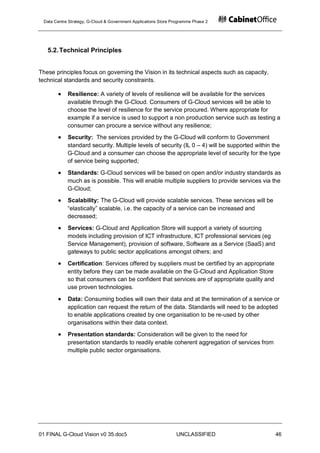
5.2.      Technical Principles .......................................................................................................... 46

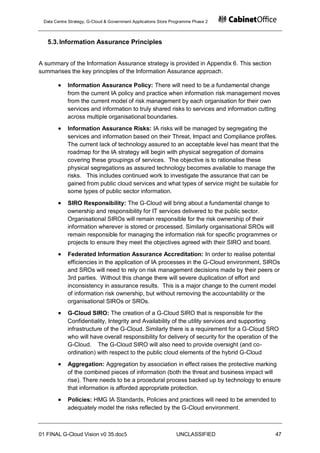
5.3.      Information Assurance Principles .................................................................................... 47

5.5.      Transition Principles.......................................................................................................... 50

6.     Scenarios ............................................................................................................................... 51

7.     Conclusion ............................................................................................................................. 52


01 FINAL G-Cloud Vision v0 35.doc5                                                 UNCLASSIFIED                                                   8
Data Centre Strategy, G-Cloud & Government Applications Store Programme Phase 2


8.     Appendices ............................................................................................................................ 53

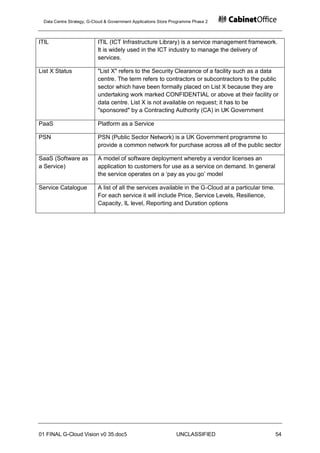
A1. Appendix 1 - Glossary of terms ............................................................................................ 53

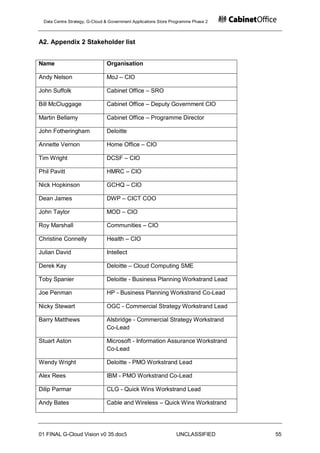
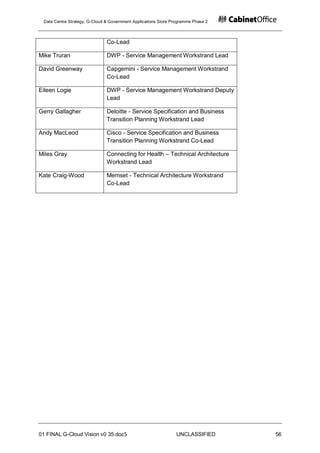
A2. Appendix 2 Stakeholder list .................................................................................................. 55

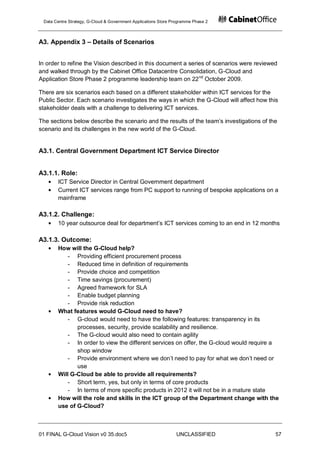
A3. Appendix 3 – Details of Scenarios........................................................................................ 57

A3.1. Central Government Department ICT Service Director ................................................... 57

A3.1.1. Role: ................................................................................................................................. 57

A3.1.2. Challenge: ........................................................................................................................ 57

A3.1.3. Outcome: .......................................................................................................................... 57

A3.2. Local Government Director of Housing ............................................................................. 59

A3.2.1. Role: ................................................................................................................................. 59

A3.2.2. Challenge: ........................................................................................................................ 59

A3.2.3. Outcome A: ...................................................................................................................... 59

A3.2.4. Outcome B: ...................................................................................................................... 60

A3.3. Private Sector Application Provider................................................................................... 61

A3.3.1. Role................................................................................................................................... 61

A3.3.2. Challenge: ........................................................................................................................ 61

A3.3.3. Outcome: .......................................................................................................................... 61

A3.4. Central Government Department ICT Service Director ................................................... 62

A3.4.1. Role: ................................................................................................................................. 62

A3.4.2. Challenge: ........................................................................................................................ 62

A3.4.3. Outcome: .......................................................................................................................... 62

A3.5. Local Government CIO....................................................................................................... 63

A3.5.1. Role: ................................................................................................................................. 63

A3.5.2. Challenge: ........................................................................................................................ 63

A3.5.3. Outcome: .......................................................................................................................... 63

A3.6. Private Sector ICT Provider ............................................................................................... 64

A3.6.1. Role: ................................................................................................................................. 64


01 FINAL G-Cloud Vision v0 35.doc5                                                UNCLASSIFIED                                                  9
Data Centre Strategy, G-Cloud & Government Applications Store Programme Phase 2


A3.6.2. Challenge: ........................................................................................................................ 64

A3.6.3. Outcome: .......................................................................................................................... 64

A4. Appendix 4 Drivers for Change............................................................................................. 65

A4.1. Strategic Drivers for Change ............................................................................................. 65

A4.2. Financial Drivers for Change ............................................................................................. 65

A4.3. Non Financial Drivers for Change ..................................................................................... 66

A4.4. Technological Drivers for Change ..................................................................................... 67

A5. Appendix 5 Programme Risks .............................................................................................. 68

A6. Appendix 6 Information Assurance ...................................................................................... 78


01 FINAL G-Cloud Vision v0 35.doc5                                              UNCLASSIFIED                                              10
Data Centre Strategy, G-Cloud & Government Applications Store Programme Phase 2


   1. Purpose of Document

The G-Cloud, Government Applications Store and Data Centre Consolidation Phase 2
programme started on 5 October 2009 and will run till 12 February 2010. The programme
comprises seven workstrands and a Programme Office function. These workstrands have
been staffed by a mix of civil servants, consultants and industry volunteers.

This document provides a Vision of how the G-Cloud, Government Applications Store and
Data Centre Consolidation will deliver ICT services to the Public Sector. The Vision builds on
the Government Data Centre Strategy Phase 1 Report produced by Phase 1 of the
programme; it is also based on the Government ICT Strategy.

The Vision should be used by stakeholders to gain an overview and high level understanding
of G-Cloud.

The Vision is underpinned by further documents which provide more detail in addition to that
provided in the Vision, these include:

       Commercial Strategy
       Technical Architecture Strategy
       Information Assurance Strategy
       Service Management Framework Approach
       Service Specification
       Transition Approach
       Business Plan


01 FINAL G-Cloud Vision v0 35.doc5                              UNCLASSIFIED               11
Data Centre Strategy, G-Cloud & Government Applications Store Programme Phase 2


   2. Introduction

The Government Data Centre Strategy Programme Phase 1 identified the desirability of
consolidating existing public sector data centres and creating a private government
computing cloud (G-Cloud) for the public sector. This document describes the Vision of how
a consolidated set of public sector data centres and a G-Cloud would provide ICT services to
the public sector. It will be used by Phase 2 of the Data Centre Consolidation, G-Cloud and
Applications Store programme to develop more detailed business case and plans,
specifications, architectures and a transition strategy for and to the G-Cloud.

UK Government currently has an extensive and disparate ICT estate supporting the delivery
of services. The emergence of cloud computing and new application delivery models offer
the opportunity to consolidate and improve this existing ICT estate through provision of
standard, commodity ICT services to the whole of the public sector through a government
cloud (G-Cloud).

The government will develop an integrated set of strategies for consolidation of existing data
centres in the public sector, delivery of ICT services through a government cloud (G-Cloud)
and the development of an Application Store for purchase of G-Cloud services.

These strategies will address a number of government objectives:

       Reduction of ICT costs
            -    A sustainable reduction in the operational costs of ICT across public sector to
                 contribute to the Operational Efficiency Programme (OEP) savings target for
                 ICT

            -    The reduction in cost will include a lower cost associated with future change
                 in ICT service provider specifically the cost of transition to a new provider

       Improve government services and agility through use of ICT
            -    To support a better citizen experience of government services by allowing
                 government to provide new ICT services faster to meet citizen needs

            -    Enabling improved responsiveness to ministerial and business generated
                 changes through faster deployment of ICT services

       Reduction of carbon footprint due to Government ICT services
            -    Through consolidating and optimising use of existing spare ICT capacity and
                 decommissioning unused capacity

            -    Adoption of more carbon efficient technology


01 FINAL G-Cloud Vision v0 35.doc5                              UNCLASSIFIED                     12
Data Centre Strategy, G-Cloud & Government Applications Store Programme Phase 2


       Improve data centre services
            -    By removing known issues in existing infrastructure including lack of
                 resilience and known security concerns

       Align with other Government thinking
            -    Including supporting the objectives of Digital Britain through the deployment
                 of ICT services and creation of a new market for government ICT services

            -    Integrating with wider Government ICT initiatives e.g. PSN, Desktop Strategy
                 to ensure that the overall government ICT Strategy is supported by the G-
                 Cloud

In order to implement the G-Cloud and support these strategies a set of multi dimensional
changes will need to occur:

       Technical – implementation of a G-Cloud architecture covering applications , data
       management storage and security services;
       Process – implementation of processes to use and manage G-Cloud services;
       Commercial – implementation of a commercial framework to permit contracting of
       services from the G-Cloud; and
       Cultural – a shift to sharing and re-use of ICT services from the G-Cloud
The remainder of this document describes the Vision for Datacentre Consolidation, G-Cloud
and Application Store which will meet these objectives. The services described will be
available to all UK public sector organisations from small bodies through to major central
government departments. The Vision described is for 10 years hence, although many
aspects of the Vision can be implemented within 2 years.


01 FINAL G-Cloud Vision v0 35.doc5                              UNCLASSIFIED                     13
Data Centre Strategy, G-Cloud & Government Applications Store Programme Phase 2


   3. Why Use Cloud Computing in the Public Sector

Why should the Public Sector adopt Cloud Computing? What will a new model for delivery of
ICT to the Public Sector bring? Is Cloud computing dependent on new and untried
technology? In this section these questions are answered and why the new model proposed
for ICT in the Public Sector must be implemented is explained.


   3.1. Public Sector ICT Landscape


Public Sector ICT has developed to meet the needs of specific public bodies, with limited
sharing of resources, this approach has led to duplication and excess capacity with ICT
system silos in individual public bodies.

Public Sector ICT is now subject to a number of significant drivers for change. These drivers
range from budgetary pressures to ensuring the UK is at the leading edge of the global
digital economy.


   3.1.1.        Budgetary Pressures


In April 2009, HM Treasury published the Operational Efficiency Programme (OEP) Final
Report which estimated that overall savings of around 20 per cent of the estimated £16
billion annual Public Sector ICT expenditure (£3.2 billion) should be achievable without
compromising the quality of frontline public services. These savings must now be found by
delivering ICT services more efficiently.


   3.1.2.        Green Agenda


Government runs some of the world‟s largest computer systems and is Britain‟s largest
purchaser of Information and Communication Technology (ICT). This technology is used to
improve the lives of millions of people and can enable smarter ways of working to reduce
carbon. However, this same technology is a major consumer of energy and natural
resources. UK government has made a number of sustainable operational commitments:

       Central government office estate will achieve carbon neutrality by 2012;
       UK to reduce greenhouse gases by 26% or more by 2020, 60% by 2050; and
       Sustainable Operations on the Government Estate (SOGE) targets.


01 FINAL G-Cloud Vision v0 35.doc5                              UNCLASSIFIED                14
Data Centre Strategy, G-Cloud & Government Applications Store Programme Phase 2


ICT globally emits comparable levels of carbon to the aviation industry, and emissions
continue to grow. Recognising this, the Greening Government ICT Strategy set two
challenging targets which support delivery of mandatory SOGE (Sustainability on the
Government Estate) targets:
       government ICT will be carbon neutral by 2012, and
       carbon neutral across its lifecycle by 2020.
In order to deliver on these commitments delivery of ICT services to the Public Sector in new
more energy efficient ways which support the Government‟s climate change agenda need to
be developed and implemented.


   3.1.3.        Digital Britain


The delivery of services to the public by ICT enables wider Government aims for the UK in
the global digital economy and citizen engagement. The Government in the Digital Britain
Report (June 2009) identifies the need for the UK to be at the leading edge of the global
digital economy. The Report also states that “an ambitious and clear programme of The
Digital Switchover of Public Services, to primarily electronic and online delivery, will
unlock significant cost savings, whilst at the same time serving to increase levels of
satisfaction”. The achievement of these aims will require a step change in the efficiency of
ICT procurement and delivery by the Public Sector.


   3.1.4.        ICT Procurement


Government procurements are overseen by the Office of Government Commerce (OGC)
which has an objective of ensuring the Government gets best value from its spending and
that procurements support the Government‟s sustainability agenda.

Currently the procurement and delivery of ICT programmes in the Public Sector is a lengthy
and costly process. Procurement of large ICT systems can take in excess of 12 months. The
cost of this procurement cycle for both the Public Sector and Suppliers is significant. The
length of time involved means that ICT services in support of new Government policies can
rarely be deployed in the timescale best suited to support the policy. A more agile method of
procuring and delivering ICT in the Public Sector is needed.

These constraints affect Local and Regional Government in addition to central Government.

The OGC is seeking ways in which government procurements can become more efficient
and quicker while supporting sustainability.


01 FINAL G-Cloud Vision v0 35.doc5                              UNCLASSIFIED                   15
Data Centre Strategy, G-Cloud & Government Applications Store Programme Phase 2


   3.1.5.        ICT Strategy for Government


The CIO Council agreed the overall ICT strategy for Government in summer 2009.

This ICT Strategy supports existing core public sector goals, set in Digital Britain, Building
Britain‟s Future, Excellence and fairness, and the Operational Efficiency Programme:

       improving public service delivery
       improving access to public services, and
       increasing the efficiency of public service delivery


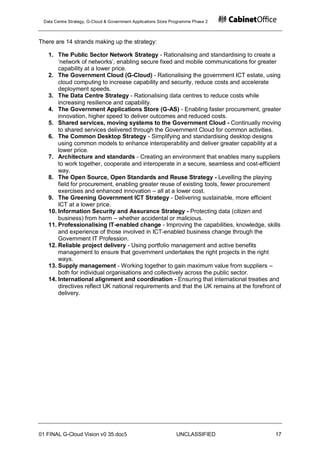
At the heart of the strategy is the creation of a common, secure and flexible infrastructure
that is available across the public sector. It comprises the strands depicted below:


01 FINAL G-Cloud Vision v0 35.doc5                              UNCLASSIFIED                     16
Data Centre Strategy, G-Cloud & Government Applications Store Programme Phase 2


There are 14 strands making up the strategy:

   1. The Public Sector Network Strategy - Rationalising and standardising to create a
       „network of networks‟, enabling secure fixed and mobile communications for greater
       capability at a lower price.
   2. The Government Cloud (G-Cloud) - Rationalising the government ICT estate, using
       cloud computing to increase capability and security, reduce costs and accelerate
       deployment speeds.
   3. The Data Centre Strategy - Rationalising data centres to reduce costs while
       increasing resilience and capability.
   4. The Government Applications Store (G-AS) - Enabling faster procurement, greater
       innovation, higher speed to deliver outcomes and reduced costs.
   5. Shared services, moving systems to the Government Cloud - Continually moving
       to shared services delivered through the Government Cloud for common activities.
   6. The Common Desktop Strategy - Simplifying and standardising desktop designs
       using common models to enhance interoperability and deliver greater capability at a
       lower price.
   7. Architecture and standards - Creating an environment that enables many suppliers
       to work together, cooperate and interoperate in a secure, seamless and cost-efficient
       way.
   8. The Open Source, Open Standards and Reuse Strategy - Levelling the playing
       field for procurement, enabling greater reuse of existing tools, fewer procurement
       exercises and enhanced innovation – all at a lower cost.
   9. The Greening Government ICT Strategy - Delivering sustainable, more efficient
       ICT at a lower price.
   10. Information Security and Assurance Strategy - Protecting data (citizen and
       business) from harm – whether accidental or malicious.
   11. Professionalising IT-enabled change - Improving the capabilities, knowledge, skills
       and experience of those involved in ICT-enabled business change through the
       Government IT Profession.
   12. Reliable project delivery - Using portfolio management and active benefits
       management to ensure that government undertakes the right projects in the right
       ways.
   13. Supply management - Working together to gain maximum value from suppliers –
       both for individual organisations and collectively across the public sector.
   14. International alignment and coordination - Ensuring that international treaties and
       directives reflect UK national requirements and that the UK remains at the forefront of
       delivery.


01 FINAL G-Cloud Vision v0 35.doc5                              UNCLASSIFIED               17
Data Centre Strategy, G-Cloud & Government Applications Store Programme Phase 2


   3.1.6.        Quality of Data Centres


The Data Centre Strategy Report produced by the Strategic Supply Board for the Government CIO
Council in September 2009 had a number of findings including:

       There is a major opportunity for government to make significant cost savings whilst
       delivering improved agility, flexibility, resilience, security and environmental
       sustainability. High level analysis suggests a reduction in ICT data centre
       infrastructure costs will deliver a net £900 million of cost savings over 5 years, with
       recurrent savings of more than £300m a year thereafter;
       There are significant variations within the current estate that are not justified by
       differences in business needs, which will be rationalised by the approach proposed
       in this Vision;
       Other organisations have successfully delivered major ICT consolidation
       programmes to create a dynamic ICT infrastructure and there is considerable
       experience to draw on;
       The challenges in consolidating ICT infrastructure are organisational and cultural
       rather than technical; and
       There is the potential for further cost saving and operational benefits by delivering a
       government private Cloud (G-Cloud) in addition to data centre consolidation.


   3.2. Developments in the ICT Industry


Recent developments in ICT have made it possible to consolidate ICT Infrastructure in a way
that delivers increased flexibility and responsiveness to business needs whilst reducing
costs. This change involves a move from ICT being provided individually by organisations
procuring their own separate ICT infrastructure, to a new model in which ICT is provided as
a utility which is known as “Cloud Computing”. Over the last few years consumer facing firms
delivering products in large volumes have adopted Cloud computing.

Cloud computing is most frequently cited as providing ICT “as a service” to customers using
a utility model over a network. Cloud computing offers a commercial model of “pay as you
use” thus avoiding the capital expenditure usually associated with provision of ICT. The
flexibility provided by Cloud computing has enabled its rapid growth and a corresponding
lowering of costs. Cloud services can be either infrastructure or application services.

At the core of the Cloud computing model are 3 principles:

       simplification and standardisation of ICT infrastructure;
       automated processes to support activities such as change management and service
       reporting; and


01 FINAL G-Cloud Vision v0 35.doc5                              UNCLASSIFIED                     18
Data Centre Strategy, G-Cloud & Government Applications Store Programme Phase 2


       enabling of Software as a Service (SaaS) through standards and multi tenanting of
       services.
Cloud application services are applications delivered as a service via a network to a browser
front end. Cloud application services usually require the creation of a multitenant architecture
where one application supports many firms or organisations, but provides a unique view for
each. Cloud applications are often SaaS, but not all SaaS applications are cloud application
services. SaaS applications delivered as single-tenant applications on dedicated
infrastructures are not Cloud application services.

Large corporate firms which have implemented Cloud computing report:

       ICT cost reductions of 40-65%;
       improved agility in implementing strategy with ICT support; and
       improved speed in implementing changes to support business needs.
Public Cloud services are gaining in acceptance by corporate world and the Public Cloud
providers are increasing their capacity and services. Amazon has 1000 staff involved in
developing their Public Cloud offering. Early concerns of the market regarding the security
and service levels offered by Public Clouds are being taken very seriously and
improvements have been made in these areas with further improvements planned. However
a number of firms have decided to setup a Cloud computing model in house, creating a
private cloud for use only within their organisation. This provides a number of advantages:

       Cloud services can be tailored to the firm‟s requirements;
       security is under the control and monitoring of the organisation; and
       end to end service levels are easier to achieve.


01 FINAL G-Cloud Vision v0 35.doc5                              UNCLASSIFIED                 19
Data Centre Strategy, G-Cloud & Government Applications Store Programme Phase 2


   3.2.1.        Will G-Cloud Deliver?


The G-Cloud model can bring many beneficial changes to the delivery of ICT across the
Public Sector but will it really deliver? In the section below how Cloud computing has the
foundations and track record to succeed is described.


   3.2.2.        Will Cloud Computing Happen?


What is the evidence that Cloud computing is becoming a standard ICT delivery model:

       Large ICT Services Suppliers have invested in the implementation of large global
       public clouds;
       The ICT industry itself is migrating to the use of clouds to deliver in house ICT
       services; and
       Private sector organisations are adopting Cloud computing to deliver ICT services.


   3.2.3.        Can the benefits be delivered?


What is the evidence that the key elements of the G-Cloud – Cloud computing, Data Centre
Consolidation and Software as a Service (SaaS) are capable of delivering the promised
benefits:

       Bechtel have adopted a cloud computing model with a resulting saving of 60% on
       their ICT costs;
       In a data centre consolidation programme Hewlett-Packard have reduced the number
       of data centres globally from 85 to just 6;
       IBM have reduced their data centres globally from 155 to 7; and
       Telegraph Media Group has used SaaS to
            -    make new functionality available without complex software upgrades
            -    pay only for the computing power needed
            -    lower total cost of ownership of ICT.
However in order to gain the benefits of Cloud computing the Public Sector will need to
adopt a new approach to ICT services. The existing approach of defining and procuring
bespoke systems which meet the specific needs of a department will need to shift to an
approach which makes use of standard or generic systems which are available at lower cost
and adapts the processes of the department to use the system.


01 FINAL G-Cloud Vision v0 35.doc5                              UNCLASSIFIED                 20
Data Centre Strategy, G-Cloud & Government Applications Store Programme Phase 2


The commercial potential of cloud computing and cloud services is widely accepted, both in
private industry and in the public sector. The opportunities for cost reduction and efficiency
in the UK public sector are real and achievable, but require significant changes to
procurement practices, delivery frameworks and across the supplier landscape.

A pre-requisite for realisation of the commercial objectives are a set of UK Government
technical & operational standards that can define the G-Cloud based on a (significant)
number of competing infrastructural service providers operating at any appropriate security
level.

However Government has a significant legacy of applications which exhibit many pre-cloud
symptoms, including low server utilisation and high operational costs. It must be understood
that the cloud computing and cloud sourcing paradigms do not always directly lead to
reduced costs - the real challenge will be to ensure that sufficient economy of scale and
standardisation is reached quickly enough to deliver a net saving.

   3.2.4.        Does G-Cloud depend on leading edge technology?


Does the G-Cloud depend on new and untried technologies which mean that the Public
Sector must take on significant technology risks in its implementation?

In fact the innovation of the G-Cloud model is in its approach to the governance and
management of ICT in the Public Sector rather than the deployment of new technology.

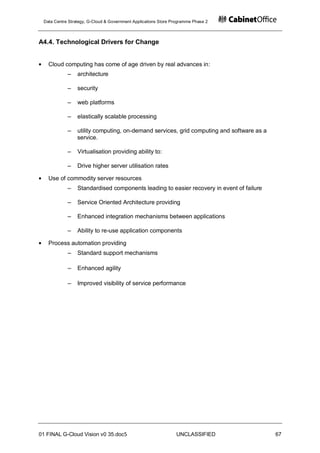
Cloud computing is based on significant amounts of existing technology. Specific aspects of
the G-Cloud may require new technologies but this will not be the norm for the majority of
the G-Cloud if a prudent approach to its design is implemented.

Instead for G-Cloud to be successful Public Sector leadership will need to encourage
existing ICT services to be re-used where possible avoiding bespoke solutions to common
challenges across the Public Sector.

The successful introduction and implementation of the G-Cloud is a leadership not a
technology challenge.

   3.2.5.        Key Risks


The programme must manage effectively a number of risks in order to deliver the G-Cloud
benefits. These risks cover a number of key areas including: Commercial, Information
Assurance, Technical Architecture, Organisation and Governance.

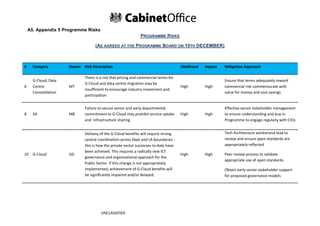
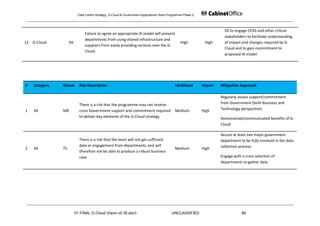
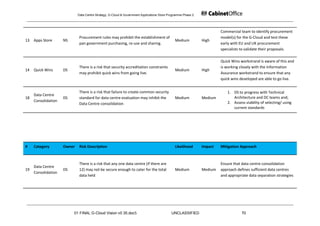
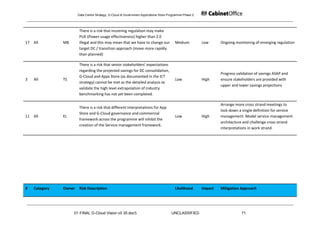
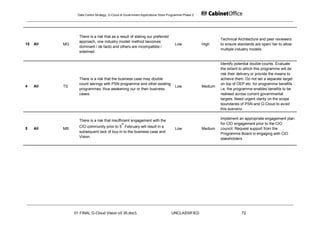
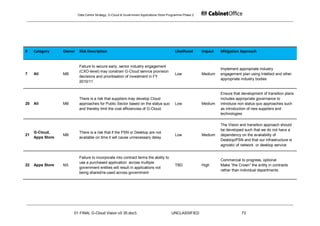
The full list of key risks to delivery of the programme are listed in Appendix 5. However a
number of key risks are highlighted in the following sections.

3.3.9.1 Commercial

A Commercial approach will be implemented which manages the following risks:

       Current resource constrained environment prevents up front investment for G-Cloud
       becoming available;


01 FINAL G-Cloud Vision v0 35.doc5                              UNCLASSIFIED                  21
Data Centre Strategy, G-Cloud & Government Applications Store Programme Phase 2


       Pricing and contractual framework for the G-Cloud is attractive to Public Sector but
       discourages suppliers from making services available on the G-Cloud;

       Business case may double count savings with other Public Sector programmes;

       Procurement regulations do not allow additional consumers after initial procurement
       of the service; and

       Take up of G-Cloud proceeds too slowly so benefits will not be significant enough to
       attract Public Sector organisations in future.

3.3.9.2 Information Assurance

An Information Assurance approach will be implemented which manages the following risks:

       Aggregation of data in G-Cloud raising IL levels beyond 4 and preventing use of G-
       Cloud services by public bodies with lower IL infrastructure; and

       Common infrastructure and shared nature of G-Cloud cannot be assured by
       departmental SIRO model and so are not accredited.

In addition the challenges of situational awareness on the G-Cloud will require approaches
to be developed during the implementation of the G-Cloud.

More details of the Information Assurance principles and approach to risks are provided in
Section 5.3 and Appendix 6.

3.3.9.3 Technical Architecture

A Technical Architecture for the G-Cloud will be developed which manages the risk that
adoption of G-Cloud “locks” the Public Sector into a particular vendor‟s proprietary standards
as industry standards for Cloud technologies are not currently agreed

3.3.9.4 Organisation and Governance

An Organisation and Governance approach will be implemented which manages the
following risks:

       G-Cloud is not taken up or deployed effectively across the Public Sector due to de-
       centralised nature of ICT governance in the Public Sector; and

       Senior stakeholders may not support the implementation of the G-Cloud.

3.3.9.5 Public Sector Network

The G-Cloud programme will have a number of dependencies on the Public Sector Network
programme. Programme managements will work together to ensure that these
dependencies are managed or mitigated in order that the G-Cloud is implemented as
planned.


01 FINAL G-Cloud Vision v0 35.doc5                              UNCLASSIFIED                  22
Data Centre Strategy, G-Cloud & Government Applications Store Programme Phase 2


   3.3. Benefits


The new world of the G-Cloud offering utility computing from consolidated data centres and
encouraging re-use of ICT assets through the Government Applications Store will bring a
comprehensive set of benefits across the Public Sector ICT landscape.


   3.3.1.        Budgetary Pressures


The G-Cloud will deliver a fundamental contribution to the cost savings for OEP and will
facilitate and accelerate the OEP targets. This will be achieved by:

       Data Centre Consolidation
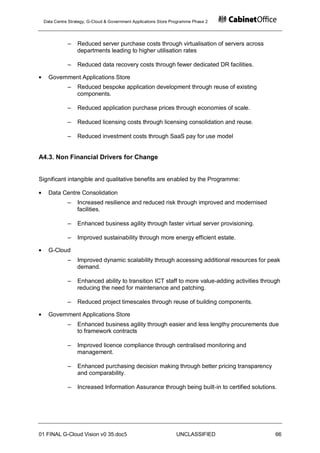
            -    Reduced hardware maintenance, server capital expenditure, and power
                 consumption through more efficient and better utilised infrastructure.
            -    Reduced up-front investment costs through standardisation and sharing of
                 assets.
            -    Reduced estate footprint through site sales/repurposing of accommodation.
       G-Cloud
            -    Reduced capital investment in computer infrastructure through utility-based
                 rental of computing and processing time.
            -    Reduced server purchase costs through virtualisation of servers across
                 departments leading to higher utilisation rates
            -    Reduced data recovery costs through fewer dedicated DR facilities.
       Government Applications Store
            -    Reduced bespoke application development through reuse of existing
                 components.
            -    Reduced application purchase prices through economies of scale.
            -    Reduced licensing costs through licensing consolidation and reuse.
            -    Reduced investment costs through SaaS pay for use model
            -    Volume discounts achieved by purchasers apply to all public sector bodies
                 already using the service


   3.3.2.        Green Agenda


The G-Cloud will lead to more efficient use of ICT by the Public Sector so lowering the
carbon emissions associated with delivering ICT services:

       Consolidation of data centres will reduce footprint of building estate;


01 FINAL G-Cloud Vision v0 35.doc5                              UNCLASSIFIED                   23
Data Centre Strategy, G-Cloud & Government Applications Store Programme Phase 2


       Virtualisation will drive higher server utilisation reducing server footprint; and
       Re-use of ICT assets will lower development and project resources used to
       implement new services and systems.
The G-Cloud will also facilitate smarter ways of working through integration of government
information and data sources, further reducing government‟s environmental impact and
carbon footprint.


   3.3.3.        Digital Britain


The G-Cloud will deliver greater agility and speed in the delivery of policy and services,
underpinned by the adoption of shared infrastructure at lower cost. The agility will result from
the ability to re-use existing assets and the new commercial model reducing procurement
timescales and costs.

The G-Cloud will through the Government Applications Store create a marketplace with a
low cost of entry to new and small ICT suppliers encouraging the development of new UK
ICT businesses and supporting the UK‟s position in the digital world.


   3.3.4.        ICT Procurement


The commercial model of the G-Cloud will be based on pre agreed frameworks. This will
remove the need for lengthy and costly procurements. This will reduce costs for both the
Public Sector and Suppliers. In addition the Public Sector will be able to deliver ICT services
faster in support of policy.

Procurement law will apply to the G-Cloud, and all normal rules will need to be followed. It
will be important to get this right at the outset. This is particularly the case given the arrival
of the regulations implementing the Remedies Directive on 20 December 2009. This puts an
increasing emphasis on the use of legally compliant procurement vehicles.


   3.3.5.        Current Initiatives


The G-Cloud will complement and support the implementation of existing Public Sector
programmes:

       PSN: the G-Cloud will offer PSN a route to market through the Government
       Applications Store. In addition the G-Cloud will use PSN services to connect users to
       G-Cloud services.
       Strategic Desktop: the G-Cloud will provide ICT services for the Strategic Desktop


01 FINAL G-Cloud Vision v0 35.doc5                              UNCLASSIFIED                   24
Data Centre Strategy, G-Cloud & Government Applications Store Programme Phase 2


   3.3.6.         Quality of Data Centres


Existing data centre space and infrastructure will be rationalised into a smaller set of secure
physical data centres – these will host both the G-Cloud and existing legacy applications
during the migration period. The outcome will be a significantly smaller footprint in highly
virtualised shared data centres which meet government standards for resilience, security
and sustainability at an overall lower cost. This will result not only in a reduction in the costs
of data centres but also in the risks of disruption to delivery of ICT services to the Public
Sector.


   3.3.7.         ICT Market


The market for Cloud services, IaaS, PaaS and SaaS is expanding; the G-Cloud and
Government Applications Store will offer the Public Sector the opportunity to access this
market. The expansion of this market will provide the Public Sector with new services and
greater competition will help to that these services will be cost efficient.


01 FINAL G-Cloud Vision v0 35.doc5                               UNCLASSIFIED                    25
Data Centre Strategy, G-Cloud & Government Applications Store Programme Phase 2


   4. The New World of G-Cloud

The G-Cloud, Government Applications Store and consolidation of existing public sector
data centres are all components of the new model for delivery of public sector ICT services.
The G-Cloud will provide a variety of infrastructure and application services for the public
sector. The Government Applications Store will provide a “portal” to purchase G-Cloud
services. The consolidation of existing data centres will provide both a modern and fit for
purpose environment for the public sector ICT while at the same ensuring that excess data
centre capacity is reduced to meet government cost saving and carbon emission reduction
targets.

These services will be offered both from a UK government specific cloud (G-Cloud) and from
public clouds. Services from the public clouds will be used where the public cloud service
offers appropriate levels of security, service levels and performance for public sector use. It
is anticipated that the levels of security on the G-Cloud will support higher impact levels than
on the public clouds.

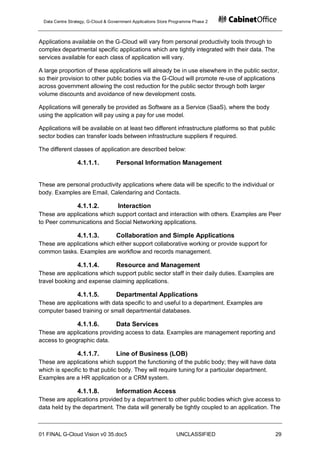
The vision is for G-Cloud services to be accessed via the Public Sector Network (PSN) from
the strategic government desktop although in the short term other existing public sector
networks and desktops may be used to access the G-Cloud.


01 FINAL G-Cloud Vision v0 35.doc5                              UNCLASSIFIED                 26
Data Centre Strategy, G-Cloud & Government Applications Store Programme Phase 2


   4.1. G-Cloud


G-Cloud: “bringing utility convenience to public sector ICT – shared, flexible, agile,
transparent and efficient allocation of ICT when it’s needed, through sharing standardised
resources to reduce costs”

The G-Cloud is the delivery of Public Sector ICT by a shared secure “utility” style ICT
services infrastructure, underpinned by a new commercial model enabling public bodies to
have the option to pay only for the service at the time when they use it. This approach is now
developing rapidly and is known as “Cloud Computing”. It is enabled by common standards,
and by heavily automated secure business processes that enable substantial reductions in
costs.


“G-Cloud” is the Public Sector brand for the use of certified cloud computing.

There will be 3 main categories of G-Cloud branded services:-

       Software as a Service (SaaS) which includes managed services, common, utility and
       custom services, all of which can be configured for use by many Public Sector
       bodies;
       Platform as a Service (PaaS) will be will be used to provide a platform for creating
       new business applications based on shared re-usable components. The platform
       offered will be approved and overseen by the CTO Council;
       Infrastructure as a Service (IaaS) will provide ICT infrastructure primarily computing
       resource and data storage.

The G-Cloud will be a UK Public Sector implementation of “cloud computing” that will provide
both secure, private cloud services and access to certified public cloud services, for example
those provided by Amazon cloud services. These services will range from ICT infrastructure
services through to application and information services and to ICT professional services
such as service management.

The G-Cloud will offer dedicated „private‟ services for public sector organisations, and trusted
public cloud services. The range and sophistication of public cloud services is growing and
more of the Public Sector‟s ICT needs will be met from public clouds as today‟s constraints
are addressed over time. These constraints currently include:-

       Information Assurance requirements e.g. data centres are outside the UK;
       End to end performance of services from public clouds may not be guaranteed; and
       Proprietary standards used by some public clouds create the risk of lock in.


G-Cloud private cloud services will address these constraints, enabling earlier use of the
shared utility model across the public sector. Private G-Cloud services will typically be
provisioned by suppliers using an industry standard platform for example Microsoft Azure,
VMware, or Eucalyptus - an Open Source platform that implements Amazon AWS
standards.


01 FINAL G-Cloud Vision v0 35.doc5                              UNCLASSIFIED                 27
Data Centre Strategy, G-Cloud & Government Applications Store Programme Phase 2


    The services offered by the G-Cloud will be defined in a Service Catalogue which any public
    sector organisation can use to purchase ICT services. Each service will be described in the
    Service Catalogue, its description will include details of the service, service levels offered,
    service reports provided, if relevant the increments of capacity offered, time periods or
    increments for which the service can be procured and the price of the service.

    Services provided by the G-Cloud will be up to security level IL4 only.

    In order to provide services in the G-Cloud a supplier will undergo a certification process for
    both their organisation and each of their services. This certification process will ensure that
    services meet the quality and information assurance requirements of the public sector and
    will provide consuming public bodies with the confidence that G-Cloud services are suitable
    for supporting provision of services to citizens. The information assurance certification will
    represent a partial accreditation, a residual element of accreditation which cannot be carried
    out centrally remaining with the consuming organisation.

    A public sector body will govern the certification process, overseeing and managing the
    approval of suppliers and their services.


       4.1.1.        Application and Information Services


    The G-Cloud will provide a variety of application and information services to the public
    sector. These services will vary from the purchase of software licenses to access to
    government stores of information where this is appropriate from a statutory and information
    assurance perspective. The focus will be on re-use of existing assets and use of commodity
    services. Existing common application services where possible will be offered so that public
    bodies do not need to develop or commission development of new application services.


                              Application & Information Services

-   ERP                                                                                -   DVLA./IPS
-   Flex Desktop                                                                           Verification
-   Gateway (Citizen                                                                   -   Authentication
    and Business                                                                           Services
    Authentication)                                                                    -   Correspondence
-   Payment of                                                                             Handling
    Grants                                                                             -   Secure Data
-   Government                                                                             Handling (GCHQ)
    Banking                                                                            -   CIS (X)
-   Government
    Vetting


                         Procurement Strand and Crowd Sourcing

    01 FINAL G-Cloud Vision v0 35.doc5                              UNCLASSIFIED                      28
Data Centre Strategy, G-Cloud & Government Applications Store Programme Phase 2


Applications available on the G-Cloud will vary from personal productivity tools through to
complex departmental specific applications which are tightly integrated with their data. The
services available for each class of application will vary.

A large proportion of these applications will already be in use elsewhere in the public sector,
so their provision to other public bodies via the G-Cloud will promote re-use of applications
across government allowing the cost reduction for the public sector through both larger
volume discounts and avoidance of new development costs.

Applications will generally be provided as Software as a Service (SaaS), where the body
using the application will pay using a pay for use model.

Applications will be available on at least two different infrastructure platforms so that public
sector bodies can transfer loads between infrastructure suppliers if required.

The different classes of application are described below:

                 4.1.1.1.          Personal Information Management


These are personal productivity applications where data will be specific to the individual or
body. Examples are Email, Calendaring and Contacts.

                 4.1.1.2.           Interaction
These are applications which support contact and interaction with others. Examples are Peer
to Peer communications and Social Networking applications.

                 4.1.1.3.          Collaboration and Simple Applications
These are applications which either support collaborative working or provide support for
common tasks. Examples are workflow and records management.

                 4.1.1.4.          Resource and Management
These are applications which support public sector staff in their daily duties. Examples are
travel booking and expense claiming applications.

                 4.1.1.5.          Departmental Applications
These are applications with data specific to and useful to a department. Examples are
computer based training or small departmental databases.

                 4.1.1.6.          Data Services
These are applications providing access to data. Examples are management reporting and
access to geographic data.

                 4.1.1.7.          Line of Business (LOB)
These are applications which support the functioning of the public body; they will have data
which is specific to that public body. They will require tuning for a particular department.
Examples are a HR application or a CRM system.

                 4.1.1.8.          Information Access
These are applications provided by a department to other public bodies which give access to
data held by the department. The data will generally be tightly coupled to an application. The


01 FINAL G-Cloud Vision v0 35.doc5                              UNCLASSIFIED                       29
Data Centre Strategy, G-Cloud & Government Applications Store Programme Phase 2


G-Cloud will provide this service as a gateway using CTO Council endorsed G-Cloud
services to connect the two public bodies.

This service will only be permitted where statute allows the data to be shared with the
requesting public body and information assurance requirements for the data are adequately
supported across the G-Cloud.

An example of this service is CISx from the DWP.


   4.1.2.        Infrastructure and Platform Services


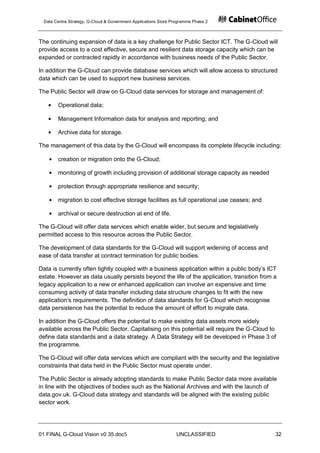
The G-Cloud will provide a variety of ICT infrastructure and platform services to the public
sector. These services will be based on a layered architecture model, and are standardised
to widen their applicability to multiple public sector consumers.


                                                                                               Database


                                                                                           Operating System
                                                        IL Level Options
                           Service Level

                                           Resilience


                                                                                        CPU Processor Power


                                                                                           Memory Capacity


                                                                                      Disk, SAN or offline storage


                                                                           Environment (space, air conditioning & power only)


A public body will be able to purchase services at multiple layers. For example on one
occasion the body could purchase a server capacity service onto which the body loads its
own operating system and database. On another occasion the body may choose to
purchase a database service into which the supplier has packaged underlying operating
system and server capacity.

Data across the Public Sector continues to expand. A key infrastructure service offering will
be storage services for data, such as SAN services. This offering will enable public bodies
to access and store their data cost effectively in resilient, secure storage, with the ability to
expand or contract the capacity without major capital investment in their ICT infrastructure.

There is an opportunity for greater development of services for Data Management, Storage
and Security separately from services provided for applications processing. This Data
Capability can become a long-term asset in that applications can be chosen accordingly to
meet a given organisations current business priorities.

The G-Cloud will provide data services for storage and management of:
      Operational data;


01 FINAL G-Cloud Vision v0 35.doc5                                                                   UNCLASSIFIED               30
Data Centre Strategy, G-Cloud & Government Applications Store Programme Phase 2


       Management Information data for analysis and reporting; and

       Archive data for storage.

Database services are becoming common in cloud computing, so in addition database
services will be offered as part of G-Cloud, providing structured storage of data. This service
will enable public bodies to access and use data to support new business services. The G-
Cloud will implement standards that will enable wider, but secure and legislatively permitted
shared access to data resources with other Public Sector bodies where there is a policy
decision to do so.

More detail on G-Cloud data services are provided in Section 4.1.3 Data in the G-Cloud.

In order to ensure that services in the G-Cloud are available from multiple suppliers the
services available will conform to open and industry standards for ICT components. The
capacity of services will be measured using industry standard units.

Services will be defined so that varying levels of resilience, service levels and support allow
consumers to purchase services to host business services of varying priority to the public
body involved. In addition this differentiation will allow the purchase of services with high
levels of resilience and superior service levels for production systems while more cost
effective services with lower service levels are available for development and test services.

Specific specifications of services for purposes such as Disaster Recovery will also be
available.

   4.1.3.        Data Services on the G-Cloud


Data is one of the key assets of the Public Sector. As it develops, the G-Cloud will become
the repository of a significant portion of Public Sector data. Data also persists beyond an
application, with migration between applications being required as the application stack
changes.

Cloud providers are addressing the new challenges and opportunities management of data
in a cloud environment offers:

       Microsoft has implemented cloud-based data platforms which seek to provide a
       database service which meets the needs of primarily network based application
       access;

       Cisco are offering SAN consolidation services and security approaches for multiple
       organisation use of SANs;

       Amazon offers database services including tools which are scalable to meet the
       needs of cloud services; and

       Other suppliers are developing data and database services for the cloud.


01 FINAL G-Cloud Vision v0 35.doc5                              UNCLASSIFIED                  31
Data Centre Strategy, G-Cloud & Government Applications Store Programme Phase 2


The continuing expansion of data is a key challenge for Public Sector ICT. The G-Cloud will
provide access to a cost effective, secure and resilient data storage capacity which can be
expanded or contracted rapidly in accordance with business needs of the Public Sector.

In addition the G-Cloud can provide database services which will allow access to structured
data which can be used to support new business services.

The Public Sector will draw on G-Cloud data services for storage and management of:

       Operational data;

       Management Information data for analysis and reporting; and

       Archive data for storage.

The management of this data by the G-Cloud will encompass its complete lifecycle including:

       creation or migration onto the G-Cloud;

       monitoring of growth including provision of additional storage capacity as needed

       protection through appropriate resilience and security;

       migration to cost effective storage facilities as full operational use ceases; and

       archival or secure destruction at end of life.

The G-Cloud will offer data services which enable wider, but secure and legislatively
permitted access to this resource across the Public Sector.

The development of data standards for the G-Cloud will support widening of access and
ease of data transfer at contract termination for public bodies.

Data is currently often tightly coupled with a business application within a public body‟s ICT
estate. However as data usually persists beyond the life of the application, transition from a
legacy application to a new or enhanced application can involve an expensive and time
consuming activity of data transfer including data structure changes to fit with the new
application‟s requirements. The definition of data standards for G-Cloud which recognise
data persistence has the potential to reduce the amount of effort to migrate data.

In addition the G-Cloud offers the potential to make existing data assets more widely
available across the Public Sector. Capitalising on this potential will require the G-Cloud to
define data standards and a data strategy. A Data Strategy will be developed in Phase 3 of
the programme.

The G-Cloud will offer data services which are compliant with the security and the legislative
constraints that data held in the Public Sector must operate under.

The Public Sector is already adopting standards to make Public Sector data more available
in line with the objectives of bodies such as the National Archives and with the launch of
data.gov.uk. G-Cloud data strategy and standards will be aligned with the existing public
sector work.


01 FINAL G-Cloud Vision v0 35.doc5                              UNCLASSIFIED                 32
Data Centre Strategy, G-Cloud & Government Applications Store Programme Phase 2


However data obtained by the Public Sector must only be used in the manner allowed and
specified by the associated legislation, the strategy for data and the operational controls of
the G-Cloud will ensure that data is not accessed or shared in violation of this principle. This
will require the storage of data in separated infrastructure storage areas. The G-Cloud will
data tools to permit the wider sharing of appropriate data in a controlled manner.


   4.1.4.        Professional ICT Services


A number of professional services will be provided to support the delivery of G-Cloud
components and to aggregate services from components available on the G-Cloud.

                 4.1.4.1.          Service Management Services


Both suppliers and larger public bodies will offer service management services on the G-
Cloud. This service will manage the overall delivery of services from the G-Cloud so that an
integrated and consistent operational service is provided. These services will include the
service management of operational services such as change management, incident
management and service reporting. The service management will be based on a common
industry accepted framework such as ITIL. This will enable suppliers of service components
to use a standard method for interaction with the service integrator and public sector
consumers. These services will be of particular value to smaller public bodies with limited
ICT expertise available in their organisation.

                 4.1.4.2.          System Integration Services


These services will provide public bodies with services which will integrate G-Cloud
components into coherent services which can be consumed by a public sector body.


   4.1.5.        Exclusions from G-Cloud Scope

The G-Cloud will provide a wide range of ICT and business services across all of the Public
Sector. These services will be made available over time in line with the G-Cloud roadmap.
The initial G-Cloud services will therefore be limited in range and coverage across Public
Sector compared to the end Vision for G-Cloud.

However even in the final Vision the scope of G-Cloud and Government Applications Store
does not include:

       Services which are not ICT services or business services not supported primarily by
       ICT systems, for example
          - Facilities management;
          - Catering services;
          - Stationary procurement;


01 FINAL G-Cloud Vision v0 35.doc5                              UNCLASSIFIED                  33
Data Centre Strategy, G-Cloud & Government Applications Store Programme Phase 2


       Development of services which are already provided by other strategic Government
       projects such as PSN or common desktop, although these services may be
       purchased through the Government Applications Store;
       IL5 IL5 and above are not provided in the G-Cloud, although such services may be
       co-located in the data centres from which G-Cloud services are provided. However
       only those elements of an application which are at IL 5 and above are excluded from
       G-Cloud, lower security rated components of the application can be hosted within the
       G-Cloud;
       Legacy services of limited life or applicability which would not justify cost of migration
       to G-Cloud;
       Making G-Cloud services available to the private sector, eg commercial firms except
       for the creation of composite services for resale to the Public Sector, for example
       providing infrastructure services to a software house so that it can provide a
       complete application service to a set of public bodies; and
       Making G-Cloud services available to foreign governments.

There are no exclusions to the Data Centre Consolidation at this stage, However as detailed
design and planning continues it may be necessary to exclude overseas locations due to
reliance on network capacity and information assurance considerations.


   4.2. Government Applications Store


Government Applications Store: “enabling faster, more cost-effective and more consistent
certified ICT enabled solutions to business challenges through reusing and sharing
applications and services”

The Government Applications Store is the Public Sector ICT marketplace to readily source,
share and promote Managed Services, Utility Services and Common Services. It will include
Infrastructure components and services aswell as application and business solutions. Only
where existing services cannot meet a public body‟s requirements will Custom Services to
create a new service be available.

The services available will include private G-Cloud services, certified public cloud and other
ICT Services (eg COTS); and other public sector ICT services such as PSN services.

Services available through the Government Applications Store will be certified to
demonstrate their compliance to Public Sector standards and requirements. The commercial
framework of the Government Application Store will allow purchasers to buy certified
services from an on-line catalogue under a cross public sector framework contract. The
scope, service levels, security accreditation and price of the services will be available for
review and comparison by potential purchasers. Services will be paid for on a per use or
subscription basis. The latest price achieved for the service will be shown to purchasers,
however if subsequently a lower price for this service is achieved by another organisation
then this will be made available to all subscribers of the service - from the point at which the
new lower price is achieved.


01 FINAL G-Cloud Vision v0 35.doc5                              UNCLASSIFIED                   34
Data Centre Strategy, G-Cloud & Government Applications Store Programme Phase 2


  Home     About     Managed    Utility Services   Common      Custom          FAQs       Contact us
                     Service                       Services    Services

         UK Govt Applications Store
           What do you want to do?
     Type in query                 Search

                                             Please choose your required service below
         Featured Apps

         Featured Apps
                                               Managed
                                                                                       Utility
         Featured Apps                         Services
                                                                                      Services
         Featured Apps


                                            Common
                                            Services                               Custom
                                                                                   Services


The Government Applications Store will provide a portal for public bodies purchasing
services from the G-Cloud. Open Source software and services will be available in the
Government Applications Store encouraging cost effective services to be provided in this
market.

While the Government Applications Store will have a centrally managed „master catalogue‟,
there will be the capability to configure views of the catalogue for specific communities, for
example to enable focus on services most relevant to a particular type of organisation, or to
„gray out‟ services which are not funded by the user‟s organisation. There will also be the
ability to support „Communities of Interest‟, encouraging public sector organisations and
individuals to innovate by creating/configuring and then sharing locally generated
applications. „Closed loop‟ feedback will provide visibility of what‟s working, enabling future
trial and purchasing decisions to be informed by others‟ experiences.


Certification of a service will include review and approval of its information assurance,
service management and commercial elements.

In order to avoid “lock in” to a particular infrastructure provider there will be a choice of at
least two infrastructure providers for each application. In principle purchasers will be able to
transfer their chosen application service to another infrastructure provider if required at some
future point, although this may involve some data migration activity.


01 FINAL G-Cloud Vision v0 35.doc5                              UNCLASSIFIED                           35
Data Centre Strategy, G-Cloud & Government Applications Store Programme Phase 2


Following selection of the application and infrastructure provider, the purchased service will
be provisioned through an automated process in the public body‟s infrastructure and data
context.

The Government Applications Store will continually be updated with new services. It will be
an open marketplace encouraging new suppliers to join the existing community of ICT
suppliers to the public sector. In order to support new suppliers joining a prototyping facility
will be available on the Government Applications Store. The prototyping facility will allow a
supplier to offer free for a period a new service without complete certification. If this service
is taken up by public bodies the supplier will be able to subsequently “upgrade” the service
to certified and chargeable. This will provide an agile way for new and smaller suppliers to
trial new services and join the Government Applications Store. Services that add new value
will be welcomed into the portfolio provided they meet the minimum assurance requirements
– the approach will be „light touch‟ and will emphasise validating service outcomes rather
than auditing the detailed implementation approach.

The Government Applications Store will also list requests for new services from public
bodies. Suppliers and other public bodies will be able to review these requests and decide
whether they wish to provide the suggested service. If new services are created in response
to the requests they will be required to undergo certification before being made available on
the Application Store.

The public sector body will be responsible for identifying in advance:

                 which services users in the body can purchase;

                 which users are allowed to purchase services; and

                 which disallowed services can be seen by users. So that if necessary a user
                 can raise a request/justification for a currently unapproved for purchase
                 service to be made available for purchase within their public body.

The Government Applications Store will be designed so that potential purchasers of services
are directed to existing managed services, then common and utility services only if these
sources do not yield a satisfactory option will the purchaser be able to commission a custom
solution, which must meet G-Cloud certification standards. This approach will encourage re-
use of existing services, thereby reducing cost for the public sector by preventing
unnecessary development of new applications and maximising volume discounts with
existing Suppliers.


01 FINAL G-Cloud Vision v0 35.doc5                              UNCLASSIFIED                   36
Data Centre Strategy, G-Cloud & Government Applications Store Programme Phase 2


   4.3. Data Centre Consolidation


Data Centre Consolidation: “delivering public sector ICT services from the optimum
number of high performing, energy-efficient, cost-effective and standards-based data
centres”

Existing data centre space and infrastructure will be rationalised into a smaller set of secure
physical data centres – these will host both the G-Cloud and existing legacy applications
during the migration period. The outcome will be a significantly smaller footprint in highly
virtualised shared data centres which meet government standards for resilience, security
and sustainability at an overall lower cost.

Consolidation can commence through inviting suppliers that currently operate multiple data
centres for the public sector to consolidate to two each, with the savings achievable through
estate and virtualisation rebated to their public sector clients. As existing contracts expire,
replacement G-Cloud services can then be sourced from the Government Applications Store
where available;- where not contract renewal can be used to drive provision of additional G-
Cloud services as the preferred choice. During the transition period some unique residual
needs will need to be sourced via a conventional procurement exercise.

All services delivered from existing facilities will be analysed to identify those which may be
discontinued, combined, re-engineered or replaced in order to improve service delivery
efficiency and lower the risk exposure on delivery of public sector ICT services.

Consolidation will focus on removing data centres with significant issues:

            Lack of resilience;

            Security concerns;

            Lack of capacity (space or power); and

            Situated in areas of risk eg sited on a floodplain so at risk of flooding.

Consolidation will include implementing the Phase 1 recommendation that a set of
mandatory minimum standards for data centre security and resilience across government
are produced and that the consolidated data centres adhere to these standards.

Substandard data centres will be addressed either by improvement of the facility or transition
of its load to a more appropriate facility. Adoption of a transition approach will only be carried
out where transition costs do not outweigh benefits of the transition.

The data centre consolidation will provide a set of modern, resilient, secure data centres.
The data centres will be a mix of private and government owned but will be managed to
meet requirements across government and provide services to the G-Cloud. They will make
services available to government and application providers on a fair and flexible basis. This
approach which fosters competition will be underpinned by appropriate technical and
commercial arrangements.


01 FINAL G-Cloud Vision v0 35.doc5                              UNCLASSIFIED                   37
Data Centre Strategy, G-Cloud & Government Applications Store Programme Phase 2


A set of the data centres will remain outside the G-Cloud to provide specific non commodity
type services that the G-Cloud is not designed to provide. An example of these services
would be where a public body requires services at IL 5 or IL 6 security level.

It is intended that Data Centre Consolidation will be progressed through three parallel
projects which will;

            Consolidate Public Sector owned Data Centres

            Consolidate Private Sector owned or operated Data Centres

            Procure new services from the market both for infrastructure and Data Centre
            facility services

A standard benchmark (e.g. Rack as a Service) will be established to enable the comparison
of the cost and quality of facilities from the various sourcing routes.

   4.4. Organisation and Governance in the world of G-Cloud

The G-Cloud involves substantial change from today‟s ICT delivery model; - public sector CIO
teams will shift from managing the whole ICT lifecycle, to the selection and integration of
relevant services. Retained ICT organisations will be able to increase focus on business
engagement and achieving value adding outcomes as less effort will be needed on
infrastructure management.

 Technical standards for the G-Cloud will be controlled by the CTO Council through the cross
government Enterprise Architecture (xGEA). A regulator/authority will be responsible for:

            Maintenance of standards applicable to services including security

            Certification of suppliers and supplier services

The delivery of services on the G-Cloud will conform to a comprehensive service
management framework based on ITIL. This framework will cover the management of
processes such as:

            Change Management

            Incident Management

            Service Reporting

Larger government departments may interact directly with suppliers on the G-Cloud,
however for many public sector bodies a Service Manager will provide a service
management service which ensures that the body has an integrated set of services from the
G-Cloud and that delivery of these services is managed.


01 FINAL G-Cloud Vision v0 35.doc5                              UNCLASSIFIED               38
Data Centre Strategy, G-Cloud & Government Applications Store Programme Phase 2


                                                              Department C
                                    Department B

          Department A
                                                                  Service           Regulatory
                                       Service                  Management         or Authority
                                     Management                                       Body
                                                                                   responsible
                                                                                        for
                                                                                    Standards
                                  Service Catalogue                                    and
                                                                                   Certification

                                         G- Cloud

                 Application           Infrastructure          Professional
                  Services                Services               Services


The options for organisation and governance in the G-Cloud are being developed by the G-
Cloud Phase 2 programme.


01 FINAL G-Cloud Vision v0 35.doc5                              UNCLASSIFIED                       39
Data Centre Strategy, G-Cloud & Government Applications Store Programme Phase 2


   4.5. Roadmap


The implementation of the Data Centre Consolidation, G-Cloud and Government
Applications Store will cover a period of 5 or more years, but an objective of the roadmap will
be that the achievement of benefits will commence early. The approach to building the G-
Cloud will be to build blocks of ICT services to support Public Sector digital capabilities and
then roll these out through the G-Cloud across the Public Sector.

The identification of and prioritisation of services to be built will be based on the
requirements of Public Sector bodies and communities. For example if secure email facilities
is identified by a group of Local Authorities as a service they require urgently then this would
be an early service made available on the G-Cloud.

The roadmap for specific services and their sequencing on the G-Cloud will be a deliverable
of Phase 3 of the programme. However in the remainder of this section the approach to
developing this roadmap is described and a potential roadmap is outlined.

Where appropriate the approach taken to implementation will be to identify public bodies
with existing plans to procure or implement a service suitable for inclusion on the G-Cloud,
this public body will then lead on the procurement of the service for the G-Cloud ensuring
that the procured or developed service meets the security, technical and contractual
certification requirements of the G-Cloud. The new service will then be available to all public
bodies for sharing and re-use via the Government Applications Store. This approach will
minimise the need to fund central development and procurement of services, in addition it
will ensure that each new service already has a committed market providing confidence to
private sector suppliers that participation in the procurement is worthwhile and will result in
genuine new business.

Risk management of the G-Cloud will also dictate the sequencing with which new services
are introduced. In the early stages – years 1 and 2 of the programme, private cloud, lower
criticality services with moderate service level and security requirements will be added.
Example services could include existing services such as Government Gateway or DCSF
collaborative working.

As confidence in the G-Cloud brand grows and the Government Applications Store becomes
a dynamic and vibrant market place, services which are critical to Public Sector delivery and
have higher service level and security requirements will be incorporated into the G-Cloud.
Public cloud services will also be enabled at this time. Early candidates for inclusion on the
G-Cloud will include the „Champion Assets‟ endorsed by the Government CIO Council‟s.

Subject to funding approval, the programme will be initiated in Spring 2010 to startup the
delivery of Data Centre consolidation, G-Cloud and Government Applications Store.
However, once the operational management and regulatory functions of the G-Cloud
become mature, the programme will transfer further development of the G-Cloud to these
bodies and itself be wound down.

The programme will be responsible for those aspects of the G-Cloud implementation will
require central control for example the procurement of the Government Applications Store.


01 FINAL G-Cloud Vision v0 35.doc5                              UNCLASSIFIED                  40
Data Centre Strategy, G-Cloud & Government Applications Store Programme Phase 2


The programme will manage the organisational and cultural activities required to transition
public bodies to use of the G-Cloud. The G-Cloud will require a cultural change in the ICT
departments of public bodies. In the G-Cloud identification of business needs and matching
re-usable assets rather than procurement and management of custom solutions will be
critical to cost effective delivery of ICT. An approach to equipping the ICT department with
the structure and skills to successfully move to this G-Cloud way of working will be provided
by the programme to participating public bodies.

While the definitive approach to implementation of the G-Cloud will be delivered in Phase 3,
a potential approach is outlined in the succeeding paragraphs:

A planned engagement programme across public bodies will identify the „early adopter‟
public bodies for creation and re-use of G-Cloud services. A small group of early adopters
across Central and Local Government in year 1 will pioneer use of the G-Cloud. The G-
Cloud will be extended to larger groups of public bodies in further years, with existing
adopters expanding the percentage of services they draw from the G-Cloud over time.

In order for the G-Cloud to deliver its benefits it must become a trusted brand. This will be
enabled by the risk managed approach to delivery of the G-Cloud but could also be
supported by the publicising of G-Cloud successes for example an annual G-Cloud Award
could be initiated.

Potential milestones in year 1 include:

       Setup of management function for G-Cloud including regulator
       Procurement of Government Applications Store
       Initiate a consolidation programme for Public Sector owned Data Centres
       Initiate a consolidation programme for Private Sector owned or operated Data
       Centres
       Procurement of new infrastructure and Data Centre facility services for ICT services
       Implementation of some G-Cloud services by at least two central government
       departments
       Implementation of private G-Cloud services for a local authority

Key achievements in year 2- 3

       Front line “innovation culture” established
       First G-Cloud Awards ceremony held
       Launch of public cloud services
       Early adopters will now have 40% of relevant ICT services from G-Cloud
       Consolidation and closure of more data centres across Public Sector and suppliers
       G-Cloud becomes self funding
       Early adopters have 70% of relevant ICT services from G-Cloud

During succeeding years, the G-Cloud could continue to expand by:

       Completion of data centre consolidation
       Adoption of G-Cloud across remaining public bodies
       Public Sector retained ICT departments complete transition to new model


01 FINAL G-Cloud Vision v0 35.doc5                              UNCLASSIFIED                    41
Data Centre Strategy, G-Cloud & Government Applications Store Programme Phase 2


During this period the G-Cloud becomes a trusted and reliable brand for Public Sector ICT
services. Suppliers will use the G-Cloud as the primary route to market for providing ICT
services to Public Sector. Digital services of high criticality to citizens and Public Sector will
become established on the G-Cloud, re-use of digital assets will be the predominant model
in Public Sector ICT. The approach to delivery of ICT services in Public Sector will be based
on an established culture of sharing assets.


   4.6. Transition

The approach to transition to the Vision of the G-Cloud must meet a number of
requirements:

            Transition must take place in a manner which ensures that public sector services
            are not disrupted;

            Individual G-Cloud services are made available as soon as suitably available and
            certified rather than when all planned services are ready so that the resulting
            savings can begin quickly;

            Public bodies moving to the G-Cloud must not incur unnecessary costs by
            terminating existing contracts early; and

            The public sector must have the skills and governance in place to purchase and
            manage services provided by the G-Cloud.

These requirements mean that the transition to the Vision will take place in a phased
manner. Phasing of the transition will affect both the implementation of the G-Cloud itself
and its adoption by individual public bodies.

Services will be introduced to the G-Cloud by suppliers over time. The initial Service
Catalogue for the G-Cloud will reflect those services which are technologically feasible to
provide over the G-Cloud today, as suppliers and public sector understanding of the
potential of G-Cloud develops both parties will make new services available. In addition the
types of services available will evolve with technology, as new technologies appear the
potential services and their economic feasibility for provision through the G-Cloud will
change leading to new services continually being added to G-Cloud. This approach to
implementation of the G-Cloud will ensure that its initial use is not delayed while large
numbers of services are developed for deployment in a “big bang” launch.

An individual public body will adopt the G-Cloud in a phased manner also. This will allow the
public body to purchase services from the G-Cloud as existing ICT contracts for those types
of ICT services terminate. This means that the public body will not need to terminate
contracts early and incur termination charges unnecessarily.

Another advantage of this phased approach is that it avoids the risk of a “big bang”
implementation of G-Cloud at a public body where potentially all its services are at risk of
failure at go live. It also allows the public sector to develop the skills required for managing
G-Cloud services over time.


01 FINAL G-Cloud Vision v0 35.doc5                              UNCLASSIFIED                       42
Data Centre Strategy, G-Cloud & Government Applications Store Programme Phase 2


A detailed approach to Transition is being prepared as part of the G-Cloud Phase 2
programme.


   5. Principles

The Vision has been developed based on a number of principles which cover Commercial,
Technical, Operational and Transition aspects of the G-Cloud. The principles govern the
extent, outcomes and structure of the Vision.


   5.1. Commercial Principles


The commercial principles will support the creation of a commercial framework to support a
transition to cloud computing and cloud sourcing enabling sustained lower costs, improved
agility and better service.

            Ease of Change: Creating a marketplace where purchasers can switch easily
            between providers at the end of contracts and establish the principle of contract
            migration and make provision for it by:

            -    limiting the term of contracts

            -    Minimise termination clauses

            -    Open standards for connecting

            -    Allow the market to determine the best approach to term contracts

            -    Transition (see later)

            Comparable Pricing: Pricing should reflect total cost of service and be priced on
            a utility model by a measurable unit (transaction, user, month, capacity). Pricing
            should incorporate and make visible all additional service charges, or costs of
            change. The ultimate aim is for no term contracts. Different business models may
            exist for different parts of the stack (IaaS, PaaS, SaaS) and for different IL levels

            Ease of Transaction: To minimise the transaction cost for purchase of service
            through the cloud. Transacting should be standardised, simple, and low cost for
            both parties by:

            -    Frameworks should be designed for categories of service to incorporate
                 simplified legal requirements

            -    Single standardised version of Ts & Cs would be optimal incorporating legal
                 concepts determined by the framework


01 FINAL G-Cloud Vision v0 35.doc5                              UNCLASSIFIED                   43
Data Centre Strategy, G-Cloud & Government Applications Store Programme Phase 2


            Market Access: Ensure a competitive open market and that suppliers can deliver
            and scale what is being sold. Limit the barriers to entry. Achieve this by:

            -    Establishing a code of conduct laying out expectations and responsibilities of
                 all participants

            -     Establishing a cloud certifier role

            -    Application Store and G-Cloud should be available to all entrants provided
                 that they meet certain criteria including:

                                  Technical validation

                                  Business probity

            -    Accreditation standards should be open, and published

            -    Technical access standards should be open and published

            -    Prototyping facility to allow suppliers to trial new services in an agile manner

            Reusable Intellectual Property: To create a commercial model which supports
            reuse of IP by incentivising suppliers to sell services which share or reuse
            retained government IP in the cloud and creating an environment where the
            cloud is the most profitable and accessible marketplace to build a rich
            marketplace of useable services

            Governance and Dispute: To protect customer and provider with comfort that
            the service represents their interests fairly. Ensure that all players adhere to the
            rules and principles of the cloud. Establish a place of arbitration/recourse for
            disputes within the system. Ensure that the Crown doesn‟t abuse its position to
            place onerous demands on entrants, and to trust the market to find an acceptable
            balance of risk and value. This can be achieved by:

            -    Establishing an independent body to act as ultimate arbiter, and to uphold
                 spirit of principles

            -    The arbiter should be an independent body representing suppliers and the
                 government


01 FINAL G-Cloud Vision v0 35.doc5                              UNCLASSIFIED                    44
Data Centre Strategy, G-Cloud & Government Applications Store Programme Phase 2


            Framework for Contracting: To minimise supplier effort to access G-Cloud with
            a simple government procurement framework by:

            -    Developing a single method for contracting with the public sector for an
                 agreed basket of services

            -    A standard set of terms and conditions which apply across all customers

            -    Treating the crown as a single customer

            -    Transferability of reusable assets under this agreement between agencies

            -    'Accessibility of shared services across public sector customers'

            Management Information Transparency: For the market to work effectively
            suppliers will need to share pricing and supply data openly. We will incorporate a
            Service Information principle into contracts and access framework to open
            access to pricing and volume transaction data

            Compliance: To ensure that once a viable marketplace exists, government
            departments use it. Ensure that there is no duplication of sales costs for
            suppliers. Incentivise compliance/ penalise non-compliance. Achieve this by:

            -    Creating a framework (voluntary or mandated) which encourages all
                 departments to adopt frameworks and pricing levels

            -    Link adoption and savings to recognisable OEP savings

            -    Ensuring that a penalty process exists to penalise non-standard choices

            Transitioning and Transforming: To encourage incumbent providers to
            transition service prior to the termination of contracts. Taking into account the
            need for large scale transformation of legacy to allow consumption of G-Cloud.
            Allow suppliers to transition business models to cloud principles within a given
            time frame. Ways of achieving this are:

            -    Encouraging and allowing different commercial principles to hold for transition
                 proposals, ie: contract renewals, longer contracts

            -    Suspending commercial principles for suppliers in some markets whilst critical
                 mass is built up

            -    Suspending commercial principles to allow incumbents to transition in return
                 for extended contract length

            -    Short term contract extensions to enable the transition of aggregated
                 common demand

            -    Paying a transitional premium during the transition period to non-continuing
                 data-centre vendors.


01 FINAL G-Cloud Vision v0 35.doc5                              UNCLASSIFIED                    45
Data Centre Strategy, G-Cloud & Government Applications Store Programme Phase 2


   5.2. Technical Principles


These principles focus on governing the Vision in its technical aspects such as capacity,
technical standards and security constraints.

            Resilience: A variety of levels of resilience will be available for the services
            available through the G-Cloud. Consumers of G-Cloud services will be able to
            choose the level of resilience for the service procured. Where appropriate for
            example if a service is used to support a non production service such as testing a
            consumer can procure a service without any resilience;
            Security: The services provided by the G-Cloud will conform to Government
            standard security. Multiple levels of security (IL 0 – 4) will be supported within the
            G-Cloud and a consumer can choose the appropriate level of security for the type
            of service being supported;

            Standards: G-Cloud services will be based on open and/or industry standards as
            much as is possible. This will enable multiple suppliers to provide services via the
            G-Cloud;
            Scalability: The G-Cloud will provide scalable services. These services will be
            “elastically” scalable, i.e. the capacity of a service can be increased and
            decreased;
            Services: G-Cloud and Application Store will support a variety of sourcing
            models including provision of ICT infrastructure, ICT professional services (eg
            Service Management), provision of software, Software as a Service (SaaS) and
            gateways to public sector applications amongst others; and

            Certification: Services offered by suppliers must be certified by an appropriate
            entity before they can be made available on the G-Cloud and Application Store
            so that consumers can be confident that services are of appropriate quality and
            use proven technologies.

            Data: Consuming bodies will own their data and at the termination of a service or
            application can request the return of the data. Standards will need to be adopted
            to enable applications created by one organisation to be re-used by other
            organisations within their data context.
            Presentation standards: Consideration will be given to the need for
            presentation standards to readily enable coherent aggregation of services from
            multiple public sector organisations.


01 FINAL G-Cloud Vision v0 35.doc5                              UNCLASSIFIED                    46
Data Centre Strategy, G-Cloud & Government Applications Store Programme Phase 2


   5.3. Information Assurance Principles


A summary of the Information Assurance strategy is provided in Appendix 6. This section
summarises the key principles of the Information Assurance approach.

            Information Assurance Policy: There will need to be a fundamental change
            from the current IA policy and practice when information risk management moves
            from the current model of risk management by each organisation for their own
            services and information to truly shared risks to services and information cutting
            across multiple organisational boundaries.
            Information Assurance Risks: IA risks will be managed by segregating the
            services and information based on their Threat, Impact and Compliance profiles.
            The current lack of technology assured to an acceptable level has meant that the
            roadmap for the IA strategy will begin with physical segregation of domains
            covering these groupings of services. The objective is to rationalise these
            physical segregations as assured technology becomes available to manage the
            risks. This includes continued work to investigate the assurance that can be
            gained from public cloud services and what types of service might be suitable for
            some types of public sector information.
            SIRO Responsibility: The G-Cloud will bring about a fundamental change to
            ownership and responsibility for IT services delivered to the public sector.
            Organisational SIROs will remain responsible for the risk ownership of their
            information wherever is stored or processed. Similarly organisational SROs will
            remain responsible for managing the information risk for specific programmes or
            projects to ensure they meet the objectives agreed with their SIRO and board.

            Federated Information Assurance Accreditation: In order to realise potential
            efficiencies in the application of IA processes in the G-Cloud environment, SIROs
            and SROs will need to rely on risk management decisions made by their peers or
            3rd parties. Without this change there will severe duplication of effort and
            inconsistency in assurance results. This is a major change to the current model
            of information risk ownership, but without removing the accountability or the
            organisational SIROs or SROs.
            G-Cloud SIRO: The creation of a G-Cloud SIRO that is responsible for the
            Confidentiality, Integrity and Availability of the utility services and supporting
            infrastructure of the G-Cloud. Similarly there is a requirement for a G-Cloud SRO
            who will have overall responsibility for delivery of security for the operation of the
            G-Cloud. The G-Cloud SIRO will also need to provide oversight (and co-
            ordination) with respect to the public cloud elements of the hybrid G-Cloud
            Aggregation: Aggregation by association in effect raises the protective marking
            of the combined pieces of information (both the threat and business impact will
            rise). There needs to be a procedural process backed up by technology to ensure
            that information is afforded appropriate protection.
            Policies: HMG IA Standards, Policies and practices will need to be amended to
            adequately model the risks reflected by the G-Cloud environment.


01 FINAL G-Cloud Vision v0 35.doc5                              UNCLASSIFIED                    47
Data Centre Strategy, G-Cloud & Government Applications Store Programme Phase 2


            Compliance: There will need to be a set of assured services and components
            that build to a point that allows the risk owners and risk managers of consuming
            organisations to make a minimum amount of evaluation before reaching a
            decision on the use any particular service available from the applications store.


01 FINAL G-Cloud Vision v0 35.doc5                              UNCLASSIFIED                    48
Data Centre Strategy, G-Cloud & Government Applications Store Programme Phase 2


   5.4. Operating Principles

These principles focus on governing the Vision in its operational aspects such as service
management, change management and service reporting.

            Services: The scope and detail of services will be clearly defined in a Service
            Catalogue;
            Service Management: The delivery of services will be managed using a
            framework based on accepted industry standards such as ITIL. This will include
            processes for incident management, change management and service reporting;

            Service Integrator: A service integration offering will be provided by Suppliers so
            that public bodies will have access to support in integrating G-Cloud services to
            create a comprehensive ICT service for their organisations;

            Governance: The roles and responsibilities of supplier, service integrator and
            consumer of services will be clearly defined;

            Service Levels: The range and detail of Service Levels available for service will
            be defined in the Service Catalogue;
            Change Management: The procedure for change to services including notice
            period will be clearly defined;

            Capacity: Service capacity can be varied for defined periods of time. The
            minimum period and increments over which/by which a service capacity can be
            varied will vary by service, but will be defined in the Service Catalogue; and
            Monitoring: Service Levels will be monitored by the supplier or service integrator
            and reported to consumers of services. Reporting intervals will be defined as part
            of the service description in the Service Catalogue.


01 FINAL G-Cloud Vision v0 35.doc5                              UNCLASSIFIED                  49
Data Centre Strategy, G-Cloud & Government Applications Store Programme Phase 2


   5.5. Transition Principles

The transition from the existing ICT estate to the new model of the G-Cloud will be governed
by a series of principles which protect against disruption to public services and the incurring
of unnecessary costs by the public sector.

            Phasing: G-Cloud services will be designed so that individual public sector
            organisations can adopt G-Cloud services in an incremental manner if required
            so that a “big bang” approach to adoption of G-Cloud services is not mandatory;

            Implementation of Services: The G-Cloud will be capable of evolving the type
            and capacity of services provided so that services are made available based on
            proven technologies at any point in time;
            Current Contracts: Existing public sector ICT contracts will not be terminated
            early to facilitate an adoption of G-Cloud services unless appropriate transition
            can be managed in a cost effective way;
            Planning: Replacement of traditional ICT services with G-Cloud ICT services by
            a public body will be accompanied by the development and implementation of a
            comprehensive transition plan for that public body covering both the
            technological, service management, organisational and governance aspects of
            the adoption of the G-Cloud so that transition to the G-Cloud does not impact
            delivery of services to citizens; and
            Risk Management: Transition will be delivered in a „risk managed‟ way.


01 FINAL G-Cloud Vision v0 35.doc5                              UNCLASSIFIED                    50
Data Centre Strategy, G-Cloud & Government Applications Store Programme Phase 2


   6. Scenarios

In order to refine the Vision described in this document a series of scenarios were reviewed
and walked through by the Cabinet Office Datacentre Consolidation, G-Cloud and
Application Store Phase 2 programme leadership team on 22 nd October 2009.

The results of these reviews are documented in the appendix 3.


01 FINAL G-Cloud Vision v0 35.doc5                              UNCLASSIFIED               51
Data Centre Strategy, G-Cloud & Government Applications Store Programme Phase 2


   7. Conclusion

The Vision will provide a significant number of tactical and strategic benefits to UK
Government and its provision of services.

The Vision is a platform upon which the next steps for implementation of data centre
consolidation, G-Cloud and Government Applications Store can be based.

The Vision will be used as a platform for the development of a specification of the services
on the G-Cloud and a Transition Strategy for consolidation of data centres and
implementation of G-Cloud and Government Applications Store.

These specifications and the strategy will be used to inform a business case to government
for implementation of the Vision.


01 FINAL G-Cloud Vision v0 35.doc5                              UNCLASSIFIED                   52
Data Centre Strategy, G-Cloud & Government Applications Store Programme Phase 2


   8. Appendices


   A1. Appendix 1 - Glossary of terms


Term                       Definition

Application Store          Synonym for Government Applications Store.

Cloud Computing            Gartner Definition: a style of computing where massively scalable
                           ICT-enabled capabilities are delivered 'as a service' to external
                           customers using Internet technologies.

                           The provision of computing platform/storage services has been the
                           initial focus for many Cloud Computing providers but any ICT
                           resource e.g. applications, data, and middleware can be delivered in
                           this style.

COTS                       Common Off The Shelf software packages.

ESB (Enterprise            An ESB is an integration layer or mechanism linking different
Service Bus)               components and services in the ICT architecture of an organisation

G-Cloud                    The G-Cloud is the delivery of Public Sector ICT by a shared secure
                           “utility” style ICT services infrastructure, underpinned by a new
                           commercial model enabling public bodies to have the option to pay
                           only for the service at the time when they use it. This approach is now
                           developing rapidly and is known as “Cloud Computing”. It is enabled
                           by common standards, and by heavily automated secure business
                           processes that enable substantial reductions in costs.

                           “G-Cloud” is the Public Sector brand for the use of secure cloud
                           computing.

Government                 The Government Applications Store is the Public Sector ICT
Applications Store         marketplace to readily source, share and promote complete “out of
                           the box” applications, business solutions and services. Infrastructure
                           components and services can also be procured from the G-Cloud to
                           create a new service in response to a specific business requirement.
                           It is used by public sector bodies to purchase services which will then
                           be automatically provisioned on the G-Cloud.

IaaS                       Infrastructure as a Service

Impact Level (IL)          A UK Government standard for assessing the impact of possible
                           compromises to the Confidentiality, Integrity or Availability of
                           information in the public sector

Infrastructure             ICT hardware components including servers and SANs


01 FINAL G-Cloud Vision v0 35.doc5                              UNCLASSIFIED                    53
Data Centre Strategy, G-Cloud & Government Applications Store Programme Phase 2


ITIL                       ITIL (ICT Infrastructure Library) is a service management framework.
                           It is widely used in the ICT industry to manage the delivery of
                           services.

List X Status              "List X" refers to the Security Clearance of a facility such as a data
                           centre. The term refers to contractors or subcontractors to the public
                           sector which have been formally placed on List X because they are
                           undertaking work marked CONFIDENTIAL or above at their facility or
                           data centre. List X is not available on request; it has to be
                           "sponsored" by a Contracting Authority (CA) in UK Government

PaaS                       Platform as a Service

PSN                        PSN (Public Sector Network) is a UK Government programme to
                           provide a common network for purchase across all of the public sector

SaaS (Software as          A model of software deployment whereby a vendor licenses an
a Service)                 application to customers for use as a service on demand. In general
                           the service operates on a „pay as you go‟ model

Service Catalogue          A list of all the services available in the G-Cloud at a particular time.
                           For each service it will include Price, Service Levels, Resilience,
                           Capacity, IL level, Reporting and Duration options


01 FINAL G-Cloud Vision v0 35.doc5                              UNCLASSIFIED                           54
Data Centre Strategy, G-Cloud & Government Applications Store Programme Phase 2


A2. Appendix 2 Stakeholder list


Name                            Organisation

Andy Nelson                     MoJ – CIO

John Suffolk                    Cabinet Office – SRO

Bill McCluggage                 Cabinet Office – Deputy Government CIO

Martin Bellamy                  Cabinet Office – Programme Director

John Fotheringham               Deloitte

Annette Vernon                  Home Office – CIO

Tim Wright                      DCSF – CIO

Phil Pavitt                     HMRC – CIO

Nick Hopkinson                  GCHQ – CIO

Dean James                      DWP – CICT COO

John Taylor                     MOD – CIO

Roy Marshall                    Communities – CIO

Christine Connelly              Health – CIO

Julian David                    Intellect

Derek Kay                       Deloitte – Cloud Computing SME

Toby Spanier                    Deloitte - Business Planning Workstrand Lead

Joe Penman                      HP - Business Planning Workstrand Co-Lead

Nicky Stewart                   OGC - Commercial Strategy Workstrand Lead

Barry Matthews                  Alsbridge - Commercial Strategy Workstrand
                                Co-Lead

Stuart Aston                    Microsoft - Information Assurance Workstrand
                                Co-Lead

Wendy Wright                    Deloitte - PMO Workstrand Lead

Alex Rees                       IBM - PMO Workstrand Co-Lead

Dilip Parmar                    CLG - Quick Wins Workstrand Lead

Andy Bates                      Cable and Wireless – Quick Wins Workstrand


01 FINAL G-Cloud Vision v0 35.doc5                               UNCLASSIFIED       55
Data Centre Strategy, G-Cloud & Government Applications Store Programme Phase 2


                               Co-Lead

Mike Truran                    DWP - Service Management Workstrand Lead

David Greenway                 Capgemini - Service Management Workstrand
                               Co-Lead

Eileen Logie                   DWP - Service Management Workstrand Deputy
                               Lead

Gerry Gallagher                Deloitte - Service Specification and Business
                               Transition Planning Workstrand Lead

Andy MacLeod                   Cisco - Service Specification and Business
                               Transition Planning Workstrand Co-Lead

Miles Gray                     Connecting for Health – Technical Architecture
                               Workstrand Lead

Kate Craig-Wood                Memset - Technical Architecture Workstrand
                               Co-Lead


01 FINAL G-Cloud Vision v0 35.doc5                              UNCLASSIFIED       56
Data Centre Strategy, G-Cloud & Government Applications Store Programme Phase 2


A3. Appendix 3 – Details of Scenarios


In order to refine the Vision described in this document a series of scenarios were reviewed
and walked through by the Cabinet Office Datacentre Consolidation, G-Cloud and
Application Store Phase 2 programme leadership team on 22 nd October 2009.

There are six scenarios each based on a different stakeholder within ICT services for the
Public Sector. Each scenario investigates the ways in which the G-Cloud will affect how this
stakeholder deals with a challenge to delivering ICT services.

The sections below describe the scenario and the results of the team‟s investigations of the
scenario and its challenges in the new world of the G-Cloud.


A3.1. Central Government Department ICT Service Director


A3.1.1. Role:
       ICT Service Director in Central Government department
       Current ICT services range from PC support to running of bespoke applications on a
       mainframe

A3.1.2. Challenge:
       10 year outsource deal for department‟s ICT services coming to an end in 12 months

A3.1.3. Outcome:
       How will the G-Cloud help?
           - Providing efficient procurement process
           - Reduced time in definition of requirements
           - Provide choice and competition
           - Time savings (procurement)
           - Agreed framework for SLA
           - Enable budget planning
           - Provide risk reduction
       What features would G-Cloud need to have?
           - G-cloud would need to have the following features: transparency in its
              processes, security, provide scalability and resilience.
           - The G-cloud would also need to contain agility
           - In order to view the different services on offer, the G-cloud would require a
              shop window
           - Provide environment where we don‟t need to pay for what we don‟t need or
              use
       Will G-Cloud be able to provide all requirements?
           - Short term, yes, but only in terms of core products
           - In terms of more specific products in 2012 it will not be in a mature state
       How will the role and skills in the ICT group of the Department change with the
       use of G-Cloud?


01 FINAL G-Cloud Vision v0 35.doc5                              UNCLASSIFIED               57
Data Centre Strategy, G-Cloud & Government Applications Store Programme Phase 2


         - Different type of commercial awareness and knowledge
         - Increased visibility across govt departments
         - Different approach to service management
       What assumptions have you made?
         - We are in 2012
         - 3 key challenges = green agenda, digital Britain, reducing overall cost


01 FINAL G-Cloud Vision v0 35.doc5                              UNCLASSIFIED         58
Data Centre Strategy, G-Cloud & Government Applications Store Programme Phase 2


A3.2. Local Government Director of Housing


A3.2.1. Role:
   Director of Housing in Local Government

A3.2.2. Challenge:
     New government legislation requires local authority to monitor new aspects of private
     rental property in the borough
     Responsibility will be given to the borough in 6 months time
     Existing ICT systems are at full capacity and do offer appropriate functionality

A3.2.3. Outcome A:
   How will the G-Cloud help?
          - Provide scale
          - Enable us to buy more of the same thing
          - We don‟t need to go through a competitive procurement process
          - Provide resilience
          - Easy to terminate
   What features would G-Cloud need to have?
          - Similar to Scenario 1, for example G-cloud would need to have transparency
              in it‟s processes, Security, provide scalability, resilience, and agility
          - In order to view the different services on offer, the G-cloud would require a
              shop window
          - Provide agreed commercial principles
   Will G-Cloud be able to provide all requirements?
          - Yes
   How will the role and skills in the ICT group of the Department change with the use
   of G-Cloud?
          - There would be little change in skills
   What assumptions have you made?
          - There is a service that already exists and provides the appropriate
              functionality
          - Current capacity is provided by the G-cloud
          - Business change has already taken place, therefore there will be little change
              in terms of skills


01 FINAL G-Cloud Vision v0 35.doc5                              UNCLASSIFIED                 59
Data Centre Strategy, G-Cloud & Government Applications Store Programme Phase 2


A3.2.4. Outcome B:
   How will the G-Cloud help?
          - Provide a brokerage service
   What features would G-Cloud need to have?
          - Aggregated demand
          - Application sharing/re-use of applications
   Will G-Cloud be able to provide all requirements?
          - Yes
   How will the role and skills in the ICT group of the Department change with the use
   of G-Cloud?
          - The role would require someone who is more focussed on strategy
          - There would be a certain amount of headcount reduction
          - The remaining staff would be required to perform a different type of support
              and maintenance
          - Less bespoke applications and a reduction in the number of legacy systems
              would mean more standardised skill sets with less specialist knowledge
              required
   What assumptions have you made?
          - Existing ICT systems DO NOT provide the appropriate functionality
          - All required applications have already been purchased by the Crown


01 FINAL G-Cloud Vision v0 35.doc5                              UNCLASSIFIED         60
Data Centre Strategy, G-Cloud & Government Applications Store Programme Phase 2


A3.3. Private Sector Application Provider


A3.3.1. Role
     Small private sector software group
     Just completed successful software implementation at a Police force
     Functionality of software developed would be relevant to other Police forces

A3.3.2. Challenge:
     Software group has limited marketing and sales resources

A3.3.3. Outcome:
   How will the Application Store help?
          - The application store would provide a low cost shop window
          - A rating system would enable users to rate services/applications and add
              comments
          - Provide a window on certified solutions
          - Reduced cost of sale/procurement, which would also mean a reduced price
              point
          - A small application provider could use a larger shared infrastructure to build
              applications leading to a reduction in barriers to entry
   What features would the Application Store need to have?
          - Star ratings
          - Associated services/infrastructure services
          - Want to have categories of solution i.e. „other customers have bought this‟
   How will the processes and skills of the Software firm change to use Application
   Store?
          - Going to have to change to online marketing
          - How you get paid for your sales/for your application will affect your cash flow
          - Have to align your process around standardised service management
          - Certification services
          - Change your support services/provide maintenance packages
          - Move resources from design to implementation
          - Lower cost of sale
   What assumptions have you made?
          - Central certification i.e. Once a product is certified it doesn‟t require re-
              certification to be sold on or over time
          - Don‟t have to compete every time i.e. Not a bidding system for use of
              services/applications
          - The department could also want to integrate it and sell
          - Standard desktop environment
          - Standard application development environment


01 FINAL G-Cloud Vision v0 35.doc5                              UNCLASSIFIED              61
Data Centre Strategy, G-Cloud & Government Applications Store Programme Phase 2


A3.4. Central Government Department ICT Service Director


A3.4.1. Role:
     ICT Service Director in Central Government department
     G-Cloud provides infrastructure for application supporting Department‟s main function

A3.4.2. Challenge:
     Changes in economic environment mean that capacity requirements will increase in
     next 3 months significantly beyond projections when G-Cloud services were contracted

A3.4.3. Outcome:
   How will the G-Cloud help?
          - Elastic scalability
          - By buying standard solutions, it is easier for the supplier community to roll out
              the things that you want
          - Season ticket concept:: cost will vary with the length of time, the longer you
              have it the cheaper it will be
          - Balanced demand across Government e.g. as the demand for the DWP goes
              down, the demand for the HMRC will go up and vice versa
          - Give advice on the extra things you might need to make the applications
              work
   What features would G-Cloud need to have?
          - Standard building blocks
          - Speed of procurement
          - Flexible offerings
          - Ability to aggregate demand
   Will G-Cloud be able to provide all requirements?
          - No , does not include networks
   What assumptions have you made?
          - Application store included access to PSN services
          - Minimum period of the rental terms becomes a differentiator
          - Standardised units across the G-cloud
          - Defined time period for which prices are fixed
          - Minimum time period for which a price will be held firm


01 FINAL G-Cloud Vision v0 35.doc5                              UNCLASSIFIED               62
Data Centre Strategy, G-Cloud & Government Applications Store Programme Phase 2


A3.5. Local Government CIO


A3.5.1. Role:
     CIO in Local Government
     G-Cloud infrastructure services provided to Social Services department

A3.5.2. Challenge:
     Performance of G-Cloud services has recently deteriorated
     Social Services director very concerned as social workers effectiveness being impacted

A3.5.3. Outcome:
   How can CIO resolve issue with G-Cloud?
          - There is a shift in the commercial model that results in the CIO being able to
             easily switch providers (low switch costs) for continuous poor performance
   What features would G-Cloud need to have both in technical and governance
   terms to enable resolution of the issue?
          - A back room/account management team pulling things together
          - Point of vertical escalation
          - Point of negotiation of requirements
          - Application service rating
   What roles and skills would the CIO need in his team to resolve the issue?
          - Business understanding of local Government to offer re-use/other services
          - CIO role will have to change to incorporate capacity management and
             forecasting
          - Replace ICT procurement with a G-cloud ICT person within the local
             Government office
          - Lead to in-house expertise
          - A change in the retained ICT capability
   What assumptions have you made?
          - That there is a single point of contact for all cloud services
          - Frontline has some business knowledge
          - There is some knowledge of the service provider


01 FINAL G-Cloud Vision v0 35.doc5                              UNCLASSIFIED             63
Data Centre Strategy, G-Cloud & Government Applications Store Programme Phase 2


A3.6. Private Sector ICT Provider


A3.6.1. Role:
     Supplier of infrastructure and application services to Central Government department

A3.6.2. Challenge:
     Supplier‟s 10 year outsource contract for the department‟s ICT services coming to an
     end in 12 months
     Current ICT services range from PC support to running of bespoke applications on a
     mainframe

A3.6.3. Outcome:
   How will the G-Cloud help?
          - G-Cloud will provide opportunities to increase market share in public sector
          - Offers broader international scope for repeat business
          - Reduced bid costs because the organisation has cloud accreditation
   What features would G-Cloud need to have?
          - Brokering service so that application providers can offer applications across
              the cloud
          - Published open standards for interoperability
   Will G-Cloud be able to provide all requirements?
          - G-cloud will not provide all requirements as there may be legacy/heritage
              systems that may remain outside the cloud
   What assumptions have you made?
          - The supplier was going to be accredited and move into the cloud


01 FINAL G-Cloud Vision v0 35.doc5                              UNCLASSIFIED                64
Data Centre Strategy, G-Cloud & Government Applications Store Programme Phase 2


A4. Appendix 4 Drivers for Change

In section 2.1 above, an overview of the factors affecting Public Sector ICT is provided. In
this appendix the drivers for change in Public Sector ICT are listed.


A4.1. Strategic Drivers for Change


   CSR010 VFM Programme: OEP annual ICT saving targets of £3.2Bn achievable in
   three years including £1.6Bn from the ICT Collaborative Procurement Strategy.
            ‒    G-Cloud will deliver a fundamental contribution to the OEP and will facilitate
                 and accelerate the OEP targets.

   Climate change: Greening Government ICT white paper (July 2008) energy efficiency
   and ICT equipment disposal recommendations. Government is Britain‟s largest
   purchaser of ICT.
            ‒    G-Cloud will facilitate smarter ways of working through ubiquitous and secure
                 access to data, further reducing government‟s environmental impact and
                 carbon footprint.

   Digital Britain: strategic vision for ensuring that the UK is at the leading edge of the
   global digital economy. This requires a step change in the efficiency of the delivery of
   purchases and ICT procurement.
            ‒    G-Cloud will deliver greater agility and speed in the delivery of policy and
                 services, underpinned the adoption of shared infrastructure at lower cost.


A4.2. Financial Drivers for Change


Cash releasing benefits have been estimated as significantly in excess of £900m over 5
years, with savings of £300m per annum thereafter.

These will be achieved by:

   Data Centre Consolidation
            ‒    Reduced hardware maintenance, server capital expenditure, and power
                 consumption through more efficient and better utilised infrastructure.

            ‒    Reduced up-front investment costs through standardisation and sharing of
                 assets.

            ‒    Reduced estate footprint through site sales/repurposing of accommodation.
   G-Cloud
            ‒    Reduced capital investment in computer infrastructure through utility-based
                 rental of computing and processing time.


01 FINAL G-Cloud Vision v0 35.doc5                              UNCLASSIFIED                      65
Data Centre Strategy, G-Cloud & Government Applications Store Programme Phase 2


            ‒    Reduced server purchase costs through virtualisation of servers across
                 departments leading to higher utilisation rates

            ‒    Reduced data recovery costs through fewer dedicated DR facilities.

   Government Applications Store
            ‒    Reduced bespoke application development through reuse of existing
                 components.

            ‒    Reduced application purchase prices through economies of scale.

            ‒    Reduced licensing costs through licensing consolidation and reuse.

            ‒    Reduced investment costs through SaaS pay for use model


A4.3. Non Financial Drivers for Change


Significant intangible and qualitative benefits are enabled by the Programme:

   Data Centre Consolidation
            ‒    Increased resilience and reduced risk through improved and modernised
                 facilities.

            ‒    Enhanced business agility through faster virtual server provisioning.

            ‒    Improved sustainability through more energy efficient estate.

   G-Cloud
            ‒    Improved dynamic scalability through accessing additional resources for peak
                 demand.

            ‒    Enhanced ability to transition ICT staff to more value-adding activities through
                 reducing the need for maintenance and patching.

            ‒    Reduced project timescales through reuse of building components.

   Government Applications Store
            ‒    Enhanced business agility through easier and less lengthy procurements due
                 to framework contracts

            ‒    Improved licence compliance through centralised monitoring and
                 management.

            ‒    Enhanced purchasing decision making through better pricing transparency
                 and comparability.

            ‒    Increased Information Assurance through being built-in to certified solutions.


01 FINAL G-Cloud Vision v0 35.doc5                              UNCLASSIFIED                   66
Data Centre Strategy, G-Cloud & Government Applications Store Programme Phase 2


A4.4. Technological Drivers for Change


   Cloud computing has come of age driven by real advances in:
            ‒    architecture

            ‒    security

            ‒    web platforms

            ‒    elastically scalable processing

            ‒    utility computing, on-demand services, grid computing and software as a
                 service.

            ‒    Virtualisation providing ability to:

            ‒    Drive higher server utilisation rates

   Use of commodity server resources
            ‒    Standardised components leading to easier recovery in event of failure

            ‒    Service Oriented Architecture providing

            ‒    Enhanced integration mechanisms between applications

            ‒    Ability to re-use application components

   Process automation providing
            ‒    Standard support mechanisms

            ‒    Enhanced agility

            ‒    Improved visibility of service performance


01 FINAL G-Cloud Vision v0 35.doc5                              UNCLASSIFIED               67
A5. Appendix 5 Programme Risks
                                                              PROGRAMME R ISKS

                                   (AS AGREED AT THE PROGRAMME BOARD ON 10TH DECEMBER)


#     Category        Owner Risk Description                                         Likelihood   Impact   Mitigation Approach

                             There is a risk that pricing and commercial terms for
      G-Cloud, Data                                                                                        Ensure that terms adequately reward
                             G-Cloud and data centre migration may be
6     Centre          MT                                                             High         High     commercial risk commensurate with
                             insufficient to encourage industry investment and
      Consolidation                                                                                        value for money and cost savings
                             participation


                             Failure to secure senior and early departmental                               Effective senior stakeholder management
8     All             MB     commitment to G-Cloud may prohibit service uptake       High         High     to ensure understanding and buy-in
                             and infrastructure sharing                                                    Programme to engage regularly with CIOs


                             Delivery of the G-Cloud benefits will require strong                          Tech Architecture workstrand lead to
                             central coordination across Dept and LA boundaries -                          review and ensure open standards are
                             this is how the private sector successes to date have                         appropriately reflected
                             been achieved. This requires a radically new ICT
10 G-Cloud            GG                                                             High         High     Peer review process to validate
                             governance and organisational approach for the
                                                                                                           appropriate use of open standards.
                             Public Sector. If this change is not appropriately
                             implemented, achievement of G-Cloud benefits will                             Obtain early senior stakeholder support
                             be significantly impaired and/or delayed.                                     for proposed governance models


                                      UNCLASSIFIED
Data Centre Strategy, G-Cloud & Government Applications Store Programme Phase 2


                                                                                                                       DS to engage CESG and other critical
                              Failure to agree an appropriate IA model will prevent
                                                                                                                       stakeholders to facilitate understanding
                              departments from using shared infrastructure and
12 G-Cloud          DS                                                                         High          High      of impact and changes required by G-
                              suppliers from easily providing services over the G-
                                                                                                                       Cloud and to gain commitment to
                              Cloud.
                                                                                                                       proposed IA model


#   Category   Owner       Risk Description                                                 Likelihood      Impact   Mitigation Approach

                                                                                                                     Regularly assess support/commitment
                           There is a risk that the programme may not receive                                        from Government (both Business and
1   All        MB          cross Government support and commitment required                 Medium          High     Technology perspective)
                           to deliver key elements of the G-Cloud strategy                                           Demonstrate/communicated benefits of G-
                                                                                                                     Cloud

                                                                                                                     Secure at least one major government
                           There is a risk that the team will not get sufficient                                     department to be fully involved in the data
                           data or engagement from departments, and will                                             collection process.
2   All        TS                                                                           Medium          High
                           therefore not be able to produce a robust business
                           case                                                                                      Engage with a cross selection of
                                                                                                                     departments to gather data


                         01 FINAL G-Cloud Vision v0 35.doc5                              UNCLASSIFIED                            69
Data Centre Strategy, G-Cloud & Government Applications Store Programme Phase 2


                                                                                                                        Commercial team to identify procurement
                              Procurement rules may prohibit the establishment of                                       model(s) for the G-Cloud and test these
13   Apps Store      NS                                                                        Medium          High
                              pan government purchasing, re-use and sharing.                                            early with EU and UK procurement
                                                                                                                        specialists to validate their proposals.

                                                                                                                        Quick Wins workstrand is aware of this and
                              There is a risk that security accreditation constraints                                   is working closely with the Information
14   Quick Wins      DS                                                                        Medium          High
                              may prohibit quick wins from going live.                                                  Assurance workstrand to ensure that any
                                                                                                                        quick wins developed are able to go live.


                              There is a risk that failure to create common security                                       1. DS to progress with Technical
     Data Centre
18                   DS       standard for data centre evaluation may inhibit the              Medium          Medium         Architecture and DC teams and;
     Consolidation                                                                                                         2. Assess viability of selecting/ using
                              Data Centre consolidation
                                                                                                                              current standards


#    Category        Owner    Risk Description                                                 Likelihood      Impact   Mitigation Approach


                              There is a risk that any one data centre (if there are                                    Ensure that data centre consolidation
     Data Centre
19                   DS       12) may not be secure enough to cater for the total              Medium          Medium   approach defines sufficient data centres
     Consolidation
                              data held                                                                                 and appropriate data separation strategies


                          01 FINAL G-Cloud Vision v0 35.doc5                                UNCLASSIFIED                            70
Data Centre Strategy, G-Cloud & Government Applications Store Programme Phase 2


                         There is a risk that incoming regulation may make
                         PUE (Power usage effectiveness) higher than 2.0
17   All        MB       illegal and this may mean that we have to change our             Medium          Low      Ongoing monitoring of emerging regulation
                         target DC / transition approach (move more rapidly
                         than planned)

                         There is a risk that senior stakeholders’ expectations
                         regarding the projected savings for DC consolidation,
                                                                                                                   Progress validation of savings ASAP and
                         G-Cloud and Apps Store (as documented in the ICT
3    All        TS                                                                        Low             High     ensure stakeholders are provided with
                         strategy) cannot be met as the detailed analysis to
                                                                                                                   upper and lower savings projections
                         validate the high level extrapolation of industry
                         benchmarking has not yet been completed.

                                                                                                                   Arrange more cross strand meetings to
                         There is a risk that different interpretations for App
                                                                                                                   lock-down a single definition for service
                         Store and G-Cloud governance and commercial
11   All        EL                                                                        Low             High     management. Model service management
                         framework across the programme will inhibit the
                                                                                                                   architecture and challenge cross strand
                         creation of the Service management framework.
                                                                                                                   interpretations in work strand.


#    Category   Owner    Risk Description                                                 Likelihood      Impact   Mitigation Approach


                     01 FINAL G-Cloud Vision v0 35.doc5                                UNCLASSIFIED                            71
Data Centre Strategy, G-Cloud & Government Applications Store Programme Phase 2


                  There is a risk that as a result of stating our preferred
                                                                                                            Technical Architecture and peer reviewers
                  approach, one industry model/ method becomes
15   All   MG                                                                      Low             High     to ensure standards are open/ fair to allow
                  dominant / de facto and others are incompatible /
                                                                                                            multiple industry models
                  sidelined.


                                                                                                            Identify potential double counts. Evaluate
                                                                                                            the extent to which this programme will de
                                                                                                            risk their delivery or provide the means to
                  There is a risk that the business case may double                                         achieve them. Do not set a separate target
                  count savings with PSN programme and other existing                                       on top of OEP etc. for programme benefits -
4    All   TS                                                                      Low             Medium
                  programmes, thus weakening our or their business                                          i.e. the programme enables benefits to be
                  cases.                                                                                    realised across current governmental
                                                                                                            targets. Need urgent clarity on the scope
                                                                                                            boundaries of PSN and G-Cloud to avoid
                                                                                                            this scenario

                  There is a risk that insufficient engagement with the                                     Implement an appropriate engagement plan
                                              th                                                            for CIO engagement prior to the CIO
                  CIO community prior to 5 February will result in a
5    All   MB                                                                      Low             Medium   council. Request support from the
                  subsequent lack of buy-in to the business case and                                        Programme Board in engaging with CIO
                  Vision.
                                                                                                            stakeholders


                01 FINAL G-Cloud Vision v0 35.doc5                              UNCLASSIFIED                            72
Data Centre Strategy, G-Cloud & Government Applications Store Programme Phase 2


#    Category     Owner    Risk Description                                                 Likelihood      Impact   Mitigation Approach


                           Failure to secure early, senior industry engagement
                                                                                                                     Implement appropriate industry
                           (CXO-level) may constrain G-Cloud service provision
7    All          MB                                                                        Low             Medium   engagement plan using Intellect and other
                           decisions and prioritisation of investment in FY
                                                                                                                     appropriate industry bodies
                           2010/11


                                                                                                                     Ensure that development of transition plans
                           There is a risk that suppliers may develop Cloud                                          includes appropriate governance to
20   All          MB       approaches for Public Sector based on the status quo             Low             Medium   introduce non status quo approaches such
                           and thereby limit the cost efficiencies of G-Cloud.                                       as introduction of new suppliers and
                                                                                                                     technologies

                                                                                                                     The Vision and transition approach should
                                                                                                                     be developed such that we do not have a
     G-Cloud,              There is a risk that if the PSN or Desktop are not
21                MB                                                                        Low             Medium   dependency on the availability of
     Apps Store            available on time it will cause unnecessary delay
                                                                                                                     Desktop/PSN and that our infrastructure is
                                                                                                                     agnostic of network or desktop service


                           Failure to incorporate into contract terms the ability to
                                                                                                                     Commercial to progress, optional
                           use a purchased application across multiple
22   Apps Store   NS                                                                        TBD             High     Make “the Crown” the entity in contracts
                           government entities will result in applications not
                                                                                                                     rather than individual departments
                           being shared/re-used across government


                       01 FINAL G-Cloud Vision v0 35.doc5                                UNCLASSIFIED                            73
Data Centre Strategy, G-Cloud & Government Applications Store Programme Phase 2


                               There is a risk that commercial and carbon gains are
    16   All         MB        made by departments on their own and the G-Cloud                 TBD              Medium     MB to provide mitigation w/c 17th January
                               does not deliver large enough incremental savings


                                                                POTENTIAL PROGRAMME RISKS

                                 (SUBMITTED BY HMT FOR CONSIDERATION FOR INCLUSION INTO RISK REGISTER)


#   Category Owner   Risk Description                                    Likelihood        Impact       Mitigation Approach

                     Government Governance of the
                     Programme

                                                                                                        Input is being actively sought from CIOs in both local and central
                     Delivery of the G-Cloud benefits will require
                                                                                                        government sectors, in order to build a high level of buy-in to the
23 All         TBC   strong central coordination across Dept and         TBD               [high]
                                                                                                        programme’s direction of travel, deliverables, and governance
                     LA boundaries - this is how the good private
                                                                                                        model.
                     sector successes to date have been
                     achieved. This requires a radically new
                     governance and organisational approach.


                            01 FINAL G-Cloud Vision v0 35.doc5                               UNCLASSIFIED                                74
Data Centre Strategy, G-Cloud & Government Applications Store Programme Phase 2


                                                                                                              Alternative funding routes will be explored, including funding from
                                                                                                              within the public sector CIO Community, and also upfront funding
                                                                                                              from suppliers that is then repaid through service charges (HMT
                        Funding/ upfront investment                                                           would be content with this provided this does not add to the
                                                                                                              national debt and still produces significant savings post high interest
    24 All      TBC     In the current resource constrained                  TBD               [high]         rates levied). HMT can consider providing new funding for the
                        environment, upfront investment funding                                               central project team, but first want the project to explore whether
                        will be particularly difficult to secure.                                             the CIO Community would fund these costs from existing budgets,
                                                                                                              on the basis that the investment will help deliver savings later on.
                                                                                                              Early adopters could provide seed funding, further reducing the
                                                                                                              barriers to entry (and affordability constraints) for later adopters.


#     Category Owner Risk Description                                                Likelihood Impact Mitigation Approach


                                                                                                                Develop a business case which delivers significant benefits for a
                       Achieving critical mass quickly
                                                                                                                reasonable level of funding within 2-3 years. Enable the early
                                                                                                                adopters to share in the benefits of increased downstream scale,
                       If the programme does not achieve a certain critical
25       All    TBC                                                                      TBD         [high]     as more organisations make use of the programme. The
                       mass within the first 2-3 years, benefits will not be
                                                                                                                Programme Director will engage the SRO and the Chair of the
                       significant enough to attract public sector
                                                                                                                Programme Board to develop a broader socialisation and
                       organisations in the future.
                                                                                                                engagement approach post the CIO Council meeting.


                                01 FINAL G-Cloud Vision v0 35.doc5                               UNCLASSIFIED                                  75
Data Centre Strategy, G-Cloud & Government Applications Store Programme Phase 2


                                                                                                      Work is already underway across government to secure political
                                                                                                      support for the programme as part of the wider ICT Strategy.
                                                                                                      Angela Smith has issued the ICT Strategy to ministers and their
                                                                                                      departments, who have all formally accepted it. (Confirmation of
                                                                                                      support from HMT still in progress.) The programme is positioned
                                                                                                      as an enabler of government policy, including OEP, Digital Britain,
               Political Sponsorship
                                                                                                      Smarter Government, Building Britain’s Future and the Green ICT
26 All   TBC                                                                TBD            [high]     Strategy – hence it centres on improving efficiency and delivering
               This IT-enabled programme may not be viewed as
                                                                                                      relevant business change capability, through buying IT differently
               appealing to Ministers.
                                                                                                      and therefore should appeal to a delivery focused politicians.
                                                                                                      Government policy is to enable decentralisation, and efficient IT
                                                                                                      decentralisation can only be undertaken successfully (and cost
                                                                                                      effectively) with the strong central co-ordination for standard IT
                                                                                                      assets, infrastructure and processes that will be delivered by the
                                                                                                      programme.
               Transition Plan
                                                                                                      Work is still in progress on the governance and organisational
                                                                                                      model, and the transition plan. Discussions are underway with
               Though the vision and end destination of the
27 All   TBC                                                                TBD            [high]     programme board members, and departments and LAs – the
               programme are clear, the journey is not currently
                                                                                                      proposed way forwards will be reviewed at the next programme-
               developed enough to provide stakeholders with
                                                                                                      HMT meeting in late January.
               sufficient confidence of the programme’s success.


                                                                          APPENDIX


                       01 FINAL G-Cloud Vision v0 35.doc5                               UNCLASSIFIED                                76
Data Centre Strategy, G-Cloud & Government Applications Store Programme Phase 2


        Abbreviation                                                  Name

              MB                   Martin Bellamy (Programme Director)

               TS                  Toby Spanier (Business Planning Lead)

               NS                  Nicky Stewart (Commercial Strategy Lead)

              MG                   Miles Gray (Technical Architecture Lead)

              GG                   Gerry Gallagher (Service Specification / Transition Planning Lead)

               EL                  Eileen Logie (Service Management Deputy Lead)

             HMT                   HM Treasury


01 FINAL G-Cloud Vision v0 35.doc5                              UNCLASSIFIED                            77
Data Centre Strategy, G-Cloud & Government Applications Store Programme Phase 2


A6. Appendix 6 Information Assurance


Information Assurance (IA) Workstream Report Summary

1. This workstream report, referred to as the Information Assurance Strategy (IA Strategy)
   for ease of reference, sets out the vision and initial proposals for an IA Strategy covering
   the vision of the of the Public Sector IT Strategy for Data Centres, Government
   Applications Store and a Government Secure Cloud (G-Cloud) environment. It should
   be read alongside the G-Cloud Vision and the Commercial, Service Management and
   Technical Architecture workstream reports. Where necessary parts of these documents
   have been reproduced in the IA Strategy for the ease of the reader. Annex A gives a
   brief account of the working method of the IA Workstream in devising the IA Strategy.


Vision and Scope


2. The vision of the G-Cloud programme is set out in Reference A covering the creation of
   a single „hybrid‟ cloud1 for the G-Cloud environment providing multiple services across a
   range of assurance requirements. In order for the IA strategy to set out the IA areas that
   will need to be covered, this strategy has created an IA Scope. The IA Strategy also sets
   out an initial proposal for a roadmap identifying the steps that will need to take place to
   identify if this vision is achievable.


3. The IA Strategy identifies the IA benefits of cross public sector IA governance, assured
   utility computing components, service re-use and application rationalisation.


4. CONCLUSION: There will need to be a fundamental change from the current IA policy
   and practice when information risk management moves from the current model of risk
   management by each organisation for their own services and information to truly shared
   risks to services and information cutting across multiple organisational boundaries.


5. CONCLUSION: IA risks will be managed by segregating the services and information
   based on their Threat, Impact and Compliance profiles. The current lack of technology
   assured to an acceptable level has meant that the roadmap for the IA strategy will begin
   with physical segregation of domains covering these groupings of services. The
   objective is to rationalise these physical segregations as assured technology becomes
   available to manage the risks. This includes continued work to investigate the
   assurance that can be gained from public cloud services and what types of service might
   be suitable for some types of public sector information.


1
    The definition of “Cloud” is in accordance with those as defined by the NIST.


                                                          UNCLASSIFIED
Data Centre Strategy, G-Cloud & Government Applications Store Programme Phase 2


Governance and Roles

6. CONCLUSION: The G-Cloud will bring about a fundamental change to ownership and
   responsibility for IT services delivered to the public sector. Organisational SIROs will
   remain responsible for the risk ownership of their information wherever is stored or
   processed. Similarly organisational SROs will remain responsible for managing the
   information risk for specific programmes or projects to ensure they meet the objectives
   agreed with their SIRO and board.


7. CONCLUSION: In order to realise potential efficiencies in the application of IA processes
   in the G-Cloud environment, SIROs and SROs will need to rely on risk management
   decisions made by their peers or 3 rd parties. Without this change there will severe
   duplication of effort and inconsistency in assurance results. This is a major change to
   the current model of information risk ownership, but without removing the accountability
   or the organisational SIROs or SROs.


8. RECOMMENDATION: The creation of a G-Cloud SIRO that is responsible for the
   Confidentiality, Integrity and Availability of the utility services and supporting
   infrastructure of the G-Cloud. Similarly there is a requirement for a G-Cloud SRO who
   will have overall responsibility for delivery of security for the operation of the G-Cloud.
   The G-Cloud SIRO will also need to provide oversight (and co-ordination) with respect to
   the public cloud elements of the hybrid G-Cloud


9. RECOMMENDATION: The IA regime will look to CIO/CTO Council groups for strategic
   direction, as well as the agreement that services, architectures and information flows (i.e.
   information exchange standards) are consistent with the CTO Council‟s Service
   Orientated Architecture, especially when looking at the re-use of applications and
   components when building new services. CTO/CIO council groups will act as counsel for
   the G-Cloud IA governance structures.


10. RECOMMENDATION: Phase 3 of the programme to work via the Cabinet Office (IS&A),
    who work in close collaboration with CESG, to engage with the SIRO community to test
    the proposals in this strategy. In particular the roles and responsibilities related to G-
    Cloud SIRO, G-Cloud SRO and organisational SIRO.

Asset Valuation and Aggregation


11. CONCLUSION: Asset valuation, involving aggregation (both accumulation and
    association) is a key challenge going forward for the IA strategy. Engagement with the
    Pan Government Accreditors, CESG, CPNI, IADG and a selection of SIROs will be
    required to reach an agreed approach to this issue. The expectation is that aggregation
    by accumulation will cause an increase in the Impact Levels for Confidentiality, Integrity
    and Availability, in many cases by at least one level.


12. CONCLUSION: Aggregation by association in effect raises the protective marking of the
    combined pieces of information (both the threat and business impact will rise). There


01 FINAL G-Cloud Vision v0 35.doc5                              UNCLASSIFIED                  79
Data Centre Strategy, G-Cloud & Government Applications Store Programme Phase 2


   needs to be a procedural process backed up by technology to ensure that information is
   afforded appropriate protection.


13. CONCLUSION: There is a need to articulate the architectural principles that will allow the
    de-aggregation of information. E.g. mechanisms to ensure that normal users cannot
    view or retrieve an entire dataset. These mechanisms need to be evaluated
    appropriately so that they can be used as risk treatments. This work should begin at the
    start of Phase 3.


14. CONCLUSION: The availability of a given service is inherently limited by the underlying
    services, e.g. the network and the data centre. There is parity in terms of the levels of
    availability between each of the services provided in the data centre and the network,
    e.g. any data centre should be able to support a service that requires support up to IL4.


15. CONCLUSION: The aggregated level of impact for the loss of a number of services or
    data centres may well reach as high as IL6. In some cases the aggregated impact of the
    compromise to the confidentiality, integrity of a single utility computing service used by a
    large proportion of the public sector may also reach as high as Impact Level 6.


Risk Assessment, Risk Management and Service Assurance
    Methodologies


16. CONCLUSION: Current HMG IA Standards, Policies and practices will need to be
    amended to adequately model the risks reflected by the G-Cloud environment.


17. RECOMMENDATION: The creation of new product and service assurance
    methodologies covering shared services and shared data/information operating in a
    cloud environment. This is necessary to enable efficient, reusable assessment of
    applications and services to facilitate the delivery, composition and risk management of
    services. The governance of the G-Cloud environment must include oversight of all
    protective monitoring, forensics, incident management and compliance activities.


18. RECOMMENDATION: Phase 3 should begin with a comprehensive Threat and Risk
    Assessment covering the issues of asset valuation and aggregation.


Assured Technologies


19. RECOMMENDATION: Phase 3 should begin with urgent research work in to the
    assurance available in current technologies to assist in creating the initial G-Cloud
    environment. E.g. Resource sharing technology such as virtualisation, Gateway
    Services, Identity Management (including authentication and authorisation) and
    Encryption.


01 FINAL G-Cloud Vision v0 35.doc5                              UNCLASSIFIED                  80
Data Centre Strategy, G-Cloud & Government Applications Store Programme Phase 2


20. CONCLUSION: Without assured virtualisation technology and an effective federated and
    brokered Identity, Authentication and Authorisation model for the Public Sector, many of
    the IA and business benefits will not be realised. Where resource sharing technology
    with strong containment is desirable, it is likely that tools to manage deployment will also
    be required.

Compliance


21. CONCLUSION: A common issue with cloud computing concerns the demonstration of
    legal and statutory obligations. This subject will be taken forward with Treasury
    Solicitors (TSoL) and the Information Commissioners Office (ICO), as well as the SIRO
    community in the next phase of the Datacentre and G-Cloud programme. One of the
    single biggest risks to the successful creation of a community cloud for the public sector
    will be an inability to demonstrate legal and statutory compliance.


22. CONCLUSION: The areas of responsibility for Codes of Connections and authorisation
    for applications and services are still to be resolved. The expectation is that the G-Cloud
    SIRO will be responsible for the authorisation of utility services. The responsibility for
    authorising agility services, including those hosted on utility services, may well rest with
    the organisational SIRO. We will need a method of understanding whether any
    consumer is attempting to breach the use of the IA conditions related to the use of a
    service.


23. CONCLUSION: There will need to be a set of assured services and components that
    build to a point that allows the risk owners and risk managers of consuming
    organisations to make a minimum amount of evaluation before reaching a decision on
    the use any particular service available from the applications store.


Roadmap


24. RECOMMENDATION: The proposal for an IA roadmap is in section 5. The G-Cloud
    Commercial Strategy gives an indicative timeline. In Phase 3 of the programme, the IA
    roadmap and roadmaps from other strands will need to be aligned and a common
    timeline agreed.


25. To achieve the vision of a single physical community cloud there is a requirement to
    create assured multiple logical instances of a resource on a single physical platform.
    There is also a requirement for tools to manage deployment of logical instances of those
    resources.


01 FINAL G-Cloud Vision v0 35.doc5                              UNCLASSIFIED                  81
Data Centre Strategy, G-Cloud & Government Applications Store Programme Phase 2


There has only been enough time and detailed information gathering during Phase 2 of this
programme to create a set of IA proposals and suggested principles to the many IA
questions and challenges posed by the use of Public and Private Clouds. The IA
Workstream recommends that paper based scenarios and pilots (including quick wins) are
used to test the proposals made in the paper and create more detailed policies and
procedures.


01 FINAL G-Cloud Vision v0 35.doc5                              UNCLASSIFIED            82

g-cloud vision

  • 1.
    DATA CENTRE STRATEGY,G-CLOUD & GOVERNMENT APPLICATIONS STORE PROGRAMME PHASE 2 PHASE 2 SCOPE REPORT Authors: Martin Bellamy and Gerry Gallagher Date: 10 February 2011 Version No: 0.35 UNCLASSIFIED
  • 2.
    Data Centre Strategy,G-Cloud & Government Applications Store Programme Phase 2 Summary of Vision Introduction 1.1 At the core of the programme is the vision of providing political, business and ICT leaders with greatly improved agility, flexibility and choice in the ICT that enables the public sector and to deliver substantial cost savings on both existing and new ICT services. This will involve a wholesale move to shared utility style ICT services for use as „the default‟ across the public sector. Citizens, staff and the third sector will benefit from greater innovation and choice and from more personalised presentation of relevant services from across the public sector. 1.2 The programme is being designed to address key ICT related objectives set out by the Operational Efficiency Programme, and those of the Green ICT Strategy, Digital Britain, Building Britain‟s Future and Smarter Government. 1.3 Recent developments in ICT have made it possible to consolidate ICT Infrastructure in a way that delivers increased flexibility and responsiveness to business needs whilst reducing costs. This change involves a move from ICT being provided individually by organisations procuring their own separate ICT infrastructure, to a new model in which ICT is provided as a utility which is known as “Cloud Computing”. The flexibility provided by Cloud computing has enabled its rapid growth and a corresponding lowering of costs. 1.4 Public sector organisations will benefit from ready access to a wide range of pre- accredited ICT services. These will include both „public cloud‟ services and common and custom „private cloud‟ services procured by other public sector organisations. Services will offer usage based pricing, elastic scalability (up or down), and there will be in built flexibility to switch to alternate services or providers. 1.5 Cost savings will be founded on driving down the number of unique public sector services through rationalising, sharing and re-using software and infrastructure across organisational boundaries, joining up buying power by establishing an open and transparent marketplace that delivers „latest best prices‟ to all, and by introducing standard, automated processes across the entire ICT lifecycle;- from purchasing new solutions through to migrating existing services to a new supplier. Industry standards will be used „as is‟ for public cloud services. For private cloud services common standards and services will be driven „up the stack‟ to the maximum possible extent; the technical standards landscape will be controlled by the CTO Council through the cross government Enterprise Architecture (xGEA). 1.6 G-Cloud services will be selected and procured from the Government Applications Store, and automatically provisioned – either from public cloud providers, or from a private cloud platform hosted in one of a much reduced number of List X compliant government data centres; these will also support legacy services during the transition period. 1.7 The way forwards involves substantial change from today‟s ICT delivery model;- public sector CIO teams will shift from managing the whole ICT lifecycle, to the selection and integration of relevant services. A federated (rather than centralised) implementation approach is proposed, allowing many public sector organisations and suppliers to contribute re-usable assets that can be sourced by others from the Government Applications Store. Retained ICT organisations will be able to increase focus on business engagement and 01 FINAL G-Cloud Vision v0 35.doc5 UNCLASSIFIED 2
  • 3.
    Data Centre Strategy,G-Cloud & Government Applications Store Programme Phase 2 achieving value adding outcomes as less effort will be needed on infrastructure management. There will be choice in the „road-map‟ for each organization; the route chosen will depend on business priorities and the current ICT and contractual landscape. 1.8 Major change inevitably creates execution risks. Other public and private sector organisations that have pioneered the move to a shared utility ICT delivery model have had strong central drive and leadership. Most private sector organisations have had "someone in charge" on a global basis. The US government has introduced the Klinger Cohen act and Economic Development act, which mandate some elements of a more common public sector approach to ICT. The main areas of challenge in successfully moving to the new model include leadership, business change management, stakeholder engagement and creating a win-win proposition for business leaders, users of ICT services, public sector ICT professionals and the ICT supplier community. For the UK, leadership by the CIO Council is central to achieving the transition within the public sector‟s devolved, federated organisation. Engagement of Permanent Secretaries and other business leaders will be also be crucial. The programme will allocate significant resource to the „soft‟ aspects of change; this will include centrally co-ordinated communications support and sharing of experience. 1.9 The new approach enables substantial benefits in small and medium sized public sector organisations including local authorities which may be relatively easier to realise in the short term, as well as significant benefits in central government in the longer term. Implementation planning will ensure appropriate balance to mitigate the risk that focus on large organisations „crowds out‟ the potential delivery of larger benefits to the majority. 1.10 Establishing and maintaining „trust‟ will be essential for public sector organisations to move to the new model – individual organisations will remain responsible for the service they provide to the public and will need to be able to count on G-Cloud services as being at least as good as those used today. G-Cloud will be the internal brand for secure, trusted and shared public sector ICT services;- all G-Cloud services will have common characteristics including pre-certified standards compliance covering areas such as service delivery, technical (data, inter-operability etc) and information assurance, provisioning from an efficient and sustainable data centre, and will be available through the Government Applications Store at a „value for money‟ best public sector price. 1.11 Given that significant value comes from up front, sharable work on commercials, service management and information assurance, frameworks will be developed in each of these areas to enable certification/validation on a component level, so that work does not have to be repeated when components are assembled into new combinations. 1.12 The transition to the new approach will be achieved through a series of business focused implementation programmes, each of which will deliver financial and other business benefits. Some of these will be progressed in parallel. Potential implementation programmes include Consolidating Data Centres, Utility Applications, Efficient Hosting, Streamlining legacy, Empowering Business Change, Delivering for Citizens and Staff. 1.13 The programme is adopting a "learning by doing approach” through the “Quick Wins” work strand. Quick Wins will launch a number of initiatives in February 2010 including several prototype cloud development environments and a demo version of the Government Applications Store. These will be available free of charge to public sector organisations. The strand is exploring extending its scope to build proofs of concept of some automation and 01 FINAL G-Cloud Vision v0 35.doc5 UNCLASSIFIED 3
  • 4.
    Data Centre Strategy,G-Cloud & Government Applications Store Programme Phase 2 management services. The Quick Wins strand provides a foundation that can potentially be used to develop a full proof of concept of the future G-Cloud model. CIO Council members are encouraged to help build programme momentum and early experience by signing their organisations up to participate in the Quick Wins pilots. 1.14 While further work is needed to determine implementation timescales, the ambition is to deliver substantial cost savings in the period 2011-2014, to have the proposed approach fully in place for new services within 3-5 years, and to complete the majority of legacy rationalisation and migration within 10 years. Data Centre Consolidation 2.1 Consolidation can commence through inviting suppliers that currently operate multiple data centres for the public sector to consolidate to two each, with the savings achievable through estate reductions and virtualisation rebated to their public sector clients. As existing contracts expire, replacement G Cloud services can then be sourced from the Government Applications Store where available;- where not, contract renewal can be used to drive provision of additional G Cloud services as the preferred choice. During the transition period some unique residual needs will need to be sourced via a conventional procurement exercise. 2.2 Private G Cloud services will be provisioned from a limited number of sustainable data centres. Analysis will be conducted to determine whether there is a case for procuring data centre estate separately from ICT services; this would enable sharing of physical facilities between multiple G Cloud service providers and ease inter-supplier service transfers. G Cloud 3.1 There will be 3 main categories of G Cloud branded services:- Software as a Service (SaaS) which includes managed services, common, utility and custom services, all of which can be configured for use by many Public Sector bodies. Platform as a Service (PaaS); a framework overseen by the CTO Council that will be used to create and manage provisioning of new business applications based on shared re-usable components ; and Infrastructure as a Service (IaaS) for hosting existing applications. This includes services providing capability for o Managing, securing and storing data o Hosting applications 3.2 The G Cloud brand will offer dedicated „private‟ services for public sector organisations, and trusted public cloud services in each category. Public cloud services are developing rapidly, and are already used by a number of public sector bodies, for example for services that do not involve personal data. The range and sophistication of public cloud services will continue to grow and more of the Public Sector‟s ICT needs will be met from public clouds as today‟s constraints are addressed over time. These constraints currently include:- 01 FINAL G-Cloud Vision v0 35.doc5 UNCLASSIFIED 4
  • 5.
    Data Centre Strategy,G-Cloud & Government Applications Store Programme Phase 2 Information Assurance requirements e.g. data centres are outside the UK; End to end performance of services from public clouds may not be guaranteed; and Proprietary standards used by some public clouds create the risk of lock in. 3.3 G-Cloud private cloud services will address these constraints, enabling earlier use of the shared utility model across the public sector. Private G Cloud services will typically be provisioned by suppliers using an industry standard platform for example Microsoft Azure, VMware, or Eucalyptus, an Open Source platform that implements Amazon Web Services standards. Government Applications Store 4.1 The Government Applications Store will be the marketplace in which trusted services can be trialled and then purchased from a variety of sources by the Public Sector. The services available will include private G-Cloud services, certified public cloud and other ICT Services (eg COTS); and other public sector ICT services such as PSN services. 4.2 The Government Applications Store will be an open marketplace encouraging both existing and new suppliers to the Public Sector to participate. New suppliers to the Public Sector will be able to promote and trial their services as “free” prototypes on the Government Applications Store in order to gauge market interest, with a defined commercial process to introduce new categories of service where demand is generated. Services that add new value will be welcomed into the portfolio provided they meet the minimum assurance requirements – the approach will be „light touch‟ and will emphasise validating service outcomes rather than auditing the detailed implementation approach. 4.3 Services available through the Government Applications Store will be certified to demonstrate their compliance to Public Sector requirements. The scope, service levels, security accreditation and price of the services will be available for review by potential purchasers. 4.4 The commercial framework of the Government Application Store will allow purchasers to buy certified services from an on-line catalogue under a cross public sector framework contract. Services will be paid for on a per use or subscription basis. The latest price achieved for the service will be shown to purchasers, however if subsequently a lower price for this service is achieved by another organisation then this will be made available to all subscribers of the service - from the point at which the new lower price is achieved. 4.5 The Government Applications Store will encourage re-use of existing services. Purchasers will be directed to existing Managed Services and then to Common Government and Utility services. Only if these types of offerings are not suitable will purchasers proceed to build a custom service. The application services offered will vary from commodity applications which can be used by any organisation with little change to line of business applications which will require adapting to a particular organisation. 4.6 In order to avoid “lock in” to a particular infrastructure provider there will be a choice of at least two infrastructure providers for each application. In principle purchasers will be 01 FINAL G-Cloud Vision v0 35.doc5 UNCLASSIFIED 5
  • 6.
    Data Centre Strategy,G-Cloud & Government Applications Store Programme Phase 2 able to transfer their chosen application service to another infrastructure provider if required at some future point, although this may involve some data migration activity. 4.7 Following selection of the application and infrastructure provider, the purchased service will be provisioned through an automated process in the organisation‟s data context. This will require standards for common data items, again to be specified by the CTO Council. Subject to policy and individuals‟ decisions, these standards will also ease the process of sharing data between different public sector organisations. 4.8 While the Government Applications Store will have a centrally managed „master catalogue‟, there will be the capability to configure views of the catalogue for specific communities, for example to enable focus on services most relevant to a particular type of organisation, or to „grey out‟ services which are not approved by the user‟s organisation. There will also be the ability to support „Communities of Interest‟, encouraging public sector organisations and individuals to innovate by creating/configuring and then sharing locally generated applications. „Closed loop‟ feedback will provide visibility of what‟s working, enabling future trial and purchasing decisions to be informed by others‟ experiences. 01 FINAL G-Cloud Vision v0 35.doc5 UNCLASSIFIED 6
  • 7.
    Data Centre Strategy,G-Cloud & Government Applications Store Programme Phase 2 Contents 1. Purpose of Document ........................................................................................................... 11 2. Introduction ............................................................................................................................ 12 3. Why Use Cloud Computing in the Public Sector ................................................................ 14 3.1. Public Sector ICT Landscape........................................................................................... 14 3.1.1. Budgetary Pressures..................................................................................................... 14 3.1.2. Green Agenda ............................................................................................................... 14 3.1.3. Digital Britain .................................................................................................................. 15 3.1.4. ICT Procurement ........................................................................................................... 15 3.1.5. ICT Strategy for Government ....................................................................................... 16 3.1.6. Quality of Data Centres................................................................................................. 18 3.2. Developments in the ICT Industry ................................................................................... 18 3.2.1. Will G-Cloud Deliver? .................................................................................................... 20 3.2.2. Will Cloud Computing Happen? ................................................................................... 20 3.2.3. Can the benefits be delivered? .................................................................................... 20 3.2.4. Does G-Cloud depend on leading edge technology? ................................................ 21 3.2.5. Key Risks ....................................................................................................................... 21 3.3. Benefits .............................................................................................................................. 23 3.3.1. Budgetary Pressures..................................................................................................... 23 3.3.2. Green Agenda ............................................................................................................... 23 3.3.3. Digital Britain .................................................................................................................. 24 3.3.4. ICT Procurement ........................................................................................................... 24 3.3.5. Current Initiatives........................................................................................................... 24 3.3.6. Quality of Data Centres................................................................................................. 25 3.3.7. ICT Market ..................................................................................................................... 25 4. The New World of G-Cloud .................................................................................................. 26 4.1. G-Cloud .............................................................................................................................. 27 01 FINAL G-Cloud Vision v0 35.doc5 UNCLASSIFIED 7
  • 8.
    Data Centre Strategy,G-Cloud & Government Applications Store Programme Phase 2 4.1.1. Application and Information Services .......................................................................... 28 4.1.1.1. Personal Information Management .......................................................................... 29 4.1.1.2. Interaction................................................................................................................... 29 4.1.1.3. Collaboration and Simple Applications .................................................................... 29 4.1.1.4. Resource and Management ..................................................................................... 29 4.1.1.5. Departmental Applications ........................................................................................ 29 4.1.1.6. Data Services ............................................................................................................. 29 4.1.1.7. Line of Business (LOB) ............................................................................................. 29 4.1.1.8. Information Access .................................................................................................... 29 4.1.2. Infrastructure and Platform Services ........................................................................... 30 4.1.3. Data Services on the G-Cloud...................................................................................... 31 4.1.4. Professional ICT Services ............................................................................................ 33 4.1.4.1. Service Management Services ................................................................................. 33 4.1.4.2. System Integration Services ..................................................................................... 33 4.1.5. Exclusions from G-Cloud Scope .................................................................................. 33 4.2. Government Applications Store ....................................................................................... 34 4.3. Data Centre Consolidation ............................................................................................... 37 4.4. Organisation and Governance in the world of G-Cloud ................................................. 38 4.5. Roadmap ........................................................................................................................... 40 4.6. Transition ........................................................................................................................... 42 5. Principles ............................................................................................................................... 43 5.1. Commercial Principles ...................................................................................................... 43 5.2. Technical Principles .......................................................................................................... 46 5.3. Information Assurance Principles .................................................................................... 47 5.5. Transition Principles.......................................................................................................... 50 6. Scenarios ............................................................................................................................... 51 7. Conclusion ............................................................................................................................. 52 01 FINAL G-Cloud Vision v0 35.doc5 UNCLASSIFIED 8
  • 9.
    Data Centre Strategy,G-Cloud & Government Applications Store Programme Phase 2 8. Appendices ............................................................................................................................ 53 A1. Appendix 1 - Glossary of terms ............................................................................................ 53 A2. Appendix 2 Stakeholder list .................................................................................................. 55 A3. Appendix 3 – Details of Scenarios........................................................................................ 57 A3.1. Central Government Department ICT Service Director ................................................... 57 A3.1.1. Role: ................................................................................................................................. 57 A3.1.2. Challenge: ........................................................................................................................ 57 A3.1.3. Outcome: .......................................................................................................................... 57 A3.2. Local Government Director of Housing ............................................................................. 59 A3.2.1. Role: ................................................................................................................................. 59 A3.2.2. Challenge: ........................................................................................................................ 59 A3.2.3. Outcome A: ...................................................................................................................... 59 A3.2.4. Outcome B: ...................................................................................................................... 60 A3.3. Private Sector Application Provider................................................................................... 61 A3.3.1. Role................................................................................................................................... 61 A3.3.2. Challenge: ........................................................................................................................ 61 A3.3.3. Outcome: .......................................................................................................................... 61 A3.4. Central Government Department ICT Service Director ................................................... 62 A3.4.1. Role: ................................................................................................................................. 62 A3.4.2. Challenge: ........................................................................................................................ 62 A3.4.3. Outcome: .......................................................................................................................... 62 A3.5. Local Government CIO....................................................................................................... 63 A3.5.1. Role: ................................................................................................................................. 63 A3.5.2. Challenge: ........................................................................................................................ 63 A3.5.3. Outcome: .......................................................................................................................... 63 A3.6. Private Sector ICT Provider ............................................................................................... 64 A3.6.1. Role: ................................................................................................................................. 64 01 FINAL G-Cloud Vision v0 35.doc5 UNCLASSIFIED 9
  • 10.
    Data Centre Strategy,G-Cloud & Government Applications Store Programme Phase 2 A3.6.2. Challenge: ........................................................................................................................ 64 A3.6.3. Outcome: .......................................................................................................................... 64 A4. Appendix 4 Drivers for Change............................................................................................. 65 A4.1. Strategic Drivers for Change ............................................................................................. 65 A4.2. Financial Drivers for Change ............................................................................................. 65 A4.3. Non Financial Drivers for Change ..................................................................................... 66 A4.4. Technological Drivers for Change ..................................................................................... 67 A5. Appendix 5 Programme Risks .............................................................................................. 68 A6. Appendix 6 Information Assurance ...................................................................................... 78 01 FINAL G-Cloud Vision v0 35.doc5 UNCLASSIFIED 10
  • 11.
    Data Centre Strategy,G-Cloud & Government Applications Store Programme Phase 2 1. Purpose of Document The G-Cloud, Government Applications Store and Data Centre Consolidation Phase 2 programme started on 5 October 2009 and will run till 12 February 2010. The programme comprises seven workstrands and a Programme Office function. These workstrands have been staffed by a mix of civil servants, consultants and industry volunteers. This document provides a Vision of how the G-Cloud, Government Applications Store and Data Centre Consolidation will deliver ICT services to the Public Sector. The Vision builds on the Government Data Centre Strategy Phase 1 Report produced by Phase 1 of the programme; it is also based on the Government ICT Strategy. The Vision should be used by stakeholders to gain an overview and high level understanding of G-Cloud. The Vision is underpinned by further documents which provide more detail in addition to that provided in the Vision, these include: Commercial Strategy Technical Architecture Strategy Information Assurance Strategy Service Management Framework Approach Service Specification Transition Approach Business Plan 01 FINAL G-Cloud Vision v0 35.doc5 UNCLASSIFIED 11
  • 12.
    Data Centre Strategy,G-Cloud & Government Applications Store Programme Phase 2 2. Introduction The Government Data Centre Strategy Programme Phase 1 identified the desirability of consolidating existing public sector data centres and creating a private government computing cloud (G-Cloud) for the public sector. This document describes the Vision of how a consolidated set of public sector data centres and a G-Cloud would provide ICT services to the public sector. It will be used by Phase 2 of the Data Centre Consolidation, G-Cloud and Applications Store programme to develop more detailed business case and plans, specifications, architectures and a transition strategy for and to the G-Cloud. UK Government currently has an extensive and disparate ICT estate supporting the delivery of services. The emergence of cloud computing and new application delivery models offer the opportunity to consolidate and improve this existing ICT estate through provision of standard, commodity ICT services to the whole of the public sector through a government cloud (G-Cloud). The government will develop an integrated set of strategies for consolidation of existing data centres in the public sector, delivery of ICT services through a government cloud (G-Cloud) and the development of an Application Store for purchase of G-Cloud services. These strategies will address a number of government objectives: Reduction of ICT costs - A sustainable reduction in the operational costs of ICT across public sector to contribute to the Operational Efficiency Programme (OEP) savings target for ICT - The reduction in cost will include a lower cost associated with future change in ICT service provider specifically the cost of transition to a new provider Improve government services and agility through use of ICT - To support a better citizen experience of government services by allowing government to provide new ICT services faster to meet citizen needs - Enabling improved responsiveness to ministerial and business generated changes through faster deployment of ICT services Reduction of carbon footprint due to Government ICT services - Through consolidating and optimising use of existing spare ICT capacity and decommissioning unused capacity - Adoption of more carbon efficient technology 01 FINAL G-Cloud Vision v0 35.doc5 UNCLASSIFIED 12
  • 13.
    Data Centre Strategy,G-Cloud & Government Applications Store Programme Phase 2 Improve data centre services - By removing known issues in existing infrastructure including lack of resilience and known security concerns Align with other Government thinking - Including supporting the objectives of Digital Britain through the deployment of ICT services and creation of a new market for government ICT services - Integrating with wider Government ICT initiatives e.g. PSN, Desktop Strategy to ensure that the overall government ICT Strategy is supported by the G- Cloud In order to implement the G-Cloud and support these strategies a set of multi dimensional changes will need to occur: Technical – implementation of a G-Cloud architecture covering applications , data management storage and security services; Process – implementation of processes to use and manage G-Cloud services; Commercial – implementation of a commercial framework to permit contracting of services from the G-Cloud; and Cultural – a shift to sharing and re-use of ICT services from the G-Cloud The remainder of this document describes the Vision for Datacentre Consolidation, G-Cloud and Application Store which will meet these objectives. The services described will be available to all UK public sector organisations from small bodies through to major central government departments. The Vision described is for 10 years hence, although many aspects of the Vision can be implemented within 2 years. 01 FINAL G-Cloud Vision v0 35.doc5 UNCLASSIFIED 13
  • 14.
    Data Centre Strategy,G-Cloud & Government Applications Store Programme Phase 2 3. Why Use Cloud Computing in the Public Sector Why should the Public Sector adopt Cloud Computing? What will a new model for delivery of ICT to the Public Sector bring? Is Cloud computing dependent on new and untried technology? In this section these questions are answered and why the new model proposed for ICT in the Public Sector must be implemented is explained. 3.1. Public Sector ICT Landscape Public Sector ICT has developed to meet the needs of specific public bodies, with limited sharing of resources, this approach has led to duplication and excess capacity with ICT system silos in individual public bodies. Public Sector ICT is now subject to a number of significant drivers for change. These drivers range from budgetary pressures to ensuring the UK is at the leading edge of the global digital economy. 3.1.1. Budgetary Pressures In April 2009, HM Treasury published the Operational Efficiency Programme (OEP) Final Report which estimated that overall savings of around 20 per cent of the estimated £16 billion annual Public Sector ICT expenditure (£3.2 billion) should be achievable without compromising the quality of frontline public services. These savings must now be found by delivering ICT services more efficiently. 3.1.2. Green Agenda Government runs some of the world‟s largest computer systems and is Britain‟s largest purchaser of Information and Communication Technology (ICT). This technology is used to improve the lives of millions of people and can enable smarter ways of working to reduce carbon. However, this same technology is a major consumer of energy and natural resources. UK government has made a number of sustainable operational commitments: Central government office estate will achieve carbon neutrality by 2012; UK to reduce greenhouse gases by 26% or more by 2020, 60% by 2050; and Sustainable Operations on the Government Estate (SOGE) targets. 01 FINAL G-Cloud Vision v0 35.doc5 UNCLASSIFIED 14
  • 15.
    Data Centre Strategy,G-Cloud & Government Applications Store Programme Phase 2 ICT globally emits comparable levels of carbon to the aviation industry, and emissions continue to grow. Recognising this, the Greening Government ICT Strategy set two challenging targets which support delivery of mandatory SOGE (Sustainability on the Government Estate) targets: government ICT will be carbon neutral by 2012, and carbon neutral across its lifecycle by 2020. In order to deliver on these commitments delivery of ICT services to the Public Sector in new more energy efficient ways which support the Government‟s climate change agenda need to be developed and implemented. 3.1.3. Digital Britain The delivery of services to the public by ICT enables wider Government aims for the UK in the global digital economy and citizen engagement. The Government in the Digital Britain Report (June 2009) identifies the need for the UK to be at the leading edge of the global digital economy. The Report also states that “an ambitious and clear programme of The Digital Switchover of Public Services, to primarily electronic and online delivery, will unlock significant cost savings, whilst at the same time serving to increase levels of satisfaction”. The achievement of these aims will require a step change in the efficiency of ICT procurement and delivery by the Public Sector. 3.1.4. ICT Procurement Government procurements are overseen by the Office of Government Commerce (OGC) which has an objective of ensuring the Government gets best value from its spending and that procurements support the Government‟s sustainability agenda. Currently the procurement and delivery of ICT programmes in the Public Sector is a lengthy and costly process. Procurement of large ICT systems can take in excess of 12 months. The cost of this procurement cycle for both the Public Sector and Suppliers is significant. The length of time involved means that ICT services in support of new Government policies can rarely be deployed in the timescale best suited to support the policy. A more agile method of procuring and delivering ICT in the Public Sector is needed. These constraints affect Local and Regional Government in addition to central Government. The OGC is seeking ways in which government procurements can become more efficient and quicker while supporting sustainability. 01 FINAL G-Cloud Vision v0 35.doc5 UNCLASSIFIED 15
  • 16.
    Data Centre Strategy,G-Cloud & Government Applications Store Programme Phase 2 3.1.5. ICT Strategy for Government The CIO Council agreed the overall ICT strategy for Government in summer 2009. This ICT Strategy supports existing core public sector goals, set in Digital Britain, Building Britain‟s Future, Excellence and fairness, and the Operational Efficiency Programme: improving public service delivery improving access to public services, and increasing the efficiency of public service delivery At the heart of the strategy is the creation of a common, secure and flexible infrastructure that is available across the public sector. It comprises the strands depicted below: 01 FINAL G-Cloud Vision v0 35.doc5 UNCLASSIFIED 16
  • 17.
    Data Centre Strategy,G-Cloud & Government Applications Store Programme Phase 2 There are 14 strands making up the strategy: 1. The Public Sector Network Strategy - Rationalising and standardising to create a „network of networks‟, enabling secure fixed and mobile communications for greater capability at a lower price. 2. The Government Cloud (G-Cloud) - Rationalising the government ICT estate, using cloud computing to increase capability and security, reduce costs and accelerate deployment speeds. 3. The Data Centre Strategy - Rationalising data centres to reduce costs while increasing resilience and capability. 4. The Government Applications Store (G-AS) - Enabling faster procurement, greater innovation, higher speed to deliver outcomes and reduced costs. 5. Shared services, moving systems to the Government Cloud - Continually moving to shared services delivered through the Government Cloud for common activities. 6. The Common Desktop Strategy - Simplifying and standardising desktop designs using common models to enhance interoperability and deliver greater capability at a lower price. 7. Architecture and standards - Creating an environment that enables many suppliers to work together, cooperate and interoperate in a secure, seamless and cost-efficient way. 8. The Open Source, Open Standards and Reuse Strategy - Levelling the playing field for procurement, enabling greater reuse of existing tools, fewer procurement exercises and enhanced innovation – all at a lower cost. 9. The Greening Government ICT Strategy - Delivering sustainable, more efficient ICT at a lower price. 10. Information Security and Assurance Strategy - Protecting data (citizen and business) from harm – whether accidental or malicious. 11. Professionalising IT-enabled change - Improving the capabilities, knowledge, skills and experience of those involved in ICT-enabled business change through the Government IT Profession. 12. Reliable project delivery - Using portfolio management and active benefits management to ensure that government undertakes the right projects in the right ways. 13. Supply management - Working together to gain maximum value from suppliers – both for individual organisations and collectively across the public sector. 14. International alignment and coordination - Ensuring that international treaties and directives reflect UK national requirements and that the UK remains at the forefront of delivery. 01 FINAL G-Cloud Vision v0 35.doc5 UNCLASSIFIED 17
  • 18.
    Data Centre Strategy,G-Cloud & Government Applications Store Programme Phase 2 3.1.6. Quality of Data Centres The Data Centre Strategy Report produced by the Strategic Supply Board for the Government CIO Council in September 2009 had a number of findings including: There is a major opportunity for government to make significant cost savings whilst delivering improved agility, flexibility, resilience, security and environmental sustainability. High level analysis suggests a reduction in ICT data centre infrastructure costs will deliver a net £900 million of cost savings over 5 years, with recurrent savings of more than £300m a year thereafter; There are significant variations within the current estate that are not justified by differences in business needs, which will be rationalised by the approach proposed in this Vision; Other organisations have successfully delivered major ICT consolidation programmes to create a dynamic ICT infrastructure and there is considerable experience to draw on; The challenges in consolidating ICT infrastructure are organisational and cultural rather than technical; and There is the potential for further cost saving and operational benefits by delivering a government private Cloud (G-Cloud) in addition to data centre consolidation. 3.2. Developments in the ICT Industry Recent developments in ICT have made it possible to consolidate ICT Infrastructure in a way that delivers increased flexibility and responsiveness to business needs whilst reducing costs. This change involves a move from ICT being provided individually by organisations procuring their own separate ICT infrastructure, to a new model in which ICT is provided as a utility which is known as “Cloud Computing”. Over the last few years consumer facing firms delivering products in large volumes have adopted Cloud computing. Cloud computing is most frequently cited as providing ICT “as a service” to customers using a utility model over a network. Cloud computing offers a commercial model of “pay as you use” thus avoiding the capital expenditure usually associated with provision of ICT. The flexibility provided by Cloud computing has enabled its rapid growth and a corresponding lowering of costs. Cloud services can be either infrastructure or application services. At the core of the Cloud computing model are 3 principles: simplification and standardisation of ICT infrastructure; automated processes to support activities such as change management and service reporting; and 01 FINAL G-Cloud Vision v0 35.doc5 UNCLASSIFIED 18
  • 19.
    Data Centre Strategy,G-Cloud & Government Applications Store Programme Phase 2 enabling of Software as a Service (SaaS) through standards and multi tenanting of services. Cloud application services are applications delivered as a service via a network to a browser front end. Cloud application services usually require the creation of a multitenant architecture where one application supports many firms or organisations, but provides a unique view for each. Cloud applications are often SaaS, but not all SaaS applications are cloud application services. SaaS applications delivered as single-tenant applications on dedicated infrastructures are not Cloud application services. Large corporate firms which have implemented Cloud computing report: ICT cost reductions of 40-65%; improved agility in implementing strategy with ICT support; and improved speed in implementing changes to support business needs. Public Cloud services are gaining in acceptance by corporate world and the Public Cloud providers are increasing their capacity and services. Amazon has 1000 staff involved in developing their Public Cloud offering. Early concerns of the market regarding the security and service levels offered by Public Clouds are being taken very seriously and improvements have been made in these areas with further improvements planned. However a number of firms have decided to setup a Cloud computing model in house, creating a private cloud for use only within their organisation. This provides a number of advantages: Cloud services can be tailored to the firm‟s requirements; security is under the control and monitoring of the organisation; and end to end service levels are easier to achieve. 01 FINAL G-Cloud Vision v0 35.doc5 UNCLASSIFIED 19
  • 20.
    Data Centre Strategy,G-Cloud & Government Applications Store Programme Phase 2 3.2.1. Will G-Cloud Deliver? The G-Cloud model can bring many beneficial changes to the delivery of ICT across the Public Sector but will it really deliver? In the section below how Cloud computing has the foundations and track record to succeed is described. 3.2.2. Will Cloud Computing Happen? What is the evidence that Cloud computing is becoming a standard ICT delivery model: Large ICT Services Suppliers have invested in the implementation of large global public clouds; The ICT industry itself is migrating to the use of clouds to deliver in house ICT services; and Private sector organisations are adopting Cloud computing to deliver ICT services. 3.2.3. Can the benefits be delivered? What is the evidence that the key elements of the G-Cloud – Cloud computing, Data Centre Consolidation and Software as a Service (SaaS) are capable of delivering the promised benefits: Bechtel have adopted a cloud computing model with a resulting saving of 60% on their ICT costs; In a data centre consolidation programme Hewlett-Packard have reduced the number of data centres globally from 85 to just 6; IBM have reduced their data centres globally from 155 to 7; and Telegraph Media Group has used SaaS to - make new functionality available without complex software upgrades - pay only for the computing power needed - lower total cost of ownership of ICT. However in order to gain the benefits of Cloud computing the Public Sector will need to adopt a new approach to ICT services. The existing approach of defining and procuring bespoke systems which meet the specific needs of a department will need to shift to an approach which makes use of standard or generic systems which are available at lower cost and adapts the processes of the department to use the system. 01 FINAL G-Cloud Vision v0 35.doc5 UNCLASSIFIED 20
  • 21.
    Data Centre Strategy,G-Cloud & Government Applications Store Programme Phase 2 The commercial potential of cloud computing and cloud services is widely accepted, both in private industry and in the public sector. The opportunities for cost reduction and efficiency in the UK public sector are real and achievable, but require significant changes to procurement practices, delivery frameworks and across the supplier landscape. A pre-requisite for realisation of the commercial objectives are a set of UK Government technical & operational standards that can define the G-Cloud based on a (significant) number of competing infrastructural service providers operating at any appropriate security level. However Government has a significant legacy of applications which exhibit many pre-cloud symptoms, including low server utilisation and high operational costs. It must be understood that the cloud computing and cloud sourcing paradigms do not always directly lead to reduced costs - the real challenge will be to ensure that sufficient economy of scale and standardisation is reached quickly enough to deliver a net saving. 3.2.4. Does G-Cloud depend on leading edge technology? Does the G-Cloud depend on new and untried technologies which mean that the Public Sector must take on significant technology risks in its implementation? In fact the innovation of the G-Cloud model is in its approach to the governance and management of ICT in the Public Sector rather than the deployment of new technology. Cloud computing is based on significant amounts of existing technology. Specific aspects of the G-Cloud may require new technologies but this will not be the norm for the majority of the G-Cloud if a prudent approach to its design is implemented. Instead for G-Cloud to be successful Public Sector leadership will need to encourage existing ICT services to be re-used where possible avoiding bespoke solutions to common challenges across the Public Sector. The successful introduction and implementation of the G-Cloud is a leadership not a technology challenge. 3.2.5. Key Risks The programme must manage effectively a number of risks in order to deliver the G-Cloud benefits. These risks cover a number of key areas including: Commercial, Information Assurance, Technical Architecture, Organisation and Governance. The full list of key risks to delivery of the programme are listed in Appendix 5. However a number of key risks are highlighted in the following sections. 3.3.9.1 Commercial A Commercial approach will be implemented which manages the following risks: Current resource constrained environment prevents up front investment for G-Cloud becoming available; 01 FINAL G-Cloud Vision v0 35.doc5 UNCLASSIFIED 21
  • 22.
    Data Centre Strategy,G-Cloud & Government Applications Store Programme Phase 2 Pricing and contractual framework for the G-Cloud is attractive to Public Sector but discourages suppliers from making services available on the G-Cloud; Business case may double count savings with other Public Sector programmes; Procurement regulations do not allow additional consumers after initial procurement of the service; and Take up of G-Cloud proceeds too slowly so benefits will not be significant enough to attract Public Sector organisations in future. 3.3.9.2 Information Assurance An Information Assurance approach will be implemented which manages the following risks: Aggregation of data in G-Cloud raising IL levels beyond 4 and preventing use of G- Cloud services by public bodies with lower IL infrastructure; and Common infrastructure and shared nature of G-Cloud cannot be assured by departmental SIRO model and so are not accredited. In addition the challenges of situational awareness on the G-Cloud will require approaches to be developed during the implementation of the G-Cloud. More details of the Information Assurance principles and approach to risks are provided in Section 5.3 and Appendix 6. 3.3.9.3 Technical Architecture A Technical Architecture for the G-Cloud will be developed which manages the risk that adoption of G-Cloud “locks” the Public Sector into a particular vendor‟s proprietary standards as industry standards for Cloud technologies are not currently agreed 3.3.9.4 Organisation and Governance An Organisation and Governance approach will be implemented which manages the following risks: G-Cloud is not taken up or deployed effectively across the Public Sector due to de- centralised nature of ICT governance in the Public Sector; and Senior stakeholders may not support the implementation of the G-Cloud. 3.3.9.5 Public Sector Network The G-Cloud programme will have a number of dependencies on the Public Sector Network programme. Programme managements will work together to ensure that these dependencies are managed or mitigated in order that the G-Cloud is implemented as planned. 01 FINAL G-Cloud Vision v0 35.doc5 UNCLASSIFIED 22
  • 23.
    Data Centre Strategy,G-Cloud & Government Applications Store Programme Phase 2 3.3. Benefits The new world of the G-Cloud offering utility computing from consolidated data centres and encouraging re-use of ICT assets through the Government Applications Store will bring a comprehensive set of benefits across the Public Sector ICT landscape. 3.3.1. Budgetary Pressures The G-Cloud will deliver a fundamental contribution to the cost savings for OEP and will facilitate and accelerate the OEP targets. This will be achieved by: Data Centre Consolidation - Reduced hardware maintenance, server capital expenditure, and power consumption through more efficient and better utilised infrastructure. - Reduced up-front investment costs through standardisation and sharing of assets. - Reduced estate footprint through site sales/repurposing of accommodation. G-Cloud - Reduced capital investment in computer infrastructure through utility-based rental of computing and processing time. - Reduced server purchase costs through virtualisation of servers across departments leading to higher utilisation rates - Reduced data recovery costs through fewer dedicated DR facilities. Government Applications Store - Reduced bespoke application development through reuse of existing components. - Reduced application purchase prices through economies of scale. - Reduced licensing costs through licensing consolidation and reuse. - Reduced investment costs through SaaS pay for use model - Volume discounts achieved by purchasers apply to all public sector bodies already using the service 3.3.2. Green Agenda The G-Cloud will lead to more efficient use of ICT by the Public Sector so lowering the carbon emissions associated with delivering ICT services: Consolidation of data centres will reduce footprint of building estate; 01 FINAL G-Cloud Vision v0 35.doc5 UNCLASSIFIED 23
  • 24.
    Data Centre Strategy,G-Cloud & Government Applications Store Programme Phase 2 Virtualisation will drive higher server utilisation reducing server footprint; and Re-use of ICT assets will lower development and project resources used to implement new services and systems. The G-Cloud will also facilitate smarter ways of working through integration of government information and data sources, further reducing government‟s environmental impact and carbon footprint. 3.3.3. Digital Britain The G-Cloud will deliver greater agility and speed in the delivery of policy and services, underpinned by the adoption of shared infrastructure at lower cost. The agility will result from the ability to re-use existing assets and the new commercial model reducing procurement timescales and costs. The G-Cloud will through the Government Applications Store create a marketplace with a low cost of entry to new and small ICT suppliers encouraging the development of new UK ICT businesses and supporting the UK‟s position in the digital world. 3.3.4. ICT Procurement The commercial model of the G-Cloud will be based on pre agreed frameworks. This will remove the need for lengthy and costly procurements. This will reduce costs for both the Public Sector and Suppliers. In addition the Public Sector will be able to deliver ICT services faster in support of policy. Procurement law will apply to the G-Cloud, and all normal rules will need to be followed. It will be important to get this right at the outset. This is particularly the case given the arrival of the regulations implementing the Remedies Directive on 20 December 2009. This puts an increasing emphasis on the use of legally compliant procurement vehicles. 3.3.5. Current Initiatives The G-Cloud will complement and support the implementation of existing Public Sector programmes: PSN: the G-Cloud will offer PSN a route to market through the Government Applications Store. In addition the G-Cloud will use PSN services to connect users to G-Cloud services. Strategic Desktop: the G-Cloud will provide ICT services for the Strategic Desktop 01 FINAL G-Cloud Vision v0 35.doc5 UNCLASSIFIED 24
  • 25.
    Data Centre Strategy,G-Cloud & Government Applications Store Programme Phase 2 3.3.6. Quality of Data Centres Existing data centre space and infrastructure will be rationalised into a smaller set of secure physical data centres – these will host both the G-Cloud and existing legacy applications during the migration period. The outcome will be a significantly smaller footprint in highly virtualised shared data centres which meet government standards for resilience, security and sustainability at an overall lower cost. This will result not only in a reduction in the costs of data centres but also in the risks of disruption to delivery of ICT services to the Public Sector. 3.3.7. ICT Market The market for Cloud services, IaaS, PaaS and SaaS is expanding; the G-Cloud and Government Applications Store will offer the Public Sector the opportunity to access this market. The expansion of this market will provide the Public Sector with new services and greater competition will help to that these services will be cost efficient. 01 FINAL G-Cloud Vision v0 35.doc5 UNCLASSIFIED 25
  • 26.
    Data Centre Strategy,G-Cloud & Government Applications Store Programme Phase 2 4. The New World of G-Cloud The G-Cloud, Government Applications Store and consolidation of existing public sector data centres are all components of the new model for delivery of public sector ICT services. The G-Cloud will provide a variety of infrastructure and application services for the public sector. The Government Applications Store will provide a “portal” to purchase G-Cloud services. The consolidation of existing data centres will provide both a modern and fit for purpose environment for the public sector ICT while at the same ensuring that excess data centre capacity is reduced to meet government cost saving and carbon emission reduction targets. These services will be offered both from a UK government specific cloud (G-Cloud) and from public clouds. Services from the public clouds will be used where the public cloud service offers appropriate levels of security, service levels and performance for public sector use. It is anticipated that the levels of security on the G-Cloud will support higher impact levels than on the public clouds. The vision is for G-Cloud services to be accessed via the Public Sector Network (PSN) from the strategic government desktop although in the short term other existing public sector networks and desktops may be used to access the G-Cloud. 01 FINAL G-Cloud Vision v0 35.doc5 UNCLASSIFIED 26
  • 27.
    Data Centre Strategy,G-Cloud & Government Applications Store Programme Phase 2 4.1. G-Cloud G-Cloud: “bringing utility convenience to public sector ICT – shared, flexible, agile, transparent and efficient allocation of ICT when it’s needed, through sharing standardised resources to reduce costs” The G-Cloud is the delivery of Public Sector ICT by a shared secure “utility” style ICT services infrastructure, underpinned by a new commercial model enabling public bodies to have the option to pay only for the service at the time when they use it. This approach is now developing rapidly and is known as “Cloud Computing”. It is enabled by common standards, and by heavily automated secure business processes that enable substantial reductions in costs. “G-Cloud” is the Public Sector brand for the use of certified cloud computing. There will be 3 main categories of G-Cloud branded services:- Software as a Service (SaaS) which includes managed services, common, utility and custom services, all of which can be configured for use by many Public Sector bodies; Platform as a Service (PaaS) will be will be used to provide a platform for creating new business applications based on shared re-usable components. The platform offered will be approved and overseen by the CTO Council; Infrastructure as a Service (IaaS) will provide ICT infrastructure primarily computing resource and data storage. The G-Cloud will be a UK Public Sector implementation of “cloud computing” that will provide both secure, private cloud services and access to certified public cloud services, for example those provided by Amazon cloud services. These services will range from ICT infrastructure services through to application and information services and to ICT professional services such as service management. The G-Cloud will offer dedicated „private‟ services for public sector organisations, and trusted public cloud services. The range and sophistication of public cloud services is growing and more of the Public Sector‟s ICT needs will be met from public clouds as today‟s constraints are addressed over time. These constraints currently include:- Information Assurance requirements e.g. data centres are outside the UK; End to end performance of services from public clouds may not be guaranteed; and Proprietary standards used by some public clouds create the risk of lock in. G-Cloud private cloud services will address these constraints, enabling earlier use of the shared utility model across the public sector. Private G-Cloud services will typically be provisioned by suppliers using an industry standard platform for example Microsoft Azure, VMware, or Eucalyptus - an Open Source platform that implements Amazon AWS standards. 01 FINAL G-Cloud Vision v0 35.doc5 UNCLASSIFIED 27
  • 28.
    Data Centre Strategy,G-Cloud & Government Applications Store Programme Phase 2 The services offered by the G-Cloud will be defined in a Service Catalogue which any public sector organisation can use to purchase ICT services. Each service will be described in the Service Catalogue, its description will include details of the service, service levels offered, service reports provided, if relevant the increments of capacity offered, time periods or increments for which the service can be procured and the price of the service. Services provided by the G-Cloud will be up to security level IL4 only. In order to provide services in the G-Cloud a supplier will undergo a certification process for both their organisation and each of their services. This certification process will ensure that services meet the quality and information assurance requirements of the public sector and will provide consuming public bodies with the confidence that G-Cloud services are suitable for supporting provision of services to citizens. The information assurance certification will represent a partial accreditation, a residual element of accreditation which cannot be carried out centrally remaining with the consuming organisation. A public sector body will govern the certification process, overseeing and managing the approval of suppliers and their services. 4.1.1. Application and Information Services The G-Cloud will provide a variety of application and information services to the public sector. These services will vary from the purchase of software licenses to access to government stores of information where this is appropriate from a statutory and information assurance perspective. The focus will be on re-use of existing assets and use of commodity services. Existing common application services where possible will be offered so that public bodies do not need to develop or commission development of new application services. Application & Information Services - ERP - DVLA./IPS - Flex Desktop Verification - Gateway (Citizen - Authentication and Business Services Authentication) - Correspondence - Payment of Handling Grants - Secure Data - Government Handling (GCHQ) Banking - CIS (X) - Government Vetting Procurement Strand and Crowd Sourcing 01 FINAL G-Cloud Vision v0 35.doc5 UNCLASSIFIED 28
  • 29.
    Data Centre Strategy,G-Cloud & Government Applications Store Programme Phase 2 Applications available on the G-Cloud will vary from personal productivity tools through to complex departmental specific applications which are tightly integrated with their data. The services available for each class of application will vary. A large proportion of these applications will already be in use elsewhere in the public sector, so their provision to other public bodies via the G-Cloud will promote re-use of applications across government allowing the cost reduction for the public sector through both larger volume discounts and avoidance of new development costs. Applications will generally be provided as Software as a Service (SaaS), where the body using the application will pay using a pay for use model. Applications will be available on at least two different infrastructure platforms so that public sector bodies can transfer loads between infrastructure suppliers if required. The different classes of application are described below: 4.1.1.1. Personal Information Management These are personal productivity applications where data will be specific to the individual or body. Examples are Email, Calendaring and Contacts. 4.1.1.2. Interaction These are applications which support contact and interaction with others. Examples are Peer to Peer communications and Social Networking applications. 4.1.1.3. Collaboration and Simple Applications These are applications which either support collaborative working or provide support for common tasks. Examples are workflow and records management. 4.1.1.4. Resource and Management These are applications which support public sector staff in their daily duties. Examples are travel booking and expense claiming applications. 4.1.1.5. Departmental Applications These are applications with data specific to and useful to a department. Examples are computer based training or small departmental databases. 4.1.1.6. Data Services These are applications providing access to data. Examples are management reporting and access to geographic data. 4.1.1.7. Line of Business (LOB) These are applications which support the functioning of the public body; they will have data which is specific to that public body. They will require tuning for a particular department. Examples are a HR application or a CRM system. 4.1.1.8. Information Access These are applications provided by a department to other public bodies which give access to data held by the department. The data will generally be tightly coupled to an application. The 01 FINAL G-Cloud Vision v0 35.doc5 UNCLASSIFIED 29
  • 30.
    Data Centre Strategy,G-Cloud & Government Applications Store Programme Phase 2 G-Cloud will provide this service as a gateway using CTO Council endorsed G-Cloud services to connect the two public bodies. This service will only be permitted where statute allows the data to be shared with the requesting public body and information assurance requirements for the data are adequately supported across the G-Cloud. An example of this service is CISx from the DWP. 4.1.2. Infrastructure and Platform Services The G-Cloud will provide a variety of ICT infrastructure and platform services to the public sector. These services will be based on a layered architecture model, and are standardised to widen their applicability to multiple public sector consumers. Database Operating System IL Level Options Service Level Resilience CPU Processor Power Memory Capacity Disk, SAN or offline storage Environment (space, air conditioning & power only) A public body will be able to purchase services at multiple layers. For example on one occasion the body could purchase a server capacity service onto which the body loads its own operating system and database. On another occasion the body may choose to purchase a database service into which the supplier has packaged underlying operating system and server capacity. Data across the Public Sector continues to expand. A key infrastructure service offering will be storage services for data, such as SAN services. This offering will enable public bodies to access and store their data cost effectively in resilient, secure storage, with the ability to expand or contract the capacity without major capital investment in their ICT infrastructure. There is an opportunity for greater development of services for Data Management, Storage and Security separately from services provided for applications processing. This Data Capability can become a long-term asset in that applications can be chosen accordingly to meet a given organisations current business priorities. The G-Cloud will provide data services for storage and management of: Operational data; 01 FINAL G-Cloud Vision v0 35.doc5 UNCLASSIFIED 30
  • 31.
    Data Centre Strategy,G-Cloud & Government Applications Store Programme Phase 2 Management Information data for analysis and reporting; and Archive data for storage. Database services are becoming common in cloud computing, so in addition database services will be offered as part of G-Cloud, providing structured storage of data. This service will enable public bodies to access and use data to support new business services. The G- Cloud will implement standards that will enable wider, but secure and legislatively permitted shared access to data resources with other Public Sector bodies where there is a policy decision to do so. More detail on G-Cloud data services are provided in Section 4.1.3 Data in the G-Cloud. In order to ensure that services in the G-Cloud are available from multiple suppliers the services available will conform to open and industry standards for ICT components. The capacity of services will be measured using industry standard units. Services will be defined so that varying levels of resilience, service levels and support allow consumers to purchase services to host business services of varying priority to the public body involved. In addition this differentiation will allow the purchase of services with high levels of resilience and superior service levels for production systems while more cost effective services with lower service levels are available for development and test services. Specific specifications of services for purposes such as Disaster Recovery will also be available. 4.1.3. Data Services on the G-Cloud Data is one of the key assets of the Public Sector. As it develops, the G-Cloud will become the repository of a significant portion of Public Sector data. Data also persists beyond an application, with migration between applications being required as the application stack changes. Cloud providers are addressing the new challenges and opportunities management of data in a cloud environment offers: Microsoft has implemented cloud-based data platforms which seek to provide a database service which meets the needs of primarily network based application access; Cisco are offering SAN consolidation services and security approaches for multiple organisation use of SANs; Amazon offers database services including tools which are scalable to meet the needs of cloud services; and Other suppliers are developing data and database services for the cloud. 01 FINAL G-Cloud Vision v0 35.doc5 UNCLASSIFIED 31
  • 32.
    Data Centre Strategy,G-Cloud & Government Applications Store Programme Phase 2 The continuing expansion of data is a key challenge for Public Sector ICT. The G-Cloud will provide access to a cost effective, secure and resilient data storage capacity which can be expanded or contracted rapidly in accordance with business needs of the Public Sector. In addition the G-Cloud can provide database services which will allow access to structured data which can be used to support new business services. The Public Sector will draw on G-Cloud data services for storage and management of: Operational data; Management Information data for analysis and reporting; and Archive data for storage. The management of this data by the G-Cloud will encompass its complete lifecycle including: creation or migration onto the G-Cloud; monitoring of growth including provision of additional storage capacity as needed protection through appropriate resilience and security; migration to cost effective storage facilities as full operational use ceases; and archival or secure destruction at end of life. The G-Cloud will offer data services which enable wider, but secure and legislatively permitted access to this resource across the Public Sector. The development of data standards for the G-Cloud will support widening of access and ease of data transfer at contract termination for public bodies. Data is currently often tightly coupled with a business application within a public body‟s ICT estate. However as data usually persists beyond the life of the application, transition from a legacy application to a new or enhanced application can involve an expensive and time consuming activity of data transfer including data structure changes to fit with the new application‟s requirements. The definition of data standards for G-Cloud which recognise data persistence has the potential to reduce the amount of effort to migrate data. In addition the G-Cloud offers the potential to make existing data assets more widely available across the Public Sector. Capitalising on this potential will require the G-Cloud to define data standards and a data strategy. A Data Strategy will be developed in Phase 3 of the programme. The G-Cloud will offer data services which are compliant with the security and the legislative constraints that data held in the Public Sector must operate under. The Public Sector is already adopting standards to make Public Sector data more available in line with the objectives of bodies such as the National Archives and with the launch of data.gov.uk. G-Cloud data strategy and standards will be aligned with the existing public sector work. 01 FINAL G-Cloud Vision v0 35.doc5 UNCLASSIFIED 32
  • 33.
    Data Centre Strategy,G-Cloud & Government Applications Store Programme Phase 2 However data obtained by the Public Sector must only be used in the manner allowed and specified by the associated legislation, the strategy for data and the operational controls of the G-Cloud will ensure that data is not accessed or shared in violation of this principle. This will require the storage of data in separated infrastructure storage areas. The G-Cloud will data tools to permit the wider sharing of appropriate data in a controlled manner. 4.1.4. Professional ICT Services A number of professional services will be provided to support the delivery of G-Cloud components and to aggregate services from components available on the G-Cloud. 4.1.4.1. Service Management Services Both suppliers and larger public bodies will offer service management services on the G- Cloud. This service will manage the overall delivery of services from the G-Cloud so that an integrated and consistent operational service is provided. These services will include the service management of operational services such as change management, incident management and service reporting. The service management will be based on a common industry accepted framework such as ITIL. This will enable suppliers of service components to use a standard method for interaction with the service integrator and public sector consumers. These services will be of particular value to smaller public bodies with limited ICT expertise available in their organisation. 4.1.4.2. System Integration Services These services will provide public bodies with services which will integrate G-Cloud components into coherent services which can be consumed by a public sector body. 4.1.5. Exclusions from G-Cloud Scope The G-Cloud will provide a wide range of ICT and business services across all of the Public Sector. These services will be made available over time in line with the G-Cloud roadmap. The initial G-Cloud services will therefore be limited in range and coverage across Public Sector compared to the end Vision for G-Cloud. However even in the final Vision the scope of G-Cloud and Government Applications Store does not include: Services which are not ICT services or business services not supported primarily by ICT systems, for example - Facilities management; - Catering services; - Stationary procurement; 01 FINAL G-Cloud Vision v0 35.doc5 UNCLASSIFIED 33
  • 34.
    Data Centre Strategy,G-Cloud & Government Applications Store Programme Phase 2 Development of services which are already provided by other strategic Government projects such as PSN or common desktop, although these services may be purchased through the Government Applications Store; IL5 IL5 and above are not provided in the G-Cloud, although such services may be co-located in the data centres from which G-Cloud services are provided. However only those elements of an application which are at IL 5 and above are excluded from G-Cloud, lower security rated components of the application can be hosted within the G-Cloud; Legacy services of limited life or applicability which would not justify cost of migration to G-Cloud; Making G-Cloud services available to the private sector, eg commercial firms except for the creation of composite services for resale to the Public Sector, for example providing infrastructure services to a software house so that it can provide a complete application service to a set of public bodies; and Making G-Cloud services available to foreign governments. There are no exclusions to the Data Centre Consolidation at this stage, However as detailed design and planning continues it may be necessary to exclude overseas locations due to reliance on network capacity and information assurance considerations. 4.2. Government Applications Store Government Applications Store: “enabling faster, more cost-effective and more consistent certified ICT enabled solutions to business challenges through reusing and sharing applications and services” The Government Applications Store is the Public Sector ICT marketplace to readily source, share and promote Managed Services, Utility Services and Common Services. It will include Infrastructure components and services aswell as application and business solutions. Only where existing services cannot meet a public body‟s requirements will Custom Services to create a new service be available. The services available will include private G-Cloud services, certified public cloud and other ICT Services (eg COTS); and other public sector ICT services such as PSN services. Services available through the Government Applications Store will be certified to demonstrate their compliance to Public Sector standards and requirements. The commercial framework of the Government Application Store will allow purchasers to buy certified services from an on-line catalogue under a cross public sector framework contract. The scope, service levels, security accreditation and price of the services will be available for review and comparison by potential purchasers. Services will be paid for on a per use or subscription basis. The latest price achieved for the service will be shown to purchasers, however if subsequently a lower price for this service is achieved by another organisation then this will be made available to all subscribers of the service - from the point at which the new lower price is achieved. 01 FINAL G-Cloud Vision v0 35.doc5 UNCLASSIFIED 34
  • 35.
    Data Centre Strategy,G-Cloud & Government Applications Store Programme Phase 2 Home About Managed Utility Services Common Custom FAQs Contact us Service Services Services UK Govt Applications Store What do you want to do? Type in query Search Please choose your required service below Featured Apps Featured Apps Managed Utility Featured Apps Services Services Featured Apps Common Services Custom Services The Government Applications Store will provide a portal for public bodies purchasing services from the G-Cloud. Open Source software and services will be available in the Government Applications Store encouraging cost effective services to be provided in this market. While the Government Applications Store will have a centrally managed „master catalogue‟, there will be the capability to configure views of the catalogue for specific communities, for example to enable focus on services most relevant to a particular type of organisation, or to „gray out‟ services which are not funded by the user‟s organisation. There will also be the ability to support „Communities of Interest‟, encouraging public sector organisations and individuals to innovate by creating/configuring and then sharing locally generated applications. „Closed loop‟ feedback will provide visibility of what‟s working, enabling future trial and purchasing decisions to be informed by others‟ experiences. Certification of a service will include review and approval of its information assurance, service management and commercial elements. In order to avoid “lock in” to a particular infrastructure provider there will be a choice of at least two infrastructure providers for each application. In principle purchasers will be able to transfer their chosen application service to another infrastructure provider if required at some future point, although this may involve some data migration activity. 01 FINAL G-Cloud Vision v0 35.doc5 UNCLASSIFIED 35
  • 36.
    Data Centre Strategy,G-Cloud & Government Applications Store Programme Phase 2 Following selection of the application and infrastructure provider, the purchased service will be provisioned through an automated process in the public body‟s infrastructure and data context. The Government Applications Store will continually be updated with new services. It will be an open marketplace encouraging new suppliers to join the existing community of ICT suppliers to the public sector. In order to support new suppliers joining a prototyping facility will be available on the Government Applications Store. The prototyping facility will allow a supplier to offer free for a period a new service without complete certification. If this service is taken up by public bodies the supplier will be able to subsequently “upgrade” the service to certified and chargeable. This will provide an agile way for new and smaller suppliers to trial new services and join the Government Applications Store. Services that add new value will be welcomed into the portfolio provided they meet the minimum assurance requirements – the approach will be „light touch‟ and will emphasise validating service outcomes rather than auditing the detailed implementation approach. The Government Applications Store will also list requests for new services from public bodies. Suppliers and other public bodies will be able to review these requests and decide whether they wish to provide the suggested service. If new services are created in response to the requests they will be required to undergo certification before being made available on the Application Store. The public sector body will be responsible for identifying in advance: which services users in the body can purchase; which users are allowed to purchase services; and which disallowed services can be seen by users. So that if necessary a user can raise a request/justification for a currently unapproved for purchase service to be made available for purchase within their public body. The Government Applications Store will be designed so that potential purchasers of services are directed to existing managed services, then common and utility services only if these sources do not yield a satisfactory option will the purchaser be able to commission a custom solution, which must meet G-Cloud certification standards. This approach will encourage re- use of existing services, thereby reducing cost for the public sector by preventing unnecessary development of new applications and maximising volume discounts with existing Suppliers. 01 FINAL G-Cloud Vision v0 35.doc5 UNCLASSIFIED 36
  • 37.
    Data Centre Strategy,G-Cloud & Government Applications Store Programme Phase 2 4.3. Data Centre Consolidation Data Centre Consolidation: “delivering public sector ICT services from the optimum number of high performing, energy-efficient, cost-effective and standards-based data centres” Existing data centre space and infrastructure will be rationalised into a smaller set of secure physical data centres – these will host both the G-Cloud and existing legacy applications during the migration period. The outcome will be a significantly smaller footprint in highly virtualised shared data centres which meet government standards for resilience, security and sustainability at an overall lower cost. Consolidation can commence through inviting suppliers that currently operate multiple data centres for the public sector to consolidate to two each, with the savings achievable through estate and virtualisation rebated to their public sector clients. As existing contracts expire, replacement G-Cloud services can then be sourced from the Government Applications Store where available;- where not contract renewal can be used to drive provision of additional G- Cloud services as the preferred choice. During the transition period some unique residual needs will need to be sourced via a conventional procurement exercise. All services delivered from existing facilities will be analysed to identify those which may be discontinued, combined, re-engineered or replaced in order to improve service delivery efficiency and lower the risk exposure on delivery of public sector ICT services. Consolidation will focus on removing data centres with significant issues: Lack of resilience; Security concerns; Lack of capacity (space or power); and Situated in areas of risk eg sited on a floodplain so at risk of flooding. Consolidation will include implementing the Phase 1 recommendation that a set of mandatory minimum standards for data centre security and resilience across government are produced and that the consolidated data centres adhere to these standards. Substandard data centres will be addressed either by improvement of the facility or transition of its load to a more appropriate facility. Adoption of a transition approach will only be carried out where transition costs do not outweigh benefits of the transition. The data centre consolidation will provide a set of modern, resilient, secure data centres. The data centres will be a mix of private and government owned but will be managed to meet requirements across government and provide services to the G-Cloud. They will make services available to government and application providers on a fair and flexible basis. This approach which fosters competition will be underpinned by appropriate technical and commercial arrangements. 01 FINAL G-Cloud Vision v0 35.doc5 UNCLASSIFIED 37
  • 38.
    Data Centre Strategy,G-Cloud & Government Applications Store Programme Phase 2 A set of the data centres will remain outside the G-Cloud to provide specific non commodity type services that the G-Cloud is not designed to provide. An example of these services would be where a public body requires services at IL 5 or IL 6 security level. It is intended that Data Centre Consolidation will be progressed through three parallel projects which will; Consolidate Public Sector owned Data Centres Consolidate Private Sector owned or operated Data Centres Procure new services from the market both for infrastructure and Data Centre facility services A standard benchmark (e.g. Rack as a Service) will be established to enable the comparison of the cost and quality of facilities from the various sourcing routes. 4.4. Organisation and Governance in the world of G-Cloud The G-Cloud involves substantial change from today‟s ICT delivery model; - public sector CIO teams will shift from managing the whole ICT lifecycle, to the selection and integration of relevant services. Retained ICT organisations will be able to increase focus on business engagement and achieving value adding outcomes as less effort will be needed on infrastructure management. Technical standards for the G-Cloud will be controlled by the CTO Council through the cross government Enterprise Architecture (xGEA). A regulator/authority will be responsible for: Maintenance of standards applicable to services including security Certification of suppliers and supplier services The delivery of services on the G-Cloud will conform to a comprehensive service management framework based on ITIL. This framework will cover the management of processes such as: Change Management Incident Management Service Reporting Larger government departments may interact directly with suppliers on the G-Cloud, however for many public sector bodies a Service Manager will provide a service management service which ensures that the body has an integrated set of services from the G-Cloud and that delivery of these services is managed. 01 FINAL G-Cloud Vision v0 35.doc5 UNCLASSIFIED 38
  • 39.
    Data Centre Strategy,G-Cloud & Government Applications Store Programme Phase 2 Department C Department B Department A Service Regulatory Service Management or Authority Management Body responsible for Standards Service Catalogue and Certification G- Cloud Application Infrastructure Professional Services Services Services The options for organisation and governance in the G-Cloud are being developed by the G- Cloud Phase 2 programme. 01 FINAL G-Cloud Vision v0 35.doc5 UNCLASSIFIED 39
  • 40.
    Data Centre Strategy,G-Cloud & Government Applications Store Programme Phase 2 4.5. Roadmap The implementation of the Data Centre Consolidation, G-Cloud and Government Applications Store will cover a period of 5 or more years, but an objective of the roadmap will be that the achievement of benefits will commence early. The approach to building the G- Cloud will be to build blocks of ICT services to support Public Sector digital capabilities and then roll these out through the G-Cloud across the Public Sector. The identification of and prioritisation of services to be built will be based on the requirements of Public Sector bodies and communities. For example if secure email facilities is identified by a group of Local Authorities as a service they require urgently then this would be an early service made available on the G-Cloud. The roadmap for specific services and their sequencing on the G-Cloud will be a deliverable of Phase 3 of the programme. However in the remainder of this section the approach to developing this roadmap is described and a potential roadmap is outlined. Where appropriate the approach taken to implementation will be to identify public bodies with existing plans to procure or implement a service suitable for inclusion on the G-Cloud, this public body will then lead on the procurement of the service for the G-Cloud ensuring that the procured or developed service meets the security, technical and contractual certification requirements of the G-Cloud. The new service will then be available to all public bodies for sharing and re-use via the Government Applications Store. This approach will minimise the need to fund central development and procurement of services, in addition it will ensure that each new service already has a committed market providing confidence to private sector suppliers that participation in the procurement is worthwhile and will result in genuine new business. Risk management of the G-Cloud will also dictate the sequencing with which new services are introduced. In the early stages – years 1 and 2 of the programme, private cloud, lower criticality services with moderate service level and security requirements will be added. Example services could include existing services such as Government Gateway or DCSF collaborative working. As confidence in the G-Cloud brand grows and the Government Applications Store becomes a dynamic and vibrant market place, services which are critical to Public Sector delivery and have higher service level and security requirements will be incorporated into the G-Cloud. Public cloud services will also be enabled at this time. Early candidates for inclusion on the G-Cloud will include the „Champion Assets‟ endorsed by the Government CIO Council‟s. Subject to funding approval, the programme will be initiated in Spring 2010 to startup the delivery of Data Centre consolidation, G-Cloud and Government Applications Store. However, once the operational management and regulatory functions of the G-Cloud become mature, the programme will transfer further development of the G-Cloud to these bodies and itself be wound down. The programme will be responsible for those aspects of the G-Cloud implementation will require central control for example the procurement of the Government Applications Store. 01 FINAL G-Cloud Vision v0 35.doc5 UNCLASSIFIED 40
  • 41.
    Data Centre Strategy,G-Cloud & Government Applications Store Programme Phase 2 The programme will manage the organisational and cultural activities required to transition public bodies to use of the G-Cloud. The G-Cloud will require a cultural change in the ICT departments of public bodies. In the G-Cloud identification of business needs and matching re-usable assets rather than procurement and management of custom solutions will be critical to cost effective delivery of ICT. An approach to equipping the ICT department with the structure and skills to successfully move to this G-Cloud way of working will be provided by the programme to participating public bodies. While the definitive approach to implementation of the G-Cloud will be delivered in Phase 3, a potential approach is outlined in the succeeding paragraphs: A planned engagement programme across public bodies will identify the „early adopter‟ public bodies for creation and re-use of G-Cloud services. A small group of early adopters across Central and Local Government in year 1 will pioneer use of the G-Cloud. The G- Cloud will be extended to larger groups of public bodies in further years, with existing adopters expanding the percentage of services they draw from the G-Cloud over time. In order for the G-Cloud to deliver its benefits it must become a trusted brand. This will be enabled by the risk managed approach to delivery of the G-Cloud but could also be supported by the publicising of G-Cloud successes for example an annual G-Cloud Award could be initiated. Potential milestones in year 1 include: Setup of management function for G-Cloud including regulator Procurement of Government Applications Store Initiate a consolidation programme for Public Sector owned Data Centres Initiate a consolidation programme for Private Sector owned or operated Data Centres Procurement of new infrastructure and Data Centre facility services for ICT services Implementation of some G-Cloud services by at least two central government departments Implementation of private G-Cloud services for a local authority Key achievements in year 2- 3 Front line “innovation culture” established First G-Cloud Awards ceremony held Launch of public cloud services Early adopters will now have 40% of relevant ICT services from G-Cloud Consolidation and closure of more data centres across Public Sector and suppliers G-Cloud becomes self funding Early adopters have 70% of relevant ICT services from G-Cloud During succeeding years, the G-Cloud could continue to expand by: Completion of data centre consolidation Adoption of G-Cloud across remaining public bodies Public Sector retained ICT departments complete transition to new model 01 FINAL G-Cloud Vision v0 35.doc5 UNCLASSIFIED 41
  • 42.
    Data Centre Strategy,G-Cloud & Government Applications Store Programme Phase 2 During this period the G-Cloud becomes a trusted and reliable brand for Public Sector ICT services. Suppliers will use the G-Cloud as the primary route to market for providing ICT services to Public Sector. Digital services of high criticality to citizens and Public Sector will become established on the G-Cloud, re-use of digital assets will be the predominant model in Public Sector ICT. The approach to delivery of ICT services in Public Sector will be based on an established culture of sharing assets. 4.6. Transition The approach to transition to the Vision of the G-Cloud must meet a number of requirements: Transition must take place in a manner which ensures that public sector services are not disrupted; Individual G-Cloud services are made available as soon as suitably available and certified rather than when all planned services are ready so that the resulting savings can begin quickly; Public bodies moving to the G-Cloud must not incur unnecessary costs by terminating existing contracts early; and The public sector must have the skills and governance in place to purchase and manage services provided by the G-Cloud. These requirements mean that the transition to the Vision will take place in a phased manner. Phasing of the transition will affect both the implementation of the G-Cloud itself and its adoption by individual public bodies. Services will be introduced to the G-Cloud by suppliers over time. The initial Service Catalogue for the G-Cloud will reflect those services which are technologically feasible to provide over the G-Cloud today, as suppliers and public sector understanding of the potential of G-Cloud develops both parties will make new services available. In addition the types of services available will evolve with technology, as new technologies appear the potential services and their economic feasibility for provision through the G-Cloud will change leading to new services continually being added to G-Cloud. This approach to implementation of the G-Cloud will ensure that its initial use is not delayed while large numbers of services are developed for deployment in a “big bang” launch. An individual public body will adopt the G-Cloud in a phased manner also. This will allow the public body to purchase services from the G-Cloud as existing ICT contracts for those types of ICT services terminate. This means that the public body will not need to terminate contracts early and incur termination charges unnecessarily. Another advantage of this phased approach is that it avoids the risk of a “big bang” implementation of G-Cloud at a public body where potentially all its services are at risk of failure at go live. It also allows the public sector to develop the skills required for managing G-Cloud services over time. 01 FINAL G-Cloud Vision v0 35.doc5 UNCLASSIFIED 42
  • 43.
    Data Centre Strategy,G-Cloud & Government Applications Store Programme Phase 2 A detailed approach to Transition is being prepared as part of the G-Cloud Phase 2 programme. 5. Principles The Vision has been developed based on a number of principles which cover Commercial, Technical, Operational and Transition aspects of the G-Cloud. The principles govern the extent, outcomes and structure of the Vision. 5.1. Commercial Principles The commercial principles will support the creation of a commercial framework to support a transition to cloud computing and cloud sourcing enabling sustained lower costs, improved agility and better service. Ease of Change: Creating a marketplace where purchasers can switch easily between providers at the end of contracts and establish the principle of contract migration and make provision for it by: - limiting the term of contracts - Minimise termination clauses - Open standards for connecting - Allow the market to determine the best approach to term contracts - Transition (see later) Comparable Pricing: Pricing should reflect total cost of service and be priced on a utility model by a measurable unit (transaction, user, month, capacity). Pricing should incorporate and make visible all additional service charges, or costs of change. The ultimate aim is for no term contracts. Different business models may exist for different parts of the stack (IaaS, PaaS, SaaS) and for different IL levels Ease of Transaction: To minimise the transaction cost for purchase of service through the cloud. Transacting should be standardised, simple, and low cost for both parties by: - Frameworks should be designed for categories of service to incorporate simplified legal requirements - Single standardised version of Ts & Cs would be optimal incorporating legal concepts determined by the framework 01 FINAL G-Cloud Vision v0 35.doc5 UNCLASSIFIED 43
  • 44.
    Data Centre Strategy,G-Cloud & Government Applications Store Programme Phase 2 Market Access: Ensure a competitive open market and that suppliers can deliver and scale what is being sold. Limit the barriers to entry. Achieve this by: - Establishing a code of conduct laying out expectations and responsibilities of all participants - Establishing a cloud certifier role - Application Store and G-Cloud should be available to all entrants provided that they meet certain criteria including:  Technical validation  Business probity - Accreditation standards should be open, and published - Technical access standards should be open and published - Prototyping facility to allow suppliers to trial new services in an agile manner Reusable Intellectual Property: To create a commercial model which supports reuse of IP by incentivising suppliers to sell services which share or reuse retained government IP in the cloud and creating an environment where the cloud is the most profitable and accessible marketplace to build a rich marketplace of useable services Governance and Dispute: To protect customer and provider with comfort that the service represents their interests fairly. Ensure that all players adhere to the rules and principles of the cloud. Establish a place of arbitration/recourse for disputes within the system. Ensure that the Crown doesn‟t abuse its position to place onerous demands on entrants, and to trust the market to find an acceptable balance of risk and value. This can be achieved by: - Establishing an independent body to act as ultimate arbiter, and to uphold spirit of principles - The arbiter should be an independent body representing suppliers and the government 01 FINAL G-Cloud Vision v0 35.doc5 UNCLASSIFIED 44
  • 45.
    Data Centre Strategy,G-Cloud & Government Applications Store Programme Phase 2 Framework for Contracting: To minimise supplier effort to access G-Cloud with a simple government procurement framework by: - Developing a single method for contracting with the public sector for an agreed basket of services - A standard set of terms and conditions which apply across all customers - Treating the crown as a single customer - Transferability of reusable assets under this agreement between agencies - 'Accessibility of shared services across public sector customers' Management Information Transparency: For the market to work effectively suppliers will need to share pricing and supply data openly. We will incorporate a Service Information principle into contracts and access framework to open access to pricing and volume transaction data Compliance: To ensure that once a viable marketplace exists, government departments use it. Ensure that there is no duplication of sales costs for suppliers. Incentivise compliance/ penalise non-compliance. Achieve this by: - Creating a framework (voluntary or mandated) which encourages all departments to adopt frameworks and pricing levels - Link adoption and savings to recognisable OEP savings - Ensuring that a penalty process exists to penalise non-standard choices Transitioning and Transforming: To encourage incumbent providers to transition service prior to the termination of contracts. Taking into account the need for large scale transformation of legacy to allow consumption of G-Cloud. Allow suppliers to transition business models to cloud principles within a given time frame. Ways of achieving this are: - Encouraging and allowing different commercial principles to hold for transition proposals, ie: contract renewals, longer contracts - Suspending commercial principles for suppliers in some markets whilst critical mass is built up - Suspending commercial principles to allow incumbents to transition in return for extended contract length - Short term contract extensions to enable the transition of aggregated common demand - Paying a transitional premium during the transition period to non-continuing data-centre vendors. 01 FINAL G-Cloud Vision v0 35.doc5 UNCLASSIFIED 45
  • 46.
    Data Centre Strategy,G-Cloud & Government Applications Store Programme Phase 2 5.2. Technical Principles These principles focus on governing the Vision in its technical aspects such as capacity, technical standards and security constraints. Resilience: A variety of levels of resilience will be available for the services available through the G-Cloud. Consumers of G-Cloud services will be able to choose the level of resilience for the service procured. Where appropriate for example if a service is used to support a non production service such as testing a consumer can procure a service without any resilience; Security: The services provided by the G-Cloud will conform to Government standard security. Multiple levels of security (IL 0 – 4) will be supported within the G-Cloud and a consumer can choose the appropriate level of security for the type of service being supported; Standards: G-Cloud services will be based on open and/or industry standards as much as is possible. This will enable multiple suppliers to provide services via the G-Cloud; Scalability: The G-Cloud will provide scalable services. These services will be “elastically” scalable, i.e. the capacity of a service can be increased and decreased; Services: G-Cloud and Application Store will support a variety of sourcing models including provision of ICT infrastructure, ICT professional services (eg Service Management), provision of software, Software as a Service (SaaS) and gateways to public sector applications amongst others; and Certification: Services offered by suppliers must be certified by an appropriate entity before they can be made available on the G-Cloud and Application Store so that consumers can be confident that services are of appropriate quality and use proven technologies. Data: Consuming bodies will own their data and at the termination of a service or application can request the return of the data. Standards will need to be adopted to enable applications created by one organisation to be re-used by other organisations within their data context. Presentation standards: Consideration will be given to the need for presentation standards to readily enable coherent aggregation of services from multiple public sector organisations. 01 FINAL G-Cloud Vision v0 35.doc5 UNCLASSIFIED 46
  • 47.
    Data Centre Strategy,G-Cloud & Government Applications Store Programme Phase 2 5.3. Information Assurance Principles A summary of the Information Assurance strategy is provided in Appendix 6. This section summarises the key principles of the Information Assurance approach. Information Assurance Policy: There will need to be a fundamental change from the current IA policy and practice when information risk management moves from the current model of risk management by each organisation for their own services and information to truly shared risks to services and information cutting across multiple organisational boundaries. Information Assurance Risks: IA risks will be managed by segregating the services and information based on their Threat, Impact and Compliance profiles. The current lack of technology assured to an acceptable level has meant that the roadmap for the IA strategy will begin with physical segregation of domains covering these groupings of services. The objective is to rationalise these physical segregations as assured technology becomes available to manage the risks. This includes continued work to investigate the assurance that can be gained from public cloud services and what types of service might be suitable for some types of public sector information. SIRO Responsibility: The G-Cloud will bring about a fundamental change to ownership and responsibility for IT services delivered to the public sector. Organisational SIROs will remain responsible for the risk ownership of their information wherever is stored or processed. Similarly organisational SROs will remain responsible for managing the information risk for specific programmes or projects to ensure they meet the objectives agreed with their SIRO and board. Federated Information Assurance Accreditation: In order to realise potential efficiencies in the application of IA processes in the G-Cloud environment, SIROs and SROs will need to rely on risk management decisions made by their peers or 3rd parties. Without this change there will severe duplication of effort and inconsistency in assurance results. This is a major change to the current model of information risk ownership, but without removing the accountability or the organisational SIROs or SROs. G-Cloud SIRO: The creation of a G-Cloud SIRO that is responsible for the Confidentiality, Integrity and Availability of the utility services and supporting infrastructure of the G-Cloud. Similarly there is a requirement for a G-Cloud SRO who will have overall responsibility for delivery of security for the operation of the G-Cloud. The G-Cloud SIRO will also need to provide oversight (and co- ordination) with respect to the public cloud elements of the hybrid G-Cloud Aggregation: Aggregation by association in effect raises the protective marking of the combined pieces of information (both the threat and business impact will rise). There needs to be a procedural process backed up by technology to ensure that information is afforded appropriate protection. Policies: HMG IA Standards, Policies and practices will need to be amended to adequately model the risks reflected by the G-Cloud environment. 01 FINAL G-Cloud Vision v0 35.doc5 UNCLASSIFIED 47
  • 48.
    Data Centre Strategy,G-Cloud & Government Applications Store Programme Phase 2 Compliance: There will need to be a set of assured services and components that build to a point that allows the risk owners and risk managers of consuming organisations to make a minimum amount of evaluation before reaching a decision on the use any particular service available from the applications store. 01 FINAL G-Cloud Vision v0 35.doc5 UNCLASSIFIED 48
  • 49.
    Data Centre Strategy,G-Cloud & Government Applications Store Programme Phase 2 5.4. Operating Principles These principles focus on governing the Vision in its operational aspects such as service management, change management and service reporting. Services: The scope and detail of services will be clearly defined in a Service Catalogue; Service Management: The delivery of services will be managed using a framework based on accepted industry standards such as ITIL. This will include processes for incident management, change management and service reporting; Service Integrator: A service integration offering will be provided by Suppliers so that public bodies will have access to support in integrating G-Cloud services to create a comprehensive ICT service for their organisations; Governance: The roles and responsibilities of supplier, service integrator and consumer of services will be clearly defined; Service Levels: The range and detail of Service Levels available for service will be defined in the Service Catalogue; Change Management: The procedure for change to services including notice period will be clearly defined; Capacity: Service capacity can be varied for defined periods of time. The minimum period and increments over which/by which a service capacity can be varied will vary by service, but will be defined in the Service Catalogue; and Monitoring: Service Levels will be monitored by the supplier or service integrator and reported to consumers of services. Reporting intervals will be defined as part of the service description in the Service Catalogue. 01 FINAL G-Cloud Vision v0 35.doc5 UNCLASSIFIED 49
  • 50.
    Data Centre Strategy,G-Cloud & Government Applications Store Programme Phase 2 5.5. Transition Principles The transition from the existing ICT estate to the new model of the G-Cloud will be governed by a series of principles which protect against disruption to public services and the incurring of unnecessary costs by the public sector. Phasing: G-Cloud services will be designed so that individual public sector organisations can adopt G-Cloud services in an incremental manner if required so that a “big bang” approach to adoption of G-Cloud services is not mandatory; Implementation of Services: The G-Cloud will be capable of evolving the type and capacity of services provided so that services are made available based on proven technologies at any point in time; Current Contracts: Existing public sector ICT contracts will not be terminated early to facilitate an adoption of G-Cloud services unless appropriate transition can be managed in a cost effective way; Planning: Replacement of traditional ICT services with G-Cloud ICT services by a public body will be accompanied by the development and implementation of a comprehensive transition plan for that public body covering both the technological, service management, organisational and governance aspects of the adoption of the G-Cloud so that transition to the G-Cloud does not impact delivery of services to citizens; and Risk Management: Transition will be delivered in a „risk managed‟ way. 01 FINAL G-Cloud Vision v0 35.doc5 UNCLASSIFIED 50
  • 51.
    Data Centre Strategy,G-Cloud & Government Applications Store Programme Phase 2 6. Scenarios In order to refine the Vision described in this document a series of scenarios were reviewed and walked through by the Cabinet Office Datacentre Consolidation, G-Cloud and Application Store Phase 2 programme leadership team on 22 nd October 2009. The results of these reviews are documented in the appendix 3. 01 FINAL G-Cloud Vision v0 35.doc5 UNCLASSIFIED 51
  • 52.
    Data Centre Strategy,G-Cloud & Government Applications Store Programme Phase 2 7. Conclusion The Vision will provide a significant number of tactical and strategic benefits to UK Government and its provision of services. The Vision is a platform upon which the next steps for implementation of data centre consolidation, G-Cloud and Government Applications Store can be based. The Vision will be used as a platform for the development of a specification of the services on the G-Cloud and a Transition Strategy for consolidation of data centres and implementation of G-Cloud and Government Applications Store. These specifications and the strategy will be used to inform a business case to government for implementation of the Vision. 01 FINAL G-Cloud Vision v0 35.doc5 UNCLASSIFIED 52
  • 53.
    Data Centre Strategy,G-Cloud & Government Applications Store Programme Phase 2 8. Appendices A1. Appendix 1 - Glossary of terms Term Definition Application Store Synonym for Government Applications Store. Cloud Computing Gartner Definition: a style of computing where massively scalable ICT-enabled capabilities are delivered 'as a service' to external customers using Internet technologies. The provision of computing platform/storage services has been the initial focus for many Cloud Computing providers but any ICT resource e.g. applications, data, and middleware can be delivered in this style. COTS Common Off The Shelf software packages. ESB (Enterprise An ESB is an integration layer or mechanism linking different Service Bus) components and services in the ICT architecture of an organisation G-Cloud The G-Cloud is the delivery of Public Sector ICT by a shared secure “utility” style ICT services infrastructure, underpinned by a new commercial model enabling public bodies to have the option to pay only for the service at the time when they use it. This approach is now developing rapidly and is known as “Cloud Computing”. It is enabled by common standards, and by heavily automated secure business processes that enable substantial reductions in costs. “G-Cloud” is the Public Sector brand for the use of secure cloud computing. Government The Government Applications Store is the Public Sector ICT Applications Store marketplace to readily source, share and promote complete “out of the box” applications, business solutions and services. Infrastructure components and services can also be procured from the G-Cloud to create a new service in response to a specific business requirement. It is used by public sector bodies to purchase services which will then be automatically provisioned on the G-Cloud. IaaS Infrastructure as a Service Impact Level (IL) A UK Government standard for assessing the impact of possible compromises to the Confidentiality, Integrity or Availability of information in the public sector Infrastructure ICT hardware components including servers and SANs 01 FINAL G-Cloud Vision v0 35.doc5 UNCLASSIFIED 53
  • 54.
    Data Centre Strategy,G-Cloud & Government Applications Store Programme Phase 2 ITIL ITIL (ICT Infrastructure Library) is a service management framework. It is widely used in the ICT industry to manage the delivery of services. List X Status "List X" refers to the Security Clearance of a facility such as a data centre. The term refers to contractors or subcontractors to the public sector which have been formally placed on List X because they are undertaking work marked CONFIDENTIAL or above at their facility or data centre. List X is not available on request; it has to be "sponsored" by a Contracting Authority (CA) in UK Government PaaS Platform as a Service PSN PSN (Public Sector Network) is a UK Government programme to provide a common network for purchase across all of the public sector SaaS (Software as A model of software deployment whereby a vendor licenses an a Service) application to customers for use as a service on demand. In general the service operates on a „pay as you go‟ model Service Catalogue A list of all the services available in the G-Cloud at a particular time. For each service it will include Price, Service Levels, Resilience, Capacity, IL level, Reporting and Duration options 01 FINAL G-Cloud Vision v0 35.doc5 UNCLASSIFIED 54
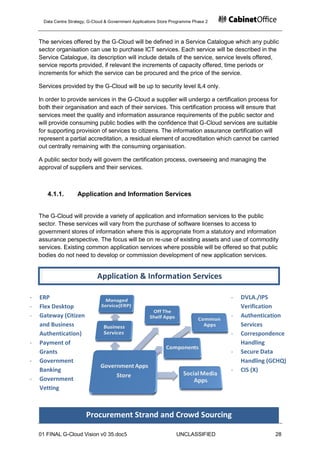
  • 55.
    Data Centre Strategy,G-Cloud & Government Applications Store Programme Phase 2 A2. Appendix 2 Stakeholder list Name Organisation Andy Nelson MoJ – CIO John Suffolk Cabinet Office – SRO Bill McCluggage Cabinet Office – Deputy Government CIO Martin Bellamy Cabinet Office – Programme Director John Fotheringham Deloitte Annette Vernon Home Office – CIO Tim Wright DCSF – CIO Phil Pavitt HMRC – CIO Nick Hopkinson GCHQ – CIO Dean James DWP – CICT COO John Taylor MOD – CIO Roy Marshall Communities – CIO Christine Connelly Health – CIO Julian David Intellect Derek Kay Deloitte – Cloud Computing SME Toby Spanier Deloitte - Business Planning Workstrand Lead Joe Penman HP - Business Planning Workstrand Co-Lead Nicky Stewart OGC - Commercial Strategy Workstrand Lead Barry Matthews Alsbridge - Commercial Strategy Workstrand Co-Lead Stuart Aston Microsoft - Information Assurance Workstrand Co-Lead Wendy Wright Deloitte - PMO Workstrand Lead Alex Rees IBM - PMO Workstrand Co-Lead Dilip Parmar CLG - Quick Wins Workstrand Lead Andy Bates Cable and Wireless – Quick Wins Workstrand 01 FINAL G-Cloud Vision v0 35.doc5 UNCLASSIFIED 55
  • 56.
    Data Centre Strategy,G-Cloud & Government Applications Store Programme Phase 2 Co-Lead Mike Truran DWP - Service Management Workstrand Lead David Greenway Capgemini - Service Management Workstrand Co-Lead Eileen Logie DWP - Service Management Workstrand Deputy Lead Gerry Gallagher Deloitte - Service Specification and Business Transition Planning Workstrand Lead Andy MacLeod Cisco - Service Specification and Business Transition Planning Workstrand Co-Lead Miles Gray Connecting for Health – Technical Architecture Workstrand Lead Kate Craig-Wood Memset - Technical Architecture Workstrand Co-Lead 01 FINAL G-Cloud Vision v0 35.doc5 UNCLASSIFIED 56
  • 57.
    Data Centre Strategy,G-Cloud & Government Applications Store Programme Phase 2 A3. Appendix 3 – Details of Scenarios In order to refine the Vision described in this document a series of scenarios were reviewed and walked through by the Cabinet Office Datacentre Consolidation, G-Cloud and Application Store Phase 2 programme leadership team on 22 nd October 2009. There are six scenarios each based on a different stakeholder within ICT services for the Public Sector. Each scenario investigates the ways in which the G-Cloud will affect how this stakeholder deals with a challenge to delivering ICT services. The sections below describe the scenario and the results of the team‟s investigations of the scenario and its challenges in the new world of the G-Cloud. A3.1. Central Government Department ICT Service Director A3.1.1. Role: ICT Service Director in Central Government department Current ICT services range from PC support to running of bespoke applications on a mainframe A3.1.2. Challenge: 10 year outsource deal for department‟s ICT services coming to an end in 12 months A3.1.3. Outcome: How will the G-Cloud help? - Providing efficient procurement process - Reduced time in definition of requirements - Provide choice and competition - Time savings (procurement) - Agreed framework for SLA - Enable budget planning - Provide risk reduction What features would G-Cloud need to have? - G-cloud would need to have the following features: transparency in its processes, security, provide scalability and resilience. - The G-cloud would also need to contain agility - In order to view the different services on offer, the G-cloud would require a shop window - Provide environment where we don‟t need to pay for what we don‟t need or use Will G-Cloud be able to provide all requirements? - Short term, yes, but only in terms of core products - In terms of more specific products in 2012 it will not be in a mature state How will the role and skills in the ICT group of the Department change with the use of G-Cloud? 01 FINAL G-Cloud Vision v0 35.doc5 UNCLASSIFIED 57
  • 58.
    Data Centre Strategy,G-Cloud & Government Applications Store Programme Phase 2 - Different type of commercial awareness and knowledge - Increased visibility across govt departments - Different approach to service management What assumptions have you made? - We are in 2012 - 3 key challenges = green agenda, digital Britain, reducing overall cost 01 FINAL G-Cloud Vision v0 35.doc5 UNCLASSIFIED 58
  • 59.
    Data Centre Strategy,G-Cloud & Government Applications Store Programme Phase 2 A3.2. Local Government Director of Housing A3.2.1. Role: Director of Housing in Local Government A3.2.2. Challenge: New government legislation requires local authority to monitor new aspects of private rental property in the borough Responsibility will be given to the borough in 6 months time Existing ICT systems are at full capacity and do offer appropriate functionality A3.2.3. Outcome A: How will the G-Cloud help? - Provide scale - Enable us to buy more of the same thing - We don‟t need to go through a competitive procurement process - Provide resilience - Easy to terminate What features would G-Cloud need to have? - Similar to Scenario 1, for example G-cloud would need to have transparency in it‟s processes, Security, provide scalability, resilience, and agility - In order to view the different services on offer, the G-cloud would require a shop window - Provide agreed commercial principles Will G-Cloud be able to provide all requirements? - Yes How will the role and skills in the ICT group of the Department change with the use of G-Cloud? - There would be little change in skills What assumptions have you made? - There is a service that already exists and provides the appropriate functionality - Current capacity is provided by the G-cloud - Business change has already taken place, therefore there will be little change in terms of skills 01 FINAL G-Cloud Vision v0 35.doc5 UNCLASSIFIED 59
  • 60.
    Data Centre Strategy,G-Cloud & Government Applications Store Programme Phase 2 A3.2.4. Outcome B: How will the G-Cloud help? - Provide a brokerage service What features would G-Cloud need to have? - Aggregated demand - Application sharing/re-use of applications Will G-Cloud be able to provide all requirements? - Yes How will the role and skills in the ICT group of the Department change with the use of G-Cloud? - The role would require someone who is more focussed on strategy - There would be a certain amount of headcount reduction - The remaining staff would be required to perform a different type of support and maintenance - Less bespoke applications and a reduction in the number of legacy systems would mean more standardised skill sets with less specialist knowledge required What assumptions have you made? - Existing ICT systems DO NOT provide the appropriate functionality - All required applications have already been purchased by the Crown 01 FINAL G-Cloud Vision v0 35.doc5 UNCLASSIFIED 60
  • 61.
    Data Centre Strategy,G-Cloud & Government Applications Store Programme Phase 2 A3.3. Private Sector Application Provider A3.3.1. Role Small private sector software group Just completed successful software implementation at a Police force Functionality of software developed would be relevant to other Police forces A3.3.2. Challenge: Software group has limited marketing and sales resources A3.3.3. Outcome: How will the Application Store help? - The application store would provide a low cost shop window - A rating system would enable users to rate services/applications and add comments - Provide a window on certified solutions - Reduced cost of sale/procurement, which would also mean a reduced price point - A small application provider could use a larger shared infrastructure to build applications leading to a reduction in barriers to entry What features would the Application Store need to have? - Star ratings - Associated services/infrastructure services - Want to have categories of solution i.e. „other customers have bought this‟ How will the processes and skills of the Software firm change to use Application Store? - Going to have to change to online marketing - How you get paid for your sales/for your application will affect your cash flow - Have to align your process around standardised service management - Certification services - Change your support services/provide maintenance packages - Move resources from design to implementation - Lower cost of sale What assumptions have you made? - Central certification i.e. Once a product is certified it doesn‟t require re- certification to be sold on or over time - Don‟t have to compete every time i.e. Not a bidding system for use of services/applications - The department could also want to integrate it and sell - Standard desktop environment - Standard application development environment 01 FINAL G-Cloud Vision v0 35.doc5 UNCLASSIFIED 61
  • 62.
    Data Centre Strategy,G-Cloud & Government Applications Store Programme Phase 2 A3.4. Central Government Department ICT Service Director A3.4.1. Role: ICT Service Director in Central Government department G-Cloud provides infrastructure for application supporting Department‟s main function A3.4.2. Challenge: Changes in economic environment mean that capacity requirements will increase in next 3 months significantly beyond projections when G-Cloud services were contracted A3.4.3. Outcome: How will the G-Cloud help? - Elastic scalability - By buying standard solutions, it is easier for the supplier community to roll out the things that you want - Season ticket concept:: cost will vary with the length of time, the longer you have it the cheaper it will be - Balanced demand across Government e.g. as the demand for the DWP goes down, the demand for the HMRC will go up and vice versa - Give advice on the extra things you might need to make the applications work What features would G-Cloud need to have? - Standard building blocks - Speed of procurement - Flexible offerings - Ability to aggregate demand Will G-Cloud be able to provide all requirements? - No , does not include networks What assumptions have you made? - Application store included access to PSN services - Minimum period of the rental terms becomes a differentiator - Standardised units across the G-cloud - Defined time period for which prices are fixed - Minimum time period for which a price will be held firm 01 FINAL G-Cloud Vision v0 35.doc5 UNCLASSIFIED 62
  • 63.
    Data Centre Strategy,G-Cloud & Government Applications Store Programme Phase 2 A3.5. Local Government CIO A3.5.1. Role: CIO in Local Government G-Cloud infrastructure services provided to Social Services department A3.5.2. Challenge: Performance of G-Cloud services has recently deteriorated Social Services director very concerned as social workers effectiveness being impacted A3.5.3. Outcome: How can CIO resolve issue with G-Cloud? - There is a shift in the commercial model that results in the CIO being able to easily switch providers (low switch costs) for continuous poor performance What features would G-Cloud need to have both in technical and governance terms to enable resolution of the issue? - A back room/account management team pulling things together - Point of vertical escalation - Point of negotiation of requirements - Application service rating What roles and skills would the CIO need in his team to resolve the issue? - Business understanding of local Government to offer re-use/other services - CIO role will have to change to incorporate capacity management and forecasting - Replace ICT procurement with a G-cloud ICT person within the local Government office - Lead to in-house expertise - A change in the retained ICT capability What assumptions have you made? - That there is a single point of contact for all cloud services - Frontline has some business knowledge - There is some knowledge of the service provider 01 FINAL G-Cloud Vision v0 35.doc5 UNCLASSIFIED 63
  • 64.
    Data Centre Strategy,G-Cloud & Government Applications Store Programme Phase 2 A3.6. Private Sector ICT Provider A3.6.1. Role: Supplier of infrastructure and application services to Central Government department A3.6.2. Challenge: Supplier‟s 10 year outsource contract for the department‟s ICT services coming to an end in 12 months Current ICT services range from PC support to running of bespoke applications on a mainframe A3.6.3. Outcome: How will the G-Cloud help? - G-Cloud will provide opportunities to increase market share in public sector - Offers broader international scope for repeat business - Reduced bid costs because the organisation has cloud accreditation What features would G-Cloud need to have? - Brokering service so that application providers can offer applications across the cloud - Published open standards for interoperability Will G-Cloud be able to provide all requirements? - G-cloud will not provide all requirements as there may be legacy/heritage systems that may remain outside the cloud What assumptions have you made? - The supplier was going to be accredited and move into the cloud 01 FINAL G-Cloud Vision v0 35.doc5 UNCLASSIFIED 64
  • 65.
    Data Centre Strategy,G-Cloud & Government Applications Store Programme Phase 2 A4. Appendix 4 Drivers for Change In section 2.1 above, an overview of the factors affecting Public Sector ICT is provided. In this appendix the drivers for change in Public Sector ICT are listed. A4.1. Strategic Drivers for Change CSR010 VFM Programme: OEP annual ICT saving targets of £3.2Bn achievable in three years including £1.6Bn from the ICT Collaborative Procurement Strategy. ‒ G-Cloud will deliver a fundamental contribution to the OEP and will facilitate and accelerate the OEP targets. Climate change: Greening Government ICT white paper (July 2008) energy efficiency and ICT equipment disposal recommendations. Government is Britain‟s largest purchaser of ICT. ‒ G-Cloud will facilitate smarter ways of working through ubiquitous and secure access to data, further reducing government‟s environmental impact and carbon footprint. Digital Britain: strategic vision for ensuring that the UK is at the leading edge of the global digital economy. This requires a step change in the efficiency of the delivery of purchases and ICT procurement. ‒ G-Cloud will deliver greater agility and speed in the delivery of policy and services, underpinned the adoption of shared infrastructure at lower cost. A4.2. Financial Drivers for Change Cash releasing benefits have been estimated as significantly in excess of £900m over 5 years, with savings of £300m per annum thereafter. These will be achieved by: Data Centre Consolidation ‒ Reduced hardware maintenance, server capital expenditure, and power consumption through more efficient and better utilised infrastructure. ‒ Reduced up-front investment costs through standardisation and sharing of assets. ‒ Reduced estate footprint through site sales/repurposing of accommodation. G-Cloud ‒ Reduced capital investment in computer infrastructure through utility-based rental of computing and processing time. 01 FINAL G-Cloud Vision v0 35.doc5 UNCLASSIFIED 65
  • 66.
    Data Centre Strategy,G-Cloud & Government Applications Store Programme Phase 2 ‒ Reduced server purchase costs through virtualisation of servers across departments leading to higher utilisation rates ‒ Reduced data recovery costs through fewer dedicated DR facilities. Government Applications Store ‒ Reduced bespoke application development through reuse of existing components. ‒ Reduced application purchase prices through economies of scale. ‒ Reduced licensing costs through licensing consolidation and reuse. ‒ Reduced investment costs through SaaS pay for use model A4.3. Non Financial Drivers for Change Significant intangible and qualitative benefits are enabled by the Programme: Data Centre Consolidation ‒ Increased resilience and reduced risk through improved and modernised facilities. ‒ Enhanced business agility through faster virtual server provisioning. ‒ Improved sustainability through more energy efficient estate. G-Cloud ‒ Improved dynamic scalability through accessing additional resources for peak demand. ‒ Enhanced ability to transition ICT staff to more value-adding activities through reducing the need for maintenance and patching. ‒ Reduced project timescales through reuse of building components. Government Applications Store ‒ Enhanced business agility through easier and less lengthy procurements due to framework contracts ‒ Improved licence compliance through centralised monitoring and management. ‒ Enhanced purchasing decision making through better pricing transparency and comparability. ‒ Increased Information Assurance through being built-in to certified solutions. 01 FINAL G-Cloud Vision v0 35.doc5 UNCLASSIFIED 66
  • 67.
    Data Centre Strategy,G-Cloud & Government Applications Store Programme Phase 2 A4.4. Technological Drivers for Change Cloud computing has come of age driven by real advances in: ‒ architecture ‒ security ‒ web platforms ‒ elastically scalable processing ‒ utility computing, on-demand services, grid computing and software as a service. ‒ Virtualisation providing ability to: ‒ Drive higher server utilisation rates Use of commodity server resources ‒ Standardised components leading to easier recovery in event of failure ‒ Service Oriented Architecture providing ‒ Enhanced integration mechanisms between applications ‒ Ability to re-use application components Process automation providing ‒ Standard support mechanisms ‒ Enhanced agility ‒ Improved visibility of service performance 01 FINAL G-Cloud Vision v0 35.doc5 UNCLASSIFIED 67
  • 68.
    A5. Appendix 5Programme Risks PROGRAMME R ISKS (AS AGREED AT THE PROGRAMME BOARD ON 10TH DECEMBER) # Category Owner Risk Description Likelihood Impact Mitigation Approach There is a risk that pricing and commercial terms for G-Cloud, Data Ensure that terms adequately reward G-Cloud and data centre migration may be 6 Centre MT High High commercial risk commensurate with insufficient to encourage industry investment and Consolidation value for money and cost savings participation Failure to secure senior and early departmental Effective senior stakeholder management 8 All MB commitment to G-Cloud may prohibit service uptake High High to ensure understanding and buy-in and infrastructure sharing Programme to engage regularly with CIOs Delivery of the G-Cloud benefits will require strong Tech Architecture workstrand lead to central coordination across Dept and LA boundaries - review and ensure open standards are this is how the private sector successes to date have appropriately reflected been achieved. This requires a radically new ICT 10 G-Cloud GG High High Peer review process to validate governance and organisational approach for the appropriate use of open standards. Public Sector. If this change is not appropriately implemented, achievement of G-Cloud benefits will Obtain early senior stakeholder support be significantly impaired and/or delayed. for proposed governance models UNCLASSIFIED
  • 69.
    Data Centre Strategy,G-Cloud & Government Applications Store Programme Phase 2 DS to engage CESG and other critical Failure to agree an appropriate IA model will prevent stakeholders to facilitate understanding departments from using shared infrastructure and 12 G-Cloud DS High High of impact and changes required by G- suppliers from easily providing services over the G- Cloud and to gain commitment to Cloud. proposed IA model # Category Owner Risk Description Likelihood Impact Mitigation Approach Regularly assess support/commitment There is a risk that the programme may not receive from Government (both Business and 1 All MB cross Government support and commitment required Medium High Technology perspective) to deliver key elements of the G-Cloud strategy Demonstrate/communicated benefits of G- Cloud Secure at least one major government There is a risk that the team will not get sufficient department to be fully involved in the data data or engagement from departments, and will collection process. 2 All TS Medium High therefore not be able to produce a robust business case Engage with a cross selection of departments to gather data 01 FINAL G-Cloud Vision v0 35.doc5 UNCLASSIFIED 69
  • 70.
    Data Centre Strategy,G-Cloud & Government Applications Store Programme Phase 2 Commercial team to identify procurement Procurement rules may prohibit the establishment of model(s) for the G-Cloud and test these 13 Apps Store NS Medium High pan government purchasing, re-use and sharing. early with EU and UK procurement specialists to validate their proposals. Quick Wins workstrand is aware of this and There is a risk that security accreditation constraints is working closely with the Information 14 Quick Wins DS Medium High may prohibit quick wins from going live. Assurance workstrand to ensure that any quick wins developed are able to go live. There is a risk that failure to create common security 1. DS to progress with Technical Data Centre 18 DS standard for data centre evaluation may inhibit the Medium Medium Architecture and DC teams and; Consolidation 2. Assess viability of selecting/ using Data Centre consolidation current standards # Category Owner Risk Description Likelihood Impact Mitigation Approach There is a risk that any one data centre (if there are Ensure that data centre consolidation Data Centre 19 DS 12) may not be secure enough to cater for the total Medium Medium approach defines sufficient data centres Consolidation data held and appropriate data separation strategies 01 FINAL G-Cloud Vision v0 35.doc5 UNCLASSIFIED 70
  • 71.
    Data Centre Strategy,G-Cloud & Government Applications Store Programme Phase 2 There is a risk that incoming regulation may make PUE (Power usage effectiveness) higher than 2.0 17 All MB illegal and this may mean that we have to change our Medium Low Ongoing monitoring of emerging regulation target DC / transition approach (move more rapidly than planned) There is a risk that senior stakeholders’ expectations regarding the projected savings for DC consolidation, Progress validation of savings ASAP and G-Cloud and Apps Store (as documented in the ICT 3 All TS Low High ensure stakeholders are provided with strategy) cannot be met as the detailed analysis to upper and lower savings projections validate the high level extrapolation of industry benchmarking has not yet been completed. Arrange more cross strand meetings to There is a risk that different interpretations for App lock-down a single definition for service Store and G-Cloud governance and commercial 11 All EL Low High management. Model service management framework across the programme will inhibit the architecture and challenge cross strand creation of the Service management framework. interpretations in work strand. # Category Owner Risk Description Likelihood Impact Mitigation Approach 01 FINAL G-Cloud Vision v0 35.doc5 UNCLASSIFIED 71
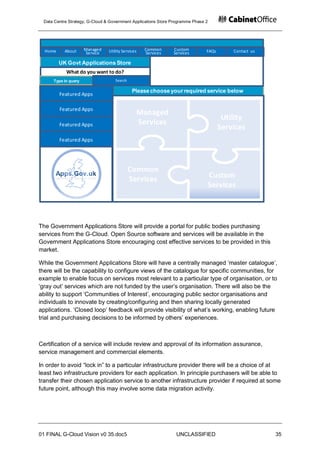
  • 72.
    Data Centre Strategy,G-Cloud & Government Applications Store Programme Phase 2 There is a risk that as a result of stating our preferred Technical Architecture and peer reviewers approach, one industry model/ method becomes 15 All MG Low High to ensure standards are open/ fair to allow dominant / de facto and others are incompatible / multiple industry models sidelined. Identify potential double counts. Evaluate the extent to which this programme will de risk their delivery or provide the means to There is a risk that the business case may double achieve them. Do not set a separate target count savings with PSN programme and other existing on top of OEP etc. for programme benefits - 4 All TS Low Medium programmes, thus weakening our or their business i.e. the programme enables benefits to be cases. realised across current governmental targets. Need urgent clarity on the scope boundaries of PSN and G-Cloud to avoid this scenario There is a risk that insufficient engagement with the Implement an appropriate engagement plan th for CIO engagement prior to the CIO CIO community prior to 5 February will result in a 5 All MB Low Medium council. Request support from the subsequent lack of buy-in to the business case and Programme Board in engaging with CIO Vision. stakeholders 01 FINAL G-Cloud Vision v0 35.doc5 UNCLASSIFIED 72
  • 73.
    Data Centre Strategy,G-Cloud & Government Applications Store Programme Phase 2 # Category Owner Risk Description Likelihood Impact Mitigation Approach Failure to secure early, senior industry engagement Implement appropriate industry (CXO-level) may constrain G-Cloud service provision 7 All MB Low Medium engagement plan using Intellect and other decisions and prioritisation of investment in FY appropriate industry bodies 2010/11 Ensure that development of transition plans There is a risk that suppliers may develop Cloud includes appropriate governance to 20 All MB approaches for Public Sector based on the status quo Low Medium introduce non status quo approaches such and thereby limit the cost efficiencies of G-Cloud. as introduction of new suppliers and technologies The Vision and transition approach should be developed such that we do not have a G-Cloud, There is a risk that if the PSN or Desktop are not 21 MB Low Medium dependency on the availability of Apps Store available on time it will cause unnecessary delay Desktop/PSN and that our infrastructure is agnostic of network or desktop service Failure to incorporate into contract terms the ability to Commercial to progress, optional use a purchased application across multiple 22 Apps Store NS TBD High Make “the Crown” the entity in contracts government entities will result in applications not rather than individual departments being shared/re-used across government 01 FINAL G-Cloud Vision v0 35.doc5 UNCLASSIFIED 73
  • 74.
    Data Centre Strategy,G-Cloud & Government Applications Store Programme Phase 2 There is a risk that commercial and carbon gains are 16 All MB made by departments on their own and the G-Cloud TBD Medium MB to provide mitigation w/c 17th January does not deliver large enough incremental savings POTENTIAL PROGRAMME RISKS (SUBMITTED BY HMT FOR CONSIDERATION FOR INCLUSION INTO RISK REGISTER) # Category Owner Risk Description Likelihood Impact Mitigation Approach Government Governance of the Programme Input is being actively sought from CIOs in both local and central Delivery of the G-Cloud benefits will require government sectors, in order to build a high level of buy-in to the 23 All TBC strong central coordination across Dept and TBD [high] programme’s direction of travel, deliverables, and governance LA boundaries - this is how the good private model. sector successes to date have been achieved. This requires a radically new governance and organisational approach. 01 FINAL G-Cloud Vision v0 35.doc5 UNCLASSIFIED 74
  • 75.
    Data Centre Strategy,G-Cloud & Government Applications Store Programme Phase 2 Alternative funding routes will be explored, including funding from within the public sector CIO Community, and also upfront funding from suppliers that is then repaid through service charges (HMT Funding/ upfront investment would be content with this provided this does not add to the national debt and still produces significant savings post high interest 24 All TBC In the current resource constrained TBD [high] rates levied). HMT can consider providing new funding for the environment, upfront investment funding central project team, but first want the project to explore whether will be particularly difficult to secure. the CIO Community would fund these costs from existing budgets, on the basis that the investment will help deliver savings later on. Early adopters could provide seed funding, further reducing the barriers to entry (and affordability constraints) for later adopters. # Category Owner Risk Description Likelihood Impact Mitigation Approach Develop a business case which delivers significant benefits for a Achieving critical mass quickly reasonable level of funding within 2-3 years. Enable the early adopters to share in the benefits of increased downstream scale, If the programme does not achieve a certain critical 25 All TBC TBD [high] as more organisations make use of the programme. The mass within the first 2-3 years, benefits will not be Programme Director will engage the SRO and the Chair of the significant enough to attract public sector Programme Board to develop a broader socialisation and organisations in the future. engagement approach post the CIO Council meeting. 01 FINAL G-Cloud Vision v0 35.doc5 UNCLASSIFIED 75
  • 76.
    Data Centre Strategy,G-Cloud & Government Applications Store Programme Phase 2 Work is already underway across government to secure political support for the programme as part of the wider ICT Strategy. Angela Smith has issued the ICT Strategy to ministers and their departments, who have all formally accepted it. (Confirmation of support from HMT still in progress.) The programme is positioned as an enabler of government policy, including OEP, Digital Britain, Political Sponsorship Smarter Government, Building Britain’s Future and the Green ICT 26 All TBC TBD [high] Strategy – hence it centres on improving efficiency and delivering This IT-enabled programme may not be viewed as relevant business change capability, through buying IT differently appealing to Ministers. and therefore should appeal to a delivery focused politicians. Government policy is to enable decentralisation, and efficient IT decentralisation can only be undertaken successfully (and cost effectively) with the strong central co-ordination for standard IT assets, infrastructure and processes that will be delivered by the programme. Transition Plan Work is still in progress on the governance and organisational model, and the transition plan. Discussions are underway with Though the vision and end destination of the 27 All TBC TBD [high] programme board members, and departments and LAs – the programme are clear, the journey is not currently proposed way forwards will be reviewed at the next programme- developed enough to provide stakeholders with HMT meeting in late January. sufficient confidence of the programme’s success. APPENDIX 01 FINAL G-Cloud Vision v0 35.doc5 UNCLASSIFIED 76
  • 77.
    Data Centre Strategy,G-Cloud & Government Applications Store Programme Phase 2 Abbreviation Name MB Martin Bellamy (Programme Director) TS Toby Spanier (Business Planning Lead) NS Nicky Stewart (Commercial Strategy Lead) MG Miles Gray (Technical Architecture Lead) GG Gerry Gallagher (Service Specification / Transition Planning Lead) EL Eileen Logie (Service Management Deputy Lead) HMT HM Treasury 01 FINAL G-Cloud Vision v0 35.doc5 UNCLASSIFIED 77
  • 78.
    Data Centre Strategy,G-Cloud & Government Applications Store Programme Phase 2 A6. Appendix 6 Information Assurance Information Assurance (IA) Workstream Report Summary 1. This workstream report, referred to as the Information Assurance Strategy (IA Strategy) for ease of reference, sets out the vision and initial proposals for an IA Strategy covering the vision of the of the Public Sector IT Strategy for Data Centres, Government Applications Store and a Government Secure Cloud (G-Cloud) environment. It should be read alongside the G-Cloud Vision and the Commercial, Service Management and Technical Architecture workstream reports. Where necessary parts of these documents have been reproduced in the IA Strategy for the ease of the reader. Annex A gives a brief account of the working method of the IA Workstream in devising the IA Strategy. Vision and Scope 2. The vision of the G-Cloud programme is set out in Reference A covering the creation of a single „hybrid‟ cloud1 for the G-Cloud environment providing multiple services across a range of assurance requirements. In order for the IA strategy to set out the IA areas that will need to be covered, this strategy has created an IA Scope. The IA Strategy also sets out an initial proposal for a roadmap identifying the steps that will need to take place to identify if this vision is achievable. 3. The IA Strategy identifies the IA benefits of cross public sector IA governance, assured utility computing components, service re-use and application rationalisation. 4. CONCLUSION: There will need to be a fundamental change from the current IA policy and practice when information risk management moves from the current model of risk management by each organisation for their own services and information to truly shared risks to services and information cutting across multiple organisational boundaries. 5. CONCLUSION: IA risks will be managed by segregating the services and information based on their Threat, Impact and Compliance profiles. The current lack of technology assured to an acceptable level has meant that the roadmap for the IA strategy will begin with physical segregation of domains covering these groupings of services. The objective is to rationalise these physical segregations as assured technology becomes available to manage the risks. This includes continued work to investigate the assurance that can be gained from public cloud services and what types of service might be suitable for some types of public sector information. 1 The definition of “Cloud” is in accordance with those as defined by the NIST. UNCLASSIFIED
  • 79.
    Data Centre Strategy,G-Cloud & Government Applications Store Programme Phase 2 Governance and Roles 6. CONCLUSION: The G-Cloud will bring about a fundamental change to ownership and responsibility for IT services delivered to the public sector. Organisational SIROs will remain responsible for the risk ownership of their information wherever is stored or processed. Similarly organisational SROs will remain responsible for managing the information risk for specific programmes or projects to ensure they meet the objectives agreed with their SIRO and board. 7. CONCLUSION: In order to realise potential efficiencies in the application of IA processes in the G-Cloud environment, SIROs and SROs will need to rely on risk management decisions made by their peers or 3 rd parties. Without this change there will severe duplication of effort and inconsistency in assurance results. This is a major change to the current model of information risk ownership, but without removing the accountability or the organisational SIROs or SROs. 8. RECOMMENDATION: The creation of a G-Cloud SIRO that is responsible for the Confidentiality, Integrity and Availability of the utility services and supporting infrastructure of the G-Cloud. Similarly there is a requirement for a G-Cloud SRO who will have overall responsibility for delivery of security for the operation of the G-Cloud. The G-Cloud SIRO will also need to provide oversight (and co-ordination) with respect to the public cloud elements of the hybrid G-Cloud 9. RECOMMENDATION: The IA regime will look to CIO/CTO Council groups for strategic direction, as well as the agreement that services, architectures and information flows (i.e. information exchange standards) are consistent with the CTO Council‟s Service Orientated Architecture, especially when looking at the re-use of applications and components when building new services. CTO/CIO council groups will act as counsel for the G-Cloud IA governance structures. 10. RECOMMENDATION: Phase 3 of the programme to work via the Cabinet Office (IS&A), who work in close collaboration with CESG, to engage with the SIRO community to test the proposals in this strategy. In particular the roles and responsibilities related to G- Cloud SIRO, G-Cloud SRO and organisational SIRO. Asset Valuation and Aggregation 11. CONCLUSION: Asset valuation, involving aggregation (both accumulation and association) is a key challenge going forward for the IA strategy. Engagement with the Pan Government Accreditors, CESG, CPNI, IADG and a selection of SIROs will be required to reach an agreed approach to this issue. The expectation is that aggregation by accumulation will cause an increase in the Impact Levels for Confidentiality, Integrity and Availability, in many cases by at least one level. 12. CONCLUSION: Aggregation by association in effect raises the protective marking of the combined pieces of information (both the threat and business impact will rise). There 01 FINAL G-Cloud Vision v0 35.doc5 UNCLASSIFIED 79
  • 80.
    Data Centre Strategy,G-Cloud & Government Applications Store Programme Phase 2 needs to be a procedural process backed up by technology to ensure that information is afforded appropriate protection. 13. CONCLUSION: There is a need to articulate the architectural principles that will allow the de-aggregation of information. E.g. mechanisms to ensure that normal users cannot view or retrieve an entire dataset. These mechanisms need to be evaluated appropriately so that they can be used as risk treatments. This work should begin at the start of Phase 3. 14. CONCLUSION: The availability of a given service is inherently limited by the underlying services, e.g. the network and the data centre. There is parity in terms of the levels of availability between each of the services provided in the data centre and the network, e.g. any data centre should be able to support a service that requires support up to IL4. 15. CONCLUSION: The aggregated level of impact for the loss of a number of services or data centres may well reach as high as IL6. In some cases the aggregated impact of the compromise to the confidentiality, integrity of a single utility computing service used by a large proportion of the public sector may also reach as high as Impact Level 6. Risk Assessment, Risk Management and Service Assurance Methodologies 16. CONCLUSION: Current HMG IA Standards, Policies and practices will need to be amended to adequately model the risks reflected by the G-Cloud environment. 17. RECOMMENDATION: The creation of new product and service assurance methodologies covering shared services and shared data/information operating in a cloud environment. This is necessary to enable efficient, reusable assessment of applications and services to facilitate the delivery, composition and risk management of services. The governance of the G-Cloud environment must include oversight of all protective monitoring, forensics, incident management and compliance activities. 18. RECOMMENDATION: Phase 3 should begin with a comprehensive Threat and Risk Assessment covering the issues of asset valuation and aggregation. Assured Technologies 19. RECOMMENDATION: Phase 3 should begin with urgent research work in to the assurance available in current technologies to assist in creating the initial G-Cloud environment. E.g. Resource sharing technology such as virtualisation, Gateway Services, Identity Management (including authentication and authorisation) and Encryption. 01 FINAL G-Cloud Vision v0 35.doc5 UNCLASSIFIED 80
  • 81.
    Data Centre Strategy,G-Cloud & Government Applications Store Programme Phase 2 20. CONCLUSION: Without assured virtualisation technology and an effective federated and brokered Identity, Authentication and Authorisation model for the Public Sector, many of the IA and business benefits will not be realised. Where resource sharing technology with strong containment is desirable, it is likely that tools to manage deployment will also be required. Compliance 21. CONCLUSION: A common issue with cloud computing concerns the demonstration of legal and statutory obligations. This subject will be taken forward with Treasury Solicitors (TSoL) and the Information Commissioners Office (ICO), as well as the SIRO community in the next phase of the Datacentre and G-Cloud programme. One of the single biggest risks to the successful creation of a community cloud for the public sector will be an inability to demonstrate legal and statutory compliance. 22. CONCLUSION: The areas of responsibility for Codes of Connections and authorisation for applications and services are still to be resolved. The expectation is that the G-Cloud SIRO will be responsible for the authorisation of utility services. The responsibility for authorising agility services, including those hosted on utility services, may well rest with the organisational SIRO. We will need a method of understanding whether any consumer is attempting to breach the use of the IA conditions related to the use of a service. 23. CONCLUSION: There will need to be a set of assured services and components that build to a point that allows the risk owners and risk managers of consuming organisations to make a minimum amount of evaluation before reaching a decision on the use any particular service available from the applications store. Roadmap 24. RECOMMENDATION: The proposal for an IA roadmap is in section 5. The G-Cloud Commercial Strategy gives an indicative timeline. In Phase 3 of the programme, the IA roadmap and roadmaps from other strands will need to be aligned and a common timeline agreed. 25. To achieve the vision of a single physical community cloud there is a requirement to create assured multiple logical instances of a resource on a single physical platform. There is also a requirement for tools to manage deployment of logical instances of those resources. 01 FINAL G-Cloud Vision v0 35.doc5 UNCLASSIFIED 81
  • 82.
    Data Centre Strategy,G-Cloud & Government Applications Store Programme Phase 2 There has only been enough time and detailed information gathering during Phase 2 of this programme to create a set of IA proposals and suggested principles to the many IA questions and challenges posed by the use of Public and Private Clouds. The IA Workstream recommends that paper based scenarios and pilots (including quick wins) are used to test the proposals made in the paper and create more detailed policies and procedures. 01 FINAL G-Cloud Vision v0 35.doc5 UNCLASSIFIED 82