Subsidy Reform in MENA: Recent 
Progress and Challenges Ahead 
Presented by Gazi Shbaikat 
Middle East and Central Asia Department 
IMF 
Sept 8, 2014
Plan of presentation 
I. Measuring Subsidies 
II. Subsides in MENA: Stylized Facts 
III. Investigating the Determinants of 
Successful Subsidy Reform 
IV. Recent Experiences of Subsidy Reform in 
MENA 
V. Policy Issues: Topics of Special Interest to 
MENA 
2
I. Measuring 
Subsidies
Subsidies, what are they and how are 
they measured? 
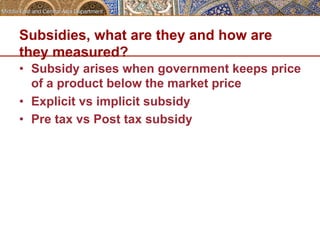
• Subsidy arises when government keeps price 
of a product below the market price 
• Explicit vs implicit subsidy 
• Pre tax vs Post tax subsidy
Measuring subsidies 
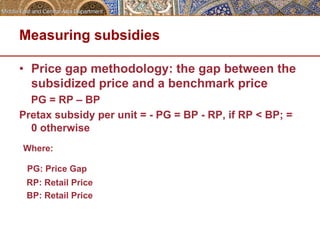
• Price gap methodology: the gap between the 
subsidized price and a benchmark price 
PG = RP – BP 
Pretax subsidy per unit = - PG = BP - RP, if RP < BP; = 
0 otherwise 
Where: 
PG: Price Gap 
RP: Retail Price 
BP: Retail Price
Measuring subsidies 
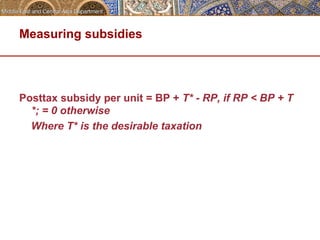
Posttax subsidy per unit = BP + T* - RP, if RP < BP + T 
*; = 0 otherwise 
Where T* is the desirable taxation
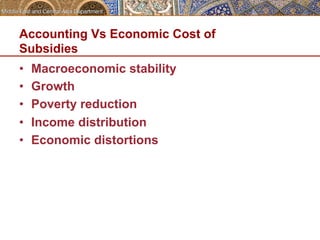
Accounting Vs Economic Cost of 
Subsidies 
• Macroeconomic stability 
• Growth 
• Poverty reduction 
• Income distribution 
• Economic distortions
8 
II. Subsidies in 
MENA: Stylized 
Facts
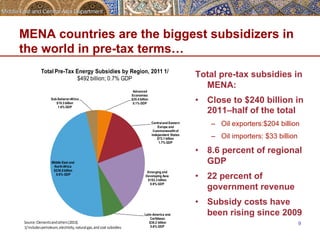
MENA countries are the biggest subsidizers in 
the world in pre-tax terms… 
Total pre-tax subsidies in 
MENA: 
• Close to $240 billion in 
2011–half of the total 
– Oil exporters:$204 billion 
– Oil importers: $33 billion 
• 8.6 percent of regional 
GDP 
• 22 percent of 
government revenue 
• Subsidy costs have 
been rising since 2009 
9 
Total Pre-Tax Energy Subsidies by Region, 2011 1/ 
Advanced 
Economies 
$25.4 billion 
0.1% GDP 
Central and Eastern 
Europe and 
Commonwealth of 
Independent States 
$72.1 billion 
1.7% GDP 
Emerging and 
Developing Asia 
$102.3 billion 
0.9% GDP 
Latin America and 
Caribbean 
$36.2 billion 
0.6% GDP 
Sub-Saharan Africa 
$19.3 billion 
1.6% GDP 
Middle East and 
North Africa 
$236.5 billion 
8.6% GDP 
$492 billion; 0.7% GDP 
Source: 
Clements 
and 
others 
(2013). 
1/ 
Includes 
petroleum, 
electricity, 
natural 
gas, 
and 
coal 
subsidies.
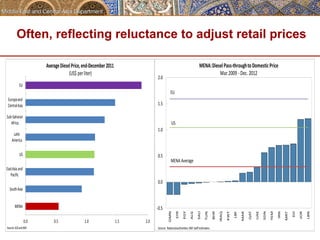
Often, reflecting reluctance to adjust retail prices 
2.0 
1.5 
1.0 
0.5 
0.0 
-­‐0.5 
EU 
US 
OMN 
SYR 
EGY 
ALG 
SAU 
TUN 
BHR 
IRAQ 
KWT 
LBY 
MAR 
QAT 
UAE 
SDN 
YEM 
IRN 
MRT 
DJI 
JOR 
LBN 
MENA: 
Diesel 
Pass-­‐through 
to 
Domestic 
Price 
Mar. 
2009 
-­‐ Dec. 
2012 
MENA 
Average 
Source: 
National 
authorities;IMF 
staff 
estimates. 
0.0 0.5 1.0 1.5 2.0 
EU 
Europe 
and 
Central 
Asia 
Sub-­‐Saharan 
Africa 
Latin 
America 
US 
East 
Asia 
and 
Pacific 
South 
Asia 
MENA 
Average 
Diesel 
Price, 
end-­‐December 
2011 
(US$ 
per 
liter) 
Source: 
GIZ 
and 
IMF.
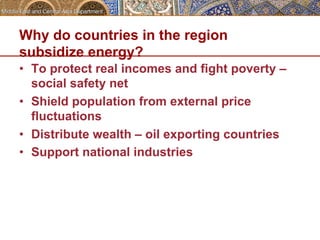
Why do countries in the region 
subsidize energy? 
• To protect real incomes and fight poverty – 
social safety net 
• Shield population from external price 
fluctuations 
• Distribute wealth – oil exporting countries 
• Support national industries
12 
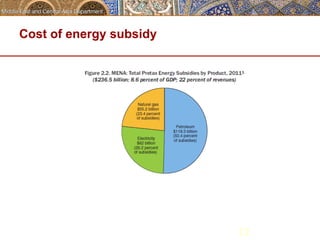
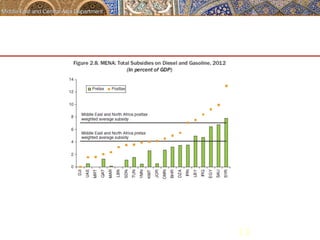
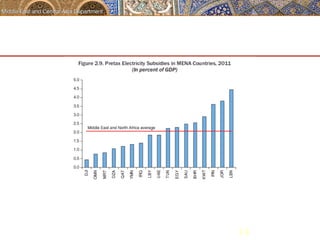
Cost of energy subsidy
13
14
15 
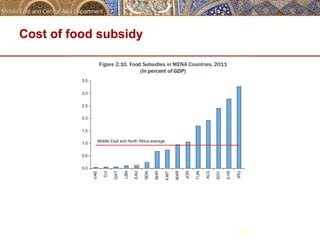
Cost of food subsidy
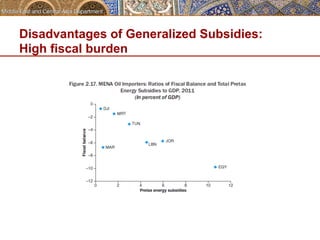
Disadvantages of Generalized Subsidies: 
High fiscal burden
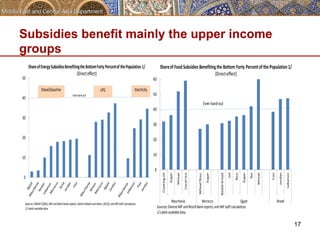
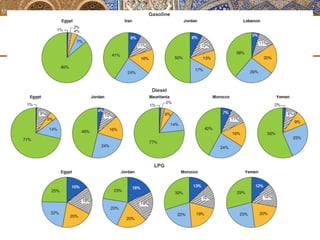
Subsidies benefit mainly the upper income 
groups 
17 
50 
40 
30 
20 
10 
0 
Share 
of 
Energy 
Subsidies 
Benefitingthe 
Bottom 
Forty 
Percent 
of 
the 
Population 
1/ 
(Direct 
effect) 
Diesel/Gasoline LPG Electricity 
Even 
hand-­‐out 
Sources: 
ESMAP 
(2005); 
IMF 
and 
World 
Bank 
reports; 
Salehi-­‐Isfahani 
and 
others 
(2013); 
and 
IMF 
staff 
calculations. 
1/ 
Latest 
available 
data. 
Share 
of 
Food 
Subsidies 
Benefiting 
the 
Bottom 
Forty Percent 
of 
the 
Population 
1/ 
60 50 
40 
30 
20 
10 
0 
Cooking 
oil 
Sugar 
Wheat 
Local 
rice 
Wheat 
flour 
Even 
hand-­‐out 
Sugar 
(Direct 
effect) 
Baladi 
bread 
Oil 
Rice 
Sugar 
Tea 
Wheat 
Iran 
Jordan 
Lebanon 
Mauritania Morocco Egypt Bread 
Sources: 
Diverse 
IMF 
and 
World 
Bank 
reports; 
and 
IMF 
staff 
calculations. 
1/ 
Latest 
available 
data.
18
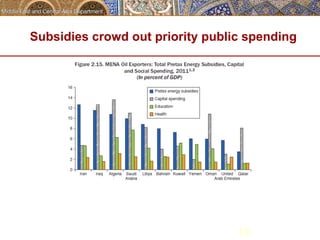
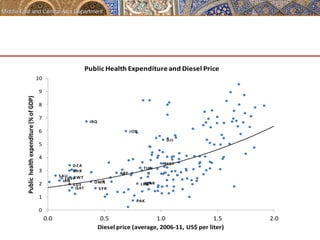
Subsidies crowd out priority public spending 
19
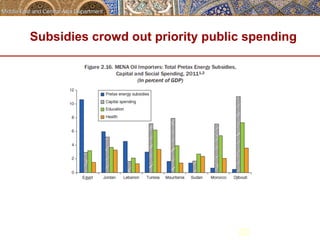
Subsidies crowd out priority public spending 
20
DZA 
BHR 
Public 
Health 
Expenditure 
and 
Diesel 
Price 
DJI 
EGY 
IRN 
IRQ 
JOR 
KWT 
LBN 
LBY 
MRT 
OMN MAR 
PAK 
QAT 
SAU 
SYR 
TUN 
ARE 
10 
9 
8 
7 
6 
5 
4 
3 
2 
1 
0 
0.0 0.5 1.0 1.5 2.0 
Public 
health 
expenditure 
(% 
of 
GDP) 
Diesel 
price 
(average, 
2006-­‐11, 
US$ 
per 
liter)
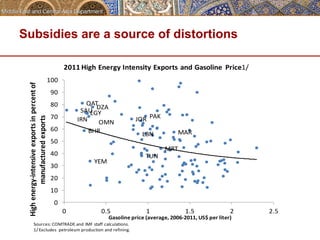
Subsidies are a source of distortions 
2011 
High 
Energy 
Intensity 
Exports 
and 
Gasoline 
DZA 
EGY 
IRN JOR 
BHR 
LBN 
MAR 
MRT 
OMN 
PAK 
QAT 
SAU 
TUN 
YEM 
100 
90 
80 
70 
60 
50 
40 
30 
20 
10 
0 
energy-­‐intensive 
exports 
in 
percent 
of 
manufactured 
exports 
Price1/ 
0 0.5 1 1.5 2 2.5 High 
Gasoline 
price 
(average, 
2006-­‐2011, 
US$ 
per 
liter) 
Sources: 
COMTRADE 
and 
IMF 
staff 
calculations. 
1/ 
Excludes 
petroleum 
production 
and 
refining.
23 
III. Investigating the 
Determinants of 
Successful Subsidy 
Reform
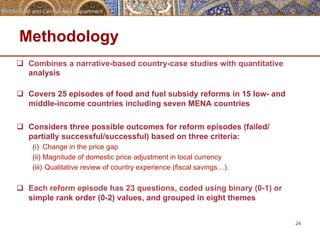
Methodology 
q Combines a narrative-based country-case studies with quantitative 
analysis 
q Covers 25 episodes of food and fuel subsidy reforms in 15 low- and 
middle-income countries including seven MENA countries 
q Considers three possible outcomes for reform episodes (failed/ 
partially successful/successful) based on three criteria: 
(i) Change in the price gap 
(ii) Magnitude of domestic price adjustment in local currency 
(iii) Qualitative review of country experience (fiscal savings…). 
q Each reform episode has 23 questions, coded using binary (0-1) or 
simple rank order (0-2) values, and grouped in eight themes 
24
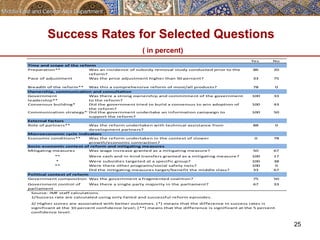
Success Rates for Selected Questions 
( in percent) 
25 
Yes 
No 
Time 
and 
scope 
of 
the 
reform 
Preparation** Was 
an 
incidence 
of 
subsidy 
removal 
study 
conducted 
prior 
to 
the 
reform? 
86 20 
Pace 
of 
adjustment Was 
the 
price 
adjustment 
higher 
than 
50 
percent? 33 75 
Breadth 
of 
the 
reform** Was 
this 
a 
comprehensive 
reform 
of 
most/all 
products? 78 0 
Ownership, 
communication 
and 
consultation 
Government 
leadership** 
Was 
there 
a 
strong 
ownership 
and 
commitment 
of 
the 
government 
to 
the 
reform? 
100 33 
Consensus 
building* Did 
the 
government 
tried 
to 
build 
a 
consensus 
to 
win 
adoption 
of 
the 
reform? 
100 43 
Communication 
strategy**Did 
the 
government 
undertake 
an 
information 
campaign 
to 
support 
the 
reform? 
100 50 
External 
factors 
Role 
of 
partners** Was 
the 
reform 
undertaken 
with 
technical 
assistance 
from 
development 
partners? 
88 0 
Macroeconomic 
cycle 
indicators 
Economic 
conditions** Was 
the 
reform 
undertaken 
in 
the 
context 
of 
slower 
growth/economic 
contraction? 
0 78 
Socio-­‐economic 
context 
of 
reform 
and 
mitigating 
measures 
Mitigating 
measures Was 
wage 
increase 
granted 
as 
a 
mitigating 
measure? 50 67 
** Were 
cash 
and 
in-­‐kind 
transfers 
granted 
as 
a 
mitigating 
measure? 100 17 
* Were 
subsidies 
targeted 
at 
a 
specific 
group? 100 38 
** Were 
there 
other 
programs/social 
safety 
nets? 100 0 
Did 
the 
mitigating 
measures 
target/benefit 
the 
middle 
class? 33 67 
Political 
context 
of 
reform 
Government 
composition Was 
the 
government 
a 
fragmented 
coalition? 75 50 
Government 
control 
of 
Was 
there 
a 
single 
party 
majority 
in 
the 
parliament? 67 33 
parliament 
Source: 
IMF 
staff 
calculations. 
1/Success 
rate 
are 
calculated 
using 
only 
failed 
and 
successful 
reform 
episodes. 
2/ 
Higher 
scores 
are 
associated 
with 
better 
outcomes. 
(*) 
means 
that 
the 
difference 
in 
success 
rates 
is 
significant 
at 
the 
10 
percent 
confidence 
level; 
(**) 
means 
that 
the 
difference 
is 
significant 
at 
the 
5 
percent 
confidence 
level.
26 
IV. Recent 
Experiences of 
Subsidy Reform in 
MENA
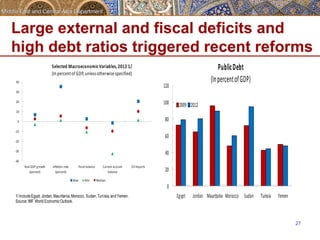
Large external and fiscal deficits and 
high debt ratios triggered recent reforms 
27 
40 
30 
20 
10 
0 
-­‐10 
-­‐20 
-­‐30 
-­‐40 
Real 
GDP 
growth 
(percent) 
Selected 
Macroeconomic 
Variables, 
2012 
1/ 
(In 
percent 
of 
GDP, 
unless 
otherwise 
specified) 
Inflation 
rate 
(percent) 
Fiscal 
balance Current 
account 
balance 
Oil 
imports 
Max Min Median 
1/ Include Egypt, Jordan, Mauritania, Morocco, Sudan, Tunisia, and Yemen. 
Source: IMF World Economic Outlook. 
120 
100 
80 
60 
40 
20 
0 
Public 
Debt 
(In 
percent 
of 
GDP) 
2009 2012 
Egypt Jordan Mauritania Morocco Sudan Tunisia Yemen
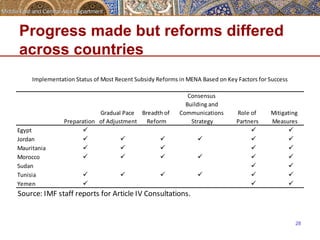
Progress made but reforms differed 
across countries 
28 
Implementation 
Status 
of 
Most 
Recent 
Subsidy 
Reforms 
in 
MENA 
Based 
on 
Key 
Factors 
for 
Success 
Preparation 
Gradual 
Pace 
of 
Adjustment 
Breadth 
of 
Reform 
Consensus 
Building 
and 
Communications 
Strategy 
Role 
of 
Partners 
Mitigating 
Measures 
Egypt ü 
ü 
ü 
Jordan ü 
ü 
ü 
ü 
ü 
ü 
Mauritania ü 
ü 
ü 
ü 
ü 
Morocco ü 
ü 
ü 
ü 
ü 
ü 
Sudan ü 
ü 
Tunisia ü 
ü 
ü 
ü 
ü 
ü 
Yemen ü 
ü 
ü 
Source: 
IMF 
staff 
reports 
for 
Article 
IV 
Consultations.
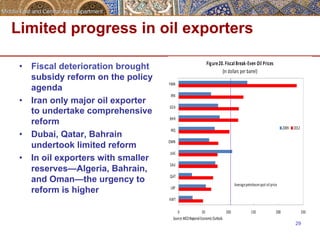
• Fiscal deterioration brought 
subsidy reform on the policy 
agenda 
• Iran only major oil exporter 
to undertake comprehensive 
reform 
• Dubai, Qatar, Bahrain 
undertook limited reform 
• In oil exporters with smaller 
reserves—Algeria, Bahrain, 
and Oman—the urgency to 
reform is higher 
29 
Limited progress in oil exporters 
0 50 100 150 200 250 
YMN 
IRN 
DZA 
BHR 
IRQ 
OMN 
UAE 
SAU 
QAT 
LBY 
KWT 
Figure 
20. 
Fiscal 
Break-­‐Even 
Oil 
Prices 
(In 
dollars 
per 
barrel) 
2009 2012 
Average 
petroleum 
spot oil 
price 
Source: 
MCD 
Regional 
Economic Outlook.
30 
V. Policy Issues: 
Topics of Special 
Interest to MENA
Strengthening social safety nets 
31 
Social safety nets 
(excluding subsidies) 
• Small at 0.7% of GDP 
• Cash transfers not 
widely used or 
underfunded 
• SSN fragmented and 
suffering from leakages 
Ø 23% of benefits accrue 
to bottom quintile 
• Limited impact on 
poverty and inequality 
Strengthening social safety nets: 
• Improve targeting to the neediest 
Ø Even targeted, subsidies less cost 
effective than other SSNs 
• Cash transfers are more effective 
Ø Do not distort prices 
Ø Provide flexibility to recipients 
Ø Relatively low administrative cost
Managing the political economy of subsidy 
reform 
32 
Challenges: 
• Lags in the timing of costs 
and benefits 
• Weak administrative 
capacity of governments 
• Long duration of the 
reform effort 
Designing political economy-robust 
reforms: 
• Build an objective case for reform 
• Increase transparency and 
implementation capacity of the state 
• Create public concern through a 
communication campaign 
• Create coalitions with those who will 
benefit from reforms 
• Embed subsidy reform in a wider policy 
reform plan
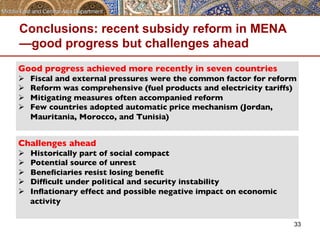
Conclusions: recent subsidy reform in MENA 
—good progress but challenges ahead 
Good progress achieved more recently in seven countries 
Ø Fiscal and external pressures were the common factor for reform 
Ø Reform was comprehensive (fuel products and electricity tariffs) 
Ø Mitigating measures often accompanied reform 
Ø Few countries adopted automatic price mechanism (Jordan, 
Mauritania, Morocco, and Tunisia) 
33 
Challenges ahead 
Ø Historically part of social compact 
Ø Potential source of unrest 
Ø Beneficiaries resist losing benefit 
Ø Difficult under political and security instability 
Ø Inflationary effect and possible negative impact on economic 
activity
Thank you 
34

Subsidy Reform in MENA: Recent Progress and Challenges Ahead (EN)

  • 1.
    Subsidy Reform inMENA: Recent Progress and Challenges Ahead Presented by Gazi Shbaikat Middle East and Central Asia Department IMF Sept 8, 2014
  • 2.
    Plan of presentation I. Measuring Subsidies II. Subsides in MENA: Stylized Facts III. Investigating the Determinants of Successful Subsidy Reform IV. Recent Experiences of Subsidy Reform in MENA V. Policy Issues: Topics of Special Interest to MENA 2
  • 3.
  • 4.
    Subsidies, what arethey and how are they measured? • Subsidy arises when government keeps price of a product below the market price • Explicit vs implicit subsidy • Pre tax vs Post tax subsidy
  • 5.
    Measuring subsidies •Price gap methodology: the gap between the subsidized price and a benchmark price PG = RP – BP Pretax subsidy per unit = - PG = BP - RP, if RP < BP; = 0 otherwise Where: PG: Price Gap RP: Retail Price BP: Retail Price
  • 6.
    Measuring subsidies Posttaxsubsidy per unit = BP + T* - RP, if RP < BP + T *; = 0 otherwise Where T* is the desirable taxation
  • 7.
    Accounting Vs EconomicCost of Subsidies • Macroeconomic stability • Growth • Poverty reduction • Income distribution • Economic distortions
  • 8.
    8 II. Subsidiesin MENA: Stylized Facts
  • 9.
    MENA countries arethe biggest subsidizers in the world in pre-tax terms… Total pre-tax subsidies in MENA: • Close to $240 billion in 2011–half of the total – Oil exporters:$204 billion – Oil importers: $33 billion • 8.6 percent of regional GDP • 22 percent of government revenue • Subsidy costs have been rising since 2009 9 Total Pre-Tax Energy Subsidies by Region, 2011 1/ Advanced Economies $25.4 billion 0.1% GDP Central and Eastern Europe and Commonwealth of Independent States $72.1 billion 1.7% GDP Emerging and Developing Asia $102.3 billion 0.9% GDP Latin America and Caribbean $36.2 billion 0.6% GDP Sub-Saharan Africa $19.3 billion 1.6% GDP Middle East and North Africa $236.5 billion 8.6% GDP $492 billion; 0.7% GDP Source: Clements and others (2013). 1/ Includes petroleum, electricity, natural gas, and coal subsidies.
  • 10.
    Often, reflecting reluctanceto adjust retail prices 2.0 1.5 1.0 0.5 0.0 -­‐0.5 EU US OMN SYR EGY ALG SAU TUN BHR IRAQ KWT LBY MAR QAT UAE SDN YEM IRN MRT DJI JOR LBN MENA: Diesel Pass-­‐through to Domestic Price Mar. 2009 -­‐ Dec. 2012 MENA Average Source: National authorities;IMF staff estimates. 0.0 0.5 1.0 1.5 2.0 EU Europe and Central Asia Sub-­‐Saharan Africa Latin America US East Asia and Pacific South Asia MENA Average Diesel Price, end-­‐December 2011 (US$ per liter) Source: GIZ and IMF.
  • 11.
    Why do countriesin the region subsidize energy? • To protect real incomes and fight poverty – social safety net • Shield population from external price fluctuations • Distribute wealth – oil exporting countries • Support national industries
  • 12.
    12 Cost ofenergy subsidy
  • 13.
  • 14.
  • 15.
    15 Cost offood subsidy
  • 16.
    Disadvantages of GeneralizedSubsidies: High fiscal burden
  • 17.
    Subsidies benefit mainlythe upper income groups 17 50 40 30 20 10 0 Share of Energy Subsidies Benefitingthe Bottom Forty Percent of the Population 1/ (Direct effect) Diesel/Gasoline LPG Electricity Even hand-­‐out Sources: ESMAP (2005); IMF and World Bank reports; Salehi-­‐Isfahani and others (2013); and IMF staff calculations. 1/ Latest available data. Share of Food Subsidies Benefiting the Bottom Forty Percent of the Population 1/ 60 50 40 30 20 10 0 Cooking oil Sugar Wheat Local rice Wheat flour Even hand-­‐out Sugar (Direct effect) Baladi bread Oil Rice Sugar Tea Wheat Iran Jordan Lebanon Mauritania Morocco Egypt Bread Sources: Diverse IMF and World Bank reports; and IMF staff calculations. 1/ Latest available data.
  • 18.
  • 19.
    Subsidies crowd outpriority public spending 19
  • 20.
    Subsidies crowd outpriority public spending 20
  • 21.
    DZA BHR Public Health Expenditure and Diesel Price DJI EGY IRN IRQ JOR KWT LBN LBY MRT OMN MAR PAK QAT SAU SYR TUN ARE 10 9 8 7 6 5 4 3 2 1 0 0.0 0.5 1.0 1.5 2.0 Public health expenditure (% of GDP) Diesel price (average, 2006-­‐11, US$ per liter)
  • 22.
    Subsidies are asource of distortions 2011 High Energy Intensity Exports and Gasoline DZA EGY IRN JOR BHR LBN MAR MRT OMN PAK QAT SAU TUN YEM 100 90 80 70 60 50 40 30 20 10 0 energy-­‐intensive exports in percent of manufactured exports Price1/ 0 0.5 1 1.5 2 2.5 High Gasoline price (average, 2006-­‐2011, US$ per liter) Sources: COMTRADE and IMF staff calculations. 1/ Excludes petroleum production and refining.
  • 23.
    23 III. Investigatingthe Determinants of Successful Subsidy Reform
  • 24.
    Methodology q Combinesa narrative-based country-case studies with quantitative analysis q Covers 25 episodes of food and fuel subsidy reforms in 15 low- and middle-income countries including seven MENA countries q Considers three possible outcomes for reform episodes (failed/ partially successful/successful) based on three criteria: (i) Change in the price gap (ii) Magnitude of domestic price adjustment in local currency (iii) Qualitative review of country experience (fiscal savings…). q Each reform episode has 23 questions, coded using binary (0-1) or simple rank order (0-2) values, and grouped in eight themes 24
  • 25.
    Success Rates forSelected Questions ( in percent) 25 Yes No Time and scope of the reform Preparation** Was an incidence of subsidy removal study conducted prior to the reform? 86 20 Pace of adjustment Was the price adjustment higher than 50 percent? 33 75 Breadth of the reform** Was this a comprehensive reform of most/all products? 78 0 Ownership, communication and consultation Government leadership** Was there a strong ownership and commitment of the government to the reform? 100 33 Consensus building* Did the government tried to build a consensus to win adoption of the reform? 100 43 Communication strategy**Did the government undertake an information campaign to support the reform? 100 50 External factors Role of partners** Was the reform undertaken with technical assistance from development partners? 88 0 Macroeconomic cycle indicators Economic conditions** Was the reform undertaken in the context of slower growth/economic contraction? 0 78 Socio-­‐economic context of reform and mitigating measures Mitigating measures Was wage increase granted as a mitigating measure? 50 67 ** Were cash and in-­‐kind transfers granted as a mitigating measure? 100 17 * Were subsidies targeted at a specific group? 100 38 ** Were there other programs/social safety nets? 100 0 Did the mitigating measures target/benefit the middle class? 33 67 Political context of reform Government composition Was the government a fragmented coalition? 75 50 Government control of Was there a single party majority in the parliament? 67 33 parliament Source: IMF staff calculations. 1/Success rate are calculated using only failed and successful reform episodes. 2/ Higher scores are associated with better outcomes. (*) means that the difference in success rates is significant at the 10 percent confidence level; (**) means that the difference is significant at the 5 percent confidence level.
  • 26.
    26 IV. Recent Experiences of Subsidy Reform in MENA
  • 27.
    Large external andfiscal deficits and high debt ratios triggered recent reforms 27 40 30 20 10 0 -­‐10 -­‐20 -­‐30 -­‐40 Real GDP growth (percent) Selected Macroeconomic Variables, 2012 1/ (In percent of GDP, unless otherwise specified) Inflation rate (percent) Fiscal balance Current account balance Oil imports Max Min Median 1/ Include Egypt, Jordan, Mauritania, Morocco, Sudan, Tunisia, and Yemen. Source: IMF World Economic Outlook. 120 100 80 60 40 20 0 Public Debt (In percent of GDP) 2009 2012 Egypt Jordan Mauritania Morocco Sudan Tunisia Yemen
  • 28.
    Progress made butreforms differed across countries 28 Implementation Status of Most Recent Subsidy Reforms in MENA Based on Key Factors for Success Preparation Gradual Pace of Adjustment Breadth of Reform Consensus Building and Communications Strategy Role of Partners Mitigating Measures Egypt ü ü ü Jordan ü ü ü ü ü ü Mauritania ü ü ü ü ü Morocco ü ü ü ü ü ü Sudan ü ü Tunisia ü ü ü ü ü ü Yemen ü ü ü Source: IMF staff reports for Article IV Consultations.
  • 29.
    • Fiscal deteriorationbrought subsidy reform on the policy agenda • Iran only major oil exporter to undertake comprehensive reform • Dubai, Qatar, Bahrain undertook limited reform • In oil exporters with smaller reserves—Algeria, Bahrain, and Oman—the urgency to reform is higher 29 Limited progress in oil exporters 0 50 100 150 200 250 YMN IRN DZA BHR IRQ OMN UAE SAU QAT LBY KWT Figure 20. Fiscal Break-­‐Even Oil Prices (In dollars per barrel) 2009 2012 Average petroleum spot oil price Source: MCD Regional Economic Outlook.
  • 30.
    30 V. PolicyIssues: Topics of Special Interest to MENA
  • 31.
    Strengthening social safetynets 31 Social safety nets (excluding subsidies) • Small at 0.7% of GDP • Cash transfers not widely used or underfunded • SSN fragmented and suffering from leakages Ø 23% of benefits accrue to bottom quintile • Limited impact on poverty and inequality Strengthening social safety nets: • Improve targeting to the neediest Ø Even targeted, subsidies less cost effective than other SSNs • Cash transfers are more effective Ø Do not distort prices Ø Provide flexibility to recipients Ø Relatively low administrative cost
  • 32.
    Managing the politicaleconomy of subsidy reform 32 Challenges: • Lags in the timing of costs and benefits • Weak administrative capacity of governments • Long duration of the reform effort Designing political economy-robust reforms: • Build an objective case for reform • Increase transparency and implementation capacity of the state • Create public concern through a communication campaign • Create coalitions with those who will benefit from reforms • Embed subsidy reform in a wider policy reform plan
  • 33.
    Conclusions: recent subsidyreform in MENA —good progress but challenges ahead Good progress achieved more recently in seven countries Ø Fiscal and external pressures were the common factor for reform Ø Reform was comprehensive (fuel products and electricity tariffs) Ø Mitigating measures often accompanied reform Ø Few countries adopted automatic price mechanism (Jordan, Mauritania, Morocco, and Tunisia) 33 Challenges ahead Ø Historically part of social compact Ø Potential source of unrest Ø Beneficiaries resist losing benefit Ø Difficult under political and security instability Ø Inflationary effect and possible negative impact on economic activity
  • 34.