Loida Garcia-Febo Coordinator, New Americans Program, Queens Library Successful Partnerships to Serve Immigrant Communities Today
 
 
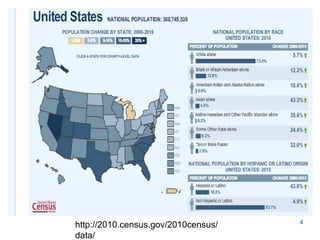
http://2010.census.gov/2010census/data/
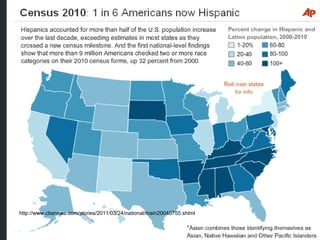
http://www.cbsnews.com/stories/2011/03/24/national/main20046755.shtml
 
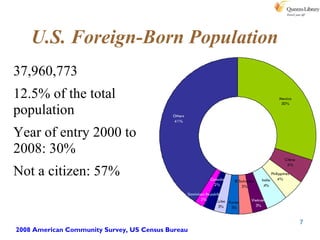
U.S. Foreign-Born Population 37,960,773 12.5% of the total population  Year of entry 2000 to 2008: 30% Not a citizen: 57% 2008 American Community Survey, US Census Bureau
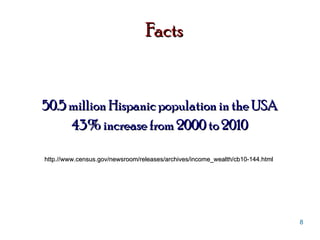
Facts 50.5 million Hispanic population in the USA 43% increase from 2000 to 2010 http.//www.census.gov/newsroom/releases/archives/income_wealth/cb10-144.html
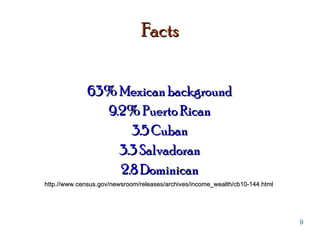
Facts 63% Mexican background 9.2% Puerto Rican 3.5 Cuban 3.3 Salvadoran 2.8 Dominican http.//www.census.gov/newsroom/releases/archives/income_wealth/cb10-144.html
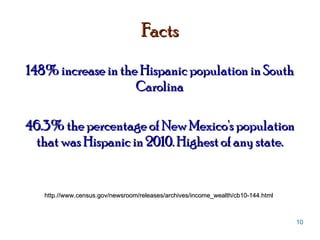
Facts 148% increase in the Hispanic population in South Carolina 46.3% the percentage of New Mexico's population that was Hispanic in 2010. Highest of any state. http.//www.census.gov/newsroom/releases/archives/income_wealth/cb10-144.html
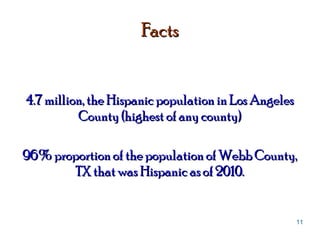
Facts 4.7 million, the Hispanic population in Los Angeles County (highest of any county) 96% proportion of the population of Webb County, TX that was Hispanic as of 2010.
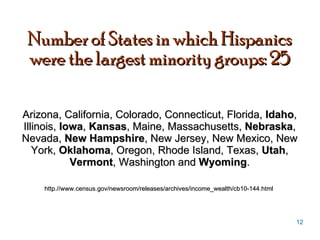
Number of States in which Hispanics were the largest minority groups: 25 Arizona, California, Colorado, Connecticut, Florida,  Idaho , Illinois,  Iowa ,  Kansas , Maine, Massachusetts,  Nebraska , Nevada,  New Hampshire , New Jersey, New Mexico, New York,  Oklahoma , Oregon, Rhode Island, Texas,  Utah ,  Vermont , Washington and  Wyoming . http.//www.census.gov/newsroom/releases/archives/income_wealth/cb10-144.html
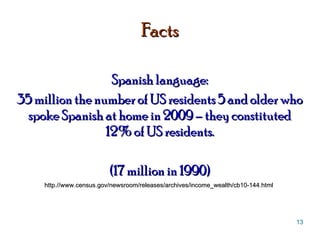
Facts Spanish language: 35 million the number of US residents 5 and older who spoke Spanish at home in 2009 – they constituted 12% of US residents. (17 million in 1990) http.//www.census.gov/newsroom/releases/archives/income_wealth/cb10-144.html
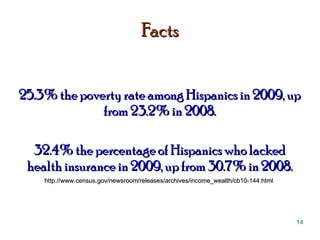
Facts 25.3% the poverty rate among Hispanics in 2009, up from 23.2% in 2008. 32.4% the percentage of Hispanics who lacked health insurance in 2009, up from 30.7% in 2008. http.//www.census.gov/newsroom/releases/archives/income_wealth/cb10-144.html
Shopping plaza in Elmhurst offering a Chinese supermarket, Vietnamese food, Indian food, Thai food, Malaysian food and “Italian” Pizza.
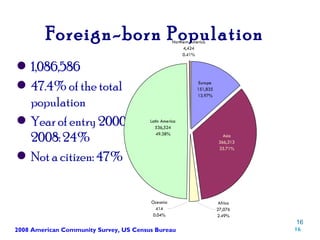
Foreign-born Population 1,086,586 47.4% of the total population Year of entry 2000 to 2008: 24% Not a citizen: 47% 2008 American Community Survey, US Census Bureau
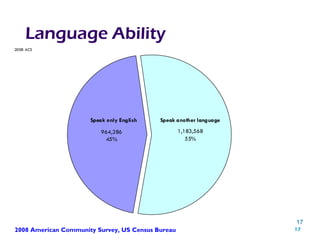
Language Ability 2008 American Community Survey, US Census Bureau
Queens ranks #1 in NYC... Hispanics Colombian (78%) Peruvian (70%) [Mexican: has increased 333.6%, 2nd in NYC]
Three Major Components Consumer Health Resources Center Health Literacy Program Queens Library Health Link
By building on already-strong relationships between Community Libraries and Queens communities, Queens Library is Helping to   decrease   health disparities in Queens. Increasing access   to cancer screening and care among medically underserved communities. Strengthening our role   as the heart of the community by facilitating access to public health information to all in the community. Providing tools   for Queens’ residents to develop their capacity to obtain, process, and understand basic health information and services needed to make appropriate health decisions.
Consumer Health  Resources Center
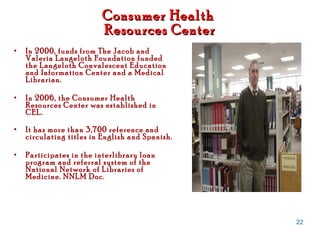
Consumer Health  Resources Center In 2000, funds from The Jacob and Valeria Langeloth Foundation funded the Langeloth Convalescent Education and Information Center and a Medical Librarian.  In 2006, the Consumer Health Resources Center was established in CEL.  It has more than 3,700 reference and circulating titles in English and Spanish. Participates in the interlibrary loan program and referral system of the National Network of Libraries of Medicine. NNLM Doc.
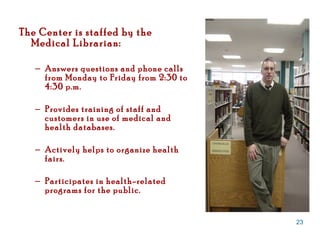
The Center is staffed by the Medical Librarian: Answers questions and phone calls from Monday to Friday from 2:30 to 4:30 p.m. Provides training of staff and customers in use of medical and health databases. Actively helps to organize health fairs. Participates in health-related programs for the public.
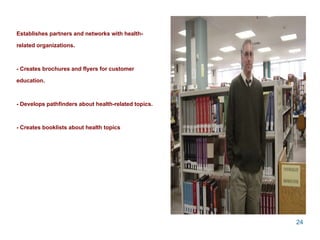
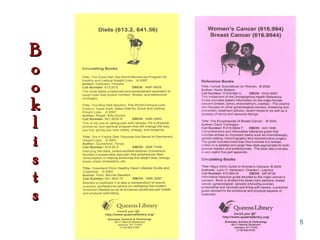
Establishes partners and networks with health-related organizations. - Creates brochures and flyers for customer education.  - Develops pathfinders about health-related topics. - Creates booklists about health topics
B o o k l i s t s
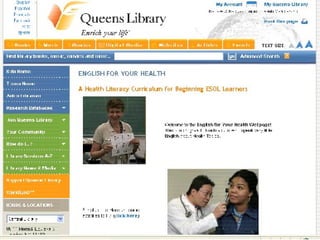
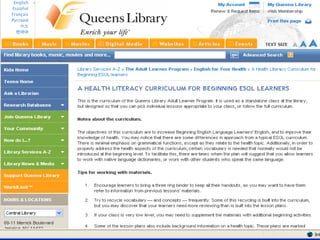
English for Your Health: A Health Literacy Curriculum for Beginning ESOL Learners
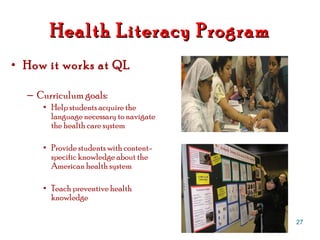
Health Literacy Program How it works at QL Curriculum goals: Help students acquire the language necessary to navigate the health care system Provide students with content-specific knowledge about the American health system Teach preventive health knowledge
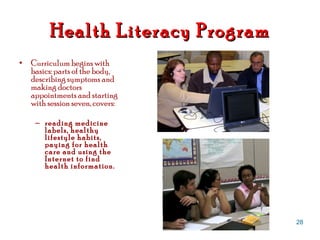
Health Literacy Program Curriculum begins with basics: parts of the body, describing symptoms and making doctors appointments and starting with session seven, covers:  reading medicine labels, healthy lifestyle habits, paying for health care and using the Internet to find health information.
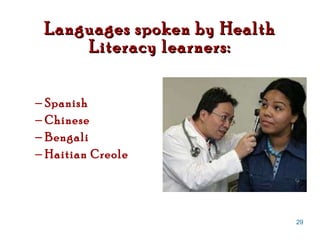
Languages spoken by Health Literacy learners: Spanish Chinese Bengali Haitian Creole
Curriculum begins with basics: parts of the body, describing symptoms and making doctors appointments and starting with session seven, covers:  reading medicine labels, healthy lifestyle habits, paying for health care and using the Internet to find health information.
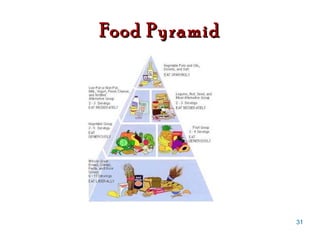
Food Pyramid
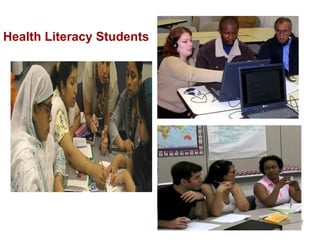
Health Literacy Students
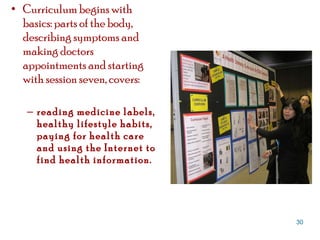
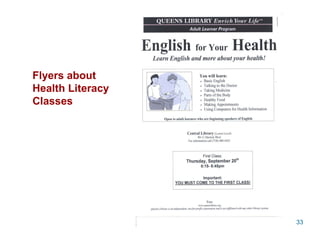
Flyers about Health Literacy Classes


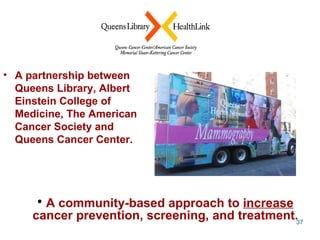
A partnership between Queens Library, Albert Einstein College of Medicine, The American Cancer Society and Queens Cancer Center. A community-based approach to  increase  cancer prevention, screening, and treatment.
Overall Goal : Increase access to cancer screening and care among medically underserved communities.
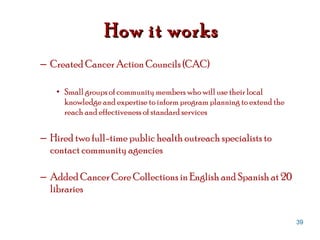
Created Cancer Action Councils (CAC) Small groups of community members who will use their local knowledge and expertise to inform program planning to extend the reach and effectiveness of standard services Hired two full-time public health outreach specialists to contact community agencies Added Cancer Core Collections in English and Spanish at 20 libraries How it works
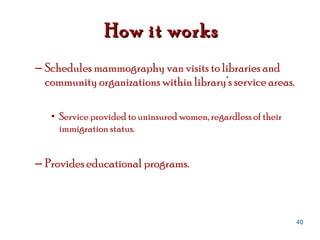
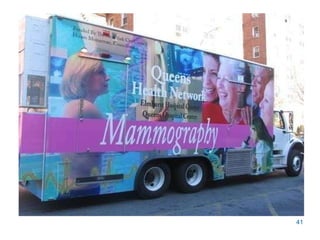
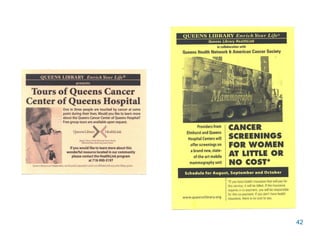
Schedules mammography van visits to libraries and community organizations within library’s service areas. Service provided to uninsured women, regardless of their immigration status. Provides educational programs. How it works
 
 
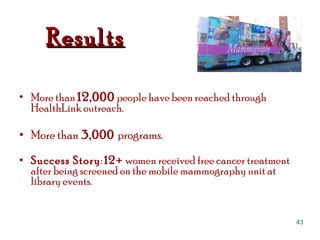
Results More than  12,000  people have been reached through HealthLink outreach. More than  3,000  programs.   Success Story :  12+  women received free cancer treatment after being screened on the mobile mammography unit at library events.
Saving Lives
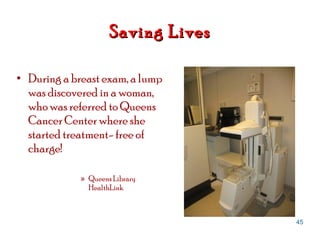
Saving Lives During a breast exam, a lump was discovered in a woman, who was referred to Queens Cancer Center where she started treatment- free of charge! Queens Library HealthLink
Queens Library is  Saving Lives During a Health Fair at Central Library, a customer’s blood pressure reading was unusually high, an ambulance was dispatched and the customer was taken to an area hospital. Consumer Health Center
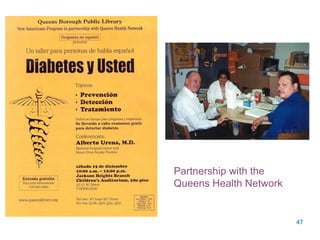
Partnership with the Queens Health Network
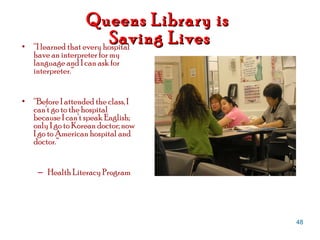
Queens Library is  Saving Lives “ I learned that every hospital have an interpreter for my language and I can ask for interpreter.” “ Before I attended the class, I can’t go to the hospital because I can’t speak English; only I go to Korean doctor; now I go to American hospital and doctor.” Health Literacy Program
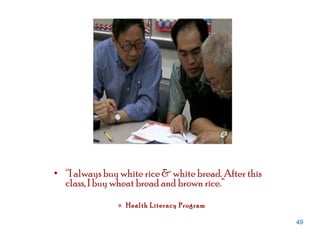
“ I always buy white rice & white bread. After this class, I buy wheat bread and brown rice.” Health Literacy Program
Financial Literacy in the Community
Financial Literacy in the Community Collections Programs Staff development Videos  Website
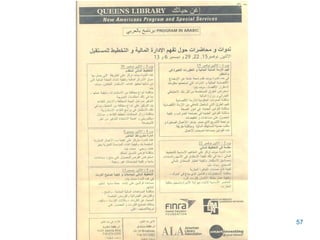
Financial Literacy in the Community Arabic Bengali Chinese English Korean Spanish
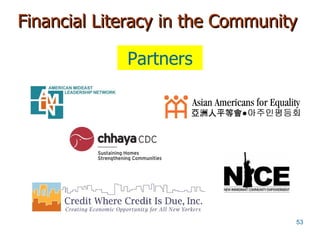
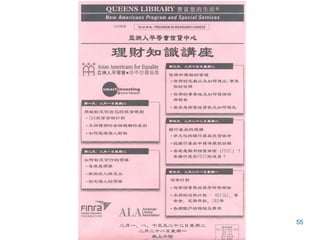
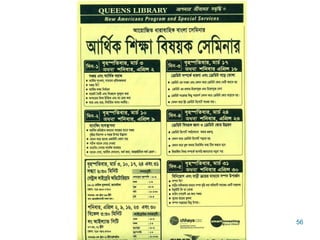
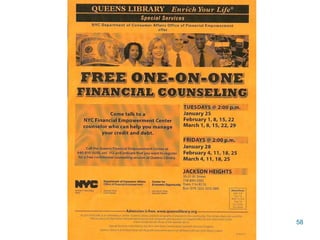
Financial Literacy in the Community Partners


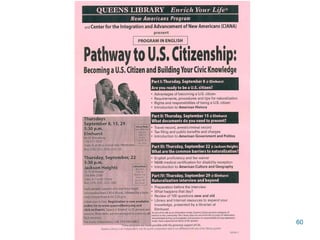
Partnering with the Center for Integration and Advancement of New Americans (CIANA).  Piloted in 2008. Established as a monthly program in January 2009. 2,000 people have attended programs from 2009-2011. Pathway to U.S. Citizenship
 
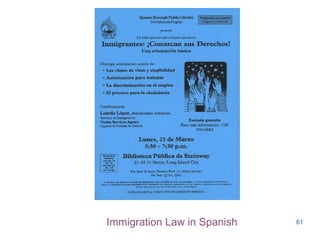
Immigration Law in Spanish
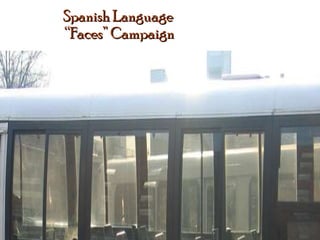
Spanish Language  “Faces” Campaign
Loida Garcia-Febo [email_address]

Successfully Partnerships to Serve Immigrant Communities Today

  • 1.
    Loida Garcia-Febo Coordinator,New Americans Program, Queens Library Successful Partnerships to Serve Immigrant Communities Today
  • 2.
  • 3.
  • 4.
  • 5.
  • 6.
  • 7.
    U.S. Foreign-Born Population37,960,773 12.5% of the total population Year of entry 2000 to 2008: 30% Not a citizen: 57% 2008 American Community Survey, US Census Bureau
  • 8.
    Facts 50.5 millionHispanic population in the USA 43% increase from 2000 to 2010 http.//www.census.gov/newsroom/releases/archives/income_wealth/cb10-144.html
  • 9.
    Facts 63% Mexicanbackground 9.2% Puerto Rican 3.5 Cuban 3.3 Salvadoran 2.8 Dominican http.//www.census.gov/newsroom/releases/archives/income_wealth/cb10-144.html
  • 10.
    Facts 148% increasein the Hispanic population in South Carolina 46.3% the percentage of New Mexico's population that was Hispanic in 2010. Highest of any state. http.//www.census.gov/newsroom/releases/archives/income_wealth/cb10-144.html
  • 11.
    Facts 4.7 million,the Hispanic population in Los Angeles County (highest of any county) 96% proportion of the population of Webb County, TX that was Hispanic as of 2010.
  • 12.
    Number of Statesin which Hispanics were the largest minority groups: 25 Arizona, California, Colorado, Connecticut, Florida, Idaho , Illinois, Iowa , Kansas , Maine, Massachusetts, Nebraska , Nevada, New Hampshire , New Jersey, New Mexico, New York, Oklahoma , Oregon, Rhode Island, Texas, Utah , Vermont , Washington and Wyoming . http.//www.census.gov/newsroom/releases/archives/income_wealth/cb10-144.html
  • 13.
    Facts Spanish language:35 million the number of US residents 5 and older who spoke Spanish at home in 2009 – they constituted 12% of US residents. (17 million in 1990) http.//www.census.gov/newsroom/releases/archives/income_wealth/cb10-144.html
  • 14.
    Facts 25.3% thepoverty rate among Hispanics in 2009, up from 23.2% in 2008. 32.4% the percentage of Hispanics who lacked health insurance in 2009, up from 30.7% in 2008. http.//www.census.gov/newsroom/releases/archives/income_wealth/cb10-144.html
  • 15.
    Shopping plaza inElmhurst offering a Chinese supermarket, Vietnamese food, Indian food, Thai food, Malaysian food and “Italian” Pizza.
  • 16.
    Foreign-born Population 1,086,58647.4% of the total population Year of entry 2000 to 2008: 24% Not a citizen: 47% 2008 American Community Survey, US Census Bureau
  • 17.
    Language Ability 2008American Community Survey, US Census Bureau
  • 18.
    Queens ranks #1in NYC... Hispanics Colombian (78%) Peruvian (70%) [Mexican: has increased 333.6%, 2nd in NYC]
  • 19.
    Three Major ComponentsConsumer Health Resources Center Health Literacy Program Queens Library Health Link
  • 20.
    By building onalready-strong relationships between Community Libraries and Queens communities, Queens Library is Helping to decrease health disparities in Queens. Increasing access to cancer screening and care among medically underserved communities. Strengthening our role as the heart of the community by facilitating access to public health information to all in the community. Providing tools for Queens’ residents to develop their capacity to obtain, process, and understand basic health information and services needed to make appropriate health decisions.
  • 21.
    Consumer Health Resources Center
  • 22.
    Consumer Health Resources Center In 2000, funds from The Jacob and Valeria Langeloth Foundation funded the Langeloth Convalescent Education and Information Center and a Medical Librarian. In 2006, the Consumer Health Resources Center was established in CEL. It has more than 3,700 reference and circulating titles in English and Spanish. Participates in the interlibrary loan program and referral system of the National Network of Libraries of Medicine. NNLM Doc.
  • 23.
    The Center isstaffed by the Medical Librarian: Answers questions and phone calls from Monday to Friday from 2:30 to 4:30 p.m. Provides training of staff and customers in use of medical and health databases. Actively helps to organize health fairs. Participates in health-related programs for the public.
  • 24.
    Establishes partners andnetworks with health-related organizations. - Creates brochures and flyers for customer education. - Develops pathfinders about health-related topics. - Creates booklists about health topics
  • 25.
    B o ok l i s t s
  • 26.
    English for YourHealth: A Health Literacy Curriculum for Beginning ESOL Learners
  • 27.
    Health Literacy ProgramHow it works at QL Curriculum goals: Help students acquire the language necessary to navigate the health care system Provide students with content-specific knowledge about the American health system Teach preventive health knowledge
  • 28.
    Health Literacy ProgramCurriculum begins with basics: parts of the body, describing symptoms and making doctors appointments and starting with session seven, covers: reading medicine labels, healthy lifestyle habits, paying for health care and using the Internet to find health information.
  • 29.
    Languages spoken byHealth Literacy learners: Spanish Chinese Bengali Haitian Creole
  • 30.
    Curriculum begins withbasics: parts of the body, describing symptoms and making doctors appointments and starting with session seven, covers: reading medicine labels, healthy lifestyle habits, paying for health care and using the Internet to find health information.
  • 31.
  • 32.
  • 33.
    Flyers about HealthLiteracy Classes
  • 34.
  • 35.
  • 36.
  • 37.
    A partnership betweenQueens Library, Albert Einstein College of Medicine, The American Cancer Society and Queens Cancer Center. A community-based approach to increase cancer prevention, screening, and treatment.
  • 38.
    Overall Goal :Increase access to cancer screening and care among medically underserved communities.
  • 39.
    Created Cancer ActionCouncils (CAC) Small groups of community members who will use their local knowledge and expertise to inform program planning to extend the reach and effectiveness of standard services Hired two full-time public health outreach specialists to contact community agencies Added Cancer Core Collections in English and Spanish at 20 libraries How it works
  • 40.
    Schedules mammography vanvisits to libraries and community organizations within library’s service areas. Service provided to uninsured women, regardless of their immigration status. Provides educational programs. How it works
  • 41.
  • 42.
  • 43.
    Results More than 12,000 people have been reached through HealthLink outreach. More than 3,000 programs. Success Story : 12+ women received free cancer treatment after being screened on the mobile mammography unit at library events.
  • 44.
  • 45.
    Saving Lives Duringa breast exam, a lump was discovered in a woman, who was referred to Queens Cancer Center where she started treatment- free of charge! Queens Library HealthLink
  • 46.
    Queens Library is Saving Lives During a Health Fair at Central Library, a customer’s blood pressure reading was unusually high, an ambulance was dispatched and the customer was taken to an area hospital. Consumer Health Center
  • 47.
    Partnership with theQueens Health Network
  • 48.
    Queens Library is Saving Lives “ I learned that every hospital have an interpreter for my language and I can ask for interpreter.” “ Before I attended the class, I can’t go to the hospital because I can’t speak English; only I go to Korean doctor; now I go to American hospital and doctor.” Health Literacy Program
  • 49.
    “ I alwaysbuy white rice & white bread. After this class, I buy wheat bread and brown rice.” Health Literacy Program
  • 50.
    Financial Literacy inthe Community
  • 51.
    Financial Literacy inthe Community Collections Programs Staff development Videos Website
  • 52.
    Financial Literacy inthe Community Arabic Bengali Chinese English Korean Spanish
  • 53.
    Financial Literacy inthe Community Partners
  • 54.
  • 55.
  • 56.
  • 57.
  • 58.
  • 59.
    Partnering with theCenter for Integration and Advancement of New Americans (CIANA). Piloted in 2008. Established as a monthly program in January 2009. 2,000 people have attended programs from 2009-2011. Pathway to U.S. Citizenship
  • 60.
  • 61.
  • 62.
    Spanish Language “Faces” Campaign
  • 64.

Editor's Notes

  • #4 The county of Queens is one of the five boroughs of NYC. Traditionally, a borough of immigrants, almost ½ of its 2.27 million residents come from over 190 countries and more than half speak a language other than English at home.
  • #8 48.4% of the borough’s population is foreign-born. Of that foreign born population, 55% came here between 1990-2006. So we can say with certainty that there is a continuing need for services for new immigrants. From the chart we can see that Latin America is the major source region, followed by Asia and Europe, with Africa just emerging.
  • #16 Immigrants have changed the look of our streets. In 1965 a new immigration law gave rise to the second largest immigration movement in our history, and the 80s gave rise to the huge third wave , followed in the 90s by the fourth wave.
  • #17 47.4% of the borough’s population is foreign-born. Of that foreign born population, 24% came to Queens between 2000-2008. So we can say with certainty that there is a continuing need for services for new immigrants. From the chart we can see that Latin America is the major source region (49%), followed by Asia (34%) and Europe (14%), with Africa just emerging. (2.5%)
  • #18 55% parle à domicile une autre langue que l'anglais (This represents the Language Spoken at Home by Ability to Speak English for the Population 5 Years and over in Queens. Queens has the greatest number of people in the City who reported themselves as speaking English less than very well As you can see, we have more people speaking another language than those who speak only English. Of the 55% who say they speak another language at home, about 30% say they speak English less than “very well,” more than enough to keep all of us in business for quite awhile! ESOL classes serving 3000 adult students annually in over 25 community libraries)
  • #19 As far as Hispanics are concerned, we have the most Colombians and Peruvians. We have had a huge influx of Mexicans over the past 10 years. This may also be due to the fact that the birth rate among Mexican immigrants is very high as we have seen from NYC Dept. of Health data. The Puerto Ricans, Dominicans & Ecuadorians are some of 20 national groups making up a Hispanic population in Queens of 597,773 (a one hundred thousand jump from the last decade).
  • #48 You are looking at some other successful coping skills programs working closely with community partners. A doctor from Elmhurst Hospital spoke in Spanish about prevention, detection, and treatment of diabetes. 25 persons attended and they were screened by staff of Elmhurst Hospital. And it turned out that two persons needed immediate medical attention! See how a library can change their lives?
  • #62 Coping skills programs are a critical link between immigrants and their new environment. Workshops are presented by lawyers, social workers, psychologists, and business and health professionals fluent in one of Queens principal languages, on topics such as immigration law, job training, the American educational system, parenting skills, how to start a small business, tenants rights and health issues . Topics are not imposed, but arrived at in conjunction with practitioners who belong to the target group and are familiar with its needs. Coping Skills programs are often the result of very successful partnerships. Some examples of coping skills programs: understanding the American public school system in Urdu…rights of immigrants, for Spanish-speakers...
  • #63 ¡Yo soy Queens Library! “ I am your Queens Library” used on bus shelters and buses throughout Queens-putting a friendly Spanish speaking face on the library.
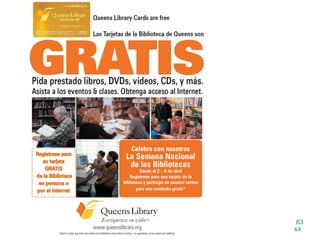
  • #64 La carte de la bibliotheque est gratuit et vous donne acces, non seulement aux livres, CDs et DVDs, mais aussi des classes et des spectacles et l'Internet.