The Role of Community Health Workers in
Delivering Primary Healthcare in Resource
Constrained Settings
What Has Worked and What Has Not:
A Review of Literature
Waqas Abrar
Staff Officer for Programmes
Population Council, Islamabad, Pakistan
Who are community health workers?
World Health Organization defines Community Health
Workers as follows:
“CHWs should be members of the communities where
they work, should be selected by the communities,
should be answerable to the communities for their
activities, should be supported by the health system but
not necessarily a part of its organization and have
shorter training than professional worker” (Lehmann &
Sanders 2007).
Global workforce of CHWs
• Approximately 1.3 million CHWs globally-both
paid and unpaid (WHO)
• Lack of organized systems in developing
countries to record CHWs
• Recent evidence suggests approximately 5
million CHWs worldwide (Perry, Zulliger and Rogers
2014)
What do CHWs do? Global Evidence
• A strategy to address growing shortage of health
workers, particularly in low-income countries
• Selected, trained and work in the communities they
belong to
• No generalized concept to profile CHWs
internationally – vary from country to country
• Work in accordance with local societal and cultural
norms to ensure community acceptance and
ownership
• Implement effective health interventions
• Likely to have substantial impact on health outcomes
Objectives of Research
• To review the global scientific evidence regarding
– Strengths of various CHW programs
– Factors to ensure their community acceptance and ownership
– Factors comprising the effectiveness of CHWs
• To make policy recommendations to take up CHW
Models in marginalized and uncovered communities in
Balochistan
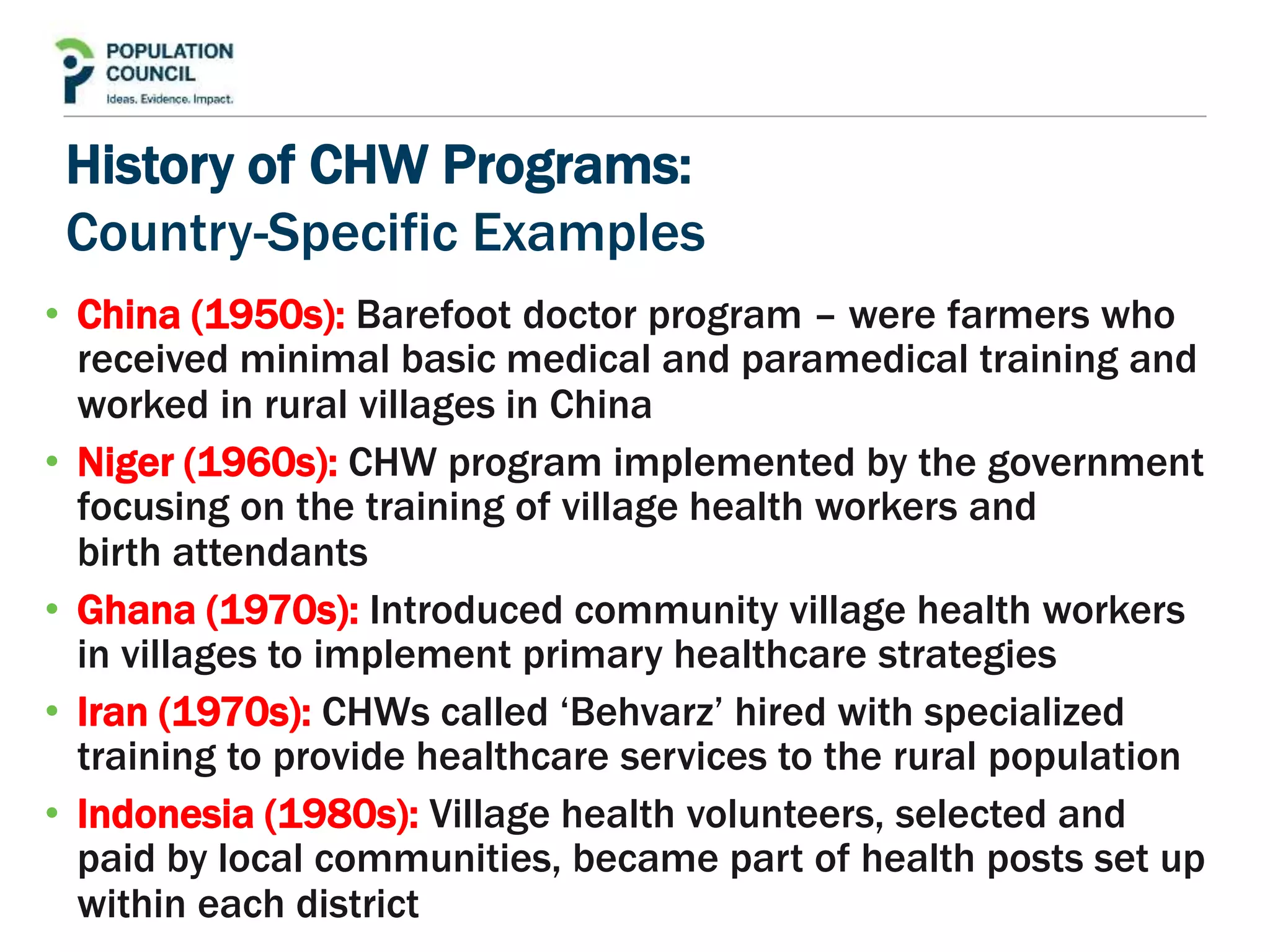
History of CHW Programs:
Country-Specific Examples
• China (1950s): Barefoot doctor program – were farmers who
received minimal basic medical and paramedical training and
worked in rural villages in China
• Niger (1960s): CHW program implemented by the government
focusing on the training of village health workers and
birth attendants
• Ghana (1970s): Introduced community village health workers
in villages to implement primary healthcare strategies
• Iran (1970s): CHWs called ‘Behvarz’ hired with specialized
training to provide healthcare services to the rural population
• Indonesia (1980s): Village health volunteers, selected and
paid by local communities, became part of health posts set up
within each district
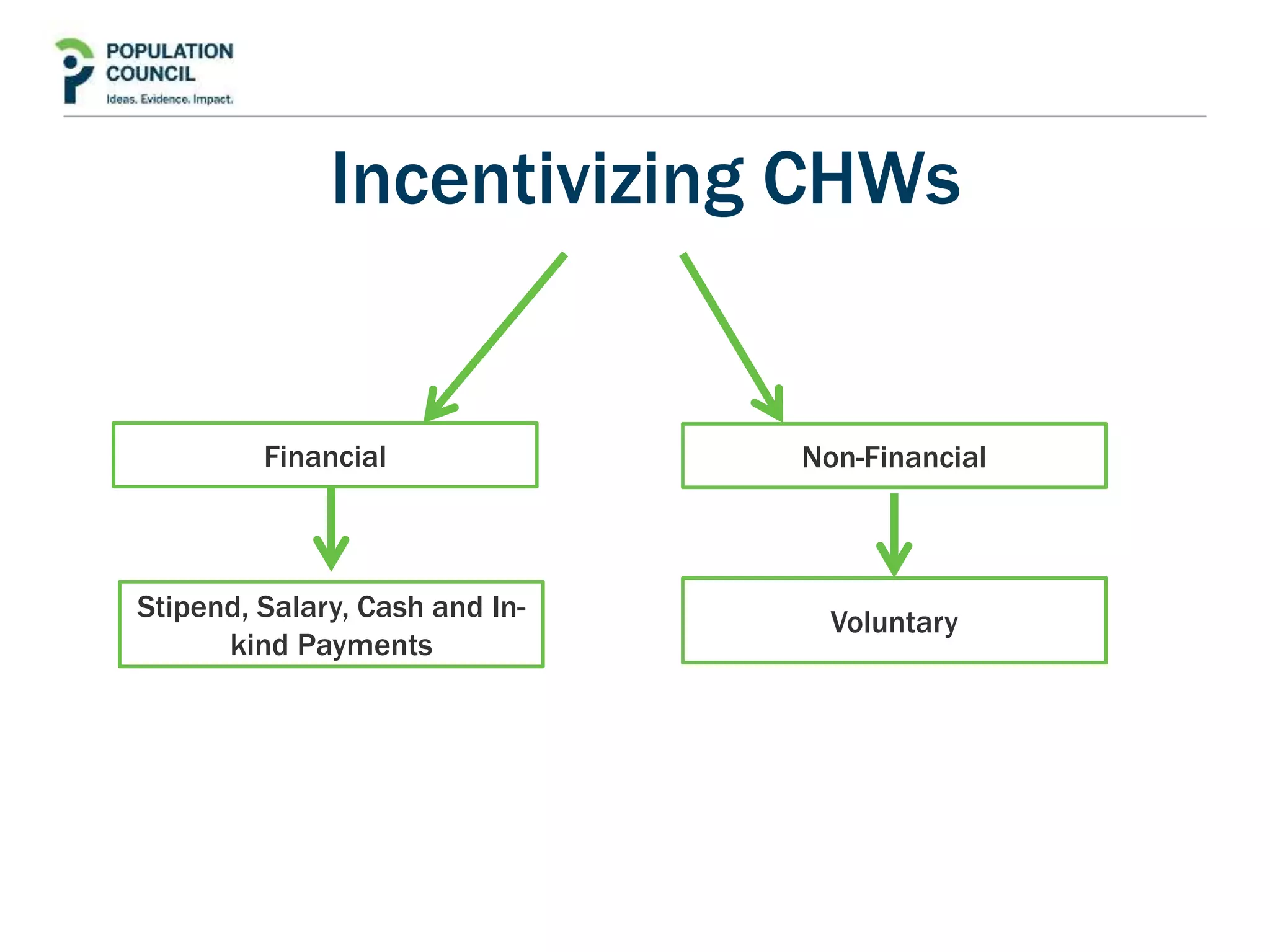
Incentivizing CHWs
Financial Non-Financial
Stipend, Salary, Cash and In-
kind Payments
Voluntary
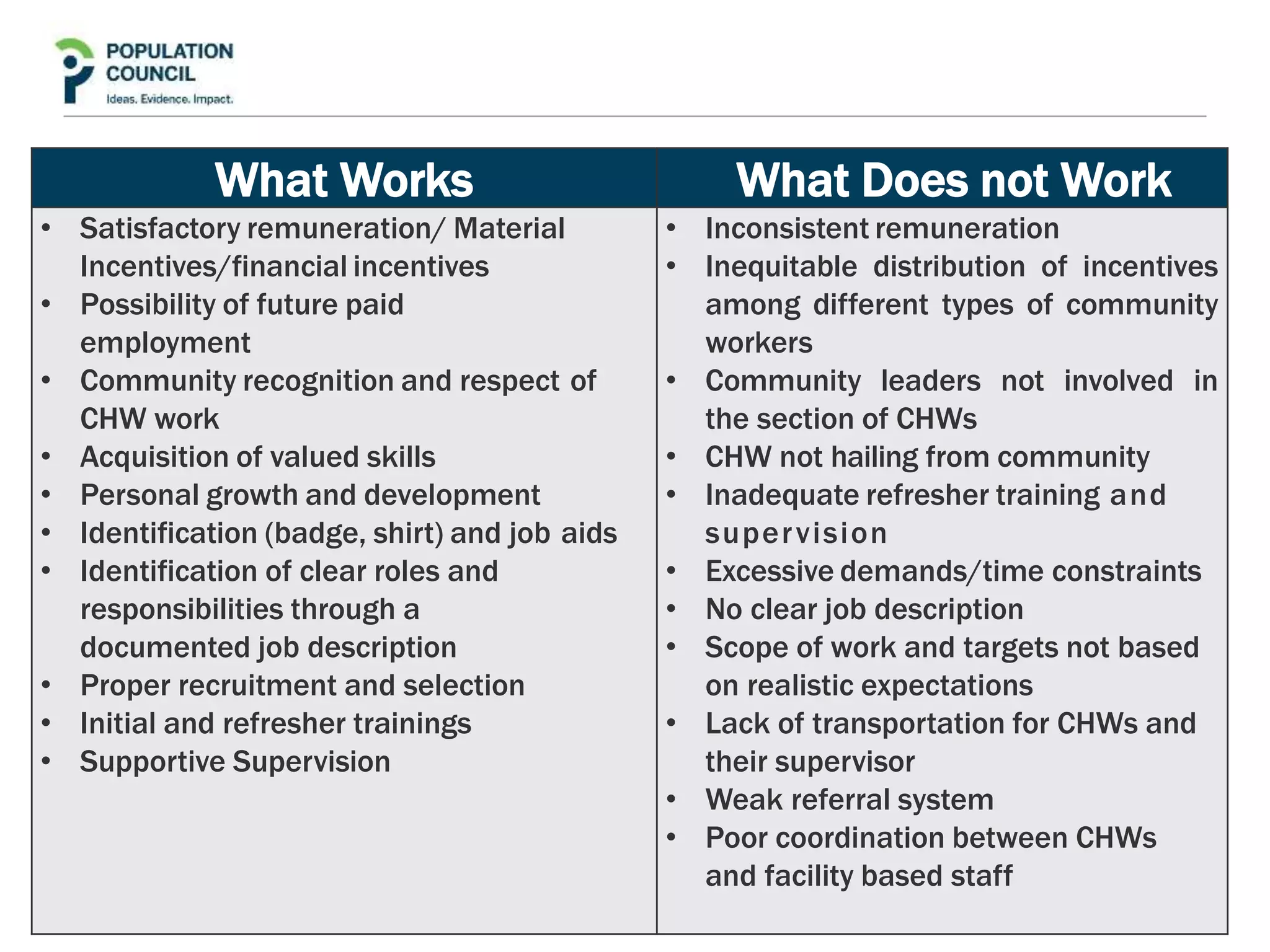
What Works What Does not Work
• Satisfactory remuneration/ Material
Incentives/financial incentives
• Possibility of future paid
employment
• Community recognition and respect of
CHW work
• Acquisition of valued skills
• Personal growth and development
• Identification (badge, shirt) and job aids
• Identification of clear roles and
responsibilities through a
documented job description
• Proper recruitment and selection
• Initial and refresher trainings
• Supportive Supervision
• Inconsistent remuneration
• Inequitable distribution of incentives
among different types of community
workers
• Community leaders not involved in
the section of CHWs
• CHW not hailing from community
• Inadequate refresher training and
supervision
• Excessive demands/time constraints
• No clear job description
• Scope of work and targets not based
on realistic expectations
• Lack of transportation for CHWs and
their supervisor
• Weak referral system
• Poor coordination between CHWs
and facility based staff
Falahi Worker Model (Pakistan)
Linking mobilization with services
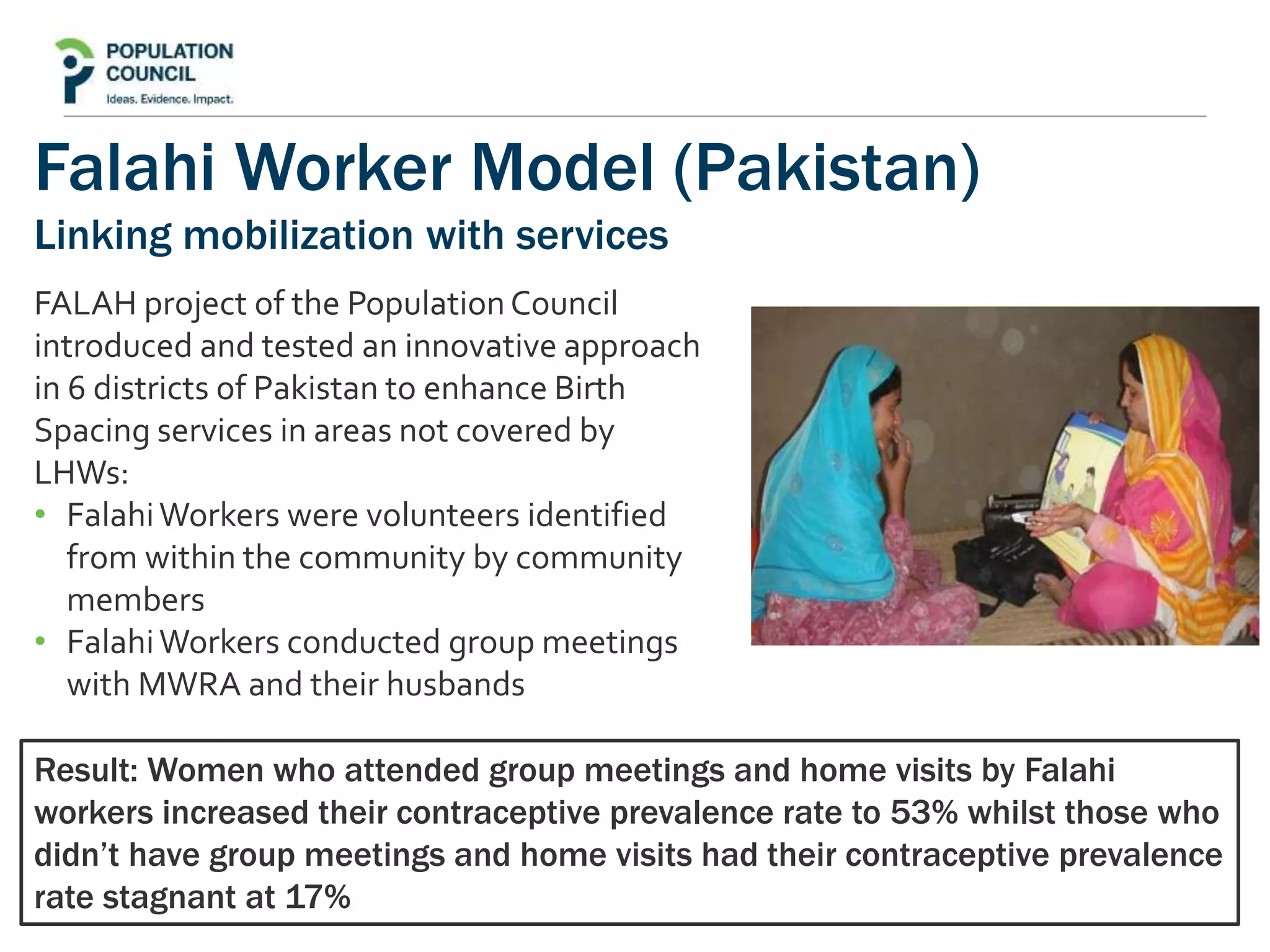
FALAH project of the PopulationCouncil
introduced and tested an innovative approach
in 6 districts of Pakistan to enhance Birth
Spacing services in areas not covered by
LHWs:
• FalahiWorkers were volunteers identified
from within the community by community
members
• FalahiWorkers conducted group meetings
with MWRA and their husbands
Result: Women who attended group meetings and home visits by Falahi
workers increased their contraceptive prevalence rate to 53% whilst those who
didn’t have group meetings and home visits had their contraceptive prevalence
rate stagnant at 17%
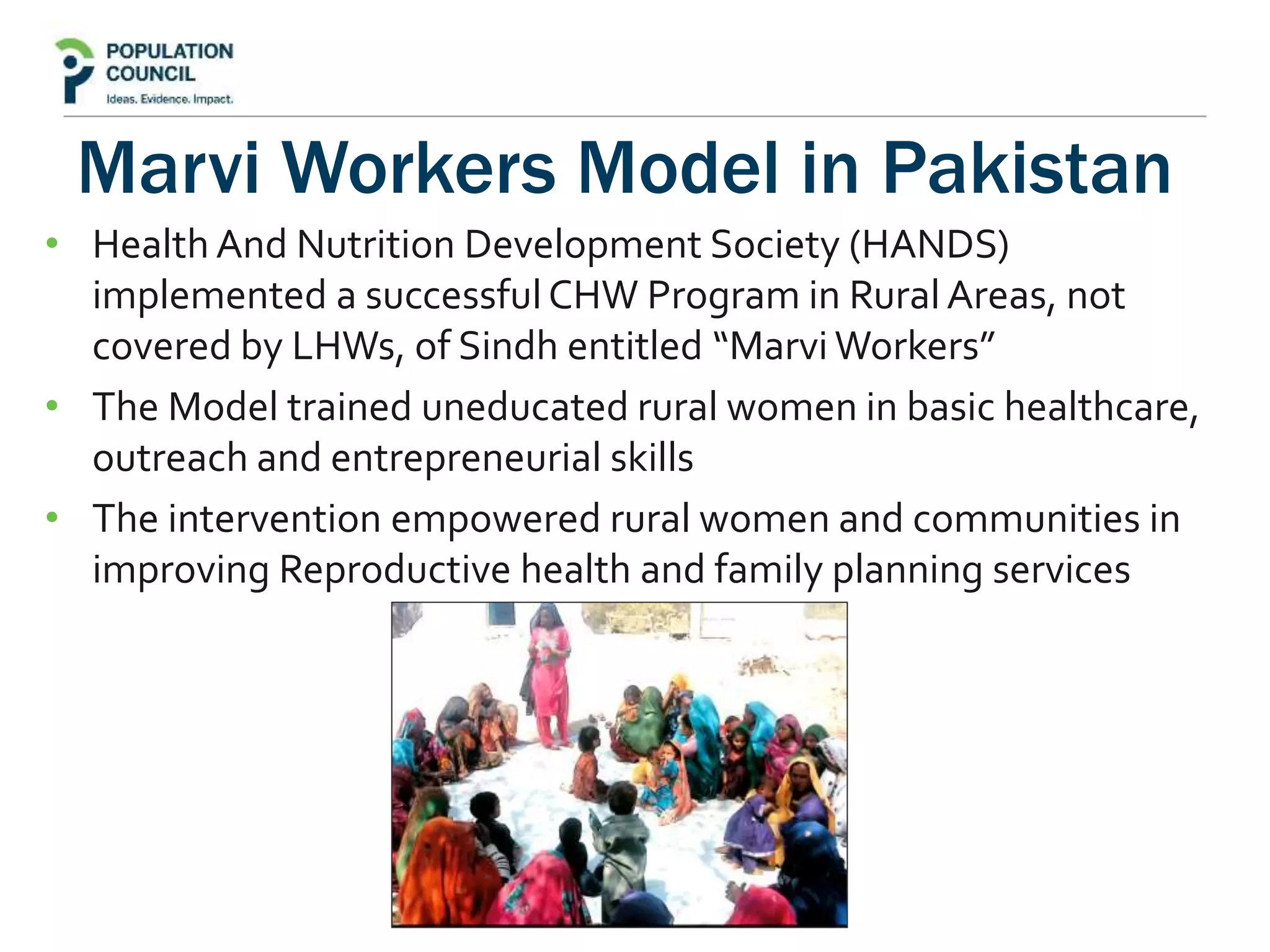
Marvi Workers Model in Pakistan
• Health And Nutrition Development Society (HANDS)
implemented a successfulCHW Program in Rural Areas, not
covered by LHWs, of Sindh entitled “Marvi Workers”
• The Model trained uneducated rural women in basic healthcare,
outreach and entrepreneurial skills
• The intervention empowered rural women and communities in
improving Reproductive health and family planning services
Recommendations for Balochistan Government
• 7000 Lady HealthWorkers are too few for a population of 9
million
• CHWs can play an increasingly significant role in healthcare
delivery in LHWs uncovered areas
• Establish policy and principles to which the CHW programs
should adhere to in the districts and should be integrated into
Provincial health Strategy
• NGOs and development partners can assist in providing technical
support to establish standards forCHW cadres that are rooted in
best and evidence-based practices.
THANKS !!

The Role of Community Health Workers in Delivering Primary Healthcare in Resource Constrained Settings

  • 1.
    The Role ofCommunity Health Workers in Delivering Primary Healthcare in Resource Constrained Settings What Has Worked and What Has Not: A Review of Literature Waqas Abrar Staff Officer for Programmes Population Council, Islamabad, Pakistan
  • 2.
    Who are communityhealth workers? World Health Organization defines Community Health Workers as follows: “CHWs should be members of the communities where they work, should be selected by the communities, should be answerable to the communities for their activities, should be supported by the health system but not necessarily a part of its organization and have shorter training than professional worker” (Lehmann & Sanders 2007).
  • 3.
    Global workforce ofCHWs • Approximately 1.3 million CHWs globally-both paid and unpaid (WHO) • Lack of organized systems in developing countries to record CHWs • Recent evidence suggests approximately 5 million CHWs worldwide (Perry, Zulliger and Rogers 2014)
  • 4.
    What do CHWsdo? Global Evidence • A strategy to address growing shortage of health workers, particularly in low-income countries • Selected, trained and work in the communities they belong to • No generalized concept to profile CHWs internationally – vary from country to country • Work in accordance with local societal and cultural norms to ensure community acceptance and ownership • Implement effective health interventions • Likely to have substantial impact on health outcomes
  • 5.
    Objectives of Research •To review the global scientific evidence regarding – Strengths of various CHW programs – Factors to ensure their community acceptance and ownership – Factors comprising the effectiveness of CHWs • To make policy recommendations to take up CHW Models in marginalized and uncovered communities in Balochistan
  • 6.
    History of CHWPrograms: Country-Specific Examples • China (1950s): Barefoot doctor program – were farmers who received minimal basic medical and paramedical training and worked in rural villages in China • Niger (1960s): CHW program implemented by the government focusing on the training of village health workers and birth attendants • Ghana (1970s): Introduced community village health workers in villages to implement primary healthcare strategies • Iran (1970s): CHWs called ‘Behvarz’ hired with specialized training to provide healthcare services to the rural population • Indonesia (1980s): Village health volunteers, selected and paid by local communities, became part of health posts set up within each district
  • 7.
    Incentivizing CHWs Financial Non-Financial Stipend,Salary, Cash and In- kind Payments Voluntary
  • 8.
    What Works WhatDoes not Work • Satisfactory remuneration/ Material Incentives/financial incentives • Possibility of future paid employment • Community recognition and respect of CHW work • Acquisition of valued skills • Personal growth and development • Identification (badge, shirt) and job aids • Identification of clear roles and responsibilities through a documented job description • Proper recruitment and selection • Initial and refresher trainings • Supportive Supervision • Inconsistent remuneration • Inequitable distribution of incentives among different types of community workers • Community leaders not involved in the section of CHWs • CHW not hailing from community • Inadequate refresher training and supervision • Excessive demands/time constraints • No clear job description • Scope of work and targets not based on realistic expectations • Lack of transportation for CHWs and their supervisor • Weak referral system • Poor coordination between CHWs and facility based staff
  • 9.
    Falahi Worker Model(Pakistan) Linking mobilization with services FALAH project of the PopulationCouncil introduced and tested an innovative approach in 6 districts of Pakistan to enhance Birth Spacing services in areas not covered by LHWs: • FalahiWorkers were volunteers identified from within the community by community members • FalahiWorkers conducted group meetings with MWRA and their husbands Result: Women who attended group meetings and home visits by Falahi workers increased their contraceptive prevalence rate to 53% whilst those who didn’t have group meetings and home visits had their contraceptive prevalence rate stagnant at 17%
  • 10.
    Marvi Workers Modelin Pakistan • Health And Nutrition Development Society (HANDS) implemented a successfulCHW Program in Rural Areas, not covered by LHWs, of Sindh entitled “Marvi Workers” • The Model trained uneducated rural women in basic healthcare, outreach and entrepreneurial skills • The intervention empowered rural women and communities in improving Reproductive health and family planning services
  • 11.
    Recommendations for BalochistanGovernment • 7000 Lady HealthWorkers are too few for a population of 9 million • CHWs can play an increasingly significant role in healthcare delivery in LHWs uncovered areas • Establish policy and principles to which the CHW programs should adhere to in the districts and should be integrated into Provincial health Strategy • NGOs and development partners can assist in providing technical support to establish standards forCHW cadres that are rooted in best and evidence-based practices.
  • 12.