

KIT – University of the State of Baden-Württemberg and
National Research Center of the Helmholtz Association
KARLSRUHE SERVICE RESEARCH INSTITUTE (KSRI)
www.kit.edu
www.ksri.kit.edu
www.kit.edu
Gamification in Crowdsourcing
A review
HICSS 49 Kauai 2016
Benedikt Morschheuser, Juho Hamari, Jonna Koivisto
Photo: CC Roberto Taddeo
The authors
2
Benedikt Morschheuser
Juho Hamari (D.Sc.Econ)
Jonna Koivisto
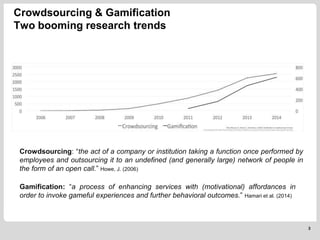
Crowdsourcing & Gamification
Two booming research trends
3
Crowdsourcing: “the act of a company or institution taking a function once performed by
employees and outsourcing it to an undefined (and generally large) network of people in
the form of an open call.” Howe, J. (2006)
Gamification: “a process of enhancing services with (motivational) affordances in
order to invoke gameful experiences and further behavioral outcomes.” Hamari et al. (2014)
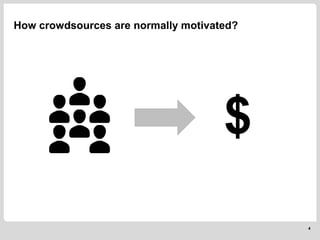
How crowdsources are normally motivated?
4
$
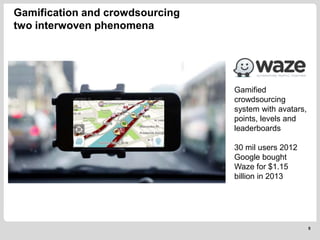
Gamification and crowdsourcing
two interwoven phenomena
5
Gamified
crowdsourcing
system with avatars,
points, levels and
leaderboards
30 mil users 2012
Google bought
Waze for $1.15
billion in 2013
However, we miss a coherent overview
6
How is gamification used in crowdsourcing?
Does gamification work?
What kind of gamification fits what kind of crowdsourcing?
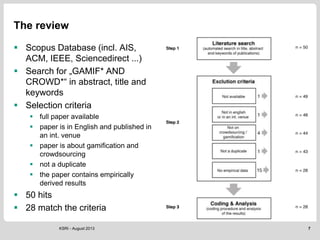
The review
 Scopus Database (incl. AIS,
ACM, IEEE, Sciencedirect ...)
 Search for „GAMIF* AND
CROWD*“ in abstract, title and
keywords
 Selection criteria
 full paper available
 paper is in English and published in
an int. venue
 paper is about gamification and
crowdsourcing
 not a duplicate
 the paper contains empirically
derived results
 50 hits
 28 match the criteria
7KSRI - August 2013
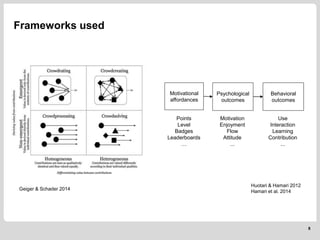
Frameworks used
8
Geiger & Schader 2014
Behavioral
outcomes
Psychological
outcomes
Motivational
affordances
Huotari & Hamari 2012
Hamari et al. 2014
Points
Level
Badges
Leaderboards
…
Motivation
Enjoyment
Flow
Attitude
...
Use
Interaction
Learning
Contribution
...
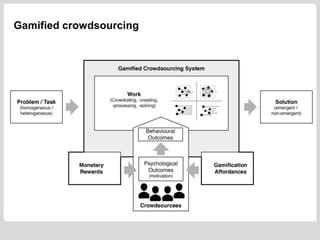
Gamified crowdsourcing
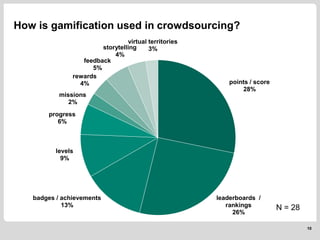
How is gamification used in crowdsourcing?
10
points / score
28%
leaderboards /
rankings
26%
badges / achievements
13%
levels
9%
progress
6%
missions
2%
rewards
4%
feedback
5%
storytelling
4%
virtual territories
3%
N = 28
11
gamification
75% gamification +
financial rewards
25%
Incentive orchestration
N = 28
0
1
2
3
4
5
6
7
8
9
Compared a non-gamified with a
gamified approach
No comparison (Interviews, user
feedback, etc.)
Compared between different
gamification designs
Does gamification work?
12
N = 17
Empirical studies on the effectiveness of gamification
Does gamification work?
13
 All empirical studies on the effectiveness of gamification in CS report
that gamification has a positive impact on crowdsourcing work
(N=17).
 Empirical studies which compare a gamified with a non-gamified
approach report the increase of engagement, quality of the output
or less cheating compared to traditional paid crowdsourcing (N=8).
 The studies highlight the importance of how gamification is
implemented. Different gamification affordances have different
effect (N=4).
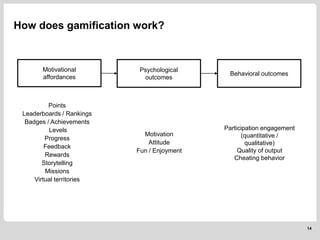
How does gamification work?
14
Behavioral outcomes
Psychological
outcomes
Motivational
affordances
Points
Leaderboards / Rankings
Badges / Achievements
Levels
Progress
Feedback
Rewards
Storytelling
Missions
Virtual territories
Motivation
Attitude
Fun / Enjoyment
Participation engagement
(quantitative /
qualitative)
Quality of output
Cheating behavior
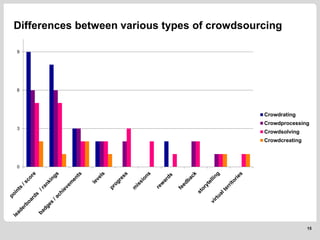
Differences between various types of crowdsourcing
15
0
3
6
9
Crowdrating
Crowdprocessing
Crowdsolving
Crowdcreating
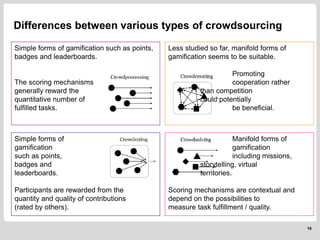
Differences between various types of crowdsourcing
16
Less studied so far, manifold forms of
gamification seems to be suitable.
Promoting
cooperation rather
than competition
could potentially
be beneficial.
Manifold forms of
gamification
including missions,
storytelling, virtual
territories.
Scoring mechanisms are contextual and
depend on the possibilities to
measure task fulfillment / quality.
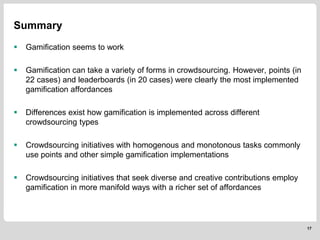
 Gamification seems to work
 Gamification can take a variety of forms in crowdsourcing. However, points (in
22 cases) and leaderboards (in 20 cases) were clearly the most implemented
gamification affordances
 Differences exist how gamification is implemented across different
crowdsourcing types
 Crowdsourcing initiatives with homogenous and monotonous tasks commonly
use points and other simple gamification implementations
 Crowdsourcing initiatives that seek diverse and creative contributions employ
gamification in more manifold ways with a richer set of affordances
17
Summary
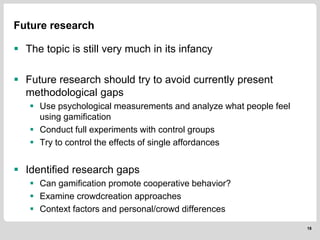
Future research
 The topic is still very much in its infancy
 Future research should try to avoid currently present
methodological gaps
 Use psychological measurements and analyze what people feel
using gamification
 Conduct full experiments with control groups
 Try to control the effects of single affordances
 Identified research gaps
 Can gamification promote cooperative behavior?
 Examine crowdcreation approaches
 Context factors and personal/crowd differences
18
Thanks
For more research on that topic:
Benedikt Morschheuser issd.iism.kit.edu
Juho Hamari juhohamari.com
Jonna Koivisto jonnakoivisto.com
Or follow us on
Researchgate
19

Gamification in Crowdsourcing: A review

  • 1.
    KIT – Universityof the State of Baden-Württemberg and National Research Center of the Helmholtz Association KARLSRUHE SERVICE RESEARCH INSTITUTE (KSRI) www.kit.edu www.ksri.kit.edu www.kit.edu Gamification in Crowdsourcing A review HICSS 49 Kauai 2016 Benedikt Morschheuser, Juho Hamari, Jonna Koivisto Photo: CC Roberto Taddeo
  • 2.
    The authors 2 Benedikt Morschheuser JuhoHamari (D.Sc.Econ) Jonna Koivisto
  • 3.
    Crowdsourcing & Gamification Twobooming research trends 3 Crowdsourcing: “the act of a company or institution taking a function once performed by employees and outsourcing it to an undefined (and generally large) network of people in the form of an open call.” Howe, J. (2006) Gamification: “a process of enhancing services with (motivational) affordances in order to invoke gameful experiences and further behavioral outcomes.” Hamari et al. (2014)
  • 4.
    How crowdsources arenormally motivated? 4 $
  • 5.
    Gamification and crowdsourcing twointerwoven phenomena 5 Gamified crowdsourcing system with avatars, points, levels and leaderboards 30 mil users 2012 Google bought Waze for $1.15 billion in 2013
  • 6.
    However, we missa coherent overview 6 How is gamification used in crowdsourcing? Does gamification work? What kind of gamification fits what kind of crowdsourcing?
  • 7.
    The review  ScopusDatabase (incl. AIS, ACM, IEEE, Sciencedirect ...)  Search for „GAMIF* AND CROWD*“ in abstract, title and keywords  Selection criteria  full paper available  paper is in English and published in an int. venue  paper is about gamification and crowdsourcing  not a duplicate  the paper contains empirically derived results  50 hits  28 match the criteria 7KSRI - August 2013
  • 8.
    Frameworks used 8 Geiger &Schader 2014 Behavioral outcomes Psychological outcomes Motivational affordances Huotari & Hamari 2012 Hamari et al. 2014 Points Level Badges Leaderboards … Motivation Enjoyment Flow Attitude ... Use Interaction Learning Contribution ...
  • 9.
  • 10.
    How is gamificationused in crowdsourcing? 10 points / score 28% leaderboards / rankings 26% badges / achievements 13% levels 9% progress 6% missions 2% rewards 4% feedback 5% storytelling 4% virtual territories 3% N = 28
  • 11.
    11 gamification 75% gamification + financialrewards 25% Incentive orchestration N = 28
  • 12.
    0 1 2 3 4 5 6 7 8 9 Compared a non-gamifiedwith a gamified approach No comparison (Interviews, user feedback, etc.) Compared between different gamification designs Does gamification work? 12 N = 17 Empirical studies on the effectiveness of gamification
  • 13.
    Does gamification work? 13 All empirical studies on the effectiveness of gamification in CS report that gamification has a positive impact on crowdsourcing work (N=17).  Empirical studies which compare a gamified with a non-gamified approach report the increase of engagement, quality of the output or less cheating compared to traditional paid crowdsourcing (N=8).  The studies highlight the importance of how gamification is implemented. Different gamification affordances have different effect (N=4).
  • 14.
    How does gamificationwork? 14 Behavioral outcomes Psychological outcomes Motivational affordances Points Leaderboards / Rankings Badges / Achievements Levels Progress Feedback Rewards Storytelling Missions Virtual territories Motivation Attitude Fun / Enjoyment Participation engagement (quantitative / qualitative) Quality of output Cheating behavior
  • 15.
    Differences between varioustypes of crowdsourcing 15 0 3 6 9 Crowdrating Crowdprocessing Crowdsolving Crowdcreating
  • 16.
    Differences between varioustypes of crowdsourcing 16 Less studied so far, manifold forms of gamification seems to be suitable. Promoting cooperation rather than competition could potentially be beneficial. Manifold forms of gamification including missions, storytelling, virtual territories. Scoring mechanisms are contextual and depend on the possibilities to measure task fulfillment / quality.
  • 17.
     Gamification seemsto work  Gamification can take a variety of forms in crowdsourcing. However, points (in 22 cases) and leaderboards (in 20 cases) were clearly the most implemented gamification affordances  Differences exist how gamification is implemented across different crowdsourcing types  Crowdsourcing initiatives with homogenous and monotonous tasks commonly use points and other simple gamification implementations  Crowdsourcing initiatives that seek diverse and creative contributions employ gamification in more manifold ways with a richer set of affordances 17 Summary
  • 18.
    Future research  Thetopic is still very much in its infancy  Future research should try to avoid currently present methodological gaps  Use psychological measurements and analyze what people feel using gamification  Conduct full experiments with control groups  Try to control the effects of single affordances  Identified research gaps  Can gamification promote cooperative behavior?  Examine crowdcreation approaches  Context factors and personal/crowd differences 18
  • 19.
    Thanks For more researchon that topic: Benedikt Morschheuser issd.iism.kit.edu Juho Hamari juhohamari.com Jonna Koivisto jonnakoivisto.com Or follow us on Researchgate 19

Editor's Notes

  • #10 Based on that we conceptualize gamified CS systems. In this paper we focused the part at the bottom.