Gamification for Volunteer 
Cloud Computing 
Alimohammad Shahri1, Mahmood Hosseini1, Fabiano Dalpiaz2, Raian Ali1 
1Bournemouth University, UK 
2Utrecht University, The Netherlands
Overview 
• Volunteer cloud computing 
• Engagement and retention 
• Why gamification? 
• Volunteer types 
• Gamer types 
• Game mechanics 
• Volunteer types and gamification 
• Gamification concerns 
• Current Progress 
• Acknowledgment 
12/12/2014 2
Volunteer Cloud Computing 
• Volunteer cloud computing 
– Volunteer computing and cloud computing 
– Customer-to-business style 
– People provide resources 
– Businesses use resources 
• Examples 
– BOINC 
– SETI@home 
12/12/2014 3
Why Should I Join? 
• Motivation problems 
– How to engage people? 
– How to retain people? 
12/12/2014 4
Gamification 
• The use of game design elements in a non-game 
context1 
• Main goals: 
– Motivation 
– Engagement 
1 Deterding, S., Sicart, M., Nacke, L., O'Hara, K., & Dixon, D. (2011, May). Gamification. using game-design elements in non-gaming contexts. In CHI'11 
Extended Abstracts on Human Factors in Computing Systems (pp. 2425-2428). ACM. 
12/12/2014 5
Why Gamification? 
• Entertaining 
• Motivating 
• Persistent, as long as entertaining 
• Everybody is a gamer, or gamer generation1 
• Can lead to more collaboration 
• Can lead to more productivity 
Beck, J. C. (2004). Got game: How the gamer generation is reshaping business forever. Harvard Business Press. 
12/12/2014 6
Volunteer Types 
• Volunteer types in cloud projects1: 
– Super-crunchers 
• Engage in processing large project data 
• Expect a good return 
– Lay public 
• Engage in small scale data processing 
• Expect contribution to science 
– Alpha testers 
• Engage in invited test processes 
• Expect distinguished recognition 
Darch, P., & Carusi, A. (2010). Retaining volunteers in volunteer computing projects. Philosophical Transactions of the Royal Society A: Mathematical, 
Physical and Engineering Sciences, 368(1926), 4177-4192. 
12/12/2014 7
Bartle’s Player Taxonomy1 
• Achievers 
– Have goals to achieve 
– Usually in the form of accumulating and disposing of large quantities 
of high-value treasure 
• Explorers 
– Try to find as much as possible about the virtual world 
– Both in breadth and in depth 
• Socialisers 
– Use the game’s communicative facilities to converse with fellow 
players 
– Interested more in other players (sometimes NPCs) 
• Killers 
– Try to impose their superiority to other players 
– Mostly by causing distress, but sometimes also by helping others 
Bartle, R. (1996). Hearts, clubs, diamonds, spades: Players who suit MUDs.Journal of MUD research, 1(1), 19. 
12/12/2014 8
Game Mechanics 
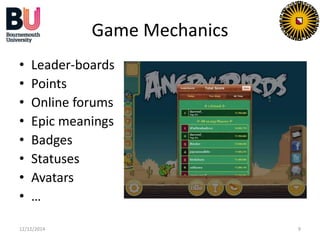
• Leader-boards 
• Points 
• Online forums 
• Epic meanings 
• Badges 
• Statuses 
• Avatars 
• … 
12/12/2014 9
Volunteer Types and 
Gamification Elements and Players 
Volunteer 
Types 
Player Types 
Example Game 
Mechanics 
Super-cruncher 
Achievers 
Socializers 
Competitive 
Non-collaborative 
Points 
Leaderboards 
Online forums 
Lay public 
Explorers 
Socializers 
Collaborative 
Non-competitive 
Online forums 
Epic meanings 
Alpha-testers 
Killers 
Socializers 
Uniqueness Seekers 
Badges 
Avatars 
Statuses 
12/12/2014 10
Gamification Concerns 
• Gamification as trivialisation of tasks 
• Gamification as a change to business 
management norms 
• Gamification as a forced mechanism 
• Gamification as undermining the tasks 
• Gamification as “one size fits all” 
• Gamification as a quality diminisher 
• Gamification as clusterisation of users 
• Gamification as a demotivator for intrinsically 
motivated users 
Shahri, A., Hosseini, M., Phalp, K., Taylor, J., & Ali, R. (2014). Gamification: a Syncretic View. Special Issue of the Personal and Ubiquitous Computing 
journal on "Mobile and Pervasive Games" [Submitted] 
12/12/2014 11
Current Progress 
Based on Empirical Study 
• Relevant Fields of Study 
– User Experience 
– Human Computer Interaction (HCI) 
– Psychology 
– Game Design 
– Management and Human Resources 
– Behavioural Economics 
– Software Engineering 
Shahri, A., Hosseini, M., Phalp, K., Taylor, J., & Ali, R. (2014). Gamification: a Syncretic View. Special Issue of the Personal and Ubiquitous Computing 
journal on "Mobile and Pervasive Games" [Submitted] 
12/12/2014 12
Current Progress 
Based on Empirical Study 
• Relevant Stakeholders 
– Strategy Makers and Management 
– Legal Departments 
– Security and Privacy Engineers 
– End-Users 
– Behavioural Economic Experts 
– IT Developers 
– Researchers 
– Domain Experts 
Shahri, A., Hosseini, M., Phalp, K., Taylor, J., & Ali, R. (2014). Gamification: a Syncretic View. Special Issue of the Personal and Ubiquitous Computing 
journal on "Mobile and Pervasive Games" [Submitted] 
12/12/2014 13
ACKNOWLEDGMENT 
• The research was supported by an FP7 Marie 
Curie CIG grant (the SOCIAD Project) and by 
Bournemouth University through the Fusion 
Investment Fund (the BBB, BUUU and 
VolaComp projects) and the Graduate School 
Santander Grant for PGR Development. 
12/12/2014 14
Thank You! 
12/12/2014 15

Gamification for volunteer cloud computing

  • 1.
    Gamification for Volunteer Cloud Computing Alimohammad Shahri1, Mahmood Hosseini1, Fabiano Dalpiaz2, Raian Ali1 1Bournemouth University, UK 2Utrecht University, The Netherlands
  • 2.
    Overview • Volunteercloud computing • Engagement and retention • Why gamification? • Volunteer types • Gamer types • Game mechanics • Volunteer types and gamification • Gamification concerns • Current Progress • Acknowledgment 12/12/2014 2
  • 3.
    Volunteer Cloud Computing • Volunteer cloud computing – Volunteer computing and cloud computing – Customer-to-business style – People provide resources – Businesses use resources • Examples – BOINC – SETI@home 12/12/2014 3
  • 4.
    Why Should IJoin? • Motivation problems – How to engage people? – How to retain people? 12/12/2014 4
  • 5.
    Gamification • Theuse of game design elements in a non-game context1 • Main goals: – Motivation – Engagement 1 Deterding, S., Sicart, M., Nacke, L., O'Hara, K., & Dixon, D. (2011, May). Gamification. using game-design elements in non-gaming contexts. In CHI'11 Extended Abstracts on Human Factors in Computing Systems (pp. 2425-2428). ACM. 12/12/2014 5
  • 6.
    Why Gamification? •Entertaining • Motivating • Persistent, as long as entertaining • Everybody is a gamer, or gamer generation1 • Can lead to more collaboration • Can lead to more productivity Beck, J. C. (2004). Got game: How the gamer generation is reshaping business forever. Harvard Business Press. 12/12/2014 6
  • 7.
    Volunteer Types •Volunteer types in cloud projects1: – Super-crunchers • Engage in processing large project data • Expect a good return – Lay public • Engage in small scale data processing • Expect contribution to science – Alpha testers • Engage in invited test processes • Expect distinguished recognition Darch, P., & Carusi, A. (2010). Retaining volunteers in volunteer computing projects. Philosophical Transactions of the Royal Society A: Mathematical, Physical and Engineering Sciences, 368(1926), 4177-4192. 12/12/2014 7
  • 8.
    Bartle’s Player Taxonomy1 • Achievers – Have goals to achieve – Usually in the form of accumulating and disposing of large quantities of high-value treasure • Explorers – Try to find as much as possible about the virtual world – Both in breadth and in depth • Socialisers – Use the game’s communicative facilities to converse with fellow players – Interested more in other players (sometimes NPCs) • Killers – Try to impose their superiority to other players – Mostly by causing distress, but sometimes also by helping others Bartle, R. (1996). Hearts, clubs, diamonds, spades: Players who suit MUDs.Journal of MUD research, 1(1), 19. 12/12/2014 8
  • 9.
    Game Mechanics •Leader-boards • Points • Online forums • Epic meanings • Badges • Statuses • Avatars • … 12/12/2014 9
  • 10.
    Volunteer Types and Gamification Elements and Players Volunteer Types Player Types Example Game Mechanics Super-cruncher Achievers Socializers Competitive Non-collaborative Points Leaderboards Online forums Lay public Explorers Socializers Collaborative Non-competitive Online forums Epic meanings Alpha-testers Killers Socializers Uniqueness Seekers Badges Avatars Statuses 12/12/2014 10
  • 11.
    Gamification Concerns •Gamification as trivialisation of tasks • Gamification as a change to business management norms • Gamification as a forced mechanism • Gamification as undermining the tasks • Gamification as “one size fits all” • Gamification as a quality diminisher • Gamification as clusterisation of users • Gamification as a demotivator for intrinsically motivated users Shahri, A., Hosseini, M., Phalp, K., Taylor, J., & Ali, R. (2014). Gamification: a Syncretic View. Special Issue of the Personal and Ubiquitous Computing journal on "Mobile and Pervasive Games" [Submitted] 12/12/2014 11
  • 12.
    Current Progress Basedon Empirical Study • Relevant Fields of Study – User Experience – Human Computer Interaction (HCI) – Psychology – Game Design – Management and Human Resources – Behavioural Economics – Software Engineering Shahri, A., Hosseini, M., Phalp, K., Taylor, J., & Ali, R. (2014). Gamification: a Syncretic View. Special Issue of the Personal and Ubiquitous Computing journal on "Mobile and Pervasive Games" [Submitted] 12/12/2014 12
  • 13.
    Current Progress Basedon Empirical Study • Relevant Stakeholders – Strategy Makers and Management – Legal Departments – Security and Privacy Engineers – End-Users – Behavioural Economic Experts – IT Developers – Researchers – Domain Experts Shahri, A., Hosseini, M., Phalp, K., Taylor, J., & Ali, R. (2014). Gamification: a Syncretic View. Special Issue of the Personal and Ubiquitous Computing journal on "Mobile and Pervasive Games" [Submitted] 12/12/2014 13
  • 14.
    ACKNOWLEDGMENT • Theresearch was supported by an FP7 Marie Curie CIG grant (the SOCIAD Project) and by Bournemouth University through the Fusion Investment Fund (the BBB, BUUU and VolaComp projects) and the Graduate School Santander Grant for PGR Development. 12/12/2014 14
  • 15.