

1
The Emerging Requirement for Digital Addiction Labels
Raian Ali, Nan Jiang, Keith Phalp, Sarah Muir, John McAlaney
Bournemouth University, UK
Thursday, March 26th,
2015
Presented By: Mahmood Hosseini, Bournemouth University, UK
2
Apologies …
Message to REFSQ community
3
 Digital Addiction (hereafter DA), has become a
serious issue that has a diversity of socio-economic
side effects. In spite of its high importance, DA got
little recognition or guidance as to how software
development should take it into account.
 This is in stark contrast to other domains known for
traditional addiction (e.g., drugs, gambling, and
alcohol) in which there are clear rules and policies
on how to manufacture, market and sell the
products.
 We advocate the need to consider DA as a first class
concept in developing software systems
4
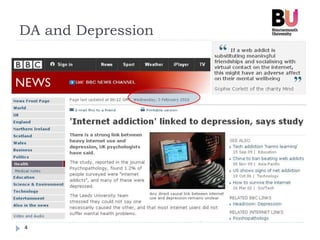
DA and Depression
5
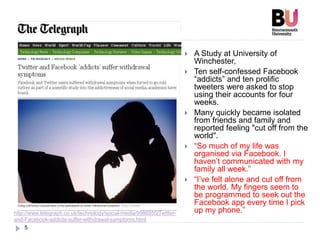
 A Study at University of
Winchester,
 Ten self-confessed Facebook
“addicts” and ten prolific
tweeters were asked to stop
using their accounts for four
weeks.
 Many quickly became isolated
from friends and family and
reported feeling "cut off from the
world".
 “So much of my life was
organised via Facebook. I
haven’t communicated with my
family all week.”
 “I’ve felt alone and cut off from
the world. My fingers seem to
be programmed to seek out the
Facebook app every time I pick
up my phone.”http://www.telegraph.co.uk/technology/social-media/9986950/Twitter-
and-Facebook-addicts-suffer-withdrawal-symptoms.html
6
Story
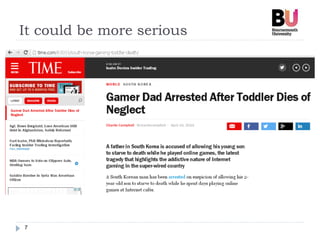
It could be more serious
7
Addiction types
8
 Kimberly S. Young classifies it to:
 Computer addiction: computer game addiction
 Information overload: web surfing addiction
 Net compulsions: online gambling or online shopping
 Cybersexual addiction: adult websites, Sexting
 Cyber-relationship addiction: online relationships
 Social Networks Addiction would be seen in this type
Young, K. “Internet addiction: Evaluation and treatment”.
Student Brit. Med. J. 1999, 7, 351-352
Symptoms
9
 SNS addiction incorporates the experience of the ‘classic’
addiction symptoms, namely
 Mood modification (i.e., engagement in SNSs leads to a
favourable change in emotional states)
 Salience (i.e., behavioral, cognitive, and emotional
preoccupation with the SNS usage)
 Tolerance (i.e., ever increasing use of SNSs over time)
 Withdrawal symptoms (i.e., experiencing unpleasant physical
and emotional symptoms when SNS use is restricted or
stopped)
 Conflict (i.e., interpersonal and intrapsychic problems ensue
because of SNS usage),
 Relapse (i.e., addicts quickly revert back in their excessive
SNS usage after an abstinence period)
Griffiths, M.D. A “components model of addiction within a
biopsychosocial framework.” J. Subst. Use 2005, 10, 191-197.
Negative Consequences
10
 Less involved with their real life communities
 Nyland, R.; Marvez, R.; Beck, J. MySpace: Social networking or social isolation? In
Proceedings of the Midwinter Conference of the Association for Education in
Journalism and Mass Communication, Midwinter Conference of the Association for
Education in Journalism and Mass Communication, Reno, NV, USA, 23–24
February 2007.
 Insecure in real-life, compensation in SNS
 Barker, V. Older adolescents’ motivations for social network site use: The influence
of gender, group identity, and collective self-esteem. CyberPsychol. Behav. 2009,
12, 209-213.
 Negative feedback on SNS has negative effect particularly for people
with low self-esteem who use SNSs to compensate that
 Ellison, N.B.; Steinfield, C.; Lampe, C. The benefits of Facebook “friends”: Social
capital and college students’ use of online social network sites. J. Comput-Mediat.
Comm. 2007, 12.
 Facebook users had lower Grade Point Averages. Of the 26% of student
feeling the impact on their lives, three-quarters (74%) claimed that it had
a negative impact, namely procrastination, distraction, and poor time-
management.
 Kirschner, P.A.; Karpinski, A.C. Facebook and academic performance. Comput.
Hum. Behav. 2010, 26, 1237-1245.
Why is not it on Software?
11
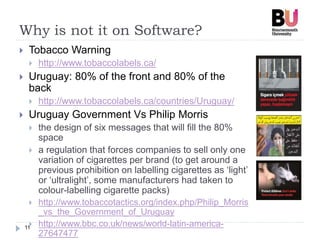
 Tobacco Warning
 http://www.tobaccolabels.ca/
 Uruguay: 80% of the front and 80% of the
back
 http://www.tobaccolabels.ca/countries/Uruguay/
 Uruguay Government Vs Philip Morris
 the design of six messages that will fill the 80%
space
 a regulation that forces companies to sell only one
variation of cigarettes per brand (to get around a
previous prohibition on labelling cigarettes as ‘light’
or ‘ultralight’, some manufacturers had taken to
colour-labelling cigarette packs)
 http://www.tobaccotactics.org/index.php/Philip_Morris
_vs_the_Government_of_Uruguay
 http://www.bbc.co.uk/news/world-latin-america-
27647477
Software can react
12
 Software is “more intelligent” than Alcohol
 Alcohol can not tell you to stop, software can
 Software can be designed to react, but when and
how?
 Besides banning/penalty (which might not be a bad
option sometimes)
 Constructive criticism
 Incentives-centred design
 Gamification
 You attend social events and share photos and get points
 Avatars
 Socio-technial treatment or a “Blended” treatment
 Peer pressure
 Mutual Commitment
Interactive Labelling for DA
13
Requirements
14
 In general, DA represents a family of challenges:
 Ethical and professional requirements
 Behavioural change requirements
 New requirements challenges:
 The need for care vs. the desire for freedom of use
 Regulatory health requirements, probably soon?
 Denial of needs
 Addicts do not recognize/admit their addiction
 Let aside providing how they would like to be treated
 Stakeholders identification
 The user, carer, public health institutes, peers, ..
Our Study
15
 Mixed methods approach
 To understand labelling requirements in 4 types:
 Content and presentation
 Ability to control, e.g. frequency, source, type, language, etc.
 Awareness: I need to know why I am receiving labels
 Adaptivity: intelligence in tailoring labels to my needs and preferences.
 First phase: Qualitative
 Interviews with 11 participants, five male and six female, aged between 19
and 35 years old. Four professionals and seven students studying Computing
(four) and Psychology (three)
 Second phase: Quantitative
 To confirm and enhance the results of the first
 72 participants completed the survey (35 male, 36 female, and one preferred
not to say). The age bands distribution was 18-25 (47%), 26-34 (33%), 35-44
(6%), 45-54 (4%), 55-64 (8%), 65+ (0%), and 2% preferred not to answer.
General findings
16
 The term Digital Addiction did not raise concerns
 It is seen as a metaphoric term though
 32% of the survey participants thought DA labelling
is certainly needed, 50% thought is likely a good
idea, 15% thought it is unlikely to be useful and 3%
thought it is not going to work.
 Addiction is about:
 Compulsive usage
 Impulsive usage
 Excessive usage
 Hasty usage
General findings (2)
17
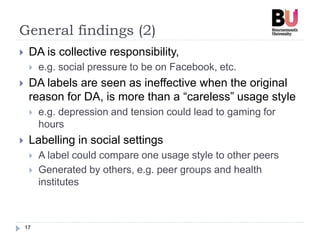
 DA is collective responsibility,
 e.g. social pressure to be on Facebook, etc.
 DA labels are seen as ineffective when the original
reason for DA, is more than a “careless” usage style
 e.g. depression and tension could lead to gaming for
hours
 Labelling in social settings
 A label could compare one usage style to other peers
 Generated by others, e.g. peer groups and health
institutes
Message: Content & Presentation
18
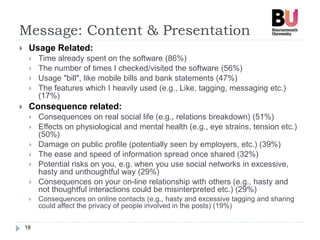
 Usage Related:
 Time already spent on the software (86%)
 The number of times I checked/visited the software (56%)
 Usage "bill", like mobile bills and bank statements (47%)
 The features which I heavily used (e.g., Like, tagging, messaging etc.)
(17%)
 Consequence related:
 Consequences on real social life (e.g., relations breakdown) (51%)
 Effects on physiological and mental health (e.g., eye strains, tension etc.)
(50%)
 Damage on public profile (potentially seen by employers, etc.) (39%)
 The ease and speed of information spread once shared (32%)
 Potential risks on you, e.g. when you use social networks in excessive,
hasty and unthoughtful way (29%)
 Consequences on your on-line relationship with others (e.g., hasty and
not thoughtful interactions could be misinterpreted etc.) (29%)
 Consequences on online contacts (e.g., hasty and excessive tagging and sharing
could affect the privacy of people involved in the posts) (19%)
Message: Content & Presentation
19
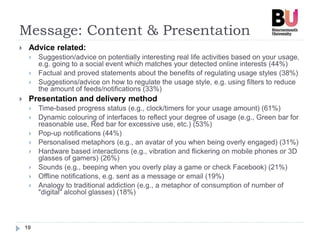
 Advice related:
 Suggestion/advice on potentially interesting real life activities based on your usage,
e.g. going to a social event which matches your detected online interests (44%)
 Factual and proved statements about the benefits of regulating usage styles (38%)
 Suggestions/advice on how to regulate the usage style, e.g. using filters to reduce
the amount of feeds/notifications (33%)
 Presentation and delivery method
 Time-based progress status (e.g., clock/timers for your usage amount) (61%)
 Dynamic colouring of interfaces to reflect your degree of usage (e.g., Green bar for
reasonable use, Red bar for excessive use, etc.) (53%)
 Pop-up notifications (44%)
 Personalised metaphors (e.g., an avatar of you when being overly engaged) (31%)
 Hardware based interactions (e.g., vibration and flickering on mobile phones or 3D
glasses of gamers) (26%)
 Sounds (e.g., beeping when you overly play a game or check Facebook) (21%)
 Offline notifications, e.g. sent as a message or email (19%)
 Analogy to traditional addiction (e.g., a metaphor of consumption of number of
"digital" alcohol glasses) (18%)
Message: Content & Presentation
20
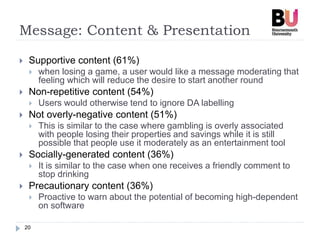
 Supportive content (61%)
 when losing a game, a user would like a message moderating that
feeling which will reduce the desire to start another round
 Non-repetitive content (54%)
 Users would otherwise tend to ignore DA labelling
 Not overly-negative content (51%)
 This is similar to the case where gambling is overly associated
with people losing their properties and savings while it is still
possible that people use it moderately as an entertainment tool
 Socially-generated content (36%)
 It is similar to the case when one receives a friendly comment to
stop drinking
 Precautionary content (36%)
 Proactive to warn about the potential of becoming high-dependent
on software
Control on the labels
21
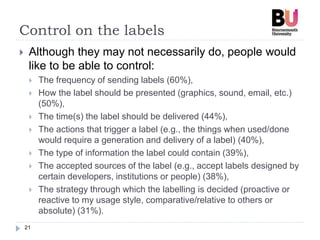
 Although they may not necessarily do, people would
like to be able to control:
 The frequency of sending labels (60%),
 How the label should be presented (graphics, sound, email, etc.)
(50%),
 The time(s) the label should be delivered (44%),
 The actions that trigger a label (e.g., the things when used/done
would require a generation and delivery of a label) (40%),
 The type of information the label could contain (39%),
 The accepted sources of the label (e.g., accept labels designed by
certain developers, institutions or people) (38%),
 The strategy through which the labelling is decided (proactive or
reactive to my usage style, comparative/relative to others or
absolute) (31%).
Awareness
22
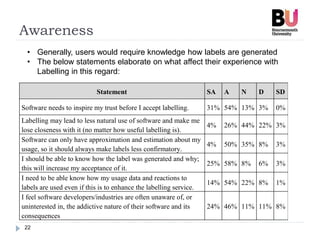
Statement SA A N D SD
Software needs to inspire my trust before I accept labelling. 31% 54% 13% 3% 0%
Labelling may lead to less natural use of software and make me
lose closeness with it (no matter how useful labelling is).
4% 26% 44% 22% 3%
Software can only have approximation and estimation about my
usage, so it should always make labels less confirmatory.
4% 50% 35% 8% 3%
I should be able to know how the label was generated and why;
this will increase my acceptance of it.
25% 58% 8% 6% 3%
I need to be able know how my usage data and reactions to
labels are used even if this is to enhance the labelling service.
14% 54% 22% 8% 1%
I feel software developers/industries are often unaware of, or
uninterested in, the addictive nature of their software and its
consequences
24% 46% 11% 11% 8%
• Generally, users would require knowledge how labels are generated
• The below statements elaborate on what affect their experience with
Labelling in this regard:
Adaptivity
23
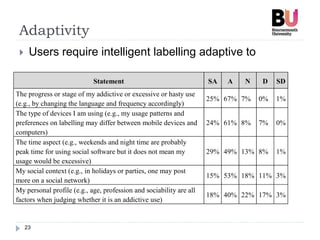
 Users require intelligent labelling adaptive to
Statement SA A N D SD
The progress or stage of my addictive or excessive or hasty use
(e.g., by changing the language and frequency accordingly)
25% 67% 7% 0% 1%
The type of devices I am using (e.g., my usage patterns and
preferences on labelling may differ between mobile devices and
computers)
24% 61% 8% 7% 0%
The time aspect (e.g., weekends and night time are probably
peak time for using social software but it does not mean my
usage would be excessive)
29% 49% 13% 8% 1%
My social context (e.g., in holidays or parties, one may post
more on a social network)
15% 53% 18% 11% 3%
My personal profile (e.g., age, profession and sociability are all
factors when judging whether it is an addictive use)
18% 40% 22% 17% 3%
RE additional challenges
24
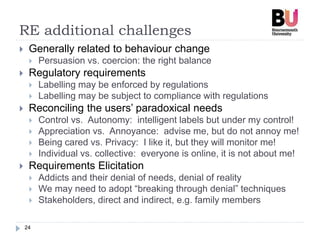
 Generally related to behaviour change
 Persuasion vs. coercion: the right balance
 Regulatory requirements
 Labelling may be enforced by regulations
 Labelling may be subject to compliance with regulations
 Reconciling the users’ paradoxical needs
 Control vs. Autonomy: intelligent labels but under my control!
 Appreciation vs. Annoyance: advise me, but do not annoy me!
 Being cared vs. Privacy: I like it, but they will monitor me!
 Individual vs. collective: everyone is online, it is not about me!
 Requirements Elicitation
 Addicts and their denial of needs, denial of reality
 We may need to adopt “breaking through denial” techniques
 Stakeholders, direct and indirect, e.g. family members
Acknowledgment
25
Bournemouth University:
Fusion Investment fund,
The Graduate School, Match-Funded Scheme
EC FP7 Marie Curie CIG Grant (the SOCIAD Project)
Streetscene Addiction Recovery Ltd in Bournemouth
http://streetscene.org.uk/
The participants in the study
The anonymous reviewers of REFSQ.
26
Thanks
We welcome collaboration
Come and visit us at Bournemouth
Contact:
Dr. Raian Ali
Director of Computing and Informatics Research
Centre
rali@bournemouth.ac.uk

The Emerging Requirement for Digital Addiction Labels

  • 1.
    1 The Emerging Requirementfor Digital Addiction Labels Raian Ali, Nan Jiang, Keith Phalp, Sarah Muir, John McAlaney Bournemouth University, UK Thursday, March 26th, 2015 Presented By: Mahmood Hosseini, Bournemouth University, UK
  • 2.
  • 3.
    Message to REFSQcommunity 3  Digital Addiction (hereafter DA), has become a serious issue that has a diversity of socio-economic side effects. In spite of its high importance, DA got little recognition or guidance as to how software development should take it into account.  This is in stark contrast to other domains known for traditional addiction (e.g., drugs, gambling, and alcohol) in which there are clear rules and policies on how to manufacture, market and sell the products.  We advocate the need to consider DA as a first class concept in developing software systems
  • 4.
  • 5.
    5  A Studyat University of Winchester,  Ten self-confessed Facebook “addicts” and ten prolific tweeters were asked to stop using their accounts for four weeks.  Many quickly became isolated from friends and family and reported feeling "cut off from the world".  “So much of my life was organised via Facebook. I haven’t communicated with my family all week.”  “I’ve felt alone and cut off from the world. My fingers seem to be programmed to seek out the Facebook app every time I pick up my phone.”http://www.telegraph.co.uk/technology/social-media/9986950/Twitter- and-Facebook-addicts-suffer-withdrawal-symptoms.html
  • 6.
  • 7.
    It could bemore serious 7
  • 8.
    Addiction types 8  KimberlyS. Young classifies it to:  Computer addiction: computer game addiction  Information overload: web surfing addiction  Net compulsions: online gambling or online shopping  Cybersexual addiction: adult websites, Sexting  Cyber-relationship addiction: online relationships  Social Networks Addiction would be seen in this type Young, K. “Internet addiction: Evaluation and treatment”. Student Brit. Med. J. 1999, 7, 351-352
  • 9.
    Symptoms 9  SNS addictionincorporates the experience of the ‘classic’ addiction symptoms, namely  Mood modification (i.e., engagement in SNSs leads to a favourable change in emotional states)  Salience (i.e., behavioral, cognitive, and emotional preoccupation with the SNS usage)  Tolerance (i.e., ever increasing use of SNSs over time)  Withdrawal symptoms (i.e., experiencing unpleasant physical and emotional symptoms when SNS use is restricted or stopped)  Conflict (i.e., interpersonal and intrapsychic problems ensue because of SNS usage),  Relapse (i.e., addicts quickly revert back in their excessive SNS usage after an abstinence period) Griffiths, M.D. A “components model of addiction within a biopsychosocial framework.” J. Subst. Use 2005, 10, 191-197.
  • 10.
    Negative Consequences 10  Lessinvolved with their real life communities  Nyland, R.; Marvez, R.; Beck, J. MySpace: Social networking or social isolation? In Proceedings of the Midwinter Conference of the Association for Education in Journalism and Mass Communication, Midwinter Conference of the Association for Education in Journalism and Mass Communication, Reno, NV, USA, 23–24 February 2007.  Insecure in real-life, compensation in SNS  Barker, V. Older adolescents’ motivations for social network site use: The influence of gender, group identity, and collective self-esteem. CyberPsychol. Behav. 2009, 12, 209-213.  Negative feedback on SNS has negative effect particularly for people with low self-esteem who use SNSs to compensate that  Ellison, N.B.; Steinfield, C.; Lampe, C. The benefits of Facebook “friends”: Social capital and college students’ use of online social network sites. J. Comput-Mediat. Comm. 2007, 12.  Facebook users had lower Grade Point Averages. Of the 26% of student feeling the impact on their lives, three-quarters (74%) claimed that it had a negative impact, namely procrastination, distraction, and poor time- management.  Kirschner, P.A.; Karpinski, A.C. Facebook and academic performance. Comput. Hum. Behav. 2010, 26, 1237-1245.
  • 11.
    Why is notit on Software? 11  Tobacco Warning  http://www.tobaccolabels.ca/  Uruguay: 80% of the front and 80% of the back  http://www.tobaccolabels.ca/countries/Uruguay/  Uruguay Government Vs Philip Morris  the design of six messages that will fill the 80% space  a regulation that forces companies to sell only one variation of cigarettes per brand (to get around a previous prohibition on labelling cigarettes as ‘light’ or ‘ultralight’, some manufacturers had taken to colour-labelling cigarette packs)  http://www.tobaccotactics.org/index.php/Philip_Morris _vs_the_Government_of_Uruguay  http://www.bbc.co.uk/news/world-latin-america- 27647477
  • 12.
    Software can react 12 Software is “more intelligent” than Alcohol  Alcohol can not tell you to stop, software can  Software can be designed to react, but when and how?  Besides banning/penalty (which might not be a bad option sometimes)  Constructive criticism  Incentives-centred design  Gamification  You attend social events and share photos and get points  Avatars  Socio-technial treatment or a “Blended” treatment  Peer pressure  Mutual Commitment
  • 13.
  • 14.
    Requirements 14  In general,DA represents a family of challenges:  Ethical and professional requirements  Behavioural change requirements  New requirements challenges:  The need for care vs. the desire for freedom of use  Regulatory health requirements, probably soon?  Denial of needs  Addicts do not recognize/admit their addiction  Let aside providing how they would like to be treated  Stakeholders identification  The user, carer, public health institutes, peers, ..
  • 15.
    Our Study 15  Mixedmethods approach  To understand labelling requirements in 4 types:  Content and presentation  Ability to control, e.g. frequency, source, type, language, etc.  Awareness: I need to know why I am receiving labels  Adaptivity: intelligence in tailoring labels to my needs and preferences.  First phase: Qualitative  Interviews with 11 participants, five male and six female, aged between 19 and 35 years old. Four professionals and seven students studying Computing (four) and Psychology (three)  Second phase: Quantitative  To confirm and enhance the results of the first  72 participants completed the survey (35 male, 36 female, and one preferred not to say). The age bands distribution was 18-25 (47%), 26-34 (33%), 35-44 (6%), 45-54 (4%), 55-64 (8%), 65+ (0%), and 2% preferred not to answer.
  • 16.
    General findings 16  Theterm Digital Addiction did not raise concerns  It is seen as a metaphoric term though  32% of the survey participants thought DA labelling is certainly needed, 50% thought is likely a good idea, 15% thought it is unlikely to be useful and 3% thought it is not going to work.  Addiction is about:  Compulsive usage  Impulsive usage  Excessive usage  Hasty usage
  • 17.
    General findings (2) 17 DA is collective responsibility,  e.g. social pressure to be on Facebook, etc.  DA labels are seen as ineffective when the original reason for DA, is more than a “careless” usage style  e.g. depression and tension could lead to gaming for hours  Labelling in social settings  A label could compare one usage style to other peers  Generated by others, e.g. peer groups and health institutes
  • 18.
    Message: Content &Presentation 18  Usage Related:  Time already spent on the software (86%)  The number of times I checked/visited the software (56%)  Usage "bill", like mobile bills and bank statements (47%)  The features which I heavily used (e.g., Like, tagging, messaging etc.) (17%)  Consequence related:  Consequences on real social life (e.g., relations breakdown) (51%)  Effects on physiological and mental health (e.g., eye strains, tension etc.) (50%)  Damage on public profile (potentially seen by employers, etc.) (39%)  The ease and speed of information spread once shared (32%)  Potential risks on you, e.g. when you use social networks in excessive, hasty and unthoughtful way (29%)  Consequences on your on-line relationship with others (e.g., hasty and not thoughtful interactions could be misinterpreted etc.) (29%)  Consequences on online contacts (e.g., hasty and excessive tagging and sharing could affect the privacy of people involved in the posts) (19%)
  • 19.
    Message: Content &Presentation 19  Advice related:  Suggestion/advice on potentially interesting real life activities based on your usage, e.g. going to a social event which matches your detected online interests (44%)  Factual and proved statements about the benefits of regulating usage styles (38%)  Suggestions/advice on how to regulate the usage style, e.g. using filters to reduce the amount of feeds/notifications (33%)  Presentation and delivery method  Time-based progress status (e.g., clock/timers for your usage amount) (61%)  Dynamic colouring of interfaces to reflect your degree of usage (e.g., Green bar for reasonable use, Red bar for excessive use, etc.) (53%)  Pop-up notifications (44%)  Personalised metaphors (e.g., an avatar of you when being overly engaged) (31%)  Hardware based interactions (e.g., vibration and flickering on mobile phones or 3D glasses of gamers) (26%)  Sounds (e.g., beeping when you overly play a game or check Facebook) (21%)  Offline notifications, e.g. sent as a message or email (19%)  Analogy to traditional addiction (e.g., a metaphor of consumption of number of "digital" alcohol glasses) (18%)
  • 20.
    Message: Content &Presentation 20  Supportive content (61%)  when losing a game, a user would like a message moderating that feeling which will reduce the desire to start another round  Non-repetitive content (54%)  Users would otherwise tend to ignore DA labelling  Not overly-negative content (51%)  This is similar to the case where gambling is overly associated with people losing their properties and savings while it is still possible that people use it moderately as an entertainment tool  Socially-generated content (36%)  It is similar to the case when one receives a friendly comment to stop drinking  Precautionary content (36%)  Proactive to warn about the potential of becoming high-dependent on software
  • 21.
    Control on thelabels 21  Although they may not necessarily do, people would like to be able to control:  The frequency of sending labels (60%),  How the label should be presented (graphics, sound, email, etc.) (50%),  The time(s) the label should be delivered (44%),  The actions that trigger a label (e.g., the things when used/done would require a generation and delivery of a label) (40%),  The type of information the label could contain (39%),  The accepted sources of the label (e.g., accept labels designed by certain developers, institutions or people) (38%),  The strategy through which the labelling is decided (proactive or reactive to my usage style, comparative/relative to others or absolute) (31%).
  • 22.
    Awareness 22 Statement SA AN D SD Software needs to inspire my trust before I accept labelling. 31% 54% 13% 3% 0% Labelling may lead to less natural use of software and make me lose closeness with it (no matter how useful labelling is). 4% 26% 44% 22% 3% Software can only have approximation and estimation about my usage, so it should always make labels less confirmatory. 4% 50% 35% 8% 3% I should be able to know how the label was generated and why; this will increase my acceptance of it. 25% 58% 8% 6% 3% I need to be able know how my usage data and reactions to labels are used even if this is to enhance the labelling service. 14% 54% 22% 8% 1% I feel software developers/industries are often unaware of, or uninterested in, the addictive nature of their software and its consequences 24% 46% 11% 11% 8% • Generally, users would require knowledge how labels are generated • The below statements elaborate on what affect their experience with Labelling in this regard:
  • 23.
    Adaptivity 23  Users requireintelligent labelling adaptive to Statement SA A N D SD The progress or stage of my addictive or excessive or hasty use (e.g., by changing the language and frequency accordingly) 25% 67% 7% 0% 1% The type of devices I am using (e.g., my usage patterns and preferences on labelling may differ between mobile devices and computers) 24% 61% 8% 7% 0% The time aspect (e.g., weekends and night time are probably peak time for using social software but it does not mean my usage would be excessive) 29% 49% 13% 8% 1% My social context (e.g., in holidays or parties, one may post more on a social network) 15% 53% 18% 11% 3% My personal profile (e.g., age, profession and sociability are all factors when judging whether it is an addictive use) 18% 40% 22% 17% 3%
  • 24.
    RE additional challenges 24 Generally related to behaviour change  Persuasion vs. coercion: the right balance  Regulatory requirements  Labelling may be enforced by regulations  Labelling may be subject to compliance with regulations  Reconciling the users’ paradoxical needs  Control vs. Autonomy: intelligent labels but under my control!  Appreciation vs. Annoyance: advise me, but do not annoy me!  Being cared vs. Privacy: I like it, but they will monitor me!  Individual vs. collective: everyone is online, it is not about me!  Requirements Elicitation  Addicts and their denial of needs, denial of reality  We may need to adopt “breaking through denial” techniques  Stakeholders, direct and indirect, e.g. family members
  • 25.
    Acknowledgment 25 Bournemouth University: Fusion Investmentfund, The Graduate School, Match-Funded Scheme EC FP7 Marie Curie CIG Grant (the SOCIAD Project) Streetscene Addiction Recovery Ltd in Bournemouth http://streetscene.org.uk/ The participants in the study The anonymous reviewers of REFSQ.
  • 26.
    26 Thanks We welcome collaboration Comeand visit us at Bournemouth Contact: Dr. Raian Ali Director of Computing and Informatics Research Centre rali@bournemouth.ac.uk