Games for Learning Institute
• Members
   • NYU (Ken Perlin, Jan L. Plass, Co-Directors, Katherine Isbister)
   • TC Columbia University (Chuck Kinzer)
   • CUNY Graduate Center (Bruce D. Homer)
   • Parsons, Dartmouth, RIT, PUC
   • Total of 11 faculty from 7 universities and their labs
     Game designers, computer scientists, engineers, educators, learning scientists, psychologists
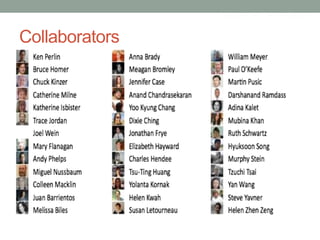
Collaborators
Games for Learning Institute
• Mission
    • Design Patterns for Games for Learning
    • Guide for Designers
    • Embedded Assessment
    • Evidence of Effectiveness of Games for Learning
    • Focus on STEM, Language, Literacy
The Game
EF Tasks in Context


         Image from foxbusiness.com


                                      Image from psych.stanford.edu
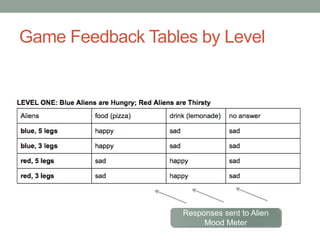
Game Feedback Tables by Level


                   Responses sent to Alien
                        Mood Meter
Literature to Support Design Concept
• Repeated exposure to tasks that require learning
 increasingly complex rule sets can improve inhibitory
 control (Dowsett and Livesey 1999)

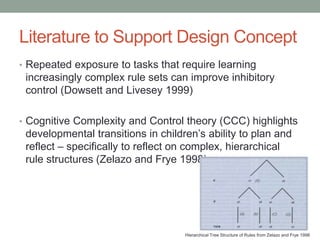
• Cognitive Complexity and Control theory (CCC) highlights
 developmental transitions in children’s ability to plan and
 reflect – specifically to reflect on complex, hierarchical
 rule structures (Zelazo and Frye 1998)


                                    Hierarchical Tree Structure of Rules from Zelazo and Frye 1998
The Design Process
• Design of game tasks focuses on three commonly cited
 target functions (Anderson 2002; Miyake, et al. 2000)

• Action video games proven to alter visuospatial attention
 and modify selective attention (Green and Bavelier 2006)

• Games for executive functioning assessment and…
 training?

• Learning Mechanics 
 Game Mechanics

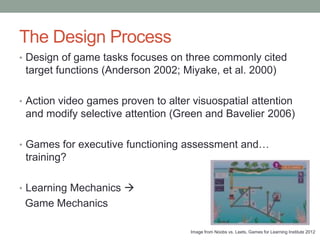
                                     Image from Noobs vs. Leets, Games for Learning Institute 2012
Directions for Future Research
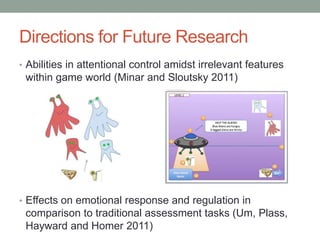
• Abilities in attentional control amidst irrelevant features
 within game world (Minar and Sloutsky 2011)


• Effects on emotional response and regulation in
 comparison to traditional assessment tasks (Um, Plass,
 Hayward and Homer 2011)
References
Anderson, P. (2002) Assessment and Development of Executive Function (EF) During
Childhood. Child Neuropsychology, 8:2, 71-82.

Dowsett, S.M. and Livesey, D.J. (1999) The Development of Inhibitory Control in
Preschool Children: Effects of “Executive Skills” Training. Development of Inhibitory
Control: John Wiley and Sons.

Green, C.S. & Bavelier, D. (2006). Effect of action video games on the spatial distribution
of visuospatial attention. Journal of Experimental Psychology: Human Perception and
Performance, 32(6), 1465-1468.

Minar, N. and Sloutsky, V. (2011) Visual Attention and the Dimensional Change Card Sort.
Juros, 2. Retrieved from: http://asiandoc.lib.ohio-
state.edu/index.php/juros/article/view/1693

Miyake, A., Friedman, N.P., Emerson, M.J., Witzki, A.H., Howerter, A., Wager, T. (2000)
The Unity and Diversity of Executive Functions and Their Contributions to Complex
“Frontal Lobe” Tasks: A Latent Variable Analysis. Cognitive Psychology, 41, 49-100.

Salen, K., & Zimmerman, E. (2003). Rules of Play: Game Design Fundamentals

Zelazo, P.D. and Frye, D. (1998) Cognitive Complexity and Control: II. The Development
of Executive Function in Childhood. Current Directions in Psychological Science.
Thank You! Danke Schön!!
This project is a collaboration among the following people at the CREATE lab and G4LI:
                                  • Bruce Homer (CUNY)
                                • Elizabeth Hayward (NYU)
                                     • Jan Plass (NYU)
                                • Seamus Donnelly (CUNY)
                              • Rachel Feigenbaum (CUNY)


       And our team of faculty and student programmers at University of Vienna:
                                   • Manuel Sprung
                                 • Alexander Hofmann
                                    • Jakob Leyrer
                                  • Gabriela Markova

This has been presented as part of: “Games 4 Resilience: Spielerisch Selbstkontrolle und
        Emotionale Kompetenz fördern” given in Vienna, Austria on May 11, 2012

Games4Resilience - Meagan Bromley

  • 2.
    Games for LearningInstitute • Members • NYU (Ken Perlin, Jan L. Plass, Co-Directors, Katherine Isbister) • TC Columbia University (Chuck Kinzer) • CUNY Graduate Center (Bruce D. Homer) • Parsons, Dartmouth, RIT, PUC • Total of 11 faculty from 7 universities and their labs Game designers, computer scientists, engineers, educators, learning scientists, psychologists
  • 3.
  • 4.
    Games for LearningInstitute • Mission • Design Patterns for Games for Learning • Guide for Designers • Embedded Assessment • Evidence of Effectiveness of Games for Learning • Focus on STEM, Language, Literacy
  • 5.
  • 9.
    EF Tasks inContext Image from foxbusiness.com Image from psych.stanford.edu
  • 11.
    Game Feedback Tablesby Level Responses sent to Alien Mood Meter
  • 13.
    Literature to SupportDesign Concept • Repeated exposure to tasks that require learning increasingly complex rule sets can improve inhibitory control (Dowsett and Livesey 1999) • Cognitive Complexity and Control theory (CCC) highlights developmental transitions in children’s ability to plan and reflect – specifically to reflect on complex, hierarchical rule structures (Zelazo and Frye 1998) Hierarchical Tree Structure of Rules from Zelazo and Frye 1998
  • 14.
    The Design Process •Design of game tasks focuses on three commonly cited target functions (Anderson 2002; Miyake, et al. 2000) • Action video games proven to alter visuospatial attention and modify selective attention (Green and Bavelier 2006) • Games for executive functioning assessment and… training? • Learning Mechanics  Game Mechanics Image from Noobs vs. Leets, Games for Learning Institute 2012
  • 15.
    Directions for FutureResearch • Abilities in attentional control amidst irrelevant features within game world (Minar and Sloutsky 2011) • Effects on emotional response and regulation in comparison to traditional assessment tasks (Um, Plass, Hayward and Homer 2011)
  • 16.
    References Anderson, P. (2002)Assessment and Development of Executive Function (EF) During Childhood. Child Neuropsychology, 8:2, 71-82. Dowsett, S.M. and Livesey, D.J. (1999) The Development of Inhibitory Control in Preschool Children: Effects of “Executive Skills” Training. Development of Inhibitory Control: John Wiley and Sons. Green, C.S. & Bavelier, D. (2006). Effect of action video games on the spatial distribution of visuospatial attention. Journal of Experimental Psychology: Human Perception and Performance, 32(6), 1465-1468. Minar, N. and Sloutsky, V. (2011) Visual Attention and the Dimensional Change Card Sort. Juros, 2. Retrieved from: http://asiandoc.lib.ohio- state.edu/index.php/juros/article/view/1693 Miyake, A., Friedman, N.P., Emerson, M.J., Witzki, A.H., Howerter, A., Wager, T. (2000) The Unity and Diversity of Executive Functions and Their Contributions to Complex “Frontal Lobe” Tasks: A Latent Variable Analysis. Cognitive Psychology, 41, 49-100. Salen, K., & Zimmerman, E. (2003). Rules of Play: Game Design Fundamentals Zelazo, P.D. and Frye, D. (1998) Cognitive Complexity and Control: II. The Development of Executive Function in Childhood. Current Directions in Psychological Science.
  • 17.
    Thank You! DankeSchön!! This project is a collaboration among the following people at the CREATE lab and G4LI: • Bruce Homer (CUNY) • Elizabeth Hayward (NYU) • Jan Plass (NYU) • Seamus Donnelly (CUNY) • Rachel Feigenbaum (CUNY) And our team of faculty and student programmers at University of Vienna: • Manuel Sprung • Alexander Hofmann • Jakob Leyrer • Gabriela Markova This has been presented as part of: “Games 4 Resilience: Spielerisch Selbstkontrolle und Emotionale Kompetenz fördern” given in Vienna, Austria on May 11, 2012