Game Story Devices
Niaz Ali (BSIT-F15-R21)
M. Usama Khalid (BSIT-F14-R45)
M. Umar Farooq (BSIT-F15-R12)
Topics Covered
• Introduction of GSD
• Types of GSD
Introduction
• Good game stories inspire us, transform us, take us to
another world.
• A game designer might argue that a good
game challenges the player.
• Games differ from other storytelling media in that they give the
player agency the power to succeed and also to fail.
• In order to create powerful, meaningful games it is important that
game designers have tools for structuring the combination of
narrative and challenges
Types of GSD
There are several game-specific story devices
1. Interactivity
2. Non-Linearity
3. Player Control
4. Collaboration
5. Immersion
6. Cinematics
1.Interactivity
 Games have a higher level of
interactivity than other media
 Games depend even more on
gameplay than story for player
satisfaction.
 By nature, stories are not
interactive. They come out of the
storyteller’s mind and are meant
only to be received by the
audience passively.
 They can also be co-storytellers—
and sometimes, they can even be
the only storytellers.
2. Non-Linearity
 Linear stories follow a physical
and temporal straight line.
 Games do not have to follow a
linear storyline.
 Beginning with the most
distant events and ending with
the most recent.
 Allows players to choose
different paths within one
storyline.
3. Player Control
 Players have the ability to
manipulate the game in some way.
 players can be storytellers in games—
something they cannot do in books
and movies.
 A common form of player control
involves character customization,
where players create their own
characters with personalized
features.
 The character creation process in
RPGs gives the player the freedom to
personalize their profile.
4. Collaboration
 The multiplayer game mode makes it possible for players to
engage in collaborative storytelling.
 MMO games in which thousands of players could conceivably
personalize their character roles, introduce new plot points, and
modify the environment itself while playing the game.
 Collaboration is similar to interactive theatre—where the players
are performers improving with each other and with the audience.
 A collaborative storyline could be initiated by the game
development team, and the paths of the story might be added by
the players.
5. Immersion
 Game storylines play a significant
role is known as game immersion.
 In immersion the story, characters,
and gameplay are so powerful and
engaging that the players find
themselves deeply caught up in the
game world.
 Bat Man , Final Fantasy , Infocom’s
text adventure Zork and the
graphically rich Myst are also
extremely immersive games
because they create an atmosphere
and a mood that is rich and
consistent.
6. Cinematics
 Another way immersion can be
compromised in a game might be
surprising to the film industry.
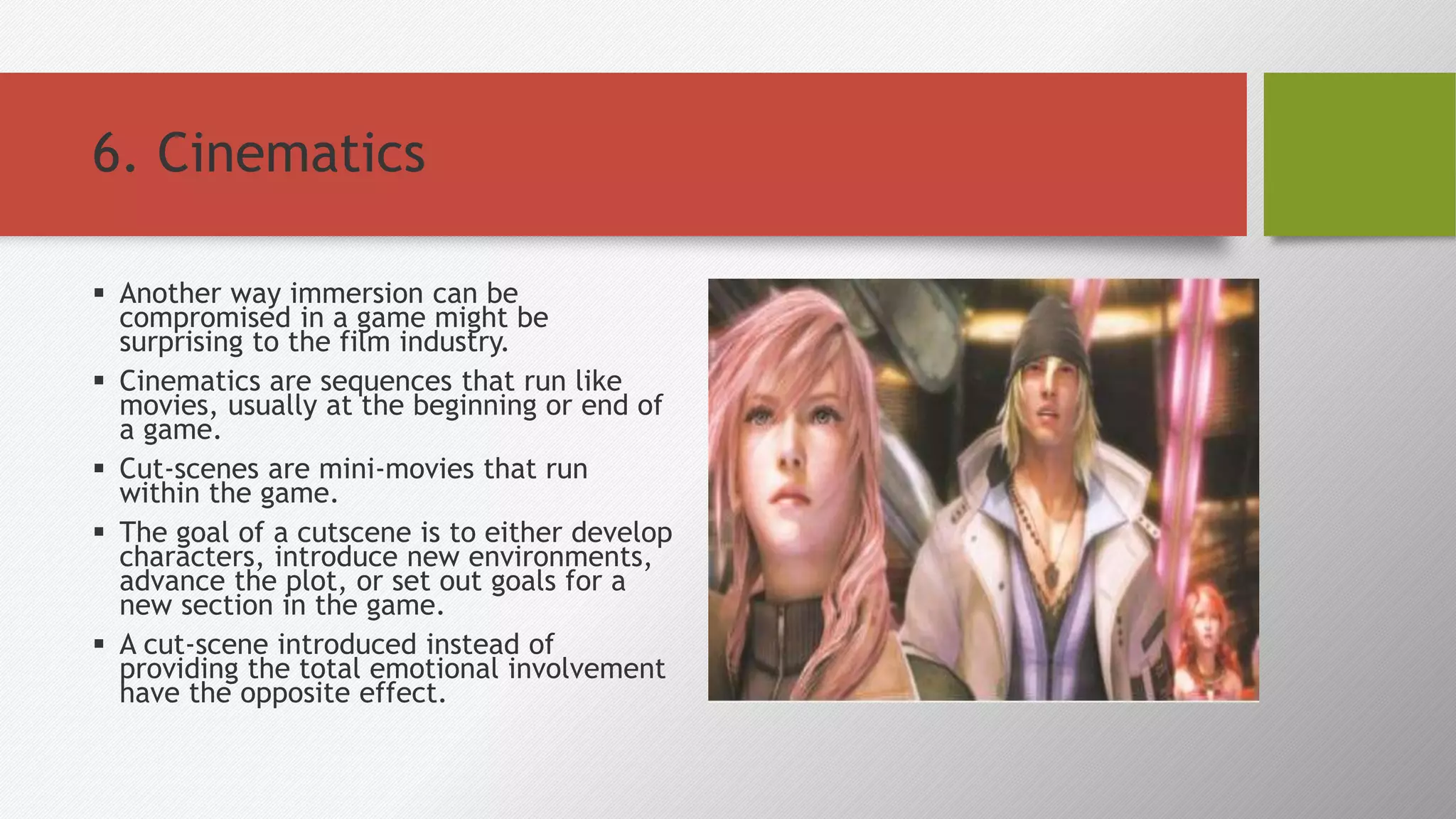
 Cinematics are sequences that run like
movies, usually at the beginning or end of
a game.
 Cut-scenes are mini-movies that run
within the game.
 The goal of a cutscene is to either develop
characters, introduce new environments,
advance the plot, or set out goals for a
new section in the game.
 A cut-scene introduced instead of
providing the total emotional involvement
have the opposite effect.

Game story devices

  • 1.
    Game Story Devices NiazAli (BSIT-F15-R21) M. Usama Khalid (BSIT-F14-R45) M. Umar Farooq (BSIT-F15-R12)
  • 2.
    Topics Covered • Introductionof GSD • Types of GSD
  • 3.
    Introduction • Good gamestories inspire us, transform us, take us to another world. • A game designer might argue that a good game challenges the player. • Games differ from other storytelling media in that they give the player agency the power to succeed and also to fail. • In order to create powerful, meaningful games it is important that game designers have tools for structuring the combination of narrative and challenges
  • 4.
    Types of GSD Thereare several game-specific story devices 1. Interactivity 2. Non-Linearity 3. Player Control 4. Collaboration 5. Immersion 6. Cinematics
  • 5.
    1.Interactivity  Games havea higher level of interactivity than other media  Games depend even more on gameplay than story for player satisfaction.  By nature, stories are not interactive. They come out of the storyteller’s mind and are meant only to be received by the audience passively.  They can also be co-storytellers— and sometimes, they can even be the only storytellers.
  • 6.
    2. Non-Linearity  Linearstories follow a physical and temporal straight line.  Games do not have to follow a linear storyline.  Beginning with the most distant events and ending with the most recent.  Allows players to choose different paths within one storyline.
  • 7.
    3. Player Control Players have the ability to manipulate the game in some way.  players can be storytellers in games— something they cannot do in books and movies.  A common form of player control involves character customization, where players create their own characters with personalized features.  The character creation process in RPGs gives the player the freedom to personalize their profile.
  • 8.
    4. Collaboration  Themultiplayer game mode makes it possible for players to engage in collaborative storytelling.  MMO games in which thousands of players could conceivably personalize their character roles, introduce new plot points, and modify the environment itself while playing the game.  Collaboration is similar to interactive theatre—where the players are performers improving with each other and with the audience.  A collaborative storyline could be initiated by the game development team, and the paths of the story might be added by the players.
  • 9.
    5. Immersion  Gamestorylines play a significant role is known as game immersion.  In immersion the story, characters, and gameplay are so powerful and engaging that the players find themselves deeply caught up in the game world.  Bat Man , Final Fantasy , Infocom’s text adventure Zork and the graphically rich Myst are also extremely immersive games because they create an atmosphere and a mood that is rich and consistent.
  • 10.
    6. Cinematics  Anotherway immersion can be compromised in a game might be surprising to the film industry.  Cinematics are sequences that run like movies, usually at the beginning or end of a game.  Cut-scenes are mini-movies that run within the game.  The goal of a cutscene is to either develop characters, introduce new environments, advance the plot, or set out goals for a new section in the game.  A cut-scene introduced instead of providing the total emotional involvement have the opposite effect.

Editor's Notes

  • #3 Time-division multiple access (TDMA) is a channel access method for shared-medium networks. It allows several users to share the same frequency channel by dividing the signal into different time slots. The users transmit in rapid succession, one after the other, each using its own time slot The public switched telephone network (PSTN) is the aggregate of the world's circuit-switched telephone networks that are operated by national, regional, or local telephony operators, providing infrastructure and services for publictelecommunication.
  • #4 Time-division multiple access (TDMA) is a channel access method for shared-medium networks. It allows several users to share the same frequency channel by dividing the signal into different time slots. The users transmit in rapid succession, one after the other, each using its own time slot The public switched telephone network (PSTN) is the aggregate of the world's circuit-switched telephone networks that are operated by national, regional, or local telephony operators, providing infrastructure and services for publictelecommunication.
  • #5 Voice Calls The most basic Teleservice supported by GSM is telephony. This includes full-rate speech at 13 kbps and emergency calls, where the nearest emergency-service provider is notified by dialing three digits. Videotext and Facsmile Another group of teleservices includes Videotext access, Teletex transmission, Facsmile alternate speech and Facsmile Group 3, Automatic Facsmile Group, 3 etc. Short Text Messages Short Messaging Service (SMS) service is a text messaging service that allows sending and receiving text messages on your GSM mobile phone. In addition to simple text messages, other text data including news, sports, financial, language, and location-based data can also be transmitted. It can send maximum 160 characters.
  • #6 Transparent bearer services use only the functions of the physical layer (layer 1 ISO/OSI reference model) to transmit data; data transmission consequently has a constant delay and throughput, that is if no errors occur. The only mechanism of any use to try and increase the quality of the transmission is forward error correction (FEC). This mechanism codes redundancy into the data-stream and Depending on the FEC, data rate of 2.4, 4.8, or 9.6 kbit/s are possible. Non-Transparent bearer services use protocols of the layers two and three to implement error correction and flow control. Non-transparent bearer services use the transparent bearer services, while adding a radio link protocol (RLP). This protocol uses mechanisms of high-level data link control (HDLC) (Halsall, 1996), and special selective-reject mechanisms to trigger retransmission of erroneous data. The achieved bit error rate is less than 10-7, but now throughput may vary, this depending on the transmission quality. Circuit switching is a method of implementing a telecommunications network in which two network nodes establish a dedicated communications channel (circuit) through the network before the nodes may communicate. Packet switching is a method of grouping data that is transmitted over a digital network into packets. Packets are made of a header and a payload. Data in the header are used by networking hardware to direct the packet to its destination where the payload is extracted and used by application software. General packet radio service (GPRS) is a packet-based wireless data communication service designed to replace the current circuit-switched services available on the second-generation global system for mobile communications (GSM) and time division multiple access High-Speed Circuit-Switched Data (HSCSD) is circuit-switched wireless data transmission for mobile users at data rates up to 38.4 Kbps, four times faster than the standard data rates of the Global System for Mobile (GSM) communication standard in 1999. HSCSD is comparable to the speed of many computer modems that communicate with today's fixed telephone networks.
  • #7 Conferencing : It allows a mobile subscriber to establish a multiparty conversation, i.e., a simultaneous conversation between three or more subscribers to setup a conference call. This service is only applicable to normal telephony. Call Waiting : This service notifies a mobile subscriber of an incoming call during a conversation. The subscriber can answer, reject, or ignore the incoming call. Call Hold : This service allows a subscriber to put an incoming call on hold and resume after a while. The call hold service is applicable to normal telephony. Call Forwarding : Call Forwarding is used to divert calls from the original recipient to another number. It is normally set up by the subscriber himself. It can be used by the subscriber to divert calls from the Mobile Station when the subscriber is not available, and so to ensure that calls are not lost. Call Barring : Call Barring is useful to restrict certain types of outgoing calls such as ISD or stop incoming calls from undesired numbers. Call barring is a flexible service that enables the subscriber to conditionally bar calls. Number Identification : There are following supplementary services related to number identification: Calling Line Identification Presentation : This service displays the telephone number of the calling party on your screen. Calling Line Identification Restriction : A person not wishing their number to be presented to others subscribes to this service. Connected Line Identification Presentation : This service is provided to give the calling party the telephone number of the person to whom they are connected. This service is useful in situations such as forwarding's where the number connected is not the number dialled. Connected Line Identification Restriction : There are times when the person called does not wish to have their number presented and so they would subscribe to this person. Normally, this overrides the presentation service. Malicious Call Identification : The malicious call identification service was provided to combat the spread of obscene or annoying calls. The victim should subscribe to this service, and then they could cause known malicious calls to be identified in the GSM network, using a simple command. Advice of Charge (AoC) : This service was designed to give the subscriber an indication of the cost of the services as they are used. Furthermore, those service providers who wish to offer rental services to subscribers without their own SIM can also utilize this service in a slightly different form. AoC for data calls is provided on the basis of time measurements. Closed User Groups (CUGs) : This service is meant for groups of subscribers who wish to call only each other and no one else.
  • #9 As suggested by the name, the radio subsystem is comprised of all the radio specific elements, i.e. the mobile stations (MS) and the base station subsystem (BSS). The connection between the RSS and the NSS (shown in figure x.ii) via the A interface (solid lines) and the connection to the OSS via the O interface (dashed lines). The A interface is generally based on a circuit-switched PCM-30 system (2.048 Mbit/s), carrying up to 30 X 64 kbit/s connections, whereas the O interface uses the Signalling System No. 7 (SS7) based on X.25 carrying system management data to/from the RSS.
  • #10 Base Station Subsystem (BSS): A GSM network is made up of many BSSs, each one being controlled by a base station controller (BSC). The main function of the BSS is to maintain the radio connections to an MS, however, it does have several other functions such as the coding/decoding of voice, and rate adaptation to/from the wireless network part. As well as a BSC, the BSS contains several BTSs. Base Transceiver Station (BTS): A BTS contains all the radio equipment (antennas, signal processing, amplifiers) necessary for radio transmission. A BTS can be used to form a radio cell, or if sectored antennas are used, several cells. The BTS is connected to the MS by the Um interface, and the BSC by the Abis interface. The Um interface comprises of all the mechanisms necessary for wireless transmission (TDMA, FDMA). Abis interface consists of 16 or 64 kbit/s connections. The area coverage from a GSM cell can vary from 100m and 35km depending on the expected traffic and the location environment. Base Station Controller (BSC): Basically, the BSC controls the BTS The functions of the BSC include reserving radio frequencies, handling handovers from one BTS to another and performing the paging of the MS. The BSC also multiplexes the radio channels onto the fixed network connections at the A interface. Mobile Station (MS): The MS is the user equipment which contains the software required for communication with the GSM network. The MS consists of user independent hard/software and the subscriber identity module (SIM), which stores the user specific data. While an MS can be identified via the international mobile equipment identity (IMEI)
  • #11 At the centre of any GSM system there is the network and switching subsystem (NSS) that connects the GSM network with the public land network (i.e. a PSTN), performs the handovers between BSS's, comprises functions for worldwide localization of users and supports charging, accounting and roaming of users between different networks and in different countries. The NSS is comprised of the following switches and databases: