Objectives:
describe biodiversity;
determine the importance of
biodiversity;
1
At the end of the lesson, you should be able to:
2
Objectives:
Explain the three types of Biodiversity
Understand extinction and know
some causes of Extinction.
3
4
Explain the Importance of Biodiversity
5
biological diversity or biodiversity is the
variety of the earth species or life, the
genes they contain, the ecosystem which
they live, and the ecosystem processes of
energy flow and nutrient cycling that
sustain all life.
BIODIVERSITY
Biodiversity and Its Types
GENETIC
DIVERSITY
SPECIES
DIVERSITY
ECOSYSTEM
DIVERSITY
BIODIVERSITY & ITS TYPES
Genetic Diversity
It refers to the variations among the genetic
resources of the organisms. Every individual of
a particular species differs from each other in
their genetic constitution.
It pertains to the variation of genes within a
species.
Genetic Diversity
BIODIVERSITY & ITS TYPES
Species Diversity
Species diversity refers to the variety of different types of species
found in a particular area. It is the biodiversity at the most basic
level. It includes all the species ranging from plants to different
microorganisms.
Species diversity is defined as the number of different species
present in an ecosystem and relative abundance of each of
those species.
Species Diversity
BIODIVERSITY & ITS TYPES
Ecosystem Diversity
An ecosystem is a collection of living and non-living
organisms and their interaction with each other.
Ecosystem biodiversity refers to the variations in the
plant and animal species living together and
connected by food chains and food webs.
Ecosystem Diversity
Threatened Species
Any species that is
becoming rare and that may
become in danger of
extinction.
Categories of Threatened
Species
1. Critically Endangered Species
2. Endangered Species
3. Vulnerable Species
Categories of Threatened
Species
1. Critically Endangered Species
Categories of Threatened
Species
2.Endangered Species
Categories of Threatened
Species
3.Vulnerable Species
Estimated Number of Philippine
Species
14 000 – 15 310
Plants
3 308 – 3 325
Vertebrates
34 940 – 35 000
Invertebrates
6 100+
Others
SPECIES RICHNESS
Species richness refers to species numbers
ABUNDANCE
Abundance refers to the number of individuals.
SPECIES DENSITY
refers to the number of individuals in an area
• Deserts typically have
low species density
compared to other
ecosystems.
SPECIES DENSITY
You want to survey the density of grass in your backyard. You noticed that there was
only one species of grass, and you counted 97 individuals of that species. Your
backyard is 10 m2. Find the species density of that grass.
Species Richness
1 Species of Grass
Density
Abundance of Grass: 97 individuals of Grass
.
You want to survey the density of grass in your backyard. You noticed that there was
only one species of grass, and you counted 97 individuals of that species. Your
backyard is 10 m2. Find the species density of that grass.
Given:
number of individual per species: 97
total unit area: 10 m2.
Write the working equation:
Substitute the values.
Solve for the species density.
Area A is 100 m2 and has 300 individuals of an ant species. What is the
species density?
Area A is 100 m2 and has 300 individuals of an ant species. What is the species
density?
Species Richness
1 Species of Ant
Density
Abundance of Ant: 300 individuals of Ant.
.
Area A is 100 m2 and has 300 individuals of an ant species. What is the
species density?
Given:
number of individual per species: 300
total unit area: 100 m2.
Write the working equation:
Substitute the values.
species density =
𝟑𝟎𝟎 𝒊𝒏𝒅𝒊𝒗𝒊𝒅𝒖𝒂𝒍𝒔
100 m2
species density =
𝟑𝟎𝟎 𝒊𝒏𝒅𝒊𝒗𝒊𝒅𝒖𝒂𝒍𝒔
100 m2
species density = 3
𝒊𝒏𝒅𝒊𝒗𝒊𝒅𝒖𝒂𝒍𝒔
m2
Solve for the species density.
Area A is 100 m2 and has 3 Species. Species A has 40 members, Species
B has 45 members, and Species C has 23 members. What is the species
richness and abundance, and the species density of each?
Area A is 100 m2 and has 3 Species. Species A has 40 members, Species B has 45
members, and Species C has 23 members. What is the species richness and
abundance, and the species density of each?
Species Richness
3 Species
Density
Abundance of Species A: 40 members
Abundance of Species B: 45 members
Abundance of Species A: 23 members
.
Area A is 100 m2 and has 3 Species. Species A has 40 members, Species
B has 45 members, and Species C has 23 members. What is the species
richness and abundance, and the species density of each?
Given:
number of individual per species: Species A = 40, Species B= 45, Species C= 23
total unit area: 100 m2.
Write the working equation:
Substitute the values.
For specie A species density =
𝟒𝟎 𝒊𝒏𝒅𝒊𝒗𝒊𝒅𝒖𝒂𝒍𝒔
100 m2
For species B species density =
𝟒𝟓 𝒊𝒏𝒅𝒊𝒗𝒊𝒅𝒖𝒂𝒍𝒔
100 m2
For specie C species density =
𝟐𝟑 𝒊𝒏𝒅𝒊𝒗𝒊𝒅𝒖𝒂𝒍𝒔
100 m2
Area A is 100 m2 and has 3 Species. Species A has 40 members, Species
B has 45 members, and Species C has 23 members. What is the species
richness and abundance, and the species density of each?
Solve for the species density
For specie A species density =
𝟒𝟎 𝒊𝒏𝒅𝒊𝒗𝒊𝒅𝒖𝒂𝒍𝒔
100 m2
0.4
𝒊𝒏𝒅𝒊𝒗𝒊𝒅𝒖𝒂𝒍𝒔
m2
For species B species density =
𝟒𝟓 𝒊𝒏𝒅𝒊𝒗𝒊𝒅𝒖𝒂𝒍𝒔
100 m2
0.45
𝒊𝒏𝒅𝒊𝒗𝒊𝒅𝒖𝒂𝒍𝒔
m2
For species C species density =
𝟐𝟑 𝒊𝒏𝒅𝒊𝒗𝒊𝒅𝒖𝒂𝒍𝒔
100 m2
0.23
𝒊𝒏𝒅𝒊𝒗𝒊𝒅𝒖𝒂𝒍𝒔
m2
BIODIVERSITY LOSS
Biodiversity loss refers to the decline or disappearance of
biological diversity, understood as the variety of living things that
inhabit the planet, its different levels of biological organization and
their respective genetic variability, as well as the natural patterns
present in ecosystems.
EXTINCTION
Extinction occurs when all of the members of a species
disappears on Earth.
Extinction means that the last individual belonging to a particular
species is gone forever.
CAUSES OF EXTINCTION
1. Natural Cause of Extinction
2. Anthropogenic Cause of Extinction
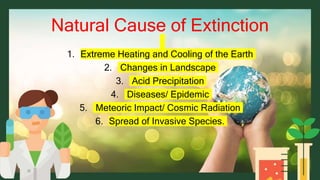
Natural Cause of Extinction
1. Extreme Heating and Cooling of the Earth
2. Changes in Landscape
3. Acid Precipitation
4. Diseases/ Epidemic
5. Meteoric Impact/ Cosmic Radiation
6. Spread of Invasive Species.
Anthropogenic or Man-made Cause of
Extinction
1. Habitat Destruction
2. Invasive Species
3. Population Growth
4. Pollution
5. Over-exploitation
BIODIVERSITY AND EXTINCTION

BIODIVERSITY AND EXTINCTION

  • 2.
    Objectives: describe biodiversity; determine theimportance of biodiversity; 1 At the end of the lesson, you should be able to: 2
  • 3.
    Objectives: Explain the threetypes of Biodiversity Understand extinction and know some causes of Extinction. 3 4 Explain the Importance of Biodiversity 5
  • 4.
    biological diversity orbiodiversity is the variety of the earth species or life, the genes they contain, the ecosystem which they live, and the ecosystem processes of energy flow and nutrient cycling that sustain all life. BIODIVERSITY
  • 5.
    Biodiversity and ItsTypes GENETIC DIVERSITY SPECIES DIVERSITY ECOSYSTEM DIVERSITY
  • 6.
    BIODIVERSITY & ITSTYPES Genetic Diversity It refers to the variations among the genetic resources of the organisms. Every individual of a particular species differs from each other in their genetic constitution. It pertains to the variation of genes within a species.
  • 7.
  • 8.
    BIODIVERSITY & ITSTYPES Species Diversity Species diversity refers to the variety of different types of species found in a particular area. It is the biodiversity at the most basic level. It includes all the species ranging from plants to different microorganisms. Species diversity is defined as the number of different species present in an ecosystem and relative abundance of each of those species.
  • 9.
  • 10.
    BIODIVERSITY & ITSTYPES Ecosystem Diversity An ecosystem is a collection of living and non-living organisms and their interaction with each other. Ecosystem biodiversity refers to the variations in the plant and animal species living together and connected by food chains and food webs.
  • 11.
  • 12.
    Threatened Species Any speciesthat is becoming rare and that may become in danger of extinction.
  • 13.
    Categories of Threatened Species 1.Critically Endangered Species 2. Endangered Species 3. Vulnerable Species
  • 14.
    Categories of Threatened Species 1.Critically Endangered Species
  • 15.
  • 16.
  • 17.
    Estimated Number ofPhilippine Species 14 000 – 15 310 Plants 3 308 – 3 325 Vertebrates 34 940 – 35 000 Invertebrates 6 100+ Others
  • 18.
    SPECIES RICHNESS Species richnessrefers to species numbers
  • 19.
    ABUNDANCE Abundance refers tothe number of individuals.
  • 20.
    SPECIES DENSITY refers tothe number of individuals in an area • Deserts typically have low species density compared to other ecosystems.
  • 21.
  • 22.
    You want tosurvey the density of grass in your backyard. You noticed that there was only one species of grass, and you counted 97 individuals of that species. Your backyard is 10 m2. Find the species density of that grass. Species Richness 1 Species of Grass Density Abundance of Grass: 97 individuals of Grass .
  • 23.
    You want tosurvey the density of grass in your backyard. You noticed that there was only one species of grass, and you counted 97 individuals of that species. Your backyard is 10 m2. Find the species density of that grass. Given: number of individual per species: 97 total unit area: 10 m2. Write the working equation: Substitute the values. Solve for the species density.
  • 24.
    Area A is100 m2 and has 300 individuals of an ant species. What is the species density?
  • 25.
    Area A is100 m2 and has 300 individuals of an ant species. What is the species density? Species Richness 1 Species of Ant Density Abundance of Ant: 300 individuals of Ant. .
  • 26.
    Area A is100 m2 and has 300 individuals of an ant species. What is the species density? Given: number of individual per species: 300 total unit area: 100 m2. Write the working equation: Substitute the values. species density = 𝟑𝟎𝟎 𝒊𝒏𝒅𝒊𝒗𝒊𝒅𝒖𝒂𝒍𝒔 100 m2 species density = 𝟑𝟎𝟎 𝒊𝒏𝒅𝒊𝒗𝒊𝒅𝒖𝒂𝒍𝒔 100 m2 species density = 3 𝒊𝒏𝒅𝒊𝒗𝒊𝒅𝒖𝒂𝒍𝒔 m2 Solve for the species density.
  • 27.
    Area A is100 m2 and has 3 Species. Species A has 40 members, Species B has 45 members, and Species C has 23 members. What is the species richness and abundance, and the species density of each?
  • 28.
    Area A is100 m2 and has 3 Species. Species A has 40 members, Species B has 45 members, and Species C has 23 members. What is the species richness and abundance, and the species density of each? Species Richness 3 Species Density Abundance of Species A: 40 members Abundance of Species B: 45 members Abundance of Species A: 23 members .
  • 29.
    Area A is100 m2 and has 3 Species. Species A has 40 members, Species B has 45 members, and Species C has 23 members. What is the species richness and abundance, and the species density of each? Given: number of individual per species: Species A = 40, Species B= 45, Species C= 23 total unit area: 100 m2. Write the working equation: Substitute the values. For specie A species density = 𝟒𝟎 𝒊𝒏𝒅𝒊𝒗𝒊𝒅𝒖𝒂𝒍𝒔 100 m2 For species B species density = 𝟒𝟓 𝒊𝒏𝒅𝒊𝒗𝒊𝒅𝒖𝒂𝒍𝒔 100 m2 For specie C species density = 𝟐𝟑 𝒊𝒏𝒅𝒊𝒗𝒊𝒅𝒖𝒂𝒍𝒔 100 m2
  • 30.
    Area A is100 m2 and has 3 Species. Species A has 40 members, Species B has 45 members, and Species C has 23 members. What is the species richness and abundance, and the species density of each? Solve for the species density For specie A species density = 𝟒𝟎 𝒊𝒏𝒅𝒊𝒗𝒊𝒅𝒖𝒂𝒍𝒔 100 m2 0.4 𝒊𝒏𝒅𝒊𝒗𝒊𝒅𝒖𝒂𝒍𝒔 m2 For species B species density = 𝟒𝟓 𝒊𝒏𝒅𝒊𝒗𝒊𝒅𝒖𝒂𝒍𝒔 100 m2 0.45 𝒊𝒏𝒅𝒊𝒗𝒊𝒅𝒖𝒂𝒍𝒔 m2 For species C species density = 𝟐𝟑 𝒊𝒏𝒅𝒊𝒗𝒊𝒅𝒖𝒂𝒍𝒔 100 m2 0.23 𝒊𝒏𝒅𝒊𝒗𝒊𝒅𝒖𝒂𝒍𝒔 m2
  • 31.
    BIODIVERSITY LOSS Biodiversity lossrefers to the decline or disappearance of biological diversity, understood as the variety of living things that inhabit the planet, its different levels of biological organization and their respective genetic variability, as well as the natural patterns present in ecosystems.
  • 32.
    EXTINCTION Extinction occurs whenall of the members of a species disappears on Earth. Extinction means that the last individual belonging to a particular species is gone forever.
  • 33.
    CAUSES OF EXTINCTION 1.Natural Cause of Extinction 2. Anthropogenic Cause of Extinction
  • 34.
    Natural Cause ofExtinction 1. Extreme Heating and Cooling of the Earth 2. Changes in Landscape 3. Acid Precipitation 4. Diseases/ Epidemic 5. Meteoric Impact/ Cosmic Radiation 6. Spread of Invasive Species.
  • 35.
    Anthropogenic or Man-madeCause of Extinction 1. Habitat Destruction 2. Invasive Species 3. Population Growth 4. Pollution 5. Over-exploitation