NatureNature
Myth vs. FactMyth vs. Fact
CausesCauses
Diagnose (S&S)Diagnose (S&S)
ImpactsImpacts
EpidemiologyEpidemiology
ClassificationClassification
TreatmentTreatment
Active StudyActive Study
ReferencesReferences
CONTENTSCONTENTS
 Termed: Attention deficit, hyperactivity
disorder
 ADD is no different from ADHD but it refers
to adults in the Diagnostic & Statistical
Manual for Mental Disorders (DSM-IV-TR)
 ADHD is a diagnosis applied to children and
adults who consistently display certain
behaviors such as distractibility, impulsivity,
and hyperactivity over a period of time.
 Myth: ADHD is caused by
bad parenting.
 Myth: Children who have
ADHD will eventually grow
out of it.
 Myth: ADHD is not a
medical condition.
 Fact: ADHD is a
neurobehavioural disorder
 Fact: 80% of children who
have ADHD will continue to
have enough symptoms to
qualify for diagnosis as an
adolescent and over 60%
of adults will maintain core
symptoms of ADHD.
 Fact: ADHD is a biological
brain based condition
officially recognized by
leading medical experts
and institutions
 Specific cause is unknown
 Twin studies showed that 75% of ADHD cases
are genetically inherited
 Twin studies also suggested that 9-20% is also
due to environmental factors
 Pregnancy: smoking, alcohol, and premature birth
 Diet: European Food and Safety Authority
(EFSA) conclude in their study that food additive
such as artificial food coloring and preservative
significantly affects children with ADHD
http://www.nimh.nih.gov/health/publications/attention-deficit-hyperactivity-disorder/what-causes-adhd.shtml
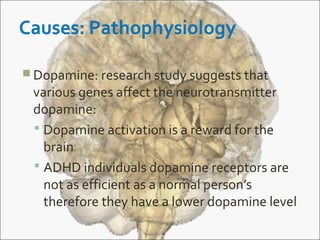
 Dopamine: research study suggests that
various genes affect the neurotransmitter
dopamine:
 Dopamine activation is a reward for the
brain
 ADHD individuals dopamine receptors are
not as efficient as a normal person’s
therefore they have a lower dopamine level
Delayed in frontal and temporal lobe
Accelerated maturity of the motor
cortex
SPECT shows reduce circulation
Pet Scan shows a decrease glucose
metabolism during activity
 DSM-IV Criteria for ADHD
I. Either A or B:
A. 6 or more of the following symptoms of
inattention have been present for at least 6 months to a
point that is disruptive and inappropriate for
developmental level:
Inattention: poor attention to detail, keeping up with
tasks, doesn’t listen when spoken to, forgetful, easily
distracted, avoid things that take effort to perform, lose
things needed for a task, often does not follow
instructions
http://www.cdc.gov/ncbddd/adhd/symptom.htm
DSM-IV Criteria for ADHD
B. Six or more of the following symptoms of hyperactivity-
impulsivity have been present for at least 6 months to an
extent that is disruptive and inappropriate for developmental
level:
 Hyperactivity: Often fidgety or squirms in seat, often runs
about or climbs when and where it is not appropriate, act
loudly, driven (always on the go), often talks excessively.
Impulsivity
 blurts out answers before questions have been
finished
 trouble waiting one's turn.
 interrupts or intrudes on others
 Some symptoms that cause impairment were present
before age 7 years.
 Some impairment from the symptoms are present in
two or more settings (e.g. at school/work and at
home).
 There must be clear evidence of significant
impairment in social, school, or work functioning.
 Based on the these criteria, three
types of ADHD are identified:
1. ADHD, CombinedType: if both
criteriaA and B are met for the
past 6 months.
Tigger type-Hyperactive,
restelessness, disorganized,
inattention, impulsivity
 2. ADHD,
Predominantly
InattentiveType: if
criterion A is met but
criterion B is not met for
the past six months
 Pooh type- Inattentive,
sluggish, slow-moving,
unmotivated, daydreamer
 3. ADHD,
Predominantly
Hyperactive-Impulsive
Type: if Criterion B is
met but Criterion A is
not met for the past six
months.
 RabbitType- over
focused, obsessive,
argumentative
 developmental disorder
 behavior disorder
 disruptive behavior disorder
 oppositional defiant disorder
 conduct disorder
 antisocial disorder
 Preschool (3-5) - Disruptive behavior,
aggression towards other children,
hyperactivity, conduct problems, inattentive
and overactive
 Middle Childhood (6-12) - Unfinished tasks
(unfinished games, uncovered toothpaste),
trouble with school work, criticism from
parents/teachers/peers, low self esteem.
Depression and conduct disorders can develop
here.
 Adolescence (13-19) - higher rates of anxiety,
depression, oppositional behavior, social
failure, substance abuse
 Adulthood (20 above) - trouble at work,
relationships, difficulty following directions,
remembering, and concentrating, emotional
and social problems
 CDC estimates 4.4 million youth ages 4-17
have been diagnosed with ADHD
 In 2003, 2.5 million youth ages 4-17 are
currently receiving medication treatment for
the disorder.
http://www.cdc.gov/ncbddd/ADHD/
treatment focuses on reducing
the symptoms of ADHD and
improving functioning through
medications, behavioral
therapies, and psychotherapy.
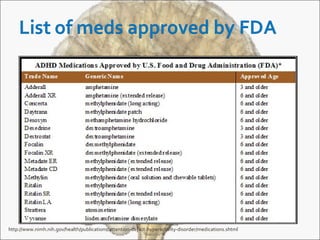
 Most are treated with stimulant such as
RITALIN (methylphenidate HCl) but non-
stimulants are also used
 Medication help to improve focus, thinking,
ability to learn and work.
 It also reduces symptoms of hyperactivity,
impulsivity, and inattention.
http://www.nimh.nih.gov/health/publications/attention-deficit-hyperactivity-
disorder/medications.shtml
http://www.nimh.nih.gov/health/publications/attention-deficit-hyperactivity-disorder/medications.shtml
 Goal: change/monitor child behaviors
 Intervention includes:
practical assistance with organizing tasks or
completing schoolwork, or working through
emotionally difficult events
allow child to give oneself praise or rewards for
acting in a desired way
Parents and teachers also can give positive or
negative feedback for certain behaviors.
Set clear rules, chore lists, and other structured
routines can help a child control his or her
behavior
http://www.nimh.nih.gov/health/publications/attention-deficit-hyperactivity-disorder/psychotherapy.shtml
Carbohydrate/Protein-balancedDiet
ManagementofFoodSensitivitiesinADHDPatients
NutritionalSupplementationforADHD
MineralDeficienciesinADHD
EssentialFattyAcidsMayBeDeficientinADHD
DisturbancesinAminoAcidMetabolisminADHD
Heavy-MetalToxicityinADHD
http://www.healing-arts.org/children/ADHD/treatments.htm
 Schedule. Keep the same routine every day, from wake-up time to
bedtime. Include time for homework, outdoor play, and indoor
activities. Keep the schedule on the refrigerator or on a bulletin
board in the kitchen.Write changes on the schedule as far in
advance as possible.
 Organize everyday items. Have a place for everything, and keep
everything in its place.This includes clothing, backpacks, and toys.
 Use homework and notebook organizers. Use organizers for
school material and supplies. Stress to your child the importance
of writing down assignments and bringing home the necessary
books.
 Be clear and consistent. Children with ADHD need consistent
rules they can understand and follow.
 Give praise or rewards when rules are followed. Children with
ADHD often receive and expect criticism. Look for good behavior,
and praise it.
NIMH (National Institute of Mental Health)
 MTA (MultimodalTreatment Study of ADHD) –
complete,
Purpose: evaluate the leading treatments for
ADHD, including various forms of behavior therapy
and medications
 PATS (Preschool ADHDTreatment Study) - complete
The study found that low doses of the stimulant
methylphenidate are safe and effective for
preschoolers but requires monitoring due to side
effects
http://www.nimh.nih.gov/health/publications/attention-deficit-hyperactivity-disorder/what-efforts-are-under-way-to-improve-
treatment.shtml
 Efficacy of Concerta inTreating ADHD in Mothers of
ChildrenWith ADHD
- involves trial of Concerta™ methylphenidate
for mothers & children with ADHD
- purpose: assess the efficacy of Concerta™ in
improving adult ADHD symptoms and impairments
-The researchers hypothesize that Concerta™
will significantly decrease mothers ADHD
symptoms and impairment, as well as improve
observed and reported parenting
http://clinicaltrials.gov/ct2/results?term=ADHD
 Study of Atomoxetine and OROS
Methylphenidate toTreat Children and
Adolescents Ages 6-17With ADHD
- purpose: is to evaluate the safety,
effectiveness, and tolerability of atomoxetine
and OROS methylphenidate, taken together,
in the treatment of ADHD in children and
adolescents ages 6-17
http://clinicaltrials.gov/ct2/results?term=ADHD
Atomoxetine (brand name: Strattera) is a drug 
approved for the treatment of
attention-deficit hyperactivity disorder (ADHD). It 
is a selective norepinephrine reuptake inhibitor
 (2009). ADHD Across the Lifespan. Retrieved February 15, 2009, from myADHD.comWeb site:
http://www.myadhd.com/adhdacrosslifespan.html
 (2008). ADHD ScreeningTest. Retrieved February 15, 2009, from ScribDWeb site:
http://www.scribd.com/doc/2281389/ADHD-Screening-Test-PDF
 (2007). NCP Attention Deficit / Hyperactivity Disorder ADHD . Retrieved February 15, 2009, from Nursing Care PlanWeb
site: http://nursingcareplan.blogspot.com/2007/05/ncp-attention-deficit-hyperactivity.html
 Goodman, Gordon (2008). Bugs,Taz, and ADHD. Retrieved February 15, 2009, fromYouTube Web site:
http://www.youtube.com/watch?v=EJNu5eUJO04
 (January 23, 2009). What Cause ADHD? Retrieved Febraury 15, 2009 from NIMH.Website:
http://www.nimh.nih.gov/health/publications/attention-deficit-hyperactivity-disorder/what-causes-adhd.shtml
 (September 20th
, s005). ADHD. Retrieved February 15, 2009 from CDC.Website:
http://www.cdc.gov/ncbddd/adhd/symptom.htm
 (September 20th
, s005). ADHD. Retrieved February 15, 2009 from CDC.Website: http://www.cdc.gov/ncbddd/ADHD/
 (January 23, 2009). What Cause ADHD? Retrieved Febraury 15, 2009 from NIMH.Website:
http://www.nimh.nih.gov/health/publications/attention-deficit-hyperactivity-disorder/medications.shtml
 (January 23, 2009). What Cause ADHD? Retrieved Febraury 15, 2009 from NIMH.Website:
http://www.nimh.nih.gov/health/publications/attention-deficit-hyperactivity-disorder/psychotherapy.shtml
 (January 23, 2009). What Cause ADHD? Retrieved Febraury 15, 2009 from NIMH.Website:
http://www.nimh.nih.gov/health/publications/attention-deficit-hyperactivity-disorder/psychotherapy.shtml
 http://clinicaltrials.gov/ct2/results?term=ADHD
 (February 12, 2009). Efficacy of Concerta inTreating ADHD in Mothers of ChildrenWith ADHD. Retrieved february 15, 2009
from clinicalTrial.gov.Website: http://clinicaltrials.gov/ct2/show/NCT00318981?term=ADHD&rank=4
Proverbs 12:15 – The way of fools seems Proverbs 12:15 – The way of fools seems 
right to them, but the wise listen to advice.right to them, but the wise listen to advice.

Adhd final ppt markbaldz

  • 3.
    NatureNature Myth vs. FactMythvs. Fact CausesCauses Diagnose (S&S)Diagnose (S&S) ImpactsImpacts EpidemiologyEpidemiology ClassificationClassification TreatmentTreatment Active StudyActive Study ReferencesReferences CONTENTSCONTENTS
  • 5.
     Termed: Attentiondeficit, hyperactivity disorder  ADD is no different from ADHD but it refers to adults in the Diagnostic & Statistical Manual for Mental Disorders (DSM-IV-TR)  ADHD is a diagnosis applied to children and adults who consistently display certain behaviors such as distractibility, impulsivity, and hyperactivity over a period of time.
  • 7.
     Myth: ADHDis caused by bad parenting.  Myth: Children who have ADHD will eventually grow out of it.  Myth: ADHD is not a medical condition.  Fact: ADHD is a neurobehavioural disorder  Fact: 80% of children who have ADHD will continue to have enough symptoms to qualify for diagnosis as an adolescent and over 60% of adults will maintain core symptoms of ADHD.  Fact: ADHD is a biological brain based condition officially recognized by leading medical experts and institutions
  • 9.
     Specific causeis unknown  Twin studies showed that 75% of ADHD cases are genetically inherited  Twin studies also suggested that 9-20% is also due to environmental factors  Pregnancy: smoking, alcohol, and premature birth  Diet: European Food and Safety Authority (EFSA) conclude in their study that food additive such as artificial food coloring and preservative significantly affects children with ADHD http://www.nimh.nih.gov/health/publications/attention-deficit-hyperactivity-disorder/what-causes-adhd.shtml
  • 10.
     Dopamine: researchstudy suggests that various genes affect the neurotransmitter dopamine:  Dopamine activation is a reward for the brain  ADHD individuals dopamine receptors are not as efficient as a normal person’s therefore they have a lower dopamine level
  • 11.
    Delayed in frontaland temporal lobe Accelerated maturity of the motor cortex SPECT shows reduce circulation Pet Scan shows a decrease glucose metabolism during activity
  • 14.
     DSM-IV Criteriafor ADHD I. Either A or B: A. 6 or more of the following symptoms of inattention have been present for at least 6 months to a point that is disruptive and inappropriate for developmental level: Inattention: poor attention to detail, keeping up with tasks, doesn’t listen when spoken to, forgetful, easily distracted, avoid things that take effort to perform, lose things needed for a task, often does not follow instructions http://www.cdc.gov/ncbddd/adhd/symptom.htm
  • 15.
    DSM-IV Criteria forADHD B. Six or more of the following symptoms of hyperactivity- impulsivity have been present for at least 6 months to an extent that is disruptive and inappropriate for developmental level:  Hyperactivity: Often fidgety or squirms in seat, often runs about or climbs when and where it is not appropriate, act loudly, driven (always on the go), often talks excessively.
  • 16.
    Impulsivity  blurts outanswers before questions have been finished  trouble waiting one's turn.  interrupts or intrudes on others  Some symptoms that cause impairment were present before age 7 years.  Some impairment from the symptoms are present in two or more settings (e.g. at school/work and at home).  There must be clear evidence of significant impairment in social, school, or work functioning.
  • 18.
     Based onthe these criteria, three types of ADHD are identified: 1. ADHD, CombinedType: if both criteriaA and B are met for the past 6 months. Tigger type-Hyperactive, restelessness, disorganized, inattention, impulsivity
  • 19.
     2. ADHD, Predominantly InattentiveType:if criterion A is met but criterion B is not met for the past six months  Pooh type- Inattentive, sluggish, slow-moving, unmotivated, daydreamer
  • 20.
     3. ADHD, Predominantly Hyperactive-Impulsive Type:if Criterion B is met but Criterion A is not met for the past six months.  RabbitType- over focused, obsessive, argumentative
  • 22.
     developmental disorder behavior disorder  disruptive behavior disorder  oppositional defiant disorder  conduct disorder  antisocial disorder
  • 25.
     Preschool (3-5)- Disruptive behavior, aggression towards other children, hyperactivity, conduct problems, inattentive and overactive  Middle Childhood (6-12) - Unfinished tasks (unfinished games, uncovered toothpaste), trouble with school work, criticism from parents/teachers/peers, low self esteem. Depression and conduct disorders can develop here.
  • 26.
     Adolescence (13-19)- higher rates of anxiety, depression, oppositional behavior, social failure, substance abuse  Adulthood (20 above) - trouble at work, relationships, difficulty following directions, remembering, and concentrating, emotional and social problems
  • 28.
     CDC estimates4.4 million youth ages 4-17 have been diagnosed with ADHD  In 2003, 2.5 million youth ages 4-17 are currently receiving medication treatment for the disorder. http://www.cdc.gov/ncbddd/ADHD/
  • 30.
    treatment focuses onreducing the symptoms of ADHD and improving functioning through medications, behavioral therapies, and psychotherapy.
  • 31.
     Most aretreated with stimulant such as RITALIN (methylphenidate HCl) but non- stimulants are also used  Medication help to improve focus, thinking, ability to learn and work.  It also reduces symptoms of hyperactivity, impulsivity, and inattention. http://www.nimh.nih.gov/health/publications/attention-deficit-hyperactivity- disorder/medications.shtml
  • 33.
  • 34.
     Goal: change/monitorchild behaviors  Intervention includes: practical assistance with organizing tasks or completing schoolwork, or working through emotionally difficult events allow child to give oneself praise or rewards for acting in a desired way Parents and teachers also can give positive or negative feedback for certain behaviors. Set clear rules, chore lists, and other structured routines can help a child control his or her behavior http://www.nimh.nih.gov/health/publications/attention-deficit-hyperactivity-disorder/psychotherapy.shtml
  • 35.
  • 36.
     Schedule. Keepthe same routine every day, from wake-up time to bedtime. Include time for homework, outdoor play, and indoor activities. Keep the schedule on the refrigerator or on a bulletin board in the kitchen.Write changes on the schedule as far in advance as possible.  Organize everyday items. Have a place for everything, and keep everything in its place.This includes clothing, backpacks, and toys.  Use homework and notebook organizers. Use organizers for school material and supplies. Stress to your child the importance of writing down assignments and bringing home the necessary books.  Be clear and consistent. Children with ADHD need consistent rules they can understand and follow.  Give praise or rewards when rules are followed. Children with ADHD often receive and expect criticism. Look for good behavior, and praise it.
  • 37.
    NIMH (National Instituteof Mental Health)  MTA (MultimodalTreatment Study of ADHD) – complete, Purpose: evaluate the leading treatments for ADHD, including various forms of behavior therapy and medications  PATS (Preschool ADHDTreatment Study) - complete The study found that low doses of the stimulant methylphenidate are safe and effective for preschoolers but requires monitoring due to side effects http://www.nimh.nih.gov/health/publications/attention-deficit-hyperactivity-disorder/what-efforts-are-under-way-to-improve- treatment.shtml
  • 38.
     Efficacy ofConcerta inTreating ADHD in Mothers of ChildrenWith ADHD - involves trial of Concerta™ methylphenidate for mothers & children with ADHD - purpose: assess the efficacy of Concerta™ in improving adult ADHD symptoms and impairments -The researchers hypothesize that Concerta™ will significantly decrease mothers ADHD symptoms and impairment, as well as improve observed and reported parenting http://clinicaltrials.gov/ct2/results?term=ADHD
  • 40.
     Study ofAtomoxetine and OROS Methylphenidate toTreat Children and Adolescents Ages 6-17With ADHD - purpose: is to evaluate the safety, effectiveness, and tolerability of atomoxetine and OROS methylphenidate, taken together, in the treatment of ADHD in children and adolescents ages 6-17 http://clinicaltrials.gov/ct2/results?term=ADHD
  • 41.
  • 42.
     (2009). ADHDAcross the Lifespan. Retrieved February 15, 2009, from myADHD.comWeb site: http://www.myadhd.com/adhdacrosslifespan.html  (2008). ADHD ScreeningTest. Retrieved February 15, 2009, from ScribDWeb site: http://www.scribd.com/doc/2281389/ADHD-Screening-Test-PDF  (2007). NCP Attention Deficit / Hyperactivity Disorder ADHD . Retrieved February 15, 2009, from Nursing Care PlanWeb site: http://nursingcareplan.blogspot.com/2007/05/ncp-attention-deficit-hyperactivity.html  Goodman, Gordon (2008). Bugs,Taz, and ADHD. Retrieved February 15, 2009, fromYouTube Web site: http://www.youtube.com/watch?v=EJNu5eUJO04  (January 23, 2009). What Cause ADHD? Retrieved Febraury 15, 2009 from NIMH.Website: http://www.nimh.nih.gov/health/publications/attention-deficit-hyperactivity-disorder/what-causes-adhd.shtml  (September 20th , s005). ADHD. Retrieved February 15, 2009 from CDC.Website: http://www.cdc.gov/ncbddd/adhd/symptom.htm  (September 20th , s005). ADHD. Retrieved February 15, 2009 from CDC.Website: http://www.cdc.gov/ncbddd/ADHD/  (January 23, 2009). What Cause ADHD? Retrieved Febraury 15, 2009 from NIMH.Website: http://www.nimh.nih.gov/health/publications/attention-deficit-hyperactivity-disorder/medications.shtml  (January 23, 2009). What Cause ADHD? Retrieved Febraury 15, 2009 from NIMH.Website: http://www.nimh.nih.gov/health/publications/attention-deficit-hyperactivity-disorder/psychotherapy.shtml  (January 23, 2009). What Cause ADHD? Retrieved Febraury 15, 2009 from NIMH.Website: http://www.nimh.nih.gov/health/publications/attention-deficit-hyperactivity-disorder/psychotherapy.shtml  http://clinicaltrials.gov/ct2/results?term=ADHD  (February 12, 2009). Efficacy of Concerta inTreating ADHD in Mothers of ChildrenWith ADHD. Retrieved february 15, 2009 from clinicalTrial.gov.Website: http://clinicaltrials.gov/ct2/show/NCT00318981?term=ADHD&rank=4
  • 43.