

BEE 4712
ENGINEERING PROJECT I
EE191: DESIGN OF HYBRID MICRO
THERMOELECTRIC AND STIRLING ENGINE
FOR
POWER GENERATION
STUDENT NAME : NURUL AIN BINTI MOHD YUSOFF
MATRIX NUMBER: EC11140
SUPERVISOR : ENCIK MOHD SHAWAL BIN JADIN
1
INTRODUCTION
 This project discusses the design and development
of a hybrid micro thermo-electric and Stirling
engine for power generation
 This design of power generation is combination
between two types of source that are the thermo-
electric and Stirling engine.
 The purpose of this project is the development of
a micro thermo-electric and Stirling engine that
capable of operating on a variety of heat sources,
specifically on waste heat. 2
PROBLEM STATEMENT
3
 Efficiency of the Stirling engine drops if the
temperature difference between the hot and
cold ends decreases.
 Efficiency of the thermoelectric drops if the
temperature difference between the hot and
cold ends decreases.
OBJECTIVE PROJECT
To design the hybrid of micro
thermoelectric and Stirling engine for
power generation.
To optimize the output power of the
hybrid system.
4
SCOPE OF RESEARCH
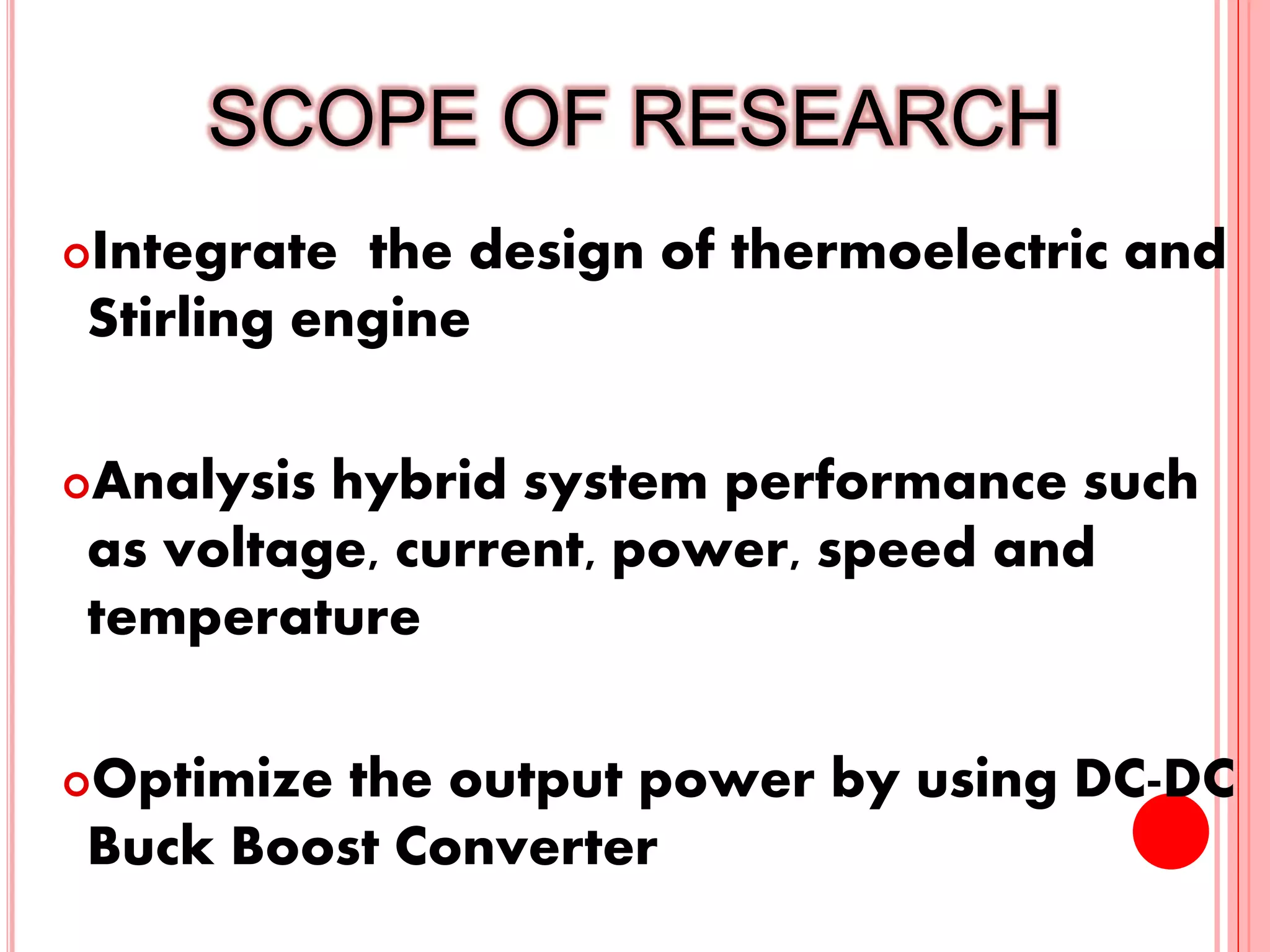
Integrate the design of thermoelectric and
Stirling engine
Analysis hybrid system performance such
as voltage, current, power, speed and
temperature
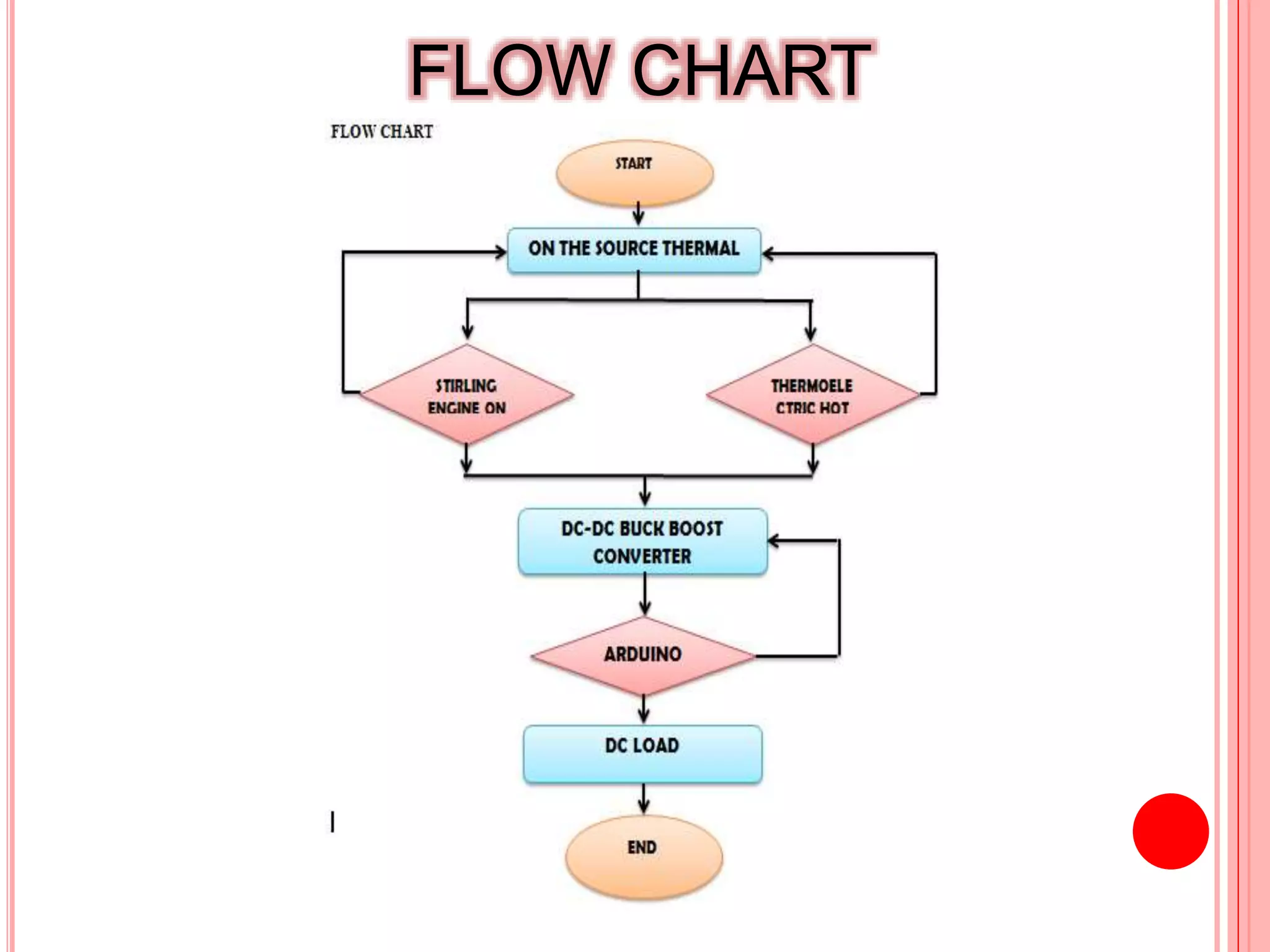
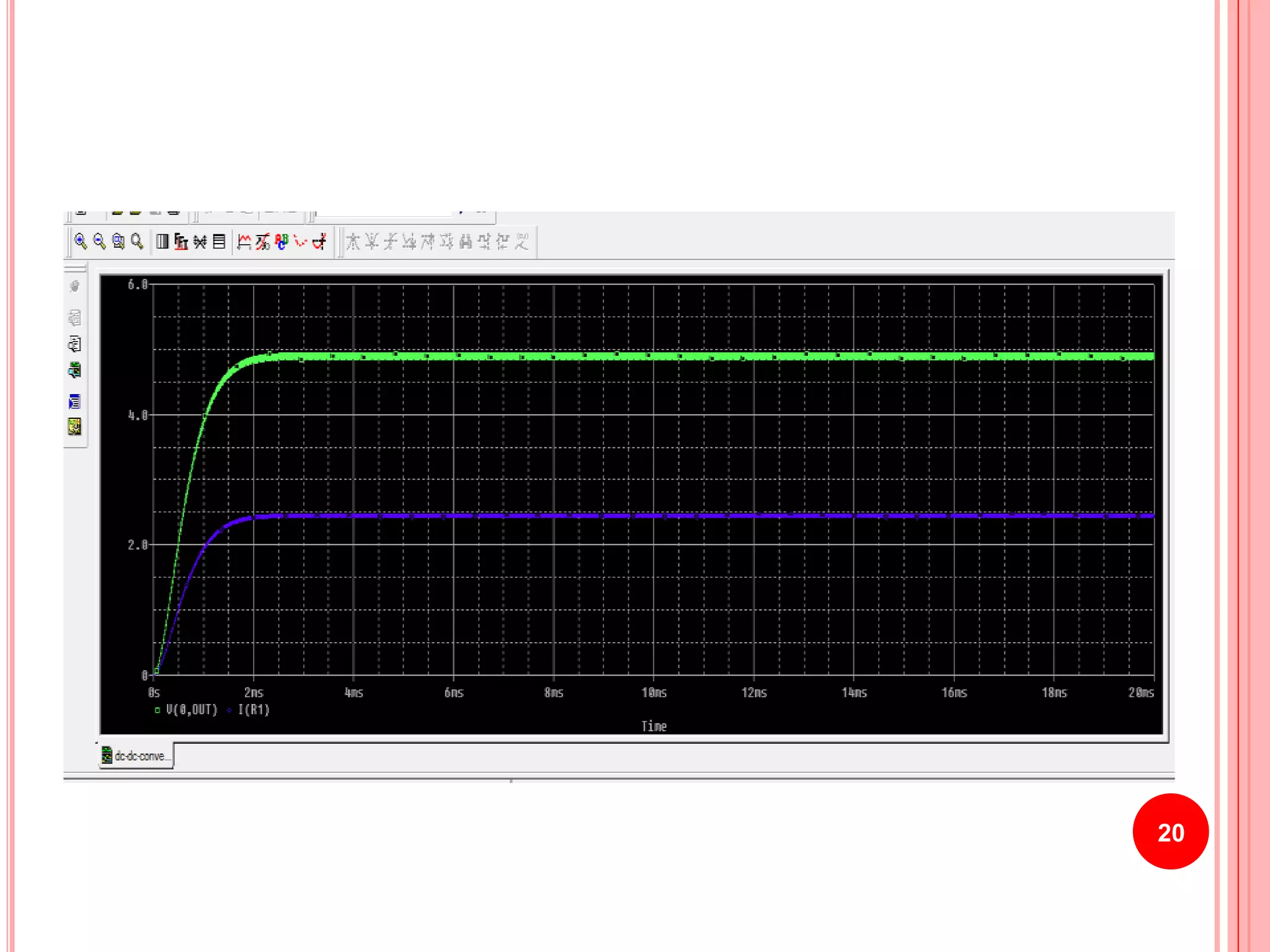
Optimize the output power by using DC-DC
Buck Boost Converter
5
LITERITURE REVIEW
Title Description Citation
Development of a
thermoelectric battery-
charger with
microcontroller-based
maximum power point
tracking technique
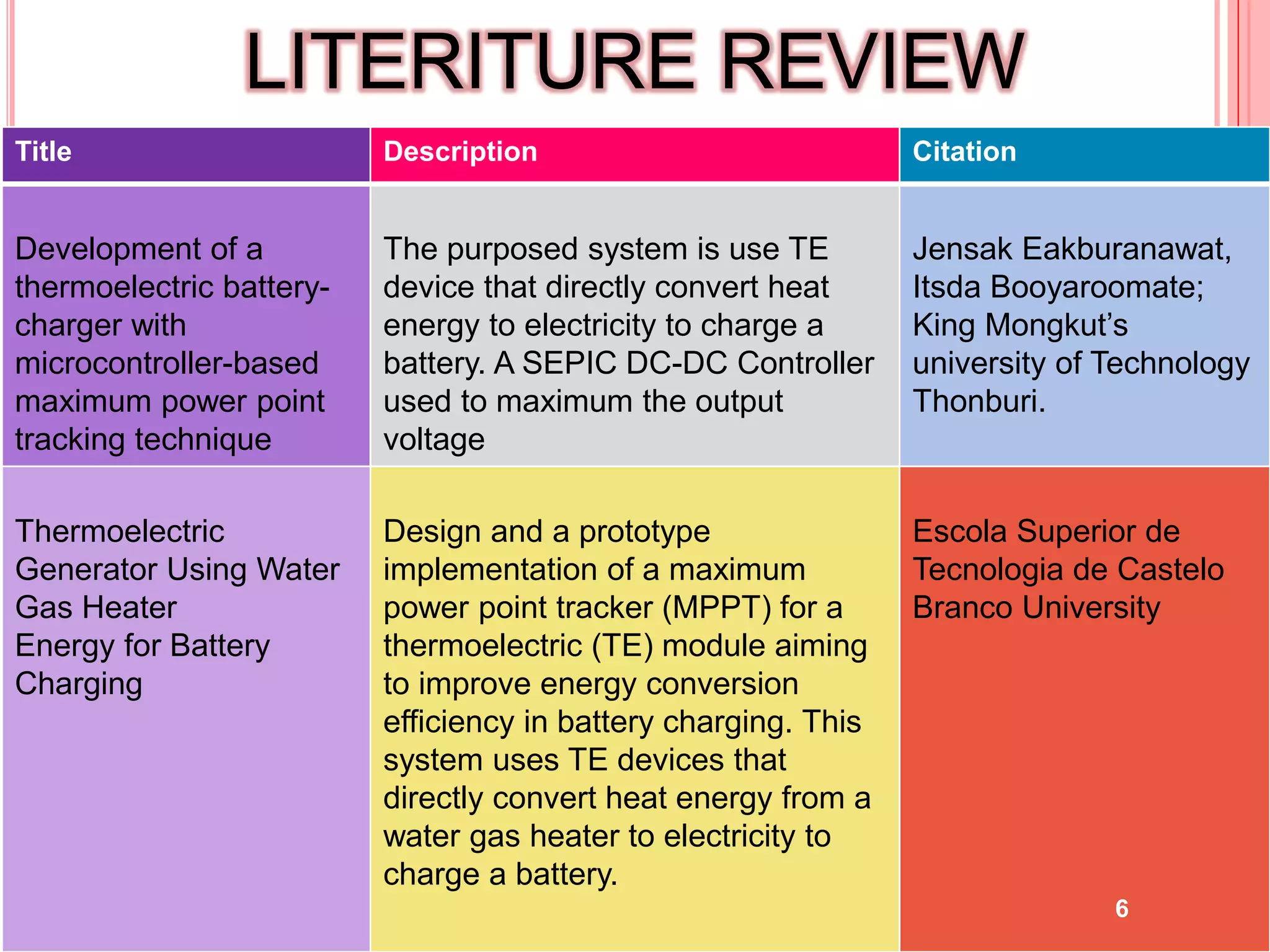
The purposed system is use TE
device that directly convert heat
energy to electricity to charge a
battery. A SEPIC DC-DC Controller
used to maximum the output
voltage
Jensak Eakburanawat,
Itsda Booyaroomate;
King Mongkut’s
university of Technology
Thonburi.
Thermoelectric
Generator Using Water
Gas Heater
Energy for Battery
Charging
Design and a prototype
implementation of a maximum
power point tracker (MPPT) for a
thermoelectric (TE) module aiming
to improve energy conversion
efficiency in battery charging. This
system uses TE devices that
directly convert heat energy from a
water gas heater to electricity to
charge a battery.
Escola Superior de
Tecnologia de Castelo
Branco University
6
LITERITURE REVIEW
Title Description Citation
Modelling of
thermoelectric
devices for electric
power generation
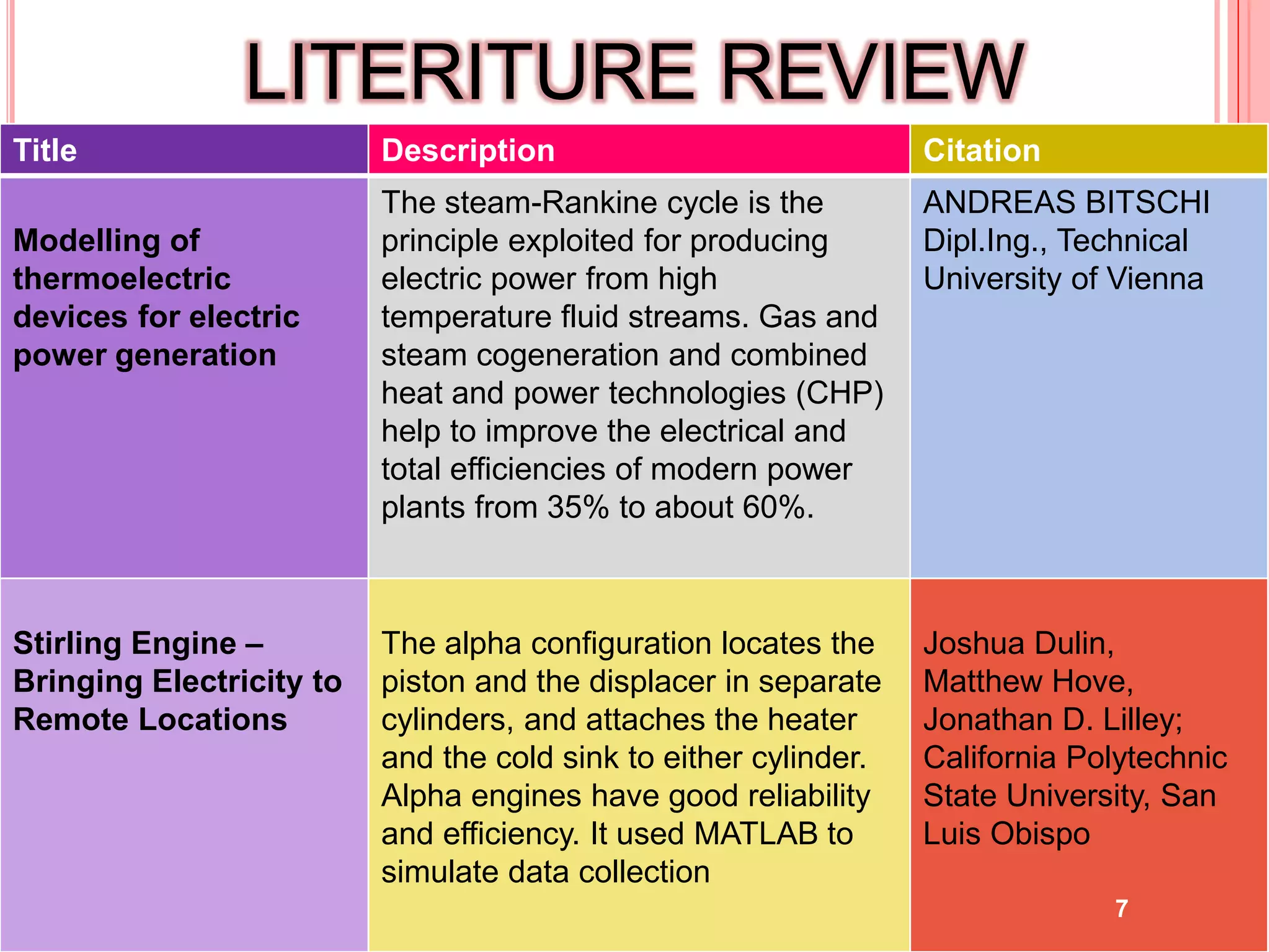
The steam-Rankine cycle is the
principle exploited for producing
electric power from high
temperature fluid streams. Gas and
steam cogeneration and combined
heat and power technologies (CHP)
help to improve the electrical and
total efficiencies of modern power
plants from 35% to about 60%.
ANDREAS BITSCHI
Dipl.Ing., Technical
University of Vienna
Stirling Engine –
Bringing Electricity to
Remote Locations
The alpha configuration locates the
piston and the displacer in separate
cylinders, and attaches the heater
and the cold sink to either cylinder.
Alpha engines have good reliability
and efficiency. It used MATLAB to
simulate data collection
Joshua Dulin,
Matthew Hove,
Jonathan D. Lilley;
California Polytechnic
State University, San
Luis Obispo
7
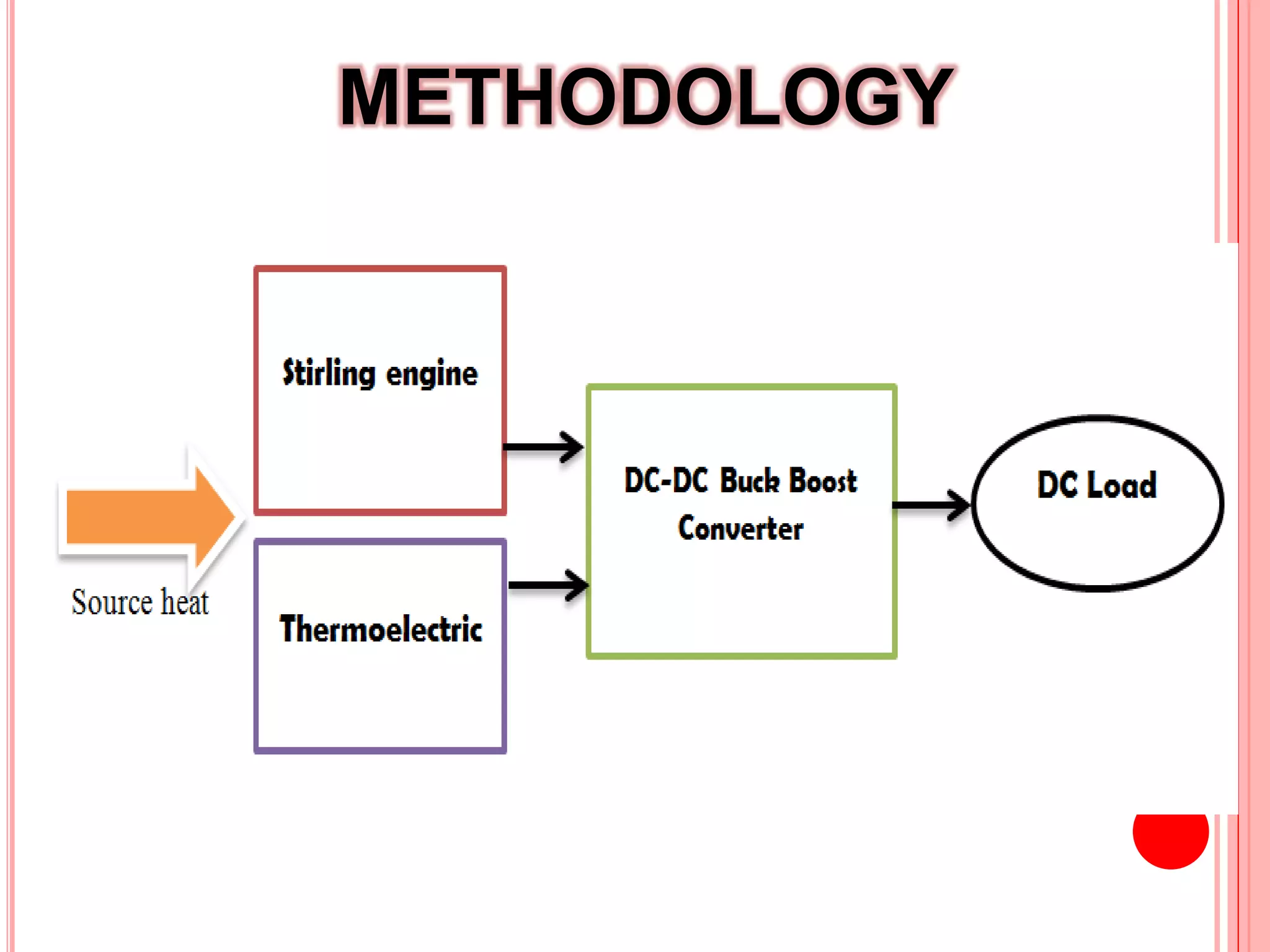
METHODOLOGY
8
9
FLOW CHART
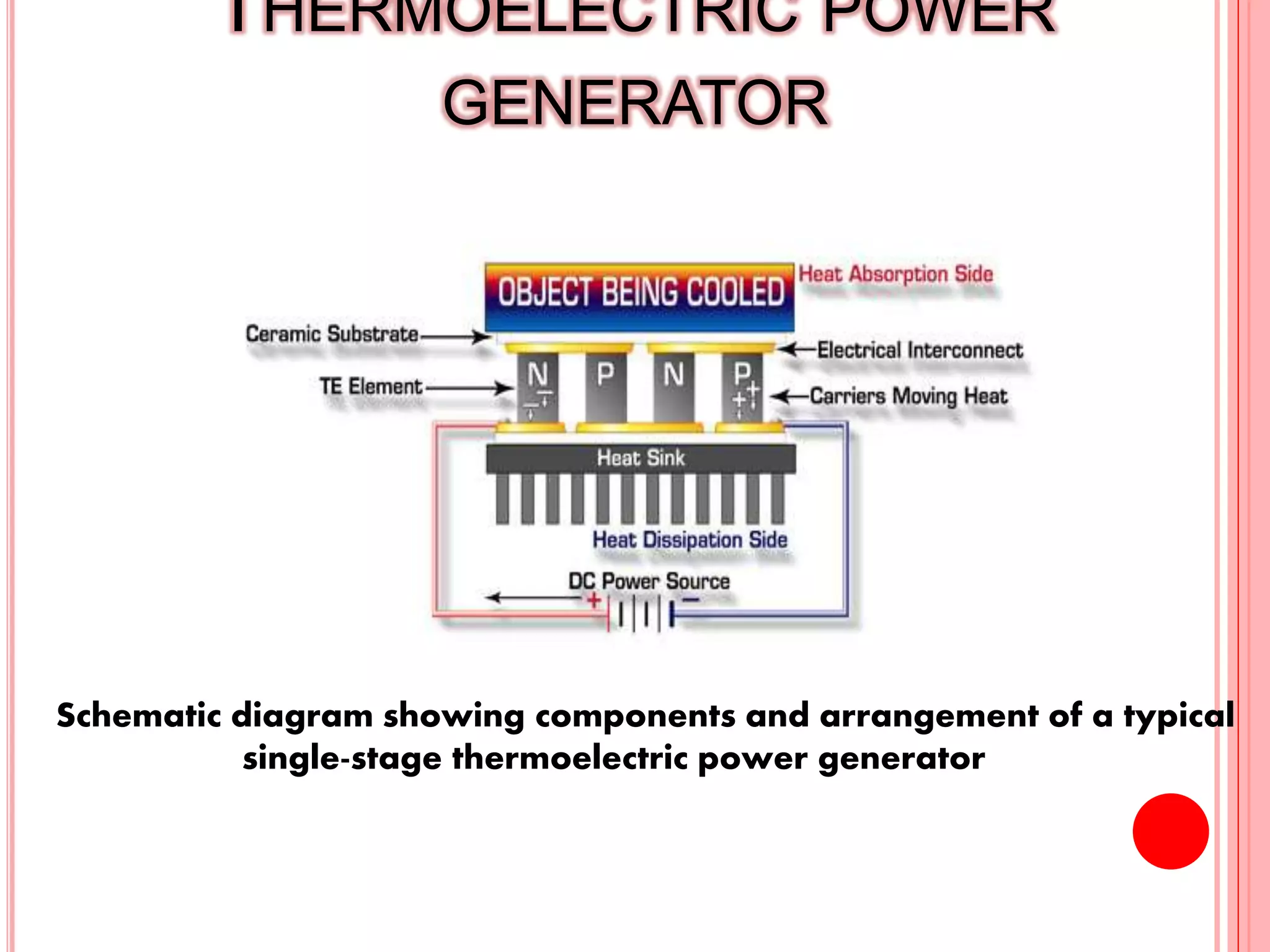
THERMOELECTRIC POWER
GENERATOR
10
Schematic diagram showing components and arrangement of a typical
single-stage thermoelectric power generator
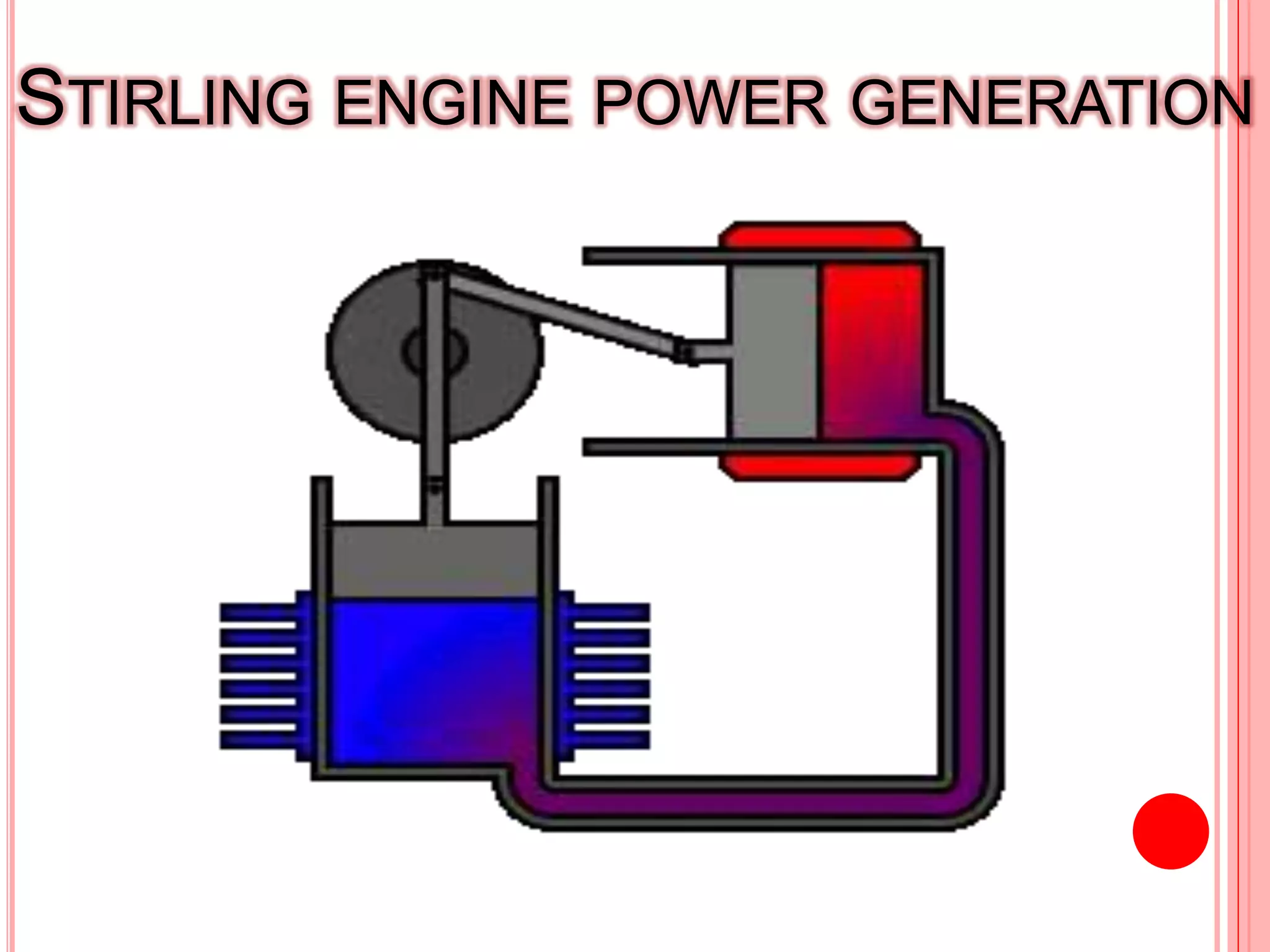
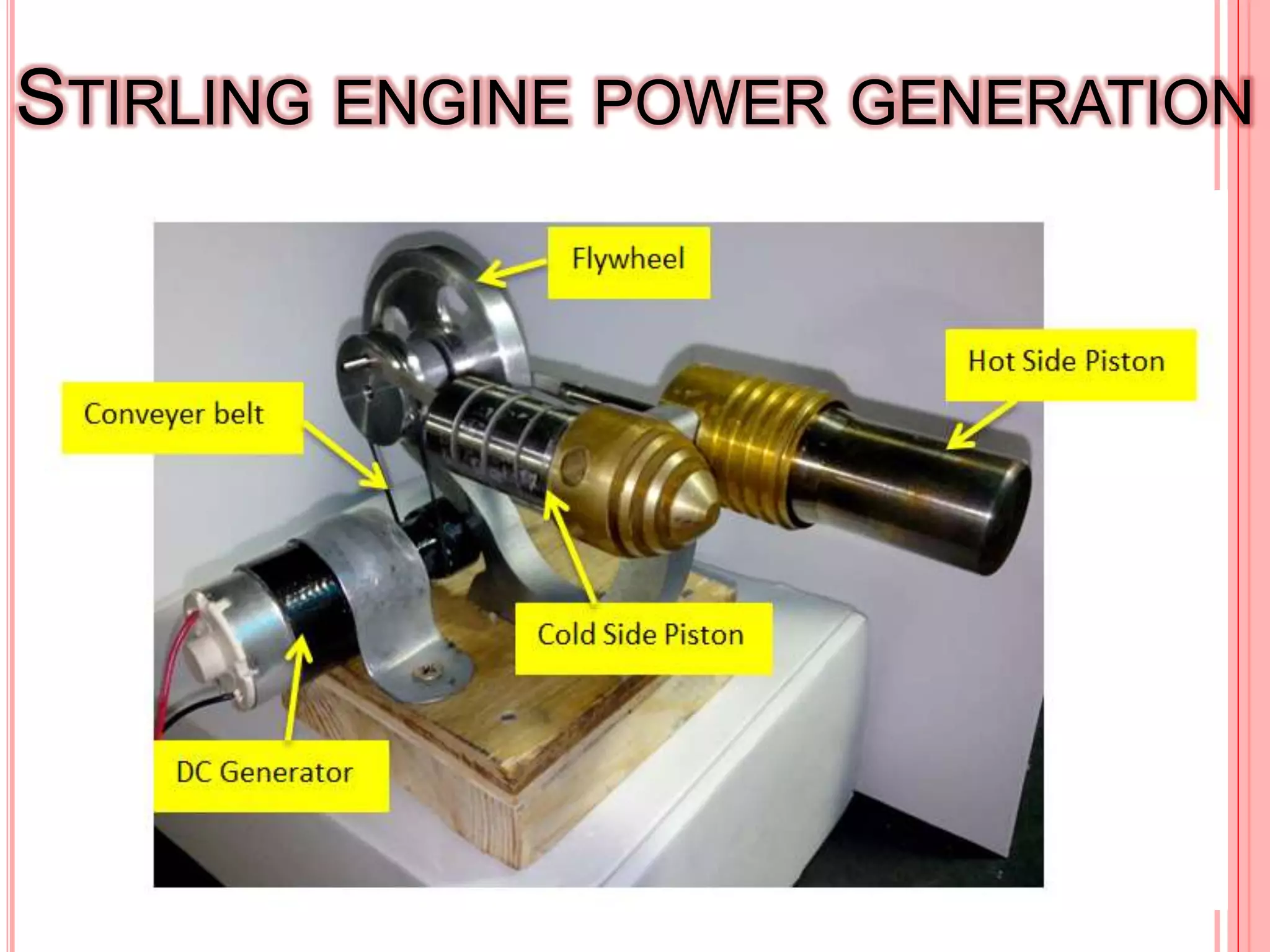
STIRLING ENGINE POWER GENERATION
11
12
RESULT & ANALYSIS
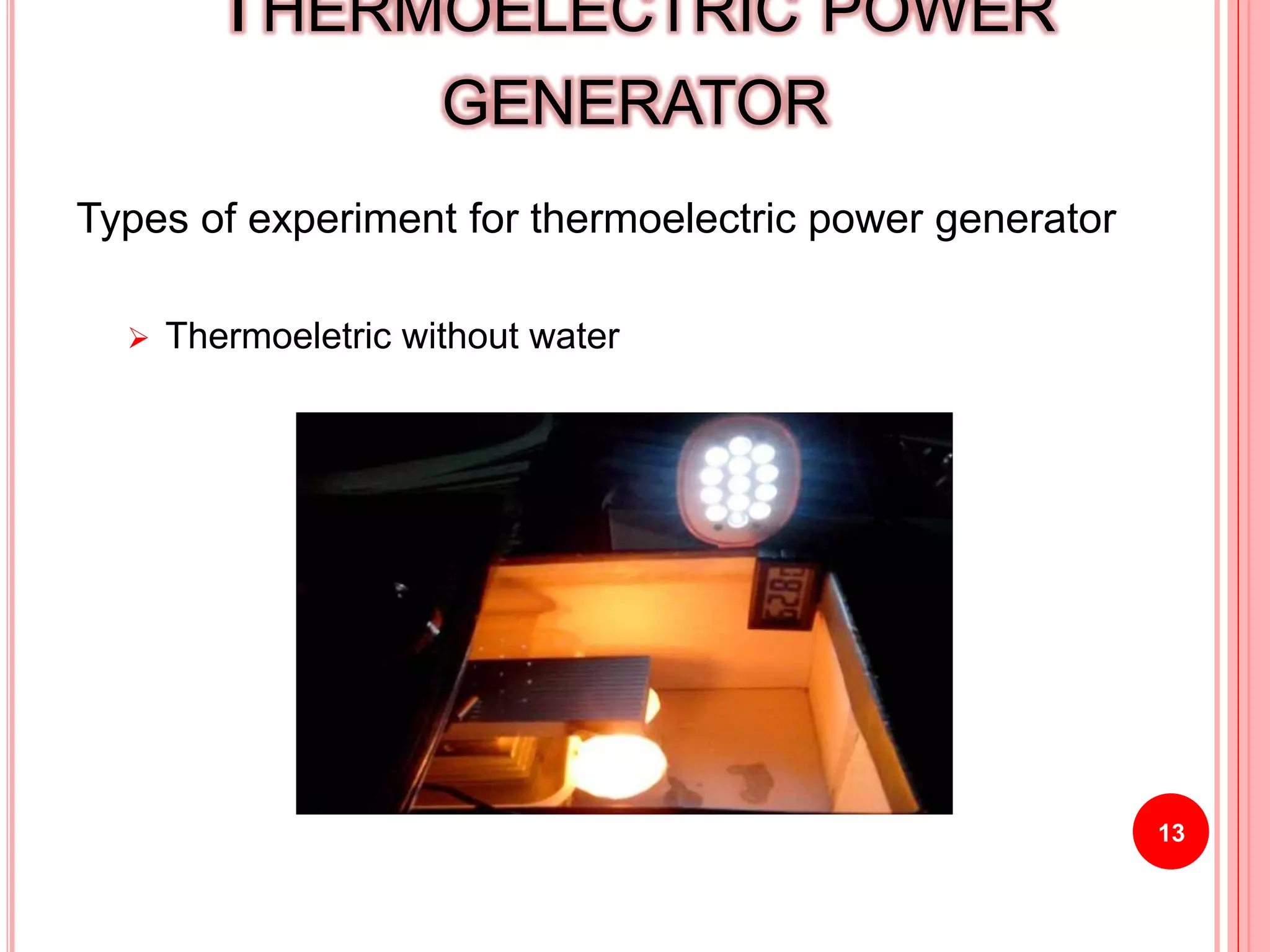
Types of experiment for thermoelectric power generator
 Thermoeletric without water
13
THERMOELECTRIC POWER
GENERATOR
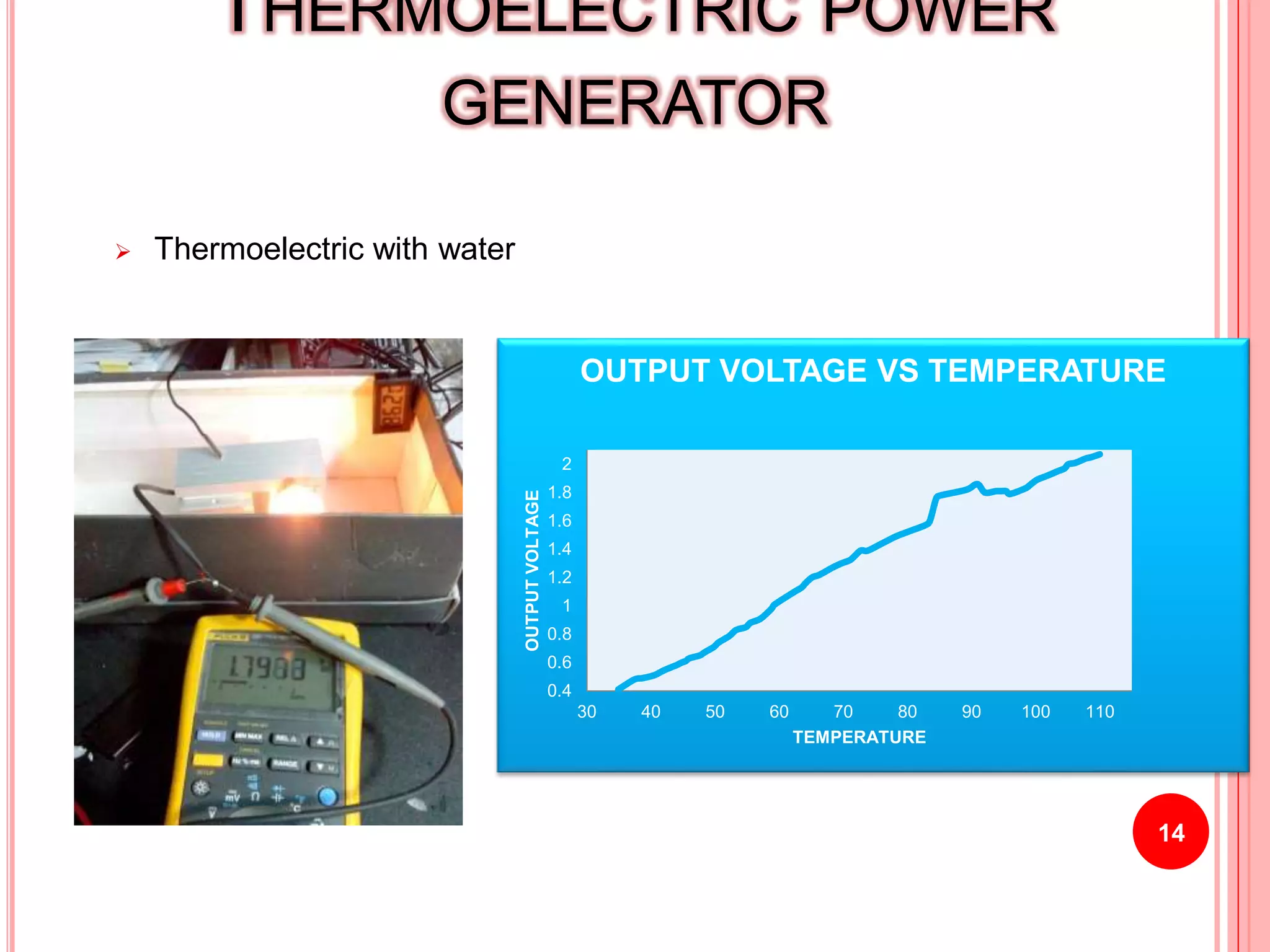
 Thermoelectric with water
14
THERMOELECTRIC POWER
GENERATOR
0.4
0.6
0.8
1
1.2
1.4
1.6
1.8
2
30 40 50 60 70 80 90 100 110
OUTPUTVOLTAGE
TEMPERATURE
OUTPUT VOLTAGE VS TEMPERATURE
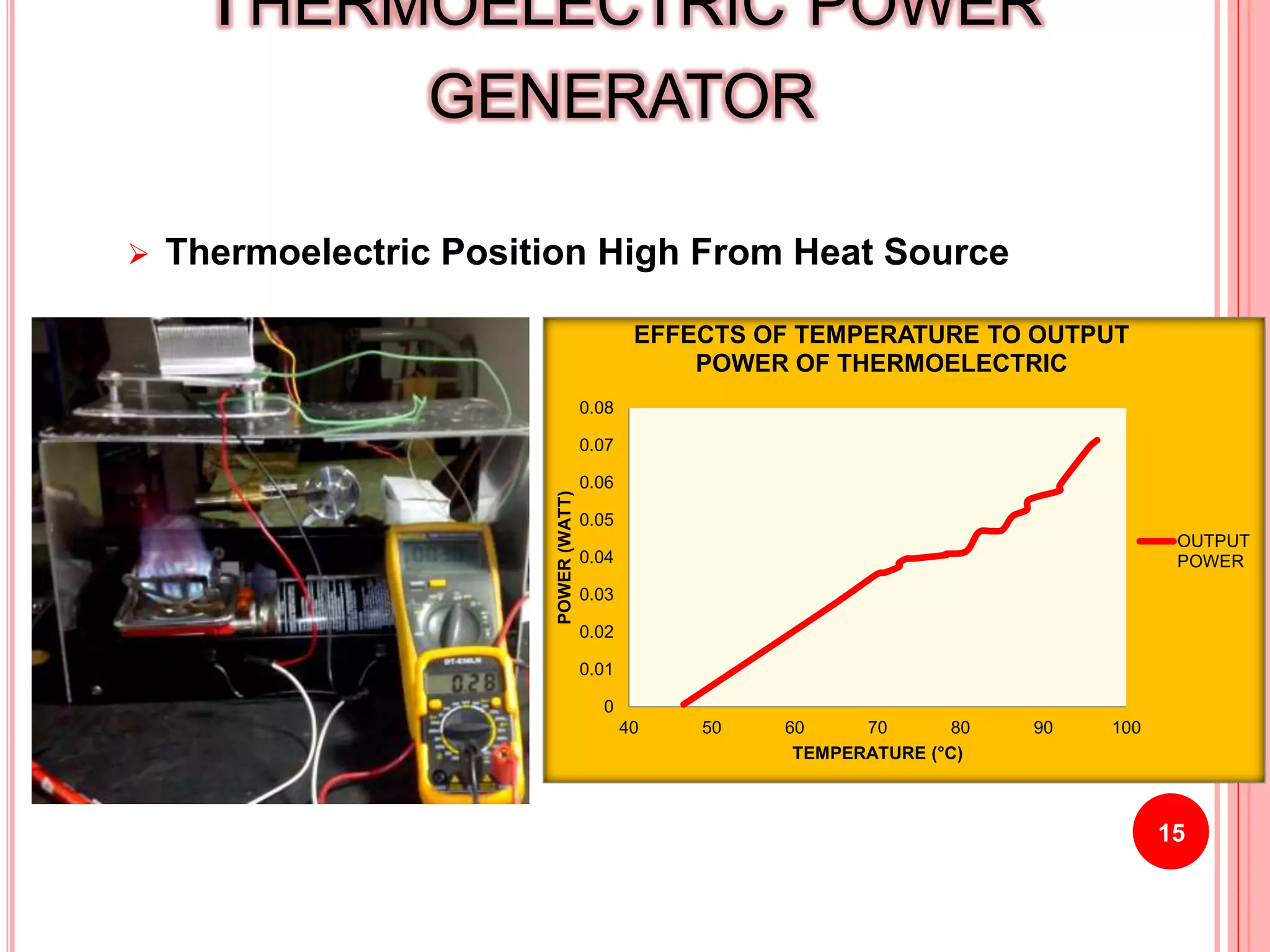
 Thermoelectric Position High From Heat Source
15
THERMOELECTRIC POWER
GENERATOR
0
0.01
0.02
0.03
0.04
0.05
0.06
0.07
0.08
40 50 60 70 80 90 100
POWER(WATT)
TEMPERATURE (°C)
EFFECTS OF TEMPERATURE TO OUTPUT
POWER OF THERMOELECTRIC
OUTPUT
POWER
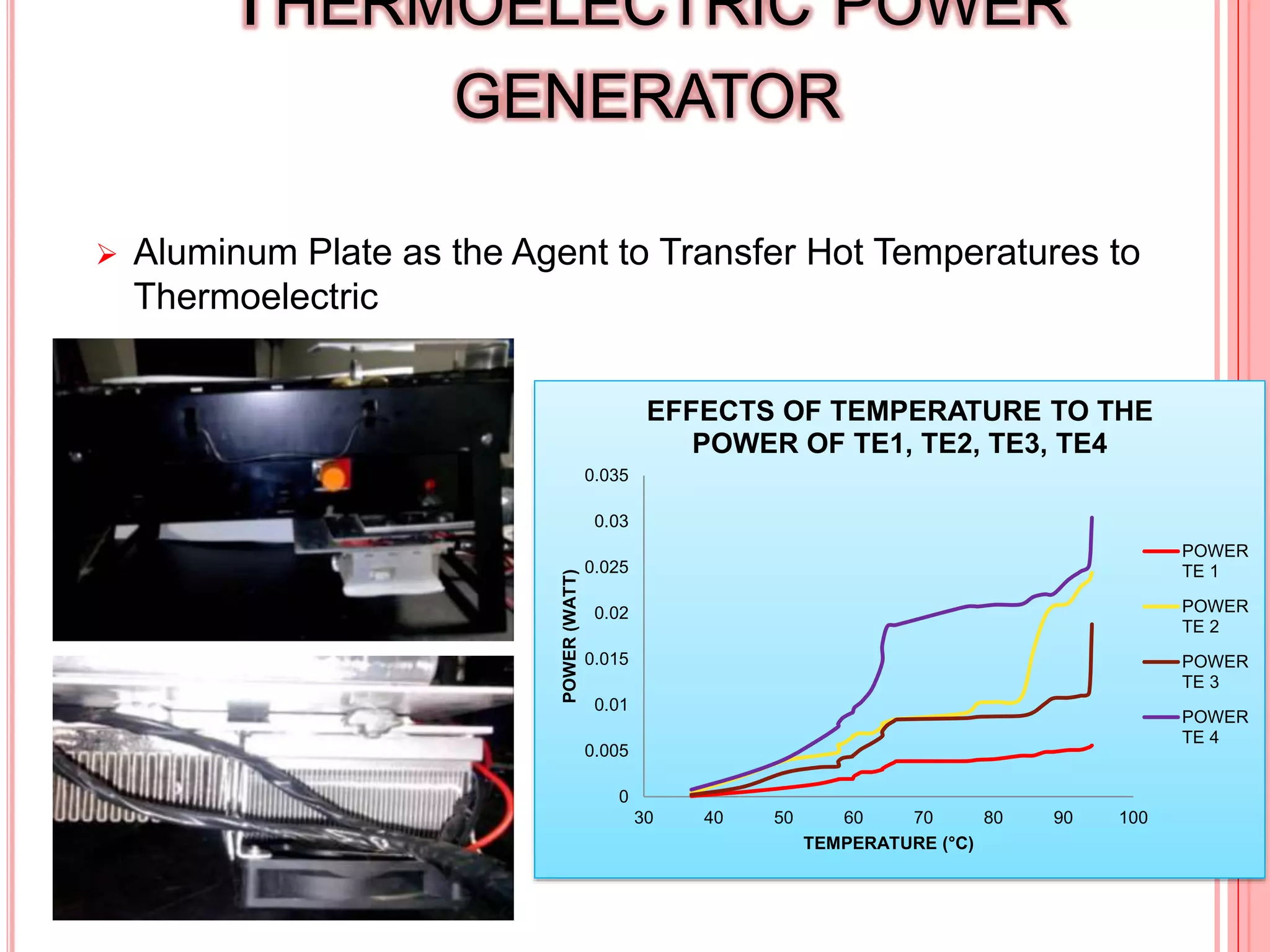
 Aluminum Plate as the Agent to Transfer Hot Temperatures to
Thermoelectric
16
THERMOELECTRIC POWER
GENERATOR
0
0.005
0.01
0.015
0.02
0.025
0.03
0.035
30 40 50 60 70 80 90 100
POWER(WATT)
TEMPERATURE (°C)
EFFECTS OF TEMPERATURE TO THE
POWER OF TE1, TE2, TE3, TE4
POWER
TE 1
POWER
TE 2
POWER
TE 3
POWER
TE 4
17
STIRLING ENGINE POWER GENERATION
18
STIRLING ENGINE POWER GENERATION
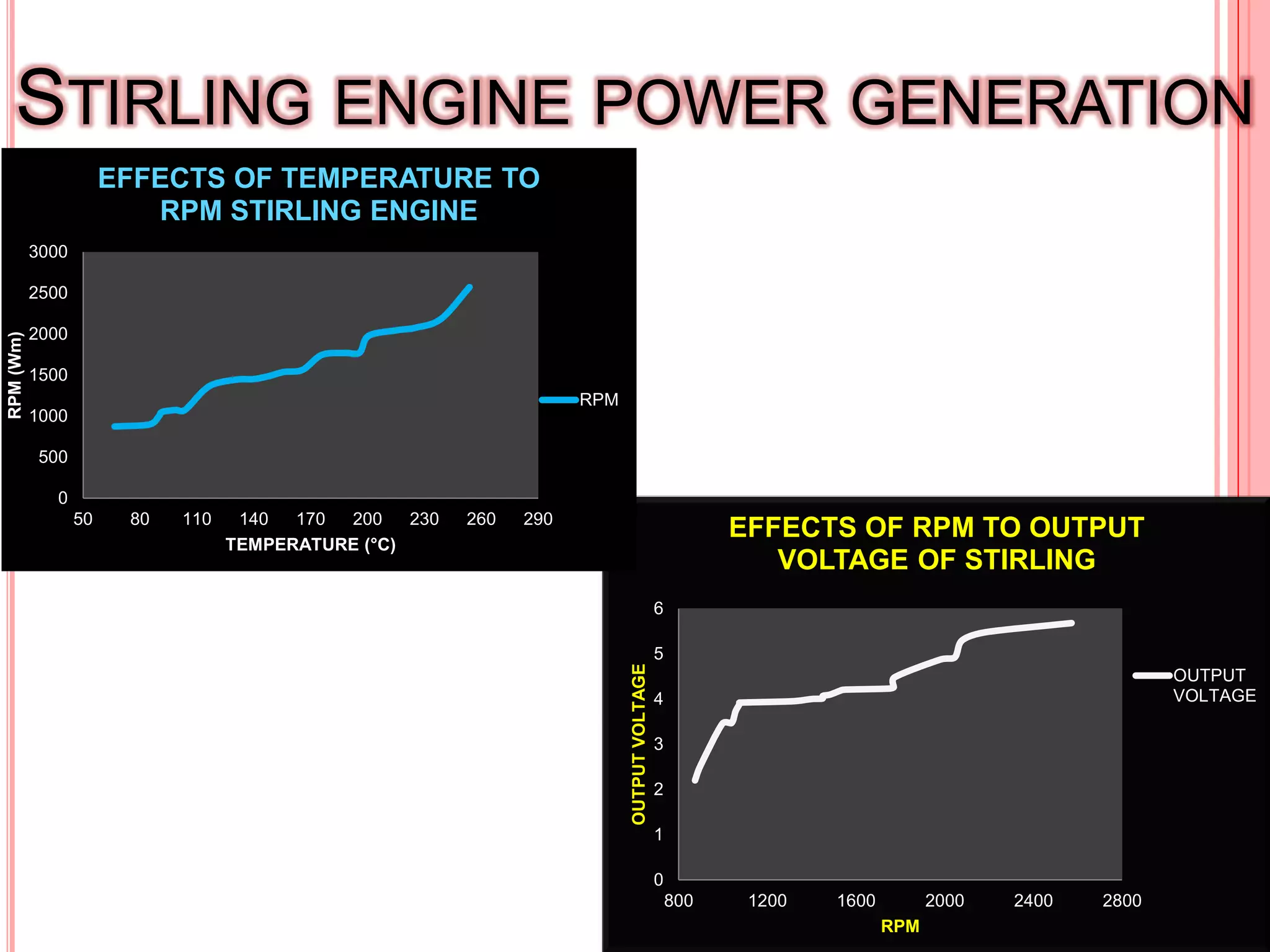
0
1
2
3
4
5
6
800 1200 1600 2000 2400 2800
OUTPUTVOLTAGE
RPM
EFFECTS OF RPM TO OUTPUT
VOLTAGE OF STIRLING
OUTPUT
VOLTAGE
0
500
1000
1500
2000
2500
3000
50 80 110 140 170 200 230 260 290
RPM(Wm)
TEMPERATURE (°C)
EFFECTS OF TEMPERATURE TO
RPM STIRLING ENGINE
RPM
19
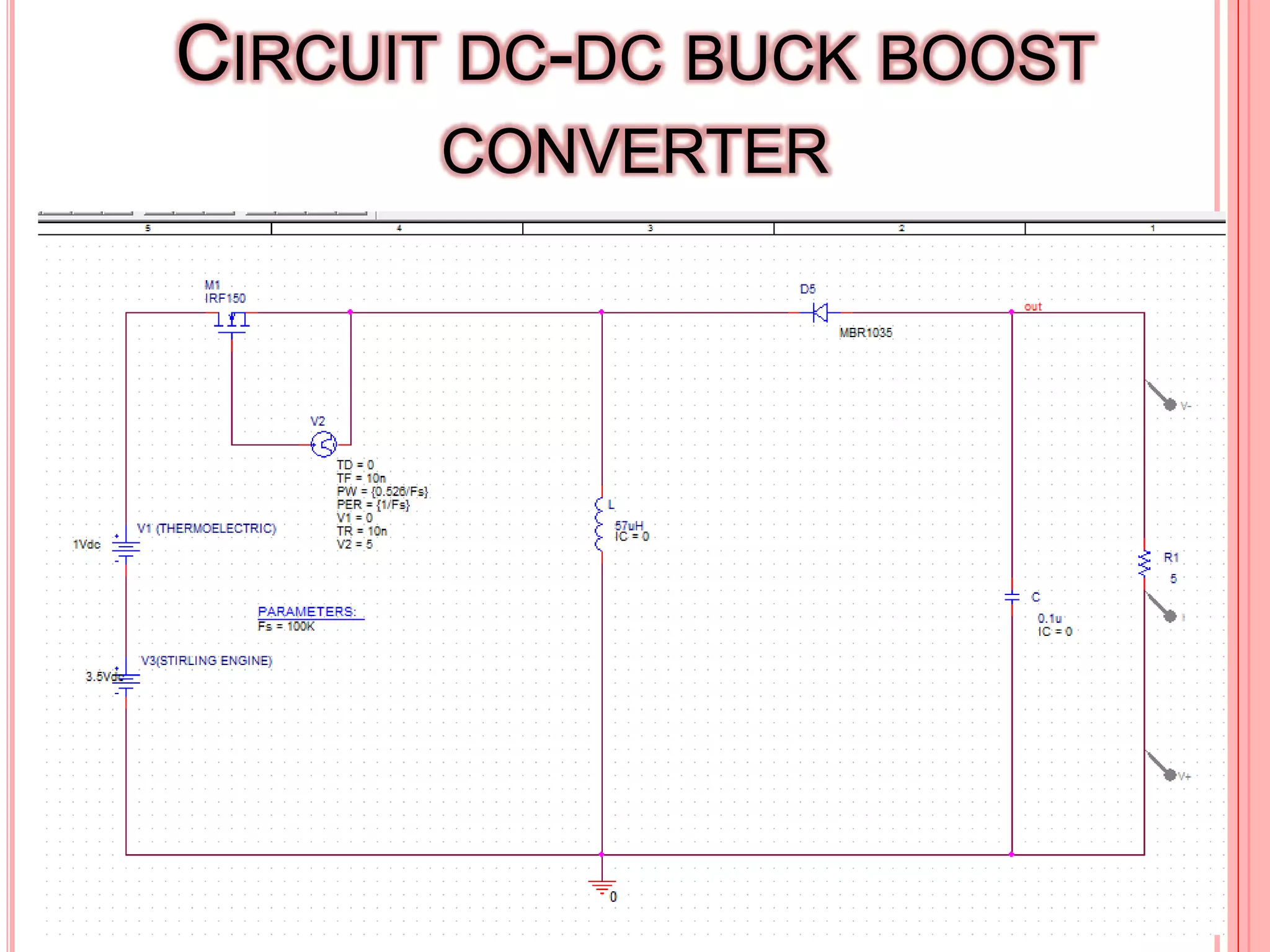
CIRCUIT DC-DC BUCK BOOST
CONVERTER
20
21
CONCLUSION
• The design could be able to produce a new
hybrid power generation system of
thermoelectric and Stirling engine.
• Optimize the power output for hybrid
power generation system.
22
REFERENCES
 Anders Killander, John C Bass. A stove-top generator for cold areas. In:
Proceedings of the IEEE 15th international conference on thermoelectrics; 1996. p.
390–3.
 Mahmudur R, Roger S. Thermoelectric power-generation for battery charging.
In: Proceedings of the IEEE conference on energy management and power
delivery, vol. 1; 1995. p. 186–91.
 A Coreless Maximum Power Point Tracking Circuit of Thermoelectric Generators
for Battery Charging Systems Sungkyu Cho, Namjae Kim, Soonseo Park and
Shiho Kim Dept. of Electrical Engineering, Chungbuk National University,
Chungbuk, 361-763, Korea. Email : {saladn, njk84, transistor,
shiho}@chungbuk.ac.kr
 Dr. John Walsh, "Basic principles of operation and applications of the Stirling
engine from its invention in 1816 to its modern uses ". Limerick Institute of
Technology, Department of Mechanical and Automobile Engineering, School of
Science, Engineering and Information Technology.Engineering Technology
Teachers Association Conference 2012, pp. 1-22, 01-Oct-2013.
23
24

Design of hybrid micro thermoelectric and stirling engine

  • 1.
    BEE 4712 ENGINEERING PROJECTI EE191: DESIGN OF HYBRID MICRO THERMOELECTRIC AND STIRLING ENGINE FOR POWER GENERATION STUDENT NAME : NURUL AIN BINTI MOHD YUSOFF MATRIX NUMBER: EC11140 SUPERVISOR : ENCIK MOHD SHAWAL BIN JADIN 1
  • 2.
    INTRODUCTION  This projectdiscusses the design and development of a hybrid micro thermo-electric and Stirling engine for power generation  This design of power generation is combination between two types of source that are the thermo- electric and Stirling engine.  The purpose of this project is the development of a micro thermo-electric and Stirling engine that capable of operating on a variety of heat sources, specifically on waste heat. 2
  • 3.
    PROBLEM STATEMENT 3  Efficiencyof the Stirling engine drops if the temperature difference between the hot and cold ends decreases.  Efficiency of the thermoelectric drops if the temperature difference between the hot and cold ends decreases.
  • 4.
    OBJECTIVE PROJECT To designthe hybrid of micro thermoelectric and Stirling engine for power generation. To optimize the output power of the hybrid system. 4
  • 5.
    SCOPE OF RESEARCH Integratethe design of thermoelectric and Stirling engine Analysis hybrid system performance such as voltage, current, power, speed and temperature Optimize the output power by using DC-DC Buck Boost Converter 5
  • 6.
    LITERITURE REVIEW Title DescriptionCitation Development of a thermoelectric battery- charger with microcontroller-based maximum power point tracking technique The purposed system is use TE device that directly convert heat energy to electricity to charge a battery. A SEPIC DC-DC Controller used to maximum the output voltage Jensak Eakburanawat, Itsda Booyaroomate; King Mongkut’s university of Technology Thonburi. Thermoelectric Generator Using Water Gas Heater Energy for Battery Charging Design and a prototype implementation of a maximum power point tracker (MPPT) for a thermoelectric (TE) module aiming to improve energy conversion efficiency in battery charging. This system uses TE devices that directly convert heat energy from a water gas heater to electricity to charge a battery. Escola Superior de Tecnologia de Castelo Branco University 6
  • 7.
    LITERITURE REVIEW Title DescriptionCitation Modelling of thermoelectric devices for electric power generation The steam-Rankine cycle is the principle exploited for producing electric power from high temperature fluid streams. Gas and steam cogeneration and combined heat and power technologies (CHP) help to improve the electrical and total efficiencies of modern power plants from 35% to about 60%. ANDREAS BITSCHI Dipl.Ing., Technical University of Vienna Stirling Engine – Bringing Electricity to Remote Locations The alpha configuration locates the piston and the displacer in separate cylinders, and attaches the heater and the cold sink to either cylinder. Alpha engines have good reliability and efficiency. It used MATLAB to simulate data collection Joshua Dulin, Matthew Hove, Jonathan D. Lilley; California Polytechnic State University, San Luis Obispo 7
  • 8.
  • 9.
  • 10.
    THERMOELECTRIC POWER GENERATOR 10 Schematic diagramshowing components and arrangement of a typical single-stage thermoelectric power generator
  • 11.
    STIRLING ENGINE POWERGENERATION 11
  • 12.
  • 13.
    Types of experimentfor thermoelectric power generator  Thermoeletric without water 13 THERMOELECTRIC POWER GENERATOR
  • 14.
     Thermoelectric withwater 14 THERMOELECTRIC POWER GENERATOR 0.4 0.6 0.8 1 1.2 1.4 1.6 1.8 2 30 40 50 60 70 80 90 100 110 OUTPUTVOLTAGE TEMPERATURE OUTPUT VOLTAGE VS TEMPERATURE
  • 15.
     Thermoelectric PositionHigh From Heat Source 15 THERMOELECTRIC POWER GENERATOR 0 0.01 0.02 0.03 0.04 0.05 0.06 0.07 0.08 40 50 60 70 80 90 100 POWER(WATT) TEMPERATURE (°C) EFFECTS OF TEMPERATURE TO OUTPUT POWER OF THERMOELECTRIC OUTPUT POWER
  • 16.
     Aluminum Plateas the Agent to Transfer Hot Temperatures to Thermoelectric 16 THERMOELECTRIC POWER GENERATOR 0 0.005 0.01 0.015 0.02 0.025 0.03 0.035 30 40 50 60 70 80 90 100 POWER(WATT) TEMPERATURE (°C) EFFECTS OF TEMPERATURE TO THE POWER OF TE1, TE2, TE3, TE4 POWER TE 1 POWER TE 2 POWER TE 3 POWER TE 4
  • 17.
  • 18.
    18 STIRLING ENGINE POWERGENERATION 0 1 2 3 4 5 6 800 1200 1600 2000 2400 2800 OUTPUTVOLTAGE RPM EFFECTS OF RPM TO OUTPUT VOLTAGE OF STIRLING OUTPUT VOLTAGE 0 500 1000 1500 2000 2500 3000 50 80 110 140 170 200 230 260 290 RPM(Wm) TEMPERATURE (°C) EFFECTS OF TEMPERATURE TO RPM STIRLING ENGINE RPM
  • 19.
    19 CIRCUIT DC-DC BUCKBOOST CONVERTER
  • 20.
  • 21.
  • 22.
    CONCLUSION • The designcould be able to produce a new hybrid power generation system of thermoelectric and Stirling engine. • Optimize the power output for hybrid power generation system. 22
  • 23.
    REFERENCES  Anders Killander,John C Bass. A stove-top generator for cold areas. In: Proceedings of the IEEE 15th international conference on thermoelectrics; 1996. p. 390–3.  Mahmudur R, Roger S. Thermoelectric power-generation for battery charging. In: Proceedings of the IEEE conference on energy management and power delivery, vol. 1; 1995. p. 186–91.  A Coreless Maximum Power Point Tracking Circuit of Thermoelectric Generators for Battery Charging Systems Sungkyu Cho, Namjae Kim, Soonseo Park and Shiho Kim Dept. of Electrical Engineering, Chungbuk National University, Chungbuk, 361-763, Korea. Email : {saladn, njk84, transistor, shiho}@chungbuk.ac.kr  Dr. John Walsh, "Basic principles of operation and applications of the Stirling engine from its invention in 1816 to its modern uses ". Limerick Institute of Technology, Department of Mechanical and Automobile Engineering, School of Science, Engineering and Information Technology.Engineering Technology Teachers Association Conference 2012, pp. 1-22, 01-Oct-2013. 23
  • 24.