The Future of Technology
Melanie Swan
Futurist
MS Futures Group
Palo Alto, CA
650-681-9482
m@melanieswan.com
http//www.melanieswan.com
Christine Peterson
Vice President and Founder
Foresight Nanotech Institute
Menlo Park, CA
650-289-0860
peterson@foresight.org
http://www.foresight.org
Liana Holmberg and Tess Chu
OS Wrangler & IP Gadfly and Developer
Linden Lab
San Francisco, CA
415-243-9000
liana@lindenlab.com
tess@lindenlab.com
http//www.lindenlab.com
The Future of Technology
October 2007
2
Summary
 We think about growth and change in linear,
exponential and discontinuous paradigms,
history is a chain of discontinuities
 The realm of technology is no longer discrete, technology is
imbuing traditional linear phenomena with exponential and
discontinuous change
 Computation (hardware and software) overview: Moore’s Law
improvements will likely continue unabated in hardware; software
however is stuck
 Not only will there be linear and exponential growth in the next 50
years but probably also discontinuous change, possibly a change
with greater impact than the Internet in our (current) lifetimes
The Future of Technology
October 2007
3
Paradigms of growth and change
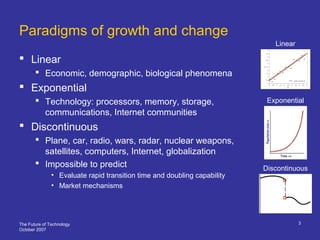
 Linear
 Economic, demographic, biological phenomena
 Exponential
 Technology: processors, memory, storage,
communications, Internet communities
 Discontinuous
 Plane, car, radio, wars, radar, nuclear weapons,
satellites, computers, Internet, globalization
 Impossible to predict
• Evaluate rapid transition time and doubling capability
• Market mechanisms
Exponential
Discontinuous
Linear
The Future of Technology
October 2007
4
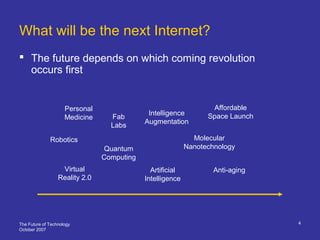
 The future depends on which coming revolution
occurs first
What will be the next Internet?
Artificial
Intelligence
Molecular
Nanotechnology
Anti-aging
Virtual
Reality 2.0
Quantum
Computing
Robotics
Intelligence
Augmentation
Personal
Medicine
Affordable
Space Launch
Fab
Labs
The Future of Technology
October 2007
5
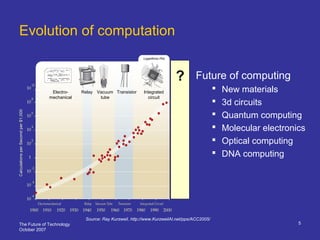
Evolution of computation
Future of computing
 New materials
 3d circuits
 Quantum computing
 Molecular electronics
 Optical computing
 DNA computing
Electro-
mechanical
Relay Vacuum
tube
Transistor Integrated
circuit
?
Source: Ray Kurzweil, http://www.KurzweilAI.net/pps/ACC2005/
The Future of Technology
October 2007
6
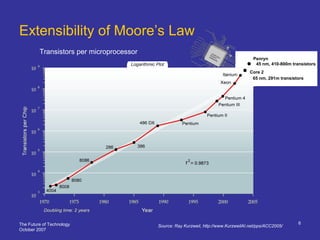
Extensibility of Moore’s Law
Source: Ray Kurzweil, http://www.KurzweilAI.net/pps/ACC2005/
Transistors per microprocessor
Penryn
45 nm, 410-800m transistors
Core 2
65 nm, 291m transistors
The Future of Technology
October 2007
7
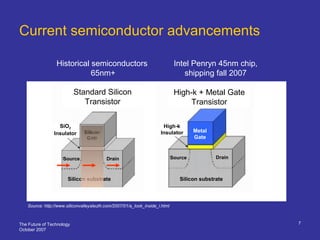
Current semiconductor advancements
Source: http://www.siliconvalleysleuth.com/2007/01/a_look_inside_i.html
Standard Silicon
Transistor
High-k + Metal Gate
Transistor
Historical semiconductors
65nm+
Intel Penryn 45nm chip,
shipping fall 2007
Metal
Gate
High-k
Insulator
Silicon substrate
Drain
Drain Source
Source
Silicon substrate
SiO2
Insulator
The Future of Technology
October 2007
8
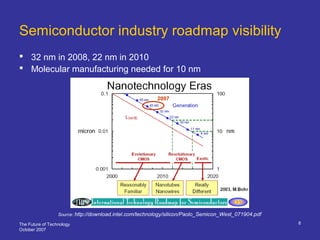
Semiconductor industry roadmap visibility
Source: http://download.intel.com/technology/silicon/Paolo_Semicon_West_071904.pdf
2007
 32 nm in 2008, 22 nm in 2010
 Molecular manufacturing needed for 10 nm
The Future of Technology
October 2007
9
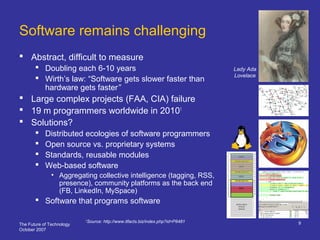
Software remains challenging
 Abstract, difficult to measure
 Doubling each 6-10 years
 Wirth’s law: “Software gets slower faster than
hardware gets faster”
 Large complex projects (FAA, CIA) failure
 19 m programmers worldwide in 20101
 Solutions?
 Distributed ecologies of software programmers
 Open source vs. proprietary systems
 Standards, reusable modules
 Web-based software
• Aggregating collective intelligence (tagging, RSS,
presence), community platforms as the back end
(FB, LinkedIn, MySpace)
 Software that programs software
1
Source: http://www.itfacts.biz/index.php?id=P8481
Lady Ada
Lovelace
The Future of Technology
October 2007
10
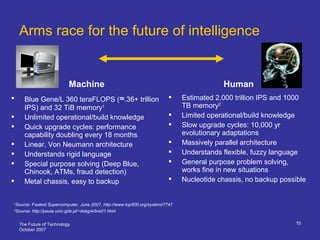
Arms race for the future of intelligence
Machine Human
 Blue Gene/L 360 teraFLOPS (≈.36+ trillion
IPS) and 32 TiB memory1
 Unlimited operational/build knowledge
 Quick upgrade cycles: performance
capability doubling every 18 months
 Linear, Von Neumann architecture
 Understands rigid language
 Special purpose solving (Deep Blue,
Chinook, ATMs, fraud detection)
 Metal chassis, easy to backup
 Estimated 2,000 trillion IPS and 1000
TB memory2
 Limited operational/build knowledge
 Slow upgrade cycles: 10,000 yr
evolutionary adaptations
 Massively parallel architecture
 Understands flexible, fuzzy language
 General purpose problem solving,
works fine in new situations
 Nucleotide chassis, no backup possible
1
Source: Fastest Supercomputer, June 2007, http://www.top500.org/system/7747
2
Source: http://paula.univ.gda.pl/~dokgrk/bre01.html
The Future of Technology
October 2007
11
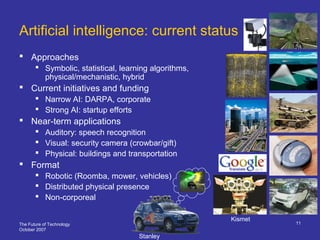
Artificial intelligence: current status
 Approaches
 Symbolic, statistical, learning algorithms,
physical/mechanistic, hybrid
 Current initiatives and funding
 Narrow AI: DARPA, corporate
 Strong AI: startup efforts
 Near-term applications
 Auditory: speech recognition
 Visual: security camera (crowbar/gift)
 Physical: buildings and transportation
 Format
 Robotic (Roomba, mower, vehicles)
 Distributed physical presence
 Non-corporeal
Kismet
Stanley
The Future of Technology
October 2007
12
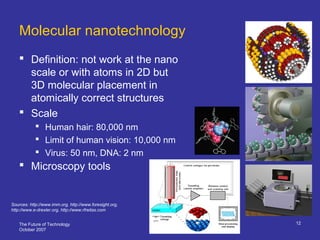
Molecular nanotechnology
 Definition: not work at the nano
scale or with atoms in 2D but
3D molecular placement in
atomically correct structures
 Scale
 Human hair: 80,000 nm
 Limit of human vision: 10,000 nm
 Virus: 50 nm, DNA: 2 nm
 Microscopy tools
Sources: http://www.imm.org, http://www.foresight.org,
http://www.e-drexler.org, http://www.rfreitas.com
The Future of Technology
October 2007
13
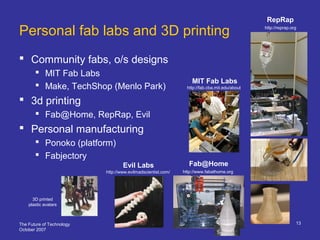
Personal fab labs and 3D printing
 Community fabs, o/s designs
 MIT Fab Labs
 Make, TechShop (Menlo Park)
 3d printing
 Fab@Home, RepRap, Evil
 Personal manufacturing
 Ponoko (platform)
 Fabjectory
http://reprap.org
http://fab.cba.mit.edu/about
MIT Fab Labs
3D printed
plastic avatars
http://www.fabathome.org
Fab@Home
RepRap
Evil Labs
http://www.evilmadscientist.com/
The Future of Technology
October 2007
14
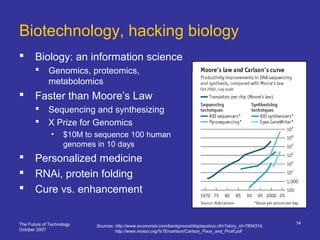
Biotechnology, hacking biology
 Biology: an information science
 Genomics, proteomics,
metabolomics
 Faster than Moore’s Law
 Sequencing and synthesizing
 X Prize for Genomics
• $10M to sequence 100 human
genomes in 10 days
 Personalized medicine
 RNAi, protein folding
 Cure vs. enhancement
Sources: http://www.economist.com/background/displaystory.cfm?story_id=7854314,
http://www.molsci.org/%7Ercarlson/Carlson_Pace_and_Prolif.pdf
The Future of Technology
October 2007
15
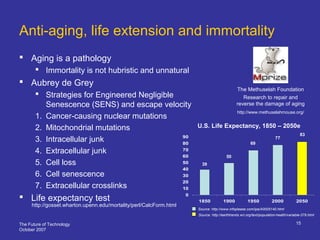
Anti-aging, life extension and immortality
 Aging is a pathology
 Immortality is not hubristic and unnatural
 Aubrey de Grey
 Strategies for Engineered Negligible
Senescence (SENS) and escape velocity
1. Cancer-causing nuclear mutations
2. Mitochondrial mutations
3. Intracellular junk
4. Extracellular junk
5. Cell loss
6. Cell senescence
7. Extracellular crosslinks
 Life expectancy test
http://gosset.wharton.upenn.edu/mortality/perl/CalcForm.html
0
10
20
30
40
50
60
70
80
90
1850 1900 1950 2000 2050
U.S. Life Expectancy, 1850 – 2050e
83
77
69
50
39
http://www.methuselahmouse.org/
Research to repair and
reverse the damage of aging
The Methuselah Foundation
Source: http://www.infoplease.com/ipa/A0005140.html
Source: http://earthtrends.wri.org/text/population-health/variable-379.html
The Future of Technology
October 2007
16
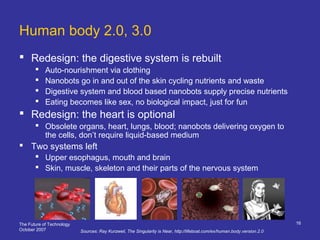
Human body 2.0, 3.0
 Redesign: the digestive system is rebuilt
 Auto-nourishment via clothing
 Nanobots go in and out of the skin cycling nutrients and waste
 Digestive system and blood based nanobots supply precise nutrients
 Eating becomes like sex, no biological impact, just for fun
 Redesign: the heart is optional
 Obsolete organs, heart, lungs, blood; nanobots delivering oxygen to
the cells, don’t require liquid-based medium
 Two systems left
 Upper esophagus, mouth and brain
 Skin, muscle, skeleton and their parts of the nervous system
Sources: Ray Kurzweil, The Singularity is Near, http://lifeboat.com/ex/human.body.version.2.0
The Future of Technology
October 2007
17
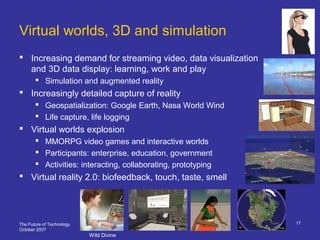
Virtual worlds, 3D and simulation
 Increasing demand for streaming video, data visualization
and 3D data display: learning, work and play
 Simulation and augmented reality
 Increasingly detailed capture of reality
 Geospatialization: Google Earth, Nasa World Wind
 Life capture, life logging
 Virtual worlds explosion
 MMORPG video games and interactive worlds
 Participants: enterprise, education, government
 Activities: interacting, collaborating, prototyping
 Virtual reality 2.0: biofeedback, touch, taste, smell
Wild Divine
The Future of Technology
October 2007
18
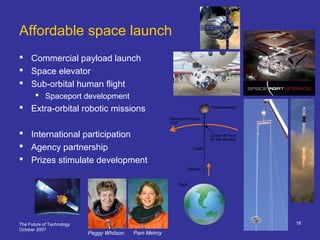
Affordable space launch
 Commercial payload launch
 Space elevator
 Sub-orbital human flight
 Spaceport development
 Extra-orbital robotic missions
 International participation
 Agency partnership
 Prizes stimulate development
Peggy Whitson Pam Melroy
The Future of Technology
October 2007
19
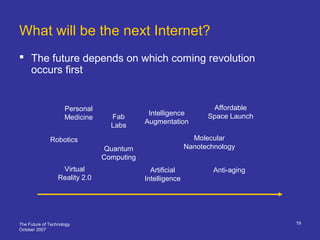
 The future depends on which coming revolution
occurs first
What will be the next Internet?
Artificial
Intelligence
Molecular
Nanotechnology
Anti-aging
Virtual
Reality 2.0
Quantum
Computing
Robotics
Intelligence
Augmentation
Personal
Medicine
Affordable
Space Launch
Fab
Labs
The Future of Technology
October 2007
20
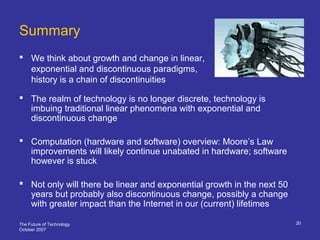
Summary
 We think about growth and change in linear,
exponential and discontinuous paradigms,
history is a chain of discontinuities
 The realm of technology is no longer discrete, technology is
imbuing traditional linear phenomena with exponential and
discontinuous change
 Computation (hardware and software) overview: Moore’s Law
improvements will likely continue unabated in hardware; software
however is stuck
 Not only will there be linear and exponential growth in the next 50
years but probably also discontinuous change, possibly a change
with greater impact than the Internet in our (current) lifetimes
Thank you
Melanie Swan
Futurist
MS Futures Group
Palo Alto, CA
m@melanieswan.com
http//www.melanieswan.com
Slides: http//www.melanieswan.com/presentations
Provided under an open source Creative Commons 3.0 license
http://creativecommons.org/licenses/by-nc-sa/3.0/
The Future of Technology
Melanie Swan
Futurist
MS Futures Group
Palo Alto, CA
650-681-9482
m@melanieswan.com
http//www.melanieswan.com
Christine Peterson
Vice President and Founder
Foresight Nanotech Institute
Menlo Park, CA
650-289-0860
peterson@foresight.org
http://www.foresight.org
Liana Holmberg and Tess Chu
OS Wrangler & IP Gadfly and Developer
Linden Lab
San Francisco, CA
415-243-9000
liana@lindenlab.com
tess@lindenlab.com
http//www.lindenlab.com

future-of-technology

  • 1.
    The Future ofTechnology Melanie Swan Futurist MS Futures Group Palo Alto, CA 650-681-9482 m@melanieswan.com http//www.melanieswan.com Christine Peterson Vice President and Founder Foresight Nanotech Institute Menlo Park, CA 650-289-0860 peterson@foresight.org http://www.foresight.org Liana Holmberg and Tess Chu OS Wrangler & IP Gadfly and Developer Linden Lab San Francisco, CA 415-243-9000 liana@lindenlab.com tess@lindenlab.com http//www.lindenlab.com
  • 2.
    The Future ofTechnology October 2007 2 Summary  We think about growth and change in linear, exponential and discontinuous paradigms, history is a chain of discontinuities  The realm of technology is no longer discrete, technology is imbuing traditional linear phenomena with exponential and discontinuous change  Computation (hardware and software) overview: Moore’s Law improvements will likely continue unabated in hardware; software however is stuck  Not only will there be linear and exponential growth in the next 50 years but probably also discontinuous change, possibly a change with greater impact than the Internet in our (current) lifetimes
  • 3.
    The Future ofTechnology October 2007 3 Paradigms of growth and change  Linear  Economic, demographic, biological phenomena  Exponential  Technology: processors, memory, storage, communications, Internet communities  Discontinuous  Plane, car, radio, wars, radar, nuclear weapons, satellites, computers, Internet, globalization  Impossible to predict • Evaluate rapid transition time and doubling capability • Market mechanisms Exponential Discontinuous Linear
  • 4.
    The Future ofTechnology October 2007 4  The future depends on which coming revolution occurs first What will be the next Internet? Artificial Intelligence Molecular Nanotechnology Anti-aging Virtual Reality 2.0 Quantum Computing Robotics Intelligence Augmentation Personal Medicine Affordable Space Launch Fab Labs
  • 5.
    The Future ofTechnology October 2007 5 Evolution of computation Future of computing  New materials  3d circuits  Quantum computing  Molecular electronics  Optical computing  DNA computing Electro- mechanical Relay Vacuum tube Transistor Integrated circuit ? Source: Ray Kurzweil, http://www.KurzweilAI.net/pps/ACC2005/
  • 6.
    The Future ofTechnology October 2007 6 Extensibility of Moore’s Law Source: Ray Kurzweil, http://www.KurzweilAI.net/pps/ACC2005/ Transistors per microprocessor Penryn 45 nm, 410-800m transistors Core 2 65 nm, 291m transistors
  • 7.
    The Future ofTechnology October 2007 7 Current semiconductor advancements Source: http://www.siliconvalleysleuth.com/2007/01/a_look_inside_i.html Standard Silicon Transistor High-k + Metal Gate Transistor Historical semiconductors 65nm+ Intel Penryn 45nm chip, shipping fall 2007 Metal Gate High-k Insulator Silicon substrate Drain Drain Source Source Silicon substrate SiO2 Insulator
  • 8.
    The Future ofTechnology October 2007 8 Semiconductor industry roadmap visibility Source: http://download.intel.com/technology/silicon/Paolo_Semicon_West_071904.pdf 2007  32 nm in 2008, 22 nm in 2010  Molecular manufacturing needed for 10 nm
  • 9.
    The Future ofTechnology October 2007 9 Software remains challenging  Abstract, difficult to measure  Doubling each 6-10 years  Wirth’s law: “Software gets slower faster than hardware gets faster”  Large complex projects (FAA, CIA) failure  19 m programmers worldwide in 20101  Solutions?  Distributed ecologies of software programmers  Open source vs. proprietary systems  Standards, reusable modules  Web-based software • Aggregating collective intelligence (tagging, RSS, presence), community platforms as the back end (FB, LinkedIn, MySpace)  Software that programs software 1 Source: http://www.itfacts.biz/index.php?id=P8481 Lady Ada Lovelace
  • 10.
    The Future ofTechnology October 2007 10 Arms race for the future of intelligence Machine Human  Blue Gene/L 360 teraFLOPS (≈.36+ trillion IPS) and 32 TiB memory1  Unlimited operational/build knowledge  Quick upgrade cycles: performance capability doubling every 18 months  Linear, Von Neumann architecture  Understands rigid language  Special purpose solving (Deep Blue, Chinook, ATMs, fraud detection)  Metal chassis, easy to backup  Estimated 2,000 trillion IPS and 1000 TB memory2  Limited operational/build knowledge  Slow upgrade cycles: 10,000 yr evolutionary adaptations  Massively parallel architecture  Understands flexible, fuzzy language  General purpose problem solving, works fine in new situations  Nucleotide chassis, no backup possible 1 Source: Fastest Supercomputer, June 2007, http://www.top500.org/system/7747 2 Source: http://paula.univ.gda.pl/~dokgrk/bre01.html
  • 11.
    The Future ofTechnology October 2007 11 Artificial intelligence: current status  Approaches  Symbolic, statistical, learning algorithms, physical/mechanistic, hybrid  Current initiatives and funding  Narrow AI: DARPA, corporate  Strong AI: startup efforts  Near-term applications  Auditory: speech recognition  Visual: security camera (crowbar/gift)  Physical: buildings and transportation  Format  Robotic (Roomba, mower, vehicles)  Distributed physical presence  Non-corporeal Kismet Stanley
  • 12.
    The Future ofTechnology October 2007 12 Molecular nanotechnology  Definition: not work at the nano scale or with atoms in 2D but 3D molecular placement in atomically correct structures  Scale  Human hair: 80,000 nm  Limit of human vision: 10,000 nm  Virus: 50 nm, DNA: 2 nm  Microscopy tools Sources: http://www.imm.org, http://www.foresight.org, http://www.e-drexler.org, http://www.rfreitas.com
  • 13.
    The Future ofTechnology October 2007 13 Personal fab labs and 3D printing  Community fabs, o/s designs  MIT Fab Labs  Make, TechShop (Menlo Park)  3d printing  Fab@Home, RepRap, Evil  Personal manufacturing  Ponoko (platform)  Fabjectory http://reprap.org http://fab.cba.mit.edu/about MIT Fab Labs 3D printed plastic avatars http://www.fabathome.org Fab@Home RepRap Evil Labs http://www.evilmadscientist.com/
  • 14.
    The Future ofTechnology October 2007 14 Biotechnology, hacking biology  Biology: an information science  Genomics, proteomics, metabolomics  Faster than Moore’s Law  Sequencing and synthesizing  X Prize for Genomics • $10M to sequence 100 human genomes in 10 days  Personalized medicine  RNAi, protein folding  Cure vs. enhancement Sources: http://www.economist.com/background/displaystory.cfm?story_id=7854314, http://www.molsci.org/%7Ercarlson/Carlson_Pace_and_Prolif.pdf
  • 15.
    The Future ofTechnology October 2007 15 Anti-aging, life extension and immortality  Aging is a pathology  Immortality is not hubristic and unnatural  Aubrey de Grey  Strategies for Engineered Negligible Senescence (SENS) and escape velocity 1. Cancer-causing nuclear mutations 2. Mitochondrial mutations 3. Intracellular junk 4. Extracellular junk 5. Cell loss 6. Cell senescence 7. Extracellular crosslinks  Life expectancy test http://gosset.wharton.upenn.edu/mortality/perl/CalcForm.html 0 10 20 30 40 50 60 70 80 90 1850 1900 1950 2000 2050 U.S. Life Expectancy, 1850 – 2050e 83 77 69 50 39 http://www.methuselahmouse.org/ Research to repair and reverse the damage of aging The Methuselah Foundation Source: http://www.infoplease.com/ipa/A0005140.html Source: http://earthtrends.wri.org/text/population-health/variable-379.html
  • 16.
    The Future ofTechnology October 2007 16 Human body 2.0, 3.0  Redesign: the digestive system is rebuilt  Auto-nourishment via clothing  Nanobots go in and out of the skin cycling nutrients and waste  Digestive system and blood based nanobots supply precise nutrients  Eating becomes like sex, no biological impact, just for fun  Redesign: the heart is optional  Obsolete organs, heart, lungs, blood; nanobots delivering oxygen to the cells, don’t require liquid-based medium  Two systems left  Upper esophagus, mouth and brain  Skin, muscle, skeleton and their parts of the nervous system Sources: Ray Kurzweil, The Singularity is Near, http://lifeboat.com/ex/human.body.version.2.0
  • 17.
    The Future ofTechnology October 2007 17 Virtual worlds, 3D and simulation  Increasing demand for streaming video, data visualization and 3D data display: learning, work and play  Simulation and augmented reality  Increasingly detailed capture of reality  Geospatialization: Google Earth, Nasa World Wind  Life capture, life logging  Virtual worlds explosion  MMORPG video games and interactive worlds  Participants: enterprise, education, government  Activities: interacting, collaborating, prototyping  Virtual reality 2.0: biofeedback, touch, taste, smell Wild Divine
  • 18.
    The Future ofTechnology October 2007 18 Affordable space launch  Commercial payload launch  Space elevator  Sub-orbital human flight  Spaceport development  Extra-orbital robotic missions  International participation  Agency partnership  Prizes stimulate development Peggy Whitson Pam Melroy
  • 19.
    The Future ofTechnology October 2007 19  The future depends on which coming revolution occurs first What will be the next Internet? Artificial Intelligence Molecular Nanotechnology Anti-aging Virtual Reality 2.0 Quantum Computing Robotics Intelligence Augmentation Personal Medicine Affordable Space Launch Fab Labs
  • 20.
    The Future ofTechnology October 2007 20 Summary  We think about growth and change in linear, exponential and discontinuous paradigms, history is a chain of discontinuities  The realm of technology is no longer discrete, technology is imbuing traditional linear phenomena with exponential and discontinuous change  Computation (hardware and software) overview: Moore’s Law improvements will likely continue unabated in hardware; software however is stuck  Not only will there be linear and exponential growth in the next 50 years but probably also discontinuous change, possibly a change with greater impact than the Internet in our (current) lifetimes
  • 21.
    Thank you Melanie Swan Futurist MSFutures Group Palo Alto, CA m@melanieswan.com http//www.melanieswan.com Slides: http//www.melanieswan.com/presentations Provided under an open source Creative Commons 3.0 license http://creativecommons.org/licenses/by-nc-sa/3.0/
  • 22.
    The Future ofTechnology Melanie Swan Futurist MS Futures Group Palo Alto, CA 650-681-9482 m@melanieswan.com http//www.melanieswan.com Christine Peterson Vice President and Founder Foresight Nanotech Institute Menlo Park, CA 650-289-0860 peterson@foresight.org http://www.foresight.org Liana Holmberg and Tess Chu OS Wrangler & IP Gadfly and Developer Linden Lab San Francisco, CA 415-243-9000 liana@lindenlab.com tess@lindenlab.com http//www.lindenlab.com