4-7-15
SCOTT STALLARD—VICE PRESIDENT
SMART ANALYTICS
RICK AZER—DIRECTOR OF DEVELOPMENT
SMART INTEGRATED INFRASTRUCTURE
FUTURE URBAN SYSTEMS: THE
CONVERGENCE OF A SMART
INTEGRATED INFRASTRUCTURE
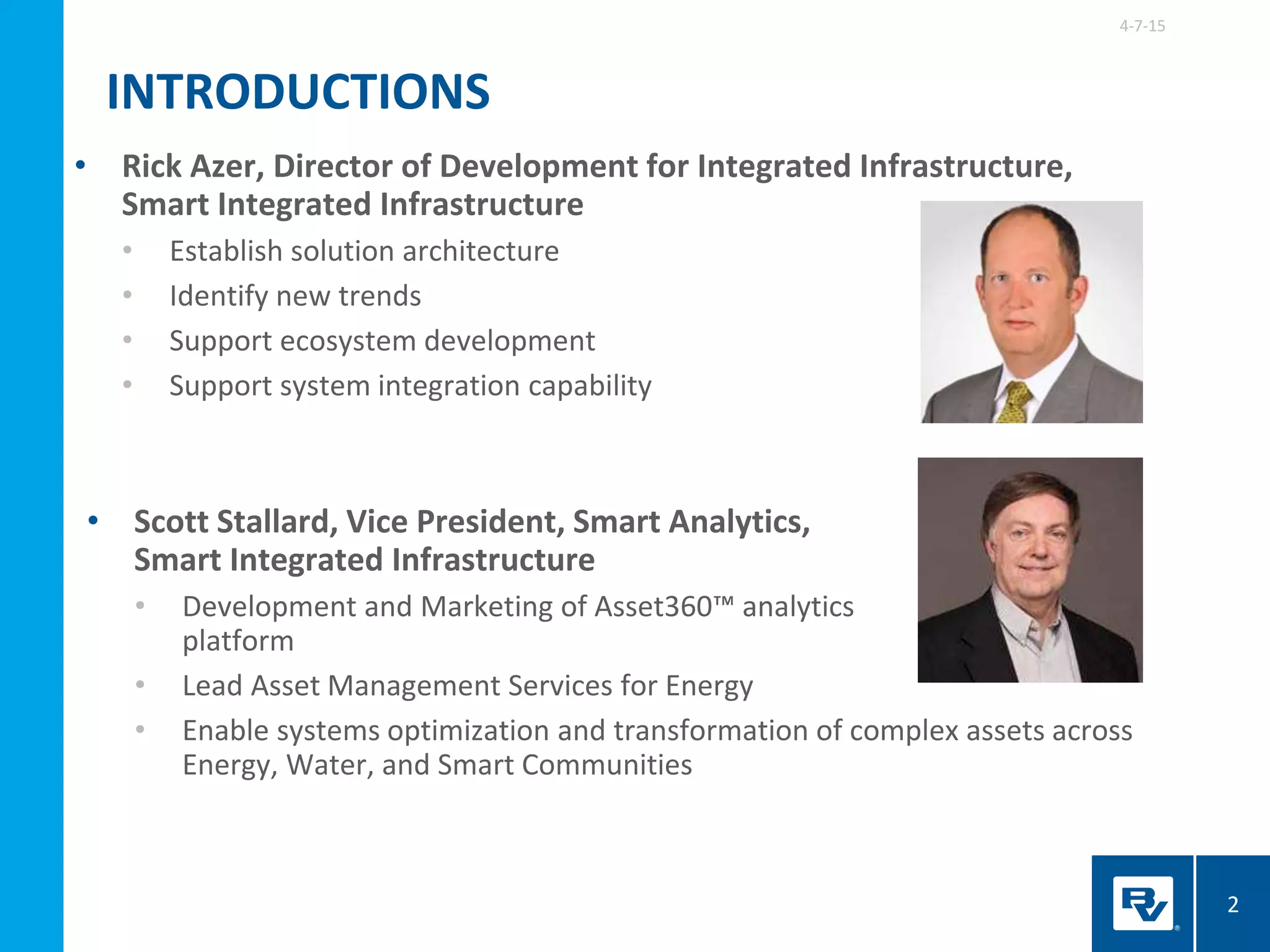
• Rick Azer, Director of Development for Integrated Infrastructure,
Smart Integrated Infrastructure
• Establish solution architecture
• Identify new trends
• Support ecosystem development
• Support system integration capability
4-7-15
2
• Scott Stallard, Vice President, Smart Analytics,
Smart Integrated Infrastructure
• Development and Marketing of Asset360™ analytics
platform
• Lead Asset Management Services for Energy
• Enable systems optimization and transformation of complex assets across
Energy, Water, and Smart Communities
INTRODUCTIONS
We are creating a very different future
centered on the technology revolution.
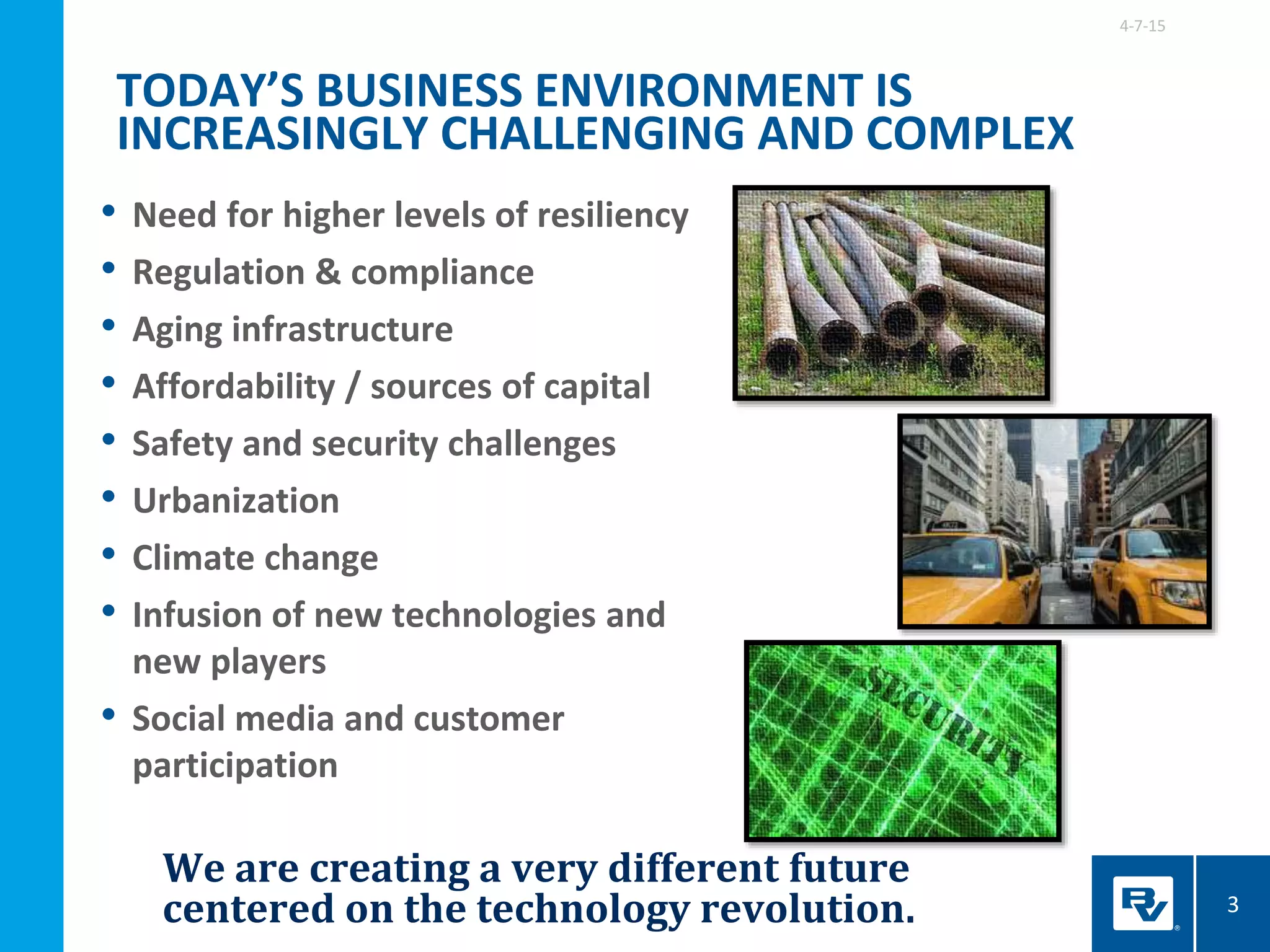
• Need for higher levels of resiliency
• Regulation & compliance
• Aging infrastructure
• Affordability / sources of capital
• Safety and security challenges
• Urbanization
• Climate change
• Infusion of new technologies and
new players
• Social media and customer
participation
TODAY’S BUSINESS ENVIRONMENT IS
INCREASINGLY CHALLENGING AND COMPLEX
4-7-15
3
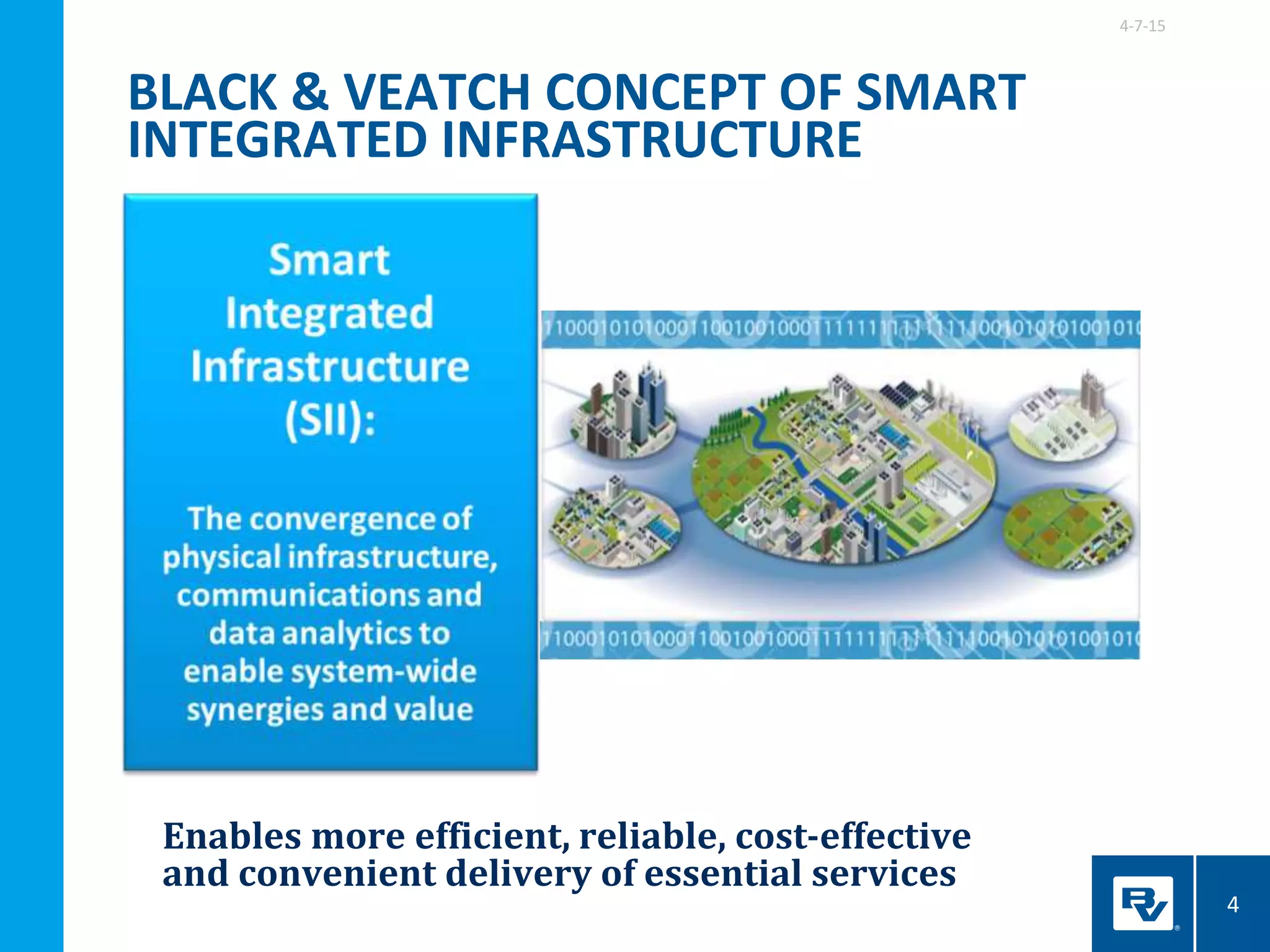
Enables more efficient, reliable, cost-effective
and convenient delivery of essential services
4-7-15
4
BLACK & VEATCH CONCEPT OF SMART
INTEGRATED INFRASTRUCTURE
SEVEN FACTORS ENABLING THE RISE OF SMART
INTEGRATED INFRASTRUCTURE
• Pervasive wireless coverage
• Transformation of public
carrier business plans to
accommodate the
Internet of Everything
• Miniaturization of processors
and the integration of
communication modules into
intelligent devices
• Abundant cheap data storage
and processing power
• Rise of cloud computing and
edge computing
• Access to vast data streams
enabling potential for
rich analytics
• Extensive improvements in
application development and
visual display capabilities
5
4-7-15
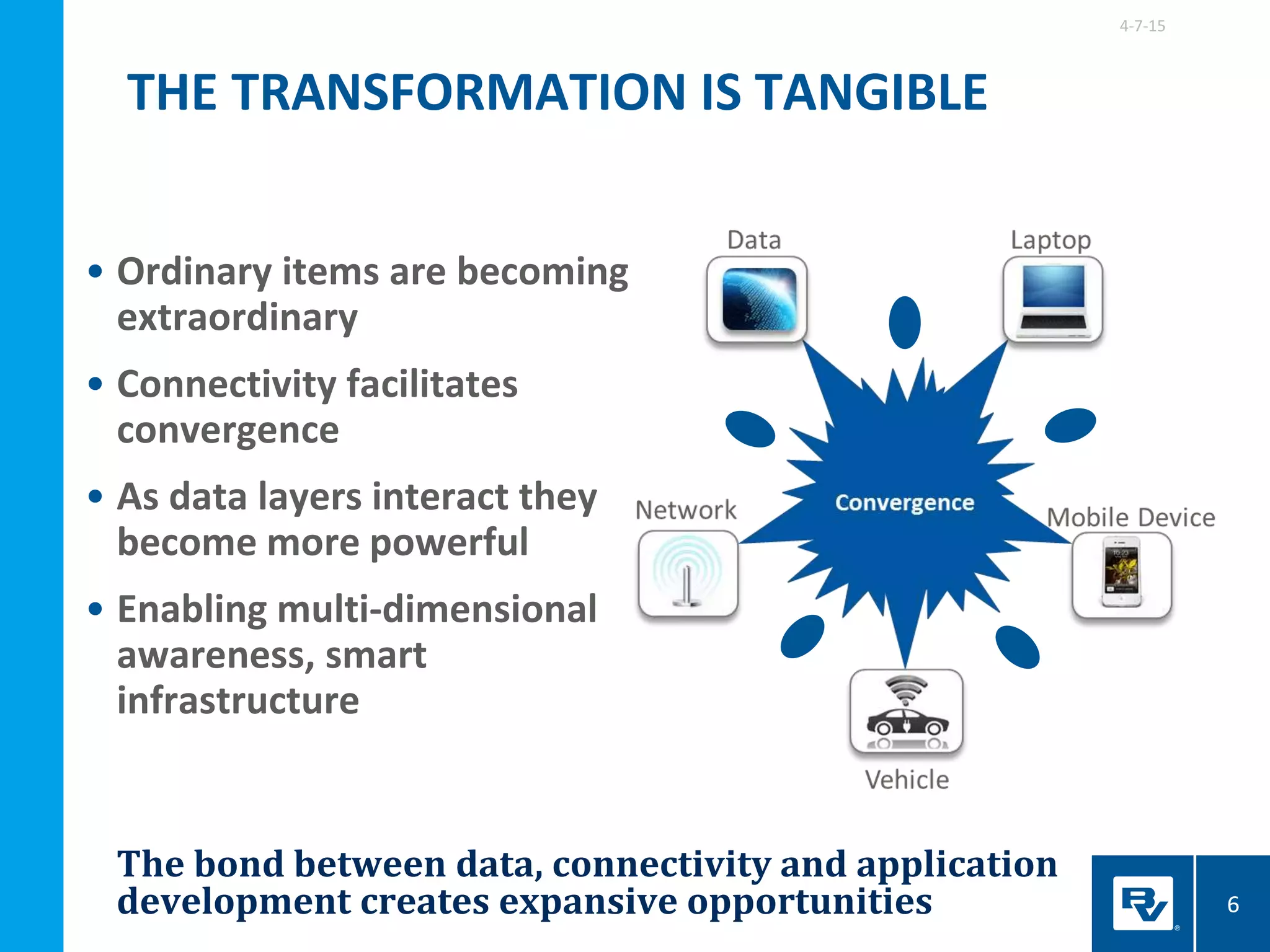
The bond between data, connectivity and application
development creates expansive opportunities
• Ordinary items are becoming
extraordinary
• Connectivity facilitates
convergence
• As data layers interact they
become more powerful
• Enabling multi-dimensional
awareness, smart
infrastructure
66
Convergence
THE TRANSFORMATION IS TANGIBLE
4-7-15
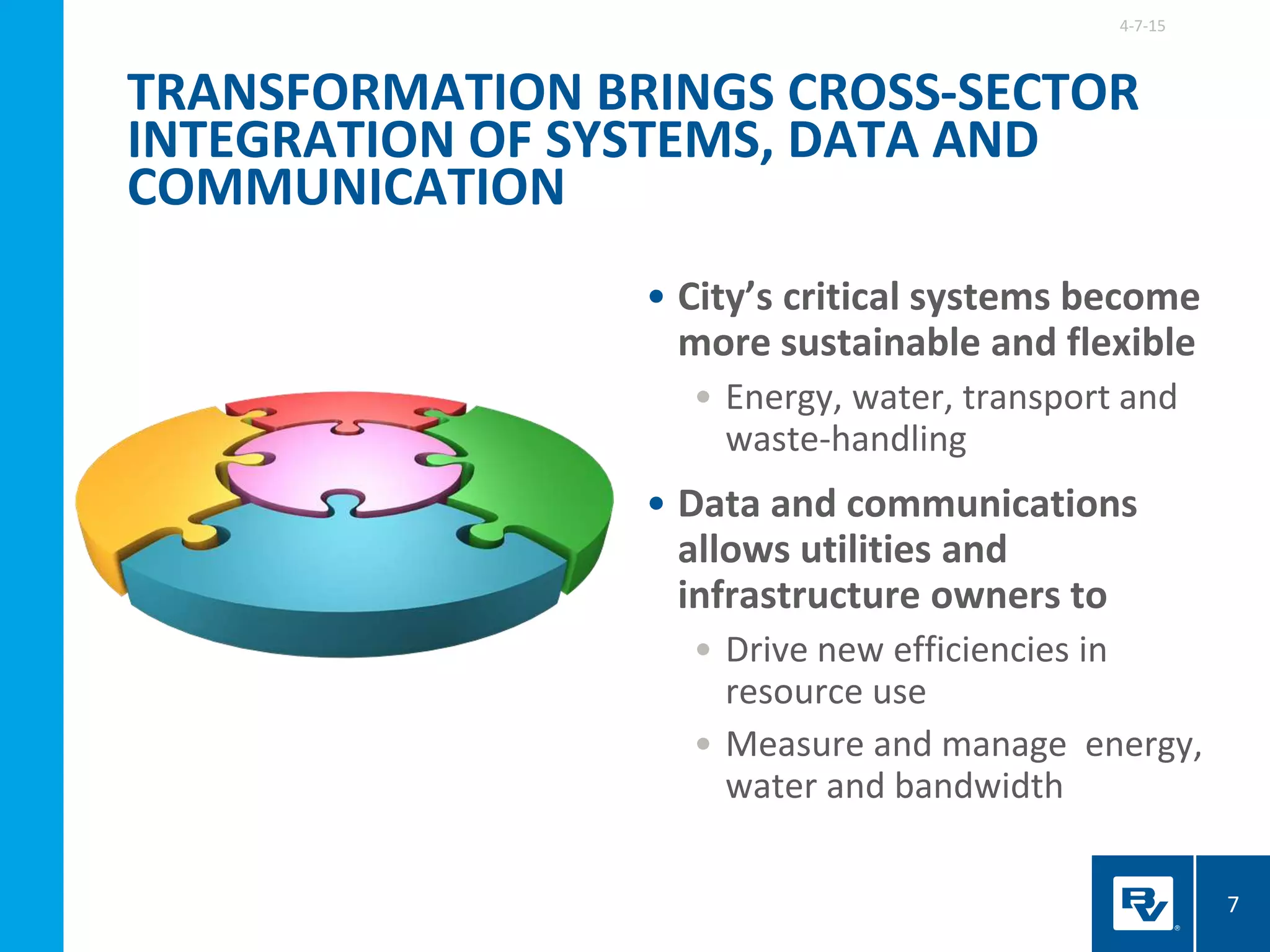
• City’s critical systems become
more sustainable and flexible
• Energy, water, transport and
waste-handling
• Data and communications
allows utilities and
infrastructure owners to
• Drive new efficiencies in
resource use
• Measure and manage energy,
water and bandwidth
7
TRANSFORMATION BRINGS CROSS-SECTOR
INTEGRATION OF SYSTEMS, DATA AND
COMMUNICATION
4-7-15
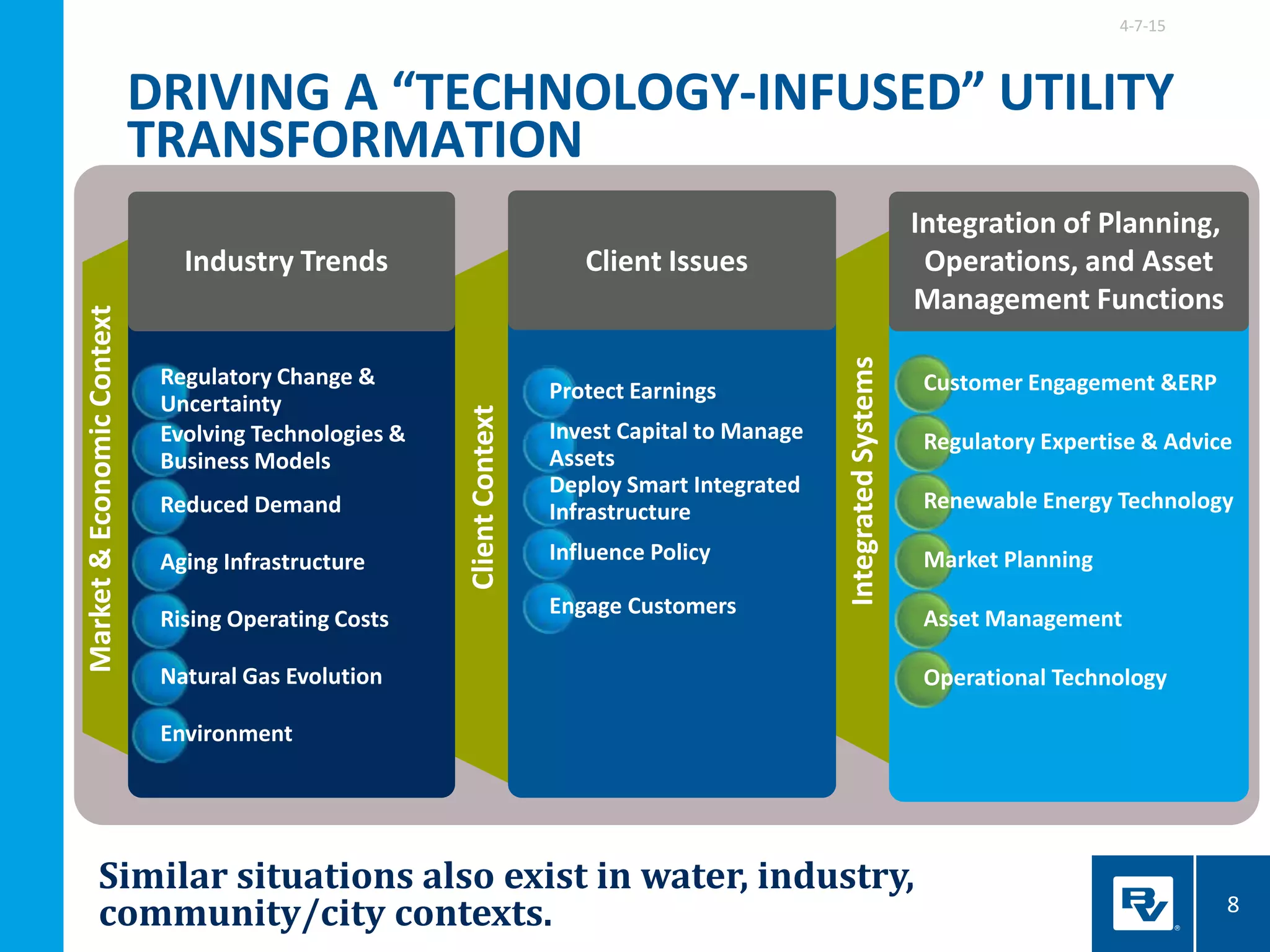
IntegratedSystems
ClientContext
Market&EconomicContext
Customer Engagement &ERP
Regulatory Expertise & Advice
Renewable Energy Technology
Market Planning
Asset Management
Operational Technology
4-7-15
8
Similar situations also exist in water, industry,
community/city contexts.
Integration of Planning,
Operations, and Asset
Management Functions
Client IssuesIndustry Trends
Protect Earnings
Invest Capital to Manage
Assets
Deploy Smart Integrated
Infrastructure
Influence Policy
Engage Customers
Regulatory Change &
Uncertainty
Evolving Technologies &
Business Models
Reduced Demand
Aging Infrastructure
Rising Operating Costs
Natural Gas Evolution
Environment
DRIVING A “TECHNOLOGY-INFUSED” UTILITY
TRANSFORMATION
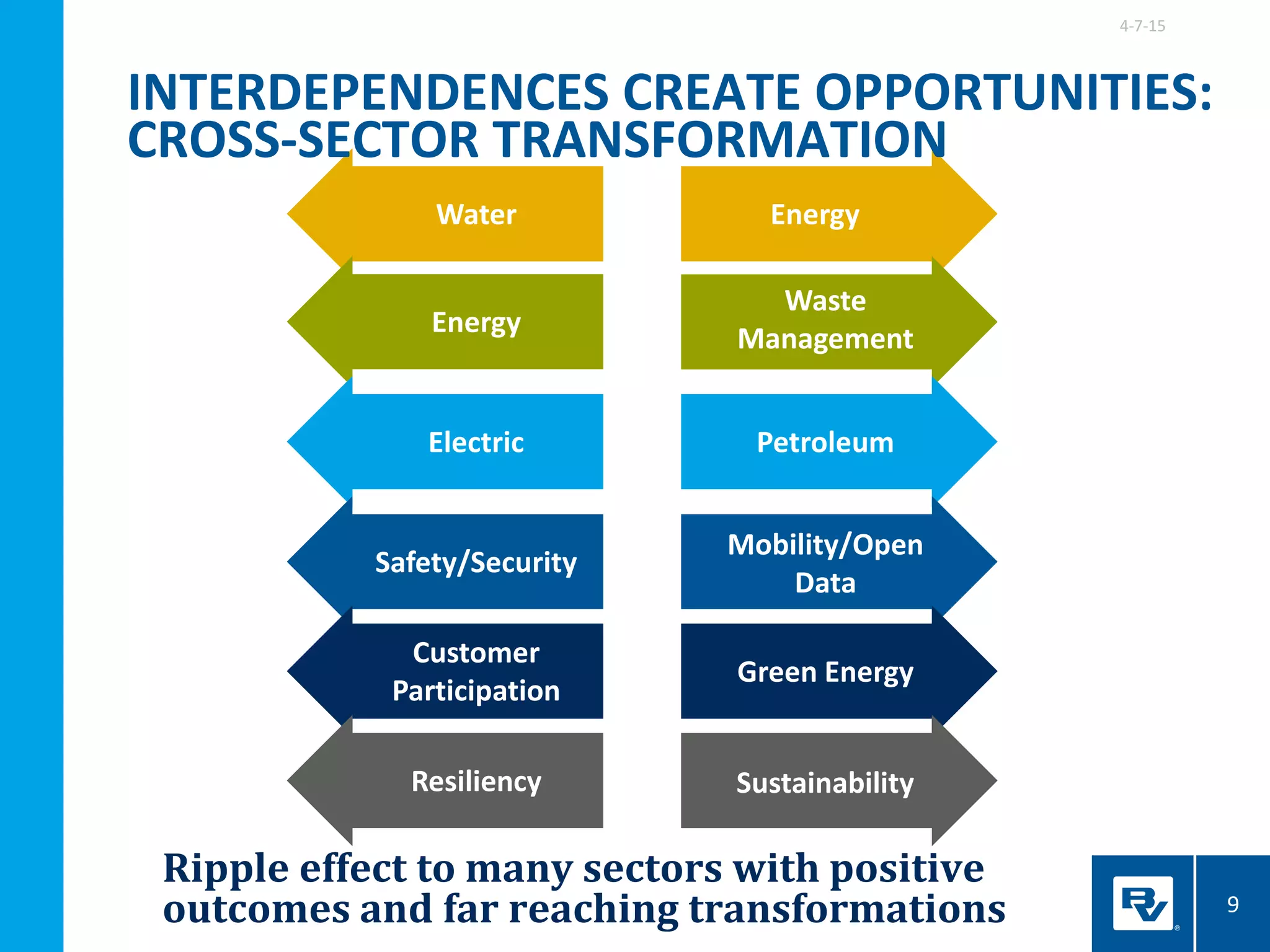
Ripple effect to many sectors with positive
outcomes and far reaching transformations
4-7-15
9
Water Energy
Energy
Waste
Management
Electric Petroleum
Safety/Security
Mobility/Open
Data
Customer
Participation
Green Energy
Resiliency Sustainability
INTERDEPENDENCES CREATE OPPORTUNITIES:
CROSS-SECTOR TRANSFORMATION
Ripple effect to many sectors with positive
outcomes and far reaching transformations
4-7-15
10
Water Energy
Waste
Management
Electric Petroleum
Safety/Security
Mobility/Open
Data
Customer
Participation
Green Energy
Resiliency Sustainability
Energy
INTERDEPENDENCES CREATE OPPORTUNITIES:
CROSS-SECTOR TRANSFORMATION
Ripple effect to many sectors with positive
outcomes and far reaching transformations
4-7-15
11
Smart City
TransportationSmart Grid/Grid Edge
INTERDEPENDENCES CREATE OPPORTUNITIES:
CROSS-SECTOR TRANSFORMATION
12
Every resident in Chicago will have a smart meter by
2017 to support the city’s planned Smart Grid. The
grid is expected to reduce energy waste and save
customers $170 million.
MIT TR Editors. ‘A Closer Look at Smart Cities’ in MIT Technology Review, 2014: November 18.
LET’S TALK
SMART
GRID….
What
makes it so
smart?
A secure, pervasive communications network is an
essential element to today’s grid operations
• Meters supply substantial intelligence
and new visibility into system
operations
• Sensors provide richer information and
context
• Gateways enable customer
participation
• More intelligent distribution critical to
address widespread renewables and EV
charging
AT THE EDGE OF THE SMART
GRID
4-7-15
13
• Cross-sector opportunity
• Electric, water/wastewater, waste, transport, lighting,
facility management, mobility
• Enormously complex
• Varies across time
• Requires lots of data
• Demand
• Usage
• Flexibility
• Tangible benefits
• Avoided capital as well
as avoided operating costs
ENERGY EFFICIENCY OPPORTUNITY
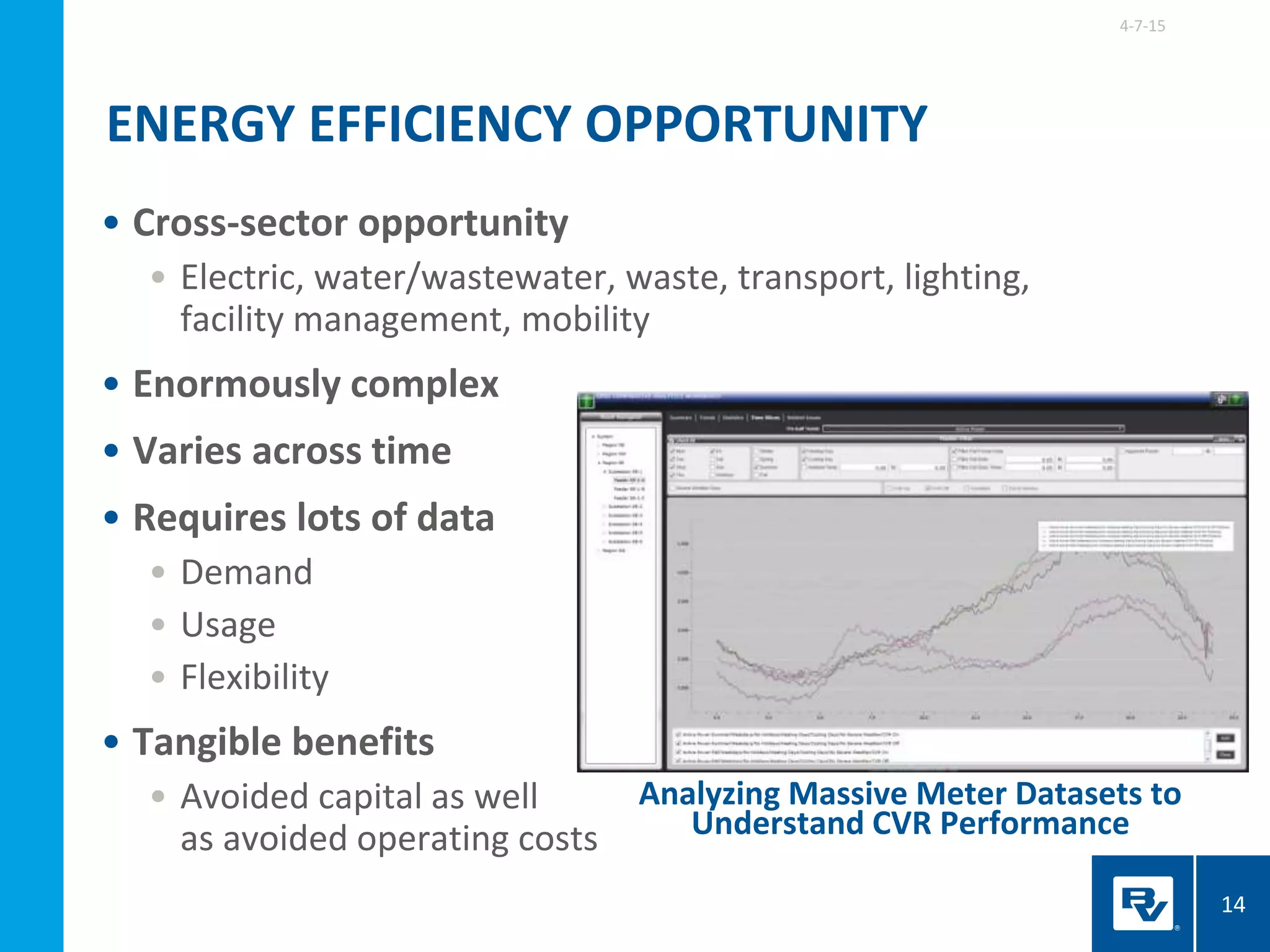
Analyzing Massive Meter Datasets to
Understand CVR Performance
4-7-15
14
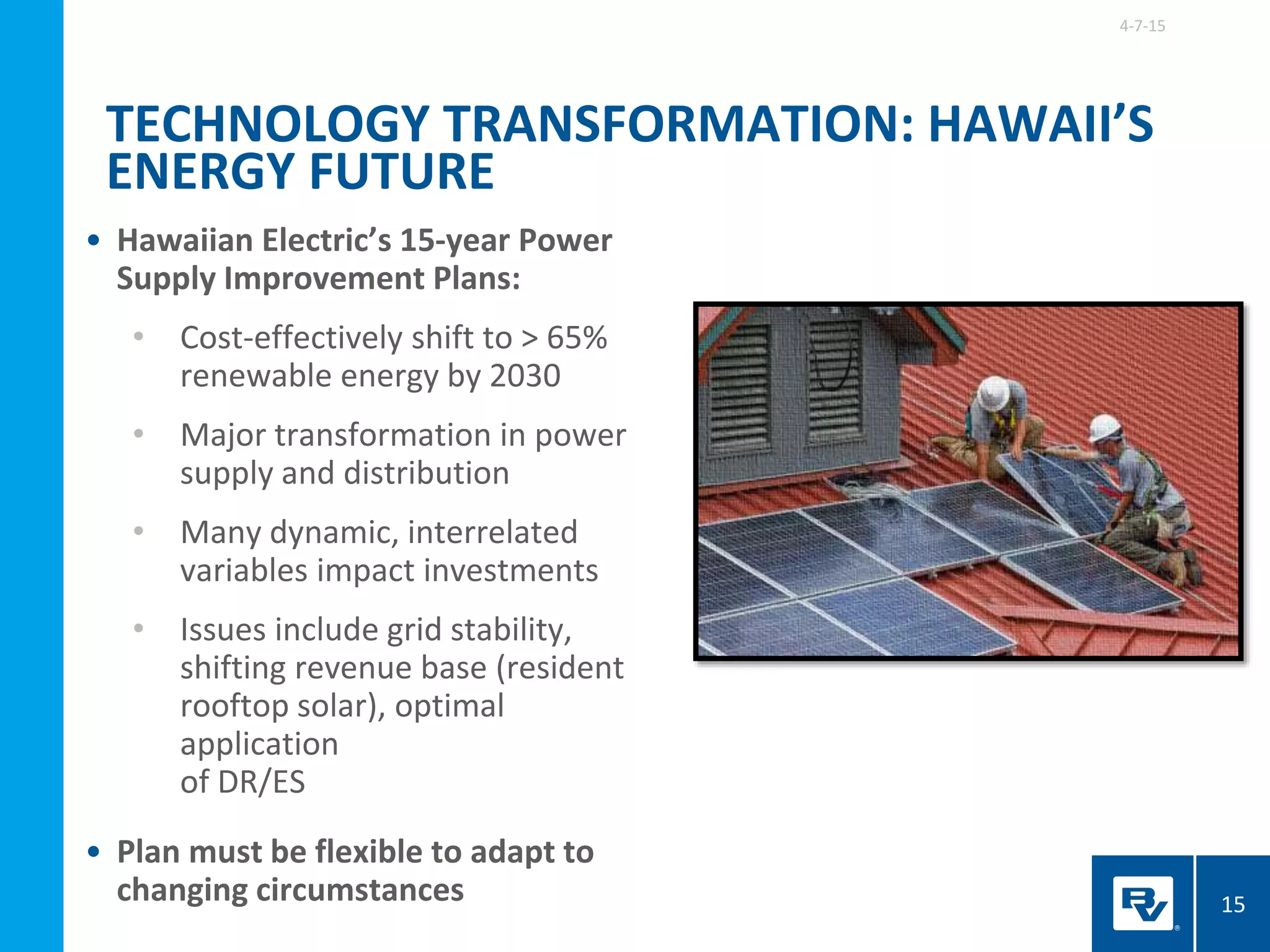
• Hawaiian Electric’s 15-year Power
Supply Improvement Plans:
• Cost-effectively shift to > 65%
renewable energy by 2030
• Major transformation in power
supply and distribution
• Many dynamic, interrelated
variables impact investments
• Issues include grid stability,
shifting revenue base (resident
rooftop solar), optimal
application
of DR/ES
• Plan must be flexible to adapt to
changing circumstances
4-7-15
15
TECHNOLOGY TRANSFORMATION: HAWAII’S
ENERGY FUTURE
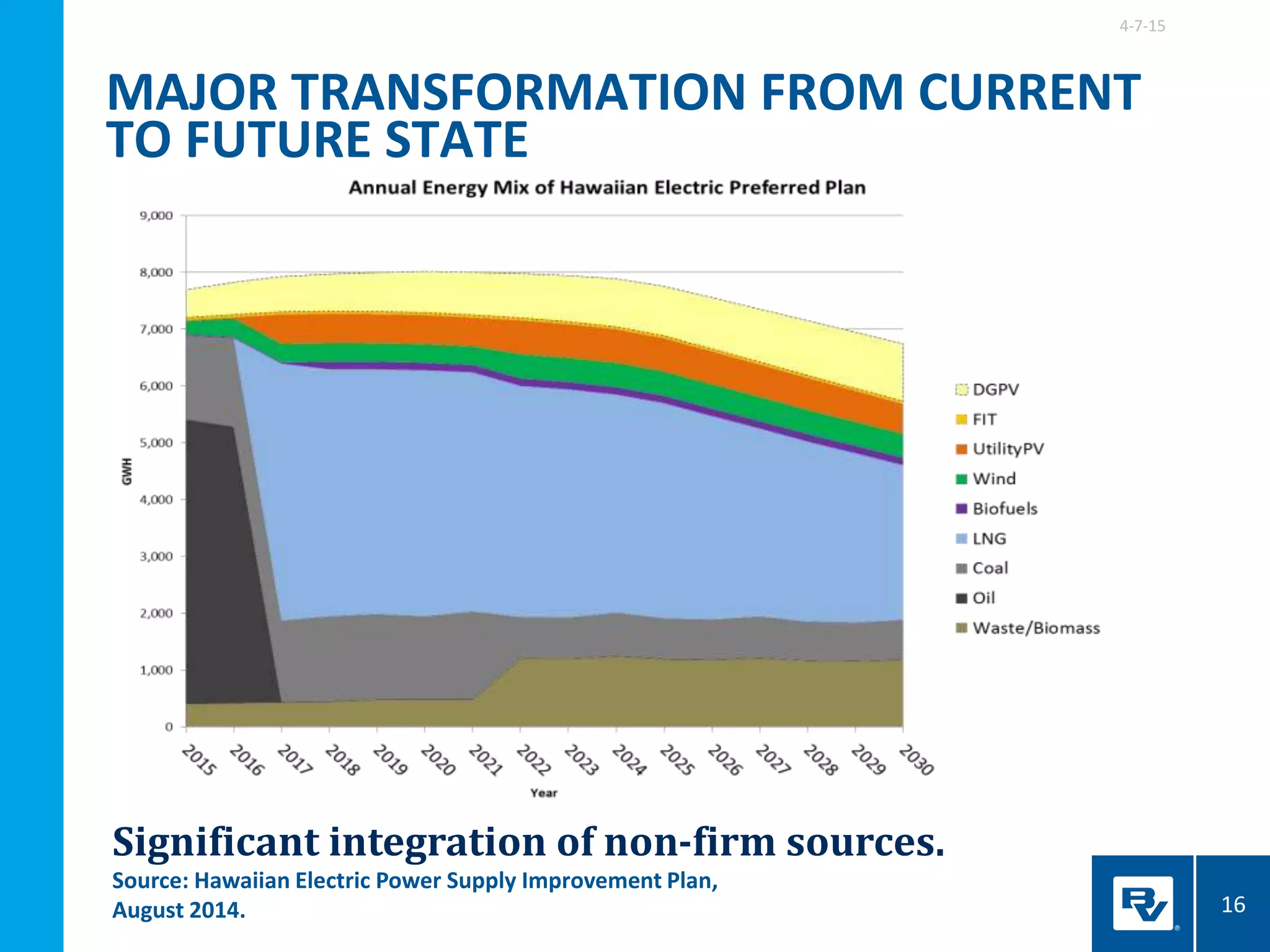
Significant integration of non-firm sources.
Source: Hawaiian Electric Power Supply Improvement Plan,
August 2014.
4-7-15
16
MAJOR TRANSFORMATION FROM CURRENT
TO FUTURE STATE
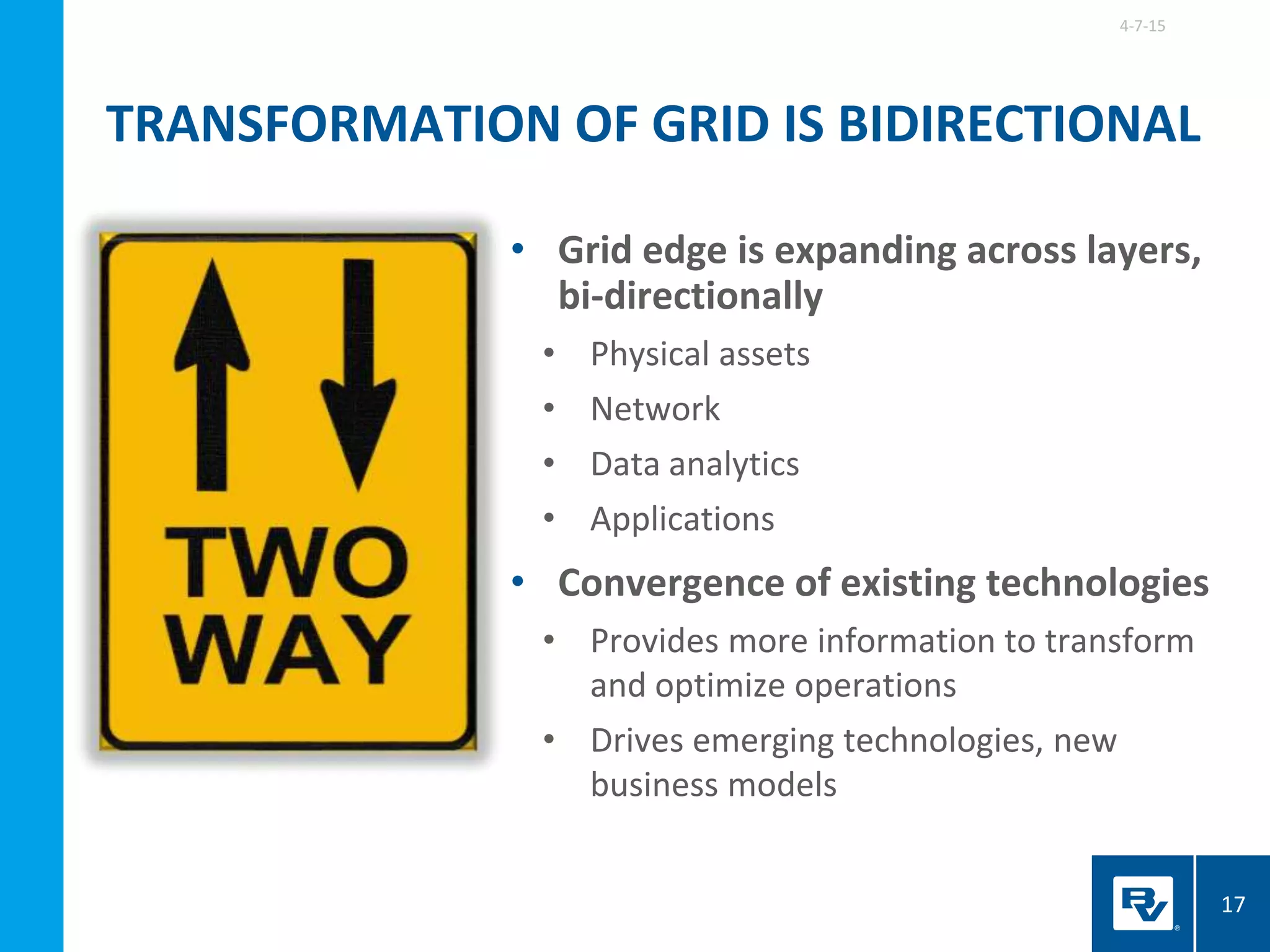
• Grid edge is expanding across layers,
bi-directionally
• Physical assets
• Network
• Data analytics
• Applications
• Convergence of existing technologies
• Provides more information to transform
and optimize operations
• Drives emerging technologies, new
business models
4-7-15
17
TRANSFORMATION OF GRID IS BIDIRECTIONAL
18
LET’S TALK SMART
TRANSPORTATION…
“The real benefits of these [connected
transportation] systems will come if cities use this
data to guide decisions about traffic management
and long-term planning.”
Knight, Will. ‘Car-Based Technology that Could Invigorate Cities’ in MIT Technology Review, 2014:
November 28.
Street-smart
sedans?
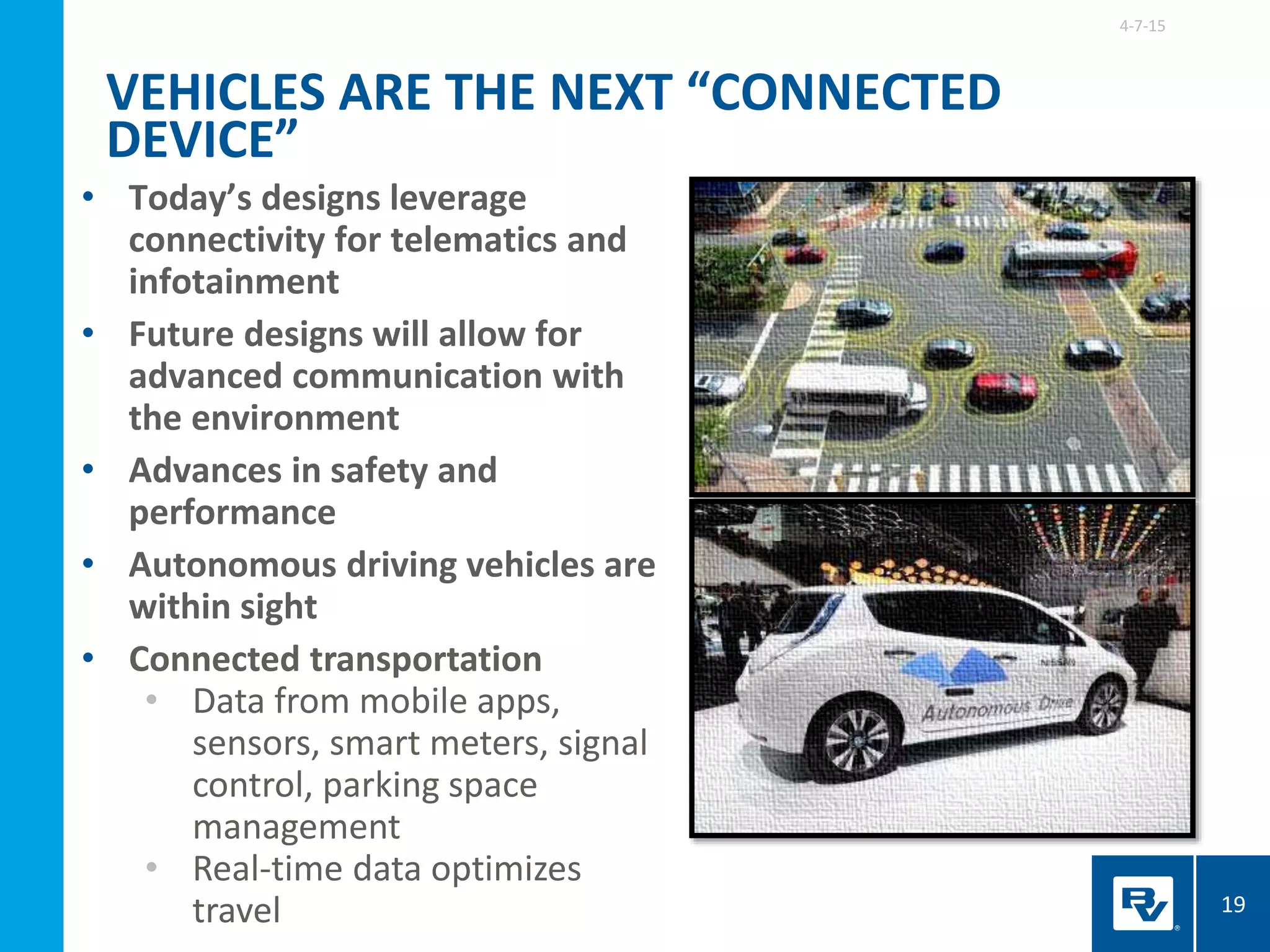
• Today’s designs leverage
connectivity for telematics and
infotainment
• Future designs will allow for
advanced communication with
the environment
• Advances in safety and
performance
• Autonomous driving vehicles are
within sight
• Connected transportation
• Data from mobile apps,
sensors, smart meters, signal
control, parking space
management
• Real-time data optimizes
travel
4-7-15
19
VEHICLES ARE THE NEXT “CONNECTED
DEVICE”
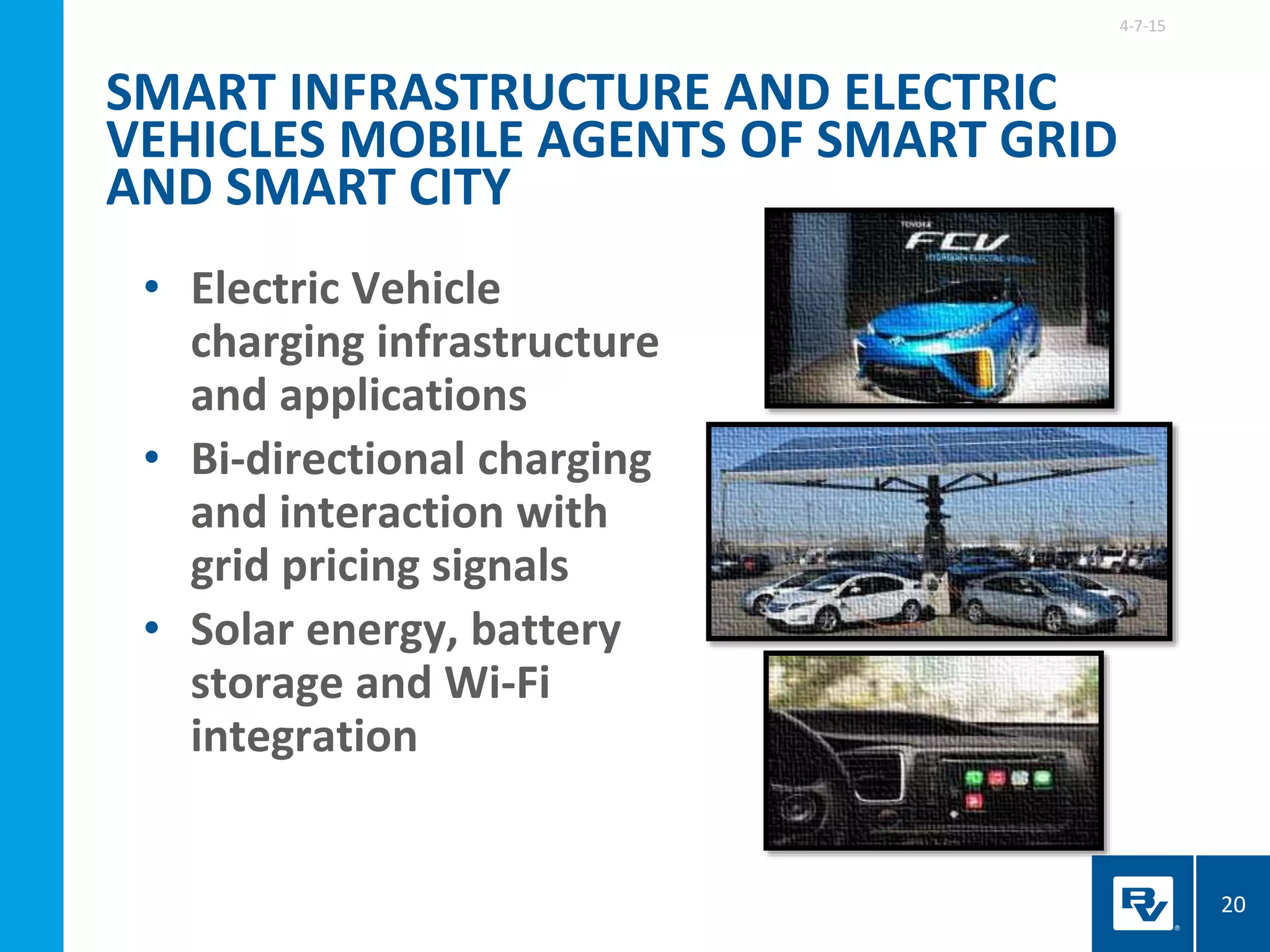
• Electric Vehicle
charging infrastructure
and applications
• Bi-directional charging
and interaction with
grid pricing signals
• Solar energy, battery
storage and Wi-Fi
integration
4-7-15
20
SMART INFRASTRUCTURE AND ELECTRIC
VEHICLES MOBILE AGENTS OF SMART GRID
AND SMART CITY
SMART INFRASTRUCTURE AND ELECTRIC
VEHICLES MOBILE AGENTS OF SMART GRID
AND SMART CITY
Source: Black & Veatch, Strategic Directions, Smart Utility Report, 2015.
• Communication infrastructure
extending to grid edge
• Use of devices, sensors and bi-
directional connectivity
• Grid Benefits
• Deeper understanding of what’s
happening on the grid
• Cheap energy to offset carbon fuel
demand
• Distributed energy storage
• Reduced peak demand
• Expansion of the Smart Grid with
more vehicle-to-grid charging
stations
4-7-15
21
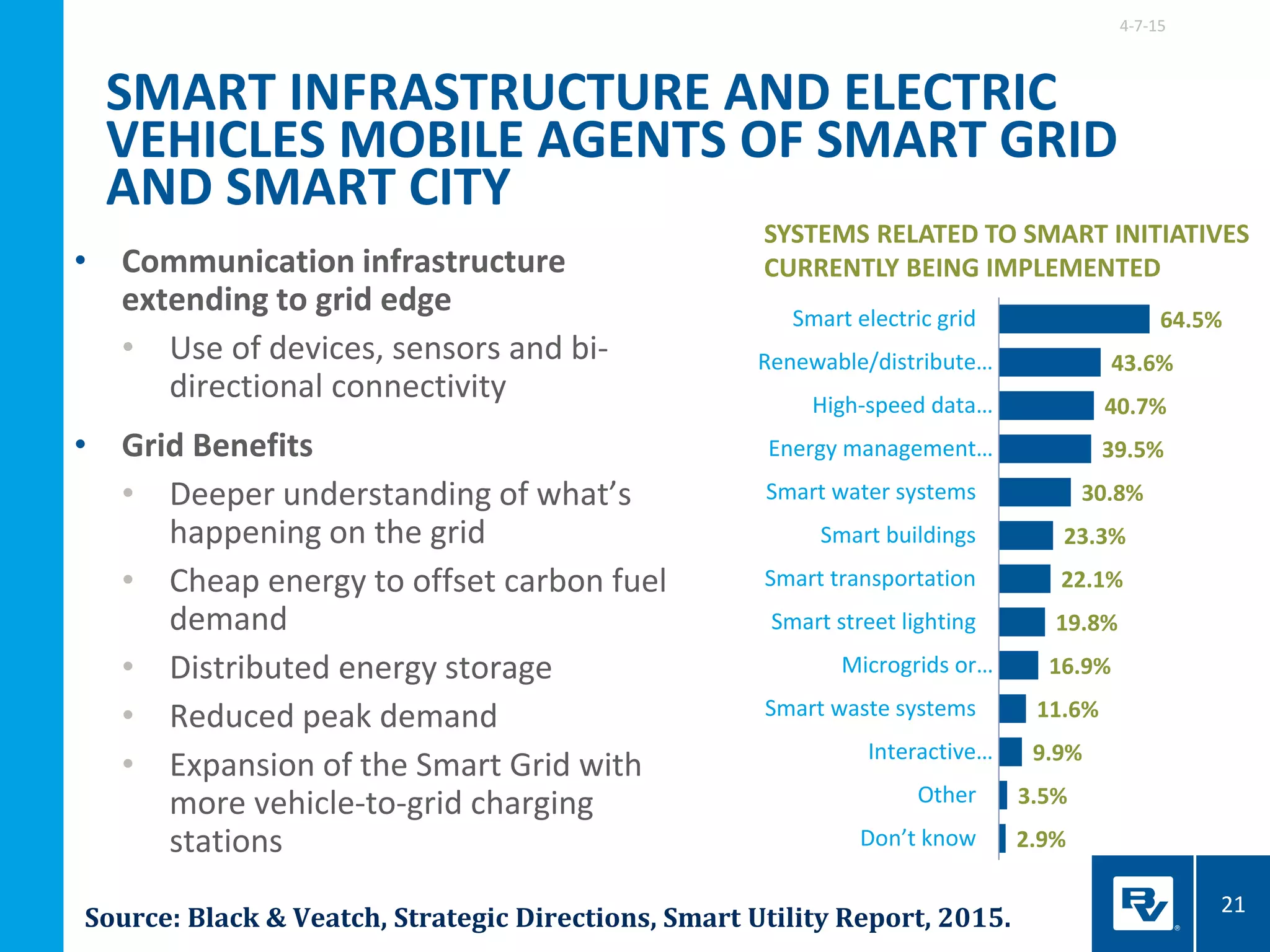
64.5%
43.6%
40.7%
39.5%
30.8%
23.3%
22.1%
19.8%
16.9%
11.6%
9.9%
3.5%
2.9%
Smart electric grid
Renewable/distribute…
High-speed data…
Energy management…
Smart water systems
Smart buildings
Smart transportation
Smart street lighting
Microgrids or…
Smart waste systems
Interactive…
Other
Don’t know
SYSTEMS RELATED TO SMART INITIATIVES
CURRENTLY BEING IMPLEMENTED
22
LET’S TALK
SMART CITIES…
“As cities turn to the evolving science of happiness to
provide residents with benefits and wellbeing, the
aspect of joy or fun services in their own right or as
part of existing functions will grow. Technology is
playing a large part in that…”
Nexgen. ’10 Tech Trends for the Smart City Manager to Look for in 2015’ in Nexgen Group Blog, 2015: January
11.
Optimizing
the urban
jungle?
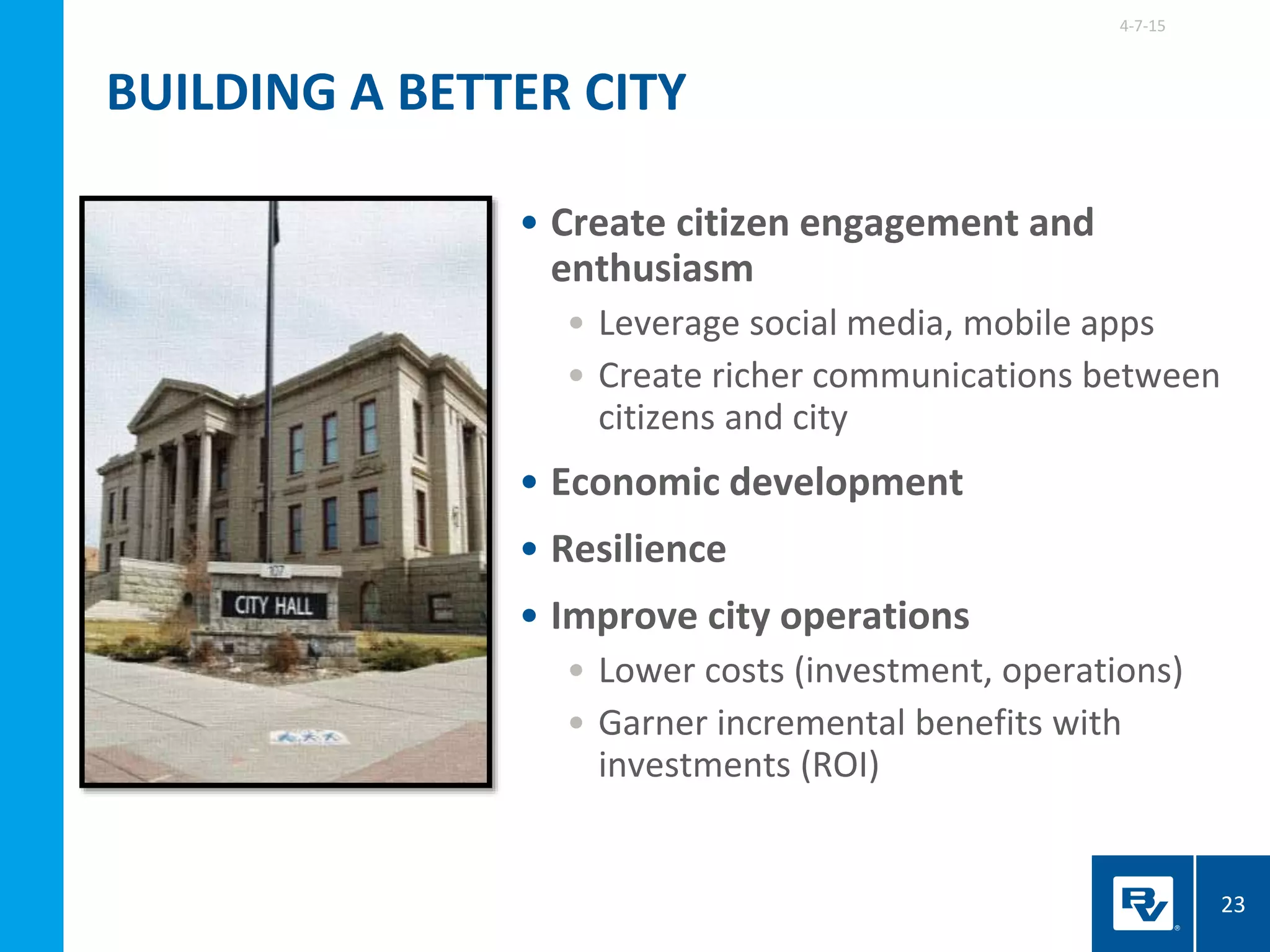
• Create citizen engagement and
enthusiasm
• Leverage social media, mobile apps
• Create richer communications between
citizens and city
• Economic development
• Resilience
• Improve city operations
• Lower costs (investment, operations)
• Garner incremental benefits with
investments (ROI)
4-7-15
23
BUILDING A BETTER CITY
Data and intelligent infrastructure drive efficient
use of resources, which enhances citizens’ day-to-
day city experience.
• Transform city data into
monetize-able assets
• Leverage an integrated and
secure data platform
• Create a community that
maximizes:
• Livability
• Workability
• Sustainability
• Customer participation
• Smart elements (parking, city
information kiosks)
4-7-15
24
BUILDING A BETTER CITY
• Smart infrastructure is
backbone of a Smart City
• Transformation trek: from
smart utility, smart
transportation and smart
grid to Smart City
• Water trek: from aging
systems to holistic water
management across full
cycle with advanced
energy/resource
management
4-7-15
25
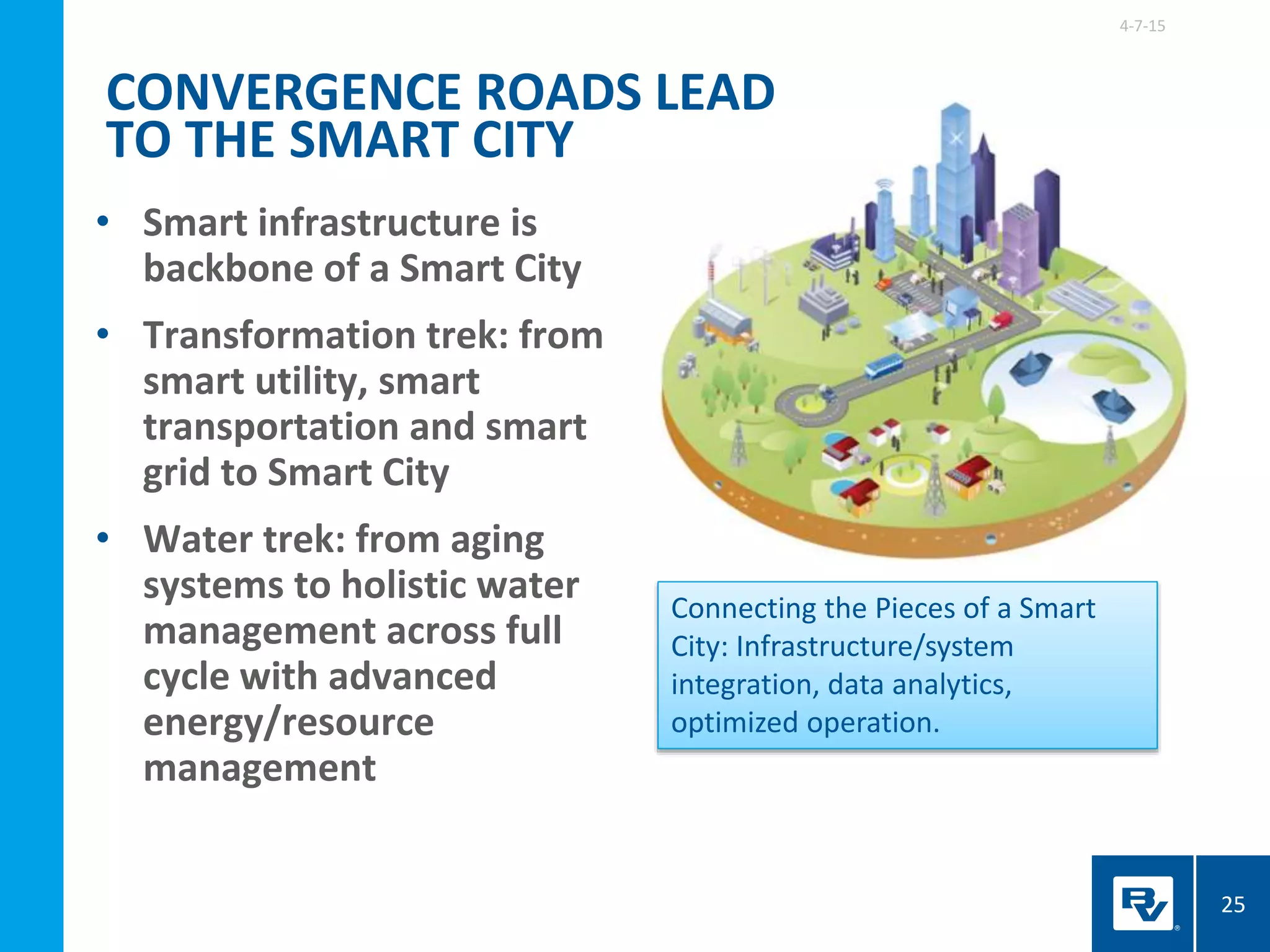
Connecting the Pieces of a Smart
City: Infrastructure/system
integration, data analytics,
optimized operation.
CONVERGENCE ROADS LEAD
TO THE SMART CITY
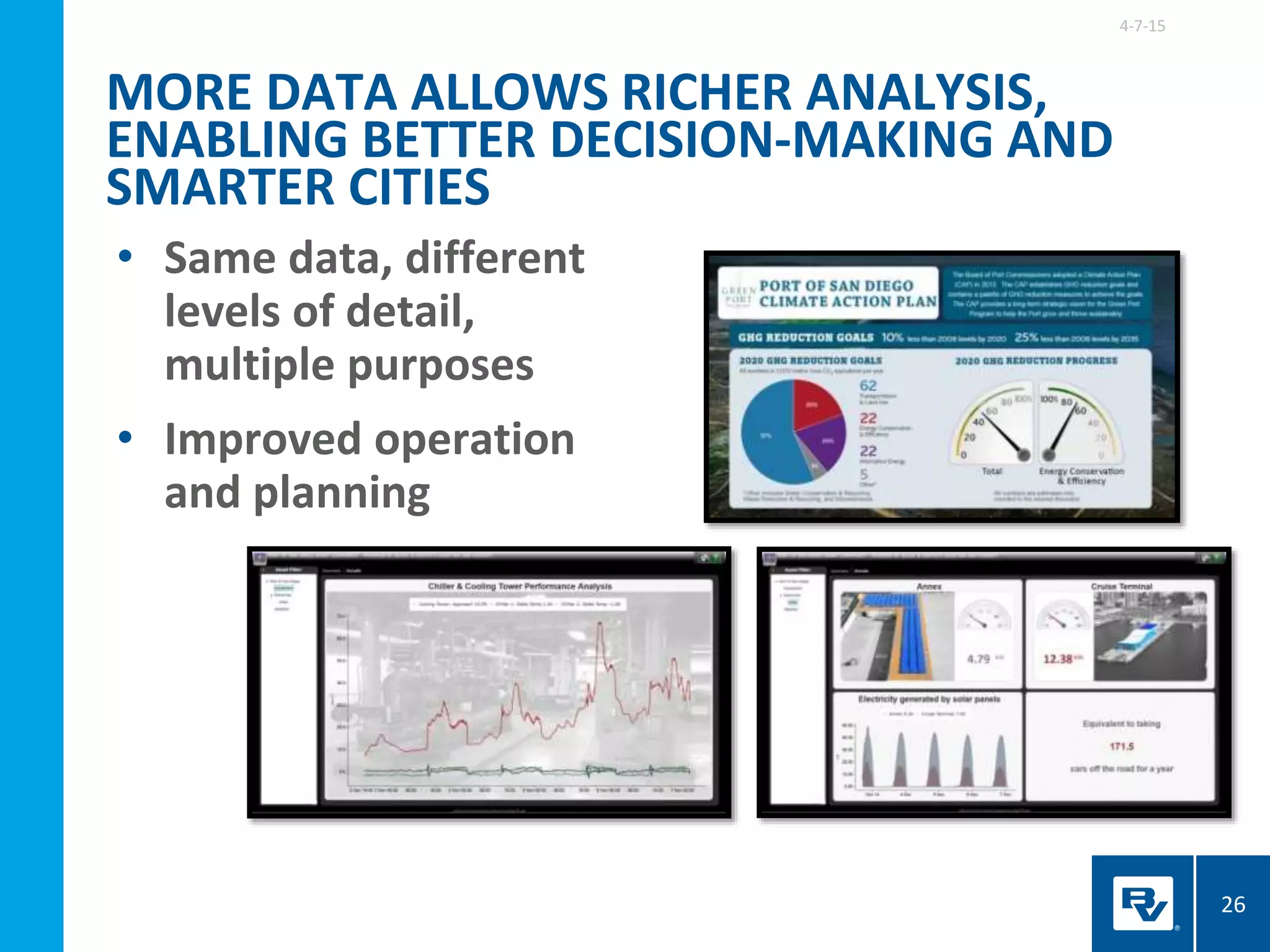
• Same data, different
levels of detail,
multiple purposes
• Improved operation
and planning
4-7-15
26
MORE DATA ALLOWS RICHER ANALYSIS,
ENABLING BETTER DECISION-MAKING AND
SMARTER CITIES
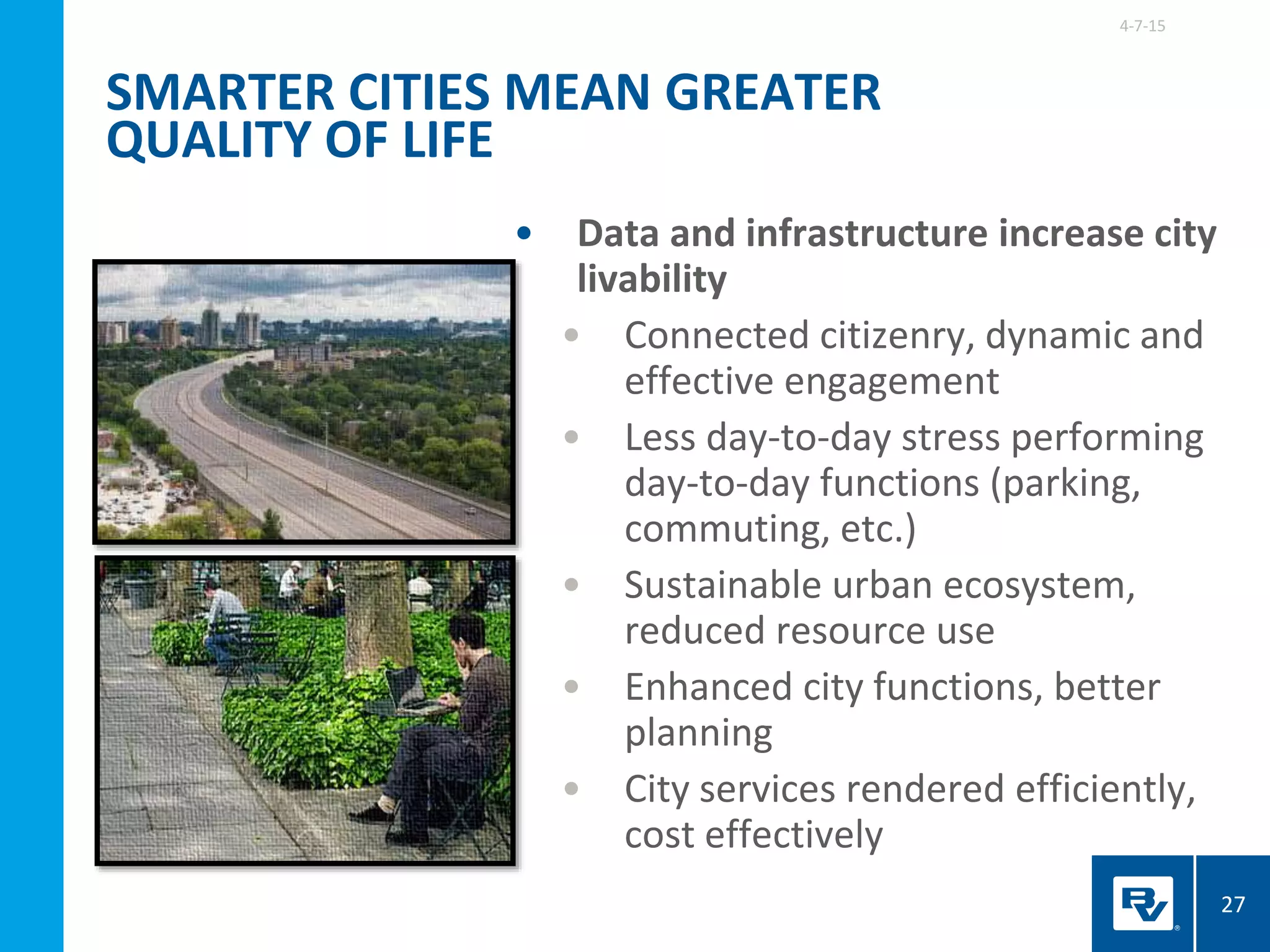
• Data and infrastructure increase city
livability
• Connected citizenry, dynamic and
effective engagement
• Less day-to-day stress performing
day-to-day functions (parking,
commuting, etc.)
• Sustainable urban ecosystem,
reduced resource use
• Enhanced city functions, better
planning
• City services rendered efficiently,
cost effectively
4-7-15
27
SMARTER CITIES MEAN GREATER
QUALITY OF LIFE
28
LET’S TALK
CONCLUSIONS…
We’re
done
already?
Nearly 81% of the U.S. population lives in cities, and this
growing urbanization is accelerating the need for Smart
Cities. Municipalities are capitalizing on the convergence
of data and intelligent infrastructure to connect city
systems and citizenry; transform urban centers and
utilities; and mobilize a new city structure based on
sustainability, resiliency and livability.
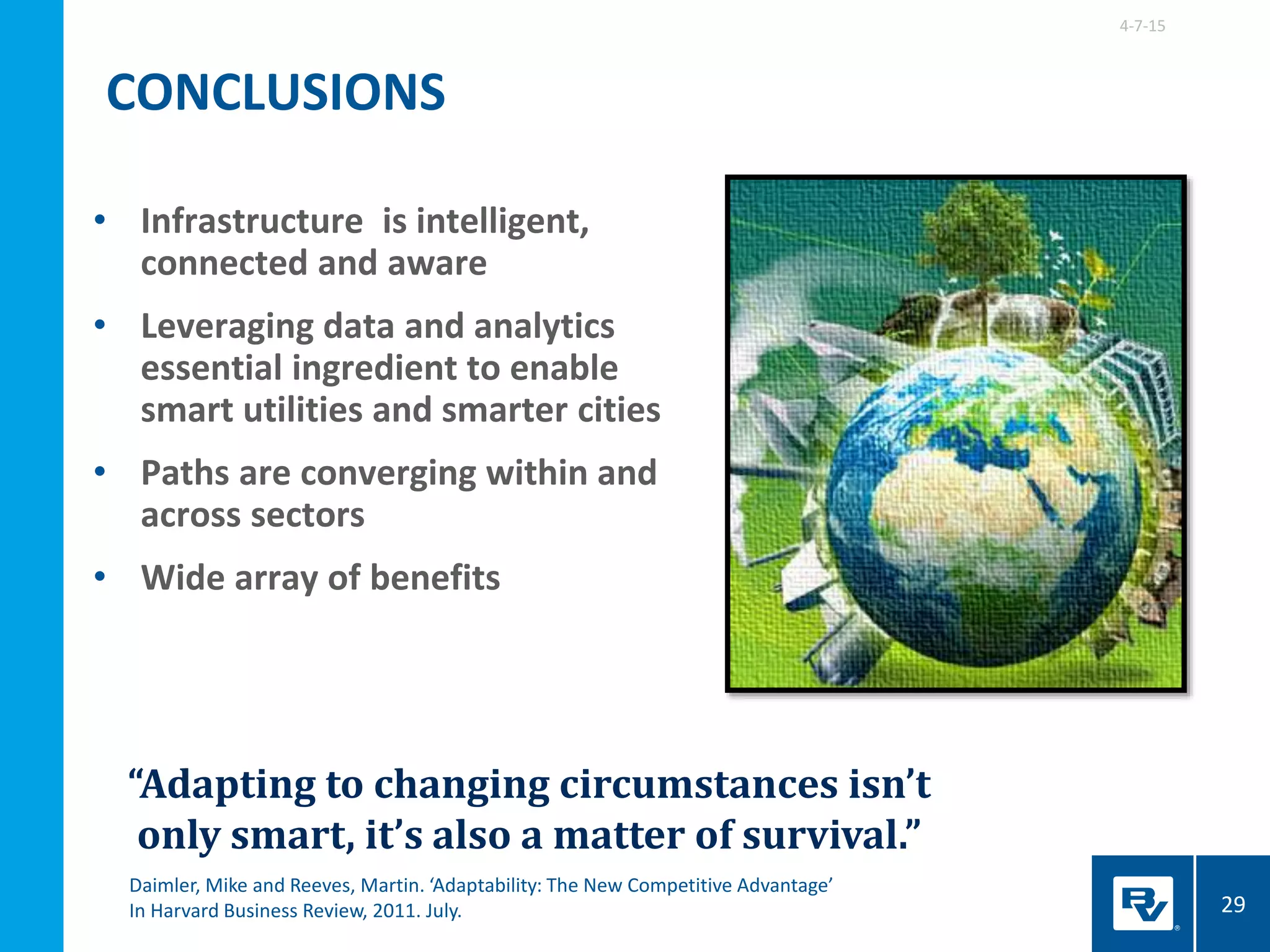
• Infrastructure is intelligent,
connected and aware
• Leveraging data and analytics
essential ingredient to enable
smart utilities and smarter cities
• Paths are converging within and
across sectors
• Wide array of benefits
4-7-15
29
“Adapting to changing circumstances isn’t
only smart, it’s also a matter of survival.”
Daimler, Mike and Reeves, Martin. ‘Adaptability: The New Competitive Advantage’
In Harvard Business Review, 2011. July.
CONCLUSIONS

Future Urban Systems: The Convergence of a Smart Integrated Infrastructure

  • 1.
    4-7-15 SCOTT STALLARD—VICE PRESIDENT SMARTANALYTICS RICK AZER—DIRECTOR OF DEVELOPMENT SMART INTEGRATED INFRASTRUCTURE FUTURE URBAN SYSTEMS: THE CONVERGENCE OF A SMART INTEGRATED INFRASTRUCTURE
  • 2.
    • Rick Azer,Director of Development for Integrated Infrastructure, Smart Integrated Infrastructure • Establish solution architecture • Identify new trends • Support ecosystem development • Support system integration capability 4-7-15 2 • Scott Stallard, Vice President, Smart Analytics, Smart Integrated Infrastructure • Development and Marketing of Asset360™ analytics platform • Lead Asset Management Services for Energy • Enable systems optimization and transformation of complex assets across Energy, Water, and Smart Communities INTRODUCTIONS
  • 3.
    We are creatinga very different future centered on the technology revolution. • Need for higher levels of resiliency • Regulation & compliance • Aging infrastructure • Affordability / sources of capital • Safety and security challenges • Urbanization • Climate change • Infusion of new technologies and new players • Social media and customer participation TODAY’S BUSINESS ENVIRONMENT IS INCREASINGLY CHALLENGING AND COMPLEX 4-7-15 3
  • 4.
    Enables more efficient,reliable, cost-effective and convenient delivery of essential services 4-7-15 4 BLACK & VEATCH CONCEPT OF SMART INTEGRATED INFRASTRUCTURE
  • 5.
    SEVEN FACTORS ENABLINGTHE RISE OF SMART INTEGRATED INFRASTRUCTURE • Pervasive wireless coverage • Transformation of public carrier business plans to accommodate the Internet of Everything • Miniaturization of processors and the integration of communication modules into intelligent devices • Abundant cheap data storage and processing power • Rise of cloud computing and edge computing • Access to vast data streams enabling potential for rich analytics • Extensive improvements in application development and visual display capabilities 5 4-7-15
  • 6.
    The bond betweendata, connectivity and application development creates expansive opportunities • Ordinary items are becoming extraordinary • Connectivity facilitates convergence • As data layers interact they become more powerful • Enabling multi-dimensional awareness, smart infrastructure 66 Convergence THE TRANSFORMATION IS TANGIBLE 4-7-15
  • 7.
    • City’s criticalsystems become more sustainable and flexible • Energy, water, transport and waste-handling • Data and communications allows utilities and infrastructure owners to • Drive new efficiencies in resource use • Measure and manage energy, water and bandwidth 7 TRANSFORMATION BRINGS CROSS-SECTOR INTEGRATION OF SYSTEMS, DATA AND COMMUNICATION 4-7-15
  • 8.
    IntegratedSystems ClientContext Market&EconomicContext Customer Engagement &ERP RegulatoryExpertise & Advice Renewable Energy Technology Market Planning Asset Management Operational Technology 4-7-15 8 Similar situations also exist in water, industry, community/city contexts. Integration of Planning, Operations, and Asset Management Functions Client IssuesIndustry Trends Protect Earnings Invest Capital to Manage Assets Deploy Smart Integrated Infrastructure Influence Policy Engage Customers Regulatory Change & Uncertainty Evolving Technologies & Business Models Reduced Demand Aging Infrastructure Rising Operating Costs Natural Gas Evolution Environment DRIVING A “TECHNOLOGY-INFUSED” UTILITY TRANSFORMATION
  • 9.
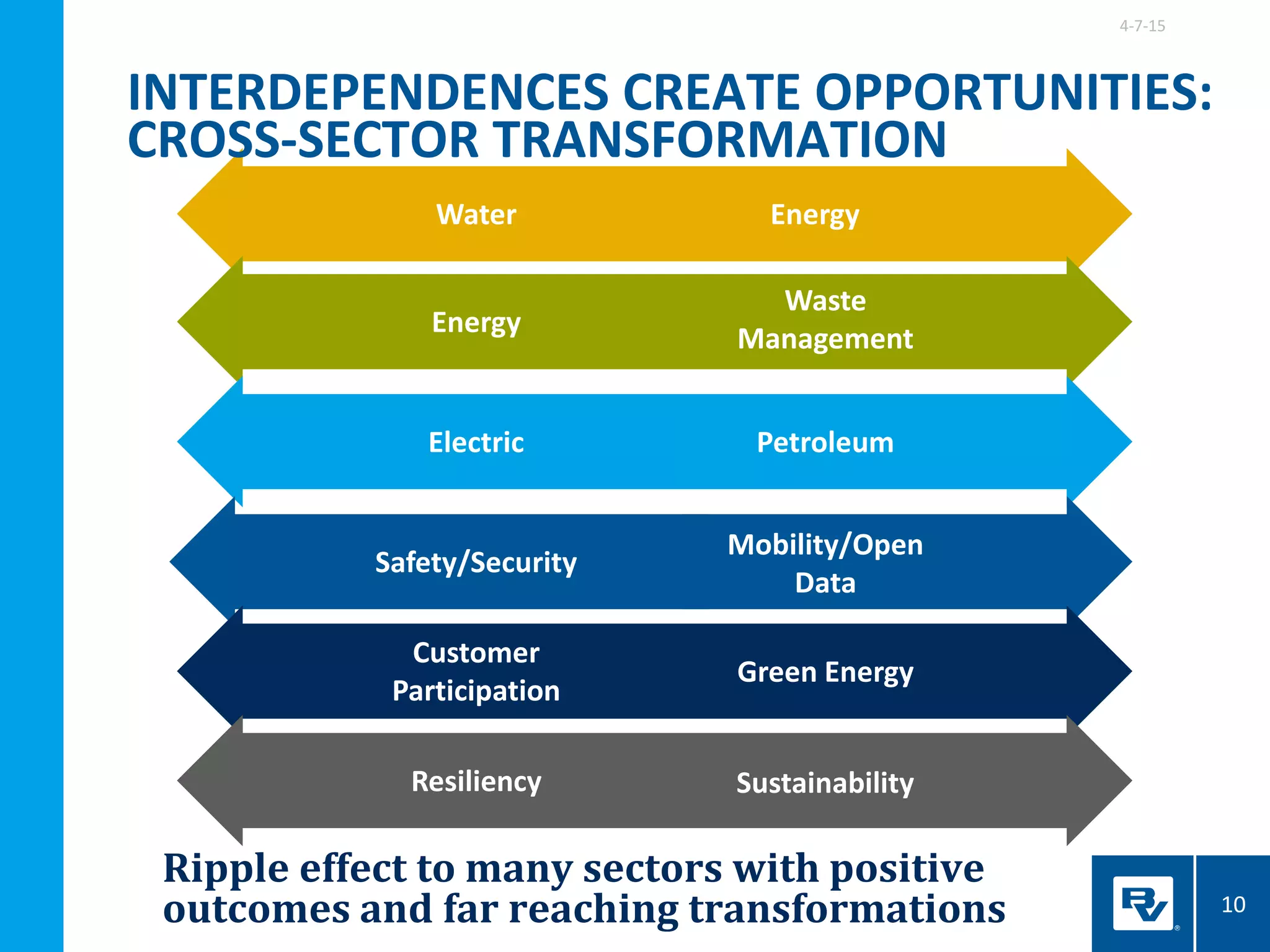
    Ripple effect tomany sectors with positive outcomes and far reaching transformations 4-7-15 9 Water Energy Energy Waste Management Electric Petroleum Safety/Security Mobility/Open Data Customer Participation Green Energy Resiliency Sustainability INTERDEPENDENCES CREATE OPPORTUNITIES: CROSS-SECTOR TRANSFORMATION
  • 10.
    Ripple effect tomany sectors with positive outcomes and far reaching transformations 4-7-15 10 Water Energy Waste Management Electric Petroleum Safety/Security Mobility/Open Data Customer Participation Green Energy Resiliency Sustainability Energy INTERDEPENDENCES CREATE OPPORTUNITIES: CROSS-SECTOR TRANSFORMATION
  • 11.
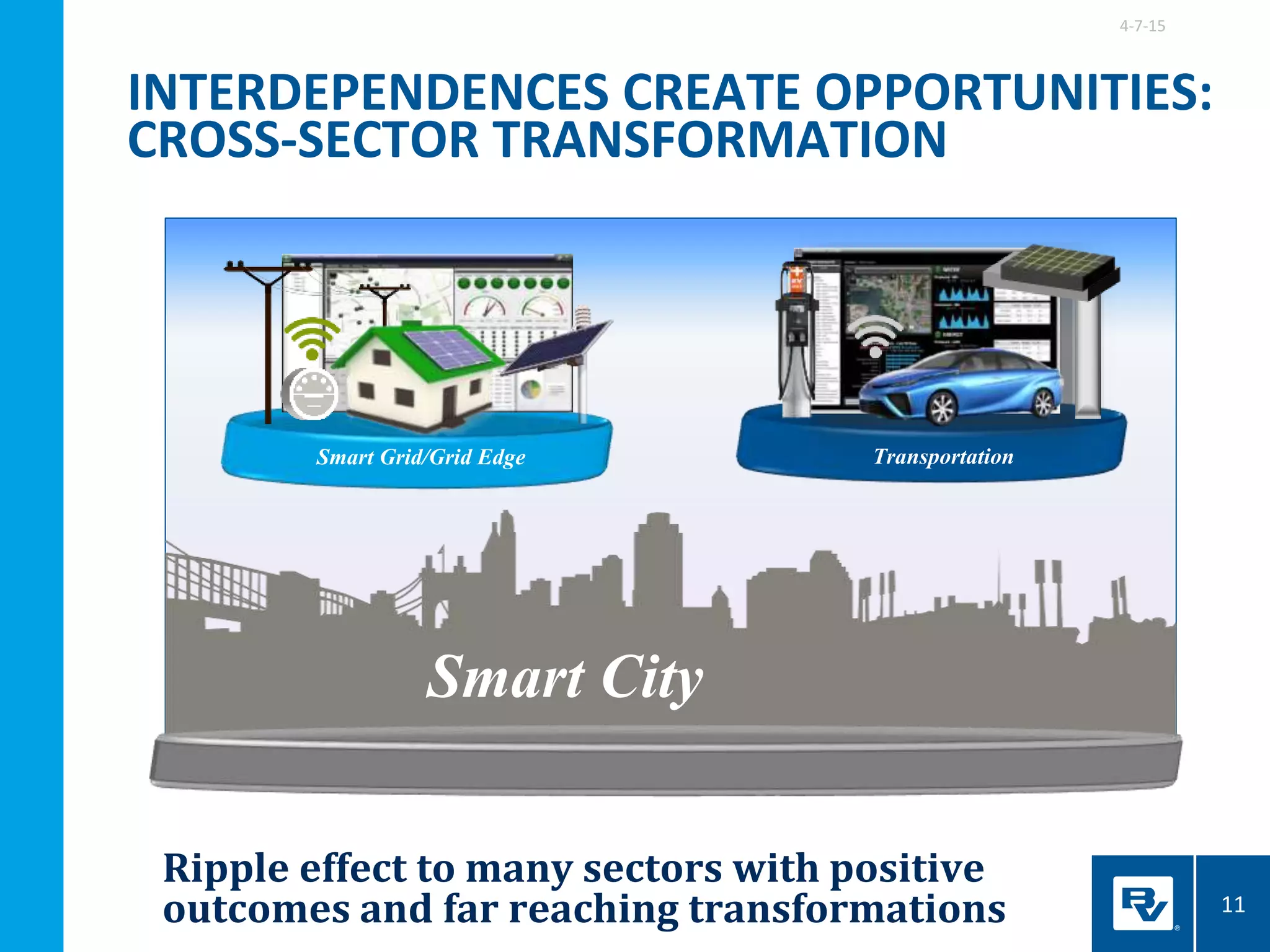
    Ripple effect tomany sectors with positive outcomes and far reaching transformations 4-7-15 11 Smart City TransportationSmart Grid/Grid Edge INTERDEPENDENCES CREATE OPPORTUNITIES: CROSS-SECTOR TRANSFORMATION
  • 12.
    12 Every resident inChicago will have a smart meter by 2017 to support the city’s planned Smart Grid. The grid is expected to reduce energy waste and save customers $170 million. MIT TR Editors. ‘A Closer Look at Smart Cities’ in MIT Technology Review, 2014: November 18. LET’S TALK SMART GRID…. What makes it so smart?
  • 13.
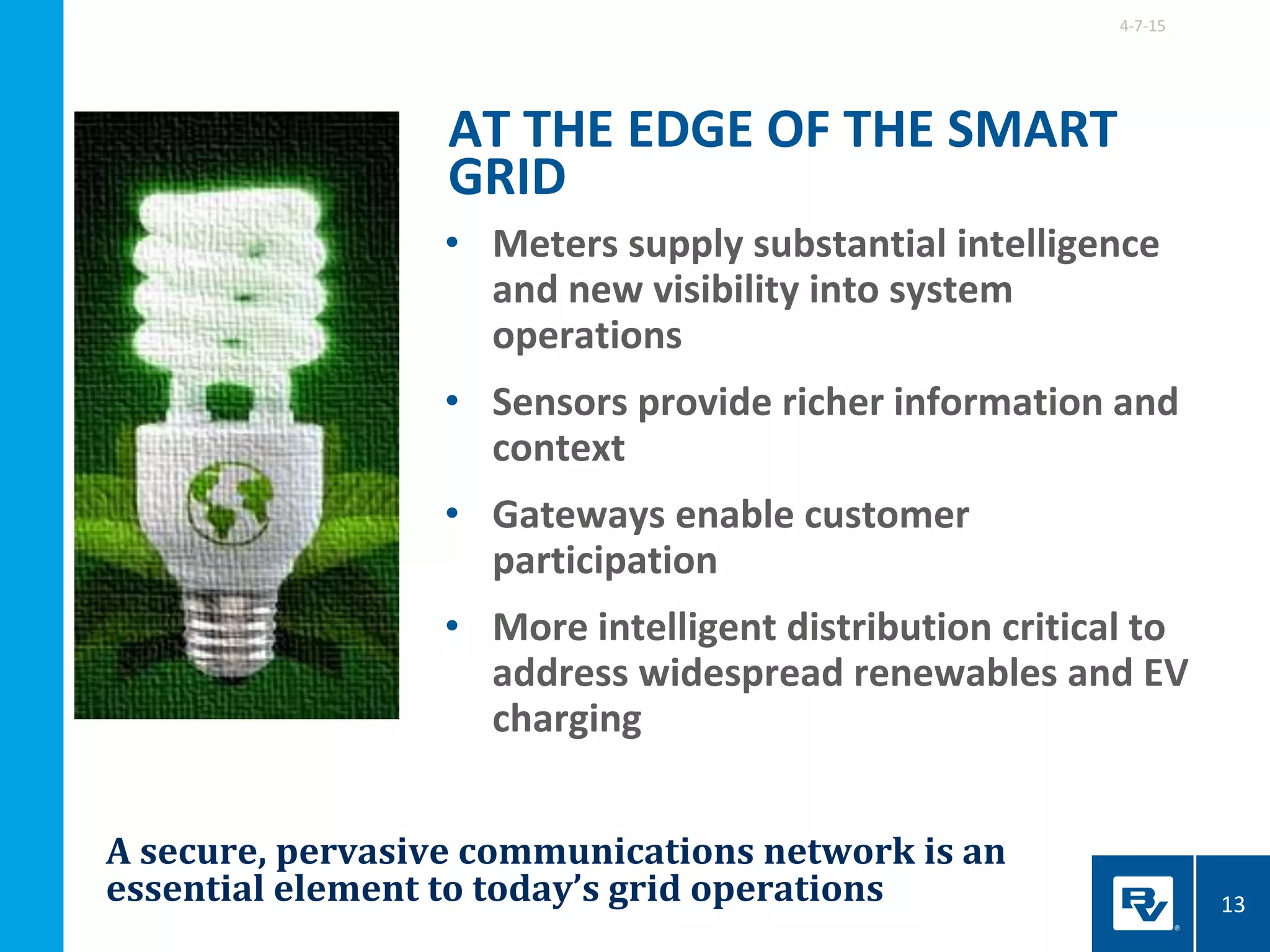
    A secure, pervasivecommunications network is an essential element to today’s grid operations • Meters supply substantial intelligence and new visibility into system operations • Sensors provide richer information and context • Gateways enable customer participation • More intelligent distribution critical to address widespread renewables and EV charging AT THE EDGE OF THE SMART GRID 4-7-15 13
  • 14.
    • Cross-sector opportunity •Electric, water/wastewater, waste, transport, lighting, facility management, mobility • Enormously complex • Varies across time • Requires lots of data • Demand • Usage • Flexibility • Tangible benefits • Avoided capital as well as avoided operating costs ENERGY EFFICIENCY OPPORTUNITY Analyzing Massive Meter Datasets to Understand CVR Performance 4-7-15 14
  • 15.
    • Hawaiian Electric’s15-year Power Supply Improvement Plans: • Cost-effectively shift to > 65% renewable energy by 2030 • Major transformation in power supply and distribution • Many dynamic, interrelated variables impact investments • Issues include grid stability, shifting revenue base (resident rooftop solar), optimal application of DR/ES • Plan must be flexible to adapt to changing circumstances 4-7-15 15 TECHNOLOGY TRANSFORMATION: HAWAII’S ENERGY FUTURE
  • 16.
    Significant integration ofnon-firm sources. Source: Hawaiian Electric Power Supply Improvement Plan, August 2014. 4-7-15 16 MAJOR TRANSFORMATION FROM CURRENT TO FUTURE STATE
  • 17.
    • Grid edgeis expanding across layers, bi-directionally • Physical assets • Network • Data analytics • Applications • Convergence of existing technologies • Provides more information to transform and optimize operations • Drives emerging technologies, new business models 4-7-15 17 TRANSFORMATION OF GRID IS BIDIRECTIONAL
  • 18.
    18 LET’S TALK SMART TRANSPORTATION… “Thereal benefits of these [connected transportation] systems will come if cities use this data to guide decisions about traffic management and long-term planning.” Knight, Will. ‘Car-Based Technology that Could Invigorate Cities’ in MIT Technology Review, 2014: November 28. Street-smart sedans?
  • 19.
    • Today’s designsleverage connectivity for telematics and infotainment • Future designs will allow for advanced communication with the environment • Advances in safety and performance • Autonomous driving vehicles are within sight • Connected transportation • Data from mobile apps, sensors, smart meters, signal control, parking space management • Real-time data optimizes travel 4-7-15 19 VEHICLES ARE THE NEXT “CONNECTED DEVICE”
  • 20.
    • Electric Vehicle charginginfrastructure and applications • Bi-directional charging and interaction with grid pricing signals • Solar energy, battery storage and Wi-Fi integration 4-7-15 20 SMART INFRASTRUCTURE AND ELECTRIC VEHICLES MOBILE AGENTS OF SMART GRID AND SMART CITY
  • 21.
    SMART INFRASTRUCTURE ANDELECTRIC VEHICLES MOBILE AGENTS OF SMART GRID AND SMART CITY Source: Black & Veatch, Strategic Directions, Smart Utility Report, 2015. • Communication infrastructure extending to grid edge • Use of devices, sensors and bi- directional connectivity • Grid Benefits • Deeper understanding of what’s happening on the grid • Cheap energy to offset carbon fuel demand • Distributed energy storage • Reduced peak demand • Expansion of the Smart Grid with more vehicle-to-grid charging stations 4-7-15 21 64.5% 43.6% 40.7% 39.5% 30.8% 23.3% 22.1% 19.8% 16.9% 11.6% 9.9% 3.5% 2.9% Smart electric grid Renewable/distribute… High-speed data… Energy management… Smart water systems Smart buildings Smart transportation Smart street lighting Microgrids or… Smart waste systems Interactive… Other Don’t know SYSTEMS RELATED TO SMART INITIATIVES CURRENTLY BEING IMPLEMENTED
  • 22.
    22 LET’S TALK SMART CITIES… “Ascities turn to the evolving science of happiness to provide residents with benefits and wellbeing, the aspect of joy or fun services in their own right or as part of existing functions will grow. Technology is playing a large part in that…” Nexgen. ’10 Tech Trends for the Smart City Manager to Look for in 2015’ in Nexgen Group Blog, 2015: January 11. Optimizing the urban jungle?
  • 23.
    • Create citizenengagement and enthusiasm • Leverage social media, mobile apps • Create richer communications between citizens and city • Economic development • Resilience • Improve city operations • Lower costs (investment, operations) • Garner incremental benefits with investments (ROI) 4-7-15 23 BUILDING A BETTER CITY
  • 24.
    Data and intelligentinfrastructure drive efficient use of resources, which enhances citizens’ day-to- day city experience. • Transform city data into monetize-able assets • Leverage an integrated and secure data platform • Create a community that maximizes: • Livability • Workability • Sustainability • Customer participation • Smart elements (parking, city information kiosks) 4-7-15 24 BUILDING A BETTER CITY
  • 25.
    • Smart infrastructureis backbone of a Smart City • Transformation trek: from smart utility, smart transportation and smart grid to Smart City • Water trek: from aging systems to holistic water management across full cycle with advanced energy/resource management 4-7-15 25 Connecting the Pieces of a Smart City: Infrastructure/system integration, data analytics, optimized operation. CONVERGENCE ROADS LEAD TO THE SMART CITY
  • 26.
    • Same data,different levels of detail, multiple purposes • Improved operation and planning 4-7-15 26 MORE DATA ALLOWS RICHER ANALYSIS, ENABLING BETTER DECISION-MAKING AND SMARTER CITIES
  • 27.
    • Data andinfrastructure increase city livability • Connected citizenry, dynamic and effective engagement • Less day-to-day stress performing day-to-day functions (parking, commuting, etc.) • Sustainable urban ecosystem, reduced resource use • Enhanced city functions, better planning • City services rendered efficiently, cost effectively 4-7-15 27 SMARTER CITIES MEAN GREATER QUALITY OF LIFE
  • 28.
    28 LET’S TALK CONCLUSIONS… We’re done already? Nearly 81%of the U.S. population lives in cities, and this growing urbanization is accelerating the need for Smart Cities. Municipalities are capitalizing on the convergence of data and intelligent infrastructure to connect city systems and citizenry; transform urban centers and utilities; and mobilize a new city structure based on sustainability, resiliency and livability.
  • 29.
    • Infrastructure isintelligent, connected and aware • Leveraging data and analytics essential ingredient to enable smart utilities and smarter cities • Paths are converging within and across sectors • Wide array of benefits 4-7-15 29 “Adapting to changing circumstances isn’t only smart, it’s also a matter of survival.” Daimler, Mike and Reeves, Martin. ‘Adaptability: The New Competitive Advantage’ In Harvard Business Review, 2011. July. CONCLUSIONS