
Using Customer Segmentation to Improve Energy Efficiency,
Water Conservation, and Program Participation
Robert Brnilovich, Black &Veatch & Harman Sandhu, SUS
| @Black_Veatch| www.bv.com
About the Speakers
Harman Sandhu
• 15 years in analytics and technology
• Experienced executive helping utilities with management
strategy, Smart Grid, and technology roadmaps
Robert Brnilovich
• 31 years in enterprise management & technology consulting
• Focused on helping E&U companies become more customer
focused and solve environmental issues with technology.
| @Black_Veatch| www.bv.com
Utility Customer is changing
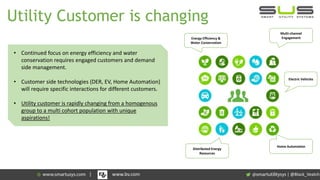
• Continued focus on energy efficiency and water
conservation requires engaged customers and demand
side management.
• Customer side technologies (DER, EV, Home Automation)
will require specific interactions for different customers.
• Utility customer is rapidly changing from a homogenous
group to a multi cohort population with unique
aspirations!
Multi-channel
EngagementEnergy Efficiency &
Water Conservation
Distributed Energy
Resources
Home Automation
Electric Vehicles
| www.bv.com | @Black_Veatch
Translating Consumer Awareness Into
Action:
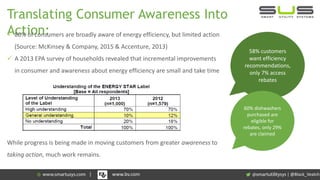
58% customers
want efficiency
recommendations,
only 7% access
rebates
60% dishwashers
purchased are
eligible for
rebates, only 29%
are claimed
 80% of consumers are broadly aware of energy efficiency, but limited action
(Source: McKinsey & Company, 2015 & Accenture, 2013)
 A 2013 EPA survey of households revealed that incremental improvements
in consumer and awareness about energy efficiency are small and take time
While progress is being made in moving customers from greater awareness to
taking action, much work remains.
| @Black_Veatch| www.bv.com
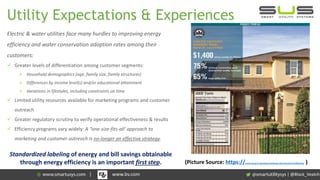
Utility Expectations & Experiences
(Picture Source: https://www3.epa.gov/region9/greenbuilding/codes/standards.html#labeling )
Electric & water utilities face many hurdles to improving energy
efficiency and water conservation adoption rates among their
customers:
 Greater levels of differentiation among customer segments:
 Household demographics (age, family size, family structures)
 Differences by income level(s) and/or educational attainment
 Variations in lifestyles, including constraints on time
 Limited utility resources available for marketing programs and customer
outreach
 Greater regulatory scrutiny to verify operational effectiveness & results
 Efficiency programs vary widely: A “one-size-fits-all’ approach to
marketing and customer outreach is no-longer an effective strategy.
Standardized labeling of energy and bill savings obtainable
through energy efficiency is an important first step.
| @Black_Veatch| www.bv.com
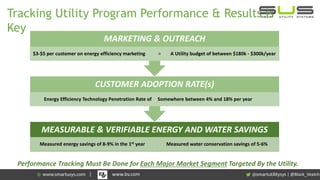
Tracking Utility Program Performance & Results is
Key
MEASURABLE & VERIFIABLE ENERGY AND WATER SAVINGS
Measured energy savings of 8-9% in the 1st year Measured water conservation savings of 5-6%
CUSTOMER ADOPTION RATE(s)
Energy Efficiency Technology Penetration Rate of Somewhere between 4% and 18% per year
MARKETING & OUTREACH
$3-$5 per customer on energy efficiency marketing = A Utility budget of between $180k - $300k/year
Performance Tracking Must Be Done for Each Major Market Segment Targeted By the Utility.
| @Black_Veatch| www.bv.com
Measurements to Drive Change
“You can’t manage what you can’t measure.”
- Peter Drucker
…we can measure, therefore we can change!
| @Black_Veatch| www.bv.com
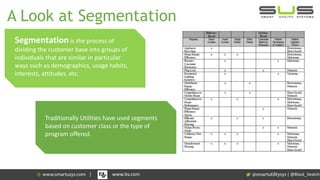
A Look at Segmentation
Segmentation is the process of
dividing the customer base into groups of
individuals that are similar in particular
ways such as demographics, usage habits,
interests, attitudes, etc.
Traditionally Utilities have used segments
based on customer class or the type of
program offered.
| @Black_Veatch| www.bv.com
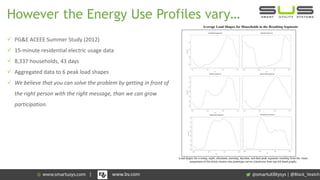
However the Energy Use Profiles vary…
 PG&E ACEEE Summer Study (2012)
 15-minute residential electric usage data
 8,337 households, 43 days
 Aggregated data to 6 peak load shapes
 We believe that you can solve the problem by getting in front of
the right person with the right message, than we can grow
participation.
| @Black_Veatch| www.bv.com
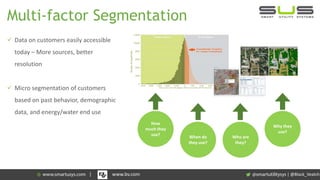
Multi-factor Segmentation
 Data on customers easily accessible
today – More sources, better
resolution
 Micro segmentation of customers
based on past behavior, demographic
data, and energy/water end use
How
much they
use?
When do
they use?
Who are
they?
Why they
use?
| @Black_Veatch| www.bv.com
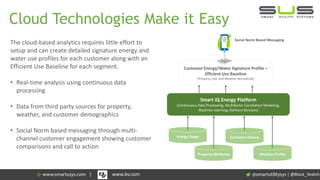
Cloud Technologies Make it Easy
The cloud-based analytics requires little effort to
setup and can create detailed signature energy and
water use profiles for each customer along with an
Efficient Use Baseline for each segment.
• Real-time analysis using continuous data
processing
• Data from third party sources for property,
weather, and customer demographics
• Social Norm based messaging through multi-
channel customer engagement showing customer
comparisons and call to action
Property Attributes Weather Profile
Energy Usage Customer History
Smart iQ Energy Platform
(Continuous Data Processing, Multifactor Correlation Modeling,
Machine Learning, Delivery Services)
Customer Energy/Water Signature Profile +
Efficient Use Baseline
(Property, Use, and Weather Normalized)
Social Norm Based Messaging
| @Black_Veatch| www.bv.com
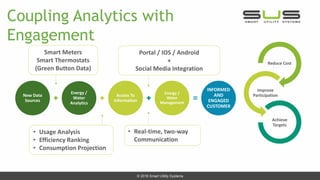
Reduce Cost
Improve
Participation
Achieve
Targets
New Data
Sources
Energy /
Water
Analytics
Access To
Information
Energy /
Water
Management
INFORMED
AND
ENGAGED
CUSTOMER
• Real-time, two-way
Communication
• Usage Analysis
• Efficiency Ranking
• Consumption Projection
Portal / IOS / Android
+
Social Media Integration
Smart Meters
Smart Thermostats
(Green Button Data)
Coupling Analytics with
Engagement
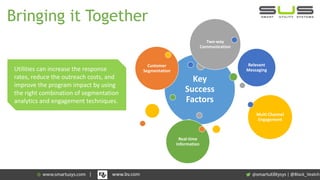
Utilities can increase the response
rates, reduce the outreach costs, and
improve the program impact by using
the right combination of segmentation
analytics and engagement techniques.
Bringing it Together
Key
Success
Factors
Customer
Segmentation
Relevant
Messaging
Multi Channel
Engagement
Real-time
Information
Two-way
Communication
| @Black_Veatch| www.bv.com
Black & Veatch Study
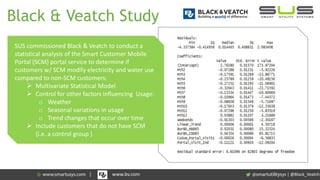
SUS commissioned Black & Veatch to conduct a
statistical analysis of the Smart Customer Mobile
Portal (SCM) portal service to determine if
customers w/ SCM modify electricity and water use
compared to non-SCM customers:
 Multivariate Statistical Model
 Control for other factors influencing Usage:
o Weather
o Seasonal variations in usage
o Trend changes that occur over time
 Include customers that do not have SCM
(i.e. a control group )
| @Black_Veatch| www.bv.com
Black & Veatch Findings
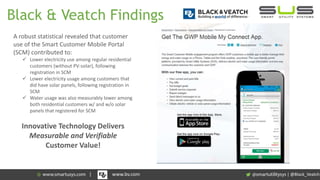
A robust statistical revealed that customer
use of the Smart Customer Mobile Portal
(SCM) contributed to:
 Lower electricity use among regular residential
customers (without PV-solar), following
registration in SCM
 Lower electricity usage among customers that
did have solar panels, following registration in
SCM
 Water usage was also measurably lower among
both residential customers w/ and w/o solar
panels that registered for SCM
Innovative Technology Delivers
Measurable and Verifiable
Customer Value!
| @Black_Veatch| www.bv.com
Group Discussion
Further Questions, Contact Us!
| @Black_Veatch| www.bv.com

A Smarter Customer Segmentation Approach for Utilities

  • 1.
    Using Customer Segmentationto Improve Energy Efficiency, Water Conservation, and Program Participation Robert Brnilovich, Black &Veatch & Harman Sandhu, SUS | @Black_Veatch| www.bv.com
  • 2.
    About the Speakers HarmanSandhu • 15 years in analytics and technology • Experienced executive helping utilities with management strategy, Smart Grid, and technology roadmaps Robert Brnilovich • 31 years in enterprise management & technology consulting • Focused on helping E&U companies become more customer focused and solve environmental issues with technology. | @Black_Veatch| www.bv.com
  • 3.
    Utility Customer ischanging • Continued focus on energy efficiency and water conservation requires engaged customers and demand side management. • Customer side technologies (DER, EV, Home Automation) will require specific interactions for different customers. • Utility customer is rapidly changing from a homogenous group to a multi cohort population with unique aspirations! Multi-channel EngagementEnergy Efficiency & Water Conservation Distributed Energy Resources Home Automation Electric Vehicles | www.bv.com | @Black_Veatch
  • 4.
    Translating Consumer AwarenessInto Action: 58% customers want efficiency recommendations, only 7% access rebates 60% dishwashers purchased are eligible for rebates, only 29% are claimed  80% of consumers are broadly aware of energy efficiency, but limited action (Source: McKinsey & Company, 2015 & Accenture, 2013)  A 2013 EPA survey of households revealed that incremental improvements in consumer and awareness about energy efficiency are small and take time While progress is being made in moving customers from greater awareness to taking action, much work remains. | @Black_Veatch| www.bv.com
  • 5.
    Utility Expectations &Experiences (Picture Source: https://www3.epa.gov/region9/greenbuilding/codes/standards.html#labeling ) Electric & water utilities face many hurdles to improving energy efficiency and water conservation adoption rates among their customers:  Greater levels of differentiation among customer segments:  Household demographics (age, family size, family structures)  Differences by income level(s) and/or educational attainment  Variations in lifestyles, including constraints on time  Limited utility resources available for marketing programs and customer outreach  Greater regulatory scrutiny to verify operational effectiveness & results  Efficiency programs vary widely: A “one-size-fits-all’ approach to marketing and customer outreach is no-longer an effective strategy. Standardized labeling of energy and bill savings obtainable through energy efficiency is an important first step. | @Black_Veatch| www.bv.com
  • 6.
    Tracking Utility ProgramPerformance & Results is Key MEASURABLE & VERIFIABLE ENERGY AND WATER SAVINGS Measured energy savings of 8-9% in the 1st year Measured water conservation savings of 5-6% CUSTOMER ADOPTION RATE(s) Energy Efficiency Technology Penetration Rate of Somewhere between 4% and 18% per year MARKETING & OUTREACH $3-$5 per customer on energy efficiency marketing = A Utility budget of between $180k - $300k/year Performance Tracking Must Be Done for Each Major Market Segment Targeted By the Utility. | @Black_Veatch| www.bv.com
  • 7.
    Measurements to DriveChange “You can’t manage what you can’t measure.” - Peter Drucker …we can measure, therefore we can change! | @Black_Veatch| www.bv.com
  • 8.
    A Look atSegmentation Segmentation is the process of dividing the customer base into groups of individuals that are similar in particular ways such as demographics, usage habits, interests, attitudes, etc. Traditionally Utilities have used segments based on customer class or the type of program offered. | @Black_Veatch| www.bv.com
  • 9.
    However the EnergyUse Profiles vary…  PG&E ACEEE Summer Study (2012)  15-minute residential electric usage data  8,337 households, 43 days  Aggregated data to 6 peak load shapes  We believe that you can solve the problem by getting in front of the right person with the right message, than we can grow participation. | @Black_Veatch| www.bv.com
  • 10.
    Multi-factor Segmentation  Dataon customers easily accessible today – More sources, better resolution  Micro segmentation of customers based on past behavior, demographic data, and energy/water end use How much they use? When do they use? Who are they? Why they use? | @Black_Veatch| www.bv.com
  • 11.
    Cloud Technologies Makeit Easy The cloud-based analytics requires little effort to setup and can create detailed signature energy and water use profiles for each customer along with an Efficient Use Baseline for each segment. • Real-time analysis using continuous data processing • Data from third party sources for property, weather, and customer demographics • Social Norm based messaging through multi- channel customer engagement showing customer comparisons and call to action Property Attributes Weather Profile Energy Usage Customer History Smart iQ Energy Platform (Continuous Data Processing, Multifactor Correlation Modeling, Machine Learning, Delivery Services) Customer Energy/Water Signature Profile + Efficient Use Baseline (Property, Use, and Weather Normalized) Social Norm Based Messaging | @Black_Veatch| www.bv.com
  • 12.
    Reduce Cost Improve Participation Achieve Targets New Data Sources Energy/ Water Analytics Access To Information Energy / Water Management INFORMED AND ENGAGED CUSTOMER • Real-time, two-way Communication • Usage Analysis • Efficiency Ranking • Consumption Projection Portal / IOS / Android + Social Media Integration Smart Meters Smart Thermostats (Green Button Data) Coupling Analytics with Engagement
  • 13.
    Utilities can increasethe response rates, reduce the outreach costs, and improve the program impact by using the right combination of segmentation analytics and engagement techniques. Bringing it Together Key Success Factors Customer Segmentation Relevant Messaging Multi Channel Engagement Real-time Information Two-way Communication | @Black_Veatch| www.bv.com
  • 14.
    Black & VeatchStudy SUS commissioned Black & Veatch to conduct a statistical analysis of the Smart Customer Mobile Portal (SCM) portal service to determine if customers w/ SCM modify electricity and water use compared to non-SCM customers:  Multivariate Statistical Model  Control for other factors influencing Usage: o Weather o Seasonal variations in usage o Trend changes that occur over time  Include customers that do not have SCM (i.e. a control group ) | @Black_Veatch| www.bv.com
  • 15.
    Black & VeatchFindings A robust statistical revealed that customer use of the Smart Customer Mobile Portal (SCM) contributed to:  Lower electricity use among regular residential customers (without PV-solar), following registration in SCM  Lower electricity usage among customers that did have solar panels, following registration in SCM  Water usage was also measurably lower among both residential customers w/ and w/o solar panels that registered for SCM Innovative Technology Delivers Measurable and Verifiable Customer Value! | @Black_Veatch| www.bv.com
  • 16.
    Group Discussion Further Questions,Contact Us! | @Black_Veatch| www.bv.com