FUTURE NETWORK ARCHITECTURES:
 REQUIREMENTS AND CHALLENGES


       Antônio Marcos Alberti


                                © Antônio M. Alberti 2011
Outline
1.   Introduction
2.   Substrate Resources and Its Integration with Software
3.   Information, ID/Loc Splitting, Semantic, Context and Mobility
4.   Autonomic and Cognitive Technologies
5.   Security, Privacy and Trust
6.   Services and Applications
7.   Simplicity, Sustainability and Evolvability


                                                            © Antônio M. Alberti 2011
1. Introduction
 The Internet has invaded most aspects of life and society,
    changing our lifestyle, work, communication and social
    interaction.

 Nobody doubts about the fundamental role of the Internet on our
  society.


                                                         © Antônio M. Alberti 2011
1. Introduction
 Nevertheless, the Internet today is a complex agglomerate of
    protocols that inherits the grown legacies of decades of
    patchwork solutions.

 It was designed in an era where technological development was
  completely different from today.

 This motivated many people to question the adequacy of the
  TCP/IP stack to meet our information society needs.

 Since this question was first made, a lot of initiatives to reshape
  the Internet appeared around the world - the so called Future
  Internet design.


                                                           © Antônio M. Alberti 2011
1. Introduction
 The main motto question is:
   Considering the current state-of-art on computing and
    communications, is it possible to design right now a new Internet
    that best meets our information society needs?

 This tutorial gives an introduction to the current approaches to
  design a new Internet.


                                                             © Antônio M. Alberti 2011
2. Substrate Resources and Its Integration with Software
 Technology Evolution
 Capacity and Ubiquity
 Internet of Things
 Real World Internet
 Virtualization


                                                           © Antônio M. Alberti 2011
Technology Evolution
 Moore's Law:
    Predicts technological developments in computing power.

 (Kurzweil, 2005):
    A theory for technological evolution – to describe the exponential
     growth of technological advances: The Law of Accelerated Returns


                                                            © Antônio M. Alberti 2011
Technology Evolution
 The Law of Accelerating Returns: Two positive feedback loops
   1. Selection of the more capable techniques of a certain stage to
      build the next stage – increases the rate of progress
      exponentially, reducing required time to obtain the same results.

   2. Selected process becomes more attractive than others and
      begins to catalyze resources to it – starts to evolve even faster,
      experiencing an additional exponential growth over the 1st.
      Source: http://www.kurzweilai.net/the-law-of-accelerating-returns


                                                                          © Antônio M. Alberti 2011
Capacity and Ubiquity
 (Kurzweil, 2005):
    Exponential growth trends for:
        Memory capacity (DRAM in bits per dollar), microprocessor clock speed
         (Hz), transistors per chip, processor performance (MIPS), magnetic
         storage (bits per dollar), the number of hosts on the Internet.


 (Saracco, 2009):
    Consistent technological developments in:
        Computing – is achieving teraflops right now and evolution proceeds to
         petaflops in the next decade.
        Display technology – has advanced enormously in later years.
        Consumer electronics, such as handsets, laptops, HDTVs, e-books,
         video games, GPSs, etc.


                                                                    © Antônio M. Alberti 2011
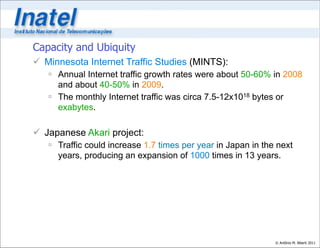
Capacity and Ubiquity
 Minnesota Internet Traffic Studies (MINTS):
    Annual Internet traffic growth rates were about 50-60% in 2008
     and about 40-50% in 2009.
    The monthly Internet traffic was circa 7.5-12x1018 bytes or
     exabytes.

 Japanese Akari project:
    Traffic could increase 1.7 times per year in Japan in the next
     years, producing an expansion of 1000 times in 13 years.


                                                              © Antônio M. Alberti 2011
Capacity and Ubiquity
 How to meet this demand?
    Mobile Access: 4G, Cognitive Radio (CR).

    Fixed Access: Fiber-To-The-Home (FTTH).

    Core: State-of-art optical transmission and switching.


                                                              © Antônio M. Alberti 2011
Capacity and Ubiquity
 The technological evolution leads to price reduction → Ubiquity.

 More and more devices are becoming computationally capable
  and connected to the Internet (e.g. clothing, buildings).

 Inexpensive computing → Ubiquitous Computing (smart
  environments and ambient intelligence).


                                                         © Antônio M. Alberti 2011
Internet of Things
 Consequences of Ubiquitous Computing:
    Connectivity anywhere, anytime, in anyplace, to anyone.

    The rise of the NEDs (Network Enabled Devices) army.

    The appearance of the Internet of Things (IoT) and Real World
     Internet (RWI).


                                                            © Antônio M. Alberti 2011
Internet of Things
 Challenges and Requirements (1/3):
    Exponential growth in the number of sensors collecting real world
     information → A flood of traffic on the network.

    Real world could be increasingly integrated to the virtual one,
     making it possible to greatly increase the interaction between
     them.

    Changes in real world objects could be reflected in virtual world –
     Changes made to virtual objects can become real.

    User’s sensitive information will be collected, such as identity,
     location and other contextualized information.


                                                                © Antônio M. Alberti 2011
Internet of Things
 Challenges and Requirements (2/3):
    Flood of sensitive information → will push network scalability to
     new limits.

    How to make this information safely available for innovative
     applications?

    How to address billions of new nodes? Addressing and traceability
     to sensors and actuators, e.g. in the case of a fire.

    Information needs to be contextualized to allow delivering to the
     right destiny, at the right time (information freshness).


                                                              © Antônio M. Alberti 2011
Internet of Things
 Challenges and Requirements (3/3):
    The need for energy-aware security → trust relations among
     nodes.

    Semantic and context → smoke detector: fire or fireworks?

    NEDs mobility → ID/Loc splitting.

    Management and control → Autonomic technologies.

    RWI as a sensorial system for Future Internet.


                                                           © Antônio M. Alberti 2011
Virtualization
 Exponential growth → diffuse substrate of digital technologies
  composed by processing, storage, display and communication
  resources.

 Much of the communication equipment today → become
  computers, with CPUs, Operating Systems, etc.

 How to make this diffuse substrate of hardware resources
  transparently and uniformly available to software?


                                                        © Antônio M. Alberti 2011
Virtualization
 The roles of virtualization on FI:
    An elementary aspect of the architecture itself;

    To enable simultaneous architectures over the physical SN,
     therefore creating a meta-architecture;

    To support experimentation with new architectures;

    To allow customizable service-aware networks, e.g. content-
     networks;

    To allow “new business models for carriers and operators”,
     (Nakao, 2009), e.g. virtual service operators.


                                                            © Antônio M. Alberti 2011
Virtualization
 My definition of network virtualization:
    To create an abstraction (indirection) layer between network
     equipment (routers, switches and radios) and network software,
     such that communication resources can be used concurrently/
     transparently/uniformly by different software instances.


 It allows multiple Virtual Networks (VNs) to share the same
  Substrate Network (SN).

 A virtual network has several of virtual nodes connected by
  physical and/or virtual links, thus forming a virtual topology.


                                                            © Antônio M. Alberti 2011
Virtualization
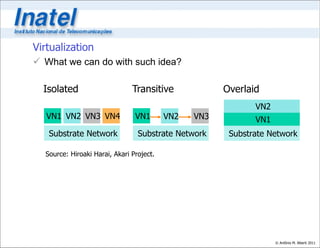
 What we can do with such idea?

  Isolated                     Transitive             Overlaid
                                                             VN2
   VN1 VN2 VN3 VN4              VN1       VN2   VN3          VN1
   Substrate Network             Substrate Network     Substrate Network

  Source: Hiroaki Harai, Akari Project.


                                                                   © Antônio M. Alberti 2011
Virtualization
 Challenges and Requirements (1/2):
    Scalability – How to support a large number of VNs?

    Manageability – How to manage a large number of VNs? How to
     manage traffic?

    Multidomain/Multioperator – How to interoperate VNs? How to
     span over multiple physical operators? Is it standardization
     required?

    Selection/Admission/Routing – Virtual topology design and
     physical entities assignment are NP-hard problems.


                                                           © Antônio M. Alberti 2011
Virtualization
 Challenges and Requirements (2/2):
    Resources Exposure – How to describe resources?

    Security, Trust and Privacy – Possible attacks, security risks,
     denial of service.

    Mobility – How to move virtual entities?

    Complexity – How to deal with the increasing complexity?
     Autonomicity?


                                                              © Antônio M. Alberti 2011
Virtualization
 Is it possible to apply virtualization on wireless networks?

 More difficult to be virtualized:
    E.g. interference, shadowing, multipaths, multiple access and
     other aspects of the propagation environment.


 These difficulties do not mean that radio resources aren’t an
  exception.

 Software Defined Radio (SDR) can be seen as a radio where
  hardware resources are exposed and reconfigured by software.


                                                            © Antônio M. Alberti 2011
Virtualization
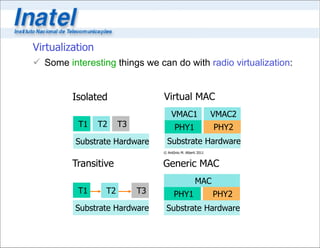
 Some interesting things we can do with radio virtualization:


         Isolated                Virtual MAC
                                     VMAC1                   VMAC2
          T1     T2    T3              PHY1                  PHY2
          Substrate Hardware       Substrate Hardware
                                 © Antônio M. Alberti 2011


         Transitive              Generic MAC
                                                    MAC
          T1      T2        T3         PHY1                  PHY2
          Substrate Hardware      Substrate Hardware
3. Information, ID/Loc Splitting, Semantic, Context and Mobility
 Information-centric Approches
 ID/Loc Splitting
 Generalized Mobility
 Semantic, Context, Context-Awareness and Ontology


                                                          © Antônio M. Alberti 2010
Information-Centric Approaches
 Information as a key ingredient in design.

 Information is in everywhere, i.e. contracts, location, police, IDs,
  descriptors, naming, etc.

 “Information is everything and everything is information” (PSIRP,
  2009).


                                                            © Antônio M. Alberti 2010
Information-Centrism
 Requirements and Challenges (1/4):
    To represent persistently and consistently information by means of
     Information Objects (IOs).

    To access information independently of its location.

    To name contents (or its representation).
        “Named content is a better abstraction for today’s communication
         problems than named hosts.” (Van Jacobson, 2009).


    To adequately manage content → versioning, encodings, copies
     of identical content.


                                                                    © Antônio M. Alberti 2010
Information-Centrism
 Requirements and Challenges (2/4):
    To use name resolution schemes to find out locators.

    To allow disruptive and consented communications, e.g. publish/
     subscribe (pub/sub) paradigm.

    To enable anycast and multi path/multi point routing of previously
     located information.

    To efficiently distribute content.

    To cache information to improve performance and efficiency.


                                                             © Antônio M. Alberti 2010
Information-Centrism
 Requirements and Challenges (3/4):
    To enable efficient, semantic rich, context-based information
     search and manipulation.

    To deal with information scope.

    To identify information uniquely.

    To rethink security from the information point of view → securing
     information per se.

    To verify publisher privacy before content publishing –
     authenticate and authorize subscribers during rendezvous.


                                                             © Antônio M. Alberti 2010
Information-Centrism
 Requirements and Challenges (4/4):
    To deal with scalability on information representation, searching,
     naming resolution, location, routing, etc.

    To deal with multi level, multi domain environments.

    To autonomously manipulate content.


                                                              © Antônio M. Alberti 2010
ID/Loc Splitting
 Future networks need to separate identifiers (ID) from locators
  (Loc) → the so called ID/Loc splitting.

 This split is required not only for physical entities (e.g. hosts),
  but also for virtual entities as well as for content.


                                                              © Antônio M. Alberti 2010
ID/Loc Splitting
 Requirements and Challenges (1/2):
    To uniquely identify every entity in the network → To move without
     identity loss.

    How to generate unique digital identifiers for real or virtual
     entities?

    How to manage IDs in order to provide generalized mobility for
     real or virtual entities?

    How to deal with privacy and traceability?
        Unique IDs can provide information sources non-repudiation.


                                                                   © Antônio M. Alberti 2010
ID/Loc Splitting
 Requirements and Challenges (2/2):
    How to use accountability information to prevent or to punish
     cyber crimes?
       Traceability based on persistent IDs discourage network misuse.


    How to manage the large number of IDs, their relationships and
     lifecycles?
       There is a massive scalability problem here!


                                                                  © Antônio M. Alberti 2010
Generalized Mobility
 General mobility means to comprehensively support user,
  terminal, service, application, virtual networks, information, and
  other real and virtual entities mobility.


                                                           © Antônio M. Alberti 2010
Semantic, Context, Context-Awareness and Ontology
 Situation-Awareness
    According to (Baker et al., 2009) “... being aware of its physical
     environment or situation and responding proactively and
     intelligently based on such awareness”.

 Context-Awareness
    To be aware of relevant contexts.

 Ontology
    For (TripCom, 2008) “an ontology is a formal definition of
     terminology and relationships among the terms in a computer-
     processable form”.


                                                               © Antônio M. Alberti 2010
Semantic, Context, Context-Awareness and Ontology
 Requirements and Challenges:
    Situation and Context Awareness → RWI as a source for situation
     and context information.

    Autonomicity → To enable a system/application/artifact to adapts
     to environmental or goal changes → Ontologies for rules, goals,
     regulations, etc.

    Context Distribution → Collaboration of context processing entities
     using the publish/subscribe paradigm.


                                                             © Antônio M. Alberti 2010
4. Autonomic and Cognitive Technologies
 Autonomic Computing
 Autonomic Communications


                                          © Antônio M. Alberti 2010
Autonomic Computing
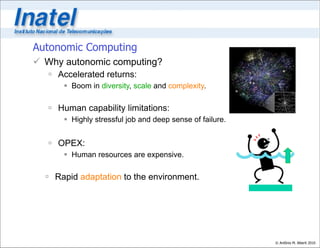
 Why autonomic computing?
    Accelerated returns:
       Boom in diversity, scale and complexity.

    Human capability limitations:
       Highly stressful job and deep sense of failure.


    OPEX:
       Human resources are expensive.

   Rapid adaptation to the environment.


                                                          © Antônio M. Alberti 2010
Autonomic Computing
 (IBM, 2001):
    A famous manifesto → autonomic computing.

    “Computing systems’ complexity appears to be approaching the
     limits of human capability”.

    Bio-inspired → human autonomic nervous system governs various
     functions without our awareness.

    Computational systems → manage themselves according to high-
     level objectives outlined by human operators.

    Reduce human interference and OPEX.


                                                         © Antônio M. Alberti 2010
Autonomic Computing
 (Kephart and Chess, 2001):

  4 autonomic properties:
    Self-Configuration - To configure components and the system
     itself to achieve high-level goals.

    Self-Optimization - To optimize proactively system resources and
     other aspects in order to improve performance, efficiency, quality,
     etc.

    Self-Healing - To detect, diagnose and repair localized problems
     and failures.

    Self-Protection - To defend against attackers, threads or cascade
     failures.

                                                              © Antônio M. Alberti 2010
Autonomic Computing
 (Dobson et al., 2010):
    The most notable omission from IBM’s original vision is
     autonomous elements communication.

 (Clark et al., 2003):
    To incorporate more autonomy in communication networks,
     creating the so-called Knowledge Plane.


                                                               © Antônio M. Alberti 2010
Autonomic Communications
 Requirements and Challenges (1/2):
    Self-awareness → introspective to the own node status and
     capabilities, e.g. antenna, bandwidth, laser.

    Self-situation or environment-aware → sensing from RWI, e.g.
     primary operators in cognitive radio.

    Information contextualization → relevance, self-situation/self-
     awareness, sound reasoning.

    Cooperation → common objectives, self-management, self-
     emergent behavior, quality and scalability of information gathering,
     privacy, security.


                                                              © Antônio M. Alberti 2010
Autonomic Communications
 Requirements and Challenges (2/2):
    Stability → self-stable, i.e. to avoid instability.

    Detail level and timely sharing → Information needs to be
     collected, filtered and distributed to cooperating nodes, in the right
     time, with right context.


                                                                © Antônio M. Alberti 2010
5. Security, Privacy and Trust
 Requirements and Challenges


                                 © Antônio M. Alberti 2010
Requirements and Challenges
   Built in or inherent;

   Change to consented communications, e.g. publish/subscribe
    paradigm;

   Establishment of trusted networks → entities, services, users, etc.

   How to evaluate trust and reputation?

   Privacy → To help users to protect and preserve their privacy;

   To identify, assess, monitor, analyze and sort risks, vulnerabilities
    and threats;


                                                               © Antônio M. Alberti 2010
6. Services and Applications
 Service-centric Approaches
 Internet of Services
 Digital Business Ecosystems


                                © Antônio M. Alberti 2010
Service-centric Approaches
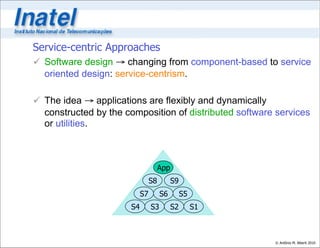
 Software design → changing from component-based to service
  oriented design: service-centrism.

 The idea → applications are flexibly and dynamically
  constructed by the composition of distributed software services
  or utilities.


                                      App
                                 S8         S9
                            S7        S6         S5
                       S4        S3         S2        S1


                                                           © Antônio M. Alberti 2010
Service-centric Approaches
 Requirements and Challenges (1/2):
    Life-cycling → dynamic, distributed and cross-domain;

    Seamless → service describing, publishing, discovering and
     negotiating will be necessary;

    How to search, discover and select candidate services?

    Which atributes are representative? Context? Semantic?

    How to make attributes searchable? Publishing in divulgation
     services?


                                                              © Antônio M. Alberti 2010
Service-centric Approaches
 Requirements and Challenges (2/2):
    Negotiation → necessary to establish SLAs (Service Level
     Agreements);

    Admission control → is there available resources to attach the
     desired service to one more application?

    Admission installation → proceeds to configure the services;

    Service monitoring, logging and exception handling;

    Management → Autonomicity?


                                                            © Antônio M. Alberti 2010
Internet of Services
 Above a certain level of abstraction everything can be viewed as
  a service → Internet of Services.

 (Villasante, 2009):
    “Internet of Services – Supporting the service economy (70% of
     GDP in modern societies)”.


                                                           © Antônio M. Alberti 2010
Digital Business Ecosystems
 Dynamic service compose-ability → integrate business
  processes with applications and services, creating the so called
  Digital Business Ecosystems (DBEs).

 DBEs → the new savannah.


                                                         © Antônio M. Alberti 2010
7. Simplicity, Sustainability and Evolvability
 Simplicity
 Sustainability
 Evolvability


                                                 © Antônio M. Alberti 2010
Simplicity
 To call attention on how difficult it is to design with simplicity we
  can evoke Leonardo Da Vinci’s:
    “Simplicity is the ultimate sophistication”.

 Or as Einstein said:
    "Make everything as simple as possible, but no simpler.”


                                                             © Antônio M. Alberti 2010
Sustainability
 Ops! We need to redesign the Internet again...

 Sustainability can be defined as the property of maintaining a
  certain level/situation in the course of time.

 Akari also aims to project a sustainable network, capable to
  evolve and support information society requirements in the next
  decades.


                                                         © Antônio M. Alberti 2010
Evolvability
 Evolvability is a definition related to biological systems.

 (Rowe & Leaney, 1997):
    “the ability of a system to adapt in response to changes in its
     environment, requirements and implementation technologies.”


                                                             © Antônio M. Alberti 2010
Thank You!
Antônio Marcos Alberti
 antonioalberti.blogspot.com


                               © Antônio M. Alberti 2010
References
 Kurzweil R (2005) The Singularity is Near: When Humans
  Transcend Biology, Viking Press, ISBN 0670033847.

 Saracco R (2009) Telecommunications Evolution: The Fabric of
  Ecosystems. Revista Telecomunicações INATEL 12(2):36-45.

 Akari (2008) New Generation Network Architecture AKARI
  Conceptual Design. Project Description v1.1.

 Cross-ETP (2009) The Cross-ETP Vision Document. European
  Technology Platforms (ETPs) Cross Vision Document v1.0.


                                                     © Antônio M. Alberti 2011
References
 Presser M, Daras P, Baker M, Karnouskos S, Gluhak A, Krco S,
  Diaz C, Verbauwhede I, Naqvi S, Alvarez F, Fernandez-Cuesta
  A (2008) Real World Internet Position Paper.

 Peterson L, Anderson T, Culler D, Roscoe T (2003) A Blueprint
  for Introducing Disruptive Technology into the Internet.
  SIGCOMM Computer Comm. Review 33(1):59-64.

 Peterson L, Shenker S, Turner J (2005) Overcoming the
  Internet Impasse through Virtualization. IEEE Computer 38(4):
  34-41.

 GENI (2006) Technical Document on Wireless Virtualization.
  Global Environment for Network Innovations (GENI) Technical
  Report GDD-06-17.

                                                       © Antônio M. Alberti 2011
References
 Jacobson V, Content-Centric Networking, Future Internet
  Assembly (FIA), Valencia, Spain, 2010.

 Rothenberg CE, Verdi FL, Magalhaes, M (2008) Towards a New
  Generation of Information-Oriented Internetworking
  Architectures. Re-Architecting the Internet, Madrid, Spain.

 Berners-Lee T, Hendler J, Lassila O (1999) The Semantic Web.
  Scientific American Magazine 23(1).

 Alberti A, (2010) Future Network Architectures: Technological
  Challenges and Trends, New Network Architectures: The Path
  to the Future Internet. Book Chapter. Springer-Verlag GmbH.
  DOI: 10.1007/978-3-642-13247-6_5. 2010.

                                                       © Antônio M. Alberti 2010
References
 Jacobson V, Smetters D, Thornton J, Plass M, Briggs N,
  Braynard R (2009) Networking Named Content. CoNEXT’09,
  Rome, Italy.

 Ahlgren B, D’Ambrosio M, Dannewitz C, Marchisio M, Marsh I,
  Ohlman B, Pentikousis K, Rembarz R, Strandberg O, Vercellone
  V (2008) Design Considerations for a Network of In-formation.
  Re-Architecting the Internet, Madrid, Spain.

 Tarkoma S, Ain M, Visala K (2009) The Publish/Subscribe
  Internet Routing Paradigm (PSIRP): Designing the Future
  Internet Architecture. Towards the Future Internet, IOS Press.

 4WARD (2010) Architecture and Design for the Future Internet:
  Second NetInf Architecture Description. Deliverable D6.2.
                                                         © Antônio M. Alberti 2010
References
 Ohlman B, Ahlgren B, et al. (2010) Networking of Information:
  An Information-centric Approach to the Network of Future. ETSI
  Future Network Technologies Workshop.

 Niebert N (2008) Vision on Future Content Networks: A
  Networks and Media Joint Venture. Future Internet Assembly
  (FIA), Madrid, Spain.

 Paulson LD (2003) News Briefs - W3C Works on Semantic Web
  Proposal. Computer Magazine 36(11):20

 Fensel D (2007) ServiceWeb 3.0. IEEE/WIC/ACM International
  Conf. on Intelligent Agent Technology, Fremont, USA.


                                                       © Antônio M. Alberti 2010
References
 Baker N, Zafar M, Moltchanov B, Knappmeyer M (2009)
  Context-Aware Systems and Implications for Future Internet,
  Towards the Future Internet, IOS Press.

 Bicocchi N, Baumgarten M, Brgulja N, Kusber R, Mamei M,
  Mulvenna M, Zambonelli F (2010) Self-Organized Data
  Ecologies for Pervasive Situation-Aware Services: The
  Knowledge Networks Approach, IEEE Transactions on Systems,
  Man and Cybernetics – Part A: System and Humans, Vol. 40,
  No. 4.

 Dey A, Abowd D (2000) Towards a better understanding of
  context and context-awareness, Proc. ACM Conf. Human
  Factors Comput. Syst.—What, Who, Where, When and How of
  Context-Awareness, Hague, The Netherlands.
                                                       © Antônio M. Alberti 2010
References
 Zimmermann A et al. (2005) Personalization and Context
  Management, User Modeling and User-Adapted Interaction 15,
  3-4, pp. 275-302.

 Giunchiglia F (1992) Contextual Reasoning, Trento, Italy.

 Wang P (2004) Experience-Grounded Semantics: A theory for
  intelligent systems, Preprint submitted to Elsevier Science.

 Gruber T (1993) A Translation Approach to Portable Ontology
  Specifications. Knowledge Acquisition, 5:199–220.

 TripCom (2008) Ontology of EDIFACT Syntax and Semantics,
  Deliverable D7.2.

                                                        © Antônio M. Alberti 2010
References
 Ben Yahia I, Bertin E, Crespi N (2007) Ontology-based
  Management Systems for the Next Generation Services: State-
  of-the-Art, presented in Networking and Services, 2007. ICNS
  Third International Conference and published in IEEE
  Transaction.

 Clark D, Partridge C, Ramming C, Wroclawski J (2003) A
  knowledge plane for the Internet, Proc. ACM SIGCOMM Conf.,
  Karlsruhe, Germany, pp. 3–10.

 Siekkinen M, et al. (2007) Beyond the Future Internet –
  Requirements of Autonomic Networking Architectures to
  Address Long Term Future Networking Challenges, 11th IEEE
  International Workshop on Future Trends of Distributed
  Computing Systems (FTDCS'07).
                                                     © Antônio M. Alberti 2010
References
 Strassner J, (2008) The Role of Autonomic Networking in
  Cognitive Networks, Cognitive Networks: Towards Self-Aware
  Networks. John Wiley and Sons, Book Chapter 23-52.


                                                   © Antônio M. Alberti 2010
References
 Jelger C (2009) Information Dispatch Points, NetArch
  Symposium Presentation, Ascona, Switzerland.

 Pollock J, Hodgson R (2004) Adaptive information: improving
  business through semantic interoperability, grid computing, and
  enterprise integration, John Wiley and Sons.


                                                         © Antônio M. Alberti 2010
References
 Kephart JO, Chess DM (2003) The Vision of Autonomic
  Computing. IEEE Computer Magazine 36(1):41-50.

 Dobson S, Sterritt R, Nixon P, Hinchey M (2010) Fulfilling the
  Vision of Autonomic Computing. Computer Magazine 43(1):
  35-41;

 Clark D, Partridge C, Ramming J, Wroclawski J (2003) A
  Knowledge Plane for the Internet. Proc. of the Conference on
  Applications, Technologies, Architectures, and Protocols for
  Computer Comm., Karlsruhe, Germany;

 Smirnov M (2004) Autonomic Communication: Research
  Agenda for a New Communications Paradigm. Fraunhofer
  FOKUS technical Report;
                                                         © Antônio M. Alberti 2010
References
 Dobson S, Denazis S, Fernández A, Gaïti D, Gelenbe E,
  Massacci F, Nixon P, Saffre F, Schmidt N, Zambonelli F, (2006)
  A Survey of Autonomic Communications. ACM Transactions on
  Autonomous and Adaptive Systems 1(2):223-259.

 Sterritt R, Bustard D W, (2003), Autonomic Computing—A
  Means of Achieving Dependability?, Proc. 10th IEEE Int’l Conf.
  and Workshop on the Eng. of Computer-Based Systems
  (ECBS 2003), IEEE Press:247-251.

 Chaparadza R, (2010), Can Autonomicity help Migration, and
  what could be a possible Evolution Path?, FIA‐GHENT:
  Migration Session, December 2010.


                                                       © Antônio M. Alberti 2010
References
 Cross-ETP (2009) The Cross-ETP Vision Document. European
  Technology Platforms (ETPs), Cross Vision Document v1.0.

 Clarke J (2008) Trust & Identity in the Future Internet,
  Presentation at FIA.

 X-ETP (2010) Future Internet Strategic Research Agenda,
  Version 1.1.

 PICOS (2008) Taxonomy, Deliverable D2.1 Version 1.0.

 RFC 4949 (2000), Internet Security Glossary, IETF Request for
  Comments 2828.

                                                             © Antônio M. Alberti 2010
References
 Chaum D (1985) Security without Identification: Transaction
  Systems to make Big Brother Obsolete, Communications of the
  ACM 28/10 1030-1044.

 Avizienis A, Laprie J, Randell B, Landwehr C, Basic concepts
  and taxonomy of dependable and secure computing, IEEE
  Transactions on Dependable and Secure Computing 1 (1).

 Pfitzmann A, Hansen M (2010), A terminology for talking about
  privacy by data minimization: Anonymity, Unlinkability,
  Undetectability, Unobservability, Pseudonymity, and Identity
  Management, Available online at http://dud.inf.tu-dresden.de/
  Anon_Terminology.shtml/.


                                                       © Antônio M. Alberti 2010
References
 Fischer-Hübner S, Hedbom H (2008) D14.1.c – PRIME
  Framework V3. Public Project Deliverable.

 Luhmann, N (1979) Trust and Power, Chichester, Wiley.

 RISEPTIS (2009) Trust in the Information Society, Report of the
  Research and Innovation for SEcurity, Privacy and
  Trustworthiness in the Information Society.

 Campolargo, M (2010) Trust in the Information Society,
  Presentation at “Trust in the Information Society” Conference.


                                                         © Antônio M. Alberti 2010
References
 European Commission, “The Future of the Internet: A
  Compendium of European Projects on ICT Research Supported
  by the EU 7th Framework Programme for RTD”, 2008.

 Pedrinaci, C., “Lightweight Semantic Annotations for Services
  on the Web”, SSAIE 2009.

 Ristol, S., “Enabling a Web of Billions of Services”, SW 2009.

 S-Cube, “The S-Cube Book”, August 2010.

 De Panfilis, S., "FISO architecture of the Future Internet", FIA
  Workshop– FISO Session May 2009.

                                                           © Antônio M. Alberti 2010
References
 Gittler, F, "NEXOF: An Approach for Service‐based System
  Architectures", 2nd International SOA Symposium, October
  2009.

 Pasic, A., “Delivering Building Blocks for Internet of Services:
  Trust, Security, Privacy and Dependability”, Book Chapter, New
  Network Architectures, 2010.

 Benko, B. K., “Autonomic Communication Elements
  and the ACE Toolkit”, ACE Toolkit tutorial, Milan, November
  2008.

 Baresi, L., Di Ferdinando, A., Manzalini, A., Zambonelli, F., “The
  CASCADAS Framework for Autonomic Communications”,
  Autonomic Communication, Springer, Heidelberg, 2009.
                                                          © Antônio M. Alberti 2010
References
 Rowe D, Leaney JR (1997) Evaluating evolvability of computer
  based systems architectures - an ontological approach”, Proc.
  International Conference on the Engineering of Computer
  Based Systems, 1997.


                                                       © Antônio M. Alberti 2010
References
 Wang P Artificial General Intelligence: A Gentle Introduction,
  Available online at: http://sites.google.com/site/narswang/home/agi-
   introduction/


 Kurzweil R (2005) The Singularity is Near: When Humans
  Transcend Biology, Viking Press, ISBN 0670033847.

 Dartmouth Meeting (1956) A Proposal for the Dartmouth
  Summer Research Project on Artificial Intelligence, Dartmouth
  College in Hanover, New Hampshire, Available online at: http://
   www-formal.stanford.edu/jmc/history/dartmouth/dartmouth.html/


 Langton C What is Artificial Life?, Available online at http://
   www.biota.org/papers/cglalife.html/


                                                                   © Antônio M. Alberti 2010
References
 McKinley P, Cheng B, Ofria C, Knoester D, Beckmann B,
  Goldsby H (2008) Harnessing Digital Evolution, IEEE Computer
  Magazine.

 Nachira F (2006) How ICT research supports Innovation
  Ecosystems and SMEs, UEAPME workshop.

 Briscoe G, De Wilde P (2006) Digital Ecosystems: Evolving
  Service-Orientated Architectures, Proceedings of the 1st
  international conference on Bio inspired models of network,
  information and computing systems.


                                                        © Antônio M. Alberti 2010
References
 Tempesti G, Mange D, Mudry P, Rossier J, Stauffer A (2007)
  Self-Replicating Hardware for Reliability: The Embryonics
  Project, ACM Journal on Emerging Technologies in Computing
  Systems (JETC), Vol. 3 Issue 2.

 Guedj D (2010) Future and Emerging Technologies Proactive
  Initiatives in FP7 call 6, Information Day, ICT Call 6 Brussels.


                                                           © Antônio M. Alberti 2010

Future network architecture: requirements and challenges

  • 1.
    FUTURE NETWORK ARCHITECTURES: REQUIREMENTS AND CHALLENGES Antônio Marcos Alberti © Antônio M. Alberti 2011
  • 2.
    Outline 1. Introduction 2. Substrate Resources and Its Integration with Software 3. Information, ID/Loc Splitting, Semantic, Context and Mobility 4. Autonomic and Cognitive Technologies 5. Security, Privacy and Trust 6. Services and Applications 7. Simplicity, Sustainability and Evolvability © Antônio M. Alberti 2011
  • 3.
    1. Introduction  TheInternet has invaded most aspects of life and society, changing our lifestyle, work, communication and social interaction.  Nobody doubts about the fundamental role of the Internet on our society. © Antônio M. Alberti 2011
  • 4.
    1. Introduction  Nevertheless,the Internet today is a complex agglomerate of protocols that inherits the grown legacies of decades of patchwork solutions.  It was designed in an era where technological development was completely different from today.  This motivated many people to question the adequacy of the TCP/IP stack to meet our information society needs.  Since this question was first made, a lot of initiatives to reshape the Internet appeared around the world - the so called Future Internet design. © Antônio M. Alberti 2011
  • 5.
    1. Introduction  Themain motto question is:  Considering the current state-of-art on computing and communications, is it possible to design right now a new Internet that best meets our information society needs?  This tutorial gives an introduction to the current approaches to design a new Internet. © Antônio M. Alberti 2011
  • 6.
    2. Substrate Resourcesand Its Integration with Software  Technology Evolution  Capacity and Ubiquity  Internet of Things  Real World Internet  Virtualization © Antônio M. Alberti 2011
  • 7.
    Technology Evolution  Moore'sLaw:  Predicts technological developments in computing power.  (Kurzweil, 2005):  A theory for technological evolution – to describe the exponential growth of technological advances: The Law of Accelerated Returns © Antônio M. Alberti 2011
  • 8.
    Technology Evolution  TheLaw of Accelerating Returns: Two positive feedback loops 1. Selection of the more capable techniques of a certain stage to build the next stage – increases the rate of progress exponentially, reducing required time to obtain the same results. 2. Selected process becomes more attractive than others and begins to catalyze resources to it – starts to evolve even faster, experiencing an additional exponential growth over the 1st. Source: http://www.kurzweilai.net/the-law-of-accelerating-returns © Antônio M. Alberti 2011
  • 9.
    Capacity and Ubiquity (Kurzweil, 2005):  Exponential growth trends for:  Memory capacity (DRAM in bits per dollar), microprocessor clock speed (Hz), transistors per chip, processor performance (MIPS), magnetic storage (bits per dollar), the number of hosts on the Internet.  (Saracco, 2009):  Consistent technological developments in:  Computing – is achieving teraflops right now and evolution proceeds to petaflops in the next decade.  Display technology – has advanced enormously in later years.  Consumer electronics, such as handsets, laptops, HDTVs, e-books, video games, GPSs, etc. © Antônio M. Alberti 2011
  • 10.
    Capacity and Ubiquity Minnesota Internet Traffic Studies (MINTS):  Annual Internet traffic growth rates were about 50-60% in 2008 and about 40-50% in 2009.  The monthly Internet traffic was circa 7.5-12x1018 bytes or exabytes.  Japanese Akari project:  Traffic could increase 1.7 times per year in Japan in the next years, producing an expansion of 1000 times in 13 years. © Antônio M. Alberti 2011
  • 11.
    Capacity and Ubiquity How to meet this demand?  Mobile Access: 4G, Cognitive Radio (CR).  Fixed Access: Fiber-To-The-Home (FTTH).  Core: State-of-art optical transmission and switching. © Antônio M. Alberti 2011
  • 12.
    Capacity and Ubiquity The technological evolution leads to price reduction → Ubiquity.  More and more devices are becoming computationally capable and connected to the Internet (e.g. clothing, buildings).  Inexpensive computing → Ubiquitous Computing (smart environments and ambient intelligence). © Antônio M. Alberti 2011
  • 13.
    Internet of Things Consequences of Ubiquitous Computing:  Connectivity anywhere, anytime, in anyplace, to anyone.  The rise of the NEDs (Network Enabled Devices) army.  The appearance of the Internet of Things (IoT) and Real World Internet (RWI). © Antônio M. Alberti 2011
  • 14.
    Internet of Things Challenges and Requirements (1/3):  Exponential growth in the number of sensors collecting real world information → A flood of traffic on the network.  Real world could be increasingly integrated to the virtual one, making it possible to greatly increase the interaction between them.  Changes in real world objects could be reflected in virtual world – Changes made to virtual objects can become real.  User’s sensitive information will be collected, such as identity, location and other contextualized information. © Antônio M. Alberti 2011
  • 15.
    Internet of Things Challenges and Requirements (2/3):  Flood of sensitive information → will push network scalability to new limits.  How to make this information safely available for innovative applications?  How to address billions of new nodes? Addressing and traceability to sensors and actuators, e.g. in the case of a fire.  Information needs to be contextualized to allow delivering to the right destiny, at the right time (information freshness). © Antônio M. Alberti 2011
  • 16.
    Internet of Things Challenges and Requirements (3/3):  The need for energy-aware security → trust relations among nodes.  Semantic and context → smoke detector: fire or fireworks?  NEDs mobility → ID/Loc splitting.  Management and control → Autonomic technologies.  RWI as a sensorial system for Future Internet. © Antônio M. Alberti 2011
  • 17.
    Virtualization  Exponential growth→ diffuse substrate of digital technologies composed by processing, storage, display and communication resources.  Much of the communication equipment today → become computers, with CPUs, Operating Systems, etc.  How to make this diffuse substrate of hardware resources transparently and uniformly available to software? © Antônio M. Alberti 2011
  • 18.
    Virtualization  The rolesof virtualization on FI:  An elementary aspect of the architecture itself;  To enable simultaneous architectures over the physical SN, therefore creating a meta-architecture;  To support experimentation with new architectures;  To allow customizable service-aware networks, e.g. content- networks;  To allow “new business models for carriers and operators”, (Nakao, 2009), e.g. virtual service operators. © Antônio M. Alberti 2011
  • 19.
    Virtualization  My definitionof network virtualization:  To create an abstraction (indirection) layer between network equipment (routers, switches and radios) and network software, such that communication resources can be used concurrently/ transparently/uniformly by different software instances.  It allows multiple Virtual Networks (VNs) to share the same Substrate Network (SN).  A virtual network has several of virtual nodes connected by physical and/or virtual links, thus forming a virtual topology. © Antônio M. Alberti 2011
  • 20.
    Virtualization  What wecan do with such idea? Isolated Transitive Overlaid VN2 VN1 VN2 VN3 VN4 VN1 VN2 VN3 VN1 Substrate Network Substrate Network Substrate Network Source: Hiroaki Harai, Akari Project. © Antônio M. Alberti 2011
  • 21.
    Virtualization  Challenges andRequirements (1/2):  Scalability – How to support a large number of VNs?  Manageability – How to manage a large number of VNs? How to manage traffic?  Multidomain/Multioperator – How to interoperate VNs? How to span over multiple physical operators? Is it standardization required?  Selection/Admission/Routing – Virtual topology design and physical entities assignment are NP-hard problems. © Antônio M. Alberti 2011
  • 22.
    Virtualization  Challenges andRequirements (2/2):  Resources Exposure – How to describe resources?  Security, Trust and Privacy – Possible attacks, security risks, denial of service.  Mobility – How to move virtual entities?  Complexity – How to deal with the increasing complexity? Autonomicity? © Antônio M. Alberti 2011
  • 23.
    Virtualization  Is itpossible to apply virtualization on wireless networks?  More difficult to be virtualized:  E.g. interference, shadowing, multipaths, multiple access and other aspects of the propagation environment.  These difficulties do not mean that radio resources aren’t an exception.  Software Defined Radio (SDR) can be seen as a radio where hardware resources are exposed and reconfigured by software. © Antônio M. Alberti 2011
  • 24.
    Virtualization  Some interestingthings we can do with radio virtualization: Isolated Virtual MAC VMAC1 VMAC2 T1 T2 T3 PHY1 PHY2 Substrate Hardware Substrate Hardware © Antônio M. Alberti 2011 Transitive Generic MAC MAC T1 T2 T3 PHY1 PHY2 Substrate Hardware Substrate Hardware
  • 25.
    3. Information, ID/LocSplitting, Semantic, Context and Mobility  Information-centric Approches  ID/Loc Splitting  Generalized Mobility  Semantic, Context, Context-Awareness and Ontology © Antônio M. Alberti 2010
  • 26.
    Information-Centric Approaches  Informationas a key ingredient in design.  Information is in everywhere, i.e. contracts, location, police, IDs, descriptors, naming, etc.  “Information is everything and everything is information” (PSIRP, 2009). © Antônio M. Alberti 2010
  • 27.
    Information-Centrism  Requirements andChallenges (1/4):  To represent persistently and consistently information by means of Information Objects (IOs).  To access information independently of its location.  To name contents (or its representation).  “Named content is a better abstraction for today’s communication problems than named hosts.” (Van Jacobson, 2009).  To adequately manage content → versioning, encodings, copies of identical content. © Antônio M. Alberti 2010
  • 28.
    Information-Centrism  Requirements andChallenges (2/4):  To use name resolution schemes to find out locators.  To allow disruptive and consented communications, e.g. publish/ subscribe (pub/sub) paradigm.  To enable anycast and multi path/multi point routing of previously located information.  To efficiently distribute content.  To cache information to improve performance and efficiency. © Antônio M. Alberti 2010
  • 29.
    Information-Centrism  Requirements andChallenges (3/4):  To enable efficient, semantic rich, context-based information search and manipulation.  To deal with information scope.  To identify information uniquely.  To rethink security from the information point of view → securing information per se.  To verify publisher privacy before content publishing – authenticate and authorize subscribers during rendezvous. © Antônio M. Alberti 2010
  • 30.
    Information-Centrism  Requirements andChallenges (4/4):  To deal with scalability on information representation, searching, naming resolution, location, routing, etc.  To deal with multi level, multi domain environments.  To autonomously manipulate content. © Antônio M. Alberti 2010
  • 31.
    ID/Loc Splitting  Futurenetworks need to separate identifiers (ID) from locators (Loc) → the so called ID/Loc splitting.  This split is required not only for physical entities (e.g. hosts), but also for virtual entities as well as for content. © Antônio M. Alberti 2010
  • 32.
    ID/Loc Splitting  Requirementsand Challenges (1/2):  To uniquely identify every entity in the network → To move without identity loss.  How to generate unique digital identifiers for real or virtual entities?  How to manage IDs in order to provide generalized mobility for real or virtual entities?  How to deal with privacy and traceability?  Unique IDs can provide information sources non-repudiation. © Antônio M. Alberti 2010
  • 33.
    ID/Loc Splitting  Requirementsand Challenges (2/2):  How to use accountability information to prevent or to punish cyber crimes?  Traceability based on persistent IDs discourage network misuse.  How to manage the large number of IDs, their relationships and lifecycles?  There is a massive scalability problem here! © Antônio M. Alberti 2010
  • 34.
    Generalized Mobility  Generalmobility means to comprehensively support user, terminal, service, application, virtual networks, information, and other real and virtual entities mobility. © Antônio M. Alberti 2010
  • 35.
    Semantic, Context, Context-Awarenessand Ontology  Situation-Awareness  According to (Baker et al., 2009) “... being aware of its physical environment or situation and responding proactively and intelligently based on such awareness”.  Context-Awareness  To be aware of relevant contexts.  Ontology  For (TripCom, 2008) “an ontology is a formal definition of terminology and relationships among the terms in a computer- processable form”. © Antônio M. Alberti 2010
  • 36.
    Semantic, Context, Context-Awarenessand Ontology  Requirements and Challenges:  Situation and Context Awareness → RWI as a source for situation and context information.  Autonomicity → To enable a system/application/artifact to adapts to environmental or goal changes → Ontologies for rules, goals, regulations, etc.  Context Distribution → Collaboration of context processing entities using the publish/subscribe paradigm. © Antônio M. Alberti 2010
  • 37.
    4. Autonomic andCognitive Technologies  Autonomic Computing  Autonomic Communications © Antônio M. Alberti 2010
  • 38.
    Autonomic Computing  Whyautonomic computing?  Accelerated returns:  Boom in diversity, scale and complexity.  Human capability limitations:  Highly stressful job and deep sense of failure.  OPEX:  Human resources are expensive.  Rapid adaptation to the environment. © Antônio M. Alberti 2010
  • 39.
    Autonomic Computing  (IBM,2001):  A famous manifesto → autonomic computing.  “Computing systems’ complexity appears to be approaching the limits of human capability”.  Bio-inspired → human autonomic nervous system governs various functions without our awareness.  Computational systems → manage themselves according to high- level objectives outlined by human operators.  Reduce human interference and OPEX. © Antônio M. Alberti 2010
  • 40.
    Autonomic Computing  (Kephartand Chess, 2001): 4 autonomic properties:  Self-Configuration - To configure components and the system itself to achieve high-level goals.  Self-Optimization - To optimize proactively system resources and other aspects in order to improve performance, efficiency, quality, etc.  Self-Healing - To detect, diagnose and repair localized problems and failures.  Self-Protection - To defend against attackers, threads or cascade failures. © Antônio M. Alberti 2010
  • 41.
    Autonomic Computing  (Dobsonet al., 2010):  The most notable omission from IBM’s original vision is autonomous elements communication.  (Clark et al., 2003):  To incorporate more autonomy in communication networks, creating the so-called Knowledge Plane. © Antônio M. Alberti 2010
  • 42.
    Autonomic Communications  Requirementsand Challenges (1/2):  Self-awareness → introspective to the own node status and capabilities, e.g. antenna, bandwidth, laser.  Self-situation or environment-aware → sensing from RWI, e.g. primary operators in cognitive radio.  Information contextualization → relevance, self-situation/self- awareness, sound reasoning.  Cooperation → common objectives, self-management, self- emergent behavior, quality and scalability of information gathering, privacy, security. © Antônio M. Alberti 2010
  • 43.
    Autonomic Communications  Requirementsand Challenges (2/2):  Stability → self-stable, i.e. to avoid instability.  Detail level and timely sharing → Information needs to be collected, filtered and distributed to cooperating nodes, in the right time, with right context. © Antônio M. Alberti 2010
  • 44.
    5. Security, Privacyand Trust  Requirements and Challenges © Antônio M. Alberti 2010
  • 45.
    Requirements and Challenges  Built in or inherent;  Change to consented communications, e.g. publish/subscribe paradigm;  Establishment of trusted networks → entities, services, users, etc.  How to evaluate trust and reputation?  Privacy → To help users to protect and preserve their privacy;  To identify, assess, monitor, analyze and sort risks, vulnerabilities and threats; © Antônio M. Alberti 2010
  • 46.
    6. Services andApplications  Service-centric Approaches  Internet of Services  Digital Business Ecosystems © Antônio M. Alberti 2010
  • 47.
    Service-centric Approaches  Softwaredesign → changing from component-based to service oriented design: service-centrism.  The idea → applications are flexibly and dynamically constructed by the composition of distributed software services or utilities. App S8 S9 S7 S6 S5 S4 S3 S2 S1 © Antônio M. Alberti 2010
  • 48.
    Service-centric Approaches  Requirementsand Challenges (1/2):  Life-cycling → dynamic, distributed and cross-domain;  Seamless → service describing, publishing, discovering and negotiating will be necessary;  How to search, discover and select candidate services?  Which atributes are representative? Context? Semantic?  How to make attributes searchable? Publishing in divulgation services? © Antônio M. Alberti 2010
  • 49.
    Service-centric Approaches  Requirementsand Challenges (2/2):  Negotiation → necessary to establish SLAs (Service Level Agreements);  Admission control → is there available resources to attach the desired service to one more application?  Admission installation → proceeds to configure the services;  Service monitoring, logging and exception handling;  Management → Autonomicity? © Antônio M. Alberti 2010
  • 50.
    Internet of Services Above a certain level of abstraction everything can be viewed as a service → Internet of Services.  (Villasante, 2009):  “Internet of Services – Supporting the service economy (70% of GDP in modern societies)”. © Antônio M. Alberti 2010
  • 51.
    Digital Business Ecosystems Dynamic service compose-ability → integrate business processes with applications and services, creating the so called Digital Business Ecosystems (DBEs).  DBEs → the new savannah. © Antônio M. Alberti 2010
  • 52.
    7. Simplicity, Sustainabilityand Evolvability  Simplicity  Sustainability  Evolvability © Antônio M. Alberti 2010
  • 53.
    Simplicity  To callattention on how difficult it is to design with simplicity we can evoke Leonardo Da Vinci’s:  “Simplicity is the ultimate sophistication”.  Or as Einstein said:  "Make everything as simple as possible, but no simpler.” © Antônio M. Alberti 2010
  • 54.
    Sustainability  Ops! Weneed to redesign the Internet again...  Sustainability can be defined as the property of maintaining a certain level/situation in the course of time.  Akari also aims to project a sustainable network, capable to evolve and support information society requirements in the next decades. © Antônio M. Alberti 2010
  • 55.
    Evolvability  Evolvability isa definition related to biological systems.  (Rowe & Leaney, 1997):  “the ability of a system to adapt in response to changes in its environment, requirements and implementation technologies.” © Antônio M. Alberti 2010
  • 56.
    Thank You! Antônio MarcosAlberti antonioalberti.blogspot.com © Antônio M. Alberti 2010
  • 57.
    References  Kurzweil R(2005) The Singularity is Near: When Humans Transcend Biology, Viking Press, ISBN 0670033847.  Saracco R (2009) Telecommunications Evolution: The Fabric of Ecosystems. Revista Telecomunicações INATEL 12(2):36-45.  Akari (2008) New Generation Network Architecture AKARI Conceptual Design. Project Description v1.1.  Cross-ETP (2009) The Cross-ETP Vision Document. European Technology Platforms (ETPs) Cross Vision Document v1.0. © Antônio M. Alberti 2011
  • 58.
    References  Presser M,Daras P, Baker M, Karnouskos S, Gluhak A, Krco S, Diaz C, Verbauwhede I, Naqvi S, Alvarez F, Fernandez-Cuesta A (2008) Real World Internet Position Paper.  Peterson L, Anderson T, Culler D, Roscoe T (2003) A Blueprint for Introducing Disruptive Technology into the Internet. SIGCOMM Computer Comm. Review 33(1):59-64.  Peterson L, Shenker S, Turner J (2005) Overcoming the Internet Impasse through Virtualization. IEEE Computer 38(4): 34-41.  GENI (2006) Technical Document on Wireless Virtualization. Global Environment for Network Innovations (GENI) Technical Report GDD-06-17. © Antônio M. Alberti 2011
  • 59.
    References  Jacobson V,Content-Centric Networking, Future Internet Assembly (FIA), Valencia, Spain, 2010.  Rothenberg CE, Verdi FL, Magalhaes, M (2008) Towards a New Generation of Information-Oriented Internetworking Architectures. Re-Architecting the Internet, Madrid, Spain.  Berners-Lee T, Hendler J, Lassila O (1999) The Semantic Web. Scientific American Magazine 23(1).  Alberti A, (2010) Future Network Architectures: Technological Challenges and Trends, New Network Architectures: The Path to the Future Internet. Book Chapter. Springer-Verlag GmbH. DOI: 10.1007/978-3-642-13247-6_5. 2010. © Antônio M. Alberti 2010
  • 60.
    References  Jacobson V,Smetters D, Thornton J, Plass M, Briggs N, Braynard R (2009) Networking Named Content. CoNEXT’09, Rome, Italy.  Ahlgren B, D’Ambrosio M, Dannewitz C, Marchisio M, Marsh I, Ohlman B, Pentikousis K, Rembarz R, Strandberg O, Vercellone V (2008) Design Considerations for a Network of In-formation. Re-Architecting the Internet, Madrid, Spain.  Tarkoma S, Ain M, Visala K (2009) The Publish/Subscribe Internet Routing Paradigm (PSIRP): Designing the Future Internet Architecture. Towards the Future Internet, IOS Press.  4WARD (2010) Architecture and Design for the Future Internet: Second NetInf Architecture Description. Deliverable D6.2. © Antônio M. Alberti 2010
  • 61.
    References  Ohlman B,Ahlgren B, et al. (2010) Networking of Information: An Information-centric Approach to the Network of Future. ETSI Future Network Technologies Workshop.  Niebert N (2008) Vision on Future Content Networks: A Networks and Media Joint Venture. Future Internet Assembly (FIA), Madrid, Spain.  Paulson LD (2003) News Briefs - W3C Works on Semantic Web Proposal. Computer Magazine 36(11):20  Fensel D (2007) ServiceWeb 3.0. IEEE/WIC/ACM International Conf. on Intelligent Agent Technology, Fremont, USA. © Antônio M. Alberti 2010
  • 62.
    References  Baker N,Zafar M, Moltchanov B, Knappmeyer M (2009) Context-Aware Systems and Implications for Future Internet, Towards the Future Internet, IOS Press.  Bicocchi N, Baumgarten M, Brgulja N, Kusber R, Mamei M, Mulvenna M, Zambonelli F (2010) Self-Organized Data Ecologies for Pervasive Situation-Aware Services: The Knowledge Networks Approach, IEEE Transactions on Systems, Man and Cybernetics – Part A: System and Humans, Vol. 40, No. 4.  Dey A, Abowd D (2000) Towards a better understanding of context and context-awareness, Proc. ACM Conf. Human Factors Comput. Syst.—What, Who, Where, When and How of Context-Awareness, Hague, The Netherlands. © Antônio M. Alberti 2010
  • 63.
    References  Zimmermann Aet al. (2005) Personalization and Context Management, User Modeling and User-Adapted Interaction 15, 3-4, pp. 275-302.  Giunchiglia F (1992) Contextual Reasoning, Trento, Italy.  Wang P (2004) Experience-Grounded Semantics: A theory for intelligent systems, Preprint submitted to Elsevier Science.  Gruber T (1993) A Translation Approach to Portable Ontology Specifications. Knowledge Acquisition, 5:199–220.  TripCom (2008) Ontology of EDIFACT Syntax and Semantics, Deliverable D7.2. © Antônio M. Alberti 2010
  • 64.
    References  Ben YahiaI, Bertin E, Crespi N (2007) Ontology-based Management Systems for the Next Generation Services: State- of-the-Art, presented in Networking and Services, 2007. ICNS Third International Conference and published in IEEE Transaction.  Clark D, Partridge C, Ramming C, Wroclawski J (2003) A knowledge plane for the Internet, Proc. ACM SIGCOMM Conf., Karlsruhe, Germany, pp. 3–10.  Siekkinen M, et al. (2007) Beyond the Future Internet – Requirements of Autonomic Networking Architectures to Address Long Term Future Networking Challenges, 11th IEEE International Workshop on Future Trends of Distributed Computing Systems (FTDCS'07). © Antônio M. Alberti 2010
  • 65.
    References  Strassner J,(2008) The Role of Autonomic Networking in Cognitive Networks, Cognitive Networks: Towards Self-Aware Networks. John Wiley and Sons, Book Chapter 23-52. © Antônio M. Alberti 2010
  • 66.
    References  Jelger C(2009) Information Dispatch Points, NetArch Symposium Presentation, Ascona, Switzerland.  Pollock J, Hodgson R (2004) Adaptive information: improving business through semantic interoperability, grid computing, and enterprise integration, John Wiley and Sons. © Antônio M. Alberti 2010
  • 67.
    References  Kephart JO,Chess DM (2003) The Vision of Autonomic Computing. IEEE Computer Magazine 36(1):41-50.  Dobson S, Sterritt R, Nixon P, Hinchey M (2010) Fulfilling the Vision of Autonomic Computing. Computer Magazine 43(1): 35-41;  Clark D, Partridge C, Ramming J, Wroclawski J (2003) A Knowledge Plane for the Internet. Proc. of the Conference on Applications, Technologies, Architectures, and Protocols for Computer Comm., Karlsruhe, Germany;  Smirnov M (2004) Autonomic Communication: Research Agenda for a New Communications Paradigm. Fraunhofer FOKUS technical Report; © Antônio M. Alberti 2010
  • 68.
    References  Dobson S,Denazis S, Fernández A, Gaïti D, Gelenbe E, Massacci F, Nixon P, Saffre F, Schmidt N, Zambonelli F, (2006) A Survey of Autonomic Communications. ACM Transactions on Autonomous and Adaptive Systems 1(2):223-259.  Sterritt R, Bustard D W, (2003), Autonomic Computing—A Means of Achieving Dependability?, Proc. 10th IEEE Int’l Conf. and Workshop on the Eng. of Computer-Based Systems (ECBS 2003), IEEE Press:247-251.  Chaparadza R, (2010), Can Autonomicity help Migration, and what could be a possible Evolution Path?, FIA‐GHENT: Migration Session, December 2010. © Antônio M. Alberti 2010
  • 69.
    References  Cross-ETP (2009)The Cross-ETP Vision Document. European Technology Platforms (ETPs), Cross Vision Document v1.0.  Clarke J (2008) Trust & Identity in the Future Internet, Presentation at FIA.  X-ETP (2010) Future Internet Strategic Research Agenda, Version 1.1.  PICOS (2008) Taxonomy, Deliverable D2.1 Version 1.0.  RFC 4949 (2000), Internet Security Glossary, IETF Request for Comments 2828. © Antônio M. Alberti 2010
  • 70.
    References  Chaum D(1985) Security without Identification: Transaction Systems to make Big Brother Obsolete, Communications of the ACM 28/10 1030-1044.  Avizienis A, Laprie J, Randell B, Landwehr C, Basic concepts and taxonomy of dependable and secure computing, IEEE Transactions on Dependable and Secure Computing 1 (1).  Pfitzmann A, Hansen M (2010), A terminology for talking about privacy by data minimization: Anonymity, Unlinkability, Undetectability, Unobservability, Pseudonymity, and Identity Management, Available online at http://dud.inf.tu-dresden.de/ Anon_Terminology.shtml/. © Antônio M. Alberti 2010
  • 71.
    References  Fischer-Hübner S,Hedbom H (2008) D14.1.c – PRIME Framework V3. Public Project Deliverable.  Luhmann, N (1979) Trust and Power, Chichester, Wiley.  RISEPTIS (2009) Trust in the Information Society, Report of the Research and Innovation for SEcurity, Privacy and Trustworthiness in the Information Society.  Campolargo, M (2010) Trust in the Information Society, Presentation at “Trust in the Information Society” Conference. © Antônio M. Alberti 2010
  • 72.
    References  European Commission,“The Future of the Internet: A Compendium of European Projects on ICT Research Supported by the EU 7th Framework Programme for RTD”, 2008.  Pedrinaci, C., “Lightweight Semantic Annotations for Services on the Web”, SSAIE 2009.  Ristol, S., “Enabling a Web of Billions of Services”, SW 2009.  S-Cube, “The S-Cube Book”, August 2010.  De Panfilis, S., "FISO architecture of the Future Internet", FIA Workshop– FISO Session May 2009. © Antônio M. Alberti 2010
  • 73.
    References  Gittler, F,"NEXOF: An Approach for Service‐based System Architectures", 2nd International SOA Symposium, October 2009.  Pasic, A., “Delivering Building Blocks for Internet of Services: Trust, Security, Privacy and Dependability”, Book Chapter, New Network Architectures, 2010.  Benko, B. K., “Autonomic Communication Elements and the ACE Toolkit”, ACE Toolkit tutorial, Milan, November 2008.  Baresi, L., Di Ferdinando, A., Manzalini, A., Zambonelli, F., “The CASCADAS Framework for Autonomic Communications”, Autonomic Communication, Springer, Heidelberg, 2009. © Antônio M. Alberti 2010
  • 74.
    References  Rowe D,Leaney JR (1997) Evaluating evolvability of computer based systems architectures - an ontological approach”, Proc. International Conference on the Engineering of Computer Based Systems, 1997. © Antônio M. Alberti 2010
  • 75.
    References  Wang PArtificial General Intelligence: A Gentle Introduction, Available online at: http://sites.google.com/site/narswang/home/agi- introduction/  Kurzweil R (2005) The Singularity is Near: When Humans Transcend Biology, Viking Press, ISBN 0670033847.  Dartmouth Meeting (1956) A Proposal for the Dartmouth Summer Research Project on Artificial Intelligence, Dartmouth College in Hanover, New Hampshire, Available online at: http:// www-formal.stanford.edu/jmc/history/dartmouth/dartmouth.html/  Langton C What is Artificial Life?, Available online at http:// www.biota.org/papers/cglalife.html/ © Antônio M. Alberti 2010
  • 76.
    References  McKinley P,Cheng B, Ofria C, Knoester D, Beckmann B, Goldsby H (2008) Harnessing Digital Evolution, IEEE Computer Magazine.  Nachira F (2006) How ICT research supports Innovation Ecosystems and SMEs, UEAPME workshop.  Briscoe G, De Wilde P (2006) Digital Ecosystems: Evolving Service-Orientated Architectures, Proceedings of the 1st international conference on Bio inspired models of network, information and computing systems. © Antônio M. Alberti 2010
  • 77.
    References  Tempesti G,Mange D, Mudry P, Rossier J, Stauffer A (2007) Self-Replicating Hardware for Reliability: The Embryonics Project, ACM Journal on Emerging Technologies in Computing Systems (JETC), Vol. 3 Issue 2.  Guedj D (2010) Future and Emerging Technologies Proactive Initiatives in FP7 call 6, Information Day, ICT Call 6 Brussels. © Antônio M. Alberti 2010