In true WesAndersonstyle,thisphotographisperfectlysymmetrical withthe centre of the image goingstraightdown the middle
of Suzy (the girl in the pink dress) face. From either side of the invisible line of symmetry there are exactly same about of the
characters inthe same position, the use of symmetry although not always obvious creates an appearance of unity between the
casts suggestingtheyare force tobe reckonedwith.Thislayoutof castalsoencouragesthe eye-linetodirectitselftothe centre of
the composition and then outwards which could imply the order of importance of each character which would tell us that Suzy
and Sam is the main the characters or that story follows them the most. Another feature of Wes Anderson films are the
meticulously planned colour palette and as you can see in Moonrise Kingdom this has also been applied here. The main colour
palette consists of greens, golds, browns and warm shades of red and cream. This aesthesis re-enforces the unified look of the
cast as well as brings the audience’s attention to the level of detail and the though process that Anderson has. The colours
illustrate and emphasize the concept of childlike wonder and memories associated with growing up and having adventures.
Starting with year and the location of the narrative sets the up
the synopsis straight away and allows readers to set the type
of world the film is set in.
The use of “peaceful” and “chaos” act as an oxymoron is this
sentence and amplifies the situation Scout Master Ward is
dealingwith especially with the additional use of emotive verb
“thrown”.
The use of sophisticated language in this opening paragraph
appeals to the target of audience of people who clearly take
film very seriously. Words like “absconded”, “lovelorn” and
“eccentric” really set the tone and will attract a particular
niche of viewer mostly someone who fit in the A and C1
category as well as someone who could be classed as an
“individualist”
The 4 star rating shows how the film was a success and liked
by viewers and critics alike. Although not quite 5 stars; this
does give the film credit and shows it’s highly thought of by
Empire.
Easy identifiable logo, placed in top of left-hand corner at page
header. This denotes the most important visual despite its size as
it introduces the brand “EMPIRE” and stages it as an authority
figure or as a highly regard opinion.
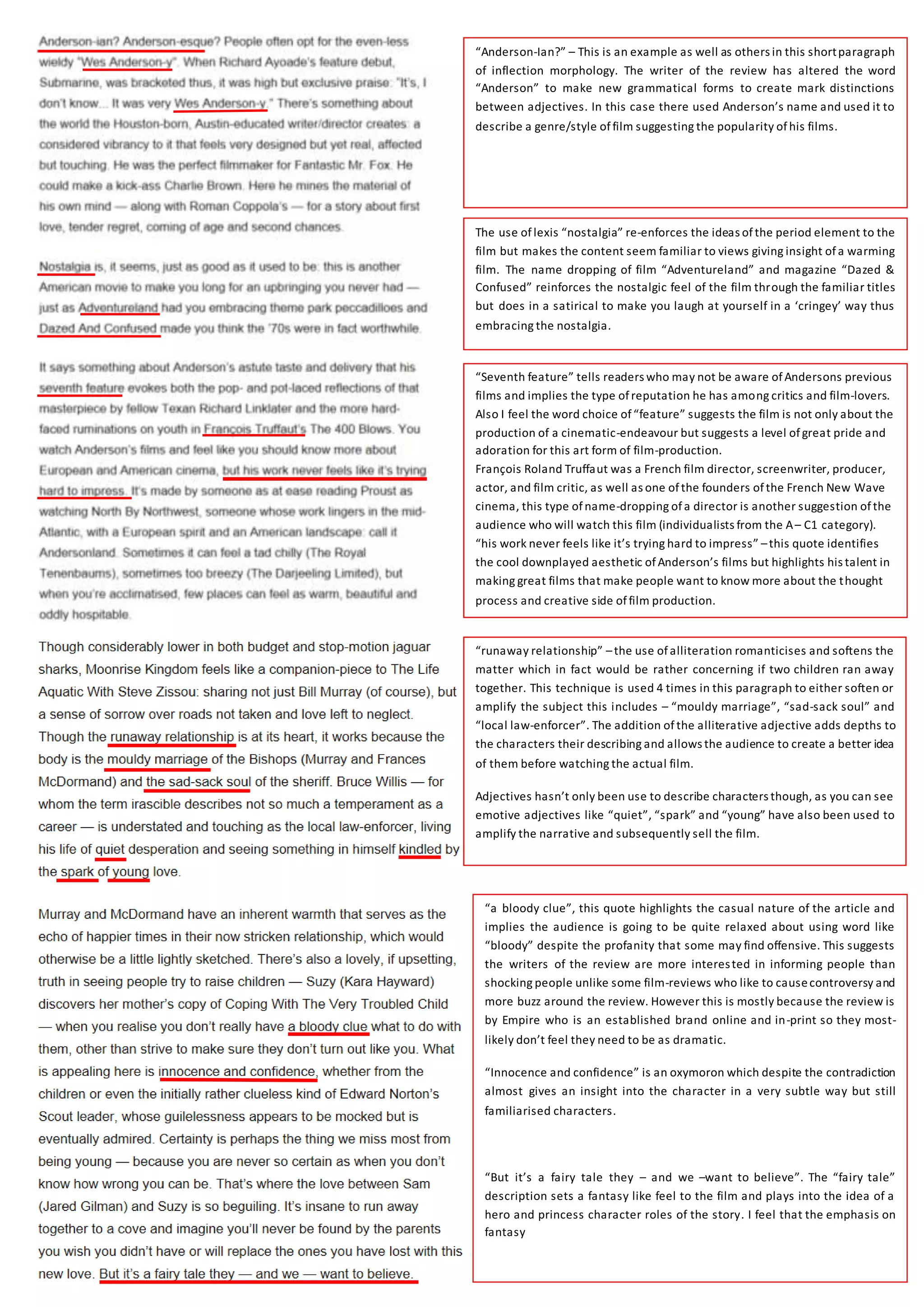
“Anderson-Ian?” – This is an example as well as others in this shortparagraph
of inflection morphology. The writer of the review has altered the word
“Anderson” to make new grammatical forms to create mark distinctions
between adjectives. In this case there used Anderson’s name and used it to
describe a genre/style offilm suggesting the popularity ofhis films.
The use oflexis “nostalgia” re-enforces the ideas ofthe period element to the
film but makes the content seem familiar to views giving insight ofa warming
film. The name dropping of film “Adventureland” and magazine “Dazed &
Confused” reinforces the nostalgic feel of the film through the familiar titles
but does in a satirical to make you laugh at yourself in a ‘cringey’ way thus
embracing the nostalgia.
“Seventh feature” tells readers who may not be aware ofAndersons previous
films and implies the type ofreputation he has among critics and film-lovers.
Also I feel the word choice of“feature” suggests the film is not only about the
production of a cinematic-endeavour but suggests a level ofgreat pride and
adoration for this art form of film-production.
François Roland Truffaut was a French film director, screenwriter, producer,
actor, and film critic, as well as one ofthe founders ofthe French New Wave
cinema, this type ofname-dropping ofa director is another suggestion ofthe
audience who will watch this film (individualists from the A– C1 category).
“his work never feels like it’s trying hard to impress” –this quote identifies
the cool downplayed aesthetic ofAnderson’s films but highlights his talent in
making great films that make people want to know more about the thought
process and creative side offilm production.
“runaway relationship” –the use ofalliteration romanticises and softens the
matter which in fact would be rather concerning if two children ran away
together. This technique is used 4 times in this paragraph to either soften or
amplify the subject this includes – “mouldy marriage”, “sad-sack soul” and
“local law-enforcer”. The addition of the alliterative adjective adds depths to
the characters their describing and allows the audience to create a better idea
of them before watching the actual film.
Adjectives hasn’t only been use to describe characters though, as you can see
emotive adjectives like “quiet”, “spark” and “young” have also been used to
amplify the narrative and subsequently sell the film.
“a bloody clue”, this quote highlights the casual nature of the article and
implies the audience is going to be quite relaxed about using word like
“bloody” despite the profanity that some may find offensive. This suggests
the writers of the review are more interested in informing people than
shocking people unlike some film-reviews who like to causecontroversy and
more buzz around the review. However this is mostly because the review is
by Empire who is an established brand online and in-print so they most-
likely don’t feel they need to be as dramatic.
“Innocence and confidence” is an oxymoron which despite the contradiction
almost gives an insight into the character in a very subtle way but still
familiarised characters.
“But it’s a fairy tale they – and we –want to believe”. The “fairy tale”
description sets a fantasy like feel to the film and plays into the idea of a
hero and princess character roles of the story. I feel that the emphasis on
fantasy
“Eventually” & “slightly”, both of the words are quite ambiguous and
suggest to me the writer is avoiding being blunt or harsh in their description
probably to avoid offensive and seem polite but still identify something they
believe to be a redeeming quality. I feel this is also why they have use the
peculiar phrasing “little pat” however I feel the obscurity reflects the tone
Wes Anderson has with his films.
“what Anderson is selling isn’t drama” – The writer has identified a key
components ofAnderson’s film where tries notto takethings seriously butatthe
same timeit’s very serious which is part ofthe charm in a film like Moonrise
Kingdom theindividual quirks is what makes it a great film plus the amazing
story and super planned design and visuals the film bring.
The final summary ofthe film is very complimentary oftheproduction and tries
to be as concise as possible allowing the reader to easily absorb EMPIRE’s
opinion of the film and highlight specific attributes such as “Terrific
performances”

Moonrise Kingdom Review - Analysis

  • 1.
    In true WesAndersonstyle,thisphotographisperfectlysymmetricalwiththe centre of the image goingstraightdown the middle of Suzy (the girl in the pink dress) face. From either side of the invisible line of symmetry there are exactly same about of the characters inthe same position, the use of symmetry although not always obvious creates an appearance of unity between the casts suggestingtheyare force tobe reckonedwith.Thislayoutof castalsoencouragesthe eye-linetodirectitselftothe centre of the composition and then outwards which could imply the order of importance of each character which would tell us that Suzy and Sam is the main the characters or that story follows them the most. Another feature of Wes Anderson films are the meticulously planned colour palette and as you can see in Moonrise Kingdom this has also been applied here. The main colour palette consists of greens, golds, browns and warm shades of red and cream. This aesthesis re-enforces the unified look of the cast as well as brings the audience’s attention to the level of detail and the though process that Anderson has. The colours illustrate and emphasize the concept of childlike wonder and memories associated with growing up and having adventures. Starting with year and the location of the narrative sets the up the synopsis straight away and allows readers to set the type of world the film is set in. The use of “peaceful” and “chaos” act as an oxymoron is this sentence and amplifies the situation Scout Master Ward is dealingwith especially with the additional use of emotive verb “thrown”. The use of sophisticated language in this opening paragraph appeals to the target of audience of people who clearly take film very seriously. Words like “absconded”, “lovelorn” and “eccentric” really set the tone and will attract a particular niche of viewer mostly someone who fit in the A and C1 category as well as someone who could be classed as an “individualist” The 4 star rating shows how the film was a success and liked by viewers and critics alike. Although not quite 5 stars; this does give the film credit and shows it’s highly thought of by Empire. Easy identifiable logo, placed in top of left-hand corner at page header. This denotes the most important visual despite its size as it introduces the brand “EMPIRE” and stages it as an authority figure or as a highly regard opinion.
  • 2.
    “Anderson-Ian?” – Thisis an example as well as others in this shortparagraph of inflection morphology. The writer of the review has altered the word “Anderson” to make new grammatical forms to create mark distinctions between adjectives. In this case there used Anderson’s name and used it to describe a genre/style offilm suggesting the popularity ofhis films. The use oflexis “nostalgia” re-enforces the ideas ofthe period element to the film but makes the content seem familiar to views giving insight ofa warming film. The name dropping of film “Adventureland” and magazine “Dazed & Confused” reinforces the nostalgic feel of the film through the familiar titles but does in a satirical to make you laugh at yourself in a ‘cringey’ way thus embracing the nostalgia. “Seventh feature” tells readers who may not be aware ofAndersons previous films and implies the type ofreputation he has among critics and film-lovers. Also I feel the word choice of“feature” suggests the film is not only about the production of a cinematic-endeavour but suggests a level ofgreat pride and adoration for this art form of film-production. François Roland Truffaut was a French film director, screenwriter, producer, actor, and film critic, as well as one ofthe founders ofthe French New Wave cinema, this type ofname-dropping ofa director is another suggestion ofthe audience who will watch this film (individualists from the A– C1 category). “his work never feels like it’s trying hard to impress” –this quote identifies the cool downplayed aesthetic ofAnderson’s films but highlights his talent in making great films that make people want to know more about the thought process and creative side offilm production. “runaway relationship” –the use ofalliteration romanticises and softens the matter which in fact would be rather concerning if two children ran away together. This technique is used 4 times in this paragraph to either soften or amplify the subject this includes – “mouldy marriage”, “sad-sack soul” and “local law-enforcer”. The addition of the alliterative adjective adds depths to the characters their describing and allows the audience to create a better idea of them before watching the actual film. Adjectives hasn’t only been use to describe characters though, as you can see emotive adjectives like “quiet”, “spark” and “young” have also been used to amplify the narrative and subsequently sell the film. “a bloody clue”, this quote highlights the casual nature of the article and implies the audience is going to be quite relaxed about using word like “bloody” despite the profanity that some may find offensive. This suggests the writers of the review are more interested in informing people than shocking people unlike some film-reviews who like to causecontroversy and more buzz around the review. However this is mostly because the review is by Empire who is an established brand online and in-print so they most- likely don’t feel they need to be as dramatic. “Innocence and confidence” is an oxymoron which despite the contradiction almost gives an insight into the character in a very subtle way but still familiarised characters. “But it’s a fairy tale they – and we –want to believe”. The “fairy tale” description sets a fantasy like feel to the film and plays into the idea of a hero and princess character roles of the story. I feel that the emphasis on fantasy
  • 3.
    “Eventually” & “slightly”,both of the words are quite ambiguous and suggest to me the writer is avoiding being blunt or harsh in their description probably to avoid offensive and seem polite but still identify something they believe to be a redeeming quality. I feel this is also why they have use the peculiar phrasing “little pat” however I feel the obscurity reflects the tone Wes Anderson has with his films. “what Anderson is selling isn’t drama” – The writer has identified a key components ofAnderson’s film where tries notto takethings seriously butatthe same timeit’s very serious which is part ofthe charm in a film like Moonrise Kingdom theindividual quirks is what makes it a great film plus the amazing story and super planned design and visuals the film bring. The final summary ofthe film is very complimentary oftheproduction and tries to be as concise as possible allowing the reader to easily absorb EMPIRE’s opinion of the film and highlight specific attributes such as “Terrific performances”