Campus of the Future 2030
Prof. Dr. David Asirvatham
Executive Dean
Taylor’s University
MALAYSIA
Contact: david.asirvatham@taylors.edu.my
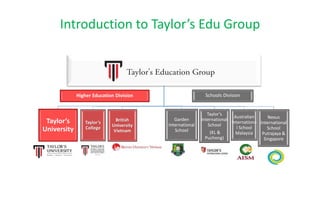
Garden
International
School
Taylor’s
International
School
(KL &
Puchong)
Australian
Internationa
l School
Malaysia
Nexus
International
School
Putrajaya &
Singapore
Taylor’s
University
Taylor’s
College
British
University
Vietnam
Schools Division
Higher Education Division
Introduction to Taylor’s Edu Group
Introduction to Taylor’s University
Lakeside Campus (Malaysia)
3
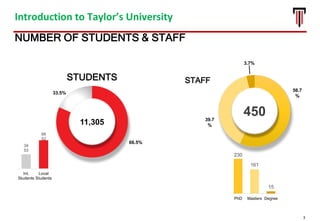
11,305
34
53
68
52
Int.
Students
Local
Students
STUDENTS
33.5%
66.5%
NUMBER OF STUDENTS & STAFF
56.7
%
39.7
%
450
STAFF
230
161
15
PhD Masters Degree
3.7%
Introduction to Taylor’s University
4
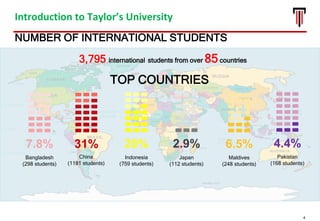
3,795 international students from over 85countries
7.8%
Bangladesh
(298 students)
20%
Indonesia
(759 students)
6.5%
Maldives
(248 students)
2.9%
Japan
(112 students)
4.4%
Pakistan
(168 students)
31%
China
(1181 students)
TOP COUNTRIES
NUMBER OF INTERNATIONAL STUDENTS
Introduction to Taylor’s University
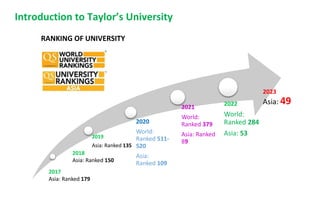
2019
Asia: Ranked 135
2020
World:
Ranked 511-
520
Asia:
Ranked 109
2021
World:
Ranked 379
Asia: Ranked
89
2017
Asia: Ranked 179
2018
Asia: Ranked 150
RANKING OF UNIVERSITY
2022
World:
Ranked 284
Asia: 53
2023
Asia: 49
Introduction to Taylor’s University
6
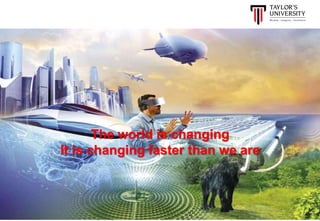
The world is changing
It is changing faster than we are
7
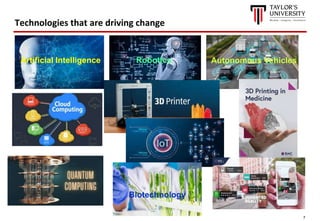
Technologies that are driving change
Artificial Intelligence Robotics Autonomous Vehicles
Biotechnology
8
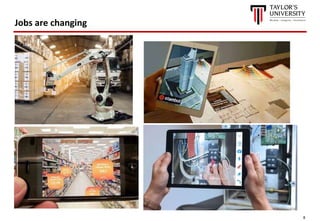
Jobs are changing
9
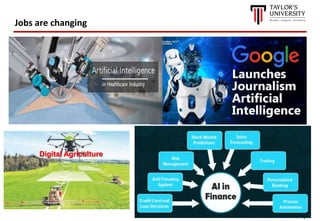
Jobs are changing
Digital Agriculture
10
How do we prepare our
students?
How should the campus of the
Future?
11
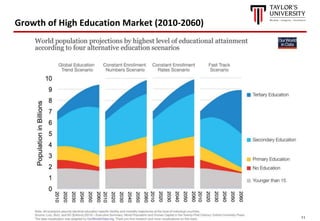
Growth of High Education Market (2010-2060)
12
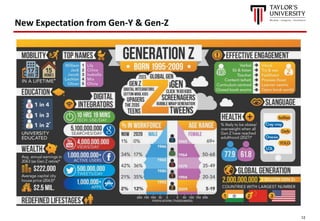
New Expectation from Gen-Y & Gen-Z
13
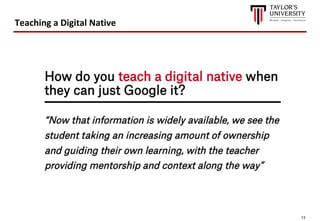
Teaching a Digital Native
14
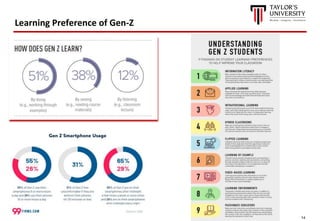
Learning Preference of Gen-Z
15
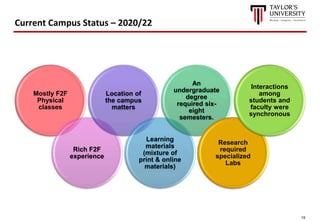
Current Campus Status – 2020/22
Mostly F2F
Physical
classes
Rich F2F
experience
Location of
the campus
matters
Learning
materials
(mixture of
print & online
materials)
An
undergraduate
degree
required six-
eight
semesters.
Research
required
specialized
Labs
Interactions
among
students and
faculty were
synchronous
16
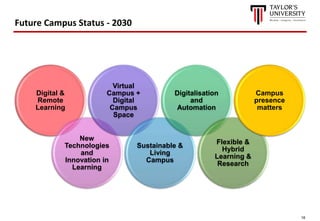
Future Campus Status - 2030
Digital &
Remote
Learning
New
Technologies
and
Innovation in
Learning
Virtual
Campus +
Digital
Campus
Space
Sustainable &
Living
Campus
Digitalisation
and
Automation
Flexible &
Hybrid
Learning &
Research
Campus
presence
matters
17
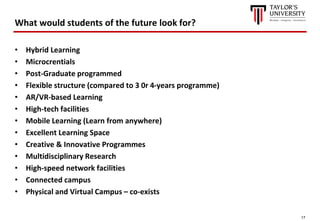
What would students of the future look for?
• Hybrid Learning
• Microcrentials
• Post-Graduate programmed
• Flexible structure (compared to 3 0r 4-years programme)
• AR/VR-based Learning
• High-tech facilities
• Mobile Learning (Learn from anywhere)
• Excellent Learning Space
• Creative & Innovative Programmes
• Multidisciplinary Research
• High-speed network facilities
• Connected campus
• Physical and Virtual Campus – co-exists
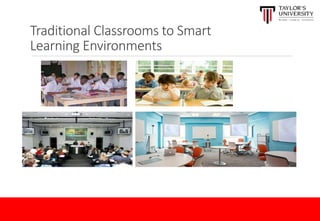
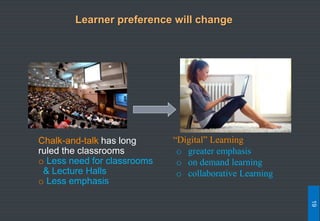
Traditional Classrooms to Smart
Learning Environments
Chalk-and-talk has long
ruled the classrooms
o Less need for classrooms
& Lecture Halls
o Less emphasis
“Digital” Learning
o greater emphasis
o on demand learning
o collaborative Learning
Learner preference will change
19
20
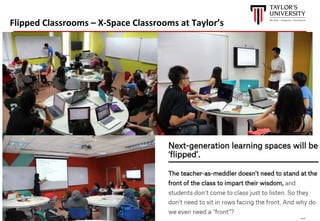
Flipped Classrooms – X-Space Classrooms at Taylor’s
21
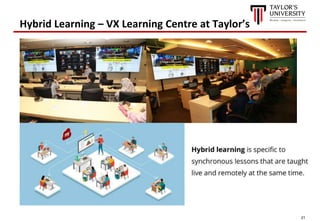
Hybrid Learning – VX Learning Centre at Taylor’s
22
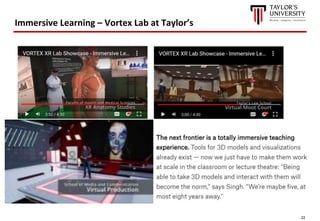
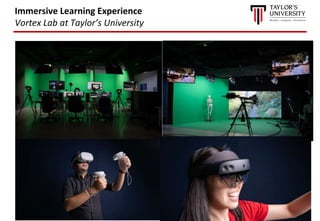
Immersive Learning – Vortex Lab at Taylor’s
23
Immersive Learning Experience
Vortex Lab at Taylor’s University
24
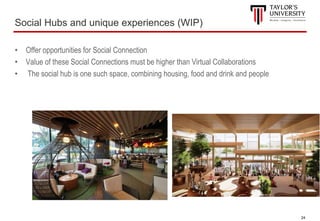
Social Hubs and unique experiences (WIP)
• Offer opportunities for Social Connection
• Value of these Social Connections must be higher than Virtual Collaborations
• The social hub is one such space, combining housing, food and drink and people
25
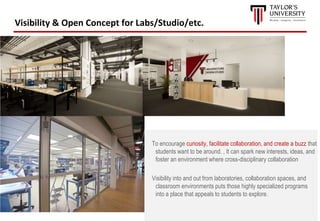
Visibility & Open Concept for Labs/Studio/etc.
To encourage curiosity, facilitate collaboration, and create a buzz that
students want to be around. , It can spark new interests, ideas, and
foster an environment where cross-disciplinary collaboration
Visibility into and out from laboratories, collaboration spaces, and
classroom environments puts those highly specialized programs
into a place that appeals to students to explore.
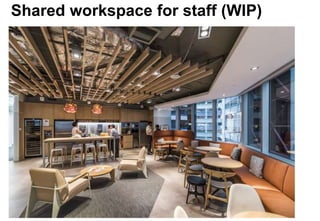
Shared workspace for staff (WIP)
27
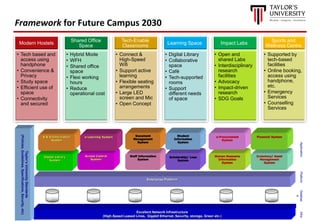
Framework for Future Campus 2030
Modern Hostels
• Tech based and
access using
handphone
• Convenience &
Privacy
• Study space
• Efficient use of
space
• Connectivity
and secured
Shared Office
Space
• Hybrid Mode
• WFH
• Shared office
space
• Flexi working
hours
• Reduce
operational cost
Tech-Enable
Classrooms
• Connect &
High-Speed
Wifi
• Support active
learning
• Flexible seating
arrangements
• Large LED
screen and Mic
• Open Concept
Learning Space
• Digital Library
• Collaborative
space
• Café
• Tech-supported
rooms
• Support
different needs
of space
Impact Labs
• Open and
shared Labs
• Interdisciplinary
research
facilities
• Advocacy
• Impact-driven
research
• SDG Goals
Sports and
Wellness Centre
• Supported by
tech-based
facilities
• Online booking,
access using
handphone,
etc.
• Emergency
Services
• Counselling
Services
Enterprise Platform
Excellent Network Infrastructure
(High-Speed Leased Lines, Gigabit Ethernet, Security, storage, Green etc.)
Uni
DB
Uni
DB
Uni
DB
Uni
DB
Taylor’s
University
Standards
(Policies,
Guidelines,
Specifications,
Security,
etc)
Uni
DB
Application
Platform
Databas
e
Infra
Uni
DB
Digital Library
System
Access Control
System
R & D Information
System
e-Learning System
Human Resource
Information
System
Inventory/ Asset
Management
System
Financial System
e-Procurement
System
Staff Information
System
Scholarship/ Loan
System
Student
Information
System
Document
Management
System
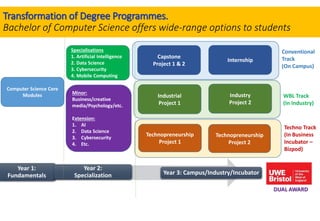
Transformation of Degree Programmes.
Bachelor of Computer Science offers wide-range options to students
Year 1:
Fundamentals
Year 2:
Specialization Year 3: Campus/Industry/Incubator
Computer Science Core
Modules
Specialisations
1. Artificial Intelligence
2. Data Science
3. Cybersecurity
4. Mobile Computing
Minor:
Business/creative
media/Psychology/etc.
Extension:
1. AI
2. Data Science
3. Cybersecurity
4. Etc.
Capstone
Project 1 & 2
Internship
Industrial
Project 1
Industry
Project 2
Technopreneurship
Project 2
Technopreneurship
Project 1
Conventional
Track
(On Campus)
WBL Track
(In Industry)
Techno Track
(In Business
Incubator –
Bizpod)
DUAL AWARD
29
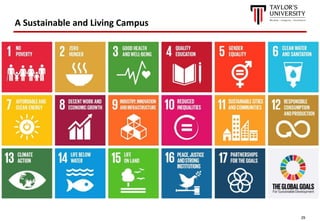
A Sustainable and Living Campus
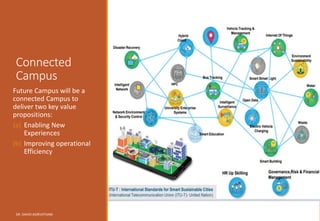
Connected
Campus
Future Campus will be a
connected Campus to
deliver two key value
propositions:
(a) Enabling New
Experiences
(b) Improving operational
Efficiency
DR. DAVID ASIRVATHAM 8-Nov-22 30
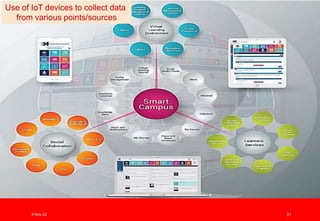
Smart Digital Campus
8-Nov-22 31
Use of IoT devices to collect data
from various points/sources
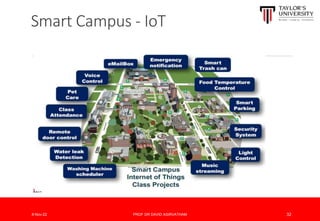
Smart Campus - IoT
8-Nov-22 PROF DR DAVID ASIRVATHAM 32
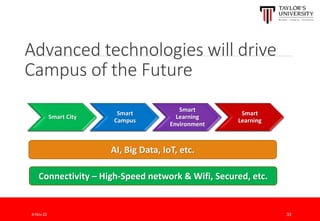
Advanced technologies will drive
Campus of the Future
8-Nov-22 33
Smart City
Smart
Campus
Smart
Learning
Environment
Smart
Learning
AI, Big Data, IoT, etc.
Connectivity – High-Speed network & Wifi, Secured, etc.
34
The new players:
AI and Big Data in Education
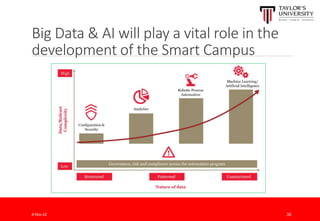
Big Data & AI will play a vital role in the
development of the Smart Campus
8-Nov-22 35
Smart Learning
Smart learning is enabled by technologies that rely on sensors,
big data, open data, new ways of connectivity and exchange of
information (e.g., Internet of Things, RFIDs); those integrated
environments belong on the broad sense of smart learning
environments
8-Nov-22 36
Smart Learning
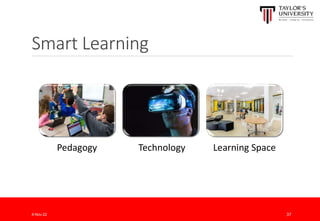
Pedagogy Technology Learning Space
8-Nov-22 37
Smart Learning
8-Nov-22 38
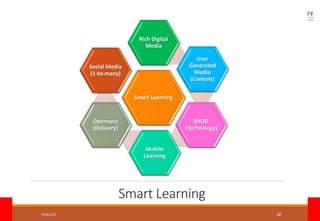
Smart Learning
Rich Digital
Media
User
Generated
Media
(Content)
BYOD
(Technology)
Mobile
Learning
Openness
(Delivery)
Social Media
(1-to-many)
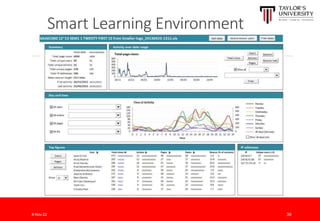
Smart Learning Environment
8-Nov-22 39
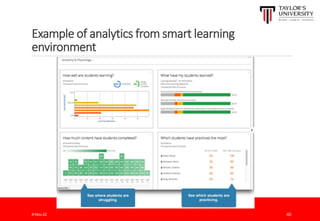
Example of analytics from smart learning
environment
8-Nov-22 40
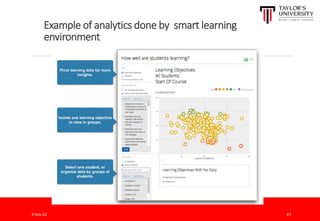
Example of analytics done by smart learning
environment
8-Nov-22 41
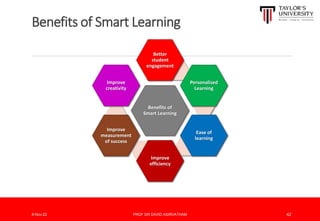
Benefits of Smart Learning
8-Nov-22 PROF DR DAVID ASIRVATHAM 42
Benefits of
Smart Learning
Better
student
engagement
Personalised
Learning
Ease of
learning
Improve
efficiency
Improve
measurement
of success
Improve
creativity
Conclusion
World is changing – Jobs are changing – Students are
changing. What about the university?
Technology and hybrid education—combined with the need for
collaboration and social environments—will shape the new
campus
Digital learning and Automation will drive the campus of the
Future.
Sustainable and Living Campus
There is a renewed interest in face-to-face experiences
After the pandemic, time to re-thinking education at all stages
and redesign them.
8-Nov-22 43
Thank
You
david.asirvatham@taylors.edu.my

Future Campus 2030

  • 1.
    Campus of theFuture 2030 Prof. Dr. David Asirvatham Executive Dean Taylor’s University MALAYSIA Contact: david.asirvatham@taylors.edu.my
  • 2.
    Garden International School Taylor’s International School (KL & Puchong) Australian Internationa l School Malaysia Nexus International School Putrajaya& Singapore Taylor’s University Taylor’s College British University Vietnam Schools Division Higher Education Division Introduction to Taylor’s Edu Group
  • 3.
    Introduction to Taylor’sUniversity Lakeside Campus (Malaysia)
  • 4.
    3 11,305 34 53 68 52 Int. Students Local Students STUDENTS 33.5% 66.5% NUMBER OF STUDENTS& STAFF 56.7 % 39.7 % 450 STAFF 230 161 15 PhD Masters Degree 3.7% Introduction to Taylor’s University
  • 5.
    4 3,795 international studentsfrom over 85countries 7.8% Bangladesh (298 students) 20% Indonesia (759 students) 6.5% Maldives (248 students) 2.9% Japan (112 students) 4.4% Pakistan (168 students) 31% China (1181 students) TOP COUNTRIES NUMBER OF INTERNATIONAL STUDENTS Introduction to Taylor’s University
  • 6.
    2019 Asia: Ranked 135 2020 World: Ranked511- 520 Asia: Ranked 109 2021 World: Ranked 379 Asia: Ranked 89 2017 Asia: Ranked 179 2018 Asia: Ranked 150 RANKING OF UNIVERSITY 2022 World: Ranked 284 Asia: 53 2023 Asia: 49 Introduction to Taylor’s University
  • 7.
    6 The world ischanging It is changing faster than we are
  • 8.
    7 Technologies that aredriving change Artificial Intelligence Robotics Autonomous Vehicles Biotechnology
  • 9.
  • 10.
  • 11.
    10 How do weprepare our students? How should the campus of the Future?
  • 12.
    11 Growth of HighEducation Market (2010-2060)
  • 13.
  • 14.
  • 15.
  • 16.
    15 Current Campus Status– 2020/22 Mostly F2F Physical classes Rich F2F experience Location of the campus matters Learning materials (mixture of print & online materials) An undergraduate degree required six- eight semesters. Research required specialized Labs Interactions among students and faculty were synchronous
  • 17.
    16 Future Campus Status- 2030 Digital & Remote Learning New Technologies and Innovation in Learning Virtual Campus + Digital Campus Space Sustainable & Living Campus Digitalisation and Automation Flexible & Hybrid Learning & Research Campus presence matters
  • 18.
    17 What would studentsof the future look for? • Hybrid Learning • Microcrentials • Post-Graduate programmed • Flexible structure (compared to 3 0r 4-years programme) • AR/VR-based Learning • High-tech facilities • Mobile Learning (Learn from anywhere) • Excellent Learning Space • Creative & Innovative Programmes • Multidisciplinary Research • High-speed network facilities • Connected campus • Physical and Virtual Campus – co-exists
  • 19.
    Traditional Classrooms toSmart Learning Environments
  • 20.
    Chalk-and-talk has long ruledthe classrooms o Less need for classrooms & Lecture Halls o Less emphasis “Digital” Learning o greater emphasis o on demand learning o collaborative Learning Learner preference will change 19
  • 21.
    20 Flipped Classrooms –X-Space Classrooms at Taylor’s
  • 22.
    21 Hybrid Learning –VX Learning Centre at Taylor’s
  • 23.
    22 Immersive Learning –Vortex Lab at Taylor’s
  • 24.
    23 Immersive Learning Experience VortexLab at Taylor’s University
  • 25.
    24 Social Hubs andunique experiences (WIP) • Offer opportunities for Social Connection • Value of these Social Connections must be higher than Virtual Collaborations • The social hub is one such space, combining housing, food and drink and people
  • 26.
    25 Visibility & OpenConcept for Labs/Studio/etc. To encourage curiosity, facilitate collaboration, and create a buzz that students want to be around. , It can spark new interests, ideas, and foster an environment where cross-disciplinary collaboration Visibility into and out from laboratories, collaboration spaces, and classroom environments puts those highly specialized programs into a place that appeals to students to explore.
  • 27.
  • 28.
    27 Framework for FutureCampus 2030 Modern Hostels • Tech based and access using handphone • Convenience & Privacy • Study space • Efficient use of space • Connectivity and secured Shared Office Space • Hybrid Mode • WFH • Shared office space • Flexi working hours • Reduce operational cost Tech-Enable Classrooms • Connect & High-Speed Wifi • Support active learning • Flexible seating arrangements • Large LED screen and Mic • Open Concept Learning Space • Digital Library • Collaborative space • Café • Tech-supported rooms • Support different needs of space Impact Labs • Open and shared Labs • Interdisciplinary research facilities • Advocacy • Impact-driven research • SDG Goals Sports and Wellness Centre • Supported by tech-based facilities • Online booking, access using handphone, etc. • Emergency Services • Counselling Services Enterprise Platform Excellent Network Infrastructure (High-Speed Leased Lines, Gigabit Ethernet, Security, storage, Green etc.) Uni DB Uni DB Uni DB Uni DB Taylor’s University Standards (Policies, Guidelines, Specifications, Security, etc) Uni DB Application Platform Databas e Infra Uni DB Digital Library System Access Control System R & D Information System e-Learning System Human Resource Information System Inventory/ Asset Management System Financial System e-Procurement System Staff Information System Scholarship/ Loan System Student Information System Document Management System
  • 29.
    Transformation of DegreeProgrammes. Bachelor of Computer Science offers wide-range options to students Year 1: Fundamentals Year 2: Specialization Year 3: Campus/Industry/Incubator Computer Science Core Modules Specialisations 1. Artificial Intelligence 2. Data Science 3. Cybersecurity 4. Mobile Computing Minor: Business/creative media/Psychology/etc. Extension: 1. AI 2. Data Science 3. Cybersecurity 4. Etc. Capstone Project 1 & 2 Internship Industrial Project 1 Industry Project 2 Technopreneurship Project 2 Technopreneurship Project 1 Conventional Track (On Campus) WBL Track (In Industry) Techno Track (In Business Incubator – Bizpod) DUAL AWARD
  • 30.
    29 A Sustainable andLiving Campus
  • 31.
    Connected Campus Future Campus willbe a connected Campus to deliver two key value propositions: (a) Enabling New Experiences (b) Improving operational Efficiency DR. DAVID ASIRVATHAM 8-Nov-22 30
  • 32.
    Smart Digital Campus 8-Nov-2231 Use of IoT devices to collect data from various points/sources
  • 33.
    Smart Campus -IoT 8-Nov-22 PROF DR DAVID ASIRVATHAM 32
  • 34.
    Advanced technologies willdrive Campus of the Future 8-Nov-22 33 Smart City Smart Campus Smart Learning Environment Smart Learning AI, Big Data, IoT, etc. Connectivity – High-Speed network & Wifi, Secured, etc.
  • 35.
    34 The new players: AIand Big Data in Education
  • 36.
    Big Data &AI will play a vital role in the development of the Smart Campus 8-Nov-22 35
  • 37.
    Smart Learning Smart learningis enabled by technologies that rely on sensors, big data, open data, new ways of connectivity and exchange of information (e.g., Internet of Things, RFIDs); those integrated environments belong on the broad sense of smart learning environments 8-Nov-22 36
  • 38.
    Smart Learning Pedagogy TechnologyLearning Space 8-Nov-22 37
  • 39.
    Smart Learning 8-Nov-22 38 SmartLearning Rich Digital Media User Generated Media (Content) BYOD (Technology) Mobile Learning Openness (Delivery) Social Media (1-to-many)
  • 40.
  • 41.
    Example of analyticsfrom smart learning environment 8-Nov-22 40
  • 42.
    Example of analyticsdone by smart learning environment 8-Nov-22 41
  • 43.
    Benefits of SmartLearning 8-Nov-22 PROF DR DAVID ASIRVATHAM 42 Benefits of Smart Learning Better student engagement Personalised Learning Ease of learning Improve efficiency Improve measurement of success Improve creativity
  • 44.
    Conclusion World is changing– Jobs are changing – Students are changing. What about the university? Technology and hybrid education—combined with the need for collaboration and social environments—will shape the new campus Digital learning and Automation will drive the campus of the Future. Sustainable and Living Campus There is a renewed interest in face-to-face experiences After the pandemic, time to re-thinking education at all stages and redesign them. 8-Nov-22 43
  • 45.