Considering the Digital Future 
(A Work in Progress) 
March 2014 
Monday, October 6, 14
“The best way to predict the future is to invent it.” 
-Robert Cannon, Internet law and policy expert 
Monday, October 6, 14
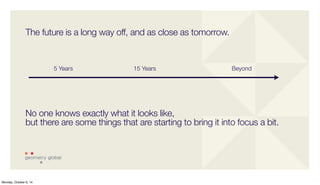
The future is a long way off, and as close as tomorrow. 
5 Years 
15 Years Beyond 
No one knows exactly what it looks like, 
but there are some things that are starting to bring it into focus a bit. 
Monday, October 6, 14
5 
Monday, October 6, 14
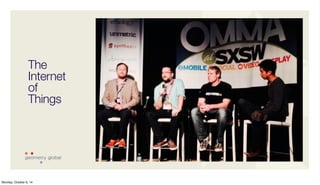
The 
Internet 
of 
Things 
Monday, October 6, 14
7 
Monday, October 6, 14
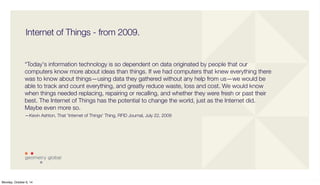
Internet of Things - from 2009. 
“Today's information technology is so dependent on data originated by people that our 
computers know more about ideas than things. If we had computers that knew everything there 
was to know about things—using data they gathered without any help from us—we would be 
able to track and count everything, and greatly reduce waste, loss and cost. We would know 
when things needed replacing, repairing or recalling, and whether they were fresh or past their 
best. The Internet of Things has the potential to change the world, just as the Internet did. 
Maybe even more so. 
—Kevin Ashton, That 'Internet of Things' Thing, RFID Journal, July 22, 2009 
Monday, October 6, 14
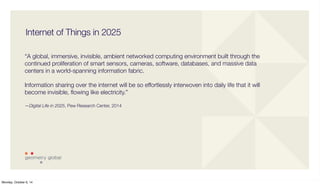
Internet of Things in 2025 
“A global, immersive, invisible, ambient networked computing environment built through the 
continued proliferation of smart sensors, cameras, software, databases, and massive data 
centers in a world-spanning information fabric. 
Information sharing over the internet will be so effortlessly interwoven into daily life that it will 
become invisible, flowing like electricity.” 
—Digital Life in 2025, Pew Research Center, 2014 
Monday, October 6, 14
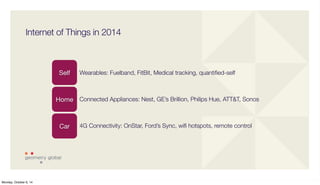
Internet of Things in 2014 
Self Wearables: Fuelband, FitBit, Medical tracking, quantified-self 
Home 
Car 
Connected Appliances: Nest, GE’s Brillion, Philips Hue, ATT&T, Sonos 
4G Connectivity: OnStar, Ford’s Sync, wifi hotspots, remote control 
Monday, October 6, 14
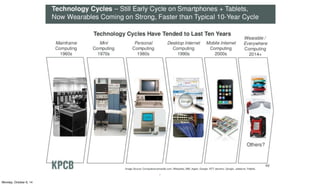
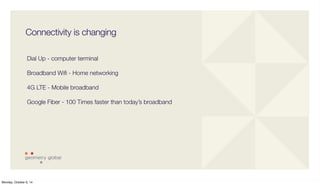
Connectivity is changing 
Dial Up - computer terminal 
Broadband Wifi - Home networking 
4G LTE - Mobile broadband 
Google Fiber - 100 Times faster than today’s broadband 
Monday, October 6, 14
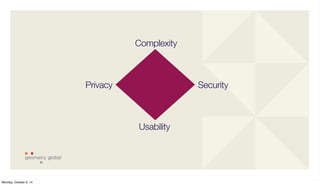
Complexity 
Privacy Security 
Usability 
Monday, October 6, 14
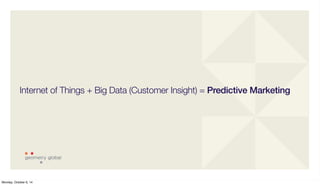
Internet of Things + Big Data (Customer Insight) = Predictive Marketing 
Monday, October 6, 14
Predictive Marketing 
The past was brand-centric and the present is consumer-centric, but the future will be predictive 
technology-centric. 
Marketing’s role will be to convince the predictive engine that it’s this brand and this product that should 
be recommended to this user at this specific moment. 
Think Google Maps, not for driving your car, but driving your life. 
Monday, October 6, 14
When everything’s predicted, 
where is the space for discovery and surprise? 
People are tired of being overwhelmed by decisions. They want certain outcomes and want 
guidance in achieving them—leaving the details to the alter predictive ego might be an enticing 
solution. 
But....humans are weird and messy creatures- eliminating choice and perfecting the act of 
delivering the right product at the right time at the right place might make life really boring. 
This is an opportunity for brands. Those that make space for fun and self expression will be 
successful. 
Monday, October 6, 14
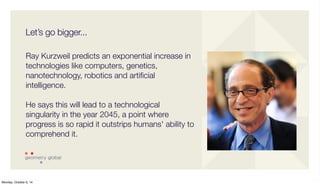
Let’s go bigger... 
Ray Kurzweil predicts an exponential increase in 
technologies like computers, genetics, 
nanotechnology, robotics and artificial 
intelligence. 
He says this will lead to a technological 
singularity in the year 2045, a point where 
progress is so rapid it outstrips humans' ability to 
comprehend it. 
Monday, October 6, 14
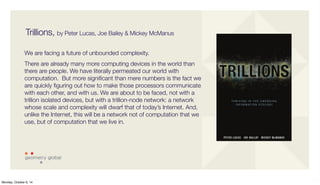
Trillions, by Peter Lucas, Joe Bailey & Mickey McManus 
We are facing a future of unbounded complexity. 
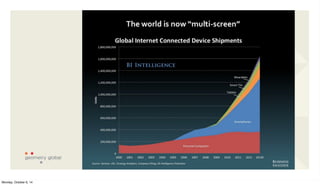
There are already many more computing devices in the world than 
there are people. We have literally permeated our world with 
computation. But more significant than mere numbers is the fact we 
are quickly figuring out how to make those processors communicate 
with each other, and with us. We are about to be faced, not with a 
trillion isolated devices, but with a trillion-node network: a network 
whose scale and complexity will dwarf that of today’s Internet. And, 
unlike the Internet, this will be a network not of computation that we 
use, but of computation that we live in. 
Monday, October 6, 14
http://vimeo.com/7395079 
Monday, October 6, 14
Trillions - business take-aways 
1. Complexity is inevitable, but bad complexity will kill you. Consider how you can foster beautiful 
complexity. Nature and evolution are the best teachers. 
2. Design is not a paint-job or product styling or user-interface "look and feel." Properly understood, 
design is the whole shooting match. If your organization isn't design literate you risk becoming a 
dinosaur lumbering among agile predators running around at your feet. 
3. Make your products and services human literate. Human beings are vastly more complex, subtle, and 
important than machines. We've spent a half-century believing that people should become "computer 
literate." That's precisely backwards. Computing should become "human literate." 
4. Computing needs to fade into the woodwork so that humans living their lives can come to the 
foreground. Think of ways you can use connectivity and computing to hide and tame complexity for 
your customers. They don't really want to think about computers, they want to think about doing their 
jobs and living their lives. 
Monday, October 6, 14
20 
Monday, October 6, 14
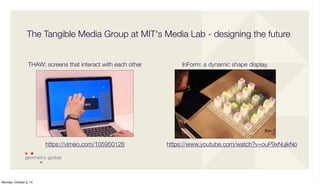
The Tangible Media Group at MIT's Media Lab - designing the future 
https://www.youtube.com/watch?v=ouP9xNujkNo 
THAW: screens that interact with each other 
https://vimeo.com/105950126 
InForm: a dynamic shape display. 
Monday, October 6, 14
Whitney Browne 
Group Director, Head of User Experience 
whitney.browne@geometry.com 
Monday, October 6, 14

Considering a Digital Future

  • 1.
    Considering the DigitalFuture (A Work in Progress) March 2014 Monday, October 6, 14
  • 2.
    “The best wayto predict the future is to invent it.” -Robert Cannon, Internet law and policy expert Monday, October 6, 14
  • 3.
    The future isa long way off, and as close as tomorrow. 5 Years 15 Years Beyond No one knows exactly what it looks like, but there are some things that are starting to bring it into focus a bit. Monday, October 6, 14
  • 4.
  • 5.
  • 6.
    The Internet of Things Monday, October 6, 14
  • 7.
  • 8.
    Internet of Things- from 2009. “Today's information technology is so dependent on data originated by people that our computers know more about ideas than things. If we had computers that knew everything there was to know about things—using data they gathered without any help from us—we would be able to track and count everything, and greatly reduce waste, loss and cost. We would know when things needed replacing, repairing or recalling, and whether they were fresh or past their best. The Internet of Things has the potential to change the world, just as the Internet did. Maybe even more so. —Kevin Ashton, That 'Internet of Things' Thing, RFID Journal, July 22, 2009 Monday, October 6, 14
  • 9.
    Internet of Thingsin 2025 “A global, immersive, invisible, ambient networked computing environment built through the continued proliferation of smart sensors, cameras, software, databases, and massive data centers in a world-spanning information fabric. Information sharing over the internet will be so effortlessly interwoven into daily life that it will become invisible, flowing like electricity.” —Digital Life in 2025, Pew Research Center, 2014 Monday, October 6, 14
  • 10.
    Internet of Thingsin 2014 Self Wearables: Fuelband, FitBit, Medical tracking, quantified-self Home Car Connected Appliances: Nest, GE’s Brillion, Philips Hue, ATT&T, Sonos 4G Connectivity: OnStar, Ford’s Sync, wifi hotspots, remote control Monday, October 6, 14
  • 11.
    Connectivity is changing Dial Up - computer terminal Broadband Wifi - Home networking 4G LTE - Mobile broadband Google Fiber - 100 Times faster than today’s broadband Monday, October 6, 14
  • 12.
    Complexity Privacy Security Usability Monday, October 6, 14
  • 13.
    Internet of Things+ Big Data (Customer Insight) = Predictive Marketing Monday, October 6, 14
  • 14.
    Predictive Marketing Thepast was brand-centric and the present is consumer-centric, but the future will be predictive technology-centric. Marketing’s role will be to convince the predictive engine that it’s this brand and this product that should be recommended to this user at this specific moment. Think Google Maps, not for driving your car, but driving your life. Monday, October 6, 14
  • 15.
    When everything’s predicted, where is the space for discovery and surprise? People are tired of being overwhelmed by decisions. They want certain outcomes and want guidance in achieving them—leaving the details to the alter predictive ego might be an enticing solution. But....humans are weird and messy creatures- eliminating choice and perfecting the act of delivering the right product at the right time at the right place might make life really boring. This is an opportunity for brands. Those that make space for fun and self expression will be successful. Monday, October 6, 14
  • 16.
    Let’s go bigger... Ray Kurzweil predicts an exponential increase in technologies like computers, genetics, nanotechnology, robotics and artificial intelligence. He says this will lead to a technological singularity in the year 2045, a point where progress is so rapid it outstrips humans' ability to comprehend it. Monday, October 6, 14
  • 17.
    Trillions, by PeterLucas, Joe Bailey & Mickey McManus We are facing a future of unbounded complexity. There are already many more computing devices in the world than there are people. We have literally permeated our world with computation. But more significant than mere numbers is the fact we are quickly figuring out how to make those processors communicate with each other, and with us. We are about to be faced, not with a trillion isolated devices, but with a trillion-node network: a network whose scale and complexity will dwarf that of today’s Internet. And, unlike the Internet, this will be a network not of computation that we use, but of computation that we live in. Monday, October 6, 14
  • 18.
  • 19.
    Trillions - businesstake-aways 1. Complexity is inevitable, but bad complexity will kill you. Consider how you can foster beautiful complexity. Nature and evolution are the best teachers. 2. Design is not a paint-job or product styling or user-interface "look and feel." Properly understood, design is the whole shooting match. If your organization isn't design literate you risk becoming a dinosaur lumbering among agile predators running around at your feet. 3. Make your products and services human literate. Human beings are vastly more complex, subtle, and important than machines. We've spent a half-century believing that people should become "computer literate." That's precisely backwards. Computing should become "human literate." 4. Computing needs to fade into the woodwork so that humans living their lives can come to the foreground. Think of ways you can use connectivity and computing to hide and tame complexity for your customers. They don't really want to think about computers, they want to think about doing their jobs and living their lives. Monday, October 6, 14
  • 20.
  • 21.
    The Tangible MediaGroup at MIT's Media Lab - designing the future https://www.youtube.com/watch?v=ouP9xNujkNo THAW: screens that interact with each other https://vimeo.com/105950126 InForm: a dynamic shape display. Monday, October 6, 14
  • 22.
    Whitney Browne GroupDirector, Head of User Experience whitney.browne@geometry.com Monday, October 6, 14