


Achievement Goal Orientation
across Gender and Ethnicity
in a Community College Honors Program

Scott R. Furtwengler, University of Houston
Candidacy Defense
Monday, November 18, 2013
Outline
•
•
•
•
•
•
•
•

Overview of the problem
Purpose of the current study
Brief overview of extant literature
Methodology
Results
Discussion
References
Questions
Overview of the problem
• In a competitive, performance-oriented
environment, females are more likely
than males to exhibit maladaptive
behavior by adopting avoidance
orientation (Bear, 1998; Shucard &
Hillman, 1990).
• Ethnicity may reflect cultural differences
in goal orientation, resulting in
maladaptive behavior by adopting
avoidance orientation (Elliot, Chirkov,
Kim, and Sheldon, 2001).
Purpose of the current study
• Research questions:

– How does achievement goal orientation
vary across gender and ethnicity in a
community college honors program?
Overview of extant literature
• Achievement goal orientation
• Post-secondary honors programs
• The community college context
Achievement Goal Orientation
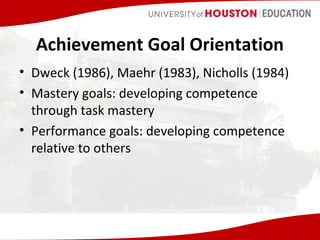
• Dweck (1986), Maehr (1983), Nicholls (1984)
• Mastery goals: developing competence
through task mastery
• Performance goals: developing competence
relative to others
Achievement Goal Orientation
• Elliot (1999), Elliot & Harackiewicz (1996),
Pintrich (2000)
• Extended to a 2 x 2 model
– Definitions of competence: mastery &
performance
– Valences of competence: approach & avoid
Achievement Goal Orientation
• Law, Elliot, & Murayama (2012)
– Performance-approach goals: high effort, high
persistence, high level of aspiration, high
academic performance
– Performance-avoidance goals: disorganized study
strategies, high test anxiety, low academic
performance, low intrinsic motivation
– Perceived competence is a moderator
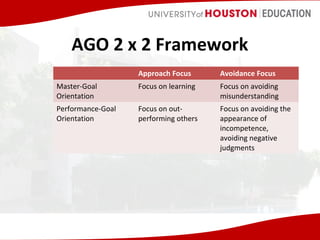
AGO 2 x 2 Framework
Approach Focus

Avoidance Focus

Master-Goal
Orientation

Focus on learning

Focus on avoiding
misunderstanding

Performance-Goal
Orientation

Focus on outperforming others

Focus on avoiding the
appearance of
incompetence,
avoiding negative
judgments
Honors Programs
• Cosgrove (2004): mean GPA
• Long & Lange (2002): conscientiousness,
openness to experience, GPA, ACT
• Rinn (2007): academic achievement and
higher academic self-concept
• Scager, Akkerman, Keesen, Mainhard, Pilot, &
Wubbels (2012): desire to learn, drive to
excel, creativity
Community College Context
• Byrne (1988): review of literature
• Long & Kurleander (2011): lower rates of
degree completion and college credits earned
• Olivas (1975) & Outcalt (1999): disproportion
of underrepresented students
Methodology
• Participants
• Instrument
• Procedure
Methodology: participants
•

•
•
•
•

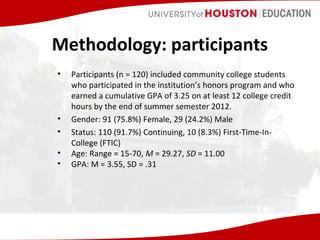
Participants (n = 120) included community college students
who participated in the institution’s honors program and who
earned a cumulative GPA of 3.25 on at least 12 college credit
hours by the end of summer semester 2012.
Gender: 91 (75.8%) Female, 29 (24.2%) Male
Status: 110 (91.7%) Continuing, 10 (8.3%) First-Time-InCollege (FTIC)
Age: Range = 15-70, M = 29.27, SD = 11.00
GPA: M = 3.55, SD = .31
Methodology: participants
Methodology: instrument
• Achievement Goal Questionnaire –
Revised or AGQ-R (Elliott & Murayama,
2008), a 12-item survey, each item
consisting of a five-point summative
response scale (Cronbach’s alphas:
Mastery-approach, .84; Masteryavoidance, .88; Performanceapproach, .92; and Performanceavoidance, .94).
Methodology: procedure
•

•

E-mail invitations to participate in the study were sent to San
Jacinto College students who had successfully completed at
least 12 hours of college-level courses and had a cumulative
grade point average of at least 3.25 and participated in the
institution’s honors program.
One respondent was excluded because he/she could not be
identified. One eighteen-year-old, Hispanic female originally
identified as “honors” and “continuing” was excluded based
on 0.66 GPA, which would have made her ineligible for the
honors program.
Results

Note: CI = confidence interval; LL = lower limit, UL = upper limit.
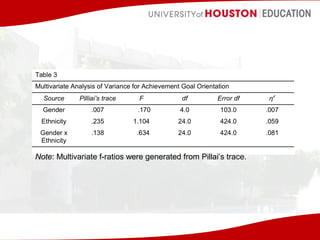
Note: Multivariate f-ratios were generated from Pillai’s trace.
Discussion
• Competitive, performance-oriented
environment may not affect AGO.
• Non-significant findings align with the
Witkow and Fuligni (2007) study with
regard to the invariance of goal
orientations across ethnicities
• Contrary to Smith et al. (2002), the
present study found no significant
statistical difference between males and
females in performance-avoidance goal
orientation
Discussion
• Limitations:

– sample size
– community college
population(generalizability).
– Quasi-experimental.
Future research
• Achievement Goal Orientation:

– Conduct SEM and CFA; possible co-activation of
performance valences; and additional dimensions.
– Analysis of variance between honors and non-honors
students
– Relationship between AGO and academic achievement as
measured by GPA
– Regression Discontinuity Design between high-ability and
typical/low-ability learners
References
•
•
•
•
•
•
•
•

Byrne, J. P. (1998). Honors Programs in Community Colleges: A Review of Recent Issues and Literature.
Cosgrove, J. R. (2004). The impact of honors programs on undergraduate academic performance,
retention, and graduation. Journal of the National Collegiate Honors Council, 45-53.
Dweck, C. S. (1986). Motivational processes affecting learning. American Psychologist, 41, 1040-1048.
Elliot, A. J., & Harackiewicz, J. M. (1996). Approach and avoidance achievement goals and intrinsic
motivation: A mediational analysis. Journal of Personality and Social Psychology, 70, 461– 475. doi:
10.1037/0022-3514.70.3.461
Law, W., Elliot, A. J., & Murayama, K. (2012). Perceived competence moderates the relation between
performance-approach and performance-avoid goals. Journal of Educational Psychology, 104, 806-819.
Long, E.C.J. & Lange S. (2002). An Exploratory Study: A Comparison of Honors & Non-Honors Students.
The National Honors Report, 23 (1): 20-30.
Long, T. L & Kurleander, M. (2011). Do community college provide a viable pathway to a baccalaureate
degree? Educational Evaluation and Policy Analysis, 31, 30-53.
Maehr, M. L. (1983). On doing well in science: Why Johnny no longer excels, why Sarah never did. In S.
Paris, G. Olson, & H. Stevenson (Eds.), Learning and motivation in the classroom (pp. 179–210). Hillsdale,
NJ: Erlbaum.
References
•
•
•
•

•

Olivas, M. A. (1975). A Statistical Portrait of Honors Programs in Two-Year Colleges. (ED
221 257).
Outcalt, C. L. (1999). The importance of community college honors programs. New
Directions for Community Colleges, 108, 59-68.
Pintrich, P. R. (2000). An achievement goal theory perspective on issues in motivation
terminology, theory, and research. Contemporary Educational Psychology, 25, 92–104.
Rinn, A. N. (2007). Effects of programmatic selectivity on the academic achievement,
Academic self-concepts, and aspirations of gifted college students. Gifted Child Quarterly,
51, 232-245.
Scager, K., Akkerman, S. F., Keesen, F., Mainhard, M. T., Pilot, A., & Wubbels, T. (2012).
Do honors students have more potential for excellence in their professional lives? Higher
Education, 64, 19-39. DOI 10.1007/s10734-011-9478-z
Questions?
Contact information
Scott R. Furtwengler
University of Houston
srfurtwengler@uh.edu

Achievement Goal Orientation across Gender and Ethnicity in a Community College Honors Program

  • 1.
    Achievement Goal Orientation acrossGender and Ethnicity in a Community College Honors Program Scott R. Furtwengler, University of Houston Candidacy Defense Monday, November 18, 2013
  • 2.
    Outline • • • • • • • • Overview of theproblem Purpose of the current study Brief overview of extant literature Methodology Results Discussion References Questions
  • 3.
    Overview of theproblem • In a competitive, performance-oriented environment, females are more likely than males to exhibit maladaptive behavior by adopting avoidance orientation (Bear, 1998; Shucard & Hillman, 1990). • Ethnicity may reflect cultural differences in goal orientation, resulting in maladaptive behavior by adopting avoidance orientation (Elliot, Chirkov, Kim, and Sheldon, 2001).
  • 4.
    Purpose of thecurrent study • Research questions: – How does achievement goal orientation vary across gender and ethnicity in a community college honors program?
  • 5.
    Overview of extantliterature • Achievement goal orientation • Post-secondary honors programs • The community college context
  • 6.
    Achievement Goal Orientation •Dweck (1986), Maehr (1983), Nicholls (1984) • Mastery goals: developing competence through task mastery • Performance goals: developing competence relative to others
  • 7.
    Achievement Goal Orientation •Elliot (1999), Elliot & Harackiewicz (1996), Pintrich (2000) • Extended to a 2 x 2 model – Definitions of competence: mastery & performance – Valences of competence: approach & avoid
  • 8.
    Achievement Goal Orientation •Law, Elliot, & Murayama (2012) – Performance-approach goals: high effort, high persistence, high level of aspiration, high academic performance – Performance-avoidance goals: disorganized study strategies, high test anxiety, low academic performance, low intrinsic motivation – Perceived competence is a moderator
  • 9.
    AGO 2 x2 Framework Approach Focus Avoidance Focus Master-Goal Orientation Focus on learning Focus on avoiding misunderstanding Performance-Goal Orientation Focus on outperforming others Focus on avoiding the appearance of incompetence, avoiding negative judgments
  • 10.
    Honors Programs • Cosgrove(2004): mean GPA • Long & Lange (2002): conscientiousness, openness to experience, GPA, ACT • Rinn (2007): academic achievement and higher academic self-concept • Scager, Akkerman, Keesen, Mainhard, Pilot, & Wubbels (2012): desire to learn, drive to excel, creativity
  • 11.
    Community College Context •Byrne (1988): review of literature • Long & Kurleander (2011): lower rates of degree completion and college credits earned • Olivas (1975) & Outcalt (1999): disproportion of underrepresented students
  • 12.
  • 13.
    Methodology: participants • • • • • Participants (n= 120) included community college students who participated in the institution’s honors program and who earned a cumulative GPA of 3.25 on at least 12 college credit hours by the end of summer semester 2012. Gender: 91 (75.8%) Female, 29 (24.2%) Male Status: 110 (91.7%) Continuing, 10 (8.3%) First-Time-InCollege (FTIC) Age: Range = 15-70, M = 29.27, SD = 11.00 GPA: M = 3.55, SD = .31
  • 14.
  • 15.
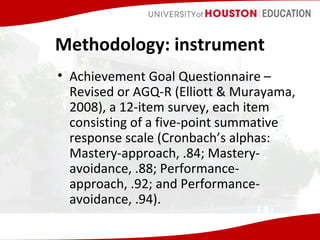
    Methodology: instrument • AchievementGoal Questionnaire – Revised or AGQ-R (Elliott & Murayama, 2008), a 12-item survey, each item consisting of a five-point summative response scale (Cronbach’s alphas: Mastery-approach, .84; Masteryavoidance, .88; Performanceapproach, .92; and Performanceavoidance, .94).
  • 16.
    Methodology: procedure • • E-mail invitationsto participate in the study were sent to San Jacinto College students who had successfully completed at least 12 hours of college-level courses and had a cumulative grade point average of at least 3.25 and participated in the institution’s honors program. One respondent was excluded because he/she could not be identified. One eighteen-year-old, Hispanic female originally identified as “honors” and “continuing” was excluded based on 0.66 GPA, which would have made her ineligible for the honors program.
  • 17.
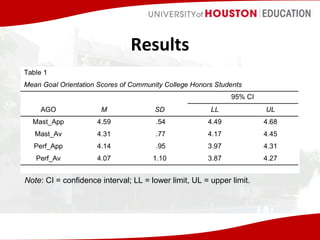
    Results Note: CI =confidence interval; LL = lower limit, UL = upper limit.
  • 19.
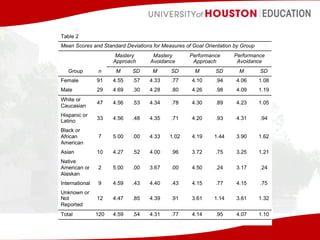
    Note: Multivariate f-ratioswere generated from Pillai’s trace.
  • 20.
    Discussion • Competitive, performance-oriented environmentmay not affect AGO. • Non-significant findings align with the Witkow and Fuligni (2007) study with regard to the invariance of goal orientations across ethnicities • Contrary to Smith et al. (2002), the present study found no significant statistical difference between males and females in performance-avoidance goal orientation
  • 21.
    Discussion • Limitations: – samplesize – community college population(generalizability). – Quasi-experimental.
  • 22.
    Future research • AchievementGoal Orientation: – Conduct SEM and CFA; possible co-activation of performance valences; and additional dimensions. – Analysis of variance between honors and non-honors students – Relationship between AGO and academic achievement as measured by GPA – Regression Discontinuity Design between high-ability and typical/low-ability learners
  • 23.
    References • • • • • • • • Byrne, J. P.(1998). Honors Programs in Community Colleges: A Review of Recent Issues and Literature. Cosgrove, J. R. (2004). The impact of honors programs on undergraduate academic performance, retention, and graduation. Journal of the National Collegiate Honors Council, 45-53. Dweck, C. S. (1986). Motivational processes affecting learning. American Psychologist, 41, 1040-1048. Elliot, A. J., & Harackiewicz, J. M. (1996). Approach and avoidance achievement goals and intrinsic motivation: A mediational analysis. Journal of Personality and Social Psychology, 70, 461– 475. doi: 10.1037/0022-3514.70.3.461 Law, W., Elliot, A. J., & Murayama, K. (2012). Perceived competence moderates the relation between performance-approach and performance-avoid goals. Journal of Educational Psychology, 104, 806-819. Long, E.C.J. & Lange S. (2002). An Exploratory Study: A Comparison of Honors & Non-Honors Students. The National Honors Report, 23 (1): 20-30. Long, T. L & Kurleander, M. (2011). Do community college provide a viable pathway to a baccalaureate degree? Educational Evaluation and Policy Analysis, 31, 30-53. Maehr, M. L. (1983). On doing well in science: Why Johnny no longer excels, why Sarah never did. In S. Paris, G. Olson, & H. Stevenson (Eds.), Learning and motivation in the classroom (pp. 179–210). Hillsdale, NJ: Erlbaum.
  • 24.
    References • • • • • Olivas, M. A.(1975). A Statistical Portrait of Honors Programs in Two-Year Colleges. (ED 221 257). Outcalt, C. L. (1999). The importance of community college honors programs. New Directions for Community Colleges, 108, 59-68. Pintrich, P. R. (2000). An achievement goal theory perspective on issues in motivation terminology, theory, and research. Contemporary Educational Psychology, 25, 92–104. Rinn, A. N. (2007). Effects of programmatic selectivity on the academic achievement, Academic self-concepts, and aspirations of gifted college students. Gifted Child Quarterly, 51, 232-245. Scager, K., Akkerman, S. F., Keesen, F., Mainhard, M. T., Pilot, A., & Wubbels, T. (2012). Do honors students have more potential for excellence in their professional lives? Higher Education, 64, 19-39. DOI 10.1007/s10734-011-9478-z
  • 25.
  • 26.
    Contact information Scott R.Furtwengler University of Houston srfurtwengler@uh.edu

Editor's Notes

  • #4 Research interests, background, preliminary research Mean differences: are non-honors students exhibiting self-handicapping behavior by not participating in an honors environment? For some community colleges, this is a question of accountability. If the students participating in honors are experiencing a higher degree of success on metrics of retention, achievement outcomes, persistence, and time-to-graduation, why aren’t all high ability students choosing to participate. If there are no measureable differences, why should we allocate resources to such a small population of students?
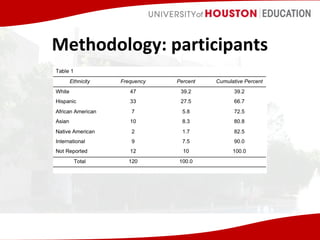
  • #14 San Jacinto College is a community college with three campuses in east and south Houston. Total unduplicated enrollment for spring 2012 was 26,465: 57% female, 33% White, 10% African American, 40% Hispanic, 5% Asian, 1% Native American, 2% non-resident alien, 9% not reported, < 1% Native Hawaiian).
  • #16 The structural validity of Elliott’s and Murayama’s revised instrument stands up to rigorous scrutiny. They found the four-factor structure to be a better fit to the data than other three- and two-factor structures, with each of the four factors exhibiting a high-degree of internal consistency and reliability
  • #19 A two-way between subjects multivariate analysis of variance (MANOVA) was conducted on four dependent variables: mastery-approach goal orientation, mastery-avoidance goal orientation, performance-approach goal orientation, and performance-avoidance goal orientation. The independent variables were gender (female, male) and ethnicity (White Non-Hispanic, Hispanic, Black Non-Hispanic, Asian/Pacific Islander, American Indian/Alaskan Native, International, & Unknown/Not Reported). The results of a statistically significant Box’s M test (p = .00) indicated a violation of the equality test of variance-covariance matrices of the dependent variables across levels of the dependent variables, therefore Pillai’s trace was used to assess multivariate effects. Using Pillai’s trace (see Table 3), the dependent variate was not significantly affected by the main effects of gender, Pillai’s trace = .007 F(4, 103) = .170, p > .05, partial η2 = .007, or ethnicity, Pillai’s trace = .235, F( 24, 424) = 1.104, p > .05, partial η2 = .059. The multivariate interaction of gender x ethnicity was not statistically significant, F < 1.0. Since no statistical difference was indicated by the multivariate analysis, a univariate analysis was not conducted.
  • #20 A two-way between subjects multivariate analysis of variance (MANOVA) was conducted on four dependent variables: mastery-approach goal orientation, mastery-avoidance goal orientation, performance-approach goal orientation, and performance-avoidance goal orientation. The independent variables were gender (female, male) and ethnicity (White Non-Hispanic, Hispanic, Black Non-Hispanic, Asian/Pacific Islander, American Indian/Alaskan Native, International, & Unknown/Not Reported). The results of a statistically significant Box’s M test (p = .00) indicated a violation of the equality test of variance-covariance matrices of the dependent variables across levels of the independent variables, therefore Pillai’s trace was used to assess multivariate effects. Using Pillai’s trace (see Table 3), the dependent variate was not significantly affected by the main effects of gender, Pillai’s trace = .007 F(4, 103) = .170, p > .05, partial η2 = .007, or ethnicity, Pillai’s trace = .235, F( 24, 424) = 1.104, p > .05, partial η2 = .059. The multivariate interaction of gender x ethnicity was not statistically significant, F < 1.0. Since no statistical difference was indicated by the multivariate analysis, a univariate analysis was not conducted.