Further Evidence of How Technology Availability Doesn’t Guarantee Usage Judith Engelbrecht, Inga Hunter and Richard Whiddett   Information Systems Group,  College of Business, Massey University, Palmerston North, New Zealand
Presentation details Introduction Study overview Study area Methodology The pilot case study Focus of the presentation Pilot study questionnaire responses Results: 1. Practice use of technologies 2. Practice size and percentage of technologies available in GP practices 3. Practice use of three technologies 4.  Clues to limitations in the use of popular systems for CDS Discussion Conclusions Acknowledgements and contact details References
Introduction International and Australasian health care organizations are seeking to improve the use of computerised clinical decision support (CDS) in health care [1;2;3] . New Zealand’s primary health care sector is now structured around not-for-profit Primary Health Organisations (PHOs) [4] .  Knowledge of IT infrastructure and its usage by PHO member practices would enable their management organisations to formulate appropriate strategies to encourage better use of technologies, and the decision support capabilities they provide.  This presentation gives preliminary results regarding the IT supporting patient care in primary care GP practices, and the utilisation of three of the most popular of those technologies for CDS.
Study overview This study of New Zealand General Practitioner (GP) practices belonging to one PHO demonstrates that those surveyed are generally well equipped with information technology (IT), suggesting there is the potential for them to be able to utilize levels of clinical decision support (CDS) similar to each other. However,  three commonly available technologies used by 80% or more of practices were all found to be used by fewer practices for CDS. This suggests that barriers other than the availability of technologies are important inhibitors to the utilization of IT for CDS.
Study area Where? Medium sized New Zealand PHOs PHO Management Services Organisations Staff Contract holders Contributing General Practitioner practices Doctors Practice nurses Practice administrators What?   What information technologies (IT) are available in the organisations How the organisations use IT in the support of clinical decision making
Methodology A literature review followed by a multiple case study of medium sized PHOs, consisting of  a pilot case study PHO, and  two other case study PHOs.  Triangulation [5]  was achieved by  the use of face-to-face interviews,  a postal questionnaire survey of GP practices and  the collection of documentation at each case study organisation.
The pilot case study PHO Face-to-face, semi-structured interviews, each of aprox. 1 hr. duration with  8 PHO management services staff and  7 health professionals/managers from a total of 3 GP practices a postal questionnaire survey of GP practices not providing interviewees, and  the collection of documentation.
Focus of the presentation Pilot study questionnaire results Qualitative data from pilot study GP practice interviews
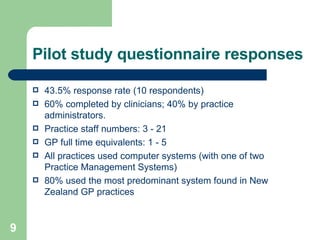
Pilot study questionnaire responses 43.5% response rate (10 respondents)  60% completed by clinicians; 40% by practice administrators.  Practice staff numbers: 3 - 21 GP full time equivalents: 1 - 5  All practices used computer systems (with one of two Practice Management Systems) 80% used the most predominant system found in New Zealand GP practices
Results 1:   Practice use of technologies   [a]  Secure network for health sector electronic messaging Technologies used in the support of patient care by 30% or more of the respondent practices. 30 AI/expert systems (e.g. risk assessor) 80 e-mail 30 Digital camera (for mole tracking) 80 Extranet application (e.g. ACC logging) 30 Laptop 90 Spreadsheet 30 Intranet application 90 Internal messaging system 40 Remote access 90 The Internet/external websites or databases 40 Information manager (e.g. Outlook) 100 Word processing software 50 Cell-phone 100 Healthlink connection  [a]   50 Scanner 100 PCs 60 Secure file transfer (e.g. Securit) 100 Printer 60 Server 100 Fax. Machine 70 Desktop publishing 100 Practice Management Systems (PMS) % Practices using technology Technology % Practices using technology Technology
Results 2:   Practice size and percentage of technologies available in GP practices Individual practices used between  45.5% and 95.5%   of the technologies shown in table 1. all but the three smallest practices [b]  used more than 50% of the technologies, but otherwise there appeared to be little evidence that increasing practice size corresponded to increased technology infrastructure.  [b]  Practices 1-3 and are the same size, based on the total number of staff and GP FTEs in each practice
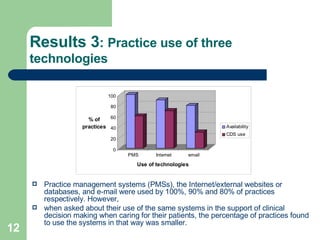
Results 3 :  Practice use of three technologies   Practice management systems (PMSs), the Internet/external websites or databases, and e-mail were used by 100%, 90% and 80% of practices respectively. However,  when asked about their use of the same systems in the support of clinical decision making when caring for their patients, the percentage of practices found to use the systems in that way was smaller.
Results 4:  Clues to limitations in the use of popular systems for CDS Practice nurse’s comments: PMS and user skills - “ It’s got the capability to do that [provide alerts and reminders]. It’s only as good as the operator…We all do our own [setting up]….I use it a lot, especially for over-dues.”  Access to, and use of the Internet - “ … I can gather [needed information] but I have to go outside of work to do it ... you see [the doctor’s] got the Internet for ‘travel’ which he looks up and … I have a lot of  queries about travel and I have to go to him for that because I can’t directly access it myself  …”
Results 4 (cont):  Clues to limitations in the use of popular systems for CDS Administrator’s comments in a practice where one of the doctors uses the Internet little and doesn’t use e-mail at all for CDS: “ Our doctors do use that [e-mail] quite a lot: for special authorities [c]  - if they’ve sent one away and they haven’t got it back; for ACC [d] , if they have a lot of clients who come in and say “ACC declined my claim. What do I do now…?”  We have a lot of interaction with WINZ [e] , because a lot of our clients are beneficiaries, so we have a lot to do with working with the case managers …” [c] Authorities needed for the prescription of certain subsidized medications [d] The Accident Compensation Corporation [e] Work and Income New Zealand
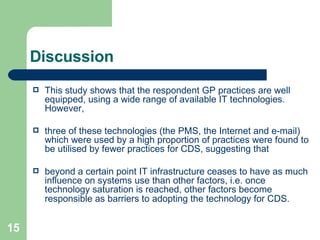
Discussion This study shows that the respondent GP practices are well equipped, using a wide range of available IT technologies. However,  three of these technologies (the PMS, the Internet and e-mail) which were used by a high proportion of practices were found to be utilised by fewer practices for CDS, suggesting that  beyond a certain point IT infrastructure ceases to have as much influence on systems use than other factors, i.e. once technology saturation is reached, other factors become responsible as barriers to adopting the technology for CDS.
Discussion cont. Such additional barriers may include resource and clinical issues such as time, cost, training, credibility, and skills in using CDS programmes, and less importantly, technical and systems considerations [6;7;8] . Actually having access to popular technologies within an organisation or even within one practice does not necessarily guarantee either their general use, or use for CDS.
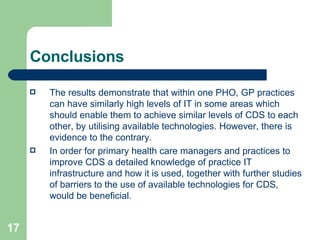
Conclusions The results demonstrate that within one PHO, GP practices can have similarly high levels of IT in some areas which should enable them to achieve similar levels of CDS to each other, by utilising available technologies. However, there is evidence to the contrary.  In order for primary health care managers and practices to improve CDS a detailed knowledge of practice IT infrastructure and how it is used, together with further studies of barriers to the use of available technologies for CDS, would be beneficial.
Acknowledgements and Contact Details Acknowledgements - With thanks to:  the staff of the pilot case study PHO management organisation and health care practices, for their generosity in sharing their knowledge and time; the local Iwi Council of Elders, Te Mauri O Rangitaane O Manawatu for their support and advice; the Tertiary Education Commission for the support provided by a Bright Future Top Achiever Doctoral Scholarship;  the Maurice and Phyllis Paykel Trust for a travel grant which contributed to the presentation of a poster based on this research which was presented at the Medinfo Congress 2007, August 20-24, Brisbane, Australia, and the Health and Disability Ethics Committee for approval for the research (reference: CEN/05/08/053). Contact details - Judith Engelbrecht, Information Systems Group, College of Business, Massey University, Palmerston North, New Zealand. Phone +64 6 356 9099 ext 7753  [email_address]
References [1]   WAVE Advisory Board. From Strategy to Reality, The WAVE Project, Kia hopu te ngaru. Wellington: Ministry of Health, 2001. [2]  National Electronic Decision Support Taskforce. Electronic decision support for Australia’s health sector. National Health Information Management Advisory Council (NHIMAC). 2003 January. [Accessed 2004 October]. URL:  http:// www.ahic.org.au/downloads/nedsrept.pdf   [3]  Metzger J and MacDonald K. Clinical decision support for the independent physician practice. First Consulting Group. California HealthCare Foundation, California: 2002 October. [Accessed 2006 November]. URL:  http://www.chcf.org/documents/ihealth/ClinicalDecisionSupport.pdf   [4]  Ministry of Health. The primary health care strategy. Wellington: Ministry of Health, 2001. [5]  Yin RK. Case Study Research: Design and Methods, 3rd ed. Applied Social Research Methods Series, vol.5. California: SAGE Publications, 2003. [6]  Engelbrecht J, Whiddett R, and Hunter I. The use of information systems for clinical decision support by primary health care practices in a medium sized PHO. Health Care and Informatics Review OnlineTM. September 2006.  [Accessed 2006 October]. URL:  http:// hcro.enigma.co.nz/website/index.cfm?fuseaction = articledisplay&FeatureID =060906   [7]  Leung GM, Yu PLH, Wong IOL, Johnston JM., and Tin KYK.  Incentives and barriers that influence clinical computerization in Hong Kong: A population-based physician survey. JAMIA March/April 2003: 10: 201-212 [8]  Wells S and Jackson R. Online management of cardiovascular risk in New Zealand with PREDICT™ – Getting evidence to the "moment of care". Health Care and Informatics Review OnlineTM. March 2005. [Accessed 2006 May]. URL:  http:// hcro.enigma.co.nz/website/index.cfm?fuseaction = articledisplay&featureid =010305

Further Evidence of How Technology Availability Doesn’t Guarantee Usage

  • 1.
    Further Evidence ofHow Technology Availability Doesn’t Guarantee Usage Judith Engelbrecht, Inga Hunter and Richard Whiddett Information Systems Group, College of Business, Massey University, Palmerston North, New Zealand
  • 2.
    Presentation details IntroductionStudy overview Study area Methodology The pilot case study Focus of the presentation Pilot study questionnaire responses Results: 1. Practice use of technologies 2. Practice size and percentage of technologies available in GP practices 3. Practice use of three technologies 4. Clues to limitations in the use of popular systems for CDS Discussion Conclusions Acknowledgements and contact details References
  • 3.
    Introduction International andAustralasian health care organizations are seeking to improve the use of computerised clinical decision support (CDS) in health care [1;2;3] . New Zealand’s primary health care sector is now structured around not-for-profit Primary Health Organisations (PHOs) [4] . Knowledge of IT infrastructure and its usage by PHO member practices would enable their management organisations to formulate appropriate strategies to encourage better use of technologies, and the decision support capabilities they provide. This presentation gives preliminary results regarding the IT supporting patient care in primary care GP practices, and the utilisation of three of the most popular of those technologies for CDS.
  • 4.
    Study overview Thisstudy of New Zealand General Practitioner (GP) practices belonging to one PHO demonstrates that those surveyed are generally well equipped with information technology (IT), suggesting there is the potential for them to be able to utilize levels of clinical decision support (CDS) similar to each other. However, three commonly available technologies used by 80% or more of practices were all found to be used by fewer practices for CDS. This suggests that barriers other than the availability of technologies are important inhibitors to the utilization of IT for CDS.
  • 5.
    Study area Where?Medium sized New Zealand PHOs PHO Management Services Organisations Staff Contract holders Contributing General Practitioner practices Doctors Practice nurses Practice administrators What? What information technologies (IT) are available in the organisations How the organisations use IT in the support of clinical decision making
  • 6.
    Methodology A literaturereview followed by a multiple case study of medium sized PHOs, consisting of a pilot case study PHO, and two other case study PHOs. Triangulation [5] was achieved by the use of face-to-face interviews, a postal questionnaire survey of GP practices and the collection of documentation at each case study organisation.
  • 7.
    The pilot casestudy PHO Face-to-face, semi-structured interviews, each of aprox. 1 hr. duration with 8 PHO management services staff and 7 health professionals/managers from a total of 3 GP practices a postal questionnaire survey of GP practices not providing interviewees, and the collection of documentation.
  • 8.
    Focus of thepresentation Pilot study questionnaire results Qualitative data from pilot study GP practice interviews
  • 9.
    Pilot study questionnaireresponses 43.5% response rate (10 respondents) 60% completed by clinicians; 40% by practice administrators. Practice staff numbers: 3 - 21 GP full time equivalents: 1 - 5 All practices used computer systems (with one of two Practice Management Systems) 80% used the most predominant system found in New Zealand GP practices
  • 10.
    Results 1: Practice use of technologies [a] Secure network for health sector electronic messaging Technologies used in the support of patient care by 30% or more of the respondent practices. 30 AI/expert systems (e.g. risk assessor) 80 e-mail 30 Digital camera (for mole tracking) 80 Extranet application (e.g. ACC logging) 30 Laptop 90 Spreadsheet 30 Intranet application 90 Internal messaging system 40 Remote access 90 The Internet/external websites or databases 40 Information manager (e.g. Outlook) 100 Word processing software 50 Cell-phone 100 Healthlink connection [a] 50 Scanner 100 PCs 60 Secure file transfer (e.g. Securit) 100 Printer 60 Server 100 Fax. Machine 70 Desktop publishing 100 Practice Management Systems (PMS) % Practices using technology Technology % Practices using technology Technology
  • 11.
    Results 2: Practice size and percentage of technologies available in GP practices Individual practices used between 45.5% and 95.5% of the technologies shown in table 1. all but the three smallest practices [b] used more than 50% of the technologies, but otherwise there appeared to be little evidence that increasing practice size corresponded to increased technology infrastructure. [b] Practices 1-3 and are the same size, based on the total number of staff and GP FTEs in each practice
  • 12.
    Results 3 : Practice use of three technologies Practice management systems (PMSs), the Internet/external websites or databases, and e-mail were used by 100%, 90% and 80% of practices respectively. However, when asked about their use of the same systems in the support of clinical decision making when caring for their patients, the percentage of practices found to use the systems in that way was smaller.
  • 13.
    Results 4: Clues to limitations in the use of popular systems for CDS Practice nurse’s comments: PMS and user skills - “ It’s got the capability to do that [provide alerts and reminders]. It’s only as good as the operator…We all do our own [setting up]….I use it a lot, especially for over-dues.” Access to, and use of the Internet - “ … I can gather [needed information] but I have to go outside of work to do it ... you see [the doctor’s] got the Internet for ‘travel’ which he looks up and … I have a lot of queries about travel and I have to go to him for that because I can’t directly access it myself …”
  • 14.
    Results 4 (cont): Clues to limitations in the use of popular systems for CDS Administrator’s comments in a practice where one of the doctors uses the Internet little and doesn’t use e-mail at all for CDS: “ Our doctors do use that [e-mail] quite a lot: for special authorities [c] - if they’ve sent one away and they haven’t got it back; for ACC [d] , if they have a lot of clients who come in and say “ACC declined my claim. What do I do now…?” We have a lot of interaction with WINZ [e] , because a lot of our clients are beneficiaries, so we have a lot to do with working with the case managers …” [c] Authorities needed for the prescription of certain subsidized medications [d] The Accident Compensation Corporation [e] Work and Income New Zealand
  • 15.
    Discussion This studyshows that the respondent GP practices are well equipped, using a wide range of available IT technologies. However, three of these technologies (the PMS, the Internet and e-mail) which were used by a high proportion of practices were found to be utilised by fewer practices for CDS, suggesting that beyond a certain point IT infrastructure ceases to have as much influence on systems use than other factors, i.e. once technology saturation is reached, other factors become responsible as barriers to adopting the technology for CDS.
  • 16.
    Discussion cont. Suchadditional barriers may include resource and clinical issues such as time, cost, training, credibility, and skills in using CDS programmes, and less importantly, technical and systems considerations [6;7;8] . Actually having access to popular technologies within an organisation or even within one practice does not necessarily guarantee either their general use, or use for CDS.
  • 17.
    Conclusions The resultsdemonstrate that within one PHO, GP practices can have similarly high levels of IT in some areas which should enable them to achieve similar levels of CDS to each other, by utilising available technologies. However, there is evidence to the contrary. In order for primary health care managers and practices to improve CDS a detailed knowledge of practice IT infrastructure and how it is used, together with further studies of barriers to the use of available technologies for CDS, would be beneficial.
  • 18.
    Acknowledgements and ContactDetails Acknowledgements - With thanks to: the staff of the pilot case study PHO management organisation and health care practices, for their generosity in sharing their knowledge and time; the local Iwi Council of Elders, Te Mauri O Rangitaane O Manawatu for their support and advice; the Tertiary Education Commission for the support provided by a Bright Future Top Achiever Doctoral Scholarship; the Maurice and Phyllis Paykel Trust for a travel grant which contributed to the presentation of a poster based on this research which was presented at the Medinfo Congress 2007, August 20-24, Brisbane, Australia, and the Health and Disability Ethics Committee for approval for the research (reference: CEN/05/08/053). Contact details - Judith Engelbrecht, Information Systems Group, College of Business, Massey University, Palmerston North, New Zealand. Phone +64 6 356 9099 ext 7753 [email_address]
  • 19.
    References [1] WAVE Advisory Board. From Strategy to Reality, The WAVE Project, Kia hopu te ngaru. Wellington: Ministry of Health, 2001. [2] National Electronic Decision Support Taskforce. Electronic decision support for Australia’s health sector. National Health Information Management Advisory Council (NHIMAC). 2003 January. [Accessed 2004 October]. URL: http:// www.ahic.org.au/downloads/nedsrept.pdf [3] Metzger J and MacDonald K. Clinical decision support for the independent physician practice. First Consulting Group. California HealthCare Foundation, California: 2002 October. [Accessed 2006 November]. URL: http://www.chcf.org/documents/ihealth/ClinicalDecisionSupport.pdf [4] Ministry of Health. The primary health care strategy. Wellington: Ministry of Health, 2001. [5] Yin RK. Case Study Research: Design and Methods, 3rd ed. Applied Social Research Methods Series, vol.5. California: SAGE Publications, 2003. [6] Engelbrecht J, Whiddett R, and Hunter I. The use of information systems for clinical decision support by primary health care practices in a medium sized PHO. Health Care and Informatics Review OnlineTM. September 2006. [Accessed 2006 October]. URL: http:// hcro.enigma.co.nz/website/index.cfm?fuseaction = articledisplay&FeatureID =060906 [7] Leung GM, Yu PLH, Wong IOL, Johnston JM., and Tin KYK. Incentives and barriers that influence clinical computerization in Hong Kong: A population-based physician survey. JAMIA March/April 2003: 10: 201-212 [8] Wells S and Jackson R. Online management of cardiovascular risk in New Zealand with PREDICT™ – Getting evidence to the "moment of care". Health Care and Informatics Review OnlineTM. March 2005. [Accessed 2006 May]. URL: http:// hcro.enigma.co.nz/website/index.cfm?fuseaction = articledisplay&featureid =010305