

Group- 10
Shashank Joshi
Apurva Kumar
Prachi Sawant
Ayushi Garg
Prateek Parimal
• The global furniture market can be broadly categorised into four
categories - domestic furniture, office/corporate furniture, hotel
furniture and furniture parts.
• Globally, domestic furniture accounts for 65 per cent of the
production value, whilst corporate/office furniture represents 15
per cent, hotel furniture 15 per cent and furniture parts 5 per cent.
• According to a World Bank study, the organised furniture industry
is expected to grow by 20 per cent every year.
• A large part of this growth is expected to come from the rapidly
growing consumer markets of Asia, implying significant potential
for growth in the Indian furniture sector.
• As with the global market, home furniture is the largest segment in
the Indian furniture market, accounting for about 65 per cent of
furniture sales.
• This is followed by, the office furniture segment with a 20 per cent
share and the contract segment, accounting for the remaining 15 per
cent. n Household n Office n Contract Consumer Segments 15%
• Following are the types of furniture market:-
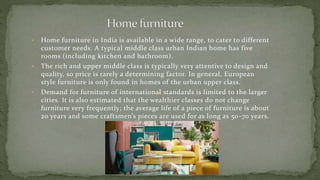
• Home furniture in India is available in a wide range, to cater to different
customer needs. A typical middle class urban Indian home has five
rooms (including kitchen and bathroom).
• The rich and upper middle class is typically very attentive to design and
quality, so price is rarely a determining factor. In general, European
style furniture is only found in homes of the urban upper class.
• Demand for furniture of international standards is limited to the larger
cities. It is also estimated that the wealthier classes do not change
furniture very frequently; the average life of a piece of furniture is about
20 years and some craftsmen’s pieces are used for as long as 50-70 years.
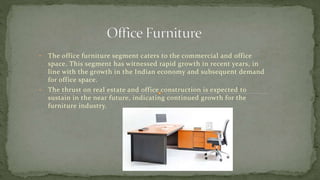
• The office furniture segment caters to the commercial and office
space. This segment has witnessed rapid growth in recent years, in
line with the growth in the Indian economy and subsequent demand
for office space.
• The thrust on real estate and office construction is expected to
sustain in the near future, indicating continued growth for the
furniture industry.
Gujarat
Besides carved chests and almirahs, Gujarat is synonymous with the
wooden swing. The different varieties of swings are made using a range of
wood from unvarnished hewn wood to rich lacquer. Sankheda village, in
Gujarat, has a unique tradition of engraving indigenously developed silver,
gold and bronze colours on wood. Surat, has a tradition of parquetry-work,
which is locally called Sadeli.
Kashmir
In Kashmir, extensive wood-work has been used for structures since
ancient times. Houses are lined with wood ceilings worked in geometrical
patterns and windows in lattice work. The Kashmiri houseboat, made
entirely of a specially seasoned wood that does not warp in water, is a
visual delight.
Hoshiarpur (Punjab)
 Wood workers here specialise in inlaying ivory, now more or less
replaced by plastic due to its low cost. Intricate designs have
received royal patronage some generations ago. Wooden
furniture, trays and mirror frames repeat certain basic motifs
and ornamentation derived from nature.
Saharanpur (Uttar Pradesh)
 This is the most flourishing commercial centre for woodcarving.
Sheesham and Teak are used for the smallscale manufacturing of
traditional, as well as modern products, such as, screens,
cigarette boxes, tables, trivets, bookends, etc. Saharanpur now
also concentrates on wood seasoning or the preparation of wood
before it is crafted, by mellowing it and making it proof resistant
against cracking and splitting.
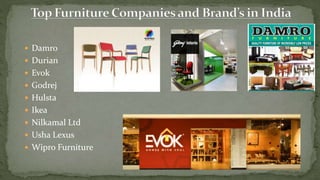
 Damro
 Durian
 Evok
 Godrej
 Hulsta
 Ikea
 Nilkamal Ltd
 Usha Lexus
 Wipro Furniture
Brand’s Established
Godrej Interio 1937
Skipper Furnishing 1986
Durian 1985
Damro 1986
 One of India’s largest furniture brand.
 Godrej Interio is the only company in India to have BIFMA certification for both
manufacturing process as well as products.
 The product categories include, home furniture and interior solutions, bedroom
solutions, living room solutions, dining room solutions, storage solutions, kids
furniture solutions, study furniture solutions, kitchen solutions, accessories,
mattresses, customized hardwood furniture and interior solutions, and institutional
furniture and interior solutions, desking solutions, seating solutions, storage
solutions, modular office solutions, healthcare furniture solutions, laboratory
furniture solutions, marine furniture solutions and 360 degree turnkey solutions.
 Recently, the brand was honoured as Asia’s Most Promising Brand 2016, World’s
Greatest Brands 2015 Asia, Home and Lifestyle Retailer of the Year.
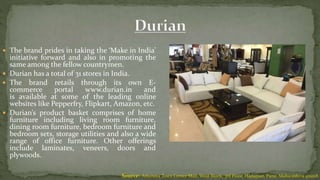
 The brand prides in taking the ‘Make in India’
initiative forward and also in promoting the
same among the fellow countrymen.
 Durian has a total of 31 stores in India.
 The brand retails through its own E-
commerce portal www.durian.in and
is available at some of the leading online
websites like Pepperfry, Flipkart, Amazon, etc.
 Durian’s product basket comprises of home
furniture including living room furniture,
dining room furniture, bedroom furniture and
bedroom sets, storage utilities and also a wide
range of office furniture. Other offerings
include laminates, veneers, doors and
plywoods.
Source: Amanora Town Center Mall, West Block, 3rd Floor, Hadapsar, Pune, Maharashtra 411028
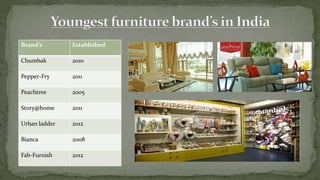
Brand’s Established
Chumbak 2010
Pepper-Fry 2011
Peachtree 2005
Story@home 2011
Urban ladder 2012
Bianca 2008
Fab-Furnish 2012
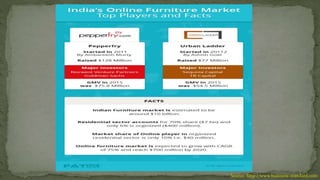
Source: http://www.business-standard.com
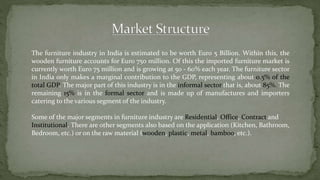
The furniture industry in India is estimated to be worth Euro 5 Billion. Within this, the
wooden furniture accounts for Euro 750 million. Of this the imported furniture market is
currently worth Euro 75 million and is growing at 50 - 60% each year. The furniture sector
in India only makes a marginal contribution to the GDP, representing about 0.5% of the
total GDP. The major part of this industry is in the informal sector that is, about 85%. The
remaining 15% is in the formal sector and is made up of manufactures and importers
catering to the various segment of the industry.
Some of the major segments in furniture industry are Residential, Office, Contract and
Institutional. There are other segments also based on the application (Kitchen, Bathroom,
Bedroom, etc.) or on the raw material (wooden, plastic, metal, bamboo, etc.).
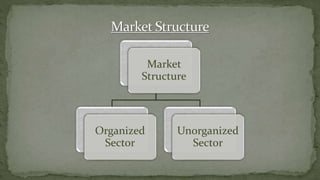
Market
Structure
Organized
Sector
Unorganized
Sector
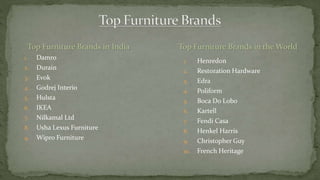
Top Furniture Brands in India
1. Damro
2. Durain
3. Evok
4. Godrej Interio
5. Hulsta
6. IKEA
7. Nilkamal Ltd
8. Usha Lexus Furniture
9. Wipro Furniture
1. Henredon
2. Restoration Hardware
3. Edra
4. Poliform
5. Boca Do Lobo
6. Kartell
7. Fendi Casa
8. Henkel Harris
9. Christopher Guy
10. French Heritage
Top Furniture Brands in the World
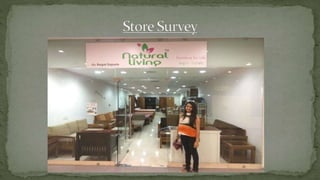
• We have visited Natural Living furniture store which is in Amanora Mall, Pune.
• 5 years old Shop
• Only Wooden Furniture- Use Sheesham Wood
• Most selling Products – Wooden Bed and Dinning
• 15% price hike After GST
• 28% GST on Furniture sector
• Best Qualilty- Customer Satisfied
• Custom Delievery Available within 15 Days
• Import From Jodhpur
• All mode of Payments.
• Weekdays – Customer Visits store
• Weekends – Purchase and Delievery
Industry Problem Constrains-
 Substitutes Like Plastic, Steel
Furniture.
 Substitutes are of lower price.
 No direct Competitors
 Less Customers
 Storage Problem
Regional Bottlenecks And
Hindering Efficiency –
Capacity Utilization -
 Less Capacity
 Catalogue Based Products –
More Made to Order
 Pricing Starts from 13000 to 2
Lakh.
 No Offers provided.
 No Seasonal Sale
 Price Decided by Head Office.
 Style and Quality of wood used
Pricing Techniques –
Most Important Cost Item –
 Raw Material i.e. Wood  In world Ikea
 In India Godrej , Neelkamal ,
Durian
Industry Leader –
 There are numerous opportunities in India for business of furniture as its
usage has been increased.
 There are opportunities like start-up, or work as a interior decorator of
furniture or the supplier of furniture to local market from national
market.
 One can move also move into the area of designing of furniture or in
manufacturing process of furniture.
Import Policy
 Importers in India require no
license or prior permission to
import furniture.
 This is leading to excessive
competition in the industry
 Import of furniture have to pass
the procedure of custom clearance
when they cross the Indian
Borders.
 The importers need to present
Originals of Commercial invoice,
packing List, Certificate of Origin,
and Bill of Lading.
Custom Clearance
Duty
 Basic Custom Duty (15 per cent) +
(2 per cent Education Cess)
 Packages should comply with Import Policy
provisions as laid down in The Policy circular
44 (RE 2000)/1997-2002 DT24th November,
2000.
 Each unit package should carry the
following details:
 (a) Name and address of the importer;
 (b) Common name of the commodity
packed;
 (c) Net quantity in terms of standard unit of
weights and measures
 (d) Month and year of packing in which the
commodity is manufactured or packed or
imported.
Packaging
 While a large amount of manufacturing activity takes place in
unorganized sector, market is slowly moving towards technology
advancement with growing number of organized players stepping-in.
 Various features like Augmented reality, The Internet of Things (IoT)
can be used for various manufacturing process.
Furniture Industry economic analysis

Furniture Industry economic analysis

  • 1.
    Group- 10 Shashank Joshi ApurvaKumar Prachi Sawant Ayushi Garg Prateek Parimal
  • 2.
    • The globalfurniture market can be broadly categorised into four categories - domestic furniture, office/corporate furniture, hotel furniture and furniture parts. • Globally, domestic furniture accounts for 65 per cent of the production value, whilst corporate/office furniture represents 15 per cent, hotel furniture 15 per cent and furniture parts 5 per cent. • According to a World Bank study, the organised furniture industry is expected to grow by 20 per cent every year. • A large part of this growth is expected to come from the rapidly growing consumer markets of Asia, implying significant potential for growth in the Indian furniture sector.
  • 3.
    • As withthe global market, home furniture is the largest segment in the Indian furniture market, accounting for about 65 per cent of furniture sales. • This is followed by, the office furniture segment with a 20 per cent share and the contract segment, accounting for the remaining 15 per cent. n Household n Office n Contract Consumer Segments 15% • Following are the types of furniture market:-
  • 4.
    • Home furniturein India is available in a wide range, to cater to different customer needs. A typical middle class urban Indian home has five rooms (including kitchen and bathroom). • The rich and upper middle class is typically very attentive to design and quality, so price is rarely a determining factor. In general, European style furniture is only found in homes of the urban upper class. • Demand for furniture of international standards is limited to the larger cities. It is also estimated that the wealthier classes do not change furniture very frequently; the average life of a piece of furniture is about 20 years and some craftsmen’s pieces are used for as long as 50-70 years.
  • 5.
    • The officefurniture segment caters to the commercial and office space. This segment has witnessed rapid growth in recent years, in line with the growth in the Indian economy and subsequent demand for office space. • The thrust on real estate and office construction is expected to sustain in the near future, indicating continued growth for the furniture industry.
  • 6.
    Gujarat Besides carved chestsand almirahs, Gujarat is synonymous with the wooden swing. The different varieties of swings are made using a range of wood from unvarnished hewn wood to rich lacquer. Sankheda village, in Gujarat, has a unique tradition of engraving indigenously developed silver, gold and bronze colours on wood. Surat, has a tradition of parquetry-work, which is locally called Sadeli. Kashmir In Kashmir, extensive wood-work has been used for structures since ancient times. Houses are lined with wood ceilings worked in geometrical patterns and windows in lattice work. The Kashmiri houseboat, made entirely of a specially seasoned wood that does not warp in water, is a visual delight.
  • 7.
    Hoshiarpur (Punjab)  Woodworkers here specialise in inlaying ivory, now more or less replaced by plastic due to its low cost. Intricate designs have received royal patronage some generations ago. Wooden furniture, trays and mirror frames repeat certain basic motifs and ornamentation derived from nature. Saharanpur (Uttar Pradesh)  This is the most flourishing commercial centre for woodcarving. Sheesham and Teak are used for the smallscale manufacturing of traditional, as well as modern products, such as, screens, cigarette boxes, tables, trivets, bookends, etc. Saharanpur now also concentrates on wood seasoning or the preparation of wood before it is crafted, by mellowing it and making it proof resistant against cracking and splitting.
  • 8.
     Damro  Durian Evok  Godrej  Hulsta  Ikea  Nilkamal Ltd  Usha Lexus  Wipro Furniture
  • 9.
    Brand’s Established Godrej Interio1937 Skipper Furnishing 1986 Durian 1985 Damro 1986
  • 10.
     One ofIndia’s largest furniture brand.  Godrej Interio is the only company in India to have BIFMA certification for both manufacturing process as well as products.  The product categories include, home furniture and interior solutions, bedroom solutions, living room solutions, dining room solutions, storage solutions, kids furniture solutions, study furniture solutions, kitchen solutions, accessories, mattresses, customized hardwood furniture and interior solutions, and institutional furniture and interior solutions, desking solutions, seating solutions, storage solutions, modular office solutions, healthcare furniture solutions, laboratory furniture solutions, marine furniture solutions and 360 degree turnkey solutions.  Recently, the brand was honoured as Asia’s Most Promising Brand 2016, World’s Greatest Brands 2015 Asia, Home and Lifestyle Retailer of the Year.
  • 11.
     The brandprides in taking the ‘Make in India’ initiative forward and also in promoting the same among the fellow countrymen.  Durian has a total of 31 stores in India.  The brand retails through its own E- commerce portal www.durian.in and is available at some of the leading online websites like Pepperfry, Flipkart, Amazon, etc.  Durian’s product basket comprises of home furniture including living room furniture, dining room furniture, bedroom furniture and bedroom sets, storage utilities and also a wide range of office furniture. Other offerings include laminates, veneers, doors and plywoods. Source: Amanora Town Center Mall, West Block, 3rd Floor, Hadapsar, Pune, Maharashtra 411028
  • 12.
    Brand’s Established Chumbak 2010 Pepper-Fry2011 Peachtree 2005 Story@home 2011 Urban ladder 2012 Bianca 2008 Fab-Furnish 2012
  • 13.
  • 14.
    The furniture industryin India is estimated to be worth Euro 5 Billion. Within this, the wooden furniture accounts for Euro 750 million. Of this the imported furniture market is currently worth Euro 75 million and is growing at 50 - 60% each year. The furniture sector in India only makes a marginal contribution to the GDP, representing about 0.5% of the total GDP. The major part of this industry is in the informal sector that is, about 85%. The remaining 15% is in the formal sector and is made up of manufactures and importers catering to the various segment of the industry. Some of the major segments in furniture industry are Residential, Office, Contract and Institutional. There are other segments also based on the application (Kitchen, Bathroom, Bedroom, etc.) or on the raw material (wooden, plastic, metal, bamboo, etc.).
  • 15.
  • 16.
    Top Furniture Brandsin India 1. Damro 2. Durain 3. Evok 4. Godrej Interio 5. Hulsta 6. IKEA 7. Nilkamal Ltd 8. Usha Lexus Furniture 9. Wipro Furniture 1. Henredon 2. Restoration Hardware 3. Edra 4. Poliform 5. Boca Do Lobo 6. Kartell 7. Fendi Casa 8. Henkel Harris 9. Christopher Guy 10. French Heritage Top Furniture Brands in the World
  • 19.
    • We havevisited Natural Living furniture store which is in Amanora Mall, Pune. • 5 years old Shop • Only Wooden Furniture- Use Sheesham Wood • Most selling Products – Wooden Bed and Dinning • 15% price hike After GST • 28% GST on Furniture sector • Best Qualilty- Customer Satisfied • Custom Delievery Available within 15 Days • Import From Jodhpur • All mode of Payments. • Weekdays – Customer Visits store • Weekends – Purchase and Delievery
  • 20.
    Industry Problem Constrains- Substitutes Like Plastic, Steel Furniture.  Substitutes are of lower price.  No direct Competitors  Less Customers  Storage Problem Regional Bottlenecks And Hindering Efficiency –
  • 21.
    Capacity Utilization - Less Capacity  Catalogue Based Products – More Made to Order  Pricing Starts from 13000 to 2 Lakh.  No Offers provided.  No Seasonal Sale  Price Decided by Head Office.  Style and Quality of wood used Pricing Techniques –
  • 22.
    Most Important CostItem –  Raw Material i.e. Wood  In world Ikea  In India Godrej , Neelkamal , Durian Industry Leader –
  • 23.
     There arenumerous opportunities in India for business of furniture as its usage has been increased.  There are opportunities like start-up, or work as a interior decorator of furniture or the supplier of furniture to local market from national market.  One can move also move into the area of designing of furniture or in manufacturing process of furniture.
  • 24.
    Import Policy  Importersin India require no license or prior permission to import furniture.  This is leading to excessive competition in the industry  Import of furniture have to pass the procedure of custom clearance when they cross the Indian Borders.  The importers need to present Originals of Commercial invoice, packing List, Certificate of Origin, and Bill of Lading. Custom Clearance
  • 25.
    Duty  Basic CustomDuty (15 per cent) + (2 per cent Education Cess)  Packages should comply with Import Policy provisions as laid down in The Policy circular 44 (RE 2000)/1997-2002 DT24th November, 2000.  Each unit package should carry the following details:  (a) Name and address of the importer;  (b) Common name of the commodity packed;  (c) Net quantity in terms of standard unit of weights and measures  (d) Month and year of packing in which the commodity is manufactured or packed or imported. Packaging
  • 26.
     While alarge amount of manufacturing activity takes place in unorganized sector, market is slowly moving towards technology advancement with growing number of organized players stepping-in.  Various features like Augmented reality, The Internet of Things (IoT) can be used for various manufacturing process.