Table of content
A.Research
1)Introduction to research
2)Properties of research
B. Team
Principles for organizing group
work
5.
What is research?
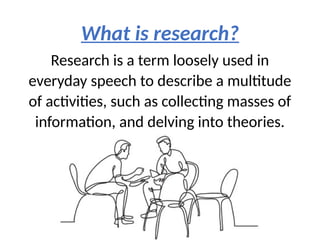
Researchis a term loosely used in
everyday speech to describe a multitude
of activities, such as collecting masses of
information, and delving into theories.
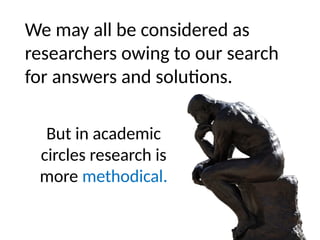
We may allbe considered as
researchers owing to our search
for answers and solutions.
But in academic
circles research is
more methodical.
8.
Objectives Of research
A.Understand better the material we study.
B. Evaluate carefully what we read.
C. Understand what is behind what we
read and what other experts tell.
9.
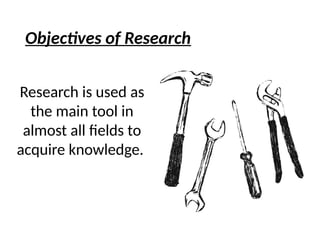
Research offers theopportunity to
learn skills which we need now and
in further studies.
10.
Research is notalways personal,
but it may be a kind of duty
fulfillment.
Internal sources
What peoplewant to achieve without
any intention to receive a reward from
the others. The only reward that one
needs is his or her success.
13.
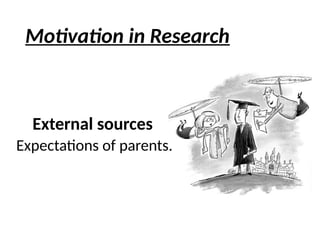
Motivation in Research
-Desire to learn how to face difficulties
and solve problems.
- Desire to get a job or gain some respect
in society.
- Desire to conduct projects and serve
people in a way or another.
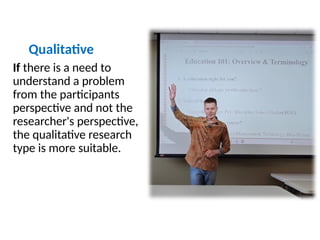
Qualitative
If there isa need to
understand a problem
from the participants
perspective and not the
researcher's perspective,
the qualitative research
type is more suitable.
Documents
This method isused by
almost all researchers
because they need to
read, interpret, and
analyze what others
have written.
Researchers should
know more about their
problems through
consulting various
sources.
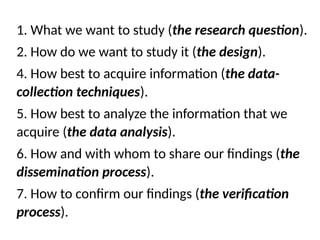
1. What wewant to study (the research question).
2. How do we want to study it (the design).
4. How best to acquire information (the data-
collection techniques).
5. How best to analyze the information that we
acquire (the data analysis).
6. How and with whom to share our findings (the
dissemination process).
7. How to confirm our findings (the verification
process).
30.
The researcher relieson
a general statement and
then seeks more detailed
information.
Deductive reasoning
"top-down approach"
31.
In research, thereis no right or
wrong direction and it all depends on
whether the selected approach fits
the investigation and its purposes.
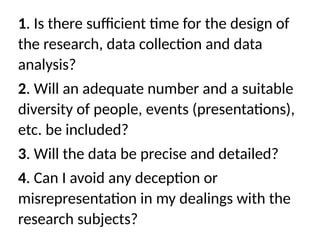
1. Is theresufficient time for the design of
the research, data collection and data
analysis?
2. Will an adequate number and a suitable
diversity of people, events (presentations),
etc. be included?
3. Will the data be precise and detailed?
4. Can I avoid any deception or
misrepresentation in my dealings with the
research subjects?
The Literature Reviewand its Importance
Critical evaluation.
Summarize concepts and theories.
Find research objectives.
37.
What is aResearch Problem?
There must be a clear and suitable
problem to address and state the
objectives in a clear manner.
38.
Selecting and identifyingthe
Problem
1.Determine the field of research.
2. Pin-point specific aspect of the
problem which is to be investigated.
39.
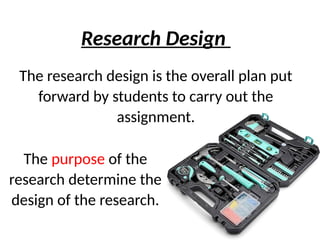
The research designis the overall plan put
forward by students to carry out the
assignment.
Research Design
The purpose of the
research determine the
design of the research.
•Cognitive goals: activelylistening to and
thinking along with fellow students, reflecting
critically on their own understanding,
identifying misconceptions, clarifying
confusion, exposing conflicting statements,
summarizing and explaining topics in own
words, developing, adjusting and following up
on plans, etc.
•Cooperation skills: communication,
management, leadership, etc.
•Social skills: giving feedback in
a non-threatening and
supportive way, taking into
account the suggestions of
others, etc.
49.
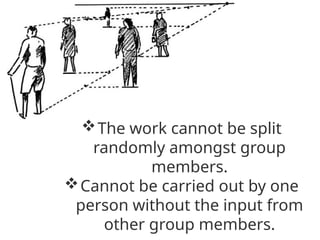
The work cannotbe split
randomly amongst group
members.
Cannot be carried out by one
person without the input from
other group members.
Differences inintellectual skills, prior
knowledge, etc.
Differences in task-related skills,
knowledge of group dynamics, etc.
Differences in areas of interest, balance
between men and women, etc.
Points to consider
52.
Group size
Four tosix people is ideal.
Greater the group ˃ Lower the individual
performance.
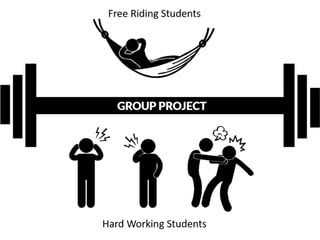
If you choose larger groups, make sure that
individual contributions are visible to avoid
freeriding behavior.
53.
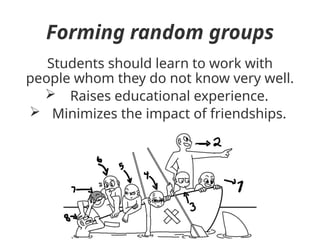
Forming random groups
Studentsshould learn to work with
people whom they do not know very well.
Raises educational experience.
Minimizes the impact of friendships.
54.
Scheduled group meetings
Aweekly contact is
especially relevant
for students who
participate in group
work.
55.
In group meetings
1.Introduce the topic, activate prior
knowledge.
2. Discuss and clarify the assignment.
3. Discuss the design and time
management.
4. Role distribution.
An authenticproblem
statement with clear
and achievable
objectives.
A well-thought-out
group.
Appropriate guidance
and monitoring.
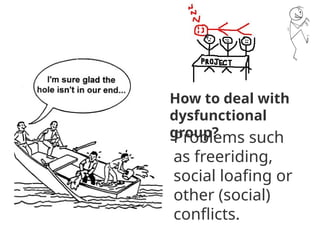
Last resolve :
dissemble the group.
60.
References
1. MOHAMED KHIDERUNIVERSITY OF
BISKRA, Faculty of Letters and
Languages, Department of Foreign
Languages, English Division, Course
Title: Research Methodology: An
Introduction, Prepared by: Dr.
Ramdane MEHIRI.
2. Ghent University, Home>
For Lecturers> Overview Teaching
Methods> Glossary>