Samra Siddiqui
 Lean Development
 Feature Driven Development
 Decide as late as possible
 As software development is always associated with some
uncertainty, better results should be achieved with an
options-based approach.
 Delaying decisions as much as possible until they can be
made based on facts and not on uncertain assumptions
and predictions.
 Delaying certain crucial decisions until customers have
realized their needs better.
3
 Deliver as fast as possible
 It is not the biggest that survives, but the fastest.
 The sooner the end product is delivered without
considerable defect, the sooner feedback can be received,
and incorporated into the next iteration.
 Customers value rapid delivery of a quality product.
4
 Empower theTeam
 Traditional belief: the managers tell the workers how to do their
own job .
 Lean approach: "find good people and let them do their own job”
 Encouraging progress, catching errors, and removing problems, but
not micro-managing.
 The developers should be given access to customer ; the team
leader should provide support and help in difficult situations.
5
 Build Integrity in
 Balance of function, usability, reliability and economy – perceived integrity
 Conceptual integrity - anywhere you look in your system, you can tell that the
design is part of the same overall design.
 One of the healthy ways towards integral architecture is refactoring. Repetitions in
the code are signs for bad code designs and should be avoided.
 At the end the integrity should be verified with thorough testing, thus ensuring the
System does what the customer expects it to and specifically the reduction of
defects
6
 See the Whole
 Software systems are not simply the sum of their parts,
but also the product of their interactions.
 The best parts do not necessarily make the best system.
 Ability of a system to achieve its purpose depends on how
well the parts work together, not just how well they
perform individually.
7
 The Client has asked for a simple calculator to perform
addition of two numbers.
 The Decision makers in delivery Team (Architects,
Analysts) planned for addition of two numbers and an
added benefit to customer for providing multiplication.
 As multiplication is nothing but adding the same number
as many times. E.g. 2 x 5 is same as adding 2 five times.
2+2+2+2+2.
 The time of Analyzing, Developing and Testing is spent.
Product is delivered to customer and they are using it only
for addition of 2 numbers.
 What should be considered as waste here?
•Introduction
•FDDActivities
•Mile Stones
•Practices in FDD
9
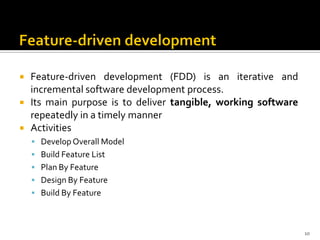
 Feature-driven development (FDD) is an iterative and
incremental software development process.
 Its main purpose is to deliver tangible, working software
repeatedly in a timely manner
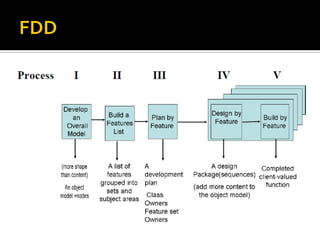
 Activities
 Develop Overall Model
 Build Feature List
 Plan By Feature
 Design By Feature
 Build By Feature
10
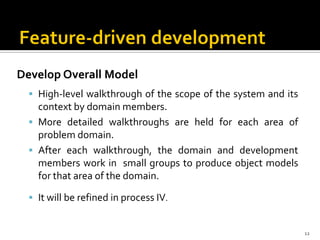
Develop Overall Model
 High-level walkthrough of the scope of the system and its
context by domain members.
 More detailed walkthroughs are held for each area of
problem domain.
 After each walkthrough, the domain and development
members work in small groups to produce object models
for that area of the domain.
 It will be refined in process IV.
12

Lect8

  • 1.
  • 2.
     Lean Development Feature Driven Development
  • 3.
     Decide aslate as possible  As software development is always associated with some uncertainty, better results should be achieved with an options-based approach.  Delaying decisions as much as possible until they can be made based on facts and not on uncertain assumptions and predictions.  Delaying certain crucial decisions until customers have realized their needs better. 3
  • 4.
     Deliver asfast as possible  It is not the biggest that survives, but the fastest.  The sooner the end product is delivered without considerable defect, the sooner feedback can be received, and incorporated into the next iteration.  Customers value rapid delivery of a quality product. 4
  • 5.
     Empower theTeam Traditional belief: the managers tell the workers how to do their own job .  Lean approach: "find good people and let them do their own job”  Encouraging progress, catching errors, and removing problems, but not micro-managing.  The developers should be given access to customer ; the team leader should provide support and help in difficult situations. 5
  • 6.
     Build Integrityin  Balance of function, usability, reliability and economy – perceived integrity  Conceptual integrity - anywhere you look in your system, you can tell that the design is part of the same overall design.  One of the healthy ways towards integral architecture is refactoring. Repetitions in the code are signs for bad code designs and should be avoided.  At the end the integrity should be verified with thorough testing, thus ensuring the System does what the customer expects it to and specifically the reduction of defects 6
  • 7.
     See theWhole  Software systems are not simply the sum of their parts, but also the product of their interactions.  The best parts do not necessarily make the best system.  Ability of a system to achieve its purpose depends on how well the parts work together, not just how well they perform individually. 7
  • 8.
     The Clienthas asked for a simple calculator to perform addition of two numbers.  The Decision makers in delivery Team (Architects, Analysts) planned for addition of two numbers and an added benefit to customer for providing multiplication.  As multiplication is nothing but adding the same number as many times. E.g. 2 x 5 is same as adding 2 five times. 2+2+2+2+2.  The time of Analyzing, Developing and Testing is spent. Product is delivered to customer and they are using it only for addition of 2 numbers.  What should be considered as waste here?
  • 9.
  • 10.
     Feature-driven development(FDD) is an iterative and incremental software development process.  Its main purpose is to deliver tangible, working software repeatedly in a timely manner  Activities  Develop Overall Model  Build Feature List  Plan By Feature  Design By Feature  Build By Feature 10
  • 12.
    Develop Overall Model High-level walkthrough of the scope of the system and its context by domain members.  More detailed walkthroughs are held for each area of problem domain.  After each walkthrough, the domain and development members work in small groups to produce object models for that area of the domain.  It will be refined in process IV. 12