CLEOFE A. LANAS
VERBAL AND NONVERBAL
COMMUNICATION
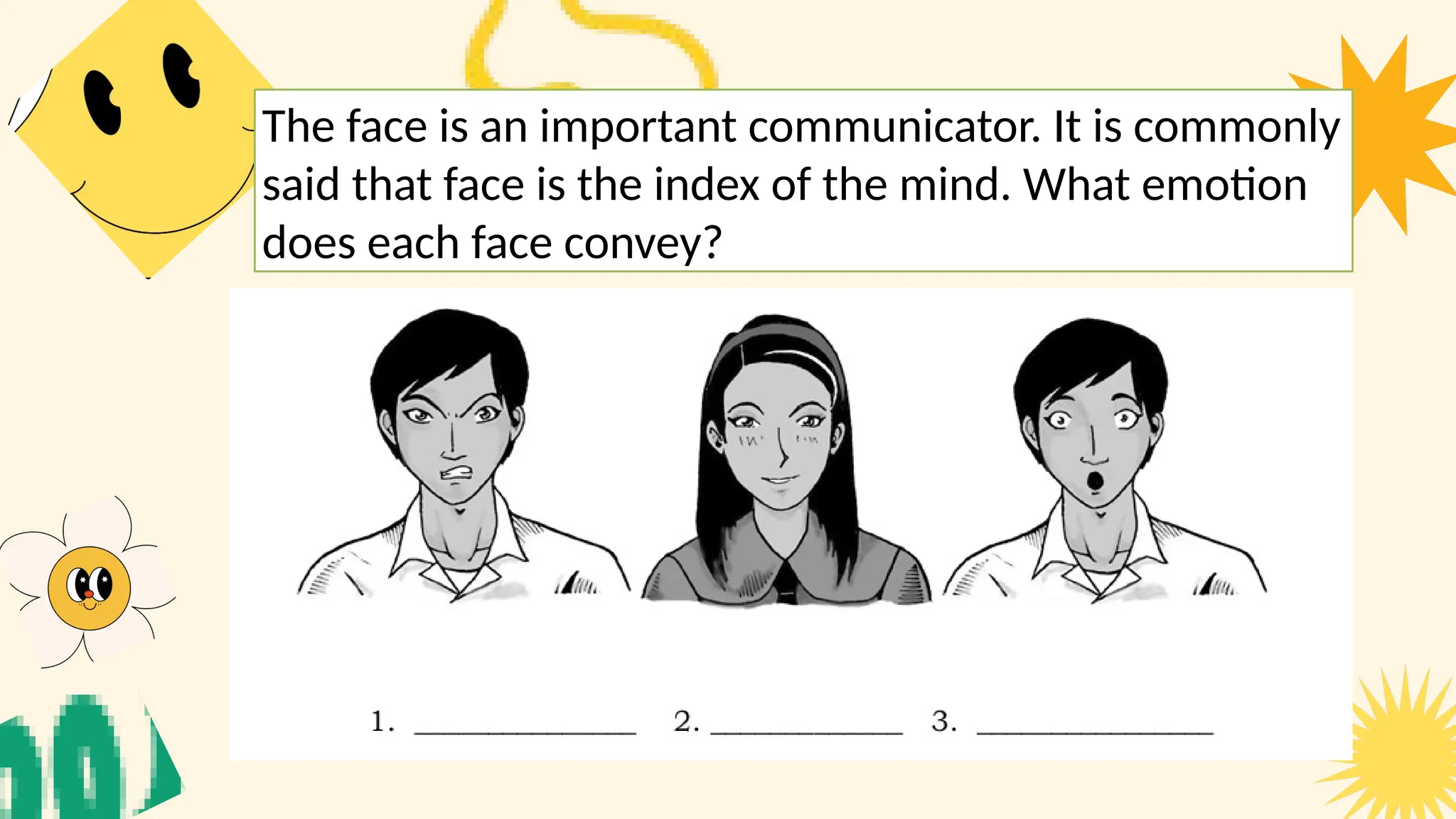
The face is an important communicator. It is commonly
said that face is the index of the mind. What emotion
does each face convey?
The face is an important communicator. It is commonly
said that face is the index of the mind. What emotion
does each face convey?
In effective communication, speakers do not only communicate using their
words but also with their actions. They should also see to it that the actions
they make must match with what they say, otherwise, miscommunication
may take place. Communication using words is called verbal communication
while communication without words such as facial expression and hand
gestures is called non-verbal communication. Communication can take
among people with or without words. There are two types of
communication: verbal and non-verbal.
Verbal
Communication
Refers to an interaction in which words
are used to relay a message. For an
effective and successful verbal
communication, use words to express
ideas which can be easily understood by
the person you are talking to. Consider
appropriateness, brevity, clarity, ethics,
and vividness when engaging in this type
of communication.
1. Appropriateness
The language that you use should be
appropriate to the environment or occasion
(i.e., whether formal or informal)
Verbal
Communication
2. Brevity
Speakers who often use simple yet precise
and powerful words are found to be more
credible. Try to achieve brevity by being more
direct with your words. Avoid fillers and
insubstantial expressions which do not add
to the message, such as “ uh”, “you know,” “I
guess,” and others.
Verbal
Communication
The language that you use should be appropriate
3. Clarity
The meaning of words, feelings, or ideas
may be interpreted differently by a listener,
hence, it is essential for you to clearly state
your message and express your ideas and
feelings.
Verbal
Communication
4. Ethics
Words should be carefully chosen in
consideration of the gender, roles, ethnicity,
preferences, and status of the person or
people you are talking to.
Verbal
Communication
5. Vividness
Words that vividly or creatively describe
things or feelings usually add color and spice
to communication. Hence, you are
encouraged to find ways to charm your
audience through the use of vivid words.
Verbal
Communication
Refers to an interaction where behavior is used to convey
and represent meanings. All kinds of human responses that are
not expressed in words are classified as nonverbal
communication. Examples of nonverbal communication are
stares, smiles, tone of voice, movements, manners of walking,
standing and sitting, appearance, style of attire, attitude towards
time and space, personality, gestures and others.
Nonverbal
Communication
Mastery of nonverbal communication is important for several
reasons: 1. It enhances and emphasizes the message of your
speech, thus making it more meaningful, truthful,
and relevant.
2. It can communicate feelings, attitudes, and
perceptions without you saying a word.
3. It can sustain the attention of listeners and keep
them engaged in the speech.
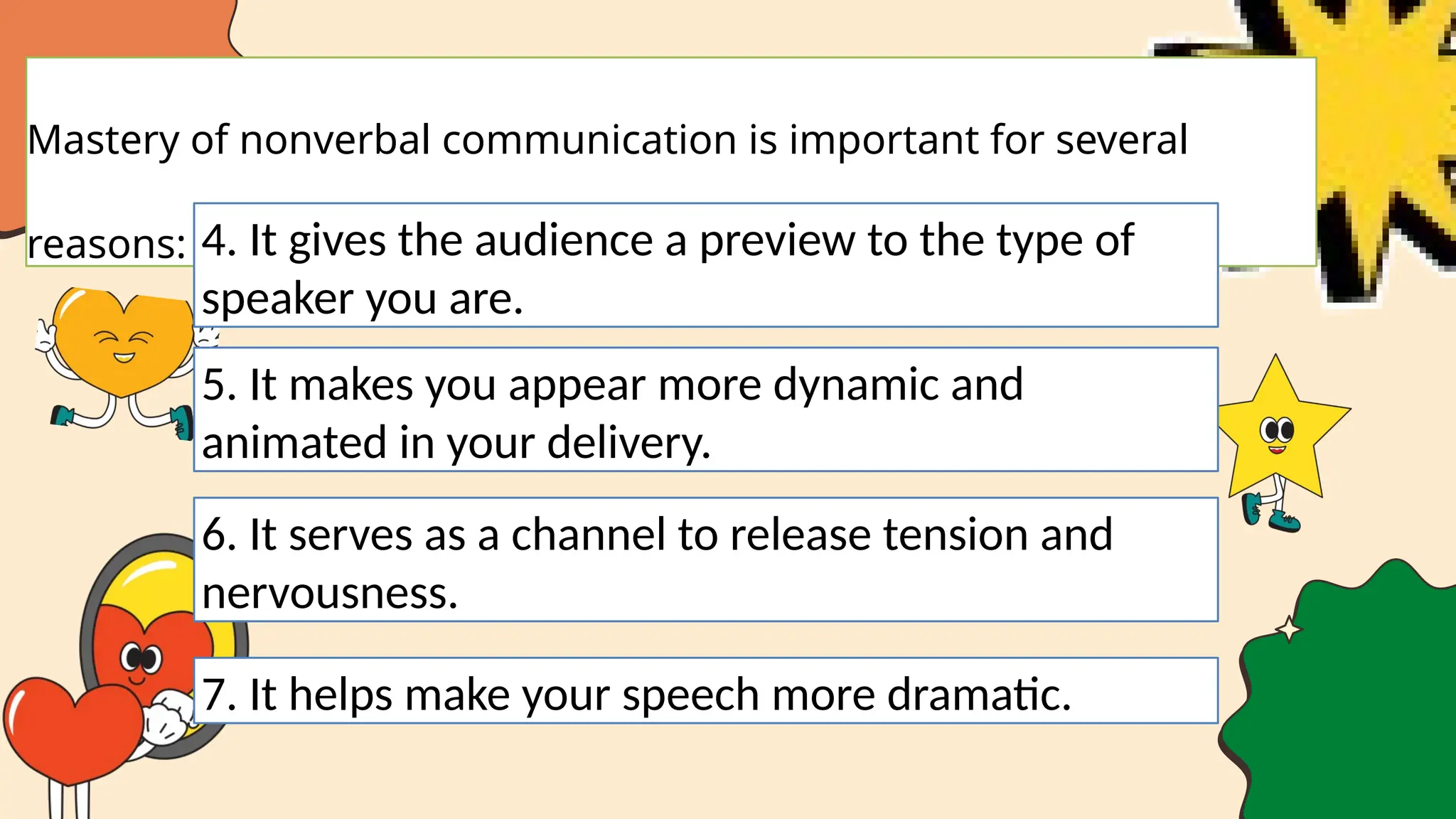
Mastery of nonverbal communication is important for several
reasons: 4. It gives the audience a preview to the type of
speaker you are.
5. It makes you appear more dynamic and
animated in your delivery.
6. It serves as a channel to release tension and
nervousness.
7. It helps make your speech more dramatic.
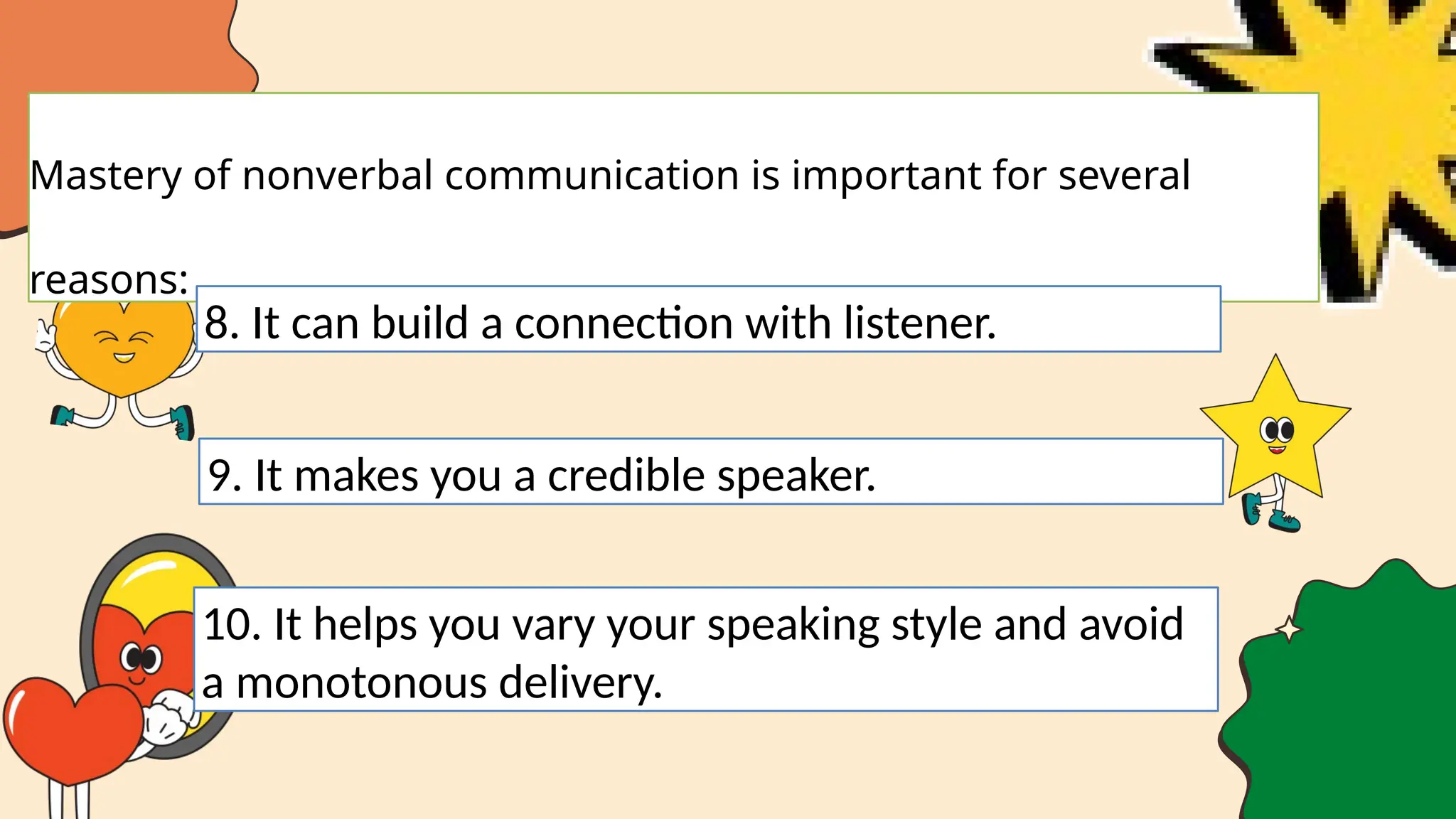
Mastery of nonverbal communication is important for several
reasons:
8. It can build a connection with listener.
9. It makes you a credible speaker.
10. It helps you vary your speaking style and avoid
a monotonous delivery.
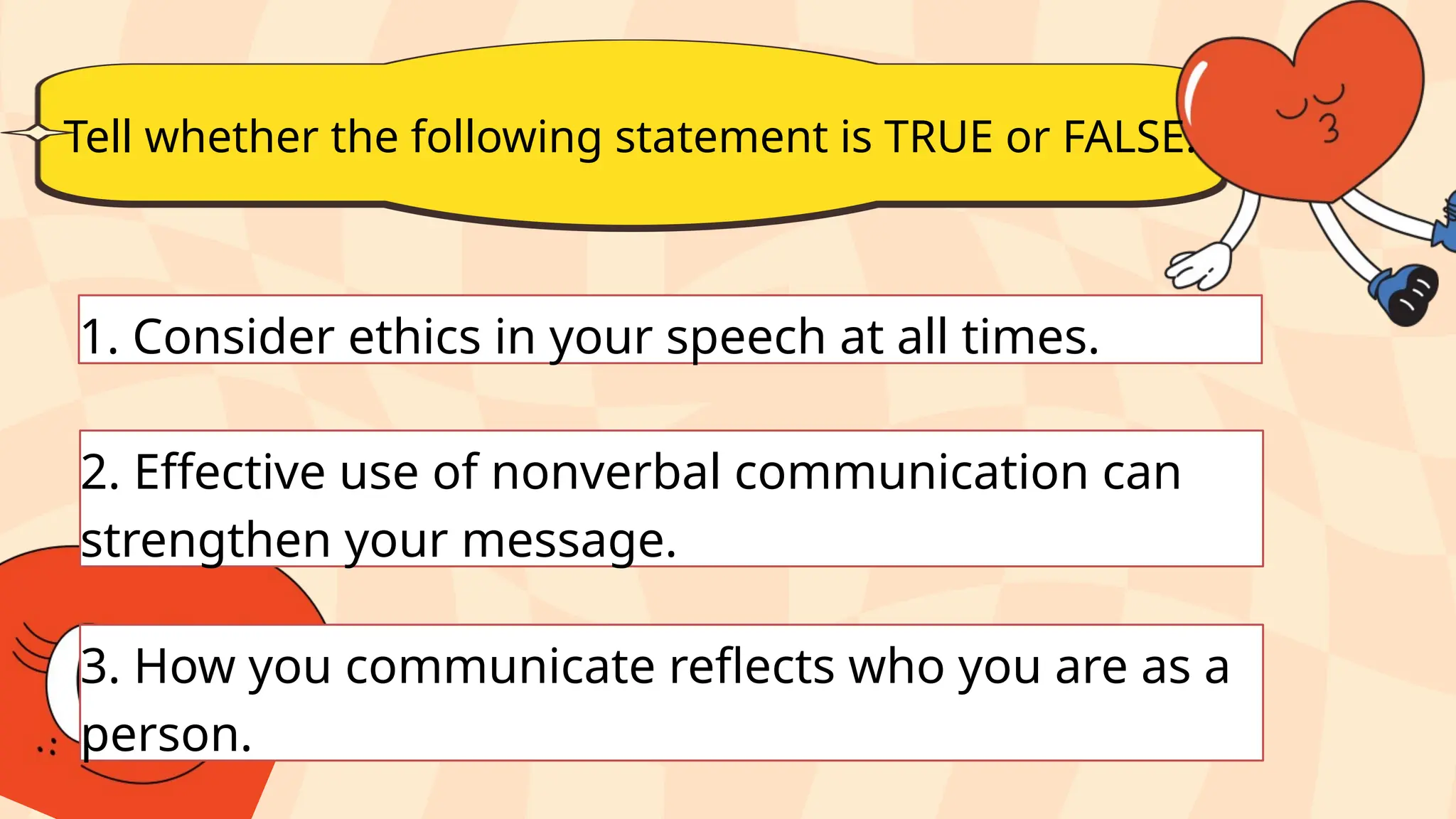
Tell whether the following statement is TRUE or FALSE.
1. Consider ethics in your speech at all times.
2. Effective use of nonverbal communication can
strengthen your message.
3. How you communicate reflects who you are as a
person.
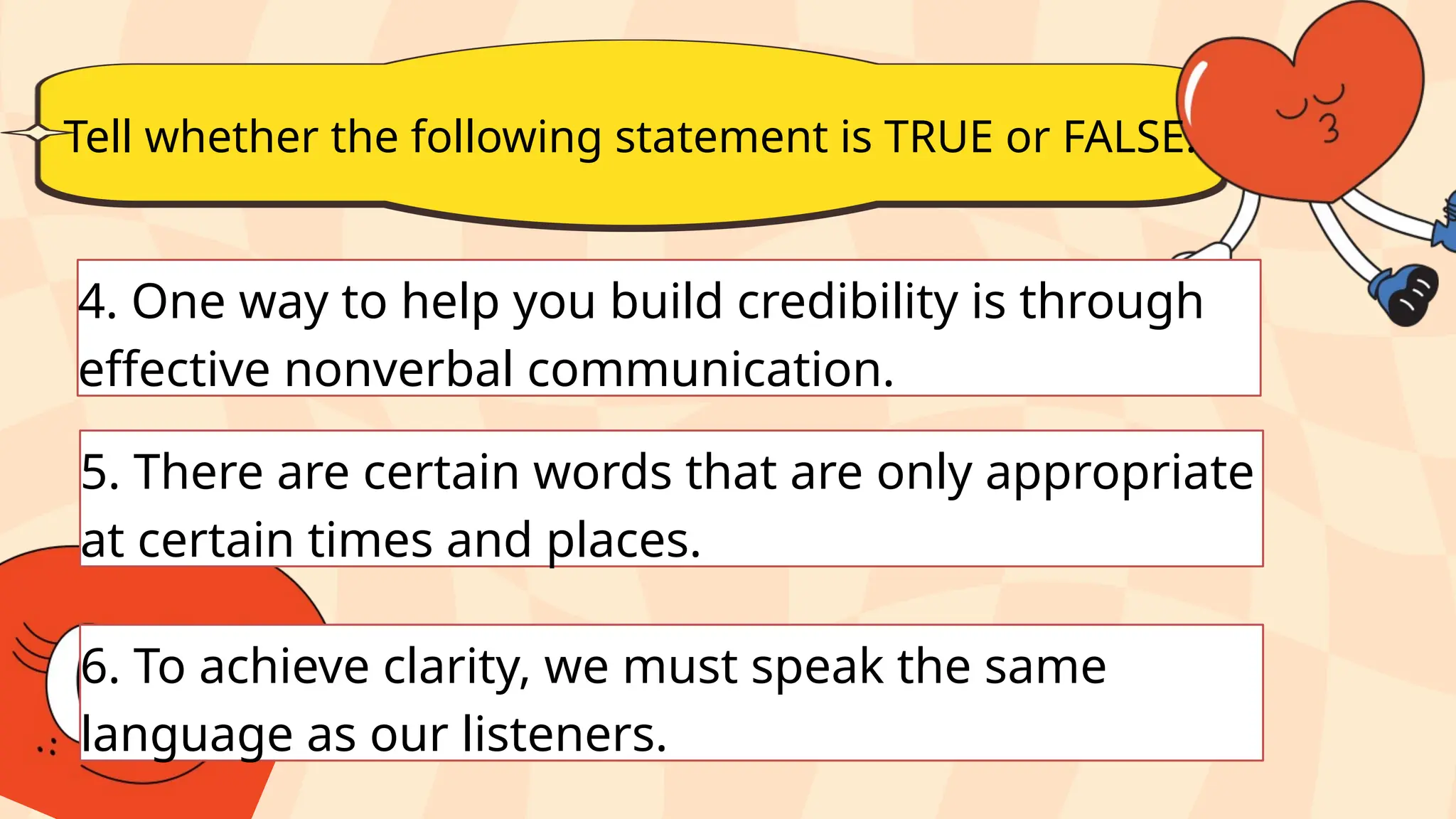
Tell whether the following statement is TRUE or FALSE.
4. One way to help you build credibility is through
effective nonverbal communication.
5. There are certain words that are only appropriate
at certain times and places.
6. To achieve clarity, we must speak the same
language as our listeners.
Tell whether the following statement is TRUE or FALSE.
7. The use of too many filters can distract your listeners.
8.Verbal communication is better than nonverbal communication.
9. When you talk to others, you should not assume too
quickly that they understand the message that you convey.
10. When you communicate, choose what you want to say
and how you want to say it.
Thank you
And
MABUHAY!

FUNDAMENTALS OF COMMUNICATION:verbal and nonverbal

  • 1.
  • 2.
  • 3.
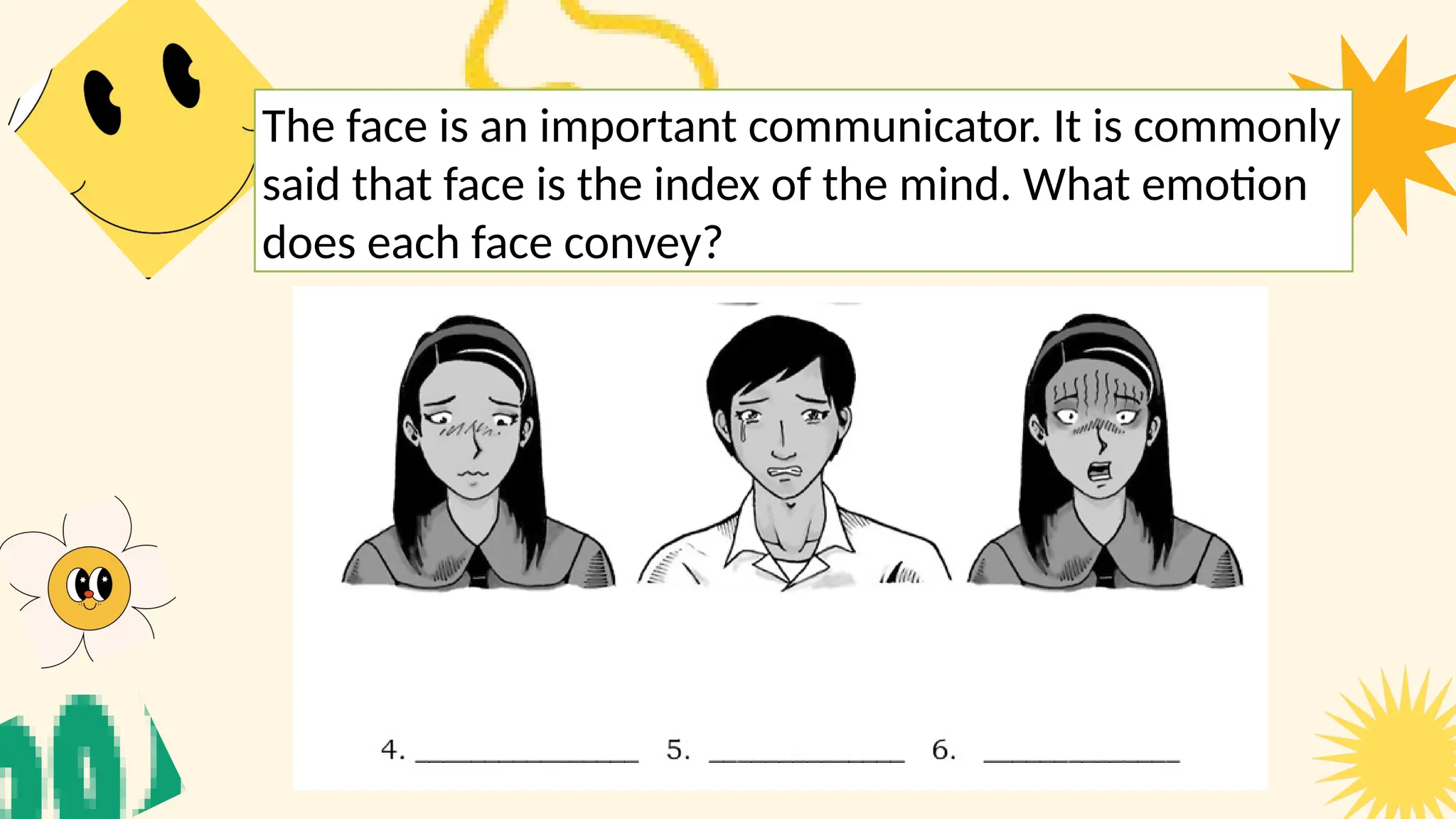
    The face isan important communicator. It is commonly said that face is the index of the mind. What emotion does each face convey?
  • 4.
    The face isan important communicator. It is commonly said that face is the index of the mind. What emotion does each face convey?
  • 5.
    In effective communication,speakers do not only communicate using their words but also with their actions. They should also see to it that the actions they make must match with what they say, otherwise, miscommunication may take place. Communication using words is called verbal communication while communication without words such as facial expression and hand gestures is called non-verbal communication. Communication can take among people with or without words. There are two types of communication: verbal and non-verbal.
  • 6.
    Verbal Communication Refers to aninteraction in which words are used to relay a message. For an effective and successful verbal communication, use words to express ideas which can be easily understood by the person you are talking to. Consider appropriateness, brevity, clarity, ethics, and vividness when engaging in this type of communication.
  • 7.
    1. Appropriateness The languagethat you use should be appropriate to the environment or occasion (i.e., whether formal or informal) Verbal Communication
  • 8.
    2. Brevity Speakers whooften use simple yet precise and powerful words are found to be more credible. Try to achieve brevity by being more direct with your words. Avoid fillers and insubstantial expressions which do not add to the message, such as “ uh”, “you know,” “I guess,” and others. Verbal Communication
  • 9.
    The language thatyou use should be appropriate 3. Clarity The meaning of words, feelings, or ideas may be interpreted differently by a listener, hence, it is essential for you to clearly state your message and express your ideas and feelings. Verbal Communication
  • 10.
    4. Ethics Words shouldbe carefully chosen in consideration of the gender, roles, ethnicity, preferences, and status of the person or people you are talking to. Verbal Communication
  • 11.
    5. Vividness Words thatvividly or creatively describe things or feelings usually add color and spice to communication. Hence, you are encouraged to find ways to charm your audience through the use of vivid words. Verbal Communication
  • 12.
    Refers to aninteraction where behavior is used to convey and represent meanings. All kinds of human responses that are not expressed in words are classified as nonverbal communication. Examples of nonverbal communication are stares, smiles, tone of voice, movements, manners of walking, standing and sitting, appearance, style of attire, attitude towards time and space, personality, gestures and others. Nonverbal Communication
  • 13.
    Mastery of nonverbalcommunication is important for several reasons: 1. It enhances and emphasizes the message of your speech, thus making it more meaningful, truthful, and relevant. 2. It can communicate feelings, attitudes, and perceptions without you saying a word. 3. It can sustain the attention of listeners and keep them engaged in the speech.
  • 14.
    Mastery of nonverbalcommunication is important for several reasons: 4. It gives the audience a preview to the type of speaker you are. 5. It makes you appear more dynamic and animated in your delivery. 6. It serves as a channel to release tension and nervousness. 7. It helps make your speech more dramatic.
  • 15.
    Mastery of nonverbalcommunication is important for several reasons: 8. It can build a connection with listener. 9. It makes you a credible speaker. 10. It helps you vary your speaking style and avoid a monotonous delivery.
  • 16.
    Tell whether thefollowing statement is TRUE or FALSE. 1. Consider ethics in your speech at all times. 2. Effective use of nonverbal communication can strengthen your message. 3. How you communicate reflects who you are as a person.
  • 17.
    Tell whether thefollowing statement is TRUE or FALSE. 4. One way to help you build credibility is through effective nonverbal communication. 5. There are certain words that are only appropriate at certain times and places. 6. To achieve clarity, we must speak the same language as our listeners.
  • 18.
    Tell whether thefollowing statement is TRUE or FALSE. 7. The use of too many filters can distract your listeners. 8.Verbal communication is better than nonverbal communication. 9. When you talk to others, you should not assume too quickly that they understand the message that you convey. 10. When you communicate, choose what you want to say and how you want to say it.
  • 19.