Importance of Vital
Communication Skills
Majok Kuath
Intro
Did you know that In a survey of 400 companies, those with leaders who communicated effectively had
47% higher total returns to shareholders over the previous five years. (Watson Wyatt, 2010)
Also 60% of employers report that job applicants have poor communication skills. (National Association of
Colleges and Employers, 2018)
Quotes:
"Communication is the solvent of all problems and is the foundation for personal development." - Peter
Shepherd
"Effective communication is 20% what you know and 80% how you feel about what you know." - Jim Rohn
Importance of Communication Skills
Communication skills are essential for success in any field or industry. Effective communication allows
individuals to convey their thoughts, ideas, and feelings clearly and confidently, and to understand the
thoughts, ideas, and feelings of others. In the workplace, strong communication skills can help build strong
relationships between colleagues and clients, improve team collaboration, increase productivity, and
enhance customer satisfaction.
In personal relationships, effective communication can improve understanding and trust between partners,
friends, and family members, and can help prevent misunderstandings and conflicts. In addition,
communication skills are important in everyday life, from expressing oneself in social situations to resolving
conflicts and negotiating agreements. Overall, communication skills are a key component of emotional
intelligence and can have a significant impact on an individual's personal and professional success.
Verbal Communication Meaning
Verbal communication refers to the use of spoken words to convey a message or information from one
person to another. This can take place in a variety of settings, from casual conversations with friends and
family members to formal presentations and public speeches.
Verbal communication involves not just the words being spoken, but also the tone of voice, inflection, and
other vocal cues that help convey meaning and emotion. Effective verbal communication involves being
clear and concise in one's speech, using appropriate language and vocabulary for the audience and
situation, and adapting one's communication style to suit the needs of the listener.
Verbal communication is a key component of interpersonal relationships, whether in personal or
professional contexts. Good verbal communication skills can help build trust and rapport, facilitate
problem-solving and conflict resolution, and convey respect and understanding between individuals.
Examples of Effective Verbal Communication
1. Active Listening: This involves paying attention to what the other person is saying, asking clarifying
questions, and providing feedback to show that you are engaged and understanding. For example, "I
hear what you're saying, and I want to make sure I understand. Can you tell me more about...?"
2. Clear and Concise Language: Using clear, simple language and avoiding jargon or technical terms
can help ensure that your message is understood by the listener. For example, "I would like to
discuss the project timeline and make sure we're on the same page" instead of "I need to talk to you
about the deliverables for Q3."
3. Empathy: Showing empathy involves acknowledging and understanding the other person's
perspective and feelings, even if you don't necessarily agree with them. For example, "I can
understand why you feel frustrated, and I want to work together to find a solution that works for
both of us."
Ways to Improve Verbal Communication
● Practice Active Listening: Paying close attention to what others are saying and actively engaging in
conversations can help you better understand their perspective and respond appropriately. Try to
avoid interrupting or assuming what the other person is saying, and instead ask clarifying questions
to ensure that you understand their message.
● Speak Clearly and Confidently: Speaking clearly and confidently can help ensure that your message
is understood by others. Focus on speaking slowly and articulating your words clearly, and use a
confident tone of voice to convey authority and credibility.
● Use Appropriate Language: Tailor your language to suit the audience and situation. Avoid using
jargon or technical terms that may not be familiar to everyone, and instead use clear, simple
language that is easy to understand.
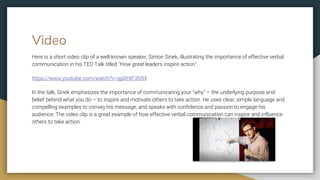
Video
Here is a short video clip of a well-known speaker, Simon Sinek, illustrating the importance of effective verbal
communication in his TED Talk titled "How great leaders inspire action":
https://www.youtube.com/watch?v=qp0HIF3SfI4
In the talk, Sinek emphasizes the importance of communicating your "why" – the underlying purpose and
belief behind what you do – to inspire and motivate others to take action. He uses clear, simple language and
compelling examples to convey his message, and speaks with confidence and passion to engage his
audience. The video clip is a great example of how effective verbal communication can inspire and influence
others to take action.
Non Verbal Communication
Nonverbal communication refers to any form of communication that doesn't involve the use of words or spoken language. It includes a
wide range of cues and signals, such as body language, facial expressions, tone of voice, gestures, and posture. Nonverbal communication
is a fundamental aspect of interpersonal communication, and can often convey more meaning than words alone. For example, a smile or a
nod of the head can convey agreement or approval, while a frown or a crossed arms may indicate disagreement or defensiveness.
Nonverbal communication can also be used to regulate interactions between individuals, such as establishing personal space or indicating
turn-taking in a conversation. It can be influenced by cultural and social norms, as different cultures may have different rules and
expectations regarding nonverbal communication. In addition, nonverbal communication can be used to enhance or reinforce verbal
messages. For example, using a confident tone of voice and maintaining eye contact can help convey credibility and sincerity, while using
exaggerated gestures or facial expressions can add emphasis or emotion to a message.
Overall, nonverbal communication is an essential component of effective interpersonal communication, and can greatly influence how
messages are perceived and understood by others.
Effective Nonverbal Communications
1. Eye Contact: Making eye contact can convey interest, attention, and respect in a conversation. It can
also help establish a connection with the other person and demonstrate confidence.
2. Facial Expressions: Smiling, nodding, and other facial expressions can convey agreement,
understanding, and friendliness. They can also add emphasis or emotion to a message.
3. Posture: Standing or sitting up straight can convey confidence and professionalism, while slouching
or crossing your arms can indicate defensiveness or disinterest.
4. Gestures: Using appropriate hand gestures can add emphasis or clarity to a message, such as
pointing to an object or using a sweeping motion to illustrate a point.
Tips for Improving Skills
1. Be aware of your body language: Pay attention to your posture, gestures, and facial expressions to ensure they are
aligned with your intended message.
2. Practice active listening: Demonstrate that you are engaged and interested in what the other person is saying through
eye contact, nodding, and appropriate facial expressions.
3. Use appropriate gestures: Use hand gestures to emphasize key points or help illustrate your message, but be mindful of
cultural and social norms.
4. Control your tone of voice: Use a calm, clear tone of voice to convey confidence and authority, but avoid speaking too
loudly or too softly.
Activity
Activity: Nonverbal Communication Quiz
Objective: To test and practice knowledge of nonverbal communication skills in a fun and engaging way.
Instructions:
1. Project the quiz questions on a screen.
2. Divide the audience into teams or allow individuals to answer the questions.
3. Read out each question and provide multiple-choice answers.
4. Allow a set amount of time for teams/individuals to choose an answer.
5. After each question, reveal the correct answer and explain why it is the correct choice.
6. Keep track of points for each team/individual.
7. At the end of the quiz, the team/individual with the most points wins.
Quiz
What does crossing your arms usually indicate in nonverbal communication?
a) Openness
b) Defensiveness
c) Excitement
d) Indifference
Which of the following is an example of a positive nonverbal cue?
a) Rolling your eyes
b) Avoiding eye contact
c) Smiling
d) Frowning
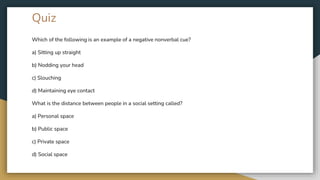
Quiz
Which of the following is an example of a negative nonverbal cue?
a) Sitting up straight
b) Nodding your head
c) Slouching
d) Maintaining eye contact
What is the distance between people in a social setting called?
a) Personal space
b) Public space
c) Private space
d) Social space
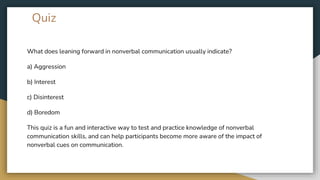
Quiz
What does leaning forward in nonverbal communication usually indicate?
a) Aggression
b) Interest
c) Disinterest
d) Boredom
This quiz is a fun and interactive way to test and practice knowledge of nonverbal
communication skills, and can help participants become more aware of the impact of
nonverbal cues on communication.
Digital Story

Digital Story

  • 1.
  • 2.
    Intro Did you knowthat In a survey of 400 companies, those with leaders who communicated effectively had 47% higher total returns to shareholders over the previous five years. (Watson Wyatt, 2010) Also 60% of employers report that job applicants have poor communication skills. (National Association of Colleges and Employers, 2018) Quotes: "Communication is the solvent of all problems and is the foundation for personal development." - Peter Shepherd "Effective communication is 20% what you know and 80% how you feel about what you know." - Jim Rohn
  • 3.
    Importance of CommunicationSkills Communication skills are essential for success in any field or industry. Effective communication allows individuals to convey their thoughts, ideas, and feelings clearly and confidently, and to understand the thoughts, ideas, and feelings of others. In the workplace, strong communication skills can help build strong relationships between colleagues and clients, improve team collaboration, increase productivity, and enhance customer satisfaction. In personal relationships, effective communication can improve understanding and trust between partners, friends, and family members, and can help prevent misunderstandings and conflicts. In addition, communication skills are important in everyday life, from expressing oneself in social situations to resolving conflicts and negotiating agreements. Overall, communication skills are a key component of emotional intelligence and can have a significant impact on an individual's personal and professional success.
  • 4.
    Verbal Communication Meaning Verbalcommunication refers to the use of spoken words to convey a message or information from one person to another. This can take place in a variety of settings, from casual conversations with friends and family members to formal presentations and public speeches. Verbal communication involves not just the words being spoken, but also the tone of voice, inflection, and other vocal cues that help convey meaning and emotion. Effective verbal communication involves being clear and concise in one's speech, using appropriate language and vocabulary for the audience and situation, and adapting one's communication style to suit the needs of the listener. Verbal communication is a key component of interpersonal relationships, whether in personal or professional contexts. Good verbal communication skills can help build trust and rapport, facilitate problem-solving and conflict resolution, and convey respect and understanding between individuals.
  • 5.
    Examples of EffectiveVerbal Communication 1. Active Listening: This involves paying attention to what the other person is saying, asking clarifying questions, and providing feedback to show that you are engaged and understanding. For example, "I hear what you're saying, and I want to make sure I understand. Can you tell me more about...?" 2. Clear and Concise Language: Using clear, simple language and avoiding jargon or technical terms can help ensure that your message is understood by the listener. For example, "I would like to discuss the project timeline and make sure we're on the same page" instead of "I need to talk to you about the deliverables for Q3." 3. Empathy: Showing empathy involves acknowledging and understanding the other person's perspective and feelings, even if you don't necessarily agree with them. For example, "I can understand why you feel frustrated, and I want to work together to find a solution that works for both of us."
  • 6.
    Ways to ImproveVerbal Communication ● Practice Active Listening: Paying close attention to what others are saying and actively engaging in conversations can help you better understand their perspective and respond appropriately. Try to avoid interrupting or assuming what the other person is saying, and instead ask clarifying questions to ensure that you understand their message. ● Speak Clearly and Confidently: Speaking clearly and confidently can help ensure that your message is understood by others. Focus on speaking slowly and articulating your words clearly, and use a confident tone of voice to convey authority and credibility. ● Use Appropriate Language: Tailor your language to suit the audience and situation. Avoid using jargon or technical terms that may not be familiar to everyone, and instead use clear, simple language that is easy to understand.
  • 7.
    Video Here is ashort video clip of a well-known speaker, Simon Sinek, illustrating the importance of effective verbal communication in his TED Talk titled "How great leaders inspire action": https://www.youtube.com/watch?v=qp0HIF3SfI4 In the talk, Sinek emphasizes the importance of communicating your "why" – the underlying purpose and belief behind what you do – to inspire and motivate others to take action. He uses clear, simple language and compelling examples to convey his message, and speaks with confidence and passion to engage his audience. The video clip is a great example of how effective verbal communication can inspire and influence others to take action.
  • 8.
    Non Verbal Communication Nonverbalcommunication refers to any form of communication that doesn't involve the use of words or spoken language. It includes a wide range of cues and signals, such as body language, facial expressions, tone of voice, gestures, and posture. Nonverbal communication is a fundamental aspect of interpersonal communication, and can often convey more meaning than words alone. For example, a smile or a nod of the head can convey agreement or approval, while a frown or a crossed arms may indicate disagreement or defensiveness. Nonverbal communication can also be used to regulate interactions between individuals, such as establishing personal space or indicating turn-taking in a conversation. It can be influenced by cultural and social norms, as different cultures may have different rules and expectations regarding nonverbal communication. In addition, nonverbal communication can be used to enhance or reinforce verbal messages. For example, using a confident tone of voice and maintaining eye contact can help convey credibility and sincerity, while using exaggerated gestures or facial expressions can add emphasis or emotion to a message. Overall, nonverbal communication is an essential component of effective interpersonal communication, and can greatly influence how messages are perceived and understood by others.
  • 9.
    Effective Nonverbal Communications 1.Eye Contact: Making eye contact can convey interest, attention, and respect in a conversation. It can also help establish a connection with the other person and demonstrate confidence. 2. Facial Expressions: Smiling, nodding, and other facial expressions can convey agreement, understanding, and friendliness. They can also add emphasis or emotion to a message. 3. Posture: Standing or sitting up straight can convey confidence and professionalism, while slouching or crossing your arms can indicate defensiveness or disinterest. 4. Gestures: Using appropriate hand gestures can add emphasis or clarity to a message, such as pointing to an object or using a sweeping motion to illustrate a point.
  • 10.
    Tips for ImprovingSkills 1. Be aware of your body language: Pay attention to your posture, gestures, and facial expressions to ensure they are aligned with your intended message. 2. Practice active listening: Demonstrate that you are engaged and interested in what the other person is saying through eye contact, nodding, and appropriate facial expressions. 3. Use appropriate gestures: Use hand gestures to emphasize key points or help illustrate your message, but be mindful of cultural and social norms. 4. Control your tone of voice: Use a calm, clear tone of voice to convey confidence and authority, but avoid speaking too loudly or too softly.
  • 11.
    Activity Activity: Nonverbal CommunicationQuiz Objective: To test and practice knowledge of nonverbal communication skills in a fun and engaging way. Instructions: 1. Project the quiz questions on a screen. 2. Divide the audience into teams or allow individuals to answer the questions. 3. Read out each question and provide multiple-choice answers. 4. Allow a set amount of time for teams/individuals to choose an answer. 5. After each question, reveal the correct answer and explain why it is the correct choice. 6. Keep track of points for each team/individual. 7. At the end of the quiz, the team/individual with the most points wins.
  • 12.
    Quiz What does crossingyour arms usually indicate in nonverbal communication? a) Openness b) Defensiveness c) Excitement d) Indifference Which of the following is an example of a positive nonverbal cue? a) Rolling your eyes b) Avoiding eye contact c) Smiling d) Frowning
  • 13.
    Quiz Which of thefollowing is an example of a negative nonverbal cue? a) Sitting up straight b) Nodding your head c) Slouching d) Maintaining eye contact What is the distance between people in a social setting called? a) Personal space b) Public space c) Private space d) Social space
  • 14.
    Quiz What does leaningforward in nonverbal communication usually indicate? a) Aggression b) Interest c) Disinterest d) Boredom This quiz is a fun and interactive way to test and practice knowledge of nonverbal communication skills, and can help participants become more aware of the impact of nonverbal cues on communication.