FUNDAMENTAL DUTIES
By
Dr.S.JERSLIN
INTRODUCTION
 42nd Amendment Act of 1976 added 10 Fundamental Duties to the
Indian Constitution. 86th Amendment Act 2002 later added 11th
Fundamental Duty to the list. Swaran Singh Committee in 1976
recommended Fundamental Duties, the necessity of which was felt
during the internal emergency of 1975-77.
 The Fundamental Duties are dealt with Article 51A under Part-IV A of
the Indian Constitution. The topic is important for IAS Exam as
questions are recurring in all its three stages- Prelims, Mains and
Interview.
 This article will mention in detail the 11 Fundamental Duties and their
importance in India. The topic forms a significant part of UPSC Political
Science, which is one of the major subjects in Prelims, Mains GS-II
and also optional under the UPSC Syllabus.
CON…
 The fundamental duties which were added by the
42nd Amendment Act of the Constitution in 1976,
in addition to creating and promoting culture, also
strengthen the hands of the legislature in
enforcing these duties vis-a-vis the fundamental
rights.
 The list of 11 Fundamental Duties under article
51-A to be obeyed by every Indian citizen is
given in the table below:
S.No 11 Fundamental Duties
1. Abide by the Indian Constitution and respect its ideals and
institutions, the National Flag and the National Anthem.
2. Cherish and follow the noble ideals that inspired the
national struggle for freedom.
3. Uphold and protect the sovereignty(power of control its
own government), unity and integrity of India.
4. Defend the country and render(give) national service when
called upon to do so
5. Promote harmony and the spirit of common brotherhood
amongst all the people of India transcending(go beyond the
limit) religious, linguistic and regional or sectional
diversities and to renounce(no connection) practices
derogatory(lack of respect) to the dignity of women
6. Value and preserve the rich heritage of the country’s
composite culture
7. Protect and improve the natural environment
including forests, lakes, rivers and wildlife and to
have compassion for living creatures
8. Develop scientific temper, humanism and the spirit
of inquiry and reform
9. Safeguard public property and to abjure(importune)
violence
10. Strive(effort) towards excellence in all spheres of
individual and collective activity so that the nation
constantly rises to higher levels of
endeavour(effort) and achievement
11. Provide opportunities for education to his child or
ward between the age of six and fourteen
years. This duty was added by the 86th
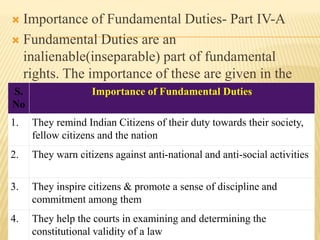
 Importance of Fundamental Duties- Part IV-A
 Fundamental Duties are an
inalienable(inseparable) part of fundamental
rights. The importance of these are given in the
table below:
S.
No
Importance of Fundamental Duties
1. They remind Indian Citizens of their duty towards their society,
fellow citizens and the nation
2. They warn citizens against anti-national and anti-social activities
3. They inspire citizens & promote a sense of discipline and
commitment among them
4. They help the courts in examining and determining the
constitutional validity of a law

Fundamental Duties.pptx

  • 1.
  • 2.
    INTRODUCTION  42nd AmendmentAct of 1976 added 10 Fundamental Duties to the Indian Constitution. 86th Amendment Act 2002 later added 11th Fundamental Duty to the list. Swaran Singh Committee in 1976 recommended Fundamental Duties, the necessity of which was felt during the internal emergency of 1975-77.  The Fundamental Duties are dealt with Article 51A under Part-IV A of the Indian Constitution. The topic is important for IAS Exam as questions are recurring in all its three stages- Prelims, Mains and Interview.  This article will mention in detail the 11 Fundamental Duties and their importance in India. The topic forms a significant part of UPSC Political Science, which is one of the major subjects in Prelims, Mains GS-II and also optional under the UPSC Syllabus.
  • 3.
    CON…  The fundamentalduties which were added by the 42nd Amendment Act of the Constitution in 1976, in addition to creating and promoting culture, also strengthen the hands of the legislature in enforcing these duties vis-a-vis the fundamental rights.  The list of 11 Fundamental Duties under article 51-A to be obeyed by every Indian citizen is given in the table below:
  • 4.
    S.No 11 FundamentalDuties 1. Abide by the Indian Constitution and respect its ideals and institutions, the National Flag and the National Anthem. 2. Cherish and follow the noble ideals that inspired the national struggle for freedom. 3. Uphold and protect the sovereignty(power of control its own government), unity and integrity of India. 4. Defend the country and render(give) national service when called upon to do so 5. Promote harmony and the spirit of common brotherhood amongst all the people of India transcending(go beyond the limit) religious, linguistic and regional or sectional diversities and to renounce(no connection) practices derogatory(lack of respect) to the dignity of women 6. Value and preserve the rich heritage of the country’s composite culture
  • 5.
    7. Protect andimprove the natural environment including forests, lakes, rivers and wildlife and to have compassion for living creatures 8. Develop scientific temper, humanism and the spirit of inquiry and reform 9. Safeguard public property and to abjure(importune) violence 10. Strive(effort) towards excellence in all spheres of individual and collective activity so that the nation constantly rises to higher levels of endeavour(effort) and achievement 11. Provide opportunities for education to his child or ward between the age of six and fourteen years. This duty was added by the 86th
  • 6.
     Importance ofFundamental Duties- Part IV-A  Fundamental Duties are an inalienable(inseparable) part of fundamental rights. The importance of these are given in the table below: S. No Importance of Fundamental Duties 1. They remind Indian Citizens of their duty towards their society, fellow citizens and the nation 2. They warn citizens against anti-national and anti-social activities 3. They inspire citizens & promote a sense of discipline and commitment among them 4. They help the courts in examining and determining the constitutional validity of a law