SWAMI VIVEKANAND
SUBHARTI UNIVERSITY
“Siksha, Seva, Sanskar, Rashtriyata”
Where Duties precede Rights
RESPONSIBILITIES FIRST, RIGHTS LATER
Prof. (Dr.) Vaibhav Goel Bhartiya, Dean,
Sardar Patel Subharti Institute of Law
Swami Vivekanand Subharti University
Dr. Reena Bishnoi, Associate Professor,
Sardar Patel Subharti Institute of Law
Swami Vivekanand Subharti University
Ms. Shivani Sharma, Assistant Professor,
Sardar Patel Subharti Institute of Law
Swami Vivekanand Subharti University
JURISPRUDENCE AND
FUNDAMENTAL DUTIES
 It is the basic principle of jurisprudence that
every right has a correlative duty and every
duty has a correlative Right.
 But the rule is not absolute.
 It is subject to certain exceptions in the sense
that a person may have a right, but there may
not be a correlative duty.
NEED FOR FUNDAMENTAL
DUTIES
 India is a country
where people belonging
to different castes, creed,
religion, sects etc. live
together.
 In order to maintain
harmony and peace and
to encourage the feeling
of brotherhood the
Fundamental Duties on
their part plays a vital
role.
 It reminds the citizens
that rights and duties go
hand in hand.
Sources of Fundamental Duties
 It is significant to note that none of the
Constitutions of Western Countries
specifically provide for the duties and
obligations of citizens
 Among the Democratic Constitutions of the
world we find mention of certain duties of
the citizens in the Japanese Constitution.
 Yugoslavian Constitution and Chapter VII
of the Soviet Constitution lays down
Fundamental Rights & Duties and also
Chapter II of the Constitution of Republic
Of China.
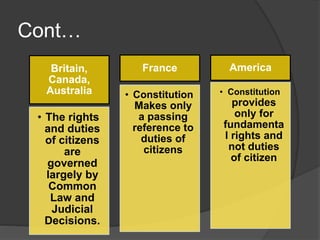
Cont…
Britain,
Canada,
Australia
• The rights
and duties
of citizens
are
governed
largely by
Common
Law and
Judicial
Decisions.
France
• Constitution
Makes only
a passing
reference to
duties of
citizens
America
• Constitution
provides
only for
fundamenta
l rights and
not duties
of citizen
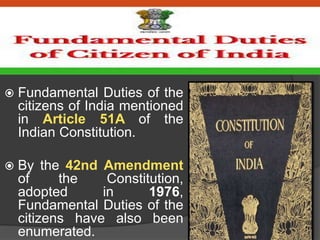
INTRODUCTION
 Fundamental Duties of the
citizens of India mentioned
in Article 51A of the
Indian Constitution.
 By the 42nd Amendment
of the Constitution,
adopted in 1976,
Fundamental Duties of the
citizens have also been
enumerated.
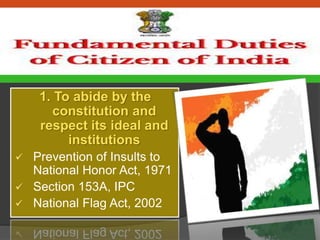
1. To abide by the
constitution and
respect its ideal and
institutions
 Prevention of Insults to
National Honor Act, 1971
 Section 153A, IPC
 National Flag Act, 2002
2. To cherish and follow
the noble ideals which
inspired our national
struggle for freedom
 Prevention of Insults to
National Honor Act, 1971
 Section 153A, IPC
 National Flag Act, 2002
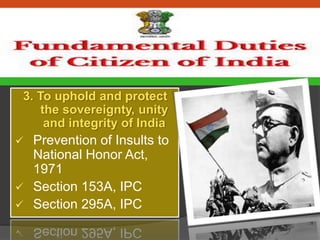
3. To uphold and protect
the sovereignty, unity
and integrity of India
 Prevention of Insults to
National Honor Act,
1971
 Section 153A, IPC
 Section 295A, IPC
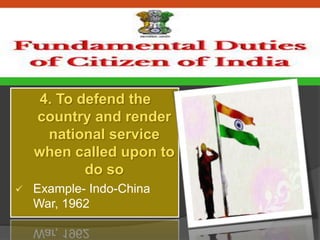
4. To defend the
country and render
national service
when called upon to
do so
 Example- Indo-China
War, 1962
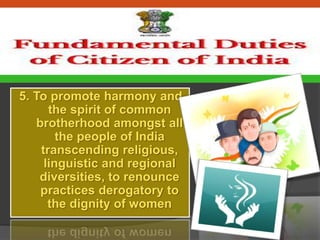
5. To promote harmony and
the spirit of common
brotherhood amongst all
the people of India
transcending religious,
linguistic and regional
diversities, to renounce
practices derogatory to
the dignity of women
 The Immoral Traffic (Prevention) Act, 1956
 The Dowry Prohibition Act, 1961 (28 of 1961) (Amended in
1986)
 The Indecent Representation of Women (Prohibition) Act,
1986
 The Commission of Sati (Prevention) Act, 1987 (3 of 1988)
 Protection of Women from Domestic Violence Act, 2005
 The Sexual Harassment of Women at Workplace
(PREVENTION, PROHIBITION and REDRESSAL) Act,
2013
 The Criminal Law (Amendment) Act, 2013
 Indian Penal code, 1860 etc.
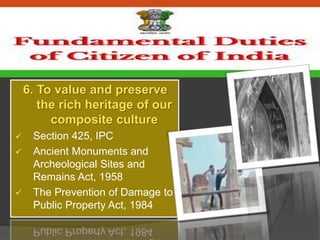
6. To value and preserve
the rich heritage of our
composite culture
 Section 425, IPC
 Ancient Monuments and
Archeological Sites and
Remains Act, 1958
 The Prevention of Damage to
Public Property Act, 1984
7. To protect and improve the natural
environment including forests,
lakes, rivers, and wild-life and to
have compassion for living
creatures
 The National Green Tribunal Act, 2010
 The Air (Prevention and Control of
Pollution) Act, 1981
 The Water (Prevention and Control of
Pollution) Act, 1974
 The Environment Protection Act, 1986
 The Hazardous Waste Management
Regulations, etc.
 Prevention of Cruelty to Animals Act, 1960
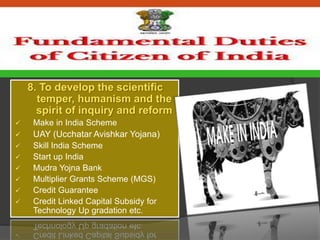
8. To develop the scientific
temper, humanism and the
spirit of inquiry and reform
 Make in India Scheme
 UAY (Ucchatar Avishkar Yojana)
 Skill India Scheme
 Start up India
 Mudra Yojna Bank
 Multiplier Grants Scheme (MGS)
 Credit Guarantee
 Credit Linked Capital Subsidy for
Technology Up gradation etc.
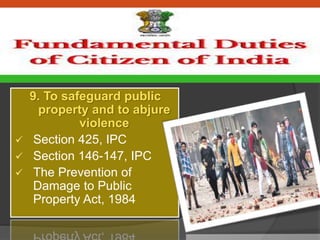
9. To safeguard public
property and to abjure
violence
 Section 425, IPC
 Section 146-147, IPC
 The Prevention of
Damage to Public
Property Act, 1984
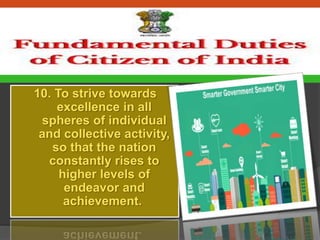
10. To strive towards
excellence in all
spheres of individual
and collective activity,
so that the nation
constantly rises to
higher levels of
endeavor and
achievement.
Article 29 (1) of the Universal
Declaration of Human Rights, 1948,
states:
“Everyone has duties to
the community in which
alone the free and full
development of his
personality is possible.”
 Scheme of Financial
Assistance for Promotion
of Art and Culture
 IMPRINT (Impacting
Research in Technology)
 Financial Assistance to
Centres of Excellence
etc.
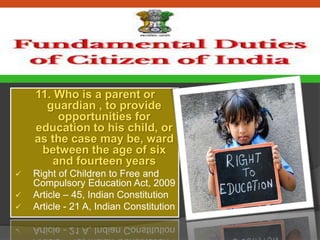
11. Who is a parent or
guardian , to provide
opportunities for
education to his child, or
as the case may be, ward
between the age of six
and fourteen years
 Right of Children to Free and
Compulsory Education Act, 2009
 Article – 45, Indian Constitution
 Article - 21 A, Indian Constitution
Enforceability of Fundamental
Duties
 Duties are observed by individuals as a result of
dictates of the social system.
 It may be necessary to enact suitable
legislation wherever necessary to require
obedience of obligations by the citizens.
 If the existing laws are inadequate to enforce
the needed discipline, the legislative vacuum
needs to be filled.
Cont..
 The citizen, it is expected, should
be his own monitor while
exercising and enforcing his
Fundamental rights.
 He should keep in mind that he
owes the duties specified in
Article 51-A to the State and if he
does not care for the duties, he
does not deserve the rights.
 Since the Fundamental Duties are
not addressed to the State, a
citizen cannot claim that.
Cont..
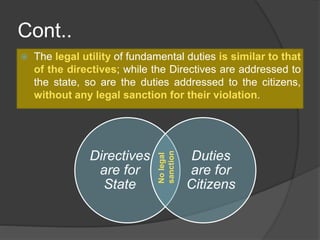
 The legal utility of fundamental duties is similar to that
of the directives; while the Directives are addressed to
the state, so are the duties addressed to the citizens,
without any legal sanction for their violation.
Directives
are for
State
Duties
are for
Citizens
No
legal
sanction
-Prof. (Dr.) Vaibhav Goel Bhartiya, Dean
-Dr. Reena Bishnoi, Associate Professor
-Ms. Shivani Sharma, Assistant Professor
Faculty of Law, Swami Vivekanand

fundamentalduties-copy-200731111138.pptx

  • 1.
    SWAMI VIVEKANAND SUBHARTI UNIVERSITY “Siksha,Seva, Sanskar, Rashtriyata” Where Duties precede Rights
  • 2.
  • 3.
    Prof. (Dr.) VaibhavGoel Bhartiya, Dean, Sardar Patel Subharti Institute of Law Swami Vivekanand Subharti University
  • 4.
    Dr. Reena Bishnoi,Associate Professor, Sardar Patel Subharti Institute of Law Swami Vivekanand Subharti University
  • 5.
    Ms. Shivani Sharma,Assistant Professor, Sardar Patel Subharti Institute of Law Swami Vivekanand Subharti University
  • 6.
    JURISPRUDENCE AND FUNDAMENTAL DUTIES It is the basic principle of jurisprudence that every right has a correlative duty and every duty has a correlative Right.  But the rule is not absolute.  It is subject to certain exceptions in the sense that a person may have a right, but there may not be a correlative duty.
  • 7.
    NEED FOR FUNDAMENTAL DUTIES India is a country where people belonging to different castes, creed, religion, sects etc. live together.  In order to maintain harmony and peace and to encourage the feeling of brotherhood the Fundamental Duties on their part plays a vital role.  It reminds the citizens that rights and duties go hand in hand.
  • 8.
    Sources of FundamentalDuties  It is significant to note that none of the Constitutions of Western Countries specifically provide for the duties and obligations of citizens  Among the Democratic Constitutions of the world we find mention of certain duties of the citizens in the Japanese Constitution.  Yugoslavian Constitution and Chapter VII of the Soviet Constitution lays down Fundamental Rights & Duties and also Chapter II of the Constitution of Republic Of China.
  • 9.
    Cont… Britain, Canada, Australia • The rights andduties of citizens are governed largely by Common Law and Judicial Decisions. France • Constitution Makes only a passing reference to duties of citizens America • Constitution provides only for fundamenta l rights and not duties of citizen
  • 10.
    INTRODUCTION  Fundamental Dutiesof the citizens of India mentioned in Article 51A of the Indian Constitution.  By the 42nd Amendment of the Constitution, adopted in 1976, Fundamental Duties of the citizens have also been enumerated.
  • 11.
    1. To abideby the constitution and respect its ideal and institutions  Prevention of Insults to National Honor Act, 1971  Section 153A, IPC  National Flag Act, 2002
  • 13.
    2. To cherishand follow the noble ideals which inspired our national struggle for freedom  Prevention of Insults to National Honor Act, 1971  Section 153A, IPC  National Flag Act, 2002
  • 14.
    3. To upholdand protect the sovereignty, unity and integrity of India  Prevention of Insults to National Honor Act, 1971  Section 153A, IPC  Section 295A, IPC
  • 15.
    4. To defendthe country and render national service when called upon to do so  Example- Indo-China War, 1962
  • 16.
    5. To promoteharmony and the spirit of common brotherhood amongst all the people of India transcending religious, linguistic and regional diversities, to renounce practices derogatory to the dignity of women
  • 17.
     The ImmoralTraffic (Prevention) Act, 1956  The Dowry Prohibition Act, 1961 (28 of 1961) (Amended in 1986)  The Indecent Representation of Women (Prohibition) Act, 1986  The Commission of Sati (Prevention) Act, 1987 (3 of 1988)  Protection of Women from Domestic Violence Act, 2005  The Sexual Harassment of Women at Workplace (PREVENTION, PROHIBITION and REDRESSAL) Act, 2013  The Criminal Law (Amendment) Act, 2013  Indian Penal code, 1860 etc.
  • 18.
    6. To valueand preserve the rich heritage of our composite culture  Section 425, IPC  Ancient Monuments and Archeological Sites and Remains Act, 1958  The Prevention of Damage to Public Property Act, 1984
  • 19.
    7. To protectand improve the natural environment including forests, lakes, rivers, and wild-life and to have compassion for living creatures  The National Green Tribunal Act, 2010  The Air (Prevention and Control of Pollution) Act, 1981  The Water (Prevention and Control of Pollution) Act, 1974  The Environment Protection Act, 1986  The Hazardous Waste Management Regulations, etc.  Prevention of Cruelty to Animals Act, 1960
  • 20.
    8. To developthe scientific temper, humanism and the spirit of inquiry and reform  Make in India Scheme  UAY (Ucchatar Avishkar Yojana)  Skill India Scheme  Start up India  Mudra Yojna Bank  Multiplier Grants Scheme (MGS)  Credit Guarantee  Credit Linked Capital Subsidy for Technology Up gradation etc.
  • 21.
    9. To safeguardpublic property and to abjure violence  Section 425, IPC  Section 146-147, IPC  The Prevention of Damage to Public Property Act, 1984
  • 22.
    10. To strivetowards excellence in all spheres of individual and collective activity, so that the nation constantly rises to higher levels of endeavor and achievement.
  • 23.
    Article 29 (1)of the Universal Declaration of Human Rights, 1948, states: “Everyone has duties to the community in which alone the free and full development of his personality is possible.”
  • 24.
     Scheme ofFinancial Assistance for Promotion of Art and Culture  IMPRINT (Impacting Research in Technology)  Financial Assistance to Centres of Excellence etc.
  • 25.
    11. Who isa parent or guardian , to provide opportunities for education to his child, or as the case may be, ward between the age of six and fourteen years  Right of Children to Free and Compulsory Education Act, 2009  Article – 45, Indian Constitution  Article - 21 A, Indian Constitution
  • 26.
    Enforceability of Fundamental Duties Duties are observed by individuals as a result of dictates of the social system.  It may be necessary to enact suitable legislation wherever necessary to require obedience of obligations by the citizens.  If the existing laws are inadequate to enforce the needed discipline, the legislative vacuum needs to be filled.
  • 27.
    Cont..  The citizen,it is expected, should be his own monitor while exercising and enforcing his Fundamental rights.  He should keep in mind that he owes the duties specified in Article 51-A to the State and if he does not care for the duties, he does not deserve the rights.  Since the Fundamental Duties are not addressed to the State, a citizen cannot claim that.
  • 28.
    Cont..  The legalutility of fundamental duties is similar to that of the directives; while the Directives are addressed to the state, so are the duties addressed to the citizens, without any legal sanction for their violation. Directives are for State Duties are for Citizens No legal sanction
  • 29.
    -Prof. (Dr.) VaibhavGoel Bhartiya, Dean -Dr. Reena Bishnoi, Associate Professor -Ms. Shivani Sharma, Assistant Professor Faculty of Law, Swami Vivekanand