Presented by –
Sanket Agrawal (02)
Periodontal ligament
Definition
The periodontal ligament is a connective tissue that
sourrounds the root and connect it to the bone. It is
continuos with the connective tissue of gingiva and
communicates with the marrow spaces through vascular
channels in the bone.
~ Carranza and
Bernard
Periodontal ligament serves the following functions.
1) Supportive Functions
~ Establishing strong attachment of teeth to the bone.
~ Maintaining conventional relationship of gingival tissues to the
teeth.
~ Protecting blood vessels and nerves from trauma induced by
mechanical forces.
~ Transmitting occlusal forces to the underlying bone: Th e
principal periodontal ligament fibers are arranged in a similar
fashion to a suspension bridge or hammock.
On loading axial forces, the wavy principle oblique fibers of
periodontal ligament spread out in their full length to resist the
major part of the forces and tooth gets depressed in the socket.
Hence, periodontal ligament can readily absorb axial forces
induced on it. However, rotational and lateral forces are absorbed
less easily. On the tension side, periodontal fi bers extend and
bone deposits while on pressure side, fibers get compressed and
bone resorbs.
~ Resisting impact of occlusal forces and thus acts as a shock
absorber. There are three dif ferent theories to explain the
mechanism of tooth support:
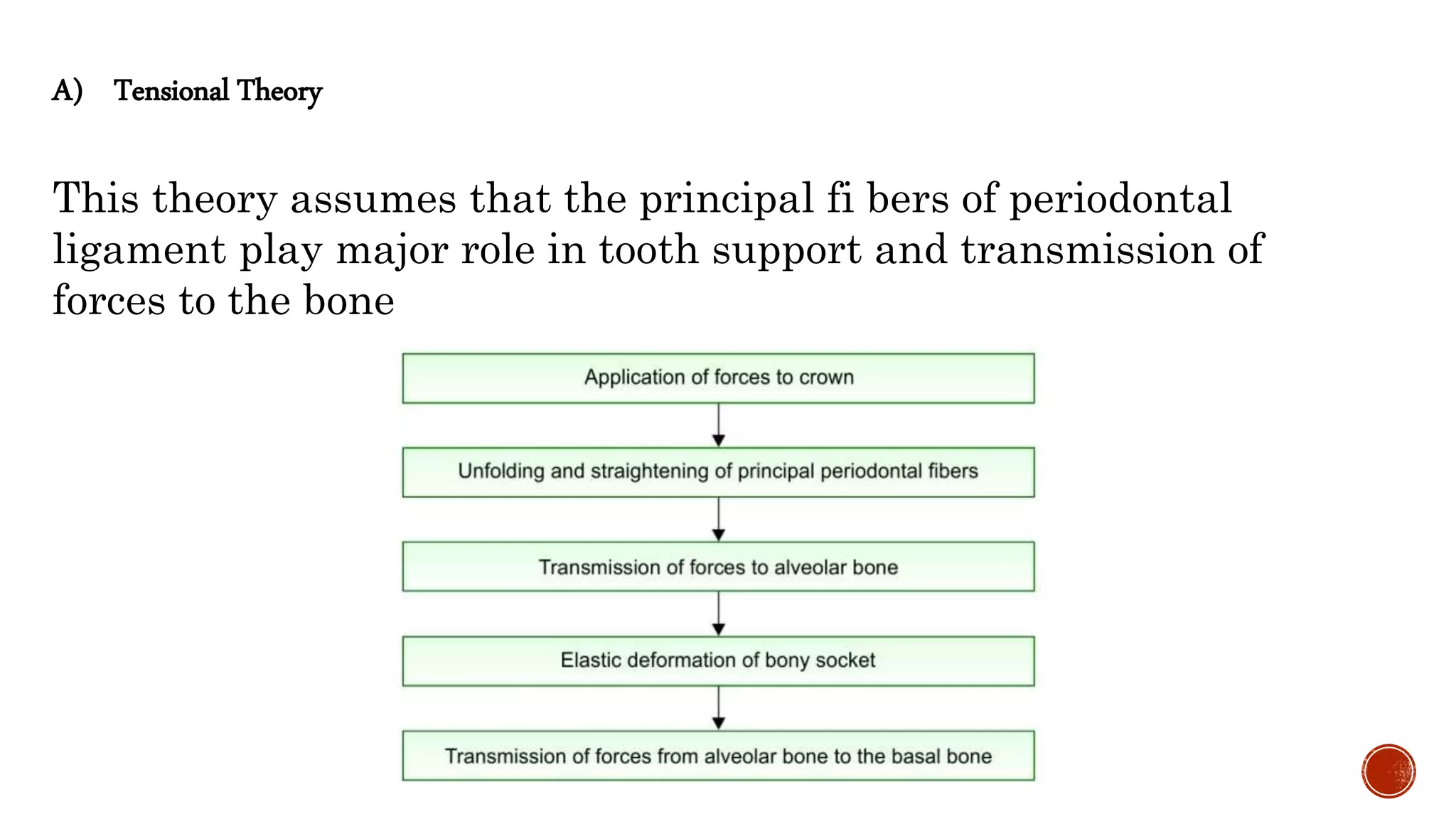
A) Tensional Theory
This theory assumes that the principal fi bers of periodontal
ligament play major role in tooth support and transmission of
forces to the bone
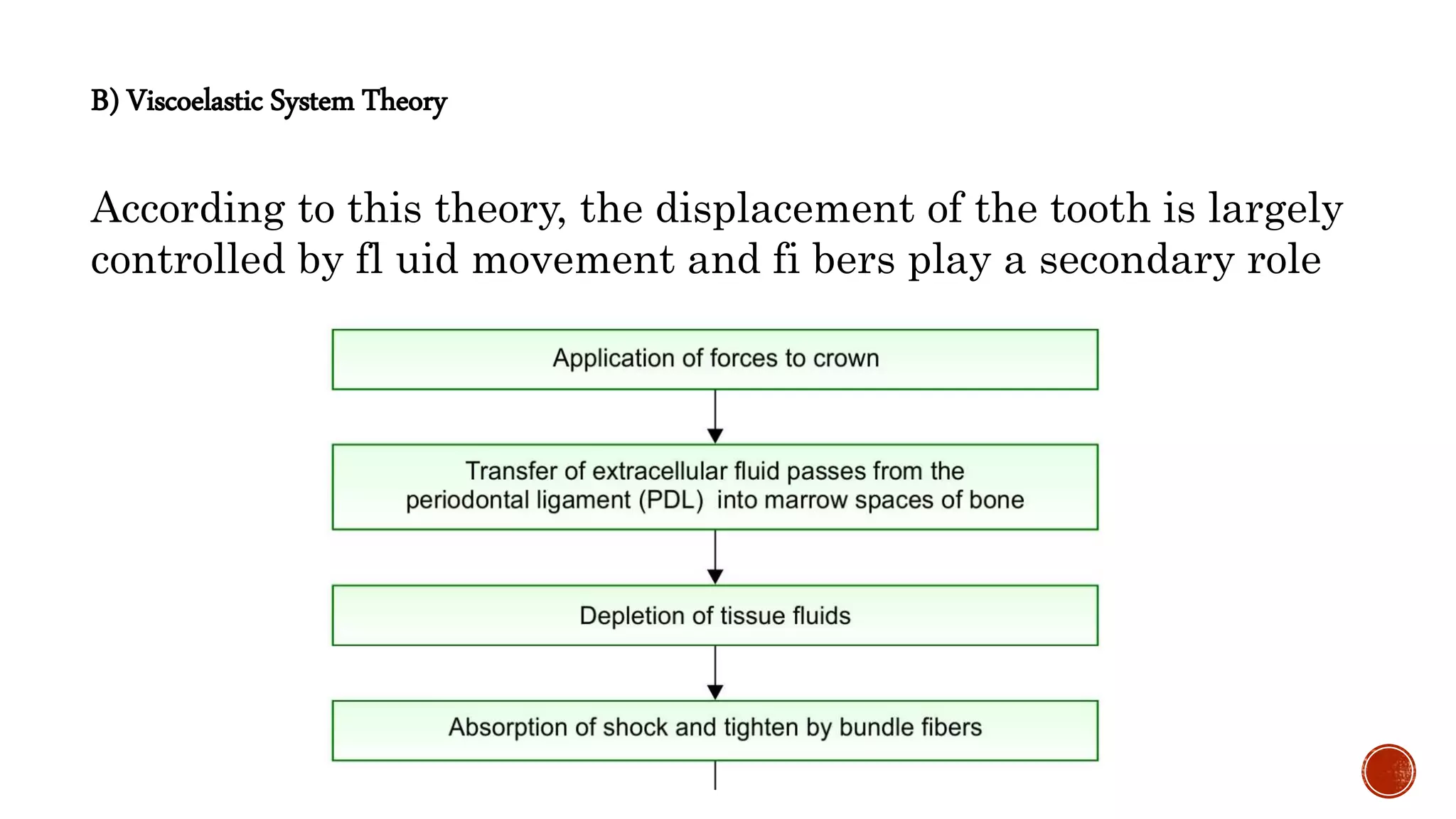
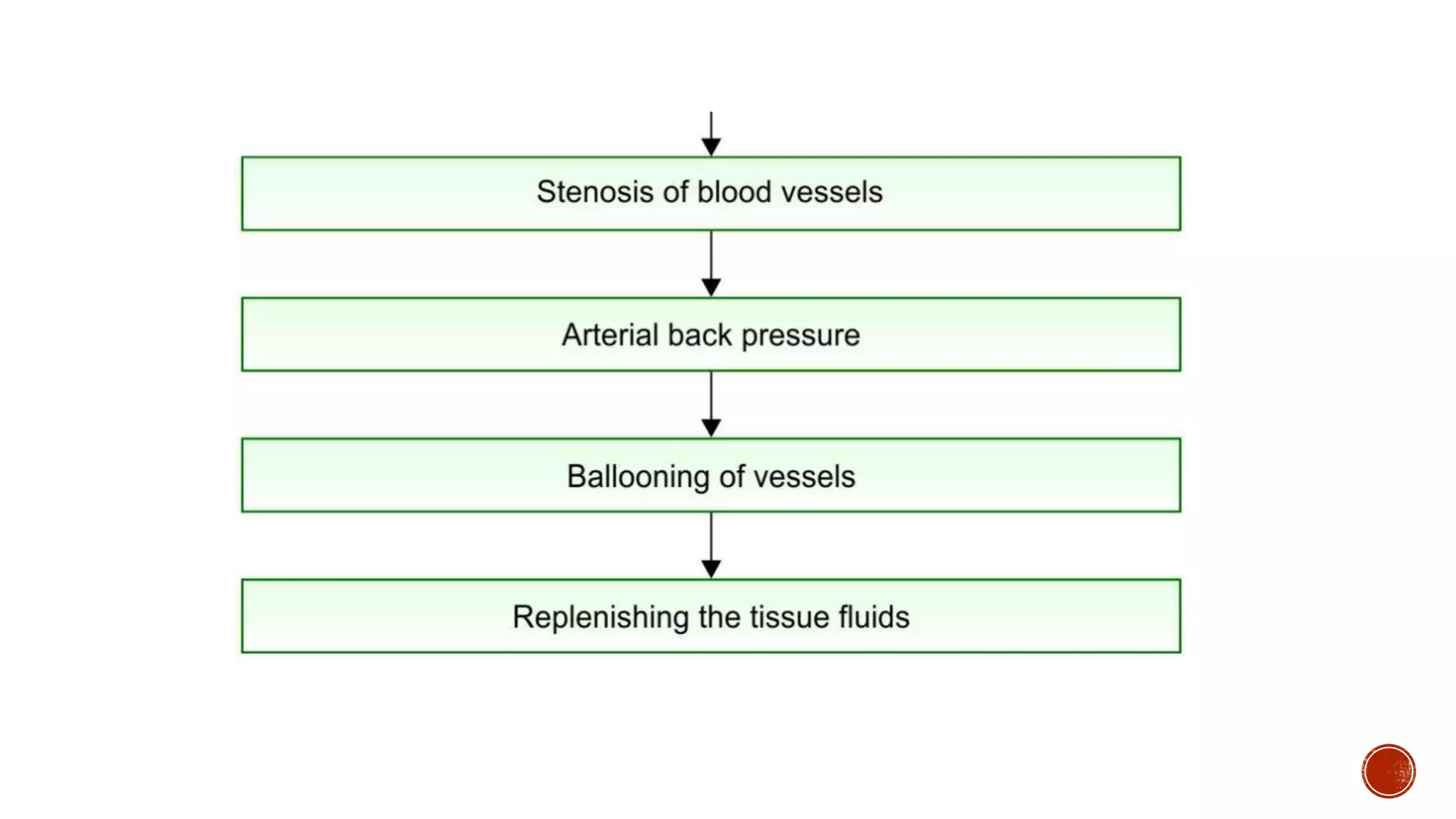
B) Viscoelastic System Theory
According to this theory, the displacement of the tooth is largely
controlled by fl uid movement and fi bers play a secondary role
C) Thixotropic Theory
According to this theory, periodontal ligament has the
rheological behavior of a thixotropic gel (i.e. the property of
becoming fl uid when shaken/stirred and then becoming
semisolid again).
2) Sensory Functions
Periodontal ligament is capable of transmitting tactile,
pressure and pain sensations by trigeminal pathways.
3) Nutritive Functions
It supplies nutrients to cementum, bone and gingiva through
blood vessels and lymphatics
4) Formative Functions
Th e tissues have the regenerative capacity in providing the cell
lineage namely osteoblast, cementoblast and fi broblast. Th us, it
helps in the formation and resorption of cementum and bone
during physiologic tooth movement and repair of injuries.
5) Homeostasis
With the presence of both formative and resorptive activity the
periodontal ligament provides a homeostasis in the tissue
environment.
Functions of Periodontal ligament

Functions of Periodontal ligament

  • 1.
  • 2.
    Periodontal ligament Definition The periodontalligament is a connective tissue that sourrounds the root and connect it to the bone. It is continuos with the connective tissue of gingiva and communicates with the marrow spaces through vascular channels in the bone. ~ Carranza and Bernard
  • 3.
    Periodontal ligament servesthe following functions. 1) Supportive Functions ~ Establishing strong attachment of teeth to the bone. ~ Maintaining conventional relationship of gingival tissues to the teeth. ~ Protecting blood vessels and nerves from trauma induced by mechanical forces. ~ Transmitting occlusal forces to the underlying bone: Th e principal periodontal ligament fibers are arranged in a similar fashion to a suspension bridge or hammock.
  • 4.
    On loading axialforces, the wavy principle oblique fibers of periodontal ligament spread out in their full length to resist the major part of the forces and tooth gets depressed in the socket. Hence, periodontal ligament can readily absorb axial forces induced on it. However, rotational and lateral forces are absorbed less easily. On the tension side, periodontal fi bers extend and bone deposits while on pressure side, fibers get compressed and bone resorbs. ~ Resisting impact of occlusal forces and thus acts as a shock absorber. There are three dif ferent theories to explain the mechanism of tooth support:
  • 5.
    A) Tensional Theory Thistheory assumes that the principal fi bers of periodontal ligament play major role in tooth support and transmission of forces to the bone
  • 6.
    B) Viscoelastic SystemTheory According to this theory, the displacement of the tooth is largely controlled by fl uid movement and fi bers play a secondary role
  • 8.
    C) Thixotropic Theory Accordingto this theory, periodontal ligament has the rheological behavior of a thixotropic gel (i.e. the property of becoming fl uid when shaken/stirred and then becoming semisolid again). 2) Sensory Functions Periodontal ligament is capable of transmitting tactile, pressure and pain sensations by trigeminal pathways.
  • 9.
    3) Nutritive Functions Itsupplies nutrients to cementum, bone and gingiva through blood vessels and lymphatics 4) Formative Functions Th e tissues have the regenerative capacity in providing the cell lineage namely osteoblast, cementoblast and fi broblast. Th us, it helps in the formation and resorption of cementum and bone during physiologic tooth movement and repair of injuries.
  • 10.
    5) Homeostasis With thepresence of both formative and resorptive activity the periodontal ligament provides a homeostasis in the tissue environment.