CONTINGENCY APPROACH
TO MANAGEMENT
ERMALYN D. DIAZ
CHAPTER 19
Objectives
1 To explain and elaborate the meaning of Situational Approach
/ Contingency Approach to management
2 To identify the different characteristics of Situational
Approach / Contingency Approach to management
3 To differentiate the advantages and disadvantages of
Situational Approach / Contingency Approach
4 Understand how leadership is often contingent on people and
situations.
Objectives
Apply Hersey and Blanchard’s situational theory of leader style
to the level of follower readiness
Explain the path-goal theory of leadership.
Understand how leadership is often contingent on people and
situations.
Apply Fiedler’s contingency model to key relationships among
leader style, situational favorability, and group task
performance.
5
6
7
8
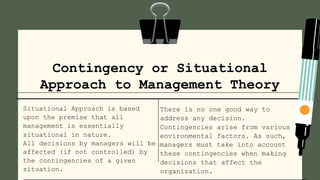
Contingency or Situational
Approach to Management Theory
Situational Approach is based
upon the premise that all
management is essentially
situational in nature.
affected (if not controlled) by
the contingencies of a given
situation.
There is no one good way to
address any decision.
Contingencies arise from various
environmental factors. As such,
All decisions by managers will be managers must take into account
these contingencies when making
decisions that affect the
organization.
PRIMARY
CHARACTERISTICS OF
THE CONTINGENCY
APPROACH
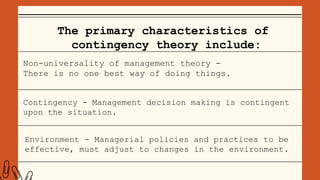
The primary characteristics of
contingency theory include:
Non-universality of management theory -
There is no one best way of doing things.
Contingency - Management decision making is contingent
upon the situation.
Environment - Managerial policies and practices to be
effective, must adjust to changes in the environment.
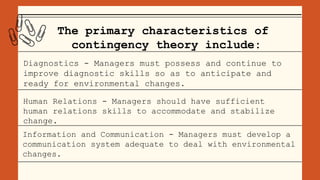
The primary characteristics of
contingency theory include:
Diagnostics - Managers must possess and continue to
improve diagnostic skills so as to anticipate and
ready for environmental changes.
Human Relations - Managers should have sufficient
human relations skills to accommodate and stabilize
change.
Information and Communication - Managers must develop a
communication system adequate to deal with environmental
changes.
Advantages of
Contingency Theory
The primary advantages of contingency
theory include:
It provides a realistic view of management and
organization.
It discards the universal validity of principles.
Managers are situation-oriented and not stereotyped.
Lends itself to an innovative and creative
management style.
The disadvantages of contingency theory
include:
It does not have a theoretical base.
Executive is expected to know all the alternative
courses of action before taking action in a
situation that is not always feasible.
A situation can be influenced by many factors.
It is difficult to analyze all these factors.
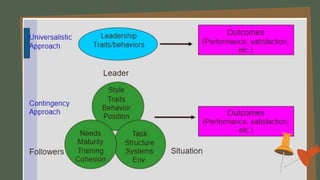
UNIVERSALISTIC&CONTINGENCY
APPROACH TO LEADERSHIPS
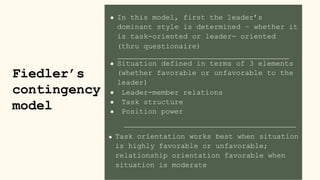
In this model, first the leader’s
Fiedler’s
contingency
model
dominant style is determined – whether it
is task-oriented or leader- oriented
(thru questionaire)
Situation defined in terms of 3 elements
(whether favorable or unfavorable to the
leader)
Leader-member relations
Task structure
Position power
Task orientation works best when situation
is highly favorable or unfavorable;
relationship orientation favorable when
situation is moderate
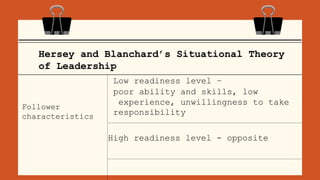
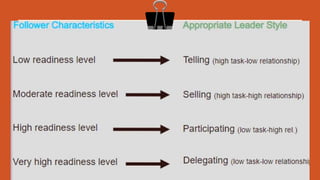
Hersey and Blanchard’s Situational Theory
of Leadership
Low readiness level –
poor ability and skills, low
experience, unwillingness to take
responsibility
Follower
characteristics
High readiness level - opposite
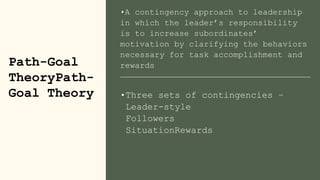
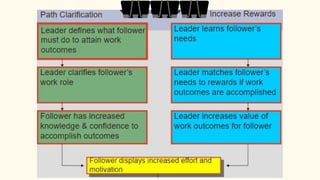
•A contingency approach to leadership
in which the leader’s responsibility
is to increase subordinates’
motivation by clarifying the behaviors
necessary for task accomplishment and
rewards
Path-Goal
TheoryPath-
Goal Theory •Three sets of contingencies –
Leader-style
Followers
SituationRewards
Teacher
Resources
Page
•https://tinyurl.com/uauvhw
THANK YOU!!!

Contingency approach to management

  • 1.
  • 2.
    Objectives 1 To explainand elaborate the meaning of Situational Approach / Contingency Approach to management 2 To identify the different characteristics of Situational Approach / Contingency Approach to management 3 To differentiate the advantages and disadvantages of Situational Approach / Contingency Approach 4 Understand how leadership is often contingent on people and situations.
  • 3.
    Objectives Apply Hersey andBlanchard’s situational theory of leader style to the level of follower readiness Explain the path-goal theory of leadership. Understand how leadership is often contingent on people and situations. Apply Fiedler’s contingency model to key relationships among leader style, situational favorability, and group task performance. 5 6 7 8
  • 4.
    Contingency or Situational Approachto Management Theory Situational Approach is based upon the premise that all management is essentially situational in nature. affected (if not controlled) by the contingencies of a given situation. There is no one good way to address any decision. Contingencies arise from various environmental factors. As such, All decisions by managers will be managers must take into account these contingencies when making decisions that affect the organization.
  • 5.
  • 6.
    The primary characteristicsof contingency theory include: Non-universality of management theory - There is no one best way of doing things. Contingency - Management decision making is contingent upon the situation. Environment - Managerial policies and practices to be effective, must adjust to changes in the environment.
  • 7.
    The primary characteristicsof contingency theory include: Diagnostics - Managers must possess and continue to improve diagnostic skills so as to anticipate and ready for environmental changes. Human Relations - Managers should have sufficient human relations skills to accommodate and stabilize change. Information and Communication - Managers must develop a communication system adequate to deal with environmental changes.
  • 8.
  • 9.
    The primary advantagesof contingency theory include: It provides a realistic view of management and organization. It discards the universal validity of principles. Managers are situation-oriented and not stereotyped. Lends itself to an innovative and creative management style.
  • 10.
    The disadvantages ofcontingency theory include: It does not have a theoretical base. Executive is expected to know all the alternative courses of action before taking action in a situation that is not always feasible. A situation can be influenced by many factors. It is difficult to analyze all these factors.
  • 11.
  • 13.
    In this model,first the leader’s Fiedler’s contingency model dominant style is determined – whether it is task-oriented or leader- oriented (thru questionaire) Situation defined in terms of 3 elements (whether favorable or unfavorable to the leader) Leader-member relations Task structure Position power Task orientation works best when situation is highly favorable or unfavorable; relationship orientation favorable when situation is moderate
  • 14.
    Hersey and Blanchard’sSituational Theory of Leadership Low readiness level – poor ability and skills, low experience, unwillingness to take responsibility Follower characteristics High readiness level - opposite
  • 16.
    •A contingency approachto leadership in which the leader’s responsibility is to increase subordinates’ motivation by clarifying the behaviors necessary for task accomplishment and rewards Path-Goal TheoryPath- Goal Theory •Three sets of contingencies – Leader-style Followers SituationRewards
  • 19.
  • 20.