FUNCTIONS OF MANAGEMENT
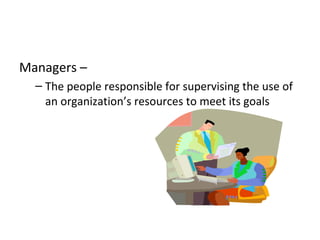
Managers –
– The people responsible for supervising the use of
an organization’s resources to meet its goals
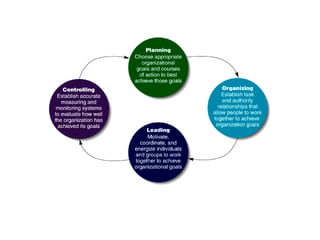
• The planning, organizing, leading, and
controlling of human and other resources
to achieve organizational goals effectively
and efficiently
• Resources include people, skills, know-how and
experience, machinery, raw materials,
computers and IT, patents, financial capital, and
loyal customers and employees
PLANNING
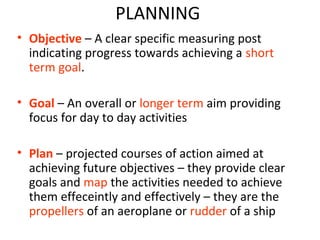
• Objective – A clear specific measuring post
indicating progress towards achieving a short
term goal.
• Goal – An overall or longer term aim providing
focus for day to day activities
• Plan – projected courses of action aimed at
achieving future objectives – they provide clear
goals and map the activities needed to achieve
them effeceintly and effectively – they are the
propellers of an aeroplane or rudder of a ship
• Planning is critical for business – we have to organise
our day’s, weekly, monthly, yearly and long range
activities.
• Planning gives us direction and helps identify and
focus important issues for business.
• Gap Analysis – see hand out
• Values
• Vision
• Mission
• SWOT Analysis
• Strategic Plans
ORGANISING
• What is organising? –
• It is defining roles, responsibilities and
arranging and coordinating the resources
needed to successfully carry out plans – Right
People in the Right Seat in the BUS called
BUSINESS
STAFFING
• What is staffing? –
• People are a hotel’s most valuable resource – the
hotel needs the right people to be attracted to join it
– then it is recruiting, training to do their jobs
effectively and treating them well to retain them.
• Losing employees is easy – recruiting is twice as hard
– Let’s do a costing of recruitment?
• Disney’s recruitment policy – what is most critical – Is
it recruiting or training?
LEADING
•

Leadership is about achieving business goals through the work of others
David Karpin

•

Trait Approach – focusses on personal qualities such as height,
intelligence, genetic etc
• Transformational Approach – leads the organisation in new direction
through leaders talent and drive
• Charismatic Approach – leads through personal magnetism, charm and
other qualities – Eg Steve Jobs of Apple Computers, JW Marriott of
Marriott Hotels
• Narcisstic Approach – leads through personal skills, magnetic attraction
and also are distrustful of others and consider themselves invincible – Eg
Napolean, Bill Gates,
MONITORING
• How are we doing?
• Are we operating within the budget?
• Are we meeting our targets?
• It is keeping an eye on how the business is
doing – checking on budgets, materials, costs,
staff, revenues, quality, safety measures etc
GOOD MANAGER
• Listening , comprehension,
vision , understanding, critical,
conecting with the reality and
close with people
Bad boy
• 1. the manager who doesn’t know how to do
his job
• 2. the manager who doen’t want to do his job
• 3. the manager who doesn’t care
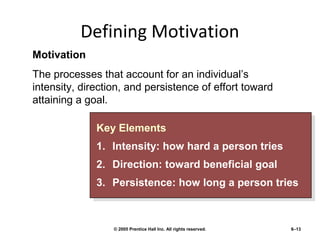
Defining Motivation
Motivation
The processes that account for an individual’s
intensity, direction, and persistence of effort toward
attaining a goal.
Key Elements
Key Elements
1. Intensity: how hard a person tries
2.
2.
3.
3.

Direction: toward beneficial goal
Persistence: how long a person tries

© 2005 Prentice Hall Inc. All rights reserved.

6–13
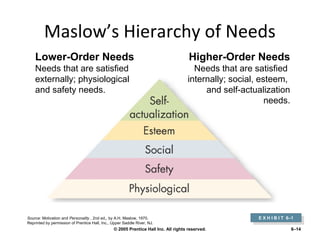
Maslow’s Hierarchy of Needs
Lower-Order Needs
Needs that are satisfied
externally; physiological
and safety needs.

Higher-Order Needs

Needs that are satisfied
internally; social, esteem,
and self-actualization
needs.

Source: Motivation and Personality , 2nd ed,, by A.H. Maslow, 1970.
Reprinted by permission of Prentice Hall, Inc., Upper Saddle River, NJ.

© 2005 Prentice Hall Inc. All rights reserved.

E X H I B I T 6–1
E X H I B I T 6–1
6–14
The Lewis Model was constructed by Richard
Lewis for purposes of culture classification
The model aims to promote “harmony through
understanding”
The model classifies cultures into three main
types:
- Linear-active
- Multi-active
- Reactive
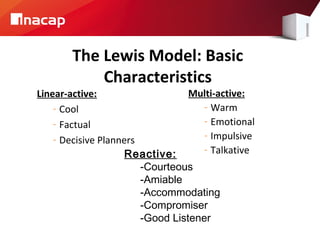
The Lewis Model: Basic
Characteristics

Multi-active:
Linear-active:
- Warm
- Cool
- Emotional
- Factual
- Impulsive
- Decisive Planners
- Talkative
Reactive:
-Courteous
-Amiable
-Accommodating
-Compromiser
-Good Listener
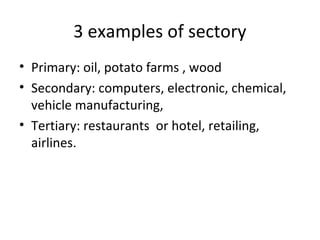
3 examples of sectory
• Primary: oil, potato farms , wood
• Secondary: computers, electronic, chemical,
vehicle manufacturing,
• Tertiary: restaurants or hotel, retailing,
airlines.
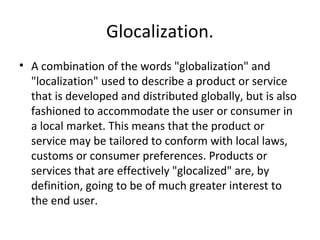
Glocalization.
• A combination of the words "globalization" and
"localization" used to describe a product or service
that is developed and distributed globally, but is also
fashioned to accommodate the user or consumer in
a local market. This means that the product or
service may be tailored to conform with local laws,
customs or consumer preferences. Products or
services that are effectively "glocalized" are, by
definition, going to be of much greater interest to
the end user.
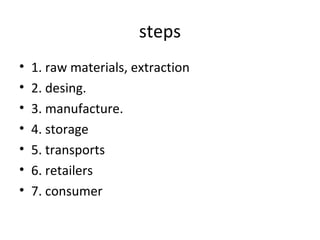
steps
•
•
•
•
•
•
•

1. raw materials, extraction
2. desing.
3. manufacture.
4. storage
5. transports
6. retailers
7. consumer
Una cadena de suministro está  formada  por  todas  aquellas  partes 
involucradas de manera directa o indirecta en la satisfacción de la solicitud 
de un cliente. La cadena de suministro incluye no solamente al fabricante y 
al proveedor, sino también a los transportistas, almacenistas, vendedores 
al  detalle  (o  menudeo)  e  incluso  a  los  mismos  clientes.  Dentro  de  cada 
organización,  como  la  del  fabricante,  abarca  todas  las  funciones  que 
participan  en  la  recepción  y  el  cumplimiento  de  una  petición  del  cliente. 
Estas funciones incluyen, pero no están limitadas al desarrollo de nuevos 
productos, la mercadotecnia, las operaciones, la distribución, las finanzas 
y el servicio al cliente.

Functions of management

  • 1.
  • 2.
    Managers – – Thepeople responsible for supervising the use of an organization’s resources to meet its goals
  • 3.
    • The planning,organizing, leading, and controlling of human and other resources to achieve organizational goals effectively and efficiently • Resources include people, skills, know-how and experience, machinery, raw materials, computers and IT, patents, financial capital, and loyal customers and employees
  • 5.
    PLANNING • Objective –A clear specific measuring post indicating progress towards achieving a short term goal. • Goal – An overall or longer term aim providing focus for day to day activities • Plan – projected courses of action aimed at achieving future objectives – they provide clear goals and map the activities needed to achieve them effeceintly and effectively – they are the propellers of an aeroplane or rudder of a ship
  • 6.
    • Planning iscritical for business – we have to organise our day’s, weekly, monthly, yearly and long range activities. • Planning gives us direction and helps identify and focus important issues for business. • Gap Analysis – see hand out • Values • Vision • Mission • SWOT Analysis • Strategic Plans
  • 7.
    ORGANISING • What isorganising? – • It is defining roles, responsibilities and arranging and coordinating the resources needed to successfully carry out plans – Right People in the Right Seat in the BUS called BUSINESS
  • 8.
    STAFFING • What isstaffing? – • People are a hotel’s most valuable resource – the hotel needs the right people to be attracted to join it – then it is recruiting, training to do their jobs effectively and treating them well to retain them. • Losing employees is easy – recruiting is twice as hard – Let’s do a costing of recruitment? • Disney’s recruitment policy – what is most critical – Is it recruiting or training?
  • 9.
    LEADING • Leadership is aboutachieving business goals through the work of others David Karpin • Trait Approach – focusses on personal qualities such as height, intelligence, genetic etc • Transformational Approach – leads the organisation in new direction through leaders talent and drive • Charismatic Approach – leads through personal magnetism, charm and other qualities – Eg Steve Jobs of Apple Computers, JW Marriott of Marriott Hotels • Narcisstic Approach – leads through personal skills, magnetic attraction and also are distrustful of others and consider themselves invincible – Eg Napolean, Bill Gates,
  • 10.
    MONITORING • How arewe doing? • Are we operating within the budget? • Are we meeting our targets? • It is keeping an eye on how the business is doing – checking on budgets, materials, costs, staff, revenues, quality, safety measures etc
  • 11.
    GOOD MANAGER • Listening, comprehension, vision , understanding, critical, conecting with the reality and close with people
  • 12.
    Bad boy • 1.the manager who doesn’t know how to do his job • 2. the manager who doen’t want to do his job • 3. the manager who doesn’t care
  • 13.
    Defining Motivation Motivation The processesthat account for an individual’s intensity, direction, and persistence of effort toward attaining a goal. Key Elements Key Elements 1. Intensity: how hard a person tries 1. Intensity: how hard a person tries 2. 2. 3. 3. Direction: toward beneficial goal Direction: toward beneficial goal Persistence: how long a person tries Persistence: how long a person tries © 2005 Prentice Hall Inc. All rights reserved. 6–13
  • 14.
    Maslow’s Hierarchy ofNeeds Lower-Order Needs Needs that are satisfied externally; physiological and safety needs. Higher-Order Needs Needs that are satisfied internally; social, esteem, and self-actualization needs. Source: Motivation and Personality , 2nd ed,, by A.H. Maslow, 1970. Reprinted by permission of Prentice Hall, Inc., Upper Saddle River, NJ. © 2005 Prentice Hall Inc. All rights reserved. E X H I B I T 6–1 E X H I B I T 6–1 6–14
  • 15.
    The Lewis Modelwas constructed by Richard Lewis for purposes of culture classification The model aims to promote “harmony through understanding” The model classifies cultures into three main types: - Linear-active - Multi-active - Reactive
  • 16.
    The Lewis Model:Basic Characteristics Multi-active: Linear-active: - Warm - Cool - Emotional - Factual - Impulsive - Decisive Planners - Talkative Reactive: -Courteous -Amiable -Accommodating -Compromiser -Good Listener
  • 17.
    3 examples ofsectory • Primary: oil, potato farms , wood • Secondary: computers, electronic, chemical, vehicle manufacturing, • Tertiary: restaurants or hotel, retailing, airlines.
  • 18.
    Glocalization. • A combinationof the words "globalization" and "localization" used to describe a product or service that is developed and distributed globally, but is also fashioned to accommodate the user or consumer in a local market. This means that the product or service may be tailored to conform with local laws, customs or consumer preferences. Products or services that are effectively "glocalized" are, by definition, going to be of much greater interest to the end user.
  • 19.
    steps • • • • • • • 1. raw materials,extraction 2. desing. 3. manufacture. 4. storage 5. transports 6. retailers 7. consumer
  • 20.
    Una cadena de suministro está formada  por  todas  aquellas  partes  involucradas de manera directa o indirecta en la satisfacción de la solicitud  de un cliente. La cadena de suministro incluye no solamente al fabricante y  al proveedor, sino también a los transportistas, almacenistas, vendedores  al  detalle  (o  menudeo)  e  incluso  a  los  mismos  clientes.  Dentro  de  cada  organización,  como  la  del  fabricante,  abarca  todas  las  funciones  que  participan  en  la  recepción  y  el  cumplimiento  de  una  petición  del  cliente.  Estas funciones incluyen, pero no están limitadas al desarrollo de nuevos  productos, la mercadotecnia, las operaciones, la distribución, las finanzas  y el servicio al cliente.

Editor's Notes