Course Name: IndustrialEconomics and Management (ME
491)
Duration: 18 Hrs
Course Manual: 5 Units
Unit 1: Management, Managerial Planning & Decision Making
Unit 2: Organising, Leading & Controlling
Unit 3: Fundamentals of Accounting and Costing
Unit 4: Engineering Economy
Unit 5: Project Management
COURSE INTRODUCTION
2.
COURSE OBJECTIVES
Introduce studentsto the basics of management, managerial
planning and the decision making process.
To equip students with the tools and techniques for planning and
decision making.
To equip students with the knowledge and techniques:
To assess the economic viability of alternative solutions to
technical problems and propose solutions.
To justify and defend the solutions proposed by them.
Understand the economic consequences of decision making
regarding savings, investment, etc and the role that financial
planning and economic optimization play in them.
Understand effective project management
3.
COURSE EXECUTION
Saturday 27thJuly, 2013: Unit 1
Sunday 28th July, 2013: Unit 2 and Unit 3
Saturday, 10th July, 2013: Unit 3
Sunday, 11th July, 2013: Unit 4 & Unit 5
Saturday: 24th August, 2013- Finish Unit 5 & Revise
Quiz:???
End of Course Examination ???
4.
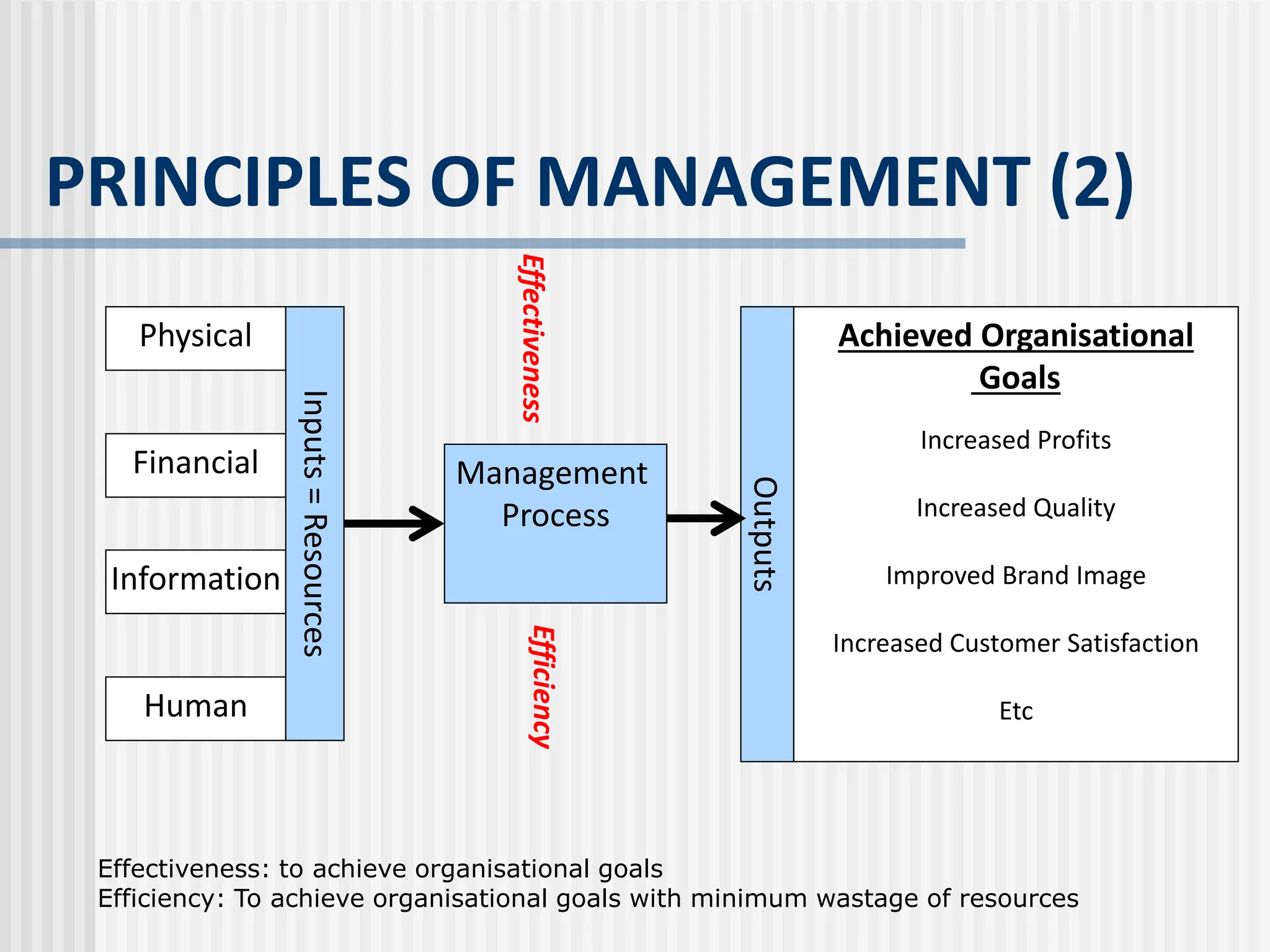
PRINCIPLES OF MANAGEMENT(1)
Management is the process of coordinating and utilizing human
and nonhuman resources in pursuit of organizational profit,
service, and survival goals.
Management is a form of work which involves coordinating an
organisation’s resources to achieve a goal.
Management can be defined as a set of activities directed at the
efficient and effective utilization of resources in the pursuit of
one or more goals.
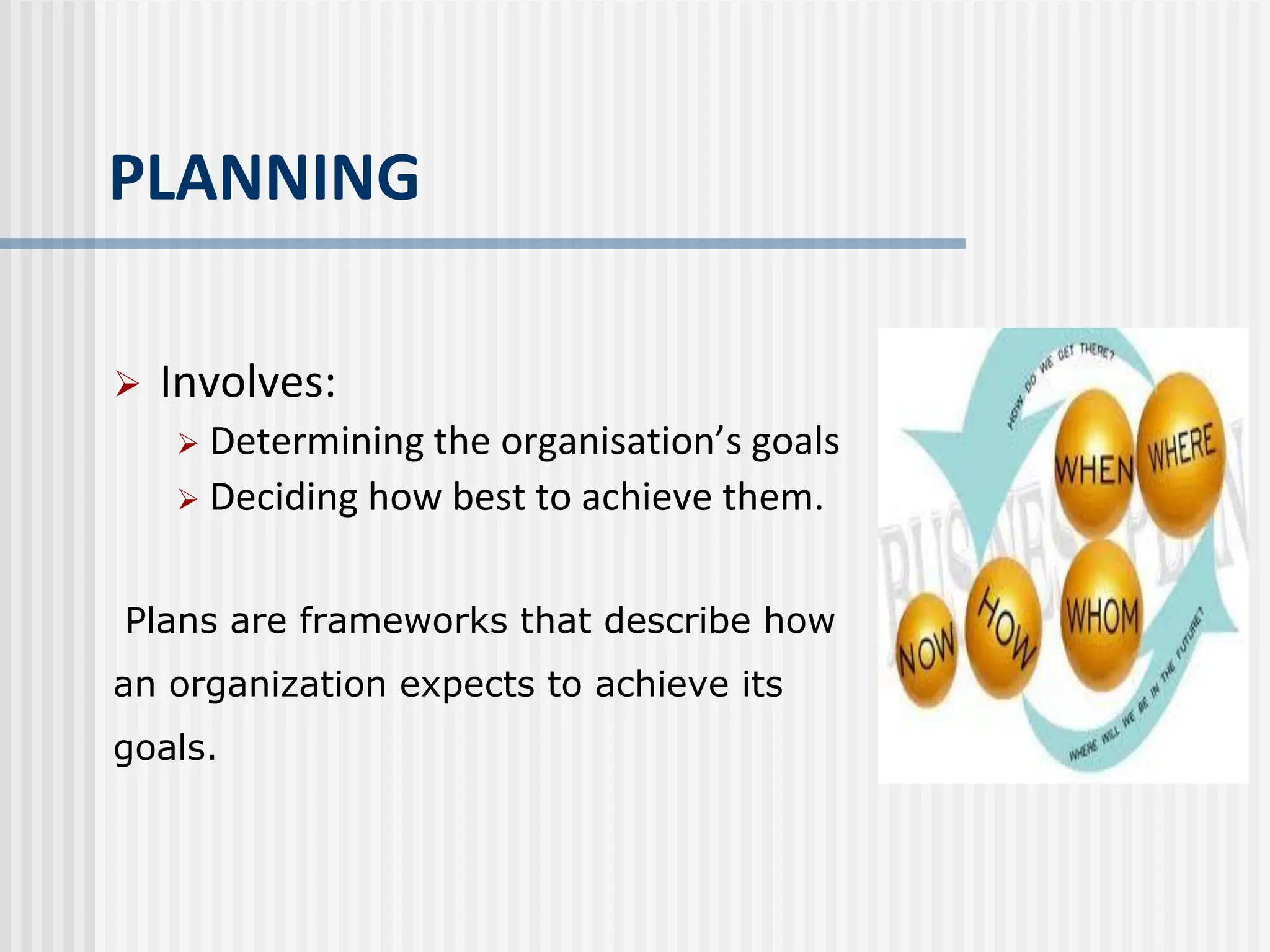
PLANNING
Involves:
Determiningthe organisation’s goals
Deciding how best to achieve them.
Plans are frameworks that describe how
an organization expects to achieve its
goals.
8.
DECISION MAKING
Theprocess of thought and
deliberation that results in a
decision.
To carry out the goals of their
organizations, managers must have
an understanding of how decisions
are made and know what decision-
making tools are available.
9.
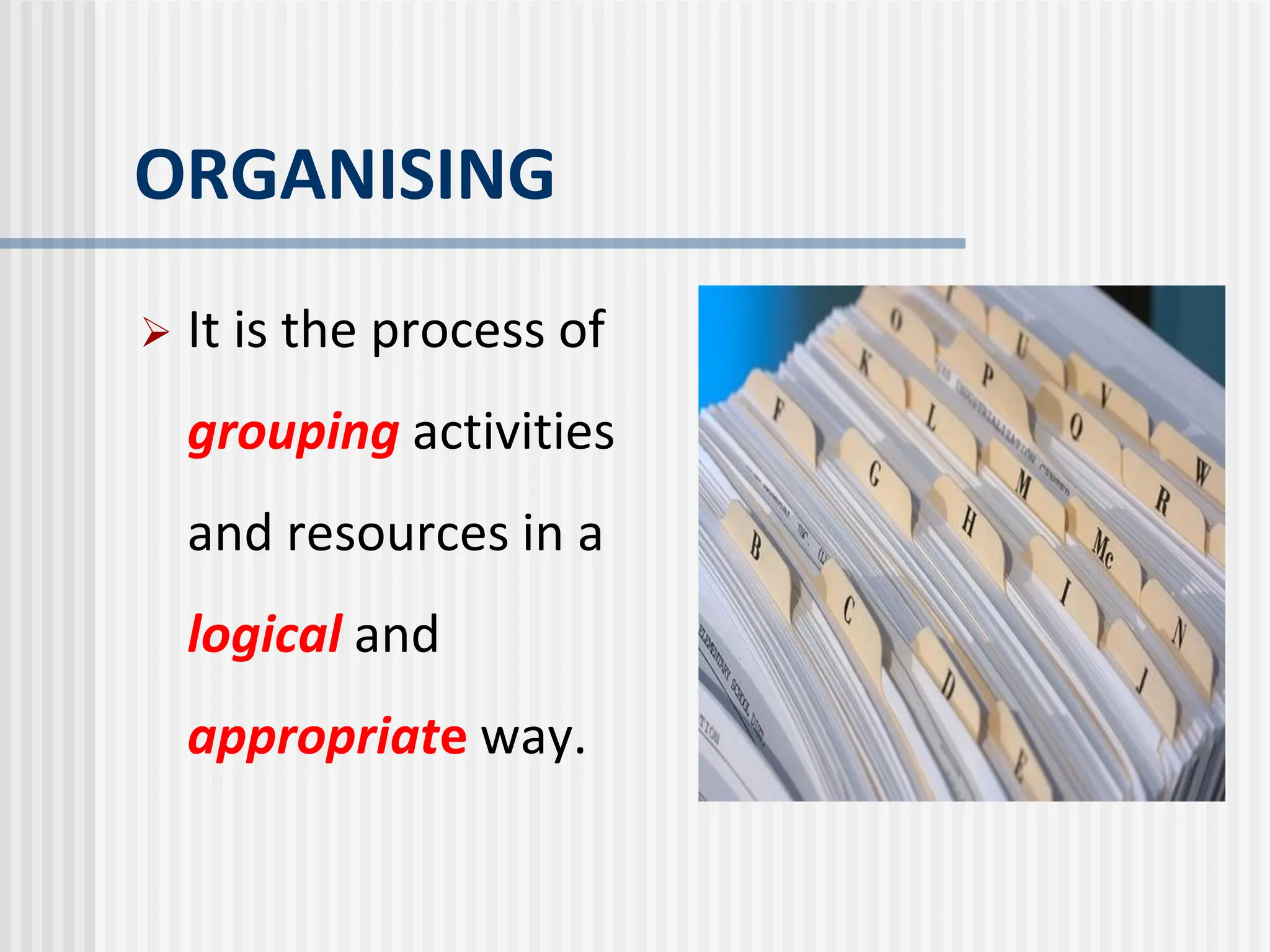
ORGANISING
It isthe process of
grouping activities
and resources in a
logical and
appropriate way.
10.
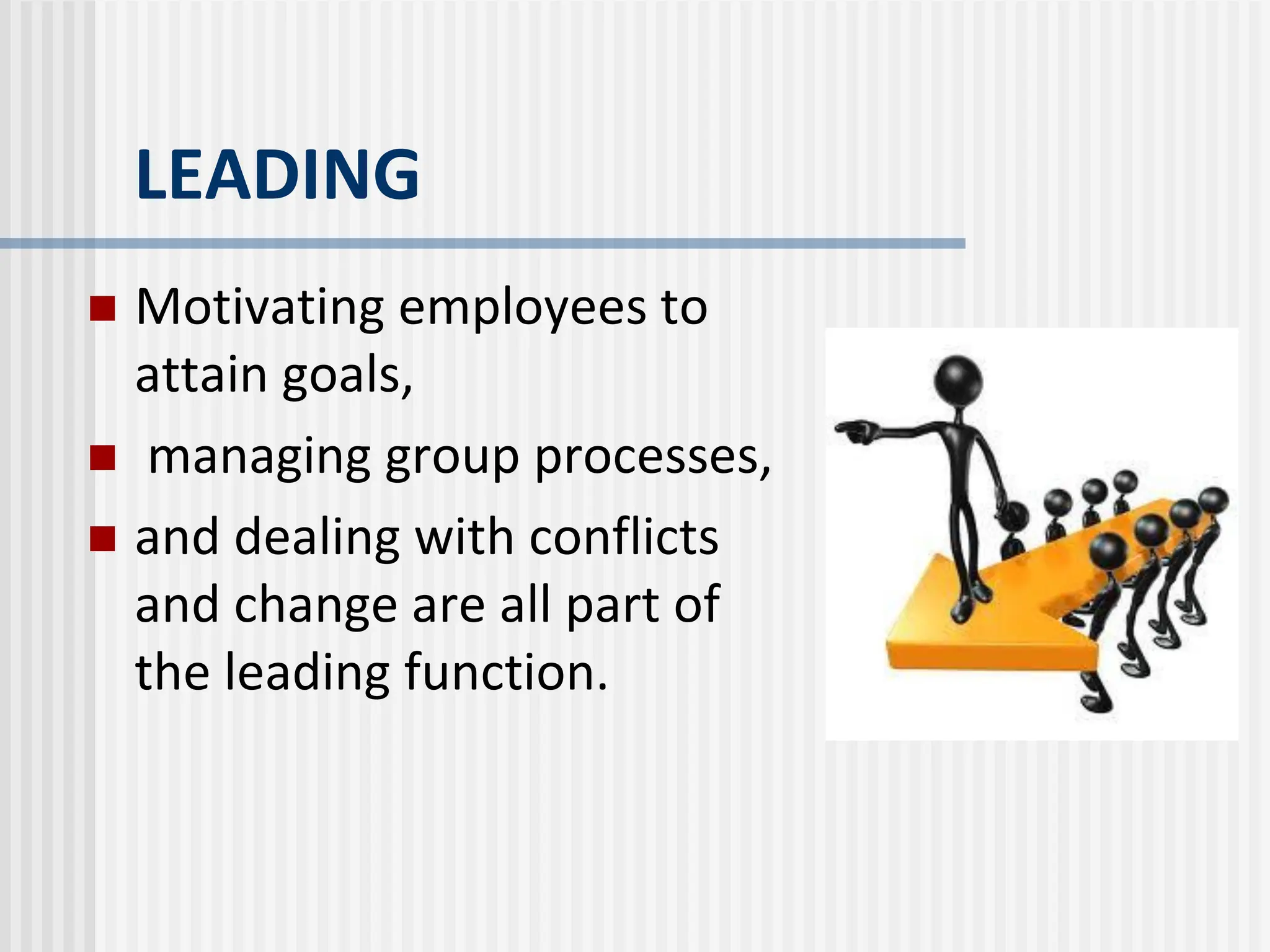
LEADING
Motivating employeesto
attain goals,
managing group processes,
and dealing with conflicts
and change are all part of
the leading function.
MANAGEMENT FUNCTIONS
Amanager’s job can be described from the
standpoint of its basic functions, roles and skills.
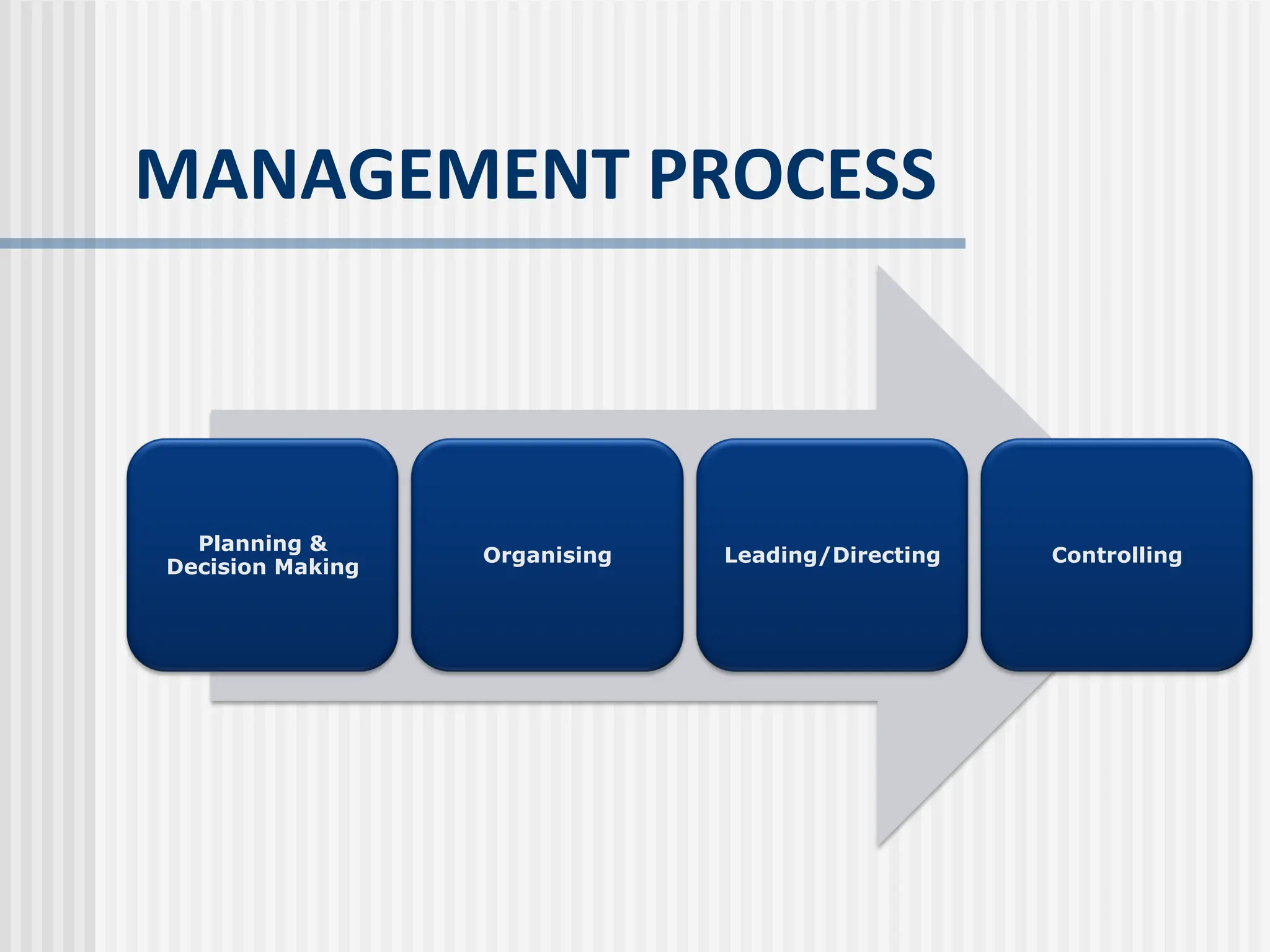
Management functions:
Planning and decision making
Organizing
Leading
Controlling
13.
MANAGEMENT ROLES ANDSKILLS
A manager's role is similar to an actor's role
in a play,
it consists of certain things he or she is expected
to do and
ways in which he or she is expected to behave.
Skills are the various talents managers need
to perform their roles effectively.
14.
MANAGEMENT ROLES
InterpersonalRoles: these include
the figurehead, the leader, and the liaison role
Informational Roles: they are
The monitor, the disseminator, and the spokesperson
are informational roles
Decisional Roles:
Managers in decisional roles act as entrepreneurs,
disturbance handlers, resource allocators, or negotiators.
15.
MANAGEMENT SKILLS (1)
Good managers tend to possess a certain mix
of skills that sets them apart from others.
Primary Skills of Managers
Technical Skills: An ability to perform a specialised
task using specific methods or processes (e.g. skills
required to do an audit).
16.
MANAGEMENT SKILLS (2)
Conceptualand Decision Making Skills: An ability to
recognise complex and dynamic issues and the variables
that influence it to resolve it.
Diagnostic Skills: An ability to define and understand
situations
Interpersonal Skills: An ability to work well with other
people.
17.
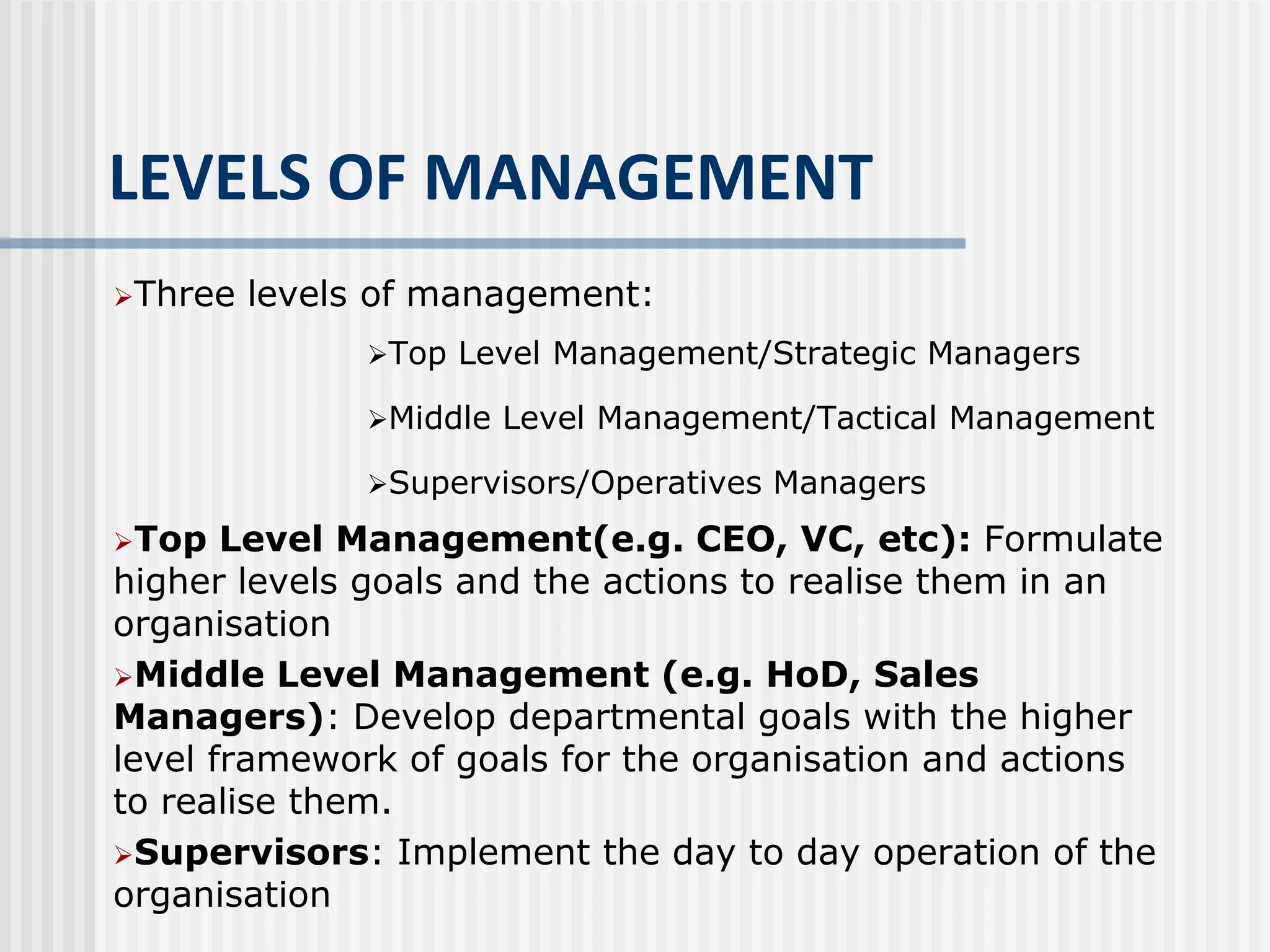
LEVELS OF MANAGEMENT
Threelevels of management:
Top Level Management/Strategic Managers
Middle Level Management/Tactical Management
Supervisors/Operatives Managers
Top Level Management(e.g. CEO, VC, etc): Formulate
higher levels goals and the actions to realise them in an
organisation
Middle Level Management (e.g. HoD, Sales
Managers): Develop departmental goals with the higher
level framework of goals for the organisation and actions
to realise them.
Supervisors: Implement the day to day operation of the
organisation
18.
PLANNING AND GOALS
Goals are statements of where an organisation
wants to be at a specified time in the future.
Without goals, an organisation is without
direction.
Goals are set as a first step in planning.
19.
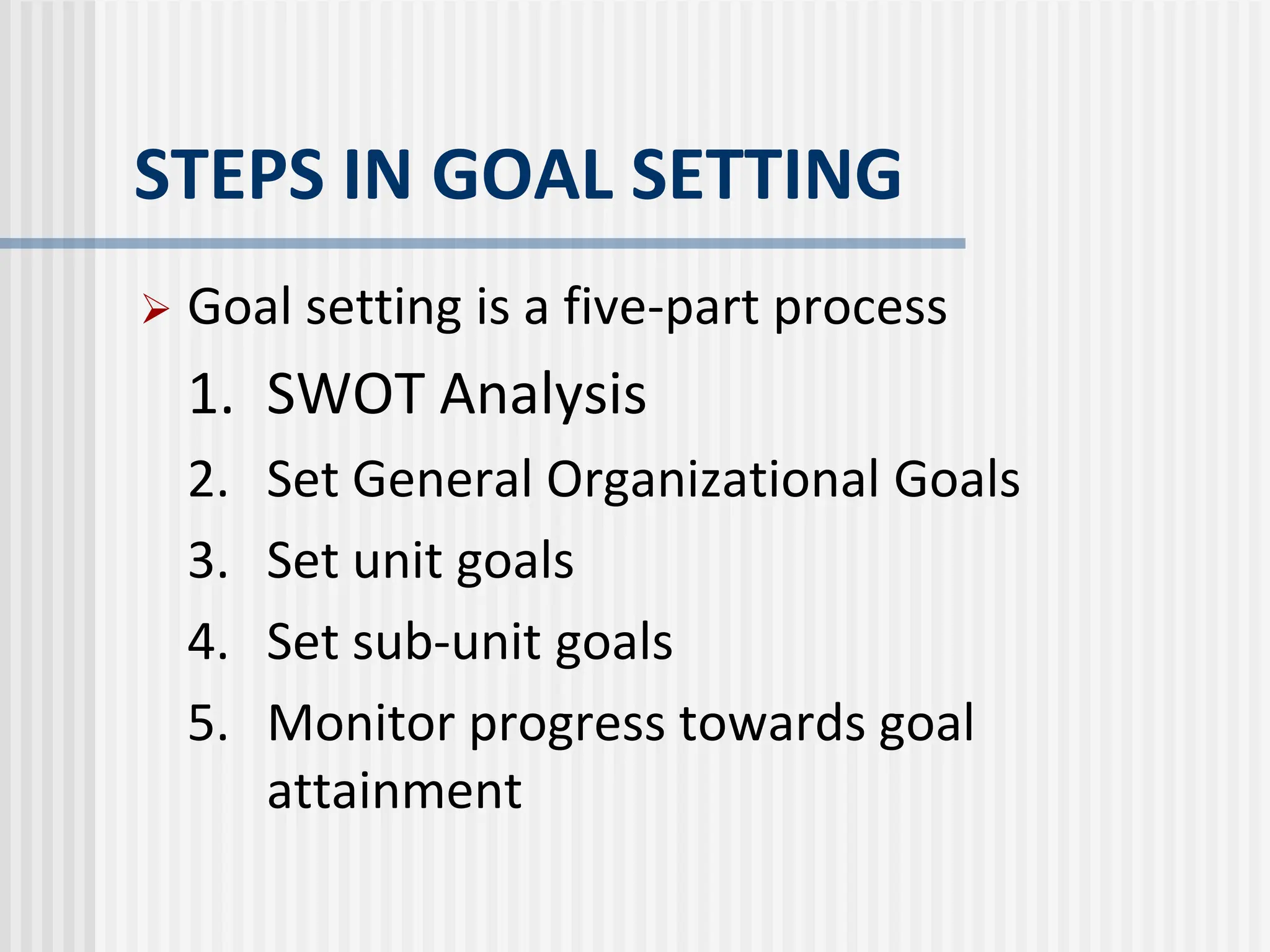
STEPS IN GOALSETTING
Goal setting is a five-part process
1. SWOT Analysis
2. Set General Organizational Goals
3. Set unit goals
4. Set sub-unit goals
5. Monitor progress towards goal
attainment
20.
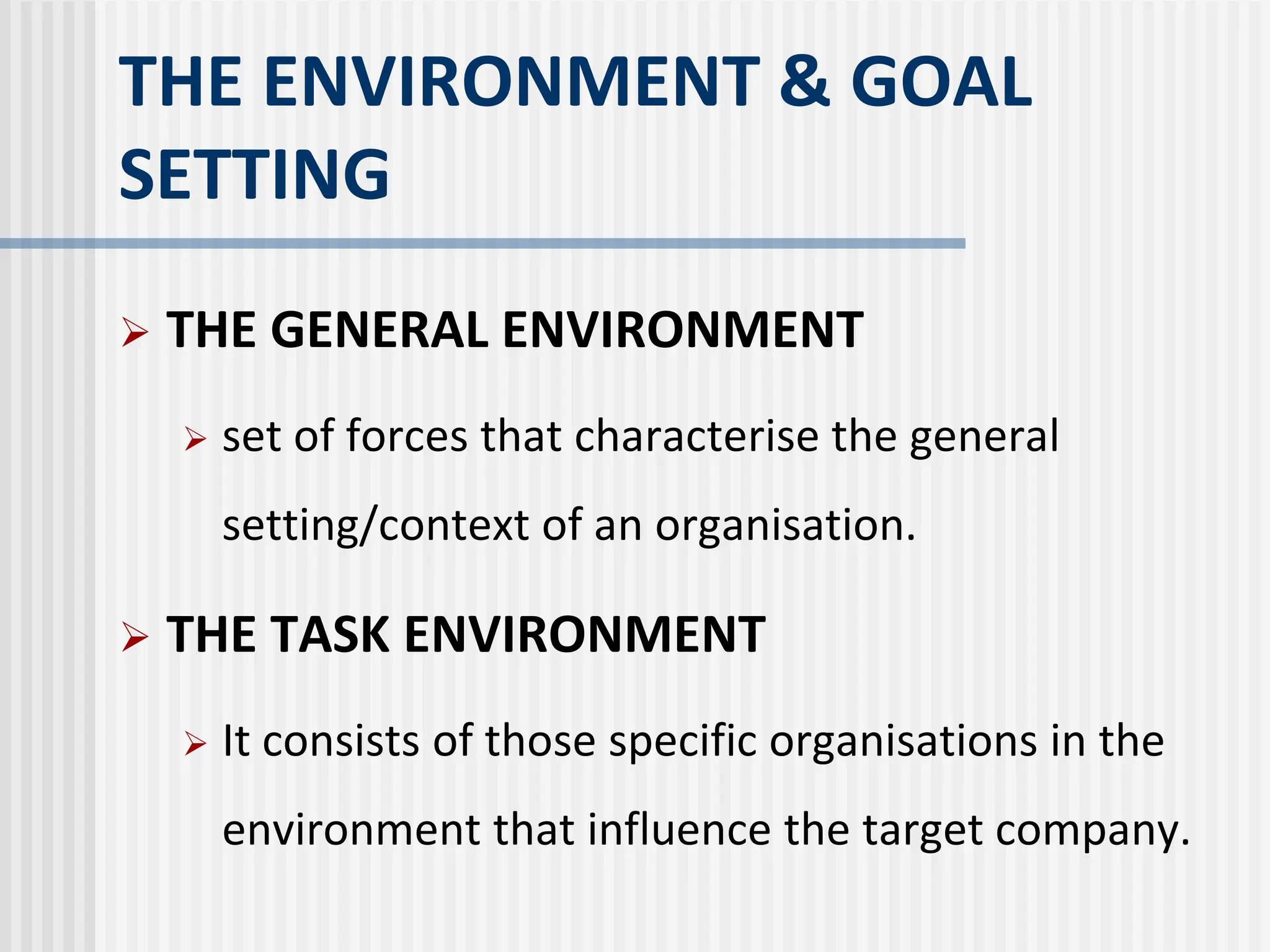
THE ENVIRONMENT &GOAL
SETTING
THE GENERAL ENVIRONMENT
set of forces that characterise the general
setting/context of an organisation.
THE TASK ENVIRONMENT
It consists of those specific organisations in the
environment that influence the target company.
21.
THE GENERAL ENVIRONMENT
Thegeneral environment consists of five
unique sets of forces:
1. Political-legal,
2. Economic,
3. International,
4. Socio-cultural and
5. Technological.
22.
THE TASK ENVIRONMENT
the task environment has five dimensions:
1. Customers,
2. Competitors,
3. Unions,
4. Regulators and,
5 Suppliers.
23.
MANAGING MULTIPLE GOALS
Organisation do not have a single goal.
Regardless of its size or diversity, any
organisation must pursue a variety of goals in
order to survive.
24.
KINDS OF GOALS
Goals can be differentiated by level,
Area or function,
Time frame and specificity.
How do managers deal with multiple goals?.
25.
GOAL OPTIMIZATION
Itis the process of balancing and trading off
between different goals for the sake of
organisational effectiveness.
The optimisation process allows the
organisation to pursue a unified vision and
helps managers maintain consistency in their
actions.