![3
How do you explain the map function?
map (x -> x + 10) [1, 2, 3]
-- [11, 12, 13]
The map function takes a function and a list, and returns a list of the
results of applying the function to all the elements of the list.
No one explain like this:
The map function takes a function and a list, and returns an empty list if
the argument list is empty. Otherwise, it returns a list whose head element
is the result of applying the function to the head element of the argument
list, and the tail part is the result of applying the map function recursively
to the tail part of the argument list.
However, the standard functional definition is similar to this explanation:
map f [] := []
map f (x :: xs) := f x :: map f xs](https://image.slidesharecdn.com/20210322programming-210409010927/85/Functional-Programming-in-Pattern-Match-Oriented-Programming-Style-Programming-2020-Research-Paper-3-320.jpg)
![The mapWithBothSides function
4
Let us consider a variation of map, mapWithBothSides.
mapWithBothSides (hs, x, ts -> (hs, x, ts)) [1, 2, 3]
-- [([], 1, [2, 3]),
([1], 2, [3])]),
([1, 2], 3, [])]
mapWithBothSides (hs, _, ts -> hs ++ ts) [1, 2, 3]
-- [[2, 3],
[1, 3],
[1, 2]]](https://image.slidesharecdn.com/20210322programming-210409010927/85/Functional-Programming-in-Pattern-Match-Oriented-Programming-Style-Programming-2020-Research-Paper-4-320.jpg)
![The mapWithBothSides function
5
Functional definition of mapWithBothSides:
mapWithBothSides f xs := helper f [] xs
where
helper f xs [] := []
helper f xs (y :: ys) := f xs y ys :: helper f (xs ++ [y]) ys
It is natural to use a helper function for defining mapWithBothSides.
Explanation of mapWithBothSides:
• takes a function of three arguments and a list, and
• returns a list of applying the function for all three-tuples consisting of an
initial prefix, the next element, and the remaining suffix.](https://image.slidesharecdn.com/20210322programming-210409010927/85/Functional-Programming-in-Pattern-Match-Oriented-Programming-Style-Programming-2020-Research-Paper-5-320.jpg)
![The gap between the explanation and definition
6
The explanations of map and mapWithBothSides are very similar, but the
definitions are very different.
map f [] := []
map f (x :: xs) := f x :: map f xs
mapWithBothSides f xs := helper f [] xs
where
helper f xs [] := []
helper f xs (y :: ys) := f xs y ys :: helper f (xs ++ [y]) ys
Can we fill this cognitive gap between the explanation and definition?](https://image.slidesharecdn.com/20210322programming-210409010927/85/Functional-Programming-in-Pattern-Match-Oriented-Programming-Style-Programming-2020-Research-Paper-6-320.jpg)
![Pattern matching fills the gap
7
User-extensible non-linear pattern matching with backtracking [Egi and
Nishiwaki, 2018] implemented in the Egison programming language can fill
the gap.
map f xs := matchAll xs as list something with
| _ ++ $x :: _ -> f x
mapWithBothSides f xs := matchAll xs as list something with
| $hs ++ $x :: $ts -> f hs x ts
The join pattern (++) splits a list to an initial prefix and the remaining suffix.
The cons pattern (::) decomposes a list to the initial element and the rest.
matchAll collects all
pattern-match results.
list something is a matcher and
specifies how to interpret the pattern.
$hs ++ $x :: $ts is a pattern that splits the target list into an initial prefix,
the next element, and the remaining suffix.](https://image.slidesharecdn.com/20210322programming-210409010927/85/Functional-Programming-in-Pattern-Match-Oriented-Programming-Style-Programming-2020-Research-Paper-7-320.jpg)
![Our approach: pattern-match-oriented programming (PMOP)
8
mapWithBothSides f xs = helper f [] xs
where
helper f xs [] := []
helper f xs (y : : ys) := (f xs y ys) :: (helper f (xs ++ [y]) ys)
mapWithBothSides f xs := matchAll xs as list something with
| $hs ++ $x :: $ts -> f hs x ts
• Our key insight: recursions can be confined in patterns.
• In this case, $hs ++ $x :: $ts confines helper.
• We call the programming style that confines explicit recursions in
patterns, pattern-match-oriented programming (PMOP).
• We aim to clarify what is PMOP by showing PMOP examples we found so
far.
Traditional FP
Our approach](https://image.slidesharecdn.com/20210322programming-210409010927/85/Functional-Programming-in-Pattern-Match-Oriented-Programming-Style-Programming-2020-Research-Paper-8-320.jpg)
![Our PMOP language (Egison)
11
We demonstrate PMOP with our language Egison.
Egison was originally designed for concise description of algorithms with
non-free data types such as multisets, graphs, mathematical expressions
[Egi and Nishiwaki, 2018].
Egison has achieved this mission by user-extensible non-linear pattern-
match facility with backtracking.
Free data types Non-free data types
Consed lists,
Syntax trees,
...etc.
Multisets, Sets, Graphs,
Mathematical
expressions,
...etc.](https://image.slidesharecdn.com/20210322programming-210409010927/85/Functional-Programming-in-Pattern-Match-Oriented-Programming-Style-Programming-2020-Research-Paper-11-320.jpg)
![The history of pattern matching
12
[Burstall, 1969]
Views
[Wadler, 1987]
Active patterns
[Erwig, 1996]
First class patterns
[Tullsen, 2000]
[Queinnec, 1990]
Egison
[Egi and Nishiwaki, 2018]
non-linear pattern,
multiple results
user-extensible pattern,
polymorphic pattern
user-extensible pattern
non-linear pattern
multiple results
multiple results,
polymorphic pattern
non-linear pattern,
polymorphic pattern
loop pattern, sequential pattern, ...](https://image.slidesharecdn.com/20210322programming-210409010927/85/Functional-Programming-in-Pattern-Match-Oriented-Programming-Style-Programming-2020-Research-Paper-12-320.jpg)
![Our PMOP language (Egison)
13
Let us see how these features are achieved in Egison:
1. Non-linear pattern matching with multiple results [Egi and Nishiwaki, 2018]
2. Ad-hoc polymorphism of patterns by matchers [Egi and Nishiwaki, 2018]
3. matchAll and matchAllDFS for controlling the order of pattern-match results
4. Builtin patterns](https://image.slidesharecdn.com/20210322programming-210409010927/85/Functional-Programming-in-Pattern-Match-Oriented-Programming-Style-Programming-2020-Research-Paper-13-320.jpg)
![Our PMOP language (Egison)
14
Let us see how these features are achieved in Egison:
1. Non-linear pattern matching with multiple results [Egi and Nishiwaki,
2018]
2. Ad-hoc polymorphism of patterns by matchers [Egi and Nishiwaki, 2018]
3. matchAll and matchAllDFS for controlling the order of pattern-match results
4. Builtin patterns](https://image.slidesharecdn.com/20210322programming-210409010927/85/Functional-Programming-in-Pattern-Match-Oriented-Programming-Style-Programming-2020-Research-Paper-14-320.jpg)
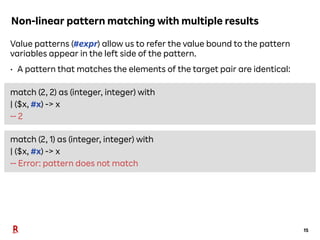
![Non-linear pattern matching with multiple results
16
The combination of matchAll and non-linear patterns is very powerful!
• Example: A pattern that matches twin primes in the infinite list of prime
numbers:
take 6 (matchAll primes as list integer with
| _ ++ $p :: #(p + 2) :: _ -> (p, p + 2))
-- [(3, 5), (5, 7), (11, 13), (17, 19), (29, 31), (41, 43)]](https://image.slidesharecdn.com/20210322programming-210409010927/85/Functional-Programming-in-Pattern-Match-Oriented-Programming-Style-Programming-2020-Research-Paper-16-320.jpg)
![Our PMOP language (Egison)
17
Let us see how these features are achieved in Egison:
1. Non-linear pattern matching with multiple results [Egi and Nishiwaki, 2018]
2.Ad-hoc polymorphism of patterns by matchers [Egi and Nishiwaki, 2018]
3. matchAll and matchAllDFS for controlling the order of pattern-match results
4. Builtin patterns](https://image.slidesharecdn.com/20210322programming-210409010927/85/Functional-Programming-in-Pattern-Match-Oriented-Programming-Style-Programming-2020-Research-Paper-17-320.jpg)
![Ad-hoc polymorphism of patterns by matchers
18
The cons pattern (::) behaves differently for each matcher:
matchAll [1, 2, 3] as list integer with
| $x :: $xs -> (x, xs)
-- [(1, [2, 3])]
matchAll [1, 2, 3] as multiset integer with
| $x :: $xs -> (x, xs)
-- [(1, [2, 3]), (2, [1, 3]), (3, [1, 2])]
matchAll [1, 2, 3] as set integer with
| $x :: $xs -> (x, xs)
-- [(1, [1, 2, 3]), (2, [1, 2, 3]), (3, [1, 2, 3])]](https://image.slidesharecdn.com/20210322programming-210409010927/85/Functional-Programming-in-Pattern-Match-Oriented-Programming-Style-Programming-2020-Research-Paper-18-320.jpg)
![Ad-hoc polymorphism of patterns by matchers
19
The value pattern is also polymorphic:
matchAll [1, 2, 3] as list integer with
| #[2, 1, 3] -> "Matched"
-- []
matchAll [1, 2, 3] as multiset integer with
| #[2, 1, 3] -> "Matched"
-- ["Matched"]](https://image.slidesharecdn.com/20210322programming-210409010927/85/Functional-Programming-in-Pattern-Match-Oriented-Programming-Style-Programming-2020-Research-Paper-19-320.jpg)
![Our PMOP language (Egison)
20
Let us see how these features are achieved in Egison:
1. Non-linear pattern matching with multiple results [Egi and Nishiwaki, 2018]
2. Ad-hoc polymorphism of patterns by matchers [Egi and Nishiwaki, 2018]
3. matchAll and matchAllDFS for controlling the order of patter-match
results
4. Builtin patterns](https://image.slidesharecdn.com/20210322programming-210409010927/85/Functional-Programming-in-Pattern-Match-Oriented-Programming-Style-Programming-2020-Research-Paper-20-320.jpg)
![matchAll and matchAllDFS control the order of pattern-match results
21
matchAll traverses the search tree in the breadth-first order:
take 6 (matchAll [1..] as set something with
| $x :: $y :: _ -> (x, y))
-- [(1, 1), (1, 2), (2, 1), (1, 3), (2, 2), (3, 1)]
matchAllDFS traverses the search tree in the depth-first order:
take 6 (matchAllDFS [1..] as set something with
| $x :: $y :: _ -> (x, y))
-- [(1, 1), (1, 2), (1, 3), (1, 4), (1, 5), (1, 6)]](https://image.slidesharecdn.com/20210322programming-210409010927/85/Functional-Programming-in-Pattern-Match-Oriented-Programming-Style-Programming-2020-Research-Paper-21-320.jpg)
![matchAll enumerates infinitely many results
22
matchAll enumerates infinitely many pattern-match results:
take 6 (matchAll primes as list integer with
| _ ++ $p :: _ ++ #(p + 6) :: _ -> (p, p + 6))
-- [(5, 11), (7, 13), (11, 17), (13, 19), (17, 23), (23, 29)]
matchAllDFS sometimes cannot enumerate all the results:
take 6 (matchAllDFS primes as list integer with
| _ ++ $p :: _ ++ #(p + 6) :: _ -> (p, p + 6))
-- infinite loop](https://image.slidesharecdn.com/20210322programming-210409010927/85/Functional-Programming-in-Pattern-Match-Oriented-Programming-Style-Programming-2020-Research-Paper-22-320.jpg)
![Our PMOP language (Egison)
23
Let us see how these features are achieved in Egison:
1. Non-linear pattern matching with multiple results [Egi and Nishiwaki, 2018]
2. Ad-hoc polymorphism of patterns by matchers [Egi and Nishiwaki, 2018]
3. matchAll and matchAllDFS for controlling the order of pattern-match results
4.Builtin patterns](https://image.slidesharecdn.com/20210322programming-210409010927/85/Functional-Programming-in-Pattern-Match-Oriented-Programming-Style-Programming-2020-Research-Paper-23-320.jpg)
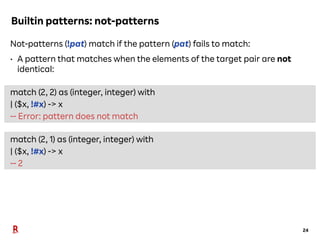
![Our language supports pattern variables with indices:
matchAllDFS [1, 2, 3] as set something with
| $x_1 :: $x_2 :: _ -> [x_1, x_2]
-- [[1, 1], [1, 2], [1, 3], [2, 1], [2, 2], [2, 3], [3, 1], [3, 2], [3, 3]]
The above pattern can be generalized using loop patterns:
matchAllDFS [1, 2, 3] as set something with
| loop $i
(1, n)
($x_i :: ...)
_
-> map (i -> x_i) [1..n]
Builtin patterns: loop patterns for representing repetitions
25
-- index variable
-- index range
-- repeated pattern
-- final pattern
... in a repeated pattern is
expanded to the repeated
pattern or final pattern
incrementing the index.
$x1 :: $x2 :: ... :: $xn :: _
$x1 :: $x2 :: _](https://image.slidesharecdn.com/20210322programming-210409010927/85/Functional-Programming-in-Pattern-Match-Oriented-Programming-Style-Programming-2020-Research-Paper-25-320.jpg)
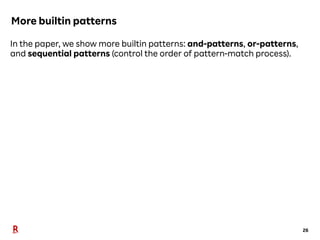
![Join-cons patterns for lists
30
map f xs := matchAll xs as list something with
| _ ++ $x :: _ -> f x
elem x xs := match xs as list eq with
| _ ++ $x :: _ -> True
| _ -> False
elem 2 [1, 2, 3] -- True
elem 4 [1, 2, 3] -- False
delete x xs := match xs as list eq with
| $hs ++ $x :: $ts -> hs ++ ts
| _ -> xs
delete 2 [1, 2, 3] -- [1, 3]
delete 4 [1, 2, 3] -- [1, 2, 3]](https://image.slidesharecdn.com/20210322programming-210409010927/85/Functional-Programming-in-Pattern-Match-Oriented-Programming-Style-Programming-2020-Research-Paper-30-320.jpg)
![Nested join-cons patterns for lists
31
concat xss := matchAllDFS xss as list (list something) with
| (_ ++ (_ ++ $x :: _) :: _) -> x
concat [[1, 2], [3], [], [4, 5]] -- [1, 2, 3, 4, 5]
unique xs := matchAllDFS xs as list eq with
-- The pattern says "x does not appear after $x".
| _ ++ $x :: !(_ ++ #x :: _) -> x
unique [1, 2, 3, 2, 4]
-- [1, 3, 2, 4] ($x matches the last appearance of an element)](https://image.slidesharecdn.com/20210322programming-210409010927/85/Functional-Programming-in-Pattern-Match-Oriented-Programming-Style-Programming-2020-Research-Paper-31-320.jpg)
![Cons patterns for multisets
33
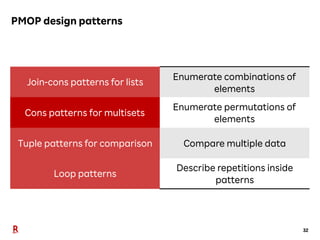
• Join-cons patterns enumerate combinations of elements:
matchAllDFS [1, 2, 3] as list something with
| _ ++ $x :: _ ++ $y:: _ -> (x, y)
-- [(1, 2), (1, 3), (2, 3)]
• Cons patterns for multisets enumerate permutations of elements:
matchAllDFS [1, 2, 3] as multiset something with
| $x :: $y:: _ -> (x, y)
-- [(1, 2), (1, 3), (2, 1), (2, 3), (3, 1), (3, 2)]
Cons patterns for multisets are often used for describing mathematical
algorithms.
We show an example in Part 4.](https://image.slidesharecdn.com/20210322programming-210409010927/85/Functional-Programming-in-Pattern-Match-Oriented-Programming-Style-Programming-2020-Research-Paper-33-320.jpg)
![Tuple patterns for comparing multiple data
35
intersect xs ys := matchAll (xs, ys) as (set eq, set eq) with
| ($x :: _, #x :: _) -> x
intersect [1, 2, 3, 4] [2, 4, 5] -- [2, 4]
difference xs ys := matchAll (xs, ys) as (set eq, set eq) with
| ($x :: _, !(#x :: _)) -> x
difference [1, 2, 3, 4] [2, 4, 5] -- [1, 3]
$x matches with a element that
appears in both lists.
$x matches with a element that
appears in xs, but not in ys.](https://image.slidesharecdn.com/20210322programming-210409010927/85/Functional-Programming-in-Pattern-Match-Oriented-Programming-Style-Programming-2020-Research-Paper-35-320.jpg)
![Builtin patterns: indexed variables and loop patterns
37
Loop patterns are often used for pattern matching graphs and trees.
A pattern that enumerates all routes from Porto that visit all cities exactly
once and return to Porto:
trips :=
let n := length graphData in
matchAll graphData as graph with
| (#"Porto", (($s_1,$p_1) : _)) ::
loop $i (2, n - 1)
((#s_(i - 1), ($s_i, $p_i) :: _) :: ...)
((#s_(n - 1), (#"Porto" & $s_n, $p_n) :: _) :: [])
-> sum (map (i -> p_i) [1..n]), map (i -> s_i) [1..n]](https://image.slidesharecdn.com/20210322programming-210409010927/85/Functional-Programming-in-Pattern-Match-Oriented-Programming-Style-Programming-2020-Research-Paper-37-320.jpg)
![SAT solver
40
A SAT solver determines whether a given propositional logic formula has
an assignment for which the formula evaluates to true.
Input formulae for SAT solvers are often in conjunctive normal form.
For example, (p ∨ q) ∧ (¬p ∨ r) ∧ (¬p ∨ ¬r) has a solution; p = false, q = true,
and r = true.
We often encode literals (e.g., p, ¬p) with integers (e.g., 1, -1).
In PMOP, we can treat a formula as a multiset of multisets of integers.
(p ∨ q) ∧ (¬p ∨ r) ∧ (¬p ∨ ¬r) [[1, 2], [-1, 3], [-1, -3]]
We see PMOP in action by showing an implementation of a SAT solver.](https://image.slidesharecdn.com/20210322programming-210409010927/85/Functional-Programming-in-Pattern-Match-Oriented-Programming-Style-Programming-2020-Research-Paper-40-320.jpg)
![let rec dp clauses =
if clauses = [] then true else if mem [] clauses then false else
try dp (one_literal_rule clauses) with Failure _ ->
try dp (pure_literal_rule clauses) with Failure _ ->
dp(resolution_rule clauses);;
let one_literal_rule clauses =
let u = hd (find (fun cl -> length cl = 1) clauses) in
assignTrue u clauses;;
let pure_literal_rule clauses =
let us = unions clauses in
let u = hd (find (u -> mem (negate u) us) us) in
assignTrue u clauses;;
The code is taken from [Harrison, 2009] and modified.
Davis-Putnum algorithm in traditional FP
42](https://image.slidesharecdn.com/20210322programming-210409010927/85/Functional-Programming-in-Pattern-Match-Oriented-Programming-Style-Programming-2020-Research-Paper-42-320.jpg)
![Davis-Putnum algorithm in PMOP
43
dp cnf :=
matchDFS cnf as multiset (multiset integer) with
| [] -> True
| [] :: _ -> False
-- one-literal rule
| ($x :: []) :: _ -> dp (assignTrue x cnf)
-- pure literal rule
| ($x :: _) :: !((#(negate x) :: _) :: _) -> dp (assignTrue x cnf)
-- otherwise
| _ -> dp (resolution cnf)](https://image.slidesharecdn.com/20210322programming-210409010927/85/Functional-Programming-in-Pattern-Match-Oriented-Programming-Style-Programming-2020-Research-Paper-43-320.jpg)
![dp cnf :=
matchDFS cnf as multiset (multiset integer) with
| [] -> True
| [] :: _ -> False
-- one-literal rule
| ($x :: []) :: _ -> dp (assignTrue x cnf)
-- pure literal rule
| ($x :: _) :: !((#(negate x) :: _) :: _) -> dp (assignTrue x cnf)
-- otherwise
| _ -> dp (resolution cnf)
Davis-Putnum algorithm in PMOP
44
We match a formula (cnf) as a multiset of
multisets of integers.](https://image.slidesharecdn.com/20210322programming-210409010927/85/Functional-Programming-in-Pattern-Match-Oriented-Programming-Style-Programming-2020-Research-Paper-44-320.jpg)
![dp cnf :=
matchDFS cnf as multiset (multiset integer) with
| [] -> True
| [] :: _ -> False
-- one-literal rule
| ($x :: []) :: _ -> dp (assignTrue x cnf)
-- pure literal rule
| ($x :: _) :: !((#(negate x) :: _) :: _) -> dp (assignTrue x cnf)
-- otherwise
| _ -> dp (resolution cnf)
Davis-Putnum algorithm in PMOP
45
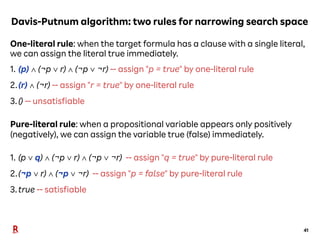
This pattern matches when cnf has a clause with a single
literal (e. g., (p) ∧ (¬p ∨ r) ∧ (¬p ∨ ¬r)).](https://image.slidesharecdn.com/20210322programming-210409010927/85/Functional-Programming-in-Pattern-Match-Oriented-Programming-Style-Programming-2020-Research-Paper-45-320.jpg)
![dp cnf :=
matchDFS cnf as multiset (multiset integer) with
| [] -> True
| [] :: _ -> False
-- one-literal rule
| ($x :: []) :: _ -> dp (assignTrue x cnf)
-- pure literal rule
| ($x :: _) :: !((#(negate x) :: _) :: _) -> dp (assignTrue x cnf)
-- otherwise
| _ -> dp (resolution cnf)
Davis-Putnum algorithm in PMOP
46
This pattern says that "the negation of literal x does not
appears in cnf" (e. g., q in (p ∨ q) ∧ (¬p ∨ r) ∧ (¬p ∨ ¬r)).](https://image.slidesharecdn.com/20210322programming-210409010927/85/Functional-Programming-in-Pattern-Match-Oriented-Programming-Style-Programming-2020-Research-Paper-46-320.jpg)
![let rec dp clauses =
if clauses = [] then true else if mem [] clauses then false else
try dp (one_literal_rule clauses) with Failure _ ->
try dp (pure_literal_rule clauses) with Failure _ ->
dp(resolution_rule clauses);;
let one_literal_rule clauses =
let u = hd (find (fun cl -> length cl = 1) clauses) in
assignTrue u clauses;;
let pure_literal_rule clauses =
let us = unions clauses in
let u = hd (find (u -> mem (negate u) us) us) in
assignTrue u clauses;;
The code is taken from [Harrison, 2009] and modified.
Davis-Putnum algorithm in traditional FP
47
PMOP confines these parts in patterns.](https://image.slidesharecdn.com/20210322programming-210409010927/85/Functional-Programming-in-Pattern-Match-Oriented-Programming-Style-Programming-2020-Research-Paper-47-320.jpg)
![dp cnf :=
matchDFS cnf as multiset (multiset integer) with
| [] -> True
| [] :: _ -> False
-- one-literal rule
| ($x :: []) :: _ -> dp (assignTrue x cnf)
-- pure literal rule
| ($x :: _) :: !((#(negate x) :: _) :: _) -> dp (assignTrue x cnf)
-- otherwise
| _ -> dp (resolution cnf)
Davis-Putnum algorithm in PMOP
48](https://image.slidesharecdn.com/20210322programming-210409010927/85/Functional-Programming-in-Pattern-Match-Oriented-Programming-Style-Programming-2020-Research-Paper-48-320.jpg)
![dp is the only recursive function in PMOP
49
dp cnf :=
matchDFS cnf as multiset (multiset integer) with
| [] -> True
| [] :: _ -> False
-- one-literal rule
| ($x :: []) :: _ -> dp (assignTrue x cnf)
-- pure literal rule
| ($x :: _) :: !((#(negate x) :: _) :: _) -> dp (assignTrue x cnf)
-- otherwise
| _ -> dp (resolution cnf)](https://image.slidesharecdn.com/20210322programming-210409010927/85/Functional-Programming-in-Pattern-Match-Oriented-Programming-Style-Programming-2020-Research-Paper-49-320.jpg)


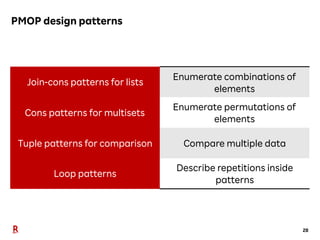
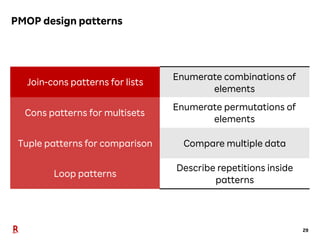
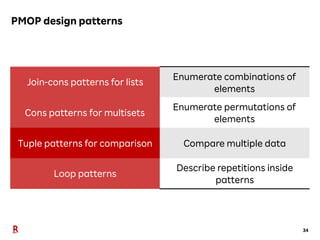
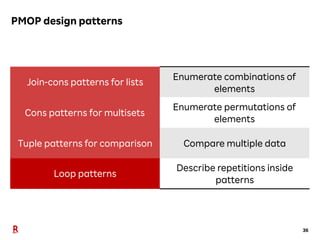
The document discusses pattern-match-oriented programming (PMOP) using the Egison programming language. PMOP aims to clarify programming with patterns by showing examples that confine explicit recursions in patterns. The key features of Egison that enable PMOP include non-linear pattern matching with multiple results, polymorphic patterns via matchers, and built-in patterns like loop patterns. The document presents several PMOP design patterns like join-cons patterns for lists, cons patterns for multisets, and tuple patterns for comparing multiple data. Examples demonstrate using patterns to define functions like map, intersection, and difference.


![[Rakuten TechConf2014] [D-2] The Pattern-Matching-Oriented Programming Langua...](https://cdn.slidesharecdn.com/ss_thumbnails/d2egisontechconf-141105041652-conversion-gate01-thumbnail.jpg?width=640&height=640&fit=bounds)


