mathcity.org
Merging man and maths
Exercise 1.1
Calculus and Analytic Geometry, MATHEMATICS 12
Available online @ http://www.mathcity.org, Version: 2.0.0
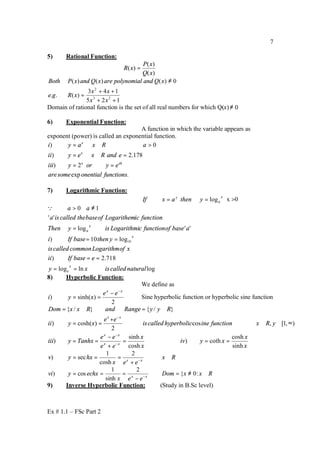
Function and Limits
Concept of Functions:
Historically, the term function was first used by German
mathematician Leibnitz (1646-1716) in 1673 to denote the dependence of one quantity on
another e.g.
1) The area “A” of a square of side “x” is given by the formula A=x2
.
As area depends on its side x, so we say that A is a function of x.
2) The area “A” of a circular disc of radius “r” is given by the formula
A=π r2
As area depends on its radius r, so we say that A is a function of r.
3) The volume “V” of a sphere of radius “r” is given by the formula
V= 3
3
4
rπ . As volume V of a sphere depends on its radius r, so we say that
V is a function of r.
The Swiss mathematician, Leonard Euler conceived the idea of denoting function
written as y=f(x) and read as y is equal to f of x. f(x) is called the value of f at x or image
of x under f .
The variable x is called independent variable and the variable y is called
dependent variable of f.
If x and y are real numbers then f is called real valued function of real numbers.
Domain of the function:
If the independent variable of a function is restricted to lie
in some set, then this set is called the domain of the function e.g.
Dom of f = {0 ≤ x≤ 5}
Range of the function:
The set of all possible values of f(x) as x varies over the
domain of f is called the range of f e.g. y = 100 – 4x2
.
As x varies over the domain [0,5] the values of y = 100 – 4x2
vary between y=0 (when
x=5) and y = 100 (when x=0)
Range of f = {0 ≤ y ≤ 100}
Definition:
A function is a rule by which we relate two sets A and B (say) in such a
way that each element of A is assigned with one and only one element of B. For example
is a function from A to B.
x
x
x
x
r
Ex # 1.1 – FSc Part 2
2
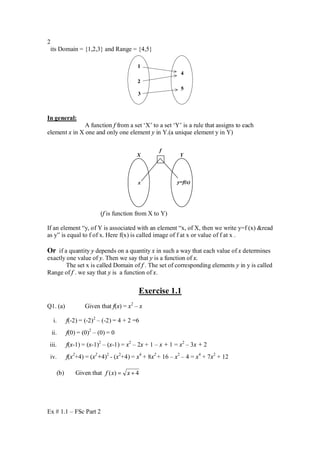
its Domain = {1,2,3} and Range = {4,5}
1
2
3
4
5
In general:
A function f from a set ‘X’ to a set ‘Y’ is a rule that assigns to each
element x in X one and only one element y in Y.(a unique element y in Y)
x y=f(x)
f
X Y
(f is function from X to Y)
If an element “y, of Y is associated with an element “x, of X, then we write y=f (x) &read
as y” is equal to f of x. Here f(x) is called image of f at x or value of f at x .
Or if a quantity y depends on a quantity x in such a way that each value of x determines
exactly one value of y. Then we say that y is a function of x.
The set x is called Domain of f . The set of corresponding elements y in y is called
Range of f . we say that y is a function of x.
Exercise 1.1
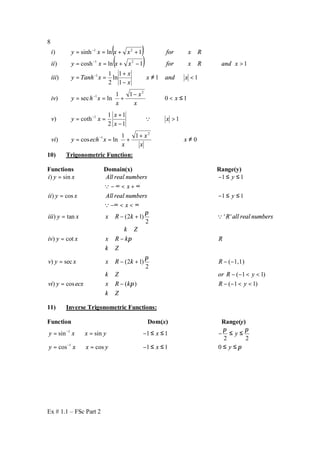
Q1. (a) Given that f(x) = x2
– x
i. f(-2) = (-2)2
– (-2) = 4 + 2 =6
ii. f(0) = (0)2
– (0) = 0
iii. f(x-1) = (x-1)2
– (x-1) = x2
– 2x + 1 – x + 1 = x2
– 3x + 2
iv. f(x2
+4) = (x2
+4)2
- (x2
+4) = x4
+ 8x2
+ 16 – x2
– 4 = x4
+ 7x2
+ 12
(b) Given that 4)( += xxf
Ex # 1.1 – FSc Part 2
3
2 2 2
) ( 2) 2 4 2
) (0) 0 4 4 2
) ( 1) 1 4 3
) ( 4) 4 4 8
i f
ii f
iii f x x x
iv f x x x
− = − + =
= + = =
− = − + = +
+ = + + = +
( )
2.
) ( ) 6 9
( ) 6( ) 9 6 6 9
( ) 6 9
( ) ( ) (6 6 9) (6 9)
6 6 9 6 9 6
6
) ( ) sin
sin sin 2cos sin
2 2
( ) sin( ) sin
( ) (
Q Giventhat
i f x x
f a h a h a h
f a a
f a h f a a h a
Now
h h
a h a h
h h
ii f x x given
f a h a h and f a a
f a h f
Now
θ ϕ θ ϕ
θ ϕ
= −
+ = + − = + −
= −
+ − + − − −
=
+ − − +
= = =
=
+ +   
− =    
   
+ = + =
+ −
Q
) sin( ) sina a h a
h h
+ −
=
[ ]
1
sin( ) sin
1 1 2
2cos sin 2cos sin
2 2 2 2
1 2 2
2cos sin cos sin
2 2 2 2 2
a h a
h
a h a a h a a h h
h h
a h h h h
a
h h
= + −
 + + + −   +        
= =          
          
        
= + = +        
        
Ex # 1.1 – FSc Part 2
4
3 2
3 2 3 3 2 2
3 3 2 2 2 2
3 2
3 3 2 2 2 2 3 2
3 3 2 2 2
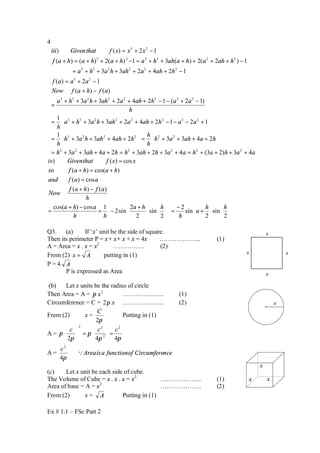
) ( ) 2 1
( ) ( ) 2( ) 1 3 ( ) 2( 2 ) 1
3 3 2 4 2 1
( ) 2 1
( ) ( )
3 3 2 4 2 1 ( 2 1)
1
3 3 2
iii Giventhat f x x x
f a h a h a h a h ah a h a ah h
a h a h ah a ah h
f a a a
Now f a h f a
a h a h ah a ah h a a
h
a h a h ah a
h
= + −
+ = + + + − = + + + + + + −
= + + + + + + −
= + −
+ −
+ + + + + + − − + −
=
= + + + + 2 3 2
3 2 2 2 2 2
2 2 2 2 2 2
4 2 1 2 1
1
3 3 4 2 3 3 4 2
3 3 4 2 3 2 3 4 (3 2) 3 4
ah h a a
h
h a h ah ah h h a ah a h
h h
h a ah a h h ah h a a h a h a a
 + + − − − + 
   = + + + + = + + + +   
= + + + + = + + + + = + + + +












+
−
=
















 +
−=
−+
=
−+
=
+=+
=
2
sin
2
sin
2
2
sin
2
2
sin2
1cos)cos(
)()(
cos)(
)cos()(
cos)()
hh
a
h
hha
hh
aha
h
afhaf
Now
aafand
hahafso
xxfthatGiveniv
Q3. (a) If ‘x’ unit be the side of square.
Then its perimeter P = x+ x+ x + x = 4x ……………….. (1)
A = Area = x . x = x2
…………… (2)
From (2) Ax = putting in (1)
P = 4 A
∴ P is expressed as Area
(b) Let x units be the radius of circle
Then Area = A = 2
xπ ……………….. (1)
Circumference = C = xπ2 ……………….. (2)
From (2) x =
π2
C
Putting in (1)
A =
ππ
π
π
π
442
2
2
22
ccc
=





=





A = nceCircumfereoffunctionaisArea
c
Q
π4
2
(c) Let x unit be each side of cube.
The Volume of Cube = x . x . x = x3
……………….. (1)
Area of base = A = x2
……………….. (2)
From (2) x = A Putting in (1)
x
x
x
x
x
x x
x
Ex # 1.1 – FSc Part 2
5
V = ( ) 2
33
)(AA =
1)(.5 23
++−= bxaxxxfQ
( )
2)2(2
063
0
062
)2()1(
1.................026
2
)2(.................002412
03249
01131248
01)1()1()1(31)2()2()2(
0)1(3)2(
2323
−=⇒−=⇒=
=−
=+
=−−
=−+−
−
=+=+−
=−−−=+−
=+−−−−=++−
=+−+−−−−=++−
=−−=
babanda
a
ba
ba
andSolving
ba
byDividing
baba
baba
baba
aba
fandfIf
m
h
xa
xxhQ
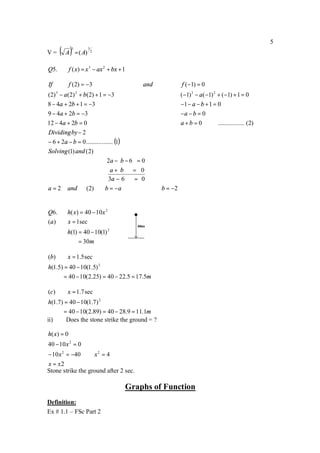
30
)1(1040)1(
sec1)(
1040)(.6
2
2
=
−=
=
−=
m
h
xb
5.175.2240)25.2(1040
)5.1(1040)5.1(
sec5.1)(
2
=−=−=
−=
=
m
h
xc
1.119.2840)89.2(1040
)7.1(1040)7.1(
sec7.1)(
2
=−=−=
−=
=
ii) Does the stone strike the ground = ?
2
44010
01040
0)(
22
2
±=
=⇒−=−
=−
=
x
xx
x
xh
Stone strike the ground after 2 sec.
Graphs of Function
Definition:
Ex # 1.1 – FSc Part 2
6
The graph of a function f is the graph of the equation y = f(x). It consists
of the points in the Cartesian plane chose co-ordinates (x , y) are input - output pairs for f
.
Note that not every curve we draw in the graph of a function. A function f can have only
one value f(x) for each x in its domain.
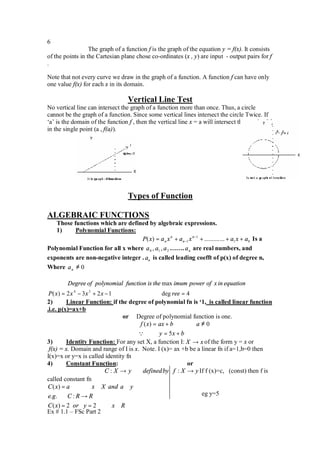
Vertical Line Test
No vertical line can intersect the graph of a function more than once. Thus, a circle
cannot be the graph of a function. Since some vertical lines intersect the circle Twice. If
‘a’ is the domain of the function f , then the vertical line x = a will intersect the graph of f
in the single point (a , f(a)).
Types of Function
ALGEBRAIC FUNCTIONS
Those functions which are defined by algebraic expressions.
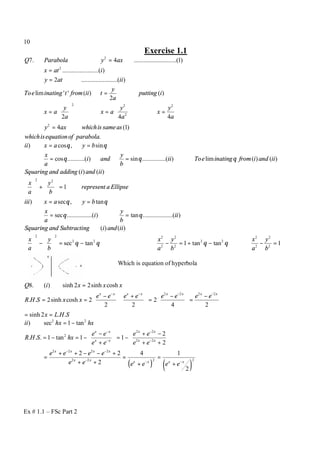
1) Polynomial Functions:
01
1
1 .............)( axaxaxaxP n
n
n
n ++++= −
− Is a
Polynomial Function for all x where 210 ,, aaa ……. na are real numbers, and
exponents are non-negative integer . na is called leading coefft of p(x) of degree n,
Where 0≠na
4deg1232)(
max
34
=−+−=
⇒
reexxxxP
equationinxofpowerimumtheisfunctionpolynomialofDegree
2) Linear Function: if the degree of polynomial fn is ‘1, is called linear function
.i.e. p(x)=ax+b
or⇒ Degree of polynomial function is one.
bxy
abaxxf
+=
≠+=
5
0)(
Q
3) Identity Function: For any set X, a function I: xX → of the form y = x or
f(x) = x. Domain and range of I is x. Note. I (x)= ax +b be a linear fn if a=1,b=0 then
I(x)=x or y=x is called identity fn
4) Constant Function: or
bydefinedyXC →: yXf →: If f (x)=c, (const) then f is
called constant fn
eg y=5
RxyorxC
RRCge
yaandXxaxC
∈∀==
→
∈∈∀=
22)(
:..
)(
Ex # 1.1 – FSc Part 2
7
5) Rational Function:
)(
)(
)(
xQ
xP
xR =
125
143
)(..
0)()()(
23
2
++
++
=
≠
xx
xx
xRge
xQandpolynomialarexQandxPBoth
Domain of rational function is the set of all real numbers for which Q(x) 0≠
6) Exponential Function:
A function in which the variable appears as
exponent (power) is called an exponential function.
) 0
) 2.178
) 2
exp .
x
x
x xh
i y a x R a
ii y e x R and e
iii y or y e
aresome onential functions
= ∴ ∈ >
= ∴ ∈ =
= =
7) Logarithmic Function:
x
a
y
ythenaxIf log== x >0
loglnlog
718.2)
log10)
''log
''
10
10
naturalcalledisxy
ebaseIfii
xofLogarithmcommoncalledis
ythenbaseIfi
abaseoffunctioncLogarithmiisyThen
functionicLogarithemofbasethecalledisa
aa
x
e
x
x
a
==
==
==
=
≠>Q
8) Hyperbolic Function:
We define as
2
)sinh()
xx
ee
xyi
−
−
== Sine hyperbolic function or hyperbolic sine function
x
x
xyiv
x
x
ee
ee
Tanhxyiii
yRxfunctioninehyperboliccalledis
ee
xyii
RyyRangeandRxxDom
xx
xx
xx
sinh
cosh
coth)
cosh
sinh
)
),1[,cos
2
)cosh()
}/{}/{
===
+
−
==
∞∈∈⇒
+
==
∈=∈=
−
−
−
Rx
eex
hxyv xx
∈
+
=== −
2
cosh
1
sec)
RxxDom
eex
echxyvi xx
∈≠=
−
=== −
:0{
2
sinh
1
cos)
9) Inverse Hyperbolic Function: (Study in B.Sc level)
Ex # 1.1 – FSc Part 2
8
( )
( )
0
11
lncos)
1
1
1
2
1
coth)
10
11
lnsec)
11
1
1
ln
2
1
)
11lncosh)
1lnsinh)
2
1
1
2
1
1
21
21
≠







 +
+==
>
−
+
==
≤<







 −
+==
<≠
−
+
==
>∈∀−+==
∈∀++==
−
−
−
−
−
−
x
x
x
x
xechyvi
x
x
x
xyv
x
x
x
x
xhyiv
xandx
x
x
xTanhyiii
xandRxforxxxyii
Rxforxxxyi
Q
10) Trigonometric Function:
Functions Domain(x) Range(y)
) sin 1 1
) cos 1 1
i y x All real numbers y
x
ii y x All real numbers y
x
= − ≤ ≤
− ∞ < + ∞
= − ≤ ≤
−∞ < < ∞
Q
Q
) tan (2 1) ' '
2
) cot
) sec (2 1) ( 1,1)
2
( 1 1)
) cos ( ) ( 1 1)
iii y x x R k R all real numbers
k Z
iv y x x R k R
k Z
v y x x R k R
k Z or R y
vi y ecx x R k R y
k Z
π
π
π
π
= ∈ − +
∈
= ∈ −
∈
= ∈ − + − −
∈ − − < <
= ∈ − − − < <
∈
Q
11) Inverse Trigonometric Functions:
Function Dom(x) Range(y)
π
ππ
≤≤≤≤−=⇔=
≤≤−≤≤−=⇔=
−
−
yxyxxy
yxyxxy
011coscos
22
11sinsin
1
1
Ex # 1.1 – FSc Part 2
9
{ }
π
ππ
π
π
ππ
<<∈=⇔=
−



−∈−−∈=⇔=






−∈−−∈=⇔=
∞<<∞−
≤≤−∈=⇔=
−
−
−
−
yRxyxxCoty
yRxecyxxCoy
yRxyxxSecy
xor
yRxTanyxxTany
0cot
0
2
,
2
)1,1(cossec
2
],0[)1,1(sec
22
1
1
1
1
12) Explicit Function:
If y is easily expressed in terms of x, then y is called an
explicit function of x.
.1..)( 3
etcxxygexfy ++==⇒
13) Implicit Function:
If x and y are so mixed up and y cannot be expressed in
term of the independent variable x, Then y is called an implicit function of x. It can be
written as. f(x , y) = 0
e.g. x2
+ xy + y2
= 2 etc.
14) Parametric Function:
For a function y =f (x) if both x& y are expressed in
another variable say ‘t’ or θ which is called a parameter of the given curve.
Such as:
i) x = at2
Parametric parabola
y = 2at
y2
= 4 a
) sec
tan
vi x a Parametricequationof hyperbola
y b
θ
θ
=
=
12
2
2
2
=−
b
y
a
x
2 2 2
) cos
sin
ii x a t Parametricequationof circle
y a t
x y a
=
=
+ =
2 2
2 2
) cos
sin
1
iii x a Parametricequationof Ellipse
y b
x y
a b
θ
θ
=
=
+ =
Ex # 1.1 – FSc Part 2
10
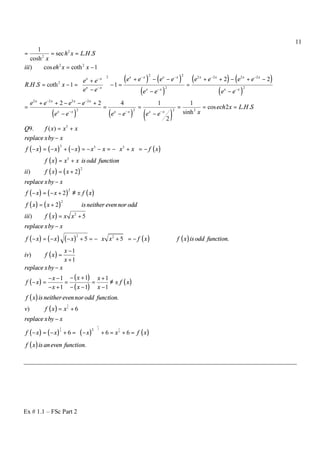
Exercise 1.1
2
2
2 2 2
2
2
7. 4 ...........................(1)
.......................( )
2 .......................( )
lim ' ' ( ) ( )
2
2 44
4
Q Parabola y ax
x at i
y at ii
y
Toe inating t from ii t putting i
a
y y y
x a x a x
a aa
y ax whichis s
⇒ =
=
=
=
  
= ⇒ = ⇒ =  
   
⇒ = (1)
.
ameas
whichisequationof parabola
2 2
) cos , sin
cos ...........( ) sin ...............( ) lim ( ) ( )
( ) ( )
1
) sec , tan
sec ............
ii x a y b
x y
i and ii Toe inating from i and ii
a b
Squaring and adding i and ii
x y
represent a Ellipse
a b
iii x a y b
x
a
θ θ
θ θ θ
θ θ
θ
= =
⇒ = =
  
+ =  
   
= =
=
2 2 2 2 2 2
2 2 2 2
2 2 2 2
....( ) tan ...................( )
( ) ( )
sec tan 1 tan tan 1
y
i ii
b
Squaring and Subtracting i and ii
x y x y x y
a b a b a b
θ
θ θ θ θ
=
   
− = − ⇒ − = + − ⇒ − =   
   
Which is equation of hyperbola
2 2 2 2
8. ( ) sinh 2 2sinh cosh
. . 2sinh cosh 2 2
2 2 4 2
sinh 2 . .
x x x x x x x x
Q i x x x
e e e e e e e e
R H S x x
x L H S
− − − −
=
    − + − −
= = = =    
    
= =
( ) ( )
2 2
2 2
2
2 2
2 2 2 2
2 2 2 2
) sec 1 tan
2
. . . 1 tan 1 1
2
2 2 4 1
2
2
x x x x
x x x x
x x x x
x x x xx x
ii hx hx
e e e e
R H S hx
e e e e
e e e e
e e e ee e
− −
− −
− −
− −−
= −
   − + −
= − = − = −   
+ + +   
+ + − − +
= = =
+ + ++
Ex # 1.1 – FSc Part 2
11
( ) ( )
( )
( ) ( )
( )
( ) ( ) ( )
2
2
2 2
2 22 2 2 2 2
2
2 2
2 2 2 2
2 2 2 2
1
sec . .
cosh
) cos coth 1
2 2
. . coth 1 1
2 2 4 1 1
cos 2 . .
sinh
2
x x x x x x x xx x
x x x x x x
x x x x
x xx x x x
h x L H S
x
iii eh x x
e e e e e e e ee e
R H S x
e e e e e e
e e e e
ech x L H S
xe ee e e e
− − − −−
− − −
− −
−− −
= = =
= −
+ − − + + − + − +
= − = − = = 
−  − −
+ + − − +
= = = = = =
−− −
( ) ( ) ( ) ( )
( )
3
3 3 3
3
9. ( )Q f x x x
replace xby x
f x x x x x x x f x
f x x x isodd function
= +
−
 − = − + − = − − = − + = − 
⇒ = +
( ) ( )
( ) ( ) ( )
( ) ( )
2
2
2
) 2
2
2
ii f x x
replace xby x
f x x f x
f x x isneither even nor odd
= +
−
− = − + ≠ ±
= +
( )
( ) ( ) ( ) ( ) ( )
2
2 2
) 5
5 5 .
iii f x x x
replace xby x
f x x x x x f x f x isodd function
= +
−
 − = − − + = − + = −
 
( )
( )
( )
( )
( )
( )
1
)
1
11 1
1 1 1
.
x
iv f x
x
replace xby x
xx x
f x f x
x x x
f x is neither evennor odd function
−
=
+
−
− +− − +
− = = = ≠ ±
− + − − −
( )
( ) ( ) ( ) ( )
( )
2
3
1
2 3 2
3 3
2
) 6
6 6 6
.
v f x x
replace xby x
f x x x x f x
f x is aneven function
= +
−
 − = − + = − + = + =
 
_______________________________________________________________________________________

chap 2 Ex#1.1

  • 1.
    mathcity.org Merging man andmaths Exercise 1.1 Calculus and Analytic Geometry, MATHEMATICS 12 Available online @ http://www.mathcity.org, Version: 2.0.0 Function and Limits Concept of Functions: Historically, the term function was first used by German mathematician Leibnitz (1646-1716) in 1673 to denote the dependence of one quantity on another e.g. 1) The area “A” of a square of side “x” is given by the formula A=x2 . As area depends on its side x, so we say that A is a function of x. 2) The area “A” of a circular disc of radius “r” is given by the formula A=π r2 As area depends on its radius r, so we say that A is a function of r. 3) The volume “V” of a sphere of radius “r” is given by the formula V= 3 3 4 rπ . As volume V of a sphere depends on its radius r, so we say that V is a function of r. The Swiss mathematician, Leonard Euler conceived the idea of denoting function written as y=f(x) and read as y is equal to f of x. f(x) is called the value of f at x or image of x under f . The variable x is called independent variable and the variable y is called dependent variable of f. If x and y are real numbers then f is called real valued function of real numbers. Domain of the function: If the independent variable of a function is restricted to lie in some set, then this set is called the domain of the function e.g. Dom of f = {0 ≤ x≤ 5} Range of the function: The set of all possible values of f(x) as x varies over the domain of f is called the range of f e.g. y = 100 – 4x2 . As x varies over the domain [0,5] the values of y = 100 – 4x2 vary between y=0 (when x=5) and y = 100 (when x=0) Range of f = {0 ≤ y ≤ 100} Definition: A function is a rule by which we relate two sets A and B (say) in such a way that each element of A is assigned with one and only one element of B. For example is a function from A to B. x x x x r
  • 2.
    Ex # 1.1– FSc Part 2 2 its Domain = {1,2,3} and Range = {4,5} 1 2 3 4 5 In general: A function f from a set ‘X’ to a set ‘Y’ is a rule that assigns to each element x in X one and only one element y in Y.(a unique element y in Y) x y=f(x) f X Y (f is function from X to Y) If an element “y, of Y is associated with an element “x, of X, then we write y=f (x) &read as y” is equal to f of x. Here f(x) is called image of f at x or value of f at x . Or if a quantity y depends on a quantity x in such a way that each value of x determines exactly one value of y. Then we say that y is a function of x. The set x is called Domain of f . The set of corresponding elements y in y is called Range of f . we say that y is a function of x. Exercise 1.1 Q1. (a) Given that f(x) = x2 – x i. f(-2) = (-2)2 – (-2) = 4 + 2 =6 ii. f(0) = (0)2 – (0) = 0 iii. f(x-1) = (x-1)2 – (x-1) = x2 – 2x + 1 – x + 1 = x2 – 3x + 2 iv. f(x2 +4) = (x2 +4)2 - (x2 +4) = x4 + 8x2 + 16 – x2 – 4 = x4 + 7x2 + 12 (b) Given that 4)( += xxf
  • 3.
    Ex # 1.1– FSc Part 2 3 2 2 2 ) ( 2) 2 4 2 ) (0) 0 4 4 2 ) ( 1) 1 4 3 ) ( 4) 4 4 8 i f ii f iii f x x x iv f x x x − = − + = = + = = − = − + = + + = + + = + ( ) 2. ) ( ) 6 9 ( ) 6( ) 9 6 6 9 ( ) 6 9 ( ) ( ) (6 6 9) (6 9) 6 6 9 6 9 6 6 ) ( ) sin sin sin 2cos sin 2 2 ( ) sin( ) sin ( ) ( Q Giventhat i f x x f a h a h a h f a a f a h f a a h a Now h h a h a h h h ii f x x given f a h a h and f a a f a h f Now θ ϕ θ ϕ θ ϕ = − + = + − = + − = − + − + − − − = + − − + = = = = + +    − =         + = + = + − Q ) sin( ) sina a h a h h + − = [ ] 1 sin( ) sin 1 1 2 2cos sin 2cos sin 2 2 2 2 1 2 2 2cos sin cos sin 2 2 2 2 2 a h a h a h a a h a a h h h h a h h h h a h h = + −  + + + −   +         = =                               = + = +                 
  • 4.
    Ex # 1.1– FSc Part 2 4 3 2 3 2 3 3 2 2 3 3 2 2 2 2 3 2 3 3 2 2 2 2 3 2 3 3 2 2 2 ) ( ) 2 1 ( ) ( ) 2( ) 1 3 ( ) 2( 2 ) 1 3 3 2 4 2 1 ( ) 2 1 ( ) ( ) 3 3 2 4 2 1 ( 2 1) 1 3 3 2 iii Giventhat f x x x f a h a h a h a h ah a h a ah h a h a h ah a ah h f a a a Now f a h f a a h a h ah a ah h a a h a h a h ah a h = + − + = + + + − = + + + + + + − = + + + + + + − = + − + − + + + + + + − − + − = = + + + + 2 3 2 3 2 2 2 2 2 2 2 2 2 2 2 4 2 1 2 1 1 3 3 4 2 3 3 4 2 3 3 4 2 3 2 3 4 (3 2) 3 4 ah h a a h h a h ah ah h h a ah a h h h h a ah a h h ah h a a h a h a a  + + − − − +     = + + + + = + + + +    = + + + + = + + + + = + + + +             + − =                  + −= −+ = −+ = +=+ = 2 sin 2 sin 2 2 sin 2 2 sin2 1cos)cos( )()( cos)( )cos()( cos)() hh a h hha hh aha h afhaf Now aafand hahafso xxfthatGiveniv Q3. (a) If ‘x’ unit be the side of square. Then its perimeter P = x+ x+ x + x = 4x ……………….. (1) A = Area = x . x = x2 …………… (2) From (2) Ax = putting in (1) P = 4 A ∴ P is expressed as Area (b) Let x units be the radius of circle Then Area = A = 2 xπ ……………….. (1) Circumference = C = xπ2 ……………….. (2) From (2) x = π2 C Putting in (1) A = ππ π π π 442 2 2 22 ccc =      =      A = nceCircumfereoffunctionaisArea c Q π4 2 (c) Let x unit be each side of cube. The Volume of Cube = x . x . x = x3 ……………….. (1) Area of base = A = x2 ……………….. (2) From (2) x = A Putting in (1) x x x x x x x x
  • 5.
    Ex # 1.1– FSc Part 2 5 V = ( ) 2 33 )(AA = 1)(.5 23 ++−= bxaxxxfQ ( ) 2)2(2 063 0 062 )2()1( 1.................026 2 )2(.................002412 03249 01131248 01)1()1()1(31)2()2()2( 0)1(3)2( 2323 −=⇒−=⇒= =− =+ =−− =−+− − =+=+− =−−−=+− =+−−−−=++− =+−+−−−−=++− =−−= babanda a ba ba andSolving ba byDividing baba baba baba aba fandfIf m h xa xxhQ 30 )1(1040)1( sec1)( 1040)(.6 2 2 = −= = −= m h xb 5.175.2240)25.2(1040 )5.1(1040)5.1( sec5.1)( 2 =−=−= −= = m h xc 1.119.2840)89.2(1040 )7.1(1040)7.1( sec7.1)( 2 =−=−= −= = ii) Does the stone strike the ground = ? 2 44010 01040 0)( 22 2 ±= =⇒−=− =− = x xx x xh Stone strike the ground after 2 sec. Graphs of Function Definition:
  • 6.
    Ex # 1.1– FSc Part 2 6 The graph of a function f is the graph of the equation y = f(x). It consists of the points in the Cartesian plane chose co-ordinates (x , y) are input - output pairs for f . Note that not every curve we draw in the graph of a function. A function f can have only one value f(x) for each x in its domain. Vertical Line Test No vertical line can intersect the graph of a function more than once. Thus, a circle cannot be the graph of a function. Since some vertical lines intersect the circle Twice. If ‘a’ is the domain of the function f , then the vertical line x = a will intersect the graph of f in the single point (a , f(a)). Types of Function ALGEBRAIC FUNCTIONS Those functions which are defined by algebraic expressions. 1) Polynomial Functions: 01 1 1 .............)( axaxaxaxP n n n n ++++= − − Is a Polynomial Function for all x where 210 ,, aaa ……. na are real numbers, and exponents are non-negative integer . na is called leading coefft of p(x) of degree n, Where 0≠na 4deg1232)( max 34 =−+−= ⇒ reexxxxP equationinxofpowerimumtheisfunctionpolynomialofDegree 2) Linear Function: if the degree of polynomial fn is ‘1, is called linear function .i.e. p(x)=ax+b or⇒ Degree of polynomial function is one. bxy abaxxf += ≠+= 5 0)( Q 3) Identity Function: For any set X, a function I: xX → of the form y = x or f(x) = x. Domain and range of I is x. Note. I (x)= ax +b be a linear fn if a=1,b=0 then I(x)=x or y=x is called identity fn 4) Constant Function: or bydefinedyXC →: yXf →: If f (x)=c, (const) then f is called constant fn eg y=5 RxyorxC RRCge yaandXxaxC ∈∀== → ∈∈∀= 22)( :.. )(
  • 7.
    Ex # 1.1– FSc Part 2 7 5) Rational Function: )( )( )( xQ xP xR = 125 143 )(.. 0)()()( 23 2 ++ ++ = ≠ xx xx xRge xQandpolynomialarexQandxPBoth Domain of rational function is the set of all real numbers for which Q(x) 0≠ 6) Exponential Function: A function in which the variable appears as exponent (power) is called an exponential function. ) 0 ) 2.178 ) 2 exp . x x x xh i y a x R a ii y e x R and e iii y or y e aresome onential functions = ∴ ∈ > = ∴ ∈ = = = 7) Logarithmic Function: x a y ythenaxIf log== x >0 loglnlog 718.2) log10) ''log '' 10 10 naturalcalledisxy ebaseIfii xofLogarithmcommoncalledis ythenbaseIfi abaseoffunctioncLogarithmiisyThen functionicLogarithemofbasethecalledisa aa x e x x a == == == = ≠>Q 8) Hyperbolic Function: We define as 2 )sinh() xx ee xyi − − == Sine hyperbolic function or hyperbolic sine function x x xyiv x x ee ee Tanhxyiii yRxfunctioninehyperboliccalledis ee xyii RyyRangeandRxxDom xx xx xx sinh cosh coth) cosh sinh ) ),1[,cos 2 )cosh() }/{}/{ === + − == ∞∈∈⇒ + == ∈=∈= − − − Rx eex hxyv xx ∈ + === − 2 cosh 1 sec) RxxDom eex echxyvi xx ∈≠= − === − :0{ 2 sinh 1 cos) 9) Inverse Hyperbolic Function: (Study in B.Sc level)
  • 8.
    Ex # 1.1– FSc Part 2 8 ( ) ( ) 0 11 lncos) 1 1 1 2 1 coth) 10 11 lnsec) 11 1 1 ln 2 1 ) 11lncosh) 1lnsinh) 2 1 1 2 1 1 21 21 ≠         + +== > − + == ≤<         − +== <≠ − + == >∈∀−+== ∈∀++== − − − − − − x x x x xechyvi x x x xyv x x x x xhyiv xandx x x xTanhyiii xandRxforxxxyii Rxforxxxyi Q 10) Trigonometric Function: Functions Domain(x) Range(y) ) sin 1 1 ) cos 1 1 i y x All real numbers y x ii y x All real numbers y x = − ≤ ≤ − ∞ < + ∞ = − ≤ ≤ −∞ < < ∞ Q Q ) tan (2 1) ' ' 2 ) cot ) sec (2 1) ( 1,1) 2 ( 1 1) ) cos ( ) ( 1 1) iii y x x R k R all real numbers k Z iv y x x R k R k Z v y x x R k R k Z or R y vi y ecx x R k R y k Z π π π π = ∈ − + ∈ = ∈ − ∈ = ∈ − + − − ∈ − − < < = ∈ − − − < < ∈ Q 11) Inverse Trigonometric Functions: Function Dom(x) Range(y) π ππ ≤≤≤≤−=⇔= ≤≤−≤≤−=⇔= − − yxyxxy yxyxxy 011coscos 22 11sinsin 1 1
  • 9.
    Ex # 1.1– FSc Part 2 9 { } π ππ π π ππ <<∈=⇔= −    −∈−−∈=⇔=       −∈−−∈=⇔= ∞<<∞− ≤≤−∈=⇔= − − − − yRxyxxCoty yRxecyxxCoy yRxyxxSecy xor yRxTanyxxTany 0cot 0 2 , 2 )1,1(cossec 2 ],0[)1,1(sec 22 1 1 1 1 12) Explicit Function: If y is easily expressed in terms of x, then y is called an explicit function of x. .1..)( 3 etcxxygexfy ++==⇒ 13) Implicit Function: If x and y are so mixed up and y cannot be expressed in term of the independent variable x, Then y is called an implicit function of x. It can be written as. f(x , y) = 0 e.g. x2 + xy + y2 = 2 etc. 14) Parametric Function: For a function y =f (x) if both x& y are expressed in another variable say ‘t’ or θ which is called a parameter of the given curve. Such as: i) x = at2 Parametric parabola y = 2at y2 = 4 a ) sec tan vi x a Parametricequationof hyperbola y b θ θ = = 12 2 2 2 =− b y a x 2 2 2 ) cos sin ii x a t Parametricequationof circle y a t x y a = = + = 2 2 2 2 ) cos sin 1 iii x a Parametricequationof Ellipse y b x y a b θ θ = = + =
  • 10.
    Ex # 1.1– FSc Part 2 10 Exercise 1.1 2 2 2 2 2 2 2 7. 4 ...........................(1) .......................( ) 2 .......................( ) lim ' ' ( ) ( ) 2 2 44 4 Q Parabola y ax x at i y at ii y Toe inating t from ii t putting i a y y y x a x a x a aa y ax whichis s ⇒ = = = =    = ⇒ = ⇒ =       ⇒ = (1) . ameas whichisequationof parabola 2 2 ) cos , sin cos ...........( ) sin ...............( ) lim ( ) ( ) ( ) ( ) 1 ) sec , tan sec ............ ii x a y b x y i and ii Toe inating from i and ii a b Squaring and adding i and ii x y represent a Ellipse a b iii x a y b x a θ θ θ θ θ θ θ θ = = ⇒ = =    + =       = = = 2 2 2 2 2 2 2 2 2 2 2 2 2 2 ....( ) tan ...................( ) ( ) ( ) sec tan 1 tan tan 1 y i ii b Squaring and Subtracting i and ii x y x y x y a b a b a b θ θ θ θ θ =     − = − ⇒ − = + − ⇒ − =        Which is equation of hyperbola 2 2 2 2 8. ( ) sinh 2 2sinh cosh . . 2sinh cosh 2 2 2 2 4 2 sinh 2 . . x x x x x x x x Q i x x x e e e e e e e e R H S x x x L H S − − − − =     − + − − = = = =          = = ( ) ( ) 2 2 2 2 2 2 2 2 2 2 2 2 2 2 2 ) sec 1 tan 2 . . . 1 tan 1 1 2 2 2 4 1 2 2 x x x x x x x x x x x x x x x xx x ii hx hx e e e e R H S hx e e e e e e e e e e e ee e − − − − − − − −− = −    − + − = − = − = −    + + +    + + − − + = = = + + ++
  • 11.
    Ex # 1.1– FSc Part 2 11 ( ) ( ) ( ) ( ) ( ) ( ) ( ) ( ) ( ) 2 2 2 2 2 22 2 2 2 2 2 2 2 2 2 2 2 2 2 2 2 1 sec . . cosh ) cos coth 1 2 2 . . coth 1 1 2 2 4 1 1 cos 2 . . sinh 2 x x x x x x x xx x x x x x x x x x x x x xx x x x h x L H S x iii eh x x e e e e e e e ee e R H S x e e e e e e e e e e ech x L H S xe ee e e e − − − −− − − − − − −− − = = = = − + − − + + − + − + = − = − = =  −  − − + + − − + = = = = = = −− − ( ) ( ) ( ) ( ) ( ) 3 3 3 3 3 9. ( )Q f x x x replace xby x f x x x x x x x f x f x x x isodd function = + −  − = − + − = − − = − + = −  ⇒ = + ( ) ( ) ( ) ( ) ( ) ( ) ( ) 2 2 2 ) 2 2 2 ii f x x replace xby x f x x f x f x x isneither even nor odd = + − − = − + ≠ ± = + ( ) ( ) ( ) ( ) ( ) ( ) 2 2 2 ) 5 5 5 . iii f x x x replace xby x f x x x x x f x f x isodd function = + −  − = − − + = − + = −   ( ) ( ) ( ) ( ) ( ) ( ) 1 ) 1 11 1 1 1 1 . x iv f x x replace xby x xx x f x f x x x x f x is neither evennor odd function − = + − − +− − + − = = = ≠ ± − + − − − ( ) ( ) ( ) ( ) ( ) ( ) 2 3 1 2 3 2 3 3 2 ) 6 6 6 6 . v f x x replace xby x f x x x x f x f x is aneven function = + −  − = − + = − + = + =   _______________________________________________________________________________________