• Magnets are made of materials that attract objects made of certain
substances like iron, cobalt, and nickel.
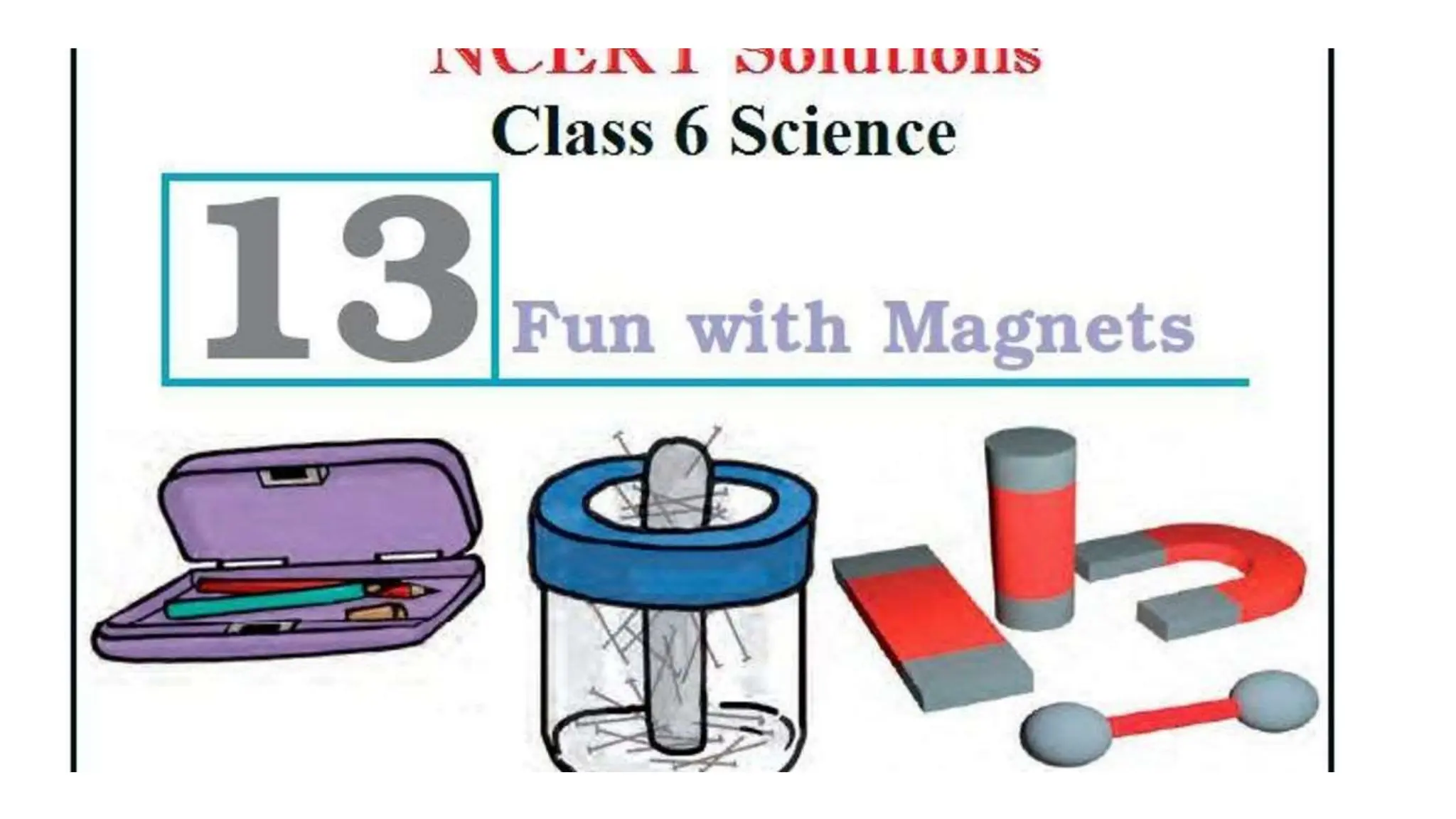
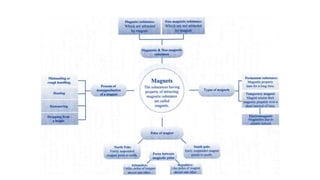
Magnets come in various shapes and sizes (Fig. 12.1). They can be found as
horseshoe, ring, cylindrical, or bar shape.
Not all objects are attracted to magnets. Objects that are attracted by a
magnet are said to be magnetic, e.g., iron and nickel. Objects that are not
attracted by a magnet, are said to be non-magnetic, e.g., wood and plastic.
• When magnetic materials (like iron filings) are brought close to a magnet,
they do not stick evenly to all parts of the magnet. They stick more on
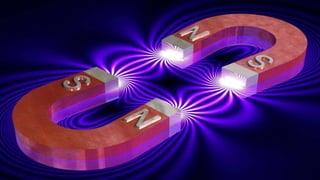
certain parts of the magnet. These are called the poles of the magnet.
Magnetic forces are the strongest at the poles. For example, the two ends
of a bar magnet are its poles.
• Natural Magnet: Magnetite is called natural magnet.
• Uses of a Magnet: A magnet finds its use at a number of places. For
example, refrigerator’s door, some pencil boxes, many toys, magnetic
stickers, soap stand, pin stand, all make use of a magnet for their
functioning.
Shapes of Magnets: Magnets are made of different materials and in
different shapes.
Effect of a magnet on materials: A magnet attracts certain materials,
whereas some do not get attracted towards magnet.
• Magnetic materials: The materials which get attracted towards the
magnet are known as magnetic materials, e.g., iron, nickel, cobalt.
• Non-magnetic materials: The materials which are not attracted
towards the magnet are known as non-magnetic materials, e.g.,
leather, plastic, cloth, paper.
• Magnetic poles: Magnetic attraction is maximum near the ends of
the magnet. These ends are called magnetic poles. When suspended
freely, magnet always aligns in north-south (N-S) direction.
• Lode stone: It was a stone used by sailors in olden days to identify
directions when they were in sea.
• Compass: This is a small glass case containing a magnetised needle
pivoted on a nail. The needle can rotate freely. Wherever it is kept, its
needle always rests in north-south direction. Normally the north-pole
of the needle is painted red or some other indication is given to
identify north and south-poles. So using this needle, north and south
can be identified.
• Attraction between two poles: Opposite poles of two magnets
attract each other. It is called attraction.
• Repulsion between two poles: Similar poles of two magnets repel
each other. It is called repulsion.
• Magnetic effect can pass through screen: Magnetic influence can
pass through screens of some substances like cloth, plastic, paper,
glass, etc.
Magnets lose their properties if they are heated, hammered or
dropped strongly and hardly. To keep them safe, bar magnets should
be kept in pairs with their unlike poles on the same side. They must
be separated by a piece of wood while two pieces of soft iron should
be placed across their ends. For horse-shoe magnet, orfe should keep
a piece of iron across the poles.
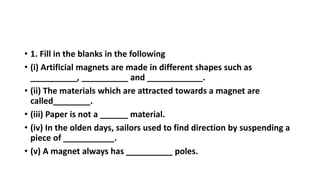
• 1. Fill in the blanks in the following
• (i) Artificial magnets are made in different shapes such as
__________, __________ and ____________.
• (ii) The materials which are attracted towards a magnet are
called________.
• (iii) Paper is not a ______ material.
• (iv) In the olden days, sailors used to find direction by suspending a
piece of ___________.
• (v) A magnet always has __________ poles.
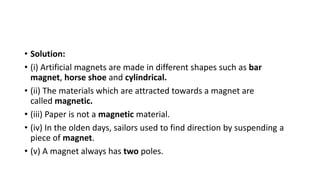
• Solution:
• (i) Artificial magnets are made in different shapes such as bar
magnet, horse shoe and cylindrical.
• (ii) The materials which are attracted towards a magnet are
called magnetic.
• (iii) Paper is not a magnetic material.
• (iv) In the olden days, sailors used to find direction by suspending a
piece of magnet.
• (v) A magnet always has two poles.
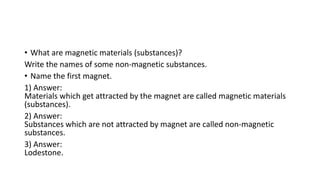
• What are magnetic materials (substances)?
Write the names of some non-magnetic substances.
• Name the first magnet.
1) Answer:
Materials which get attracted by the magnet are called magnetic materials
(substances).
2) Answer:
Substances which are not attracted by magnet are called non-magnetic
substances.
3) Answer:
Lodestone.
• 1)Where are south and north poles of earth’s magnet?
• 2)Can we isolate north-pole or south-pole?
• 3)What happens when a pole of a bar magnet say its north-pole is
marked with a chalk and suspended freely? What do you observe on
rotating the bar magnet?
• 4)What will happen to the magnet when we cut it into two pieces?
answers
• 1)Earth’s magnetic south-pole is near the geographic north-pole and
north-pole of earth’s magnet is near geographic south-pole.
• 2)No, we cannot isolate north-pole of a magnet from its south-pole or
vice versa. If you break a bar magnet into two halves, you will not get
a single north or south pole but two magnets each with its north and
south-poles.
• 3)The marked pole comes to rest in north direction. On rotating, after
some time, it again comes to rest in north direction.
• 4)When we cut a bar magnet into two pieces, both these pieces act
as magnets and we get two magnets

FUN WITH MAGNET for class 6 cbse (1).pptx

  • 2.
    • Magnets aremade of materials that attract objects made of certain substances like iron, cobalt, and nickel. Magnets come in various shapes and sizes (Fig. 12.1). They can be found as horseshoe, ring, cylindrical, or bar shape. Not all objects are attracted to magnets. Objects that are attracted by a magnet are said to be magnetic, e.g., iron and nickel. Objects that are not attracted by a magnet, are said to be non-magnetic, e.g., wood and plastic. • When magnetic materials (like iron filings) are brought close to a magnet, they do not stick evenly to all parts of the magnet. They stick more on certain parts of the magnet. These are called the poles of the magnet. Magnetic forces are the strongest at the poles. For example, the two ends of a bar magnet are its poles.
  • 4.
    • Natural Magnet:Magnetite is called natural magnet. • Uses of a Magnet: A magnet finds its use at a number of places. For example, refrigerator’s door, some pencil boxes, many toys, magnetic stickers, soap stand, pin stand, all make use of a magnet for their functioning. Shapes of Magnets: Magnets are made of different materials and in different shapes. Effect of a magnet on materials: A magnet attracts certain materials, whereas some do not get attracted towards magnet.
  • 5.
    • Magnetic materials:The materials which get attracted towards the magnet are known as magnetic materials, e.g., iron, nickel, cobalt. • Non-magnetic materials: The materials which are not attracted towards the magnet are known as non-magnetic materials, e.g., leather, plastic, cloth, paper. • Magnetic poles: Magnetic attraction is maximum near the ends of the magnet. These ends are called magnetic poles. When suspended freely, magnet always aligns in north-south (N-S) direction. • Lode stone: It was a stone used by sailors in olden days to identify directions when they were in sea.
  • 7.
    • Compass: Thisis a small glass case containing a magnetised needle pivoted on a nail. The needle can rotate freely. Wherever it is kept, its needle always rests in north-south direction. Normally the north-pole of the needle is painted red or some other indication is given to identify north and south-poles. So using this needle, north and south can be identified. • Attraction between two poles: Opposite poles of two magnets attract each other. It is called attraction. • Repulsion between two poles: Similar poles of two magnets repel each other. It is called repulsion.
  • 8.
    • Magnetic effectcan pass through screen: Magnetic influence can pass through screens of some substances like cloth, plastic, paper, glass, etc. Magnets lose their properties if they are heated, hammered or dropped strongly and hardly. To keep them safe, bar magnets should be kept in pairs with their unlike poles on the same side. They must be separated by a piece of wood while two pieces of soft iron should be placed across their ends. For horse-shoe magnet, orfe should keep a piece of iron across the poles.
  • 11.
    • 1. Fillin the blanks in the following • (i) Artificial magnets are made in different shapes such as __________, __________ and ____________. • (ii) The materials which are attracted towards a magnet are called________. • (iii) Paper is not a ______ material. • (iv) In the olden days, sailors used to find direction by suspending a piece of ___________. • (v) A magnet always has __________ poles.
  • 12.
    • Solution: • (i)Artificial magnets are made in different shapes such as bar magnet, horse shoe and cylindrical. • (ii) The materials which are attracted towards a magnet are called magnetic. • (iii) Paper is not a magnetic material. • (iv) In the olden days, sailors used to find direction by suspending a piece of magnet. • (v) A magnet always has two poles.
  • 13.
    • What aremagnetic materials (substances)? Write the names of some non-magnetic substances. • Name the first magnet. 1) Answer: Materials which get attracted by the magnet are called magnetic materials (substances). 2) Answer: Substances which are not attracted by magnet are called non-magnetic substances. 3) Answer: Lodestone.
  • 14.
    • 1)Where aresouth and north poles of earth’s magnet? • 2)Can we isolate north-pole or south-pole? • 3)What happens when a pole of a bar magnet say its north-pole is marked with a chalk and suspended freely? What do you observe on rotating the bar magnet? • 4)What will happen to the magnet when we cut it into two pieces?
  • 15.
    answers • 1)Earth’s magneticsouth-pole is near the geographic north-pole and north-pole of earth’s magnet is near geographic south-pole. • 2)No, we cannot isolate north-pole of a magnet from its south-pole or vice versa. If you break a bar magnet into two halves, you will not get a single north or south pole but two magnets each with its north and south-poles. • 3)The marked pole comes to rest in north direction. On rotating, after some time, it again comes to rest in north direction. • 4)When we cut a bar magnet into two pieces, both these pieces act as magnets and we get two magnets