2016 Storage Developer Conference. Copyright © 2016 IBM. All Rights Reserved.
Fun with Linearity:
How encryption and erasure codes are intimately related
Jason Resch
IBM
2016 Storage Developer Conference. Copyright © 2016 IBM. All Rights Reserved.
Presentation Overview
 Linear Functions
 Combining Linear Functions
 Linearity of Erasure Codes
 Erasure Codes and Encryption
 Erasure Codes and Integrity Checks
 Exploiting Linearity for New Applications
2
2016 Storage Developer Conference. Copyright © 2016 IBM. All Rights Reserved.
Linear Functions
3
2016 Storage Developer Conference. Copyright © 2016 IBM. All Rights Reserved.
Linear Functions Defined
 A function F is “linear” if it satisfies the following:
 F(x) + F(y) = F(x + y)
 In short, a function is linear if an operation
applied to the inputs yields the same result as
performing that operation on the outputs.
4
2016 Storage Developer Conference. Copyright © 2016 IBM. All Rights Reserved.
Examples of Linear Functions
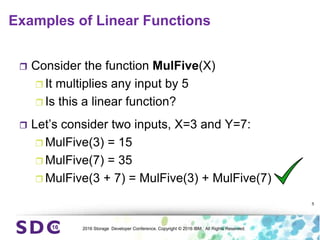
 Consider the function MulFive(X)
 It multiplies any input by 5
 Is this a linear function?
5
 Let’s consider two inputs, X=3 and Y=7:
 MulFive(3) = 15
 MulFive(7) = 35
 MulFive(3 + 7) = MulFive(3) + MulFive(7)
2016 Storage Developer Conference. Copyright © 2016 IBM. All Rights Reserved.
CRC as a Linear Function
 Many functions have this property, among them:
 The Cyclic Redundancy Check (CRC)
 CRC is commonly used for integrity checks
 CRC is a “polynomial division” in a finite field
 Addition in this field is “⊕” rather than “+”
6
2016 Storage Developer Conference. Copyright © 2016 IBM. All Rights Reserved.
Consequences of CRC’s Linearity
 Given the definition of linearity, it follows that:
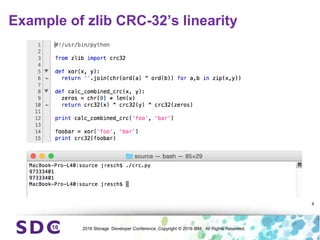
 CRC(x) ⊕ CRC(y) = CRC(x ⊕ y)
 In actual implementations of CRC, there is a
caveat, we must also add CRC(zeros)
 Where ‘zeros’ is a binary string consisting of
all zeros and is equal in length to ‘x’ and ‘y’
 CRC(x) ⊕ CRC(y) ⊕ CRC(zeros) = CRC(x ⊕ y ⊕
zeros)
7
2016 Storage Developer Conference. Copyright © 2016 IBM. All Rights Reserved.
Example of zlib CRC-32’s linearity
8
2016 Storage Developer Conference. Copyright © 2016 IBM. All Rights Reserved.
Combining Linear Functions
9
2016 Storage Developer Conference. Copyright © 2016 IBM. All Rights Reserved.
Encryption Functions
 Encryption functions, in their most basic form,
are simply random number generators
 Key acts as a “seed” to generate an arbitrarily
long set of random output–the “keystream”
 Keystream is XORed with Plaintext to encrypt
10
2016 Storage Developer Conference. Copyright © 2016 IBM. All Rights Reserved.
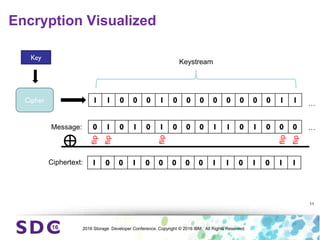
Encryption Visualized
11
Cipher
Key
1 1 0 0 0 1 0 0 0 0 0 0 0 0 1 1 …
Keystream
0 1 0 1 0 1 0 0 0 1 1 0 1 0 0 0 …
Message:
⊕
1 0 0 1 0 0 0 0 0 1 1 0 1 0 1 1
Ciphertext:
flip
flip
flip
flip
flip
2016 Storage Developer Conference. Copyright © 2016 IBM. All Rights Reserved.
Encryption and CRC
 The XOR operation used in encryption is the
same as addition in the finite field of CRC…
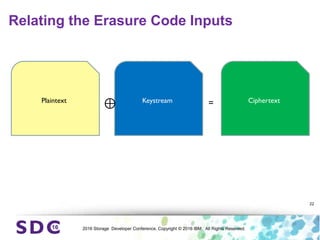
 Ciphertext = Plaintext ⊕ Keystream
 Since the Ciphertext is equal to the Plaintext
added to the Keystream it follows that:
 CRC(Ciphertext) = CRC(Plaintext) ⊕
CRC(Keystream)
12
2016 Storage Developer Conference. Copyright © 2016 IBM. All Rights Reserved.
Linearity of Erasure Codes
13
2016 Storage Developer Conference. Copyright © 2016 IBM. All Rights Reserved.
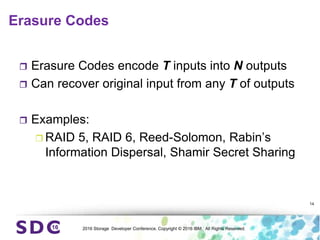
Erasure Codes
 Erasure Codes encode T inputs into N outputs
 Can recover original input from any T of outputs
 Examples:
 RAID 5, RAID 6, Reed-Solomon, Rabin’s
Information Dispersal, Shamir Secret Sharing
14
2016 Storage Developer Conference. Copyright © 2016 IBM. All Rights Reserved.
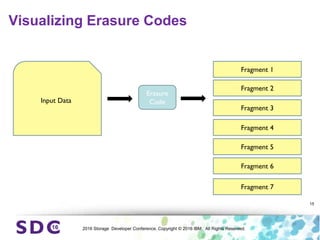
Visualizing Erasure Codes
15
Input Data
Erasure
Code
Fragment 1
Fragment 2
Fragment 3
Fragment 4
Fragment 5
Fragment 6
Fragment 7
2016 Storage Developer Conference. Copyright © 2016 IBM. All Rights Reserved.
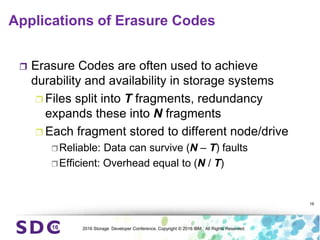
Applications of Erasure Codes
 Erasure Codes are often used to achieve
durability and availability in storage systems
 Files split into T fragments, redundancy
expands these into N fragments
 Each fragment stored to different node/drive
Reliable: Data can survive (N – T) faults
Efficient: Overhead equal to (N / T)
16
2016 Storage Developer Conference. Copyright © 2016 IBM. All Rights Reserved.
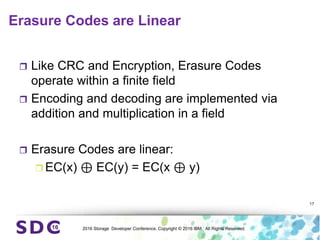
Erasure Codes are Linear
 Like CRC and Encryption, Erasure Codes
operate within a finite field
 Encoding and decoding are implemented via
addition and multiplication in a field
 Erasure Codes are linear:
 EC(x) ⊕ EC(y) = EC(x ⊕ y)
17
2016 Storage Developer Conference. Copyright © 2016 IBM. All Rights Reserved.
Erasure Codes and Encryption
18
2016 Storage Developer Conference. Copyright © 2016 IBM. All Rights Reserved.
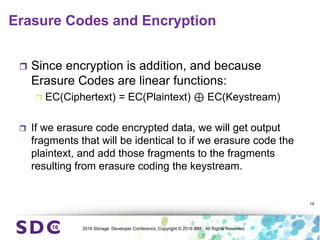
Erasure Codes and Encryption
 Since encryption is addition, and because
Erasure Codes are linear functions:
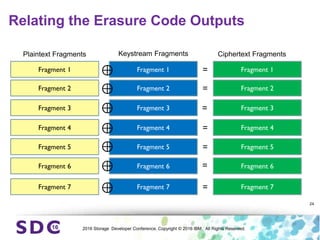
 EC(Ciphertext) = EC(Plaintext) ⊕ EC(Keystream)
 If we erasure code encrypted data, we will get output
fragments that will be identical to if we erasure code the
plaintext, and add those fragments to the fragments
resulting from erasure coding the keystream.
19
2016 Storage Developer Conference. Copyright © 2016 IBM. All Rights Reserved.
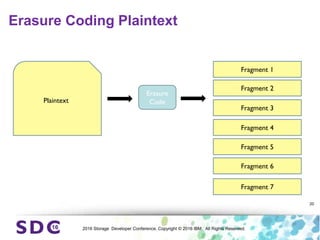
Erasure Coding Plaintext
20
Plaintext
Erasure
Code
Fragment 1
Fragment 2
Fragment 3
Fragment 4
Fragment 5
Fragment 6
Fragment 7
2016 Storage Developer Conference. Copyright © 2016 IBM. All Rights Reserved.
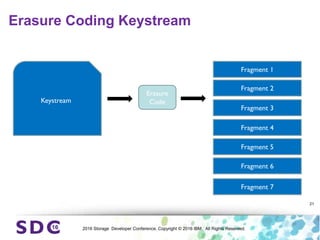
Erasure Coding Keystream
21
Keystream
Erasure
Code
Fragment 1
Fragment 2
Fragment 3
Fragment 4
Fragment 5
Fragment 6
Fragment 7
2016 Storage Developer Conference. Copyright © 2016 IBM. All Rights Reserved.
Relating the Erasure Code Inputs
22
Plaintext Keystream Ciphertext
⊕ =
2016 Storage Developer Conference. Copyright © 2016 IBM. All Rights Reserved.
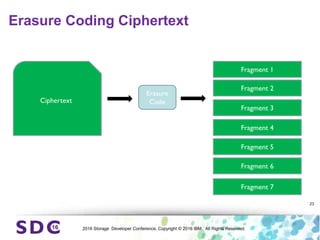
Erasure Coding Ciphertext
23
Ciphertext
Erasure
Code
Fragment 1
Fragment 2
Fragment 3
Fragment 4
Fragment 5
Fragment 6
Fragment 7
2016 Storage Developer Conference. Copyright © 2016 IBM. All Rights Reserved.
Relating the Erasure Code Outputs
24
Fragment 1
Fragment 2
Fragment 3
Fragment 4
Fragment 5
Fragment 6
Fragment 7
Fragment 1
Fragment 2
Fragment 3
Fragment 4
Fragment 5
Fragment 6
Fragment 7
Fragment 1
Fragment 2
Fragment 3
Fragment 4
Fragment 5
Fragment 6
Fragment 7
⊕
⊕
⊕
⊕
⊕
⊕
⊕
=
=
=
=
=
=
=
Plaintext Fragments Keystream Fragments Ciphertext Fragments
2016 Storage Developer Conference. Copyright © 2016 IBM. All Rights Reserved.
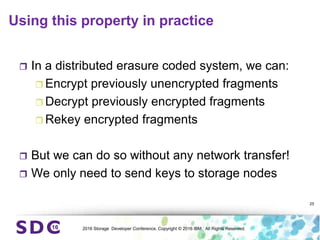
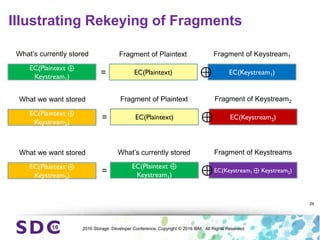
Using this property in practice
 In a distributed erasure coded system, we can:
 Encrypt previously unencrypted fragments
 Decrypt previously encrypted fragments
 Rekey encrypted fragments
 But we can do so without any network transfer!
 We only need to send keys to storage nodes
25
2016 Storage Developer Conference. Copyright © 2016 IBM. All Rights Reserved.
Illustrating Rekeying of Fragments
26
EC(Plaintext) EC(Keystream1)
EC(Plaintext ⊕
Keystream1) ⊕
=
Fragment of Plaintext Fragment of Keystream1
What’s currently stored
EC(Plaintext ⊕
Keystream2)
What we want stored
EC(Plaintext) EC(Keystream2)
⊕
=
Fragment of Plaintext Fragment of Keystream2
EC(Plaintext ⊕
Keystream2)
What we want stored
EC(Plaintext ⊕
Keystream1)
EC(Keystream1 ⊕ Keystream2)
⊕
=
What’s currently stored Fragment of Keystreams
2016 Storage Developer Conference. Copyright © 2016 IBM. All Rights Reserved.
Erasure Codes and Integrity Checks
27
2016 Storage Developer Conference. Copyright © 2016 IBM. All Rights Reserved.
Erasure Codes and CRC
 We know Erasure Codes are linear
 We know Cyclic Redundancy Checks are linear
 How can we combine them for practical uses?
 We will need to explore the internal workings of
Erasure Codes to see how this is possible..
28
2016 Storage Developer Conference. Copyright © 2016 IBM. All Rights Reserved.
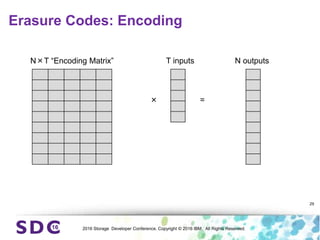
Erasure Codes: Encoding
29
N×T “Encoding Matrix” T inputs N outputs
× =
2016 Storage Developer Conference. Copyright © 2016 IBM. All Rights Reserved.
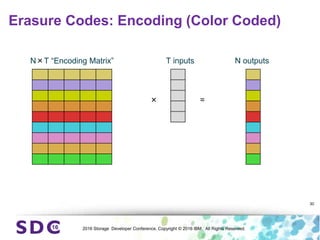
Erasure Codes: Encoding (Color Coded)
30
N×T “Encoding Matrix” T inputs N outputs
× =
2016 Storage Developer Conference. Copyright © 2016 IBM. All Rights Reserved.
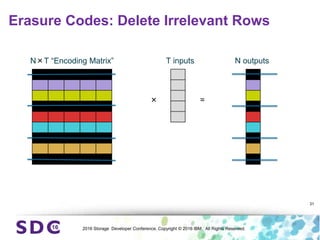
Erasure Codes: Delete Irrelevant Rows
31
N×T “Encoding Matrix” T inputs N outputs
× =
2016 Storage Developer Conference. Copyright © 2016 IBM. All Rights Reserved.
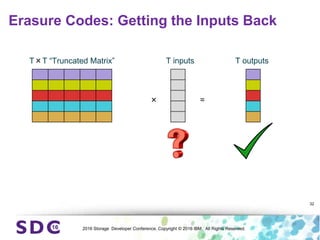
Erasure Codes: Getting the Inputs Back
32
T×T “Truncated Matrix” T inputs T outputs
× =
2016 Storage Developer Conference. Copyright © 2016 IBM. All Rights Reserved.
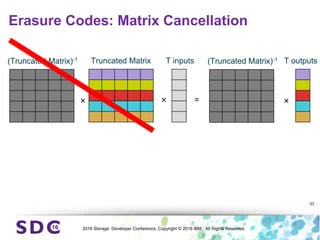
Erasure Codes: Matrix Cancellation
33
Truncated Matrix T inputs T outputs
× =
×
(Truncated Matrix)-1
×
(Truncated Matrix)-1
2016 Storage Developer Conference. Copyright © 2016 IBM. All Rights Reserved.
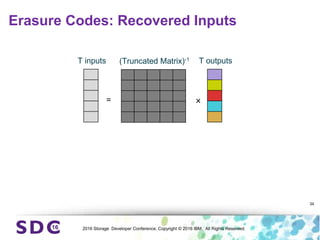
Erasure Codes: Recovered Inputs
34
T inputs T outputs
=
(Truncated Matrix)-1
×
2016 Storage Developer Conference. Copyright © 2016 IBM. All Rights Reserved.
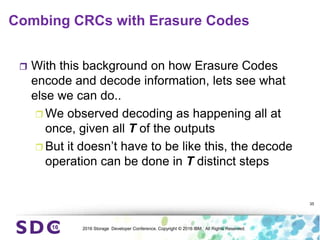
Combing CRCs with Erasure Codes
 With this background on how Erasure Codes
encode and decode information, lets see what
else we can do..
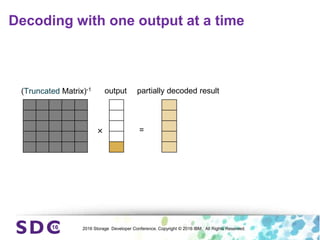
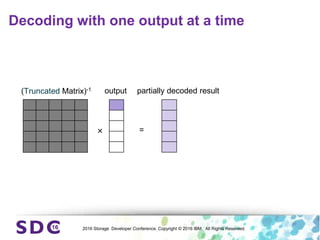
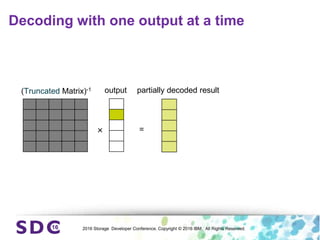
 We observed decoding as happening all at
once, given all T of the outputs
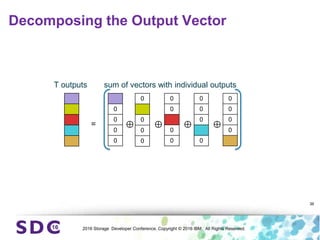
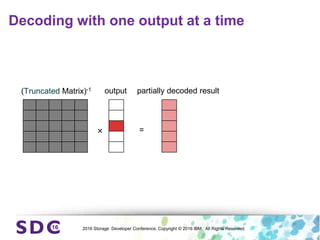
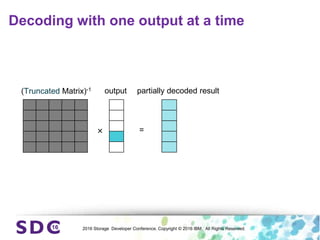
 But it doesn’t have to be like this, the decode
operation can be done in T distinct steps
35
2016 Storage Developer Conference. Copyright © 2016 IBM. All Rights Reserved.
Decomposing the Output Vector
36
T outputs
=
0
0
0
0
0
0
0
0
0
0
0
0
0
0
0
0
0
0
0
0
⊕ ⊕ ⊕ ⊕
sum of vectors with individual outputs
2016 Storage Developer Conference. Copyright © 2016 IBM. All Rights Reserved.
=
×
partially decoded result
output
(Truncated Matrix)-1
Decoding with one output at a time
2016 Storage Developer Conference. Copyright © 2016 IBM. All Rights Reserved.
=
×
partially decoded result
output
Decoding with one output at a time
(Truncated Matrix)-1
2016 Storage Developer Conference. Copyright © 2016 IBM. All Rights Reserved.
=
×
partially decoded result
output
Decoding with one output at a time
(Truncated Matrix)-1
2016 Storage Developer Conference. Copyright © 2016 IBM. All Rights Reserved.
=
×
partially decoded result
output
Decoding with one output at a time
(Truncated Matrix)-1
2016 Storage Developer Conference. Copyright © 2016 IBM. All Rights Reserved.
partially decoded result
output
=
×
Decoding with one output at a time
(Truncated Matrix)-1
2016 Storage Developer Conference. Copyright © 2016 IBM. All Rights Reserved.
9/7/2016
T inputs
=
⊕ ⊕ ⊕ ⊕
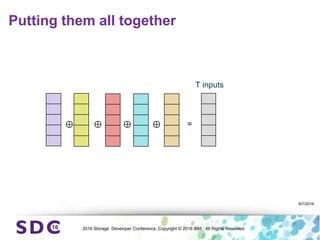
Putting them all together
2016 Storage Developer Conference. Copyright © 2016 IBM. All Rights Reserved.
Observation
 Just as the ciphertext is the sum of a plaintext
and a keystream, the original input is a sum of
the T partially decoded results
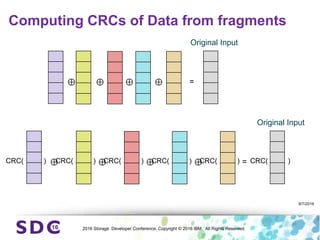
 This means the sum of the CRCs of the
partially decoded results is the data’s CRC!
43
2016 Storage Developer Conference. Copyright © 2016 IBM. All Rights Reserved.
9/7/2016
Original Input
=
⊕ ⊕ ⊕ ⊕
Computing CRCs of Data from fragments
Original Input
=
⊕ ⊕ ⊕ ⊕
CRC( ) CRC( ) CRC( ) CRC( ) CRC( ) CRC( )
2016 Storage Developer Conference. Copyright © 2016 IBM. All Rights Reserved.
Exploiting Linearity for New Applications
45
2016 Storage Developer Conference. Copyright © 2016 IBM. All Rights Reserved.
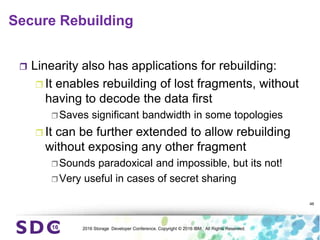
Secure Rebuilding
 Linearity also has applications for rebuilding:
 It enables rebuilding of lost fragments, without
having to decode the data first
Saves significant bandwidth in some topologies
 It can be further extended to allow rebuilding
without exposing any other fragment
Sounds paradoxical and impossible, but its not!
Very useful in cases of secret sharing
46
2016 Storage Developer Conference. Copyright © 2016 IBM. All Rights Reserved.
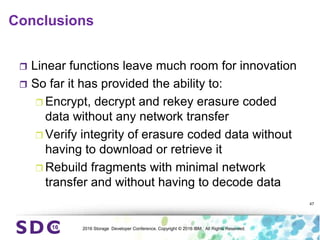
Conclusions
 Linear functions leave much room for innovation
 So far it has provided the ability to:
 Encrypt, decrypt and rekey erasure coded
data without any network transfer
 Verify integrity of erasure coded data without
having to download or retrieve it
 Rebuild fragments with minimal network
transfer and without having to decode data
47
2016 Storage Developer Conference. Copyright © 2016 IBM. All Rights Reserved.
Questions
48
Secure and Efficient Rebuilding:
http://dimacs.rutgers.edu/Workshops/SecureNetworking/Slides/resch.pptx

Fun with Linearity - How Encryption and Erasure Codes are Intimately Related.pdf

  • 1.
    2016 Storage DeveloperConference. Copyright © 2016 IBM. All Rights Reserved. Fun with Linearity: How encryption and erasure codes are intimately related Jason Resch IBM
  • 2.
    2016 Storage DeveloperConference. Copyright © 2016 IBM. All Rights Reserved. Presentation Overview  Linear Functions  Combining Linear Functions  Linearity of Erasure Codes  Erasure Codes and Encryption  Erasure Codes and Integrity Checks  Exploiting Linearity for New Applications 2
  • 3.
    2016 Storage DeveloperConference. Copyright © 2016 IBM. All Rights Reserved. Linear Functions 3
  • 4.
    2016 Storage DeveloperConference. Copyright © 2016 IBM. All Rights Reserved. Linear Functions Defined  A function F is “linear” if it satisfies the following:  F(x) + F(y) = F(x + y)  In short, a function is linear if an operation applied to the inputs yields the same result as performing that operation on the outputs. 4
  • 5.
    2016 Storage DeveloperConference. Copyright © 2016 IBM. All Rights Reserved. Examples of Linear Functions  Consider the function MulFive(X)  It multiplies any input by 5  Is this a linear function? 5  Let’s consider two inputs, X=3 and Y=7:  MulFive(3) = 15  MulFive(7) = 35  MulFive(3 + 7) = MulFive(3) + MulFive(7)
  • 6.
    2016 Storage DeveloperConference. Copyright © 2016 IBM. All Rights Reserved. CRC as a Linear Function  Many functions have this property, among them:  The Cyclic Redundancy Check (CRC)  CRC is commonly used for integrity checks  CRC is a “polynomial division” in a finite field  Addition in this field is “⊕” rather than “+” 6
  • 7.
    2016 Storage DeveloperConference. Copyright © 2016 IBM. All Rights Reserved. Consequences of CRC’s Linearity  Given the definition of linearity, it follows that:  CRC(x) ⊕ CRC(y) = CRC(x ⊕ y)  In actual implementations of CRC, there is a caveat, we must also add CRC(zeros)  Where ‘zeros’ is a binary string consisting of all zeros and is equal in length to ‘x’ and ‘y’  CRC(x) ⊕ CRC(y) ⊕ CRC(zeros) = CRC(x ⊕ y ⊕ zeros) 7
  • 8.
    2016 Storage DeveloperConference. Copyright © 2016 IBM. All Rights Reserved. Example of zlib CRC-32’s linearity 8
  • 9.
    2016 Storage DeveloperConference. Copyright © 2016 IBM. All Rights Reserved. Combining Linear Functions 9
  • 10.
    2016 Storage DeveloperConference. Copyright © 2016 IBM. All Rights Reserved. Encryption Functions  Encryption functions, in their most basic form, are simply random number generators  Key acts as a “seed” to generate an arbitrarily long set of random output–the “keystream”  Keystream is XORed with Plaintext to encrypt 10
  • 11.
    2016 Storage DeveloperConference. Copyright © 2016 IBM. All Rights Reserved. Encryption Visualized 11 Cipher Key 1 1 0 0 0 1 0 0 0 0 0 0 0 0 1 1 … Keystream 0 1 0 1 0 1 0 0 0 1 1 0 1 0 0 0 … Message: ⊕ 1 0 0 1 0 0 0 0 0 1 1 0 1 0 1 1 Ciphertext: flip flip flip flip flip
  • 12.
    2016 Storage DeveloperConference. Copyright © 2016 IBM. All Rights Reserved. Encryption and CRC  The XOR operation used in encryption is the same as addition in the finite field of CRC…  Ciphertext = Plaintext ⊕ Keystream  Since the Ciphertext is equal to the Plaintext added to the Keystream it follows that:  CRC(Ciphertext) = CRC(Plaintext) ⊕ CRC(Keystream) 12
  • 13.
    2016 Storage DeveloperConference. Copyright © 2016 IBM. All Rights Reserved. Linearity of Erasure Codes 13
  • 14.
    2016 Storage DeveloperConference. Copyright © 2016 IBM. All Rights Reserved. Erasure Codes  Erasure Codes encode T inputs into N outputs  Can recover original input from any T of outputs  Examples:  RAID 5, RAID 6, Reed-Solomon, Rabin’s Information Dispersal, Shamir Secret Sharing 14
  • 15.
    2016 Storage DeveloperConference. Copyright © 2016 IBM. All Rights Reserved. Visualizing Erasure Codes 15 Input Data Erasure Code Fragment 1 Fragment 2 Fragment 3 Fragment 4 Fragment 5 Fragment 6 Fragment 7
  • 16.
    2016 Storage DeveloperConference. Copyright © 2016 IBM. All Rights Reserved. Applications of Erasure Codes  Erasure Codes are often used to achieve durability and availability in storage systems  Files split into T fragments, redundancy expands these into N fragments  Each fragment stored to different node/drive Reliable: Data can survive (N – T) faults Efficient: Overhead equal to (N / T) 16
  • 17.
    2016 Storage DeveloperConference. Copyright © 2016 IBM. All Rights Reserved. Erasure Codes are Linear  Like CRC and Encryption, Erasure Codes operate within a finite field  Encoding and decoding are implemented via addition and multiplication in a field  Erasure Codes are linear:  EC(x) ⊕ EC(y) = EC(x ⊕ y) 17
  • 18.
    2016 Storage DeveloperConference. Copyright © 2016 IBM. All Rights Reserved. Erasure Codes and Encryption 18
  • 19.
    2016 Storage DeveloperConference. Copyright © 2016 IBM. All Rights Reserved. Erasure Codes and Encryption  Since encryption is addition, and because Erasure Codes are linear functions:  EC(Ciphertext) = EC(Plaintext) ⊕ EC(Keystream)  If we erasure code encrypted data, we will get output fragments that will be identical to if we erasure code the plaintext, and add those fragments to the fragments resulting from erasure coding the keystream. 19
  • 20.
    2016 Storage DeveloperConference. Copyright © 2016 IBM. All Rights Reserved. Erasure Coding Plaintext 20 Plaintext Erasure Code Fragment 1 Fragment 2 Fragment 3 Fragment 4 Fragment 5 Fragment 6 Fragment 7
  • 21.
    2016 Storage DeveloperConference. Copyright © 2016 IBM. All Rights Reserved. Erasure Coding Keystream 21 Keystream Erasure Code Fragment 1 Fragment 2 Fragment 3 Fragment 4 Fragment 5 Fragment 6 Fragment 7
  • 22.
    2016 Storage DeveloperConference. Copyright © 2016 IBM. All Rights Reserved. Relating the Erasure Code Inputs 22 Plaintext Keystream Ciphertext ⊕ =
  • 23.
    2016 Storage DeveloperConference. Copyright © 2016 IBM. All Rights Reserved. Erasure Coding Ciphertext 23 Ciphertext Erasure Code Fragment 1 Fragment 2 Fragment 3 Fragment 4 Fragment 5 Fragment 6 Fragment 7
  • 24.
    2016 Storage DeveloperConference. Copyright © 2016 IBM. All Rights Reserved. Relating the Erasure Code Outputs 24 Fragment 1 Fragment 2 Fragment 3 Fragment 4 Fragment 5 Fragment 6 Fragment 7 Fragment 1 Fragment 2 Fragment 3 Fragment 4 Fragment 5 Fragment 6 Fragment 7 Fragment 1 Fragment 2 Fragment 3 Fragment 4 Fragment 5 Fragment 6 Fragment 7 ⊕ ⊕ ⊕ ⊕ ⊕ ⊕ ⊕ = = = = = = = Plaintext Fragments Keystream Fragments Ciphertext Fragments
  • 25.
    2016 Storage DeveloperConference. Copyright © 2016 IBM. All Rights Reserved. Using this property in practice  In a distributed erasure coded system, we can:  Encrypt previously unencrypted fragments  Decrypt previously encrypted fragments  Rekey encrypted fragments  But we can do so without any network transfer!  We only need to send keys to storage nodes 25
  • 26.
    2016 Storage DeveloperConference. Copyright © 2016 IBM. All Rights Reserved. Illustrating Rekeying of Fragments 26 EC(Plaintext) EC(Keystream1) EC(Plaintext ⊕ Keystream1) ⊕ = Fragment of Plaintext Fragment of Keystream1 What’s currently stored EC(Plaintext ⊕ Keystream2) What we want stored EC(Plaintext) EC(Keystream2) ⊕ = Fragment of Plaintext Fragment of Keystream2 EC(Plaintext ⊕ Keystream2) What we want stored EC(Plaintext ⊕ Keystream1) EC(Keystream1 ⊕ Keystream2) ⊕ = What’s currently stored Fragment of Keystreams
  • 27.
    2016 Storage DeveloperConference. Copyright © 2016 IBM. All Rights Reserved. Erasure Codes and Integrity Checks 27
  • 28.
    2016 Storage DeveloperConference. Copyright © 2016 IBM. All Rights Reserved. Erasure Codes and CRC  We know Erasure Codes are linear  We know Cyclic Redundancy Checks are linear  How can we combine them for practical uses?  We will need to explore the internal workings of Erasure Codes to see how this is possible.. 28
  • 29.
    2016 Storage DeveloperConference. Copyright © 2016 IBM. All Rights Reserved. Erasure Codes: Encoding 29 N×T “Encoding Matrix” T inputs N outputs × =
  • 30.
    2016 Storage DeveloperConference. Copyright © 2016 IBM. All Rights Reserved. Erasure Codes: Encoding (Color Coded) 30 N×T “Encoding Matrix” T inputs N outputs × =
  • 31.
    2016 Storage DeveloperConference. Copyright © 2016 IBM. All Rights Reserved. Erasure Codes: Delete Irrelevant Rows 31 N×T “Encoding Matrix” T inputs N outputs × =
  • 32.
    2016 Storage DeveloperConference. Copyright © 2016 IBM. All Rights Reserved. Erasure Codes: Getting the Inputs Back 32 T×T “Truncated Matrix” T inputs T outputs × =
  • 33.
    2016 Storage DeveloperConference. Copyright © 2016 IBM. All Rights Reserved. Erasure Codes: Matrix Cancellation 33 Truncated Matrix T inputs T outputs × = × (Truncated Matrix)-1 × (Truncated Matrix)-1
  • 34.
    2016 Storage DeveloperConference. Copyright © 2016 IBM. All Rights Reserved. Erasure Codes: Recovered Inputs 34 T inputs T outputs = (Truncated Matrix)-1 ×
  • 35.
    2016 Storage DeveloperConference. Copyright © 2016 IBM. All Rights Reserved. Combing CRCs with Erasure Codes  With this background on how Erasure Codes encode and decode information, lets see what else we can do..  We observed decoding as happening all at once, given all T of the outputs  But it doesn’t have to be like this, the decode operation can be done in T distinct steps 35
  • 36.
    2016 Storage DeveloperConference. Copyright © 2016 IBM. All Rights Reserved. Decomposing the Output Vector 36 T outputs = 0 0 0 0 0 0 0 0 0 0 0 0 0 0 0 0 0 0 0 0 ⊕ ⊕ ⊕ ⊕ sum of vectors with individual outputs
  • 37.
    2016 Storage DeveloperConference. Copyright © 2016 IBM. All Rights Reserved. = × partially decoded result output (Truncated Matrix)-1 Decoding with one output at a time
  • 38.
    2016 Storage DeveloperConference. Copyright © 2016 IBM. All Rights Reserved. = × partially decoded result output Decoding with one output at a time (Truncated Matrix)-1
  • 39.
    2016 Storage DeveloperConference. Copyright © 2016 IBM. All Rights Reserved. = × partially decoded result output Decoding with one output at a time (Truncated Matrix)-1
  • 40.
    2016 Storage DeveloperConference. Copyright © 2016 IBM. All Rights Reserved. = × partially decoded result output Decoding with one output at a time (Truncated Matrix)-1
  • 41.
    2016 Storage DeveloperConference. Copyright © 2016 IBM. All Rights Reserved. partially decoded result output = × Decoding with one output at a time (Truncated Matrix)-1
  • 42.
    2016 Storage DeveloperConference. Copyright © 2016 IBM. All Rights Reserved. 9/7/2016 T inputs = ⊕ ⊕ ⊕ ⊕ Putting them all together
  • 43.
    2016 Storage DeveloperConference. Copyright © 2016 IBM. All Rights Reserved. Observation  Just as the ciphertext is the sum of a plaintext and a keystream, the original input is a sum of the T partially decoded results  This means the sum of the CRCs of the partially decoded results is the data’s CRC! 43
  • 44.
    2016 Storage DeveloperConference. Copyright © 2016 IBM. All Rights Reserved. 9/7/2016 Original Input = ⊕ ⊕ ⊕ ⊕ Computing CRCs of Data from fragments Original Input = ⊕ ⊕ ⊕ ⊕ CRC( ) CRC( ) CRC( ) CRC( ) CRC( ) CRC( )
  • 45.
    2016 Storage DeveloperConference. Copyright © 2016 IBM. All Rights Reserved. Exploiting Linearity for New Applications 45
  • 46.
    2016 Storage DeveloperConference. Copyright © 2016 IBM. All Rights Reserved. Secure Rebuilding  Linearity also has applications for rebuilding:  It enables rebuilding of lost fragments, without having to decode the data first Saves significant bandwidth in some topologies  It can be further extended to allow rebuilding without exposing any other fragment Sounds paradoxical and impossible, but its not! Very useful in cases of secret sharing 46
  • 47.
    2016 Storage DeveloperConference. Copyright © 2016 IBM. All Rights Reserved. Conclusions  Linear functions leave much room for innovation  So far it has provided the ability to:  Encrypt, decrypt and rekey erasure coded data without any network transfer  Verify integrity of erasure coded data without having to download or retrieve it  Rebuild fragments with minimal network transfer and without having to decode data 47
  • 48.
    2016 Storage DeveloperConference. Copyright © 2016 IBM. All Rights Reserved. Questions 48 Secure and Efficient Rebuilding: http://dimacs.rutgers.edu/Workshops/SecureNetworking/Slides/resch.pptx