Finance for
Non-financial Managers
Sonja Stojanović Gajić
30 January 2023
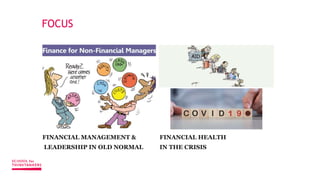
FOCUS
FINANCIAL MANAGEMENT &
LEADERSHIP IN OLD NORMAL
FINANCIAL HEALTH
IN THE CRISIS
4
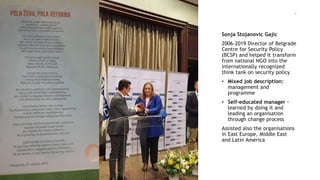
Sonja Stojanovic Gajic
2006-2019 Director of Belgrade
Centre for Security Policy
(BCSP) and helped it transform
from national NGO into the
internationally recognized
think tank on security policy
• Mixed job description:
management and
programme
• Self-educated manager -
learned by doing it and
leading an organisation
through change process
Assisted also the organisations
in East Europe, Middle East
and Latin America
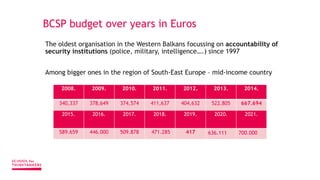
BCSP budget over years in Euros
The oldest organisation in the Western Balkans focussing on accountability of
security institutions (police, military, intelligence….) since 1997
Among bigger ones in the region of South-East Europe – mid-income country
2008. 2009. 2010. 2011. 2012. 2013. 2014.
340,337 378,649 374,574 411,637 404,632 522.805 667.694
2015. 2016. 2017. 2018. 2019. 2020. 2021.
589.659 446.000 509.878 471.285 417 636.111 700.000
How do you feel about
finance management and
fundraising?
INTRO SURVEY
https://docs.google.com/for
ms/d/e/1FAIpQLSdNiXbs3XZB
PSzZQih34855dXeaKJ5sJU0ect
KCj-GhBNBo-g/viewform
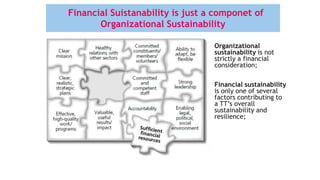
Financial Suistanability is just a componet of
Organizational Sustainability
Organizational
sustainability is not
strictly a financial
consideration;
Financial sustainability
is only one of several
factors contributing to
a TT’s overall
sustainability and
resilience;
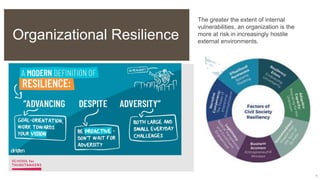
Organizational Resilience
9
The greater the extent of internal
vulnerabilities, an organization is the
more at risk in increasingly hostile
external environments.
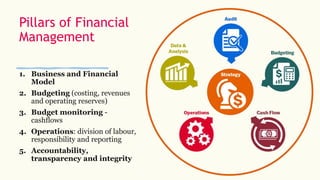
Pillars of Financial
Management
1. Business and Financial
Model
2. Budgeting (costing, revenues
and operating reserves)
3. Budget monitoring -
cashflows
4. Operations: division of labour,
responsibility and reporting
5. Accountability,
transparency and integrity
Difference between
business and funding models
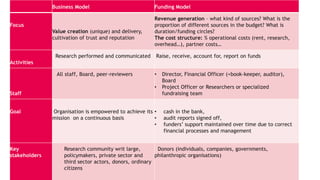
Business Model Funding Model
Focus
Value creation (unique) and delivery,
cultivation of trust and reputation
Revenue generation – what kind of sources? What is the
proportion of different sources in the budget? What is
duration/funding circles?
The cost structure: % operational costs (rent, research,
overhead…), partner costs…
Activities
Research performed and communicated Raise, receive, account for, report on funds
Staff
All staff, Board, peer-reviewers • Director, Financial Officer (+book-keeper, auditor),
Board
• Project Officer or Researchers or specialized
fundraising team
Goal Organisation is empowered to achieve its
mission on a continuous basis
• cash in the bank,
• audit reports signed off,
• funders’ support maintained over time due to correct
financial processes and management
Key
stakeholders
Research community writ large,
policymakers, private sector and
third sector actors, donors, ordinary
citizens
Donors (individuals, companies, governments,
philanthropic organisations)
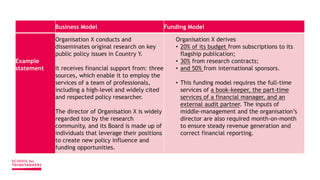
Business Model Funding Model
Example
statement
Organisation X conducts and
disseminates original research on key
public policy issues in Country Y.
It receives financial support from: three
sources, which enable it to employ the
services of a team of professionals,
including a high-level and widely cited
and respected policy researcher.
The director of Organisation X is widely
regarded too by the research
community, and its Board is made up of
individuals that leverage their positions
to create new policy influence and
funding opportunities.
Organisation X derives
• 20% of its budget from subscriptions to its
flagship publication;
• 30% from research contracts;
• and 50% from international sponsors.
• This funding model requires the full-time
services of a book-keeper, the part-time
services of a financial manager, and an
external audit partner. The inputs of
middle-management and the organisation’s
director are also required month-on-month
to ensure steady revenue generation and
correct financial reporting.
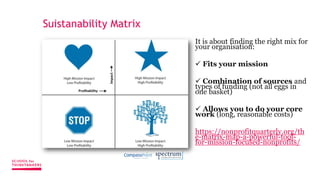
Suistanability Matrix
It is about finding the right mix for
your organisation:
 Fits your mission
 Combination of sources and
types of funding (not all eggs in
one basket)
 Allows you to do your core
work (long, reasonable costs)
https://nonprofitquarterly.org/th
e-matrix-map-a-powerful-tool-
for-mission-focused-nonprofits/
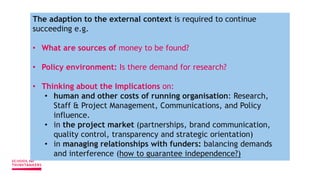
The adaption to the external context is required to continue
succeeding e.g.
• What are sources of money to be found?
• Policy environment: Is there demand for research?
• Thinking about the Implications on:
• human and other costs of running organisation: Research,
Staff & Project Management, Communications, and Policy
influence.
• in the project market (partnerships, brand communication,
quality control, transparency and strategic orientation)
• in managing relationships with funders: balancing demands
and interference (how to guarantee independence?)
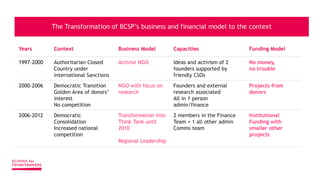
The Transformation of BCSP’s business and financial model to the context
Years Context Business Model Capacities Funding Model
1997-2000 Authoritarian Closed
Country under
international Sanctions
Activist NGO Ideas and activism of 2
founders supported by
friendly CSOs
No money,
no trouble
2000-2006 Democratic Transition
Golden Area of donors’
interest
No competition
NGO with focus on
research
Founders and external
research associated
All in 1 person
admin/finance
Projects from
donors
2006-2012 Democratic
Consolidation
Increased national
competition
Transformation into
Think Tank until
2010
Regional Leadership
2 members in the Finance
Team + 1 all other admin
Comms team
Institutional
Funding with
smaller other
projects
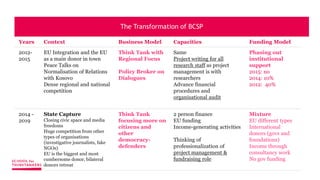
The Transformation of BCSP
Years Context Business Model Capacities Funding Model
2012-
2015
EU Integration and the EU
as a main donor in town
Peace Talks on
Normalisation of Relations
with Kosovo
Dense regional and national
competition
Think Tank with
Regional Focus
Policy Broker on
Dialogues
Same
Project writing for all
research staff as project
management is with
researchers
Advance financial
procedures and
organisational audit
Phasing out
institutional
support
2015: no
2014: 10%
2012: 40%
2014 -
2019
State Capture
Closing civic space and media
freedoms
Huge competition from other
types of organisations
(investigative journalists, fake
NGOs)
EU is the biggest and most
cumbersome donor, bilateral
donors retreat
Think Tank
focusing more on
citizens and
other
democracy-
defenders
2 person finance
EU funding
Income-generating activities
Thinking of
professionalization of
project management &
fundraising role
Mixture
EU different types
International
donors (govs and
foundations)
Income through
consultancy work
No gov funding
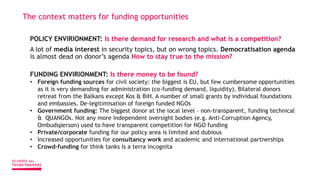
The context matters for funding opportunities
POLICY ENVIRIONMENT: Is there demand for research and what is a competition?
A lot of media interest in security topics, but on wrong topics. Democratisation agenda
is almost dead on donor’s agenda How to stay true to the mission?
FUNDING ENVIRIONMENT: Is there money to be found?
• Foreign funding sources for civil society: the biggest is EU, but few cumbersome opportunities
as it is very demanding for administration (co-funding demand, liquidity), Bilateral donors
retreat from the Balkans except Kos & BiH. A number of small grants by individual foundations
and embassies. De-legitimisation of foreign funded NGOs
• Government funding: The biggest donor at the local level – non-transparent, funding technical
& QUANGOs. Not any more independent oversight bodies (e.g. Anti-Corruption Agency,
Ombudsperson) used to have transparent competition for NGO funding
• Private/corporate funding for our policy area is limited and dubious
• Increased opportunities for consultancy work and academic and international partnerships
• Crowd-funding for think tanks is a terra incognita
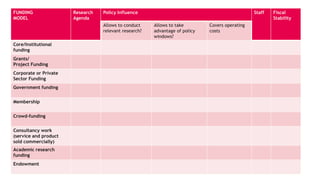
FUNDING
MODEL
Research
Agenda
Policy Influence Staff Fiscal
Stability
Allows to conduct
relevant research?
Allows to take
advantage of policy
windows?
Covers operating
costs
Core/Institutional
funding
Grants/
Project Funding
Corporate or Private
Sector Funding
Government funding
Membership
Crowd-funding
Consultancy work
(service and product
sold commercially)
Academic research
funding
Endowment
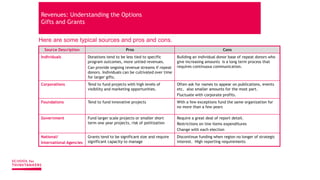
Revenues: Understanding the Options
Gifts and Grants
Here are some typical sources and pros and cons.
Source Description Pros Cons
Individuals Donations tend to be less tied to specific
program outcomes, more untied revenues.
Can provide ongoing revenue streams if repeat
donors. Individuals can be cultivated over time
for larger gifts.
Building an individual donor base of repeat donors who
give increasing amounts is a long term process that
requires continuous communication.
Corporations Tend to fund projects with high levels of
visibility and marketing opportunities.
Often ask for names to appear on publications, events
etc. also smaller amounts for the most part.
Fluctuate with corporate profits.
Foundations Tend to fund innovative projects With a few exceptions fund the same organization for
no more than a few years
Government Fund larger scale projects or smaller short
term one year projects, risk of politization
Require a great deal of report detail.
Restrictions on line items expenditures
Change with each election
National/
International Agencies
Grants tend to be significant size and require
significant capacity to manage
Discontinue funding when region no longer of strategic
interest. High reporting requirements
21
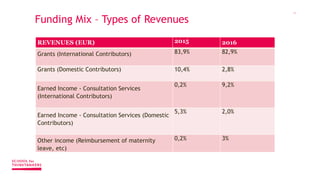
Funding Mix – Types of Revenues
REVENUES (EUR) 2015 2016
Grants (International Contributors) 83,9% 82,9%
Grants (Domestic Contributors) 10,4% 2,8%
Earned Income - Consultation Services
(International Contributors)
0,2% 9,2%
Earned Income - Consultation Services (Domestic
Contributors)
5,3% 2,0%
Other income (Reimbursement of maternity
leave, etc)
0,2% 3%
SUCCESSFUL FUNDING
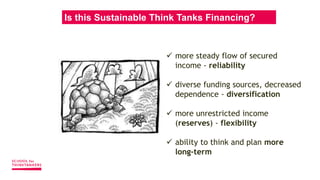
Is this Sustainable Think Tanks Financing?
 more steady flow of secured
income - reliability
 diverse funding sources, decreased
dependence - diversification
 more unrestricted income
(reserves) - flexibility
 ability to think and plan more
long-term
Under which conditions are we getting funds?
 Relationship to mission: Does this source enhance or detract from your mission? Does it enhance or detract from
your reputation?
 Acceptable conditions: Whatever administrative, contractual and/or programmatic conditions are attached to
funds, they should enable the think tank to do their policy work to the best of their abilities.
 Independence: A basic condition of a good funding model is for it to guarantee that a think tank remains
independent to govern itself and define its policy research agenda: deciding how to run the organisation, which
issues to pursue, etc.
 Transparency: A growing concern related to funding models has to do with being able to track the origin of funds
that think tanks receive and the main conditions attached to them.
 Visibility: Does this source have positive public relations or visibility benefits? What are the costs to our reputation
and credibility?
What are the costs and investments required in relation to benefits:
 Start-Up Costs: How difficult and costly is it to begin receiving income from this source?
 Continuing Costs: How difficult and costly is it to obtain this source of revenue (staff time to perform work or
report, infrastructure investment, etc.)
 Organizational Capacity: Do you have the capacity (staff, infrastructure, financial, cultural) to develop and
maintain this source?
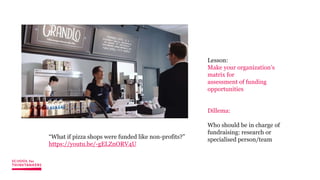
“What if pizza shops were funded like non-profits?”
https://youtu.be/-gELZnORV4U
Lesson:
Make your organization’s
matrix for
assessment of funding
opportunities
Dillema:
Who should be in charge of
fundraising: research or
specialised person/team
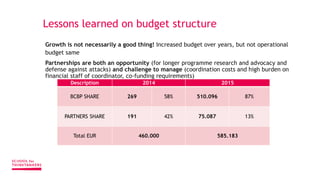
Lessons learned on budget structure
Growth is not necessarily a good thing! Increased budget over years, but not operational
budget same
Partnerships are both an opportunity (for longer programme research and advocacy and
defense against attacks) and challenge to manage (coordination costs and high burden on
financial staff of coordinator, co-funding requirements)
Description 2014 2015
BCBP SHARE 269 58% 510.096 87%
PARTNERS SHARE 191 42% 75.087 13%
Total EUR 460.000 585.183
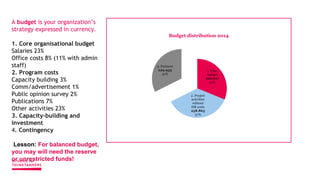
A budget is your organization’s
strategy expressed in currency.
1. Core organisational budget
Salaries 23%
Office costs 8% (11% with admin
staff)
2. Program costs
Capacity building 3%
Comm/advertisement 1%
Public opinion survey 2%
Publications 7%
Other activities 23%
3. Capacity-building and
investment
4. Contingency
Lesson: For balanced budget,
you may will need the reserve
or unrestricted funds!
1. Core
budget
220.617
31%
2. Project
activities
without
HR costs
258.865
37%
3. Partners
229.939
32%
Budget distribution 2014
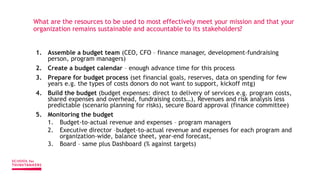
What are the resources to be used to most effectively meet your mission and that your
organization remains sustainable and accountable to its stakeholders?
1. Assemble a budget team (CEO, CFO – finance manager, development-fundraising
person, program managers)
2. Create a budget calendar – enough advance time for this process
3. Prepare for budget process (set financial goals, reserves, data on spending for few
years e.g. the types of costs donors do not want to support, kickoff mtg)
4. Build the budget (budget expenses: direct to delivery of services e.g. program costs,
shared expenses and overhead, fundraising costs…), Revenues and risk analysis less
predictable (scenario planning for risks), secure Board approval (finance committee)
5. Monitoring the budget
1. Budget-to-actual revenue and expenses – program managers
2. Executive director –budget-to-actual revenue and expenses for each program and
organization-wide, balance sheet, year-end forecast,
3. Board – same plus Dashboard (% against targets)
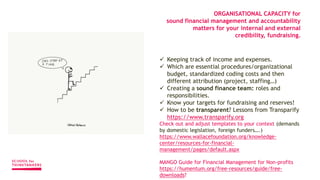
 Keeping track of income and expenses.
 Which are essential procedures/organizational
budget, standardized coding costs and then
different attribution (project, staffing…)
 Creating a sound finance team: roles and
responsibilities.
 Know your targets for fundraising and reserves!
 How to be transparent? Lessons from Transparify
https://www.transparify.org
Check out and adjust templates to your context (demands
by domestic legislation, foreign funders….)
https://www.wallacefoundation.org/knowledge-
center/resources-for-financial-
management/pages/default.aspx
MANGO Guide for Financial Management for Non-profits
https://humentum.org/free-resources/guide/free-
downloads?
ORGANISATIONAL CAPACITY for
sound financial management and accountability
matters for your internal and external
credibility, fundraising.
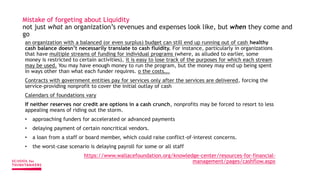
Mistake of forgeting about Liquidity
not just what an organization’s revenues and expenses look like, but when they come and
go
an organization with a balanced (or even surplus) budget can still end up running out of cash healthy
cash balance doesn’t necessarily translate to cash fluidity. For instance, particularly in organizations
that have multiple streams of funding for individual programs (where, as alluded to earlier, some
money is restricted to certain activities), it is easy to lose track of the purposes for which each stream
may be used. You may have enough money to run the program, but the money may end up being spent
in ways other than what each funder requires. o the costs….
Contracts with government entities pay for services only after the services are delivered, forcing the
service-providing nonprofit to cover the initial outlay of cash
Calendars of foundations vary
If neither reserves nor credit are options in a cash crunch, nonprofits may be forced to resort to less
appealing means of riding out the storm.
• approaching funders for accelerated or advanced payments
• delaying payment of certain noncritical vendors.
• a loan from a staff or board member, which could raise conflict-of-interest concerns.
• the worst-case scenario is delaying payroll for some or all staff
https://www.wallacefoundation.org/knowledge-center/resources-for-financial-
management/pages/cashflow.aspx
FINANCIAL
MANAGEMENT AND
LEADERSHIP DURING
A CRISIS
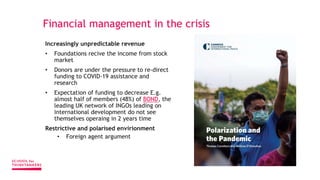
Financial management in the crisis
Increasingly unpredictable revenue
• Foundations recive the income from stock
market
• Donors are under the pressure to re-direct
funding to COVID-19 assistance and
research
• Expectation of funding to decrease E.g.
almost half of members (48%) of BOND, the
leading UK network of INGOs leading on
international development do not see
themselves operaing in 2 years time
Restrictive and polarised envirionment
• Foreign agent argument
Group Work
Group 1 - Good practice of costing for
project (how do you get money for
indirect costs…)
Group 2 - List the possible ways to
earn income and make reserve:
sources, benefits, downfalls, best
practices
Group 3 - Create demand and donor
for unpopular topic or for which there
is no call
USEFUL RESOURCES
Recommended reading
• https://nonprofitquarterly.org/pizza-and-a-laugh-a-reminder-about-your-
nonprofit-financial-stress-level/
• On Think Tanks’s section devoted to funding for think tanks:
www.onthinktanks.org/themes/funding-and-supporting-think-tanks
• Nine webinars on sustainability https://onthinktanks.org/resources/nine-
webinars-on-sustainability-for-think-tanks/ (recommend How to create a smart

project budget for a think tank & Evidence-informed Fundraising Strategy)
• Politics & Ideas has a collection of articles that are based on a series of online
course on funding models, which were delivered to dozens of think tanks in 2015,
2016 and 2017: http://politicsandideas.org/tag/funding-model
Recommended reading on nonprofit finance and crisis
• NPQ (2010) The Four Horsemen of Nonprofit Finance Apocalypse
https://nonprofitquarterly.org/the-four-horsemen-of-the-nonprofit-financial-apocalypse
• NPQ (2020) Sustanability to Survavibility: 5 Nonprofit Must-Do’s in the Time of COVID
https://nonprofitquarterly.org/sustainability-to-survivability-nonprofit-finance-must-dos-
in-the-time-of-covid
• Cash Flow Nonprofit Model https://nonprofitquarterly.org/cash-flow-nonprofit-business-
model-question-whats-whens
• Bond – 4 ways funders are supporting NGOs https://www.bond.org.uk/news/2020/04/4-
ways-funders-are-supporting-ngos-and-responding-to-coronavirus
How to manage finances in nonprofits
• https://www.wallacefoundation.org/knowledge-center/financial-management-for-
nonprofits/pages/default.aspx
• MANGO Guide for Financial Management for Non-profits
https://humentum.org/free-resources/guide/free-downloads?
• Executive directors guide to financial leadership
https://nonprofitquarterly.org/executive-directors-guide-financial-leadership-2
• Financial stress forecasting tool https://onthinktanks.org/resources/think-tanks-
stress-test-a-forecasting-tool/
• Transparify - transparency of funding https://www.transparify.org/our-methodology
Stay in touch
https://ucl.academia.edu/SonjaStojanovicGajic
sonja.stojanovic.gajic@outlook.com
SCHOOL for THINKTANKERS
www.ott.school

2023-01-30-Finance-for-Non-financial-Managers.pptx

  • 2.
    Finance for Non-financial Managers SonjaStojanović Gajić 30 January 2023
  • 3.
    FOCUS FINANCIAL MANAGEMENT & LEADERSHIPIN OLD NORMAL FINANCIAL HEALTH IN THE CRISIS
  • 4.
    4 Sonja Stojanovic Gajic 2006-2019Director of Belgrade Centre for Security Policy (BCSP) and helped it transform from national NGO into the internationally recognized think tank on security policy • Mixed job description: management and programme • Self-educated manager - learned by doing it and leading an organisation through change process Assisted also the organisations in East Europe, Middle East and Latin America
  • 5.
    BCSP budget overyears in Euros The oldest organisation in the Western Balkans focussing on accountability of security institutions (police, military, intelligence….) since 1997 Among bigger ones in the region of South-East Europe – mid-income country 2008. 2009. 2010. 2011. 2012. 2013. 2014. 340,337 378,649 374,574 411,637 404,632 522.805 667.694 2015. 2016. 2017. 2018. 2019. 2020. 2021. 589.659 446.000 509.878 471.285 417 636.111 700.000
  • 6.
    How do youfeel about finance management and fundraising?
  • 7.
  • 8.
    Financial Suistanability isjust a componet of Organizational Sustainability Organizational sustainability is not strictly a financial consideration; Financial sustainability is only one of several factors contributing to a TT’s overall sustainability and resilience;
  • 9.
    Organizational Resilience 9 The greaterthe extent of internal vulnerabilities, an organization is the more at risk in increasingly hostile external environments.
  • 10.
    Pillars of Financial Management 1.Business and Financial Model 2. Budgeting (costing, revenues and operating reserves) 3. Budget monitoring - cashflows 4. Operations: division of labour, responsibility and reporting 5. Accountability, transparency and integrity
  • 11.
  • 12.
    Business Model FundingModel Focus Value creation (unique) and delivery, cultivation of trust and reputation Revenue generation – what kind of sources? What is the proportion of different sources in the budget? What is duration/funding circles? The cost structure: % operational costs (rent, research, overhead…), partner costs… Activities Research performed and communicated Raise, receive, account for, report on funds Staff All staff, Board, peer-reviewers • Director, Financial Officer (+book-keeper, auditor), Board • Project Officer or Researchers or specialized fundraising team Goal Organisation is empowered to achieve its mission on a continuous basis • cash in the bank, • audit reports signed off, • funders’ support maintained over time due to correct financial processes and management Key stakeholders Research community writ large, policymakers, private sector and third sector actors, donors, ordinary citizens Donors (individuals, companies, governments, philanthropic organisations)
  • 13.
    Business Model FundingModel Example statement Organisation X conducts and disseminates original research on key public policy issues in Country Y. It receives financial support from: three sources, which enable it to employ the services of a team of professionals, including a high-level and widely cited and respected policy researcher. The director of Organisation X is widely regarded too by the research community, and its Board is made up of individuals that leverage their positions to create new policy influence and funding opportunities. Organisation X derives • 20% of its budget from subscriptions to its flagship publication; • 30% from research contracts; • and 50% from international sponsors. • This funding model requires the full-time services of a book-keeper, the part-time services of a financial manager, and an external audit partner. The inputs of middle-management and the organisation’s director are also required month-on-month to ensure steady revenue generation and correct financial reporting.
  • 14.
    Suistanability Matrix It isabout finding the right mix for your organisation:  Fits your mission  Combination of sources and types of funding (not all eggs in one basket)  Allows you to do your core work (long, reasonable costs) https://nonprofitquarterly.org/th e-matrix-map-a-powerful-tool- for-mission-focused-nonprofits/
  • 15.
    The adaption tothe external context is required to continue succeeding e.g. • What are sources of money to be found? • Policy environment: Is there demand for research? • Thinking about the Implications on: • human and other costs of running organisation: Research, Staff & Project Management, Communications, and Policy influence. • in the project market (partnerships, brand communication, quality control, transparency and strategic orientation) • in managing relationships with funders: balancing demands and interference (how to guarantee independence?)
  • 16.
    The Transformation ofBCSP’s business and financial model to the context Years Context Business Model Capacities Funding Model 1997-2000 Authoritarian Closed Country under international Sanctions Activist NGO Ideas and activism of 2 founders supported by friendly CSOs No money, no trouble 2000-2006 Democratic Transition Golden Area of donors’ interest No competition NGO with focus on research Founders and external research associated All in 1 person admin/finance Projects from donors 2006-2012 Democratic Consolidation Increased national competition Transformation into Think Tank until 2010 Regional Leadership 2 members in the Finance Team + 1 all other admin Comms team Institutional Funding with smaller other projects
  • 17.
    The Transformation ofBCSP Years Context Business Model Capacities Funding Model 2012- 2015 EU Integration and the EU as a main donor in town Peace Talks on Normalisation of Relations with Kosovo Dense regional and national competition Think Tank with Regional Focus Policy Broker on Dialogues Same Project writing for all research staff as project management is with researchers Advance financial procedures and organisational audit Phasing out institutional support 2015: no 2014: 10% 2012: 40% 2014 - 2019 State Capture Closing civic space and media freedoms Huge competition from other types of organisations (investigative journalists, fake NGOs) EU is the biggest and most cumbersome donor, bilateral donors retreat Think Tank focusing more on citizens and other democracy- defenders 2 person finance EU funding Income-generating activities Thinking of professionalization of project management & fundraising role Mixture EU different types International donors (govs and foundations) Income through consultancy work No gov funding
  • 18.
    The context mattersfor funding opportunities POLICY ENVIRIONMENT: Is there demand for research and what is a competition? A lot of media interest in security topics, but on wrong topics. Democratisation agenda is almost dead on donor’s agenda How to stay true to the mission? FUNDING ENVIRIONMENT: Is there money to be found? • Foreign funding sources for civil society: the biggest is EU, but few cumbersome opportunities as it is very demanding for administration (co-funding demand, liquidity), Bilateral donors retreat from the Balkans except Kos & BiH. A number of small grants by individual foundations and embassies. De-legitimisation of foreign funded NGOs • Government funding: The biggest donor at the local level – non-transparent, funding technical & QUANGOs. Not any more independent oversight bodies (e.g. Anti-Corruption Agency, Ombudsperson) used to have transparent competition for NGO funding • Private/corporate funding for our policy area is limited and dubious • Increased opportunities for consultancy work and academic and international partnerships • Crowd-funding for think tanks is a terra incognita
  • 19.
    FUNDING MODEL Research Agenda Policy Influence StaffFiscal Stability Allows to conduct relevant research? Allows to take advantage of policy windows? Covers operating costs Core/Institutional funding Grants/ Project Funding Corporate or Private Sector Funding Government funding Membership Crowd-funding Consultancy work (service and product sold commercially) Academic research funding Endowment
  • 20.
    Revenues: Understanding theOptions Gifts and Grants Here are some typical sources and pros and cons. Source Description Pros Cons Individuals Donations tend to be less tied to specific program outcomes, more untied revenues. Can provide ongoing revenue streams if repeat donors. Individuals can be cultivated over time for larger gifts. Building an individual donor base of repeat donors who give increasing amounts is a long term process that requires continuous communication. Corporations Tend to fund projects with high levels of visibility and marketing opportunities. Often ask for names to appear on publications, events etc. also smaller amounts for the most part. Fluctuate with corporate profits. Foundations Tend to fund innovative projects With a few exceptions fund the same organization for no more than a few years Government Fund larger scale projects or smaller short term one year projects, risk of politization Require a great deal of report detail. Restrictions on line items expenditures Change with each election National/ International Agencies Grants tend to be significant size and require significant capacity to manage Discontinue funding when region no longer of strategic interest. High reporting requirements
  • 21.
    21 Funding Mix –Types of Revenues REVENUES (EUR) 2015 2016 Grants (International Contributors) 83,9% 82,9% Grants (Domestic Contributors) 10,4% 2,8% Earned Income - Consultation Services (International Contributors) 0,2% 9,2% Earned Income - Consultation Services (Domestic Contributors) 5,3% 2,0% Other income (Reimbursement of maternity leave, etc) 0,2% 3%
  • 22.
  • 23.
    Is this SustainableThink Tanks Financing?  more steady flow of secured income - reliability  diverse funding sources, decreased dependence - diversification  more unrestricted income (reserves) - flexibility  ability to think and plan more long-term
  • 24.
    Under which conditionsare we getting funds?  Relationship to mission: Does this source enhance or detract from your mission? Does it enhance or detract from your reputation?  Acceptable conditions: Whatever administrative, contractual and/or programmatic conditions are attached to funds, they should enable the think tank to do their policy work to the best of their abilities.  Independence: A basic condition of a good funding model is for it to guarantee that a think tank remains independent to govern itself and define its policy research agenda: deciding how to run the organisation, which issues to pursue, etc.  Transparency: A growing concern related to funding models has to do with being able to track the origin of funds that think tanks receive and the main conditions attached to them.  Visibility: Does this source have positive public relations or visibility benefits? What are the costs to our reputation and credibility? What are the costs and investments required in relation to benefits:  Start-Up Costs: How difficult and costly is it to begin receiving income from this source?  Continuing Costs: How difficult and costly is it to obtain this source of revenue (staff time to perform work or report, infrastructure investment, etc.)  Organizational Capacity: Do you have the capacity (staff, infrastructure, financial, cultural) to develop and maintain this source?
  • 25.
    “What if pizzashops were funded like non-profits?” https://youtu.be/-gELZnORV4U Lesson: Make your organization’s matrix for assessment of funding opportunities Dillema: Who should be in charge of fundraising: research or specialised person/team
  • 26.
    Lessons learned onbudget structure Growth is not necessarily a good thing! Increased budget over years, but not operational budget same Partnerships are both an opportunity (for longer programme research and advocacy and defense against attacks) and challenge to manage (coordination costs and high burden on financial staff of coordinator, co-funding requirements) Description 2014 2015 BCBP SHARE 269 58% 510.096 87% PARTNERS SHARE 191 42% 75.087 13% Total EUR 460.000 585.183
  • 27.
    A budget isyour organization’s strategy expressed in currency. 1. Core organisational budget Salaries 23% Office costs 8% (11% with admin staff) 2. Program costs Capacity building 3% Comm/advertisement 1% Public opinion survey 2% Publications 7% Other activities 23% 3. Capacity-building and investment 4. Contingency Lesson: For balanced budget, you may will need the reserve or unrestricted funds! 1. Core budget 220.617 31% 2. Project activities without HR costs 258.865 37% 3. Partners 229.939 32% Budget distribution 2014
  • 28.
    What are theresources to be used to most effectively meet your mission and that your organization remains sustainable and accountable to its stakeholders? 1. Assemble a budget team (CEO, CFO – finance manager, development-fundraising person, program managers) 2. Create a budget calendar – enough advance time for this process 3. Prepare for budget process (set financial goals, reserves, data on spending for few years e.g. the types of costs donors do not want to support, kickoff mtg) 4. Build the budget (budget expenses: direct to delivery of services e.g. program costs, shared expenses and overhead, fundraising costs…), Revenues and risk analysis less predictable (scenario planning for risks), secure Board approval (finance committee) 5. Monitoring the budget 1. Budget-to-actual revenue and expenses – program managers 2. Executive director –budget-to-actual revenue and expenses for each program and organization-wide, balance sheet, year-end forecast, 3. Board – same plus Dashboard (% against targets)
  • 29.
     Keeping trackof income and expenses.  Which are essential procedures/organizational budget, standardized coding costs and then different attribution (project, staffing…)  Creating a sound finance team: roles and responsibilities.  Know your targets for fundraising and reserves!  How to be transparent? Lessons from Transparify https://www.transparify.org Check out and adjust templates to your context (demands by domestic legislation, foreign funders….) https://www.wallacefoundation.org/knowledge- center/resources-for-financial- management/pages/default.aspx MANGO Guide for Financial Management for Non-profits https://humentum.org/free-resources/guide/free- downloads? ORGANISATIONAL CAPACITY for sound financial management and accountability matters for your internal and external credibility, fundraising.
  • 30.
    Mistake of forgetingabout Liquidity not just what an organization’s revenues and expenses look like, but when they come and go an organization with a balanced (or even surplus) budget can still end up running out of cash healthy cash balance doesn’t necessarily translate to cash fluidity. For instance, particularly in organizations that have multiple streams of funding for individual programs (where, as alluded to earlier, some money is restricted to certain activities), it is easy to lose track of the purposes for which each stream may be used. You may have enough money to run the program, but the money may end up being spent in ways other than what each funder requires. o the costs…. Contracts with government entities pay for services only after the services are delivered, forcing the service-providing nonprofit to cover the initial outlay of cash Calendars of foundations vary If neither reserves nor credit are options in a cash crunch, nonprofits may be forced to resort to less appealing means of riding out the storm. • approaching funders for accelerated or advanced payments • delaying payment of certain noncritical vendors. • a loan from a staff or board member, which could raise conflict-of-interest concerns. • the worst-case scenario is delaying payroll for some or all staff https://www.wallacefoundation.org/knowledge-center/resources-for-financial- management/pages/cashflow.aspx
  • 31.
  • 32.
    Financial management inthe crisis Increasingly unpredictable revenue • Foundations recive the income from stock market • Donors are under the pressure to re-direct funding to COVID-19 assistance and research • Expectation of funding to decrease E.g. almost half of members (48%) of BOND, the leading UK network of INGOs leading on international development do not see themselves operaing in 2 years time Restrictive and polarised envirionment • Foreign agent argument
  • 33.
    Group Work Group 1- Good practice of costing for project (how do you get money for indirect costs…) Group 2 - List the possible ways to earn income and make reserve: sources, benefits, downfalls, best practices Group 3 - Create demand and donor for unpopular topic or for which there is no call
  • 34.
  • 35.
    Recommended reading • https://nonprofitquarterly.org/pizza-and-a-laugh-a-reminder-about-your- nonprofit-financial-stress-level/ •On Think Tanks’s section devoted to funding for think tanks: www.onthinktanks.org/themes/funding-and-supporting-think-tanks • Nine webinars on sustainability https://onthinktanks.org/resources/nine- webinars-on-sustainability-for-think-tanks/ (recommend How to create a smart project budget for a think tank & Evidence-informed Fundraising Strategy) • Politics & Ideas has a collection of articles that are based on a series of online course on funding models, which were delivered to dozens of think tanks in 2015, 2016 and 2017: http://politicsandideas.org/tag/funding-model
  • 36.
    Recommended reading onnonprofit finance and crisis • NPQ (2010) The Four Horsemen of Nonprofit Finance Apocalypse https://nonprofitquarterly.org/the-four-horsemen-of-the-nonprofit-financial-apocalypse • NPQ (2020) Sustanability to Survavibility: 5 Nonprofit Must-Do’s in the Time of COVID https://nonprofitquarterly.org/sustainability-to-survivability-nonprofit-finance-must-dos- in-the-time-of-covid • Cash Flow Nonprofit Model https://nonprofitquarterly.org/cash-flow-nonprofit-business- model-question-whats-whens • Bond – 4 ways funders are supporting NGOs https://www.bond.org.uk/news/2020/04/4- ways-funders-are-supporting-ngos-and-responding-to-coronavirus
  • 37.
    How to managefinances in nonprofits • https://www.wallacefoundation.org/knowledge-center/financial-management-for- nonprofits/pages/default.aspx • MANGO Guide for Financial Management for Non-profits https://humentum.org/free-resources/guide/free-downloads? • Executive directors guide to financial leadership https://nonprofitquarterly.org/executive-directors-guide-financial-leadership-2 • Financial stress forecasting tool https://onthinktanks.org/resources/think-tanks- stress-test-a-forecasting-tool/ • Transparify - transparency of funding https://www.transparify.org/our-methodology
  • 38.
  • 39.